People in the blockchain space often throw around the words Byzantine Fault Tolerant (BFT) as though it was self-explanatory. Additionally, BFT often pops up in discussions about consensus mechanisms. If you look closer, in the consensus algorithm space there are...
You may have heard people in the blockchain space throwing the term Inter-Blockchain Communication or IBC around lately. This term refers to any technology that allows transactions across multiple blockchains. It's not that simple though. There are actually two...
Will my donation arrive at the people in need? Or will it get lost, somewhere in the administration costs of a humanitarian organization? Today, intransparent systems confront donors with a high degree of uncertainty, which diminishes their overall willingness to...
Last October during the Outlier Ventures Diffusion Hackathon, we built a Proof of Concept of a Parking Agent System - Effortless Parking, which could solve the coordination problem of parking in crowded cities. In this post, we will look at the individual components...
Faced with the imminent Wirecard accounting scandal, and an apparent lack of diligence by audit firms, regulatory bodies, and the government have realized that financial accounting must be improved significantly. However, previous improvements in financial accounting...
Today, the long-awaited Covid-19 tracing app will be released in Germany, which should help to detect infection chains and warn potentially infected people that they were in contact with someone infected with the virus at some point recently. The decentralized...
Last week, Martin Schäffner gave an introduction to blockchain-enabled Self-Sovereign Identity at the Crypto and Blockchain Meetup bdvb HG Bayreuth. Did you miss it? No problem! Re-watch his webinar on YouTube (link below). Self-Sovereign Identity is a trending topic...
On 8 June, the Proof-of-Stake EUPos Working Group within the European Blockchain Association EBA has published its Staking Infrastructure Position Paper (PDF) over the course of a website relaunch with a new, fresh look & feel. The Position Paper aims to give...
Since 2015, Datarella has been active in building enterprise blockchain solutions in the humanitarian sector, in the fields of supply chain and mobility, and in finance and real estate. Leveraging combined resources from Munich, Germany, and its Gdansk, Poland, Baltic...
Last week we started a series of articles for an introduction to Self-Sovereign Identity components. In the first article, we have taken a look at some of the fundamental elements of SSI - Decentralized Identifiers (DIDs), their corresponding DID Documents and...
World Food Programme’s Building Blocks system is one of the best examples to understand how Blockchain technology can help to fight against COVID-19. Building Blocks is a Blockchain-based fully digitalized payment and bookkeeping system for any types of cashless...
Self-Sovereign Identity (SSI) is increasingly mentioned in connection with innovations and digital identities. Even in the context of the coronavirus crisis, SSI finds possible applications, such as the possible use of a tracking app for infected people or as a...
Despite the novel coronavirus pandemic and partial lockdown in Germany, the KOSMoS consortium held the fourth consortial meeting. Initially planned to take place in Munich, all participants joined a shared video conference from their safe places at home. Despite the...
In the last months, we have built the MVP of the Rohingya Archive, a digital heritage archive for the stateless Rohingya people. The R-Archive uses Arweave’s Blockweave technology to store documents immutable and permanently at very low costs. During our pilot phase, our partner, the Rohingya Project collected and uploaded various documents to preserve the Rohingya legacy. For detailed information on the pilot, checkout the pilot report here.
Feel invited to watch our demo, which will provide you more information on the background of the Rohingya Archive and its current features.
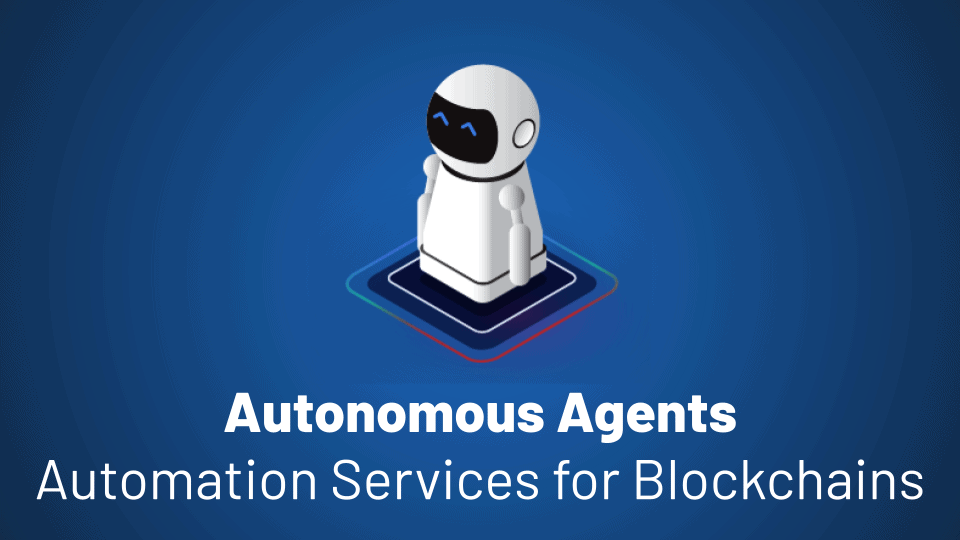
In this blog post, we look at the potential of service automation through autonomous economic agents in Blockchain-based systems. Datarella’s partner Fetch.ai has made it their mission to combine intelligent agents with blockchain technology in several use cases. Deep Parking is one of them, and using a specific example from MOBIX here you can get a feel for the potential of autonomous agents.
The path to the fourth industrial age is being paved by the interplay of Big Data-driven automation, robotics, IoT and Distributed Ledger Technologies, aka Blockchain. Given the increasing amount of data, and the number of digital services that go hand in hand with this progress, the need to automate them is also growing. Users should be relieved of unnecessary work and offered optimal results.
Agents take on the role of autonomously performing tasks on behalf of their clients (individuals or objects). For this purpose, they can also interact with each other. Intelligent agents can make complex decisions by using ML, i.e. AI-powered algorithms, based on large amounts of data.
A blockchain, with its data supply, offers a particularly favourable environment for intelligent agents. The data of a blockchain are permanently available and are logically related to each other. Decentralisation can offer robustness (no single point of failure) and lower transaction costs. Agents can assume a fully autonomous identity on a blockchain through private keys. They can use it to authenticate themselves and communicate their suitability for certain tasks. Agents can use shared protocols (possibly through smart contracts) to coordinate, collaborate efficiently, e.g. by distributing complex tasks among themselves. They can negotiate and make distributed decisions (even though voting processes use their blockchain). Tasks, goals or motives of agents can be recorded in the blockchain and economic incentives can be set for optimal task performance.
With regard to the IoT, a blockchain (as a single point of truth) can integrate various sub-systems, s.a. smart household appliances, smart buildings, smart districts and smart cities, and create added value for all agents participating in the network. Fetch.ai is an example of how intelligent agents can realize automated services based on blockchain technology.
Among the use cases of Fetch.ai, we would like to highlight agents for mobility services – traffic sign agents, parking agents for Deep Parking, agents for eMobility, agents for trains and stations that could even form a decentralised train network. In the process, increasingly intelligent autonomous agents interact on behalf of people or infrastructure, searching for each other, negotiating with each other in the interest of offering their users optimal solutions. In such a case, an autonomous agent of a car could, on behalf of its owner, seek and negotiate with agents working on behalf of parking lots to navigate the car and its owner to a quick and cheap place to park. With Deep Parking at the IAA in Munich 2021, the potential of agents for such use cases becomes clear.
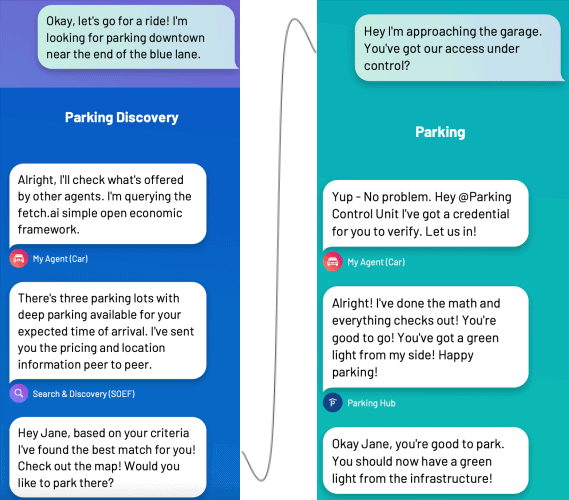
There it was demonstrated how agents negotiate their resources on behalf of vehicles, their owners and the infrastructure to find an optimal solution for everyone without further efforts for the users. The following graphics show an excerpt from the exemplary communication between the agents involved.
In this case, a user named Jane is looking for available parking space in the city centre. Without Jane having to do this herself, the agent in her car (My Agent (Car)) looks for another agent who offers a parking space via a specific (agent-)network (SOEF). Using Blockchain technology, agents handle authentication, price negotiation, reservation and even payment, autonomously according to their client’s preferences. When Jane approaches the parking lot, access is automatically granted to her car without further ado.
As shown, the scope of tasks autonomous agents can perform and the added value they can contribute is without limits. So, by using autonomous agents, the potential of Blockchain technology can be leveraged for all use cases where handling of huge amounts of data in real-time or near-time is needed.
Since 1982 an extensive destruction of public records, documenting the Rohingya legacy, has taken place. The remaining documents are at high risk of getting lost and are spread among the widely distributed Rohingya population. Preserving these documents is of tremendous value since they stake historical claims to be citizens of Myanmar as well as to preserve the Rohingya heritage.
We are happy to announce that Datarella teamed up with the Rohingya Project, and researchers from UCLA and CUNY to build the Rohingya Archive (R-Archive). The R-Archive is a decentralized digital heritage archive to preserve the endangered legacy of the stateless Rohingya people. Documents will be stored permanently and securely encrypted on the decentralized storage network Arweave.
The Rohingya People
The term, Rohingya people, describes an ethical group, originated in Rakhine State, Myanmar, previously known as Burma. In 1982, Myanmar’s government decided to deny citizenship to the predominantly Islamic Rohingya minority. In 2016, the Rohingya people were forced to flee their home country to escape the genocide through Myanmar’s armed forces and police. Now, the remaining Rohingya people are dispersed mainly over Bangladesh, India, Pakistan, Thailand, Indonesia and Saudi Arabia.
The situation of Rohingya people stays problematic. Many are living in refugee camps and are not granted a legal identity by their hosting governments. Without a legal identity, many do not have access to public services, like schooling and insurance, and are not allowed to work. The absence of a legal status results in immense barriers to creating a brighter future for the Rohingya community.
If there would be just proof of their legal claims?
The immutable Rohingya-Archive
There are still old passports and documents distributed among members of the Rohingya community. The R-Archive is meant as a decentralized tool for preserving the Rohingya legacy.
It serves three main purposes:
As a heritage and cultural archive for anthropologists and researchers.
As a community archive for the distributed Rohingya people.
As a trustworthy evidence archive for legal proceedings.
Rohingya documents, which are uploaded to the R-Archive, will be preserved forever.
Forever? Yes, because the R-Archive is connected to Arweave, a decentralized storage protocol. Our web app allows uploading securely encrypted and systematically tagged Rohingya documents to the “Blockweave”. The Blockweave (take a deep breath) is a blockchain-inspired, open & permissionless (=censorship resistance) data structure, which allows storing vast amounts of data permanently at low cost.
Okay, okay, let’s take this bite by bite.
A blockchain for data storage? Yes, you are right, normally you don’t store vast amounts of data on a blockchain. That’s the case because, with “normal” Blockchains, every node stores the complete chain, from the first to the latest block. This results in very high costs for storage. Storing 1 MB on Ethereum would set you back at least 5000USD in gas fees. In contrast, storing a 1 MB on Arweave will cost you only less then 0,03 USD in $AR.
How?
Blockweave data structure allows nodes of the network to only store an arbitrary size of the data set on their machine. The total weave size doubled in the last month from 10 to 20TB. If the growth continues, it is likely that individual miners only store a small fraction of the whole weave. However, Arweave’s consensus algorithm, incentivizes miners to replicate data sets as often as possible. The more data a miner stores of the weave, the higher is her chance of mining the next block and earning rewards.
To store data permanently, a fee is paid in $AR. The majority of AR transaction costs go into an endowment value, which is released over time to the miner. This, in combination with a very conservative estimation of the development of storage costs, allows permanent storage.
But let’s go back to the R-Archive and save the mind-blowing details of the Arweave technology for an R-Archive tech deep-dive blog post.
The R-Archive Partners
The R-Archive is a collaboration between the three partners and an MVP is built with a grant provided by the Arweave Foundation. Thank you <3.
Rohingya Project, a humanitarian organization, based in Kuala Lumpur, which is empowering refugees, leveraging innovative technologies, such as blockchain. You might know them already from our joint R-Coin project. The R-Project, led by Noor Muhammad and Saqib Sheikh, who initiated the R-Archive. Further, they provide and train field officers who are collecting Rohingya documents in Bangladesh, Saudi Arabia and Malaysia, as well as the scanning and indexing.
University researchers, Anne Gilliland from Center for Information as Evidence, UCLA and James Lowry from the Archival Technologies Lab, Queens College, City University of New York. Our academic partners created a guide for compliant data collection and a metadata standard, which allows us to index collected Rohingya documents. Further, Anne and James help us to connect to the archival and academic society.
And last but not least Datarella. We are in charge of the technical design, project management and development of the R-Archive.
Conclusion
The R-Archive is a pilot for using Arweave decentralized storage technology for any kind of digital archive. We are confident to prove the benefits of using decentralized technology, like increased security, distributed custody and democratization, and a wider distribution of trust to the archival society. Stay tuned for more updates and insights on the R-Archive.
Datarella is proud to announce the signing of a two-year contract with the European Space Agency (ESA) to further work on the space-linked supply chain product Track & Trust (T&T). As the main contractor to ESA, Datarella is supported by Weaver Labs and OroraTech.
The consortium will jointly work on a Blockchain-based enterprise solution to tackle complex supply chain challenges that humanitarian agencies across the world face in order to track aid in locations that lack access to reliable communications infrastructure.
At the end of two years of development and commercial trials, Track & Trust aims to deliver a scalable cost-efficient communications platform & network combining satellite, IoT mesh and blockchain components serving mostly supply chain use cases. The end solution will be a modular product that will provide a plug and play communication network that allows for end-to-end tracking of the supply chain. This will start from the initial supply of humanitarian aid goods, and extend all the way to the last-mile shipments even when limited or no telecommunication infrastructure is available.
Track and Trust is a unique opportunity to combine Blockchain technology with SatCom and telecom technology to expand the range of offerings for a supply chain monitoring system. With Weaver Labs and OroraTech as our consortium partners and with the technical and financial support by ESA, we have a strong setup to make a success story out of Track and Trust.
Yukitaka Nezu, Co-Founder and CFO at Datarella.
We are thrilled to expand our work with the European Space Agency and play a vital role in the Track and Trust project with our product Cell-Stack. Our innovative telecoms solution will ensure connectivity across the supply chain, making it possible for goods to be tracked in a trusted way.
Maria Lema, Co-Founder at Weaver Labs
We are looking forward to bringing in our satellite technology expertise in Track and Trust. With our IoT communication modules we will connect the products developed by the consortium via satellite networks. This allows the global tracking of deliveries, even in very remote areas.
Rupert Amann, Co-Founder and Head of Satellite Development at OroraTech
We are very excited to be backed by the ESA Business Applications and Space Solutions Program and are very much looking forward to the successful integration of blockchain, space and network infrastructure technology into our product Track & Trust.
About Datarella’s Consortium Partners
About Weaver Labs
At Weaver Labs, we are creating an open and shared marketplace of connectivity assets, with an extensive focus on security, to accelerate innovation by enabling connectivity. Our innovative software layer called Cell-Stack aggregates and digitises all the necessary assets to build Networks and access connectivity on-demand.
Weaver Labs believes that an open marketplace of connectivity assets can truly democratise access to reliable networks and stimulate innovative applications, making networks accessible to new industries and citizens that require reliable connectivity. Through prioritising security in a diverse supply chain and building trust with an open infrastructure model, we believe that these are the fundamental foundations needed to foster innovation and thus, create a positive impact on society. More about Weaver Labs: https://weaverlabs.io/
About OroraTech
OroraTech is a NewSpace start-up headquartered in Munich, Germany, providing a global satellite-based wildfire detection and monitoring service by processing data from various available satellite sources. In parallel, the company is developing its own nanosatellite constellation specialized in wildfire detection, with the first satellite launching at the end of 2021. Founded in 2018 by Thomas Grübler, Björn Stoffers, Florian Mauracher, and Rupert Amann as a spin-off from the Technical University of Munich (TUM), the company has grown to an international team of 50 employees. OroraTech has been supported by research grants from the Bavarian and German government, the European Space Agency and the European Commission, and graduated accelerator programs at Google, Samsung, Plug&Play, ESA BIC, and the German Accelerator Silicon Valley. More about OroraTech: https://ororatech.com/
A bug bounty program is used to inspect protocol code and rewards inspectors if bugs are found successfully. Code and product quality can be increased significantly by such swarm intelligence. Therefore, MOBIX stands on a solid foundation as it leverages the Fetch.ai blockchain.
Even the best developers make mistakes. In order to gradually eliminate resulting bugs, a good solution is to motivate numerous competent inspectors to search through protocol code and identify weak spots in the code. Such vulnerabilities may be lucrative for blackhat hackers, so it is important to create appropriate incentives for whitehat inspectors to work as thoroughly as possible. Considering the follow-up costs that programing errors can result in, this can often be a very sensible investment.
Bug bounty programs are open to the public for this purpose, in order to acquire as many technically skilled inspectors as possible for a bug hunt. So-called “Full Disclosure” documentation discloses the program bugs completely publicly, while in the “Responsible Disclosure” model, only the originator is informed about the bugs for a limited time to have enough time to solve the problem. Responsible Disclosure is usually utilized when bug concerns a severe vulnerability to a live system which has not yet been exploited by attackers. One such case was the Zcash Counterfeiting bug discovered by the Electric Coin Co. in 2019.
Our partner, Fetch.ai launched a bug bounty program which ran from mid-2019 until the recent migration to the mainnet, which took place on 20 September 2021. There was a public call to inspect the code on Fetch.ai‘s Github ledger repository and report bugs as a Github issue, ranging from critical to low risk level. Depending on the severity of the bug, a reward of up to $10,000 in FET was available.
We mention this because our latest project, MOBIX is deployed to the Fetch.ai blockchain. In essence we’re able to leverage both the Cosmos SDK and Fetch.ai as a foundation for MOBIX. Due to the bug bounties run by Fetch and by the Interchain Foundation to assure code quality the chances of any kind of problem is significantly minimized.
Supporting charity projects is a great thing to do. Donors deserve to know for what their contributions were used. We are happy to announce the launch of a new, central feature, our SmartAid Token Management System (TMS). Projects on SmartAid can now use the dashboard of the TMS to allocate received donation tokens to their cost centres. These transactions are made visible to donors on their individual donation trackers, creating a transparent donation experience.
Recap: Traceable Donations with SmartAid
SmartAd’s mission is to make donating more transparent and engaging. As described in this previous blog posts, SmartAid uses a private permission Ethereum Blockchain to document each donation of its users. When you donate via the integrated PayPal API, we deploy a new ERC20 contract for you and send your donation tokens to the project’s address. The “Donation Code”, which is displayed on the top of your donation tracker, is the smart contract address of your donation token. With this address, you can identify and follow your donation within the SmartAid system.
SmartAid Token Management System (TMS)
Now the journey of your donation tokens can continue. With the support of the EU-funded accelerator program, Blockpool, we developed our Token Management System, which allows projects to allocate the received tokens transparently to their various costs centres.
The budget allocation is enabled by our simplistic and user-friendly dashboard.
Project dashboard with dummy data
On the dashboard, project managers gets an overview on the most important stats of their SmartAid projects. In the “Budget” widget, the SmartAid project can create a new cost centre. After entering the budget name and amount, the budget is saved as open budget. In this state, project managers can still alter budgets. When the budget is finalized, the project manager closes the budget. At this point, the magic happens and transactions on the SmartAid Blockchain are triggered. The same percentage amount of each donation tokens in the “available budget” is transferred to a new address, representing the cost centre.
Let’s picture this:
Alice donated 200 EUR, Bob 500 EUR and Charles 300 EUR to the Water projects. A funding milestone is reached and the SmartAid project can start. The first money was spent (500€) on a report, evaluating the best place to build a water well. The project creates a 500 EUR budget on the SmartAid dashboard. Once the payment is conducted, the project manager closes the “Location Evaluation” budget. 50%(500EUR/1000EUR) of the available budget/donations tokens are spent. 100 EUR/ (200*50%) of Alice, 250 EUR of Bob and 150EUR of Charle’s donation tokens are distributed to the address representing the location assessment.
Benefits of the TMS
The TMS provides projects on SmartAid three main benefits, a clear overview on the current funding situation, a tool to dynamically plan budgets and for reporting to donors. All of them are important, however, we hope that reporting to donors can solve one of the mayor issues for charity organizations, which we identified during surveys. Currently, projects can only spend donors’ money on previously defined activities. However, not everything can be planned in advance and circumstances occur, in which the donors’ money can create more impact if spend on something else then specified before. The TMS can solve this issue by giving projects the freedom to spend donations on the most relevant causes, while keeping their donors happy by reporting closely.
The information on the fund usage is made available for donors on the SmartAid web app. The project page displays the overall allocation of project funds. Further, each donor can review the spending of her individual donation usage on her donation tracker page. Together with blog posts, this provides transparency for the donors, which are rarely by any other donation platform.
Conclusion
SmartAid’s new Token Management System provides projects with a tool for budget planning and reporting to donors. All transactions are documented tamper resistant on the SmartAid blockchain. By having donation trackers, reading from the blockchain, donors can follow their donation and answer the important question of “what happened with my donation?”. While this brings an advantage over most other online donation tools, we are still at the beginning. Users need to trust that projects honestly allocated the token representations of their donations the same way the allocated fiat funds. We are keen to migrate SmartAid to a public blockchain network to eliminate the required trust, when handling with legacy fiat systems.
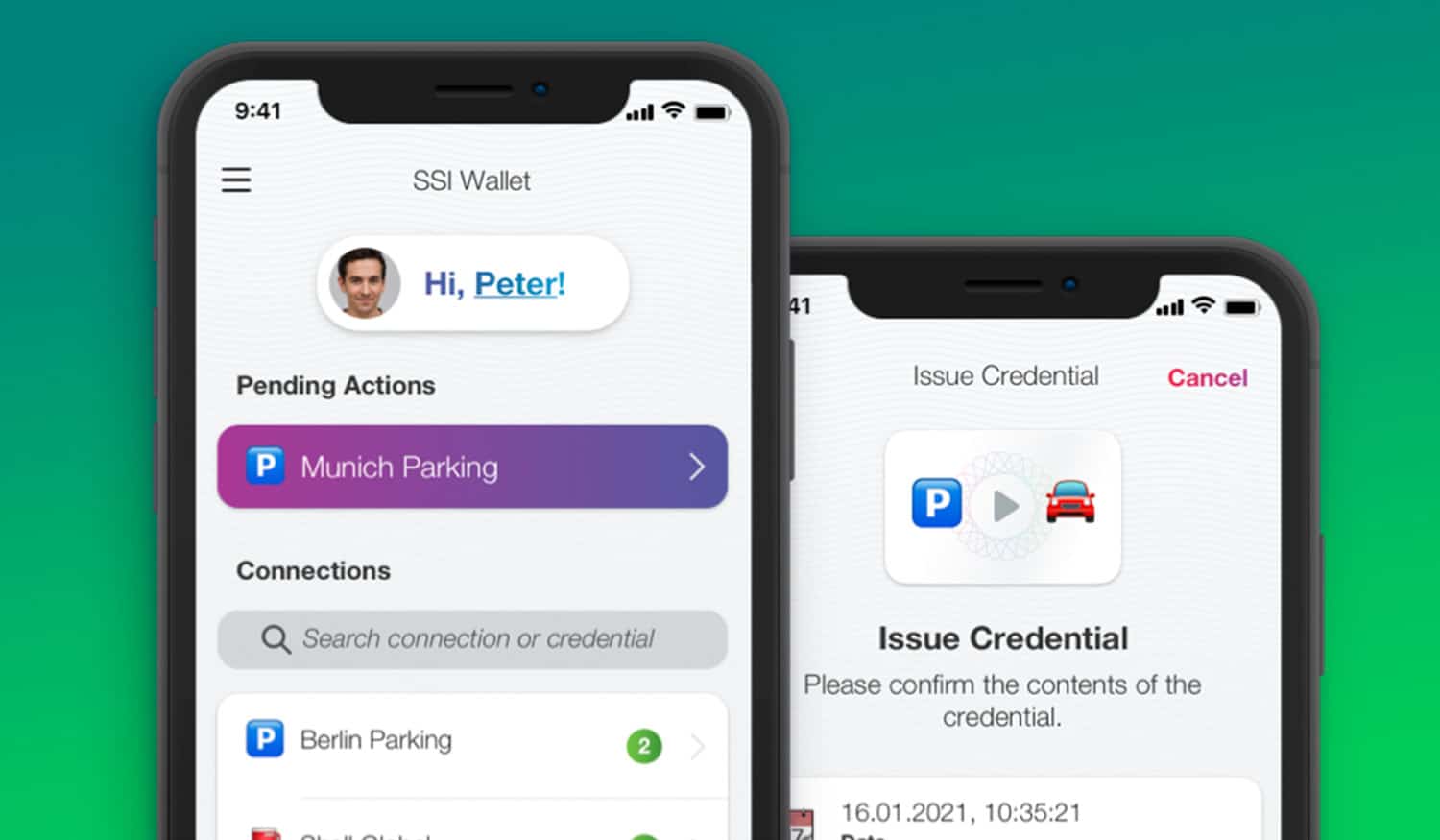
Datarella is offering its customers state-of-the-art Self-Sovereign Identity infrastructure with its SSI Wallet for innovative identity management. It can be integrated into new or existing ecosystems and provide fundamental decentralized identity infrastructure for users to authenticate, issue and receive Verifiable Credentials or transfer data. This allows for many innovative use cases like credential-based access management, automatic credential verification or trusted data transfer.
The Wallet
Having full control over an own digital identity is one of the fundamental principles for Self-Sovereign Identities. This includes that private keys and verifiable credentials are not stored on a centralized exchange or platform, but on the user’s very own devices in a decentralized manner. From this device, the user can issue or receive credentials and authenticate themselves by connecting with other SSI agents.
Like in the physical world where an identity is represented by an ID document which is often kept in a physical wallet, digital private keys and verifiable credentials are stored in a digital wallet. From here, the user can decide with whom the user interacts and shares information from its wallet. The user can ensure that private information is stored only on authorized devices and not in centralized databases which reduces the risk of data breaches tremendously. A wallet can have various forms, a browser extension, a hardware wallet or an entire app like Datarella’s SSI Wallet.
Technology
The SSI Wallet is meant to be deployed in ecosystems that allow users to interact with each other, with SSI compatible websites and IoT edge devices like micromobility vehicles. This is enabled by the Aries Framework Go, which supports a broad variety of edge- and cloud environments.
The wallet further provides a high level of privacy as it natively supports did:peer methods which creates pairwise pseudonymous DIDs for each individual connection and therefore avoids correlation by design. Even though did:peer does not require a ledger, the Aries-Framework Go supports public DID methods like did:web or DIF’s Sidetree protocol. It further allows selective disclosure of credentials thanks to its support for BBS+ signatures. The SSI wallet is therefore perfectly suited for public adoption as well.
It will soon also contain SDKR – a decentralized key backup and recovery mechanism that allows you to backup and recover your secrets with only your official eID. No need to remember passwords or the location of your backups thanks to eIDAS and decentralized and opaque storage capabilities from StorJ.
Conclusion
With our SSI Wallet, we are confident to demonstrate the benefits of Self-Sovereign Identity perfectly in a privacy-preserving and intuitive manner. By using the Aries-Framework Go, we can ensure that it works on web applications and mobile solutions as well as on proprietary IoT devices either without a ledger entirely (only P2P) or by using did:web or the Sidetree protocol.
Datarella is joining forces with Ocean Protocol to expand the Open Data Economy. moveID, our first project will be under the umbrella of GAIA-X, the European Association for Data & Cloud, as part of the GAIA-X 4 Future Mobility Project, which aims at bringing cloud applications to autonomous & networked vehicles.
The project’s overall goal will be the creation of a decentralized ecosystem of data & services that allows autonomous & networked vehicles to integrate into smart infrastructures and third-party services, following GAIA-X’s design principles. With mutual trust as its core concept, its stated goal will be achieving data sovereignty.
For Datarella, technology is an instrument to increase the quality of living, by supporting human beings in all kinds of professional and private activities. The growing complexity and diversity of our ecosystem require technological infrastructures that facilitate collaboration and cooperation. By planning, developing and implementing blockchain solutions worldwide, Datarella meets this requirement: in the fields of Finance, Supply Chain, and Mobility, we enable industry participants to join forces and create sustainable, crisis-proof business models. GAIA-X is the perfect environment for true collaboration. – Michael Reuter, CEO of Datarella
Data generated by network actors or Autonomous Economic Agents (AEAs) in the ecosystem can be useful to 3rd parties, and thus has value as an asset. Ocean Market unlocks the value of these by enabling every authenticated user to put their data up for sale and to monetize it. Vehicle data, for example, could be (re)used for traffic analysis for the generation of better traffic models such as optimized traffic light switching.
Different market actors will price data differently, depending on the method of data generation, data quality, and its utility to the potential buyer. Ocean Market allows for dynamic pricing and thus for optimal value generation for data generators and data curators, in a privacy-preserving manner.
This project will use Datarella’s Enterprise Blockchain Solutions, which serve as the foundational, underlying protocol for digital business transformation with converging technologies such as AI and autonomous machines. Datarella’s future mobility solutions are fueled by blockchain technology, real-time decentralized data management, transparency and GDPR compliance. Given the natural synergies between Ocean and Datarella, this partnership is the first of many that will drive enterprise adoption of Ocean Protocol technology in Datarella’s client base.
Our mission is for data to be treated as an asset. By tapping into underutilized data from mobility IoT sensors, AI can uncover mobility patterns and optimize services / reduce waste. Machines can speak to each other and algorithms can make optimizations – all in real-time. Ocean can tokenize mobility data from devices, thereby creating an opportunity for these tokens to be used as instruments in DeFi projects. This is one of the many ways in which we enable data owners to share in the value their data creates. – Razvan Olteanu, COO of Ocean Protocol
Ocean Protocol is a Day 1 Member of GAIA-X Association AISBL, an international non-profit organisation established to achieve the GAIA-X project goals for the development of an efficient, competitive, secure and trustworthy federation of data infrastructure and service providers for Europe – fostering digital sovereignty of European cloud service users.
—-
About Ocean Protocol Ocean Protocol’s mission is to kickstart a Web3 Data Economy that reaches the world, giving power back to data owners and enabling people to capture value from data to better our world. Data is a new asset class; Ocean Protocol unlocks its value. Data owners and consumers use the Ocean Market app to publish, discover, and consume data assets in a secure, privacy-preserving fashion. Ocean datatokens turn data into data assets. This enables data wallets, data exchanges, and data co-ops by leveraging crypto wallets, exchanges, and other DeFi tools. Projects use Ocean libraries and OCEAN in their own apps to help drive the Web3 Data Economy. The Ocean token is used to stake on data, to govern Ocean Protocol’s community funding, and to buy & sell data. Its supply is disbursed over time to drive near-term growth and long-term sustainability. OCEAN is designed to increase with a rise in usage volume.
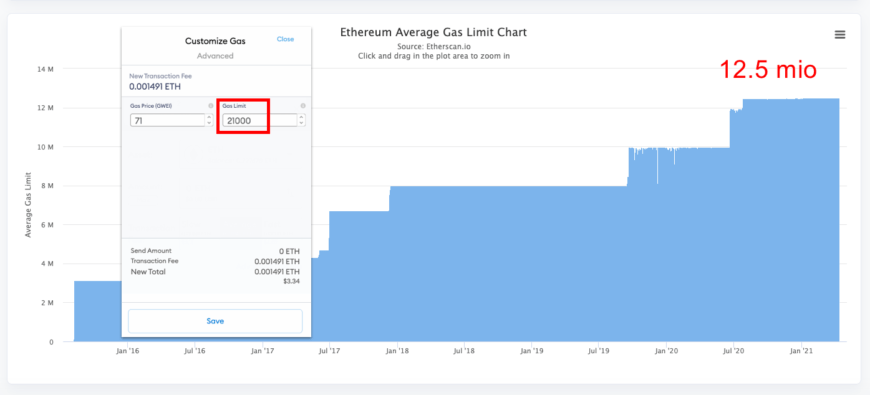
It is no secret, Ethereum, the by market cap and adoption most successful smart contract blockchain, is at its limit. Various DeFi apps, like Uniswap, Aave, games, like Axie Infinity, NFT marketplaces and issuing protocols, like OpenSea and Rarible and countless transactions and other smart contract interactions are clocking up the network. Sidechains and Layer 2 solutions are here to tackle the scaling problem of Ethereum until its transition to Ethereum 2.0 in completed.
For each transaction on Ethereum a certain amount of Gas needs to be paid. The amount depends on the computational effort. A simple transfer of ETH costs 21.000 Gas while a trade on Uniswap can cost 250.000 Gas. Miners of the network set the Block Gas Limit, which specifies the amount of how much Gas can be included within one block. This limit is currently set to around 12.5 million. A new block is minted roughly every 13 seconds. Which transaction is getting in the next block is determined by the Gas Price the sender is willing to pay. To make an example, at the current Block Gas Limit 595 simple ETH transactions could be process, rounding to 45 transactions per second.
Solving the scaling issue of Ethereum
Since ETH 2.0 is still under development various teams are working on solutions to solve the scaling problem of Ethereum. Most scaling solutions can be categorized into Sidechains or Layer 2 solutions. The main difference between Sidechains Layer 2 solutions lies in their security mechanisms.
Sidechains
The term Sidechains describe blockchains with own consensus mechanisms, which are compatible with Ethereum. Examples are the xDai and Polygon network. xDai used a delegated proof of stake consensus mechanism, which allows for fast and inexpensive stable transactions. A transaction does not take longer than 5 seconds and 500 of them cost only around $0.01. A bridge between xDai and Ethereum makes it possible to transfer any ERC20/677/827 tokens between the networks. This scaling solution is used from various NFT minting platforms, like Nifty Ink, or DAO infrastructure providers.
Layer 2
In contrast, Layer 2 solution do not have their own consensus mechanism but rely on the security of Ethereum. An example of Layer 2s are Roll-ups, which describe off-chain aggregation of transactions inside a Ethereum Smart Contract. You can differentiate between ZK-Rollups and Optimistic Roll-ups. With ZK-Rollups, funds are hold by the smart contract on the mainchain. Computation and storage are done off-chain while validity is ensured using zero-knowledge proofs. A project with works on ZK-Rollups is Loopring. Optimistic Rollups, are using a challenge period of 1-2 weeks to challenge fraud in case the aggregator has submitted an incorrect transaction. Therefore, you are “optimistic” on the submitted transactions. A project using Optimitic Rollups to scale Ethereum is Optimism. Its launch is planned for July 2021. Uniswap is currently running a demo version, Unipig, on Optimism, which only required 143x gas costs and allows for transaction in milliseconds.
Conslusion
Sidechains and Layer 2 solutions are an essential element to solve the scaling problem of Layer 1 protocols. It will be interesting to see what will happen to them when hyper scalable Layer 1 solutions arise, like Ethereum 2.0, Solana, Elrond, and many more.