by Martin Schäffner | 22 June 2021 | Featured, Smart Wallet, SSI
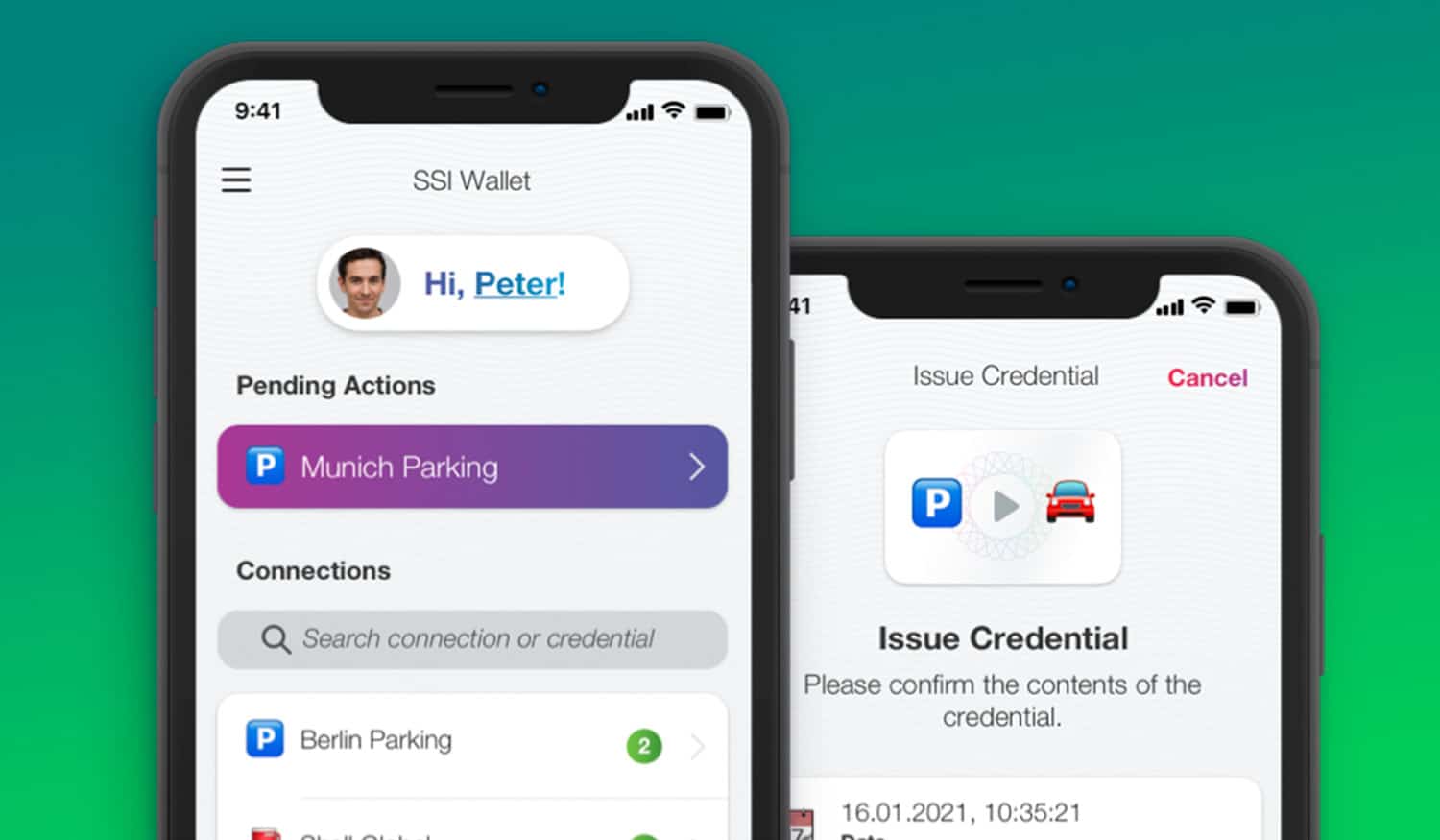
Datarella is offering its customers state-of-the-art Self-Sovereign Identity infrastructure with its SSI Wallet for innovative identity management. It can be integrated into new or existing ecosystems and provide fundamental decentralized identity infrastructure for users to authenticate, issue and receive Verifiable Credentials or transfer data. This allows for many innovative use cases like credential-based access management, automatic credential verification or trusted data transfer.
The Wallet
Having full control over an own digital identity is one of the fundamental principles for Self-Sovereign Identities. This includes that private keys and verifiable credentials are not stored on a centralized exchange or platform, but on the user’s very own devices in a decentralized manner. From this device, the user can issue or receive credentials and authenticate themselves by connecting with other SSI agents.
Like in the physical world where an identity is represented by an ID document which is often kept in a physical wallet, digital private keys and verifiable credentials are stored in a digital wallet. From here, the user can decide with whom the user interacts and shares information from its wallet. The user can ensure that private information is stored only on authorized devices and not in centralized databases which reduces the risk of data breaches tremendously. A wallet can have various forms, a browser extension, a hardware wallet or an entire app like Datarella’s SSI Wallet.
Technology
The SSI Wallet is meant to be deployed in ecosystems that allow users to interact with each other, with SSI compatible websites and IoT edge devices like micromobility vehicles. This is enabled by the Aries Framework Go, which supports a broad variety of edge- and cloud environments.
The wallet further provides a high level of privacy as it natively supports did:peer methods which creates pairwise pseudonymous DIDs for each individual connection and therefore avoids correlation by design. Even though did:peer does not require a ledger, the Aries-Framework Go supports public DID methods like did:web or DIF’s Sidetree protocol. It further allows selective disclosure of credentials thanks to its support for BBS+ signatures. The SSI wallet is therefore perfectly suited for public adoption as well.
It will soon also contain SDKR – a decentralized key backup and recovery mechanism that allows you to backup and recover your secrets with only your official eID. No need to remember passwords or the location of your backups thanks to eIDAS and decentralized and opaque storage capabilities from StorJ.
Conclusion
With our SSI Wallet, we are confident to demonstrate the benefits of Self-Sovereign Identity perfectly in a privacy-preserving and intuitive manner. By using the Aries-Framework Go, we can ensure that it works on web applications and mobile solutions as well as on proprietary IoT devices either without a ledger entirely (only P2P) or by using did:web or the Sidetree protocol.

by Michael Reuter | 12 November 2020 | Blockchain, Smart Wallet
Datarella, in partnership with Fetch.ai, a Cambridge-based artificial intelligence lab building an open-access decentralized machine learning network for smart infrastructure, announced today the launch of M-ZONE, their smart city zoning infrastructure trials in Munich, Germany. Using their AI-powered software agents to optimize resource usage and reduce the city’s carbon footprint Datarella and Fetch.ai predict mass implementation of smart city infrastructure will result in 34,000t annual CO2 emission reduction.
M-ZONE will be launched in the Connex Buildings and will utilize multi-agent blockchain-based AI digitization services to unlock data and provide smart mobility solutions in its commercial real estate properties in the city center.
“Landlords, as well as the City Council, are interested in optimizing the parking space management, to allow for available parking for all employees of corporate tenants while organizing the traffic flow and preventing commuter traffic jams,” said Michael Reuter, CEO of Datarella. “Our system incentivizes community use of public transport through a tokenized incentive system while reducing the congestion that accounts for a great deal of Munich’s CO2 emissions.”
M-ZONE will solve the needs of various stakeholders:
-
Individual commuters and drivers: save time, money, and reduces driver stress
-
Property owners: simplified approval for new development projects
-
Tenants: lower rent through dynamic parking spot sharing
-
City Council: optimized traffic flows
-
Environment: less negative impact through saved CO2
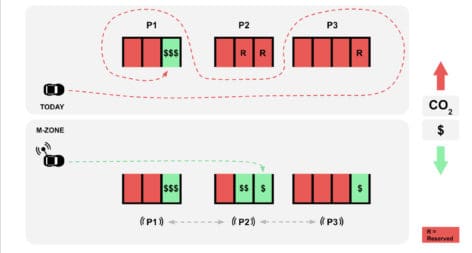 Upon implementation, AEAs (Autonomous Economic Agents) will support the sustainable and efficient use of city infrastructure in Munich through an application where they will autonomously negotiate the ‘price’ of parking spaces between the holders of parking spots, and those looking for parking spaces. Users can earn rewards in the digital currency if they choose less popular or in-demand parking spaces (or do not use the parking lot at all on some days). The Carpark AEA determines the reward levels to maximize resource usage.
“Fetch.ai provides a decentralized framework for building and customizing autonomous AI agents to carry out complex coordination tasks,” said Humayun Sheikh, CEO of Fetch.ai. “Our vision is to connect digital and real-life economies in order to enable automation over a decentralized network and change the way we use data.”
Users are incentivized to reduce their number of car trips to the Connex and adjacent corporate offices through a reward system which is measured by the utilization of parking spaces. Each registered user who is a regular car park user will be rewarded with a certain amount of tokens per minute for not parking at the parking lot. As soon as a car or its related wallet address is registered as parked by the Carpark AEA, the token airdrops to this wallet stop/slow. The number of tokens rewarded per wallet and minute depends on the current utilization of the parking lot.
“Assuming there is a 10% reduction in car usage across Munich alone, the city would see a 34.000 tonnes annual CO2 emission reduction,” continued Reuter. “Scaled up to cover all of Germany, that equates to 1.7 million tonnes CO2 reduction, annually. This smart city solution has the potential to penetrate huge markets simply by tapping into wasted data and utilizing it efficiently.”
For more information, please contact us!

by Martin Schäffner | 13 October 2020 | Blockchain, Smart Wallet
Datarella, together with CapGemini and Frankfurt School Blockchain Center, successfully applied for a feasibility study funded by the German Federal Environmental Agency (Umweltbundesamt) to explore the benefits of Blockchain technology for an emission trading system based on smart contracts.
During this study, we will work on a concept for an emissions trading register based on DLT. We will make recommendations to the Federal Environmental Agency with regards to the requirements to a DLT trading platform such as usability, scalability, performance, interoperability, security and sustainability.
Ongoing climate change is one of the major global challenges we face today. As a result, a cross-border European emission trading system (EU-ETS) is one of the EU’s most relevant tools against global warming. So far, its success is threatened by fraud and lack of transparency. Stakeholders acting in this system also complain about the absence of incentives to actually reduce emissions. With this study we will prove that by the use of Blockchain technology most of these issues will be solved thanks to the decentralized and transparent characteristics of a DLT system.
We are very much looking forward to working on this study with our partners CapGemini and FSBC in close cooperation with the German Federal Environmental Agency. We will of course keep you updated on any results we achieve.
by Martin Schäffner | 9 April 2020 | Blockchain, Smart Wallet
The Bavarian government is promising EUR 10 billion, the German government EUR 600 billion, and the US-American promised USD 1000 billion in financial aid as a countermeasure to fight the economic effects of the Corona crisis. This is a huge effort and we all hope that it will soften the economic consequences of global lockdowns. However, where will all this money go? What criteria is used to distribute it? Who reviews the applications? What will be the impact of injecting vast amounts of money into the market while the effects of the pandemic are highly limiting the production of goods and services? Here’s how Blockchain technology could help: Tokens vs Corona – A blockchain voucher system to distribute grants.
As we described, a payment distribution system like WFP uses to deliver cash to over 500.000 refugees in Jordan, could also be used to distribute financial aid of governments to citizens and businesses efficiently. In this post, however, we want to take a look at an alternative that could be distributed instead of traditional national currencies, let’s call them blockchain vouchers or tokens.
Tokens vs Corona – A Blockchain Voucher System To Distribute Grants
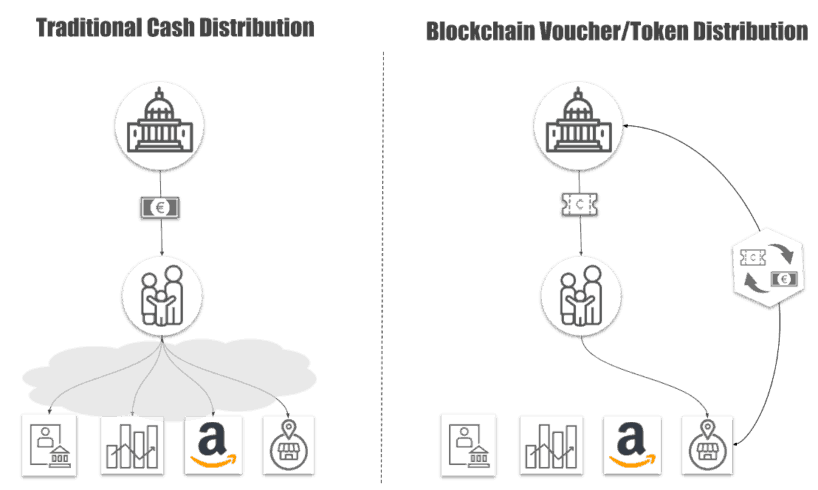
Distributing EUR or USD directly to businesses and citizens grants beneficiaries the ability to use the funds how they want. They might spend it locally, to support local business, they might put it in their bank account and save it for better days, they might invest it into the company shares or buy stuff at Amazon. Due to a lack of traceability, it’s impossible to measure the usage nor the impact of helicopter money precisely. Tokens, however, are programmable. This characteristic allows the issuing entity to predefine limiting spending parameters. For example, the government could define that it is only possible to spend these tokens on small and medium-sized businesses, located close to the consumer and within the next three months. Therefore, programmable tokens allows to create a more precise and target-orientated tool of governmental economic development aid.
dgE Krisengeld
An interesting concept of implementing blockchain vouchers was proposed during the WIRVSVIRUS hackathon, which has been organized by the German government to find innovative solutions to encounter the corona crisis. The project goes under the name dgE-Krisengeld, dgE stands for “dezentraler gemeinschaftlicher Euro” (decentral common Euro). However, informally the project is known under the term “Diggi”, a homonymous which predominantly German teenagers use as a form of address, like dude or mate.
The concept and can be summarized in three steps.
- Distribution
- Spending
- Redemption
The government could distribute Diggis to citizens via a letter using their tax ID. Consumers could then scan a QR Code and set up a wallet, which allows manage their Diggis. In the next step, citizens could spend their received Diggis at participating businesses. Therefore, the consumer could scan a QR code provided by the cashier to conduct a payment. However, since most companies cannot welcome customers at the moment, an online alternative point of sale for small businesses is required. A solution could be an opensource e-marketplace, like Openbazaar, which enables small businesses to sell their goods and future services for Diggis without paying any fees. In the last step, businesses could then redeem their received Diggis at the fiscal authority for real Euros.
The overall concept received positive resonance by German politicians. Dorothee Bär, the German State Minister for Digitalization, called the Euro token an interesting complementary system to a blockchain-based business register, which would allow especially smaller companies to participate in aid programs.In summary, the Diggi concept provides two main benefits:
- Decentral empowerment
- Local impact
Since consumers decide at which businesses they want to spend their Diggis, governmental aid would be automatically allocated to companies, perceived as valuable by the market. Diggi tokens could be programmed in a manner, that they are only spendable at business registered close to the consumer, thus creating a local impact.
Local Currencies
The concept of having a medium of exchange, which only can be “spend in a particular geographical locality at participating organizations,” is by no means novel nor innovative. It reflects the ancient concept of local currencies. Through limiting spending opportunities, these currencies stay and continue circulating in a particular community, which has economic benefits for this group. However, the limited spending opportunities, a lack of exchangeability, and relatively high cost related to managing these currencies are also their major drawbacks.
Luckily, Blockchain technology allows us to eliminate these weaknesses:
- The costs of issuing and managing a digital currency becomes marginal and requires only a couple lines of code.
- A common reserve allows to connect multiple local currencies, making them interchangeable and automatically adjusting their exchange rates. This is enabled by bonding curve contracts (next to the word “token” my favorite term at all), which will be the topic of a future blog post.
A concept of interconnected blockchain-based community currencies is brilliantly implemented by Will Rudick and his team at Grassroots Economics to inject liquidity into poor areas of Kenya and other African countries.
The Future of Donations
I am very proud to announce that we at Datarella are working at full speed together with two partners of the financial and the humanitarian sectors, to develop a solution to support the fight against the Coronavirus in Africa. This solution will be using tokens to add transparency to the field of donations – providing the donor with the certainty that her contribution was received by the people who need it. An official press release describing our Traceable Donations product will follow shortly. Stay tuned!
