by Simon Zehentreiter | 18 October 2022 | Blockchain, COSMIC-X, Featured, SSI
Datarella, together with leading industry partners and research facilities have been awarded a contract for the feasibility study titled “Collaborative Smart Services for Industrial Value Chains in Gaia-X (COSMIC-X)”, funded by the German Federal Ministry of Education and Research.
Building on the results of joint project KOSMoS, the goal of the two year project is to use the Gaia-X industry data space (IDS) for provisioning advanced smart services (ASS) in the context of spare part supply chain automation and optimization.
The target group of COSMIC-X are machine tool manufacturers, component suppliers and machine operators, with a special focus given to assisting small and medium-sized enterprises (SMEs) in taking part in and profiting off of the Gaia-X ecosystem. The specific use cases that will be explored in close collaboration with industry partners SW, HAWE und KROHNE are digital twins, trusted supply chains and platform-based maintenance.
With its expertise in blockchain technology and self-sovereign identity (SSI), Dataralla is tasked with defining the technical requirements of the use cases and, based on these, develop a blockchain-based system architecture in conformance with the Gaia-X framework. This will ensure an open, transparent and secure infrastructure for data sharing and collaboration.
We are looking forward to working on this project with all of our partners and will keep you updated on the results.
Project consortium
- Schwäbische Werkzeugmaschinen GmbH
- HAWE Hydraulik SE
- Krohne Innovation GmbH
- Universität Stuttgart – ISW
- Hochschule Furtwangen – IDACUS
- Datarella GmbH
- inovex GmbH
- Stackable GmbH
by Martin Schäffner | 4 October 2022 | Featured, KOSMoS
As part of a German consortium, Datarella has successfully finished the research project KOSMoS. KOSMoS was a joint research project aiming to build a collaborative smart contract platform for the digital value chain in the field of Industry 4.0. This research and development project was funded by the German Federal Ministry of Education and Research (BMBF) and managed by the Project Management Agency Karlsruhe (PTKA).
In addition to Datarella, the consortium consisted of Schwäbische Werkzeugmaschinen, the Institute for Control Engineering of Machine Tools and Manufacturing Equipment (ISW), the Frankfurt School Blockchain Center, inovex, ONDICS, Schütte, and Asys Group.
KOSMoS worked to develop a collaborative platform for small and medium-sized companies (SMEs) in the manufacturing sector based on distributed ledger technology (DLT). DLT is a family of innovative, decentralized technologies with blockchain technology being the most popular member of the family. Within the KOSMoS project, two different industrial use cases were realized on a DLT-based platform: 1) dynamic leasing, and 2) transparent maintenance.
The primary goal of KOSMoS was to develop a platform for the cross-company networking of production and process data using blockchain technology. The platform is able to integrate new offerings and business models. Examples include transparent maintenance concepts, dynamic leasing, and proof of quality for delivered products. Through these business models, all cooperating companies should gain an advantage. Examples of such improvements include lower prices, lower maintenance costs, and easier product distribution. In summary, the project should facilitate better cooperation amongst companies in the industry sector.
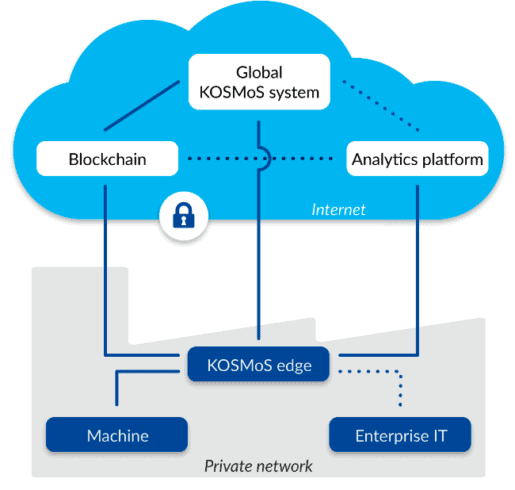
The Hyperledger Fabric DLT used in this project was part of the following logical system, where most of the individual components are accessible over standardized ports, and others were only available in private networks:
The final results of KOSMoS were presented at a full-day workshop in March including all three initiatives of the InKoWe association.
We from Datarella were very proud to be part of this innovative research project and happy to make a major contribution to the consortium with its DLT experience.

by Kira Nezu | 4 October 2022 | Featured
Datarella is happy to announce that Simon Zehentreiter is joining as a Blockchain Consultant. He is extremely passionate about blockchain technology and brings experience in business administration and information systems. Beginning in October 2022, Simon is on board as a member of the Datarella team.
Simon Zehentreiter: “My name is Simon Zehentreiter and I will be working as a Blockchain Consultant at Datarella from October 2022.
I strongly believe that blockchain technology is one of the most important inventions of our time, having the potential to radically transform entrenched processes and to open up a range of new business models. Its ability for disintermediation and democratization can unlock value for both enterprises and individuals alike. Consequently, I see it as a main driver in shaping the digital society of the future.
With my proficiency in data analytics as well as a deep understanding of the fundamentals of blockchain technology and digital assets, I want to help build innovative blockchain-based solutions, based upon real-world needs, that have a lasting transformative impact.
Datarella has already established itself at the forefront of the Web3 space, owing to a comprehensive technology stack and a bold vision for the future of blockchain technology, which is why I am excited to be a part of the team and the journey ahead.”

by Michael Reuter | 13 September 2022 | Blockchain, moveID, Partnerships, SSI
Together with 18 project partners in the Gaia-X 4 Future Mobility project moveID, Datarella develops the required digital identity infrastructure for the mobility of the future. With BOSCH heading the moveID consortium, leading mobility enterprises, Web3 companies, and research organizations create the foundation for autonomous driving and applications leveraging connected vehicles and devices.
Use Cases for the Mobility of the Future
The research project moveID comprises various scenarios of smart traffic management, s.a. parking, charging, or zoning. To create a trusted environment and connect all traffic participants, vehicles, and infrastructure components, s.a. traffic lights, access gates, and parking meters, obtain unique digital identities. All identities are managed as self-sovereign identities, a concept known as SSI, for maximum privacy and compliance with GDPR and the Gaia-X framework.
Datarella will co-create the standards and infrastructure for the future of mobility as part of the Gaia-X 4 Future Mobility moveID project, with an overall size of more than €20 million, by Gaia-X, the European Association for Data and Cloud. The three-year project brings together top industry players to build a sovereign digital infrastructure enabling secure, connected, and open mobility, with Datarella, conducting intense research and development as well as leveraging its expertise in creating successful mobility applications, s.a. Deep Parking, and MOBIX. To make moveID‘s decentralized digital identity infrastructure usable and to develop winning business models on top of it, B2B and B2C applications will be developed.
„With moveID, we will prove that European research projects like Gaia-X can be managed in an agile, dynamic way, and produce significant meaningful results for all mobility participants. Working with industry leaders like Bosch, or Continental on the one hand, and with Web3 projects and research institutes, on the other hand, collaboration is not a simple phrase – it‘s living reality“, says Datarella CEO Michael Reuter.
The Power of Web3
Besides Datarella, other project participants include Bosch, Ocean Protocol, Airbus, Continental, Fetch.ai, Materna, Denso, WOBCOM, ecsec, htw saar, Atos, Chainstep, ZU, peaq, 51nodes, ITK, DLR, and deltaDAO. The project will feature a strong Web3 component with contributions from leading projects in the space:
- peaq, the Web3 network powering the Economy of Things, will conduct intense research and development within the project. peaq will further build up its layer-one blockchain in line with the co-created requirements and standards, aiming to grant Gaia-X’s moveID the perfect infrastructure for decentralized mobility applications. peaq will also provide its core functions: peaq ID – Self-Sovereign Machine Identities (SSMIs), peaq access, and peaq pay. peaq is built using Substrate and will soon be live on both Kusama as well as Polkadot. It is working on enabling collaboration and interoperability with the Ethereum and Cosmos ecosystems for other Web3 consortia collaborators in Gaia-X.
- 51nodes, a Web3 developing and integration company brings to the project its experience with SSI architecture and implementation in the context of decentralized mobility infrastructure. In addition to the development and integration of various SSI technologies, the focus of work will be on SSI interoperability challenges.
- Through BigchainDB, Ocean Protocol – the Web3 platform to unlock data services for AI and business innovation – is providing key technical infrastructure for moveID to expedite the development of decentralized digital identity infrastructure for European mobility. Essential components of Ocean’s decentralized data marketplace technology, Compute-to-Data, and data pricing mechanisms are being leveraged to build a system architecture that ensures a seamless exchange of information between providers and customers of mobility applications.
- deltaDAO, a web3 software development, integration, and consulting company, will co-develop decentralized data infrastructure and federation services in the context of the broader Gaia-X ecosystem. deltaDAO contributes its extensive knowledge regarding Gaia-X compliance, interoperability, and integration
Peter Busch, Product Owner for Distributed Ledger Technologies (Mobility) at Bosch, said: “Web3 technologies offer a promising digital foundation for future mobility solutions. With moveID, we are setting the foundation for a hyper-connected mobility infrastructure by leveraging self-sovereign device identities and decentralized data sharing to enable hundreds of potential use cases. We are thrilled to be exploring this exciting prospect side by side with some of the leading projects in the decentralized space such as peaq, Ocean Protocol, Datarella, 51nodes, and Chainstep.”
by Michael Reuter | 22 August 2022 | Blockchain, Featured, Ocean Protocol, Partnerships, SSI
Datarella GmbH, a Web3 company builder, is joining forces with deltaDAO AG, a Web3 engineering and integration company, to expand the open data economy in the mobility and identity sectors. Both companies leverage their extensive experience in creating Web3 solutions for real-world use cases. The partners aim to allow corporate and individual users to monetize data while preserving their privacy. The first project is inspired by the partners’ collaboration in moveID, a Gaia-X 4 Future Mobility project. It will allow the monetization of mobility service provider data.
Datarella and deltaDAO will use their enterprise Web3 tools and consumer apps to jointly build solutions for the monetization of data featuring Fetch.AI and Ocean Protocol technologies. This combined tech stack serves as the foundational underlying protocol for digital business transformation with converging technologies, s.a. AI, and autonomous machines. Given the natural synergies between Datarella and deltaDAO, this cooperation will drive enterprise adoption across the partners’ client bases.
For Datarella, the purpose of technology is to increase the quality of living, by supporting human beings in professional activities and private lifestyles. The growing complexity and diversity of our ecosystem require technological infrastructures that facilitate collaboration and cooperation. By creating Web3 solutions for a global user base, Datarella illustrates the real-world benefits of its Web3 technology stack, and with deltaDAO, we will show how individual and professional users can turn the table and monetize their data, instead of “being the product”, .
Michael Reuter, CEO of Datarella
deltaDAO has become a trusted advisor for building sovereign, privacy-preserving, and secure data economy solutions. We seek to give freedom of choice and control back to data owners. As a DAO we create a new kind of data economy that is owned by no one – and open to everyone. Our partnership with Datarella will lead to many impactful real-world use cases and is a great example of how two companies can leverage each other’s strengths and experience to create real-world solutions for both individual and professional users alike. We are excited about building towards a decentralized data economy together with Datarella!
Frederic Schwill, Co–Founder of deltaDAO
About Datarella
Datarella GmbH is a Web3 company builder. Leveraging its technology stack of Blockchains, Self-Sovereign Identity SSI, Autonomous Agents, and Artificial Intelligence AI, as the tech hub for Web3 projects and companies like MOBIX, MOBIX family, IMMOBIX, or NOMIX, Datarella creates applications with real-world benefits. The Munich-based company was founded in 2013. With its decentralized teams in Munich, Gdansk (Poland), and Skopje (North Macedonia), Datarella develops bespoke Web3 innovations for their partners and clients, s.a. United Nations, World Food Programme, UKAid, ESA, Siemens, BMW, BOSCH, and Airbus.
About deltaDAO
deltaDAO AG is a software development, integration, and consulting company based in Hamburg, Germany. Its focus is to enable a transparent, secure, and decentralized data economy in which enterprises, SMEs, and public institutions can keep full technical control over their private data. As specialists in distributed ledger technologies (DLT) we are engaged in Gaia-X and built the first Minimal Viable Gaia-X (https://minimal-gaia-x.eu/) in 2021, based on open-source software and Web3 technology.
by Rebecca Johnson | 18 July 2022 | Blockchain, Track and Trust
Datarella is proud to announce the signing of a piloting agreement with Aid Pioneers e.V. (Aid Pioneers) to further work on a shipment with the space-linked supply chain product Track and Trust (T&T). Track and Trust is funded by the European Space Agency as a 2-year Demonstration Project. In this regard, Datarella, as prime contractor, together with its partners Weaver Labs and OroraTech, recently successfully completed a significant milestone with ESA.
The consortium led by Datarella is currently working on a Blockchain-based enterprise solution to tackle complex supply chain challenges that humanitarian agencies across the world face in order to track aid in locations that lack access to reliable communications infrastructure. At the end of two years of development and commercial trials, Track & Trust aims to deliver a scalable cost-efficient communications platform & network combining satellite, IoT mesh and blockchain components serving mostly supply chain use cases.
Aid Pioneers agreed to join the Track and Trust initiative as a shipment partner. They will initiate and organize an aid supply for the demonstration of the Track and Trust service. The first shipment is planned for 2023 with the goal to support people in Ukraine. Aid Pioneers is a German association joining other NGOs to build logistics to foreign countries helping people in need.
“We are very proud to have Aid Pioneers on board as our piloting partner for Track and Trust. Aid Pioneers is a young but well-established aid organization active for aid shipments to various regions including Africa, Middle-East including Balkan and Ukraine. With Aid Pioneers as our shipment partner, we have a strong setup to make a success story out of Track and Trust.” Yukitaka Nezu, Co-Founder and CFO at Datarella.
We are very excited to have a piloting agreement with Aid Pioneers and are very much looking forward to a successful shipment with them, leveraging the integration of blockchain, space and network infrastructure technology into our product Track & Trust.
As an expression of our recent progress, we can also announce: Datarella, together with its partners, successfully passed the Critical Design Review (CDR) as one of the significant milestones with ESA. Our design for Track & Trust has been assessed as valid by ESA. We are looking forward to entering the development phase next, together with our partners, in order to start piloting soon!

by Martin Schäffner | 18 July 2022 | Blockchain, Featured, SSI
As one of the selected parties in the current eSSIF program, Datarella aims to bring Anoncreds based on CL-Signatures to the Aries Framework Go. In this blogpost, we provide a progress report on the Aries Bridge from the project we are working on in the eSSIF-Lab and where we are heading next.
There are currently two major types of Verifiable Credentials used in the SSI world that implement different cryptography schemes and have different capabilities. However, both are perfectly fine to implement working SSI use cases.
The first type is based on the “Camenisch-Lysyanskaya ZKP” signature scheme, or short CL-Signatures, to issue so-called Anoncreds. It is used in SSI projects that implement Hyperledger Indy, a DLT with an SDK that was created specifically for SSI use cases and with support of the Aries Protocol. The popular Aries Cloud Agent Python is implementing these kinds of Verifiable Credentials and therefore a lot of existing SSI use cases are using Anoncreds.
The second type are JSON-LD credentials which is recommended as a standard by the W3C. It comes from an ledger independent approach and relies more on semantics which allow for a broader ecosystem interoperability. This approach is preferred among the Aries Framework Go ecosystem.
If you want to learn more about different credential types, take a look at the article “Categorizing Verifiable Credentials” from Evernym and the paper from Kalyia Young called “Verifiable Credentials Flavors Explained”.
One major problem is that these two types of Verifiable Credentials are not compatible with each other as they are using different cryptography determined by the ecosystem they are residing in. Therefore, Datarella aims to make Anoncreds available to the Aries Framework Go to get the best of both worlds. This allows for deploying agents on non-mobile edge devices while being compatible with solutions built on the Aries Cloud Agent Python or Hyperledger Indy, respectively.
We decided to write a wrapper of the indy-credx library in Go. This allows us to call the indy-credx functions for credential management from a Go environment, such as a vehicle or a mobile device. Our pull request was successfully merged in the shared rust libraries and is now openly accessible by others. However, this was just the first step. In the next step, we will integrate the wrapper with the Aries Framework Go to simplify the integration from that side.
Stay tuned for when we are giving a progress report on the Aries Bridge again in our News section; e.g. leveraging it for the mobility space in our moveID Gaia-X project.
This project has received funding from the European Union’s Horizon 2020 research and innovation programme within the framework of the eSSIF-Lab Project funded under grant agreement No 871932.



by Michael Reuter | 26 June 2022 | Blockchain, Featured, MOBIX, SSI, Track and Trust, Web3 Company Builder
With Datarella, we have been building software, tools, and applications for Web3 since 2015. Our first truly global project has been the Building Blocks application which enables users to securely pay with their smartphones in refugee camps.
We‘ve developed Track & Trust, a tracking solution for humanitarian aid logistics that leverages satellite communication. In the mobility sector, we have created SSI apps and smart parking solutions to enable secure P2P communications, streamline traffic flows, and minimize CO2 emissions. With 16 other companies, we’re part of Gaia-X consortium moveID that will create the decentralized digital infrastructure for mobility in Europe. And much more! And, in 2020, we decided to leverage our tech stack and create the Datarella Web3 Company Builder Model.
RAAY Real Estate
In 2020, we have launched RAAY Real Estate (RAAY RE) as our first standalone project, together with two partners from the real estate industry. Our RAAY RE joint venture with Hammer AG and Wertgrund Immobilien AG was the first to tokenize a commercial property, fully licensed by German regulator BaFin – Connex Coin was a breakthrough! RAAY RE will become the legal framework of our future IMMOBIX project and token.
MOBIX Marketplace
In 2021, we launched our micromobility marketplace MOBIX. By using the MOBIX app, more than 350,000 daily active users in over 120 countries are earning MOBIX Miles while riding eco-friendly vehicles, such as scooters, bikes, eBikes, eMopeds, or cargo bikes. By incentivizing users to swap their combustion engines with zero-emission transportation, MOBIX helps to decrease CO2 emissions and to make cities more liveable. In the meantime, MOBIX has evolved into the MOBIX Marketplace GmbH, a Munich-based company owned by Datarella, and Fetch.ai.
MOBIX family
The latest brainchild of Datarella’s Web3 Company Builder Model is MOBIX family – a decentralized gig economy network. MOBIX family is the first project in the Company Builder Model that will be driven with the support of an external team. Whereas RAAY RE and MOBIX have been built by internal Datarella resources, a young team of aspiring entrepreneurs from the Technical University of Munich (TUM) has taken care of the Family’s first steps. The team has presented the first MOBiX family MVP during START Ideasprint 2022, a 4-day hackathon based out of Munich.
NOMIX
In 2023, the next project – NOMIX – will launch its BIOCLOCK app. Leveraging the same tech stack as other Datarella Web3 companies, NOMIX will help users around the world maximize their healthspans, i.e. living longer while staying healthy!
We at Datarella are very happy to see more and more teams using our Web3 tools and applications, and creating new ventures! Are you interested in joining an existing Web3 team or do you want to pitch your own idea? Do you want to become part of the Web3 world but prefer to participate from the sideline, you might be interested in owning DREX, our Datarella token which entitles the holder to receive tokens of Web3 projects. In either case, please contact us!

by Rebecca Johnson | 5 May 2022 | Blockchain
The German Environment Agency (UBA) commissioned the Frankfurt School Blockchain Center, Capgemini and Datarella to elaborate a feasibility study on the use of DLT in today’s emissions trading registries. Datarella is happy to announce its successful completion.
The aim was to evaluate whether the DLT is suited to efficiently represent the current European emissions trading system (EU ETS). The insights generated by the project partners will support policymakers in informed decision making with regards to the question of whether to remain with a traditional architecture or with a central relational database. For this purpose, the technical concept of an emissions trading DLT and the consideration of the efficiency and sustainability of an emissions trading DLT were explored. As a result, we were able to demonstrate how Emission Allowances can be represented on the blockchain. Hereby, the scope of an emissions trading system can be significantly expanded without extensively altering users’ current user experience .
As a key benefit, our DLT solution offers a robust infrastructure that is secure against manipulation attempts. Additionally, with DLT, well-known advantages such as transparency and traceability can be established in emission trading systems. Our concept also provides sustainable and energy-saving operability of a DLT-based emissions trading system.
The Frankfurt School Blockchain Center, as coordinator of the project, has contributed dedicated scientific blockchain expertise. Capgemini provided a rich set of expertise in carbon trading, registries, and private blockchain implementation. Datarella as a Web3 solution provider contributed comprehensive implementation expertise of enterprise blockchain solutions.
The result of the feasibility study was highly satisfactory for the client. In the future, the result will be presented to a larger circle of interested stakeholders.