by Martin Schäffner | 20 August 2020 | Blockchain
We are proud to announce, that Datarella is now an official member of the Alastria Network.
Alastria is a non-profit association that promotes the digital economy through the development of Blockchain and Distributed Ledger Technology (DLT).
We are looking forward to developing sustainable use cases and to providing valuable solutions to industry partners.
Further, we are joining the Alastria Identity Committee to thrive the development of SSI solutions with our expertise.

by Martin Schäffner | 10 August 2020 | Blockchain, KOSMoS
How can a blockchain-based system without a central authority be managed in a well-organized manner? Often, problems like a limited amount of trust or missing rules and processes make it easy to create chaos in such an ecosystem. The challenge is to define processes and a binding set of rules while leaving enough space for potential changes. We faced this challenge of governing the KOSMoS consortium blockchain.
The KOSMoS ecosystem runs on a Hyperledger-based consortium blockchain. It enables private channels between a defined subset of actors that allows them to work on a shared database that is not accessible from not authorized parties. Usually, the industrial partner provides one Hyperledger-Framework with individual channels for each customer. This collaboration needs a governing framework with a set of defining rules and obligations for each participant and managing and working processes inside the system. At KOSMoS, we faced this challenge and summarized it in a governance model.
In the first step, we defined the stakeholders of the ecosystem and described their roles, such as the roles of the industrial partner, their customers, and potential trust stewards that can act on behalf of one party. Furthermore, we defined universal voting rights and a general voting scheme that says that all parties are equal, and decisions are only valid if all parties agree.
After defining and describing the stakeholders, we determined the governance structure that acts as the basis for decision making. Since the industrial partner actively runs the Hyperledger network, we defined a semi-decentralized structure with a slightly more powerful industrial partner than the customers. Furthermore, we added processes for changing the governance policy.
In the next step, the Hyperledger network and channel policy needed to be defined. We established procedures for changes in organizations or the infrastructure, such as adding or removing a node from the system.
Last but not least, we defined basic rules for generating, transferring, processing, and interpreting machine and production data. These rules provide information on who can write and read the data and contains a set of penalties for breaking the rules.
We further left the industrial partner the possibility to change the governance model for their specific purposes in their systems. Therefore, this governance model will act as a reference implementation and can moreover be used for other blockchain-based consortiums.
These pillars create the fundament for the KOSMoS Governance Model. Even though we received a lot of positive feedback from the project partners, there will likely be changes to the future’s governance model. Once finished, the governance model will be released at the end of the project.
The KOSMoS research project aims to provide a blockchain-based collaboration platform for industrial partners and their customers. Besides Datarella, there are eight consortium partners from the sector research, machine maintenance, and IT-service providers. Read more about KOSMoS on our Datarella website or visit the project website.
by Martin Schäffner | 10 August 2020 | Blockchain
Datarella successfully applied for the Blockpool program and is very proud to announce that it was selected into the 25 companies working on promising Blockpool solutions. The Blockpool call received over 100 proposals from 27 European countries, in more than 11 different DLT-technologies and directly affecting 8 economic sectors.
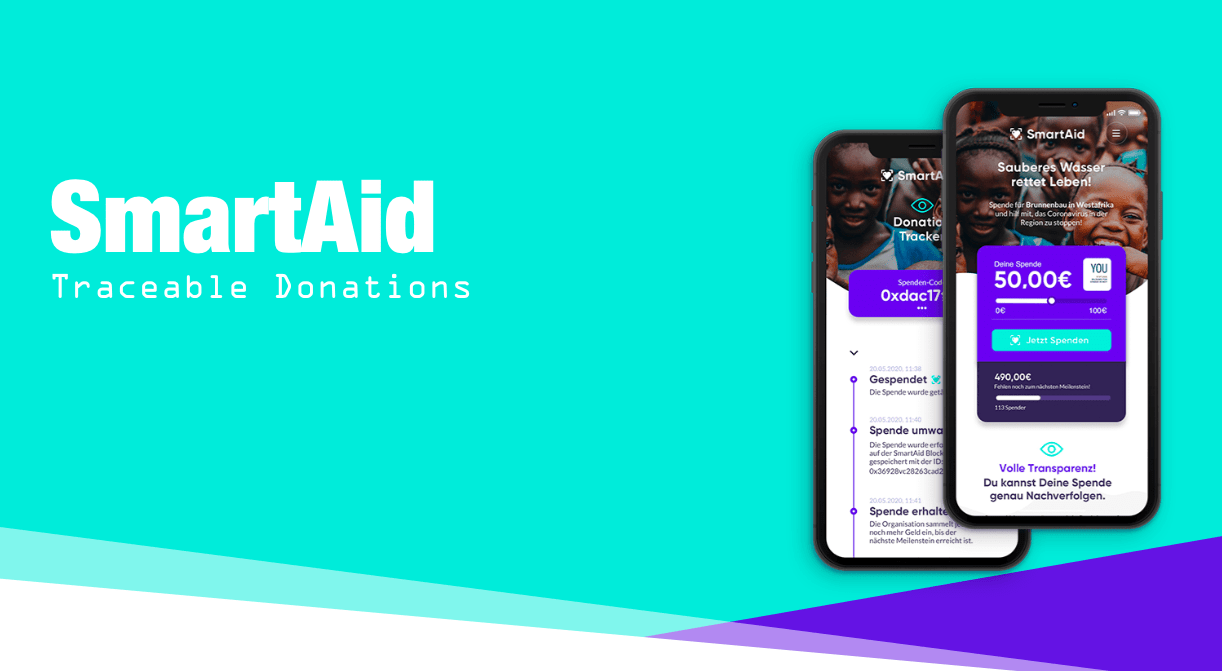
At Blockpool, Datarella will work on an important Blockchain feature supporting our product called SmartAid. SmartAid is an innovative donation platform that leverages the advantages of blockchain to bring efficiency, transparency, and trust into the world of donations. SmartAid is the world’s first fully digital application for donating and tracing the way of your money to selected charity projects. Projects all over the world can participate and receive donations through SmartAid. The use of Blockchain technology allows for
- Secure transactions,
- Traceability,
- Intuitive handling and navigation,
- Simple overview of donations, and
- Transparent transaction history.
The goal of the Blockpool program is to support cross-border DLT-based initiatives and deployment in a broad industry range. It’s primary ambition is to lead to a more cutting-edge and competitive European industry as well as to the structuring of the emerging value chain of DLTs beyond financial markets. This program is funded by the European Union’s Horizon 2020 research and innovation program.
We are very much looking forward to further developing our product SmartAid in close cooperation with the partners backing the Blockpool initiative.

by Rebecca Johnson | 5 August 2020 | Ask Datarella, Blockchain
People in the blockchain space often throw around the words Byzantine Fault Tolerant (BFT) as though it was self-explanatory. Additionally, BFT often pops up in discussions about consensus mechanisms. If you look closer, in the consensus algorithm space there are lots of variants. there’s pBFT, Tendermint BFT, BFT Raft, IBFT, and Lisk BFT to name just a few. This short post seeks to clear up the confusion.
Let’s start with what BFT isn’t. BFT, or Byzantine Fault Tolerance is not a consensus method. It is not a security model. It is not a specific technology. It is not exclusive to blockchain or exclusively useful in blockchain systems.
A system can be described as Byzantine Fault Tolerant if it provides a method for solving the byzantine general’s problem. This is a problem in computer science wherein, the system handles malfunctioning or unreliable components that give conflicting information to different parts of the system.
Lamport, Shostak and Pease described it in a Microsoft research paper in 1982 thusly:
This situation can be expressed abstractly in terms of a group of generals of the Byzantine army camped with their troops around an enemy city. Communicating only by messenger, the generals must agree upon a common battle plan. However, one or more of them may be traitors who will try to confuse the others. The problem is to find an algorithm to ensure that the loyal generals will reach agreement.
Byzantine Fault Tolerant, is at its core, a term that works as an adjective, and which as we have seen is often integrated into the names of various technologies to describe what they do. Any technology or system that has mechanisms for disregarding unreliable inputs from dishonest participants and reliably agreeing on a global state with only valid inputs from honest players can be seen as Byzantine Fault Tolerant. As such there are many security models and consensus algorithms that can be said to be Byzantine Fault Tolerant.
Additionally, underlining the fact that BFT isn’t a security model or blockchain specific consensus algorithm, BFT architectures are commonly used in military command and control as well as spaceflight and aircraft control systems. Two prominent real-life examples of BFT systems outside the blockchain space include the ARINC 659 SAFEbus network used for flight control on the Boeing 777 and 787 aircraft and SpaceX Dragon Capsule systems for approaching the International Space Station in case of multiple computer failures.

by Rebecca Johnson | 3 August 2020 | Blockchain
You may have heard people in the blockchain space throwing the term Inter-Blockchain Communication or IBC around lately. This term refers to any technology that allows transactions across multiple blockchains.
It’s not that simple though. There are actually two sub-categories of cross-chain transactions that need to be differentiated.
- Homogeneous IBC: transactions across two different operating on the same core protocol.
- Heterogeneous IBC: transactions across two different chains on different core protocols.
This is really a rabbit hole! What’s a core protocol? Essentially if two chains share the same core protocol which can natively verify and utilize the state of another blockchain using that core protocol. This is more complex than it appears at first glance.
Homogeneous IBC:
In chains such as Cosmos, all have different security models and do not all share the same consensus mechanism. Despite this, all Cosmos Blockchains are compatible with the inter-blockchain communication protocol which provides “reliable & secure inter-module communication between deterministic processes that running on independent distributed ledgers”. Additionally in chains such as Polkodot there IS a shared security module. In that case, a relay chain makes it possible for state changes on one Polkodot “parachain” to be ingested by and compatible with another parachain.
Heterogeneous IBC:
Most Blockchain ecosystems that offer Homogeneous IBC between chains operating on the same core protocol also offer some possibility for interacting with external chains that are “economically and technically sovereign”. In the case of Polkodot these chains are called Bridges. The Cosmos ecosystem uses a functionality called the “peg zone” to enable Heterogeneous IBC.
An in-depth discussion of how these functionalities work deserves its own post.

by Martin Schäffner | 27 July 2020 | Blockchain
Will my donation arrive at the people in need? Or will it get lost, somewhere in the administration costs of a humanitarian organization? Today, intransparent systems confront donors with a high degree of uncertainty, which diminishes their overall willingness to donate. Therefore, we at Datarella teamed up with the YOU Stiftung to create the next generation of donation platform for sustainable aid projects – SmartAid.
SmartAid is reinventing online charitable giving by implementing our Traceable Donation Technology – powered by Blockchain. SmartAid offers its users a unique donation experience with three distinct key value propositions:
-
- An effortless donation experience
- An engaging donation experience
- A trustless donation experience
An Effortless Donation Experience
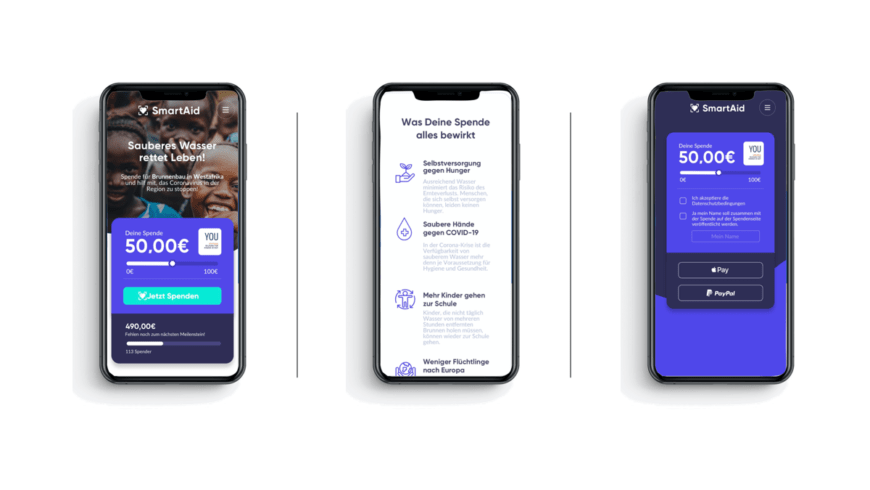
The first barrier, which hinders people from supporting impactful aid projects is the haze related to donating. Our goal is to make supporting these projects, which are often located on the other side of the world, as easy as buying a coffee. No login, no IBANS, no SWIFTs, no hidden fees, no subscriptions, no minimum amount, no bs. Simply scan a QR-Code, whether it is on a billboard at the metro station or on your computer screen or click a link and you will find yourself on the highly intuitive donation home page of SmartAid. Just a few clicks are required to conduct your good deed. Simply choose your favorite payment method and you help to create prospects for less privileged people.
An Engaging Donation Experience
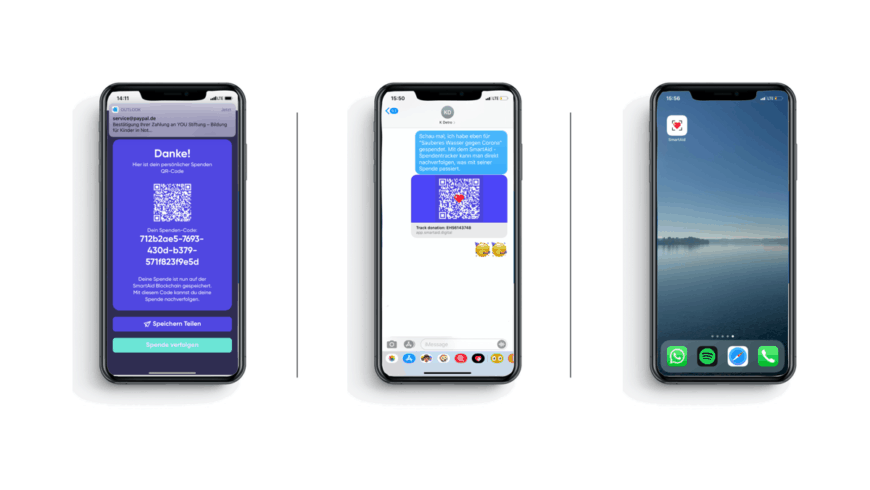
After your payment was processed, you will be rewarded with a unique QR-Code. Share this code and the attached link with your friends and family to show them the journey of your donation. Sending it to your community will also make it easy for you to find it back in your messaging history. Also, since SmartAid is a web app, you can download it to your home screen – just like a traditional app but without the hassle of downloading it from the app store.
A Trustless Donation Experience
The received QR-Code makes it not only easy to find your donation ID back in your message history, but it holds all the information required to track your very own donation among all others. At this point, SmartAid differentiates to traditional donation platforms – no trust is required since everything is documented immutably and transparently on the SmartAid Blockchain.

Traditional donation systems vs. SmartAid’s traceable donations
As illustrated in the graphic above, traditional donation systems allocate fiat currencies, like EUR, USD, in one pot, and distributed to different cost centers of an aid organization. Therefore, traditional donation platforms cannot provide donors visibility about the usage of their funds.
In contrast, on SmartAid each incoming donation is documented on the private Ethereum SmartAid Blockchain. To enable full transparency of the whereabout and usage of each individual donation, each payment will be represented by its own ERC-20 token contract. Each of these token contracts are distinguishable by their contract address. As visualized in the graphic above by different colors, this allows granting SmartAid donors blockchain secured clarity about how their funds will be used.
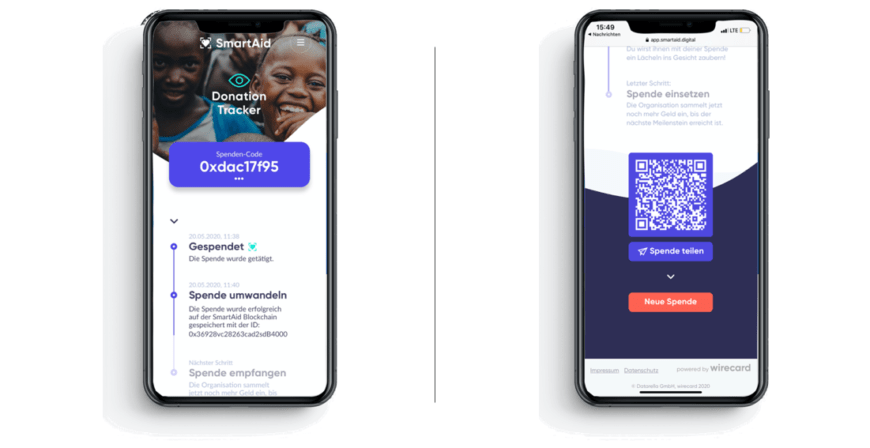
The donation tracker then provides the user an overview of the status of his donation. Here she will also be informed about the actual usage of her kind donation.
Donating hard-earned money to charity is a noble gesture. It requires a high amount of trust and transfers a significant amount of responsibility to the receiving party. Unfortunately, intransparent systems confront donors, as well as aid organizations, with a high degree of opaqueness. Donors face a high degree of uncertainty about the usage of their givings, which in turn diminishes their overall willingness to donate. At the same time, aid organizations are suffering from high costs of reporting to and providing their donors with formal audits. In both cases, the value which arrives at the people in need is significantly reduced. Therefore, we at Datarella are working with our partners on SmartAid to create the next generation of donation platform.
We are proud to announce that SmartAid is also among the winners of the EU funded H2020 accelerator Blockchers. Here we are going to extend the functionalities of SmartAid for aid organizations.
Stay tuned!
by Martin Schäffner | 21 July 2020 | Blockchain
Last October during the Outlier Ventures Diffusion Hackathon, we built a Proof of Concept of a Parking Agent System – Effortless Parking, which could solve the coordination problem of parking in crowded cities. In this post, we will look at the individual components of the promising technology stack upon which we build this project – Fetch.ai.
Do you remember Agent Smith from the Matrix trilogy? If not, let us fresh up your memory. The Matrix is a science fiction movie in which mankind almost lost the war against the machines. Most of the living human population is stacked up in energy farming towers by machines overloads in order to harvest their biologically produced energy. The consciousness of these “human batteries” is hooked up into “the Matrix”, a computer program that simulates the experience of the world how we know it today. This keeps the “human batteries” docile, sedated, and entertained. Agent Smith is a software agent living in the Matrix. His job is to hunt down humans, like the protagonist Neo and other individuals of the last reminding human resistance, which reenter the Matrix to free other individuals. Mr. Smith and other agents act autonomously to reach their goals. Further, over the trilogy, he even manages to learn a new skill, which allows him to transform other “Matrix inhabitants” into copies of himself to fight Neo.
You might be asking, what does this have to do Fetch.Ai?
Autonomous Economic Agents
The core element of Fetch.Ai is software agents, so-called Autonomous Economic Agents (AEA) which are living in Fetch’s digital world, the Open Economic Framework (OEF). Similar to Agent Smith, these software agents operate, interact, and even learn new skills autonomously. However, the goal of these agents is to actively search and discover other agents to generate economic value. An agent can represent an actor or thing in today’s economy. They can serve as a data provider, such as a sensor, which offers its data to other agents. Vise versa, agents can request data from these sources and do computations to generate valuable information. All the search and discovery takes place in Fetch.Ai’s Matrix, the Open Economic Framework. As the world ”Open” in OEF reveals, it is open, so any business or individual can join the network to offer information and services. To establish trust in a network without a gatekeeper, Fetch.ai included a Self Sovereign Identity solution (SSI) for its software agents. This allows agents to earn a good, respectively bad reputation, depending on the quality of service they provided to other network participants.
Fetch’s software agents can independently acquire new skills, which are required to conduct their tasks. Let’s say, an agent has been tasked with buying concert tickets at the cheapest price on your behalf. It already has the negotiation skill but can autonomously acquire a betting skill to participate in an auction for you. These agents are not, however, General Artificial Intelligent (AGI), since their capabilities are limited to a certain field of activity.
Fetch Ledger & Token
The legal tender in the world of Fetch.ai is the native token FET. It is used as a digital currency to pay for all transactions, e.g. buying/selling of data, network operations, e.g. deploying new agents or conduction computations, and secure communication. The state of the Fetch.Ai world – the answers to who owns what and who is who to a given point in time – is documented by its Smart Ledger. This state-of-the-art ledger technology uses 6 separate chains that synchronize in order to ensure state consensus. Using multiple synchronized blockchains makes the Smart Ledger highly scalable and capable of processing over 30k transactions per second.
As a consensus mechanism, Fetch uses Proof-of-Stake – in which any token holder can participate to secure the network. Token owners can stake their FET to secure the network and earn staking rewards paid in FET:
- Participate in a staking auction directly.
Fetch.Ai offers 200 staking slots, which can be won through actions. The winners are entitled to run one or more validator nodes for which they are rewarded with 7500 FET per slot. For participating at the auction, a minimum amount of over 750k FET is required
- Join a staking pool
FET owners, who don’t want to run a validator node or not have sufficient tokens to participate in the action, can delegate their stake and join a staking pool. Participants will be rewarded with a 10% annual return on their delegated stake.
- Binance
Also, it is possible to earn staking rewards, by holding tokens in your Binance account. This option is probably the most convenient and is rewarded with a 1-4% annual yield.
Fetch.Ai is made up of three core elements, the Autonomous Economic Agents, which generate value by acting as a data provider or consumer, the Open Economic Framework, the digital world, which connects agents with each other and a highly scalable Smart Ledger, keeping track of the current state. In the next post, we will look at possible use cases, and elaborate on how networks built on Fetch.ai can offer lower transaction costs than today’s web2.0 multi-sided markets.
Stay tuned!

by Michael Reuter | 24 June 2020 | Blockchain
Faced with the imminent Wirecard accounting scandal, and an apparent lack of diligence by audit firms, regulatory bodies, and the government have realized that financial accounting must be improved significantly. However, previous improvements in financial accounting were aimed at an intensification of financial controls that, in turn, led corporations to intensify their internal bookkeeping creativity, and limited positive results. However, we need something different: We need Traceable Accounting -A blockchain-based automated real-time accounting approach.
A new approach to financial accounting is needed. An approach that eliminates fraudulent behavior from the start. Traceable, immutable financial transactions, processed on secure, transparent distributed ledgers – this is what governments should require from all publicly listed companies.
Blockchain technology may represent the next level of accounting: Instead of keeping separate records based on transaction receipts, companies can write their transactions directly into a shared ledger, creating a system of historically consistent, enduring accounting records. All entries are distributed and cryptographically sealed, therefore falsifying or destroying them to conceal activity is practically impossible.
Benefits
Companies would benefit in many ways from this real-time traceable auditing:
- Automation: A high degree of standardization enables auditors to verify a large portion of the most critical data behind the financial statements automatically
- Minimized Costs: The cost and time necessary to conduct an audit would decline considerably
- Value Add: Companies and auditors could spend freed-up time adding value to the company’s controlling: e.g. data analysis and algorithmic predictions on the future company (and market) development
- Inclusion: The auditor and compliance officer can be included in the entire accounting process by running a trust node
It is not feasible to start with a joint register for all accounting entries. The Blockchain, as a source of trust, can also be beneficial in today’s accounting structures. It can be gradually integrated with typical accounting procedures: starting from securing the integrity of records to completely traceable audit trails. At the end of the road, fully automated audits may be the reality.
Trust in Public and Private Blockchains
Whereas Public Blockchains are designed as truly decentralized, or ‘trust-less” systems; i.e. networks that don’t need a specific trust anchor since they come with integrated trust through algorithm-based consensus mechanisms, Private Blockchains are lacking this integral trust. Private Blockchains are mostly run as centralized networks, by companies or organizations, that have full control of the data flow. Blockchain technology provides historically consistent immutable data records – but under the sole responsibility and control of the respective company. Governance Models, in which rules and processes of the Blockchain are defined, allow for a wide acceptance of the system with all participants. However, third parties that are prevented from participating in the permissioned network, can’t falsify or verify the data output.
Step 1: Adding Trust With A Trust Node
Datarella’s Traceable Accounting concept adds trust to Private Blockchains by integrating a ‘trust node’ run by a trusted third party, s.a. an audit firm or compliance officer. Additionally to the nodes run by the company itself, an audit firm runs a node with full access to the network, therefore servicing as a notary in the first place. The auditor conducts a real-time audit to verify a large portion of the most critical data. Through smart contracts, this audit can be automated to a high degree and save time and money. The audit engagement is mapped in a Governance Model, which allows for full transparency among the network’s participants as well as towards external stakeholders, s.a. stockholders, etc..
By adding trust to a Private Blockchain system through a trust node, a key inherent weakness of a partly-decentralized system is eliminated: Through the integration of audit firms in the company’s data flow, its accounting becomes trustworthy, and innovative at the same time: Traceable Accounting allows companies to run AI-based data analyses that provide valuable data to the finance department for improved controlling capabilities.
Step 2: A Fully Trustless System
At a later stage, the Private Blockchain should be morphed into a Public Blockchain that provides all interested parties with access and audit opportunities. The architecture and mechanisms of a Public Blockchain allow for the participation of entities in the network that do not have to trust each other – a Public Blockchain is designed as a ‘trustless’ system: it works without the existence of trust between the parties.
A Public Blockchain can be designed as a permissioned or a permissionless system. In a permissioned system, there is a regulatory body that sets-up a governance model defining the rules for access and behavior in the network. In a permissionless system, anyone can participate.
Traceable Accounting – A Blockchain-Based Automated Real-time Accounting Approach
Developing a fully trustless system must be the final goal for regulatory and legal bodies when envisioning a new framework for financial auditing. It meets all due diligence criteria, especially those that have fraudulently been bypassed in the Wirecard scandal.

by Martin Schäffner | 16 June 2020 | SSI
Today, the long-awaited Covid-19 tracing app will be released in Germany, which should help to detect infection chains and warn potentially infected people that they were in contact with someone infected with the virus at some point recently. The decentralized approach of the app raises some questions: Are there parallels to the concept of Self-Sovereign Identity? And if so, are we witnessing the first broadly useable application for SSI in Germany? I will face these questions in this blog post.
Even though the app is already delayed, as it was promised to be released almost two months earlier, it still comes at the right time since life in Germany is getting back to normal again. The app was released in Germany so long after other countries due to many reasons, one of them being privacy. There should be no possibility that this app holds any form of personal information for anything beyond its actual purpose. In fact, the developed app is overall pretty solid. It respects the users’ privacy, it is simple to use, and no central institution has too much control over the data. Let’s analyze some criteria from an SSI point of view to determine if it is a self-sovereign identity:
Control
To begin with, we need to look at who has control over the identifiers. These are designed to be self-creating on the user’s device and frequently automatically changing. The user doesn’t have to create and register them manually. In fact, the user has no control over how the identifiers are being created or exchanged with others. Therefore, randomly created ids violate the principle of control over the identifier since the user does not influence it.
Forming of Connections
As the next criteria, I want to take a look at how connections are established. In the SSI ecosystem, connections with others are formed via the DID Auth protocol, which verifies that the user holds valid keys for a DID. In the tracing app, this is done via Bluetooth. The device automatically recognizes other devices in Bluetooth-range and stores their ID, timestamp, and signal-strength for 14 days. If an infected person was later identified, all the IDs would be sent to a central server from which the user’s devices are frequently polling. If the IDs match up, the app warns the user that he or she might be infected. This is also contrary to an SSI approach were connections are formed with explicit consent, and exists for as long as one party terminates the connection.
Even though more criteria help to determine if the tracing app is a Self-Sovereign Identity, it is already clear that it is not a Self-Sovereign Identity, even if it is much closer than a centralized approach. However, it would be possible to align it more with SSI principles.
Tracing App with Blockchain Integration?
Let’s say the user downloads an app that has the functionality of creating compatible key pairs for an underlying blockchain or DLT. These would also not be human-readable and would further allow interactions with the underlying blockchain. If a person was diagnosed with Covid-19, the device could perform a transaction to the ledger and its IDs would be stored in a central revocation registry that the devices pull from. Therefore, there would be no need for a centralized server that is run by a single institution. Using a blockchain here would bring some benefits as well as it could work across borders and probably for less than what SAP and T-Systems, a subsidiary from the Deutsche Telekom, charge.
In short, I hope that this app has the most success and that people will use it to combat this pandemic and end it as soon as possible. I further hope that decentralized approaches, where the privacy of the user is the main priority, are becoming more popular and allows people to see that we don’t always have to provide sensitive personal information to anyone that offers an online service. And last but not least, I hope to see more people are aware of the benefits of Self-Sovereign Identity so that its public adoption is achieved earlier than expected. The concept of this app is a step in the right direction, and I hope there will be more to come!
Do you want to know more about Self-Sovereign Identity? Read my series, watch a webinar I held recently, or contact me!