For the last year, we at Datarella have been working together with two leading sensor, IoT and infrastructure providers to collectively set technological standards and build distributed ledger technology to shape the future of mobility. On 19th and 20th of October...








Blockchain Technology In The Aid Industry – Online Meetup Recap
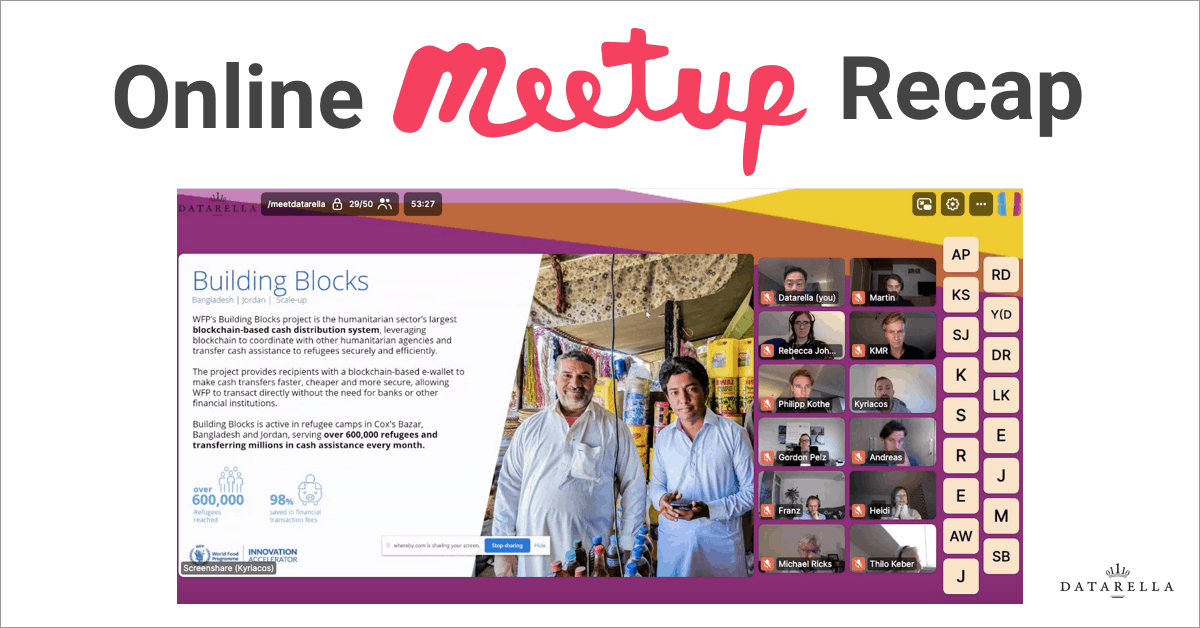
Not even COVID-19 can stop our meetups. However, since we did not want to risk the health of our audience, we decided to hold our 22nd Blockchain Munich Meetup online. No pizza, no beer, but insightful presentations of the application of blockchain technology in the aid industry.
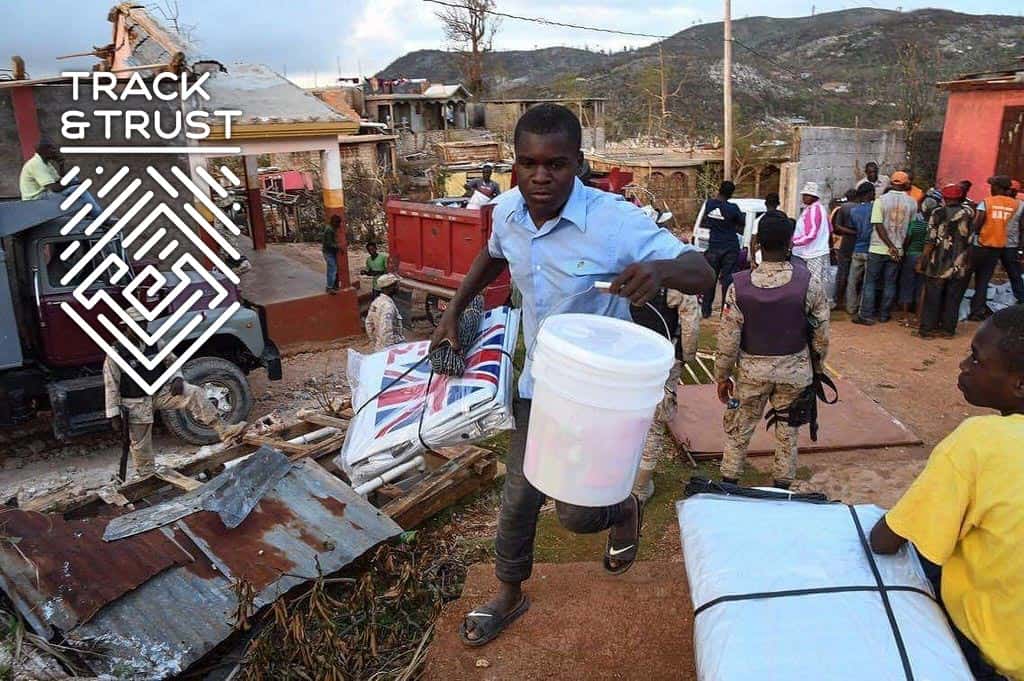
First up was Kyriacos Koupparis, head of Frontier Innovations, WFP’s innovation accelerator. After we briefly celebrated that the World Food Program recently won the Nobel Peace Prize, Kyriacos gave us an overview of the various blockchain projects at his organization. Starting with our beloved Building Blocks project, which supports over 600k refugees in Jordan and Malaysia with cash vouchers for everyday purchases. Our blockchain-based system saved WFT millions of USD in foreign bank transfer costs. We at Datarella are very glad to help to maximize the value which arrives at the people in need. Next to using blockchain for finance, WFT sees the high potential in the application of blockchain technology to increase supply chain traceability. Here, we also completely agree with WFP. As demonstrated with our Track & Trust project, Blockchain Technology allows bringing clarity to complex supply chains by documenting each handover in the T&T Blockchain.
The next speaker was Franz von Weizsäcker, Head of Blockchain Lab at Deutsche Gesellschaft für Internationale Zusammenarbeit (GIZ). The GIZ is leveraging blockchain technology for real-world use cases. Franz presented a project in Georgia, in which the Bitcoin Blockchain is used to document hashes of land registry titles. Also, the GIZ is applying blockchain technology for supply chain solutions. On the one hand, to enable tracking the origin of organic spaces, on the other hand, for digital certification, which aims for trade facilitation at customs offices. Further, it was very interesting to learn about a community currency project the GIZ has started in Cameroon. The project was inspired by the work of the Grassroots Economics Foundation in Kenya, which uses complementary currencies to overcome the shortage of national currencies in poor communities.
Our last guest speaker this evening was Gordon Pelz, who is on the Board of Trustees of the YOU Stiftung. Gordon presented to two projects, in which the YOU Stiftung leverages blockchain technology, New Baraka and SmartAid. At the New Baraka project, a slum close to Dakar, the capital of Senegal, has been turned into attractive apartment buildings. The inhabitants of the prior slum moved into the new houses. Ownership of the living spaces will be transferred after a certain period to its new residences. Here, blockchain technology comes into play and is used to document symbolic rental payments of the previous slum inhabitants. Saving the data about the payees and payments into a blockchain serves as evidence at the time of transfer of ownership of the apartments. The second use case Gordon presented was SmartAid, our next generation donation platform the YOU Stiftung had launched together with Datarella. By today, the YOU Stiftung has collected over 1150 EUR via the SmartAid web app. The first steps of building a water well in Ghana are initiated. More details about the project status are going to be communicated soon via the project’s donation tracker. For more information on SmartAid and the water project please checkout SmartAid or our news blog news.smartaid.digital.
We were very happy to hear that blockchain technology is applied in so many real use cases in the aid industry, allowing for efficiency gains, where they are most needed. Let’s leverage the benefits of blockchain technology to make our world a better place for everyone.
We are looking forward to seeing you at our next meetup again.
What Is A Digital Signature? Datarella Blockchain Bites #3
Why do we sign a contract or a bill? In our everyday life, signatures are often used as a handwritten mark to make proof of identity and intent. In public blockchain networks, participants cannot necessarily trust each other. Everyone can potentially claim to be the owner of a blockchain address and initiate a token transfer. Further, even if the message is from the owner of a blockchain address, corrupt nodes can manipulate the content, e.g. changing the beneficiary to their benefit. That’s why we need digital signatures, which allow confirming the authenticity and integrity of a message.
In this slideshow, you will learn about what digital signatures are and how they are created, using asymmetric cryptography and hash functions. Enjoy!

Datarella To Work On Blockchain Study Commissioned By German Federal Environmental Agency (Umweltbundesamt)
Datarella, together with CapGemini and Frankfurt School Blockchain Center, successfully applied for a feasibility study funded by the German Federal Environmental Agency (Umweltbundesamt) to explore the benefits of Blockchain technology for an emission trading system based on smart contracts.
During this study, we will work on a concept for an emissions trading register based on DLT. We will make recommendations to the Federal Environmental Agency with regards to the requirements to a DLT trading platform such as usability, scalability, performance, interoperability, security and sustainability.
Ongoing climate change is one of the major global challenges we face today. As a result, a cross-border European emission trading system (EU-ETS) is one of the EU’s most relevant tools against global warming. So far, its success is threatened by fraud and lack of transparency. Stakeholders acting in this system also complain about the absence of incentives to actually reduce emissions. With this study we will prove that by the use of Blockchain technology most of these issues will be solved thanks to the decentralized and transparent characteristics of a DLT system.
We are very much looking forward to working on this study with our partners CapGemini and FSBC in close cooperation with the German Federal Environmental Agency. We will of course keep you updated on any results we achieve.
Wanted: Your Feedback On SmartAid – Blockchain-Based Donations
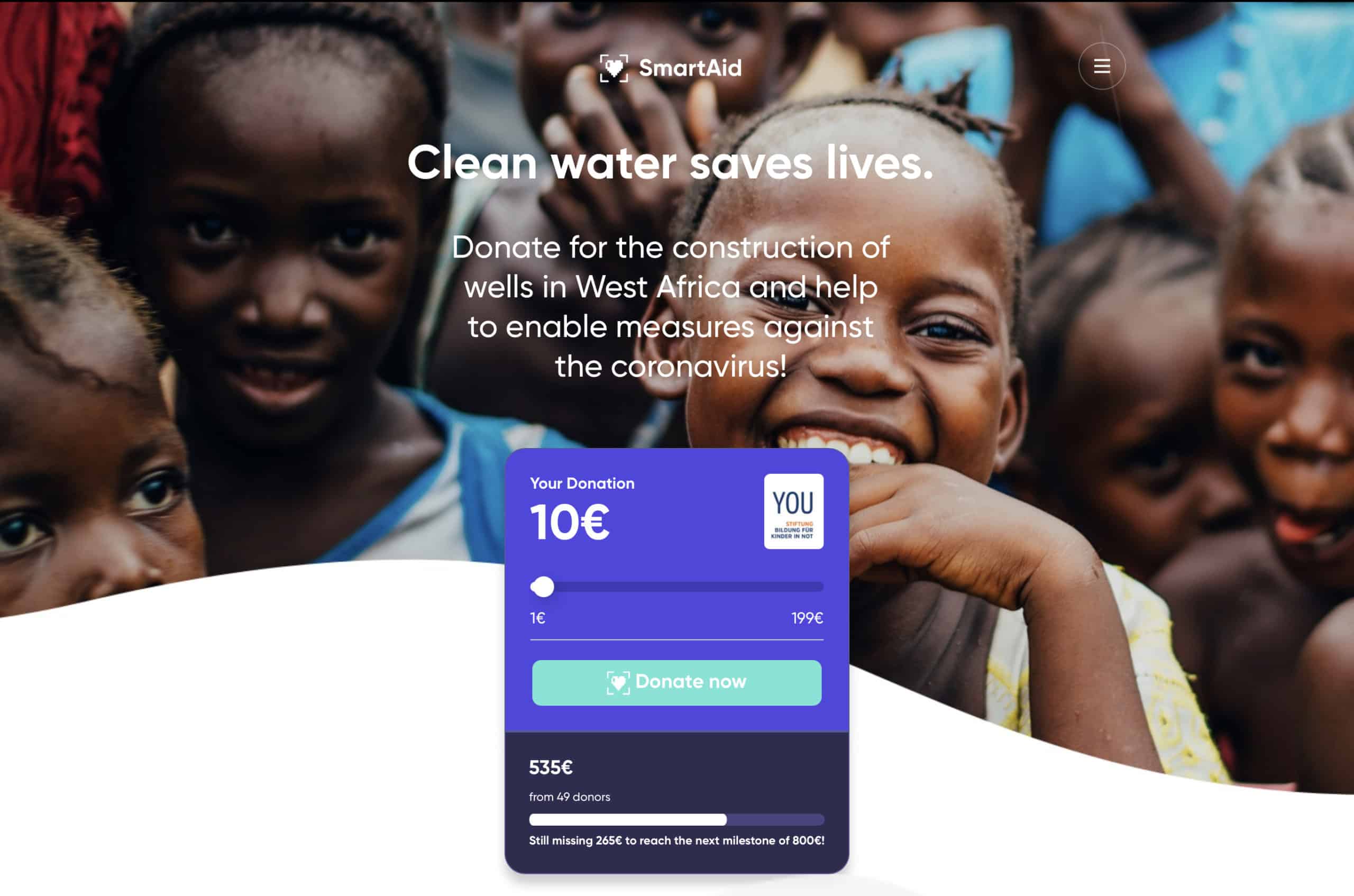
A few days ago, we launched our new blockchain-based donation app SmartAid that allows for traceable donations to charity projects all over the world. The first charity project is YOU Foundation’s “Water for West Africa”, collecting money for the construction of freshwater wells that provide West African communities with drinking water and allows for improving hygienic standards fighting the coronavirus.
SmartAid has been designed as a web app; i.e. you don’t have to download it from an app store but you simply surf to the URL www.smartaid.digital in your mobile or desktop browser and start donating, immediately. The donation process is very simple and (should be) self-explaining: you choose the amount you want to donate, you select the PayPal or credit card payment option, and confirm your donation. Done.
Since in 2020, there are thousands of different smartphones, running on millions of different versions of operating systems, even the most simple online process can result in unexpected effects; s.a. a page not loading, or a text not showing up. Since we want to make the donation experience as pleasant as possible, we’d like to invite you, and your friends, to join us and help to improve SmartAid! Donate – you could start with just 1 EUR – and send us your feedback. Although we are most interested in potential bugs or any inconveniences you might experience, of course, we’re also very happy to hear about positive experiences while donating!
Please send your feedback to smartaid (at) datarella (dot) com
It would be great if you could support us in refining and optimising SmartAid – and our friends over at YOU Foundation will be grateful for your donations that support West African rural communities! Thank you!
Why We Need SmartAid – A Winning EU Horizon 2020 Solution
We are proud to announce that SmartAid is under the winning team of two EU funded Horizon 2020 programs: Blockchers and Blockpool.
SmartAid is the next generation marketing, funding and reporting tool for non-profit organizations, seamlessly connecting donors with charitable projects. Blockchain technology allows SmartAid to introduce a new era of transparency, efficiency and effectiveness within the aid industry. By drastically reducing costs, SmartAid maximizes the value, which arrives at the people in need.
The Background
Our world is facing global challenges. Next to the almost ordinary crisis, like natural disasters, the effects of climate change, and wars, we need to deal with the pandemic outbreak of COVID-19, which has been tragic and costs many lives. However, while the economic consequences are going to hurt developed countries, they are going to be devastating for the developing world. Already before the pandemic, over 200 million people were assessed in need of humanitarian assistance.
To fight sorrow and misery, to create perspectives for humans living in less privileged countries and to turn our world into a better place for everyone, requires the help of the wealthy population. In the year 2019, over 25.3 billion EUR have been donated worldwide for international humanitarian assistance, almost 2 billion EUR from EU institutions alone, and over 2.5 billion EUR from Germany. (1)
The Problem
In poor countries, even small amounts of money can make the difference between sending your kid to school or sending them hungry to bed. Unfortunately, any type of costs diminish the value, which arrives at the people in need.
SmartAid addresses the high costs, arising through a lack of transparency and automation in the charity industry. Opaque and outdated systems result in high expenses for both donors and aid projects. For receiving organizations, financial reporting to their sponsors is related to substantial efforts. In return, the financiers also need to invest money to audit their aid projects. Manual reporting is not only costly but also vulnerable to human error and even fraud. Corruption is often an issue in aid-receiving countries. Furthermore, uncertainty about whether their donations indeed arrive at the intended destination might reduce the willingness of private donors to contribute.
In addition, the costs related to foreign fiat currency transfer are exorbitantly high. Bank fees, which eat up to 30% of the transaction volume, are no rarity. Furthermore, once donations are transferred and covered into the local currency, funds are exposed to high inflation risk, possibly making them worthless within weeks. Last but not least, measuring the impact of a donation today is very costly and can be only vaguely estimated through long term studies and surveys.
The Solution
Transparency and automation allow the creation of efficiency gains. SmartAid eliminates unnecessary cost drivers, caused through manual reporting systems, in the charity and non-profit industry.
In the current development phase, SmartAid uses a pull approach to mirror donations in fiat currency, like Euro, on the SmartAid blockchain. A PayPal API connects the traditional fiat payment world with our blockchain system, where all funding streams are documented tamper-proof, transparent and in historical order. For each donor, an individual token contract is deployed, a matching amount of tokens minted, and transferred to an address, representing the beneficiary’s bank account. By representing individual donations through a unique – thus distinguishable token, full transparency about the usage of each donor fund can be provided. This allows users of SmartAid to trace the journey of their very own donation. Certainly, also, outgoing payments are documented on the SmartAid Blockchain fully automated via the PayPal API without the costs and risks of manual accounting.
In future development stages, SmartAid can switch to a push approach. In that case, aid projects can use tokens received in multiple ways and leverage their utility. Tokens will be redeemable as vouchers at the SmartAid platform for national currency.
Further, these value units are going to be transferable to addresses, representing cost centres within an organization. Also, tokens will be usable as a medium of exchange between the charity organizations, aid implementing projects and final recipients without intermediaries, bank fees or inflation risks and fully transparent. Lastly, it will be possible to create new project tokens, leveraging a donor fund backed reserve to increase the liquidity.
The digital documentation of newly created project tokens allows non-profits and their financiers to automatically measure the impact and the value created by a donation. This will allow an effective fund allocation in the future, maximizing the generated value.
Why Blockchain
Blockchain technology allows SmartAid to document transactions in a transparent, tamper-proof, and trustless way. Distributing copies of the ledger, which keeps track of the past and current state of the SmartAid ecosystem, makes it secure and eliminates the risk of any single actor manipulating the history. Also, blockchain allows creating and managing new vouchers aka. tokens in a secure manner at neglectable costs.
Join SmartAid
If you want to learn more about SmartAid, check out our previous posts. Please feel free to contact us if you want support SmartAid by becoming a sponsor or have interesting project proposals.
(1) http://devinit.org/wp-content/uploads/2019/09/GHA-report-2019.pdf

What Is A Blockchain Address? Datarella Blockchain Bites #2
What Is A Blockchain Address?
Just like your home address, bank address, or email address a blockchain address is a unique and secure identifier. This identifier, saved on a blockchain, can be used for sending and receiving cryptocurrencies. However, in contrast to traditional addresses, blockchain addresses are not assigned by centralized authorities. These addresses are mathematically derived from a user-generated private key.
Learn more about blockchain addresses and the two types, which exits in the Ethereum Network, in our Datarella Blockchain Bites slideshow of this week: Blockchain Addresses.
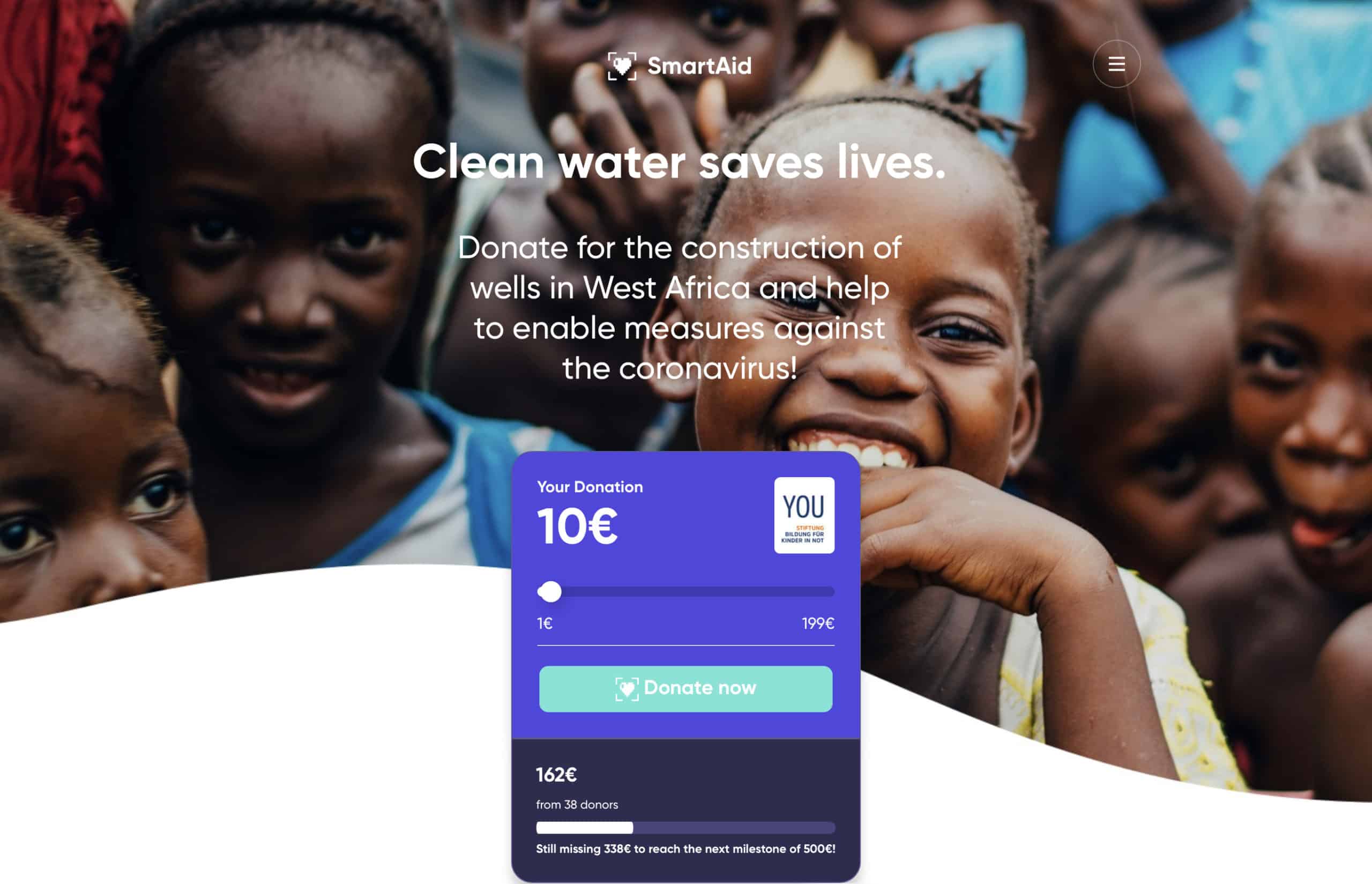
SmartAid – First Blockchain-Based Donation App Launched by Datarella and YOU Foundation
Last week, Datarella and YOU Foundation have launched SmartAid, the first digital donation app that allows for traceable donations based on blockchain technology. SmartAid offers immediate support in crisis situations and lets its donors track their donations until they reached beneficiaries. SmartAid’s first project is “Clean Water for West Africa”, a charity project initiated and managed by YOU Foundation, led by UNESCO Special Ambassador Dr. h.c. Ute-Henriette Ohoven.
Why Donating Must Be Changed!
Time and again, potential donors wonder how difficult it still is, to donate to the right cause, and in an efficient and fun way. Often, you can’t donate using your mobile, or can’t even donate online. Then, you would donate to a certain general topic, rather than to a specific project. Last, but not least, as a donor, you can’t track and trace the path of your donation. Many potential donors are put off by clunky, complex, and intransparent donation processes. Given a huge amount of spare money many people in the rich parts of our world have available for being spent to a good cause, this is a wasted opportunity.
Enter SmartAid!

Efficient, and easy-to-use, the blockchain-based web app does not only make donating fun, but offers fervently desired transparency of the money flows: Right after having donated between 1 – 199 Euro, the donation will be stored on the SmartAid blockchain. The donor receives a tracking code to trace her donation until it reaches its destination. This so-called “traceable donation” is a world first. Secure and immutable blockchain technology guarantees that all donations will reach the right beneficiary by making the flow of money transparent to the donor.
Security, Transparency, and Fun
Donating via SmartAid is not only secure, efficient, and transparent – it’s fun! A direct connection to a donor’s credit card or PayPal account allows for an easy process that even lets donors share their donations via Social Media, thus motivating others to share this experience and jointly support the charity project.
“For a long time, we at YOU Foundation have been looking for a way to enable individuals to donate to our charity projects all around the world. Therefore, we can’t wait to see SmartAid in action!”, says Ute-Henriette Ohoven, founder of YOU Foundation.
“Since 2015, we at Datarella have been working on Blockchain projects with our corporate partners, such as Bosch, Siemens, BMW, Merck, and international humanitarian organizations, such as the UN World Food Programme WFP, or UK Aid. We are very happy to launch SmartAid, together with YOU Foundation, and we are highly curious how donors will perceive the new transparency of their donations”, adds Michael Reuter, CEO of Datarella.
What Is A Private Key? Datarella Blockchain Bites #1
“Not Your Keys – Not Your Bitcoin!”
Maybe you came across this quote from the Bitcoin advocate Andreas Antonopoulos. With “keys” he is referring to the private keys, which allow users to transfer bitcoins and other crypto assets.
This is the first post of Datarella’s “Blockchain Bites” in which we want to dive in blockchain terms, bite by bite, in a visualized way.
First up, we will have a look at what is actually a private key:
Ask Datarella: What is a Security Model
When people start talking about blockchain they often mix up the security models with consensus algorithms. If you’ve ever scratched your head when these terms start getting thrown, around this post is for you.
Every IT system has some type of security model. Security models answer the question, “how will this system grant access to “good” actors and limit the damage that “bad” actors can do”. In the traditional world of networked computing, this is often achieved through a role-based access control (RBAC) model. Typically these systems rely on establishing shared communal trust in a trusted certificate authority and X.509 certificates.
The internet domain name system is somewhat more complex but follows this basic paradigm with the Internet Corporation for Assigned Names and Numbers (ICANN) being responsible for the central issuance of certificates that enable your browser to resolve human-readable internet addresses. As with Blockchain systems here, governance is key to the functioning of the security model. There are many other types of centralized security which are regularly used for military command and control systems as well as access control for civilian infrastructure.
Common Centralized Security Models:
- Mandatory Access Controls (MAC)
- Multi-level security (MLS)
- Discretionary Access Controls (DAC)
- Role-Based Access Control (RBAC)
As you can see, these are large categories that describe how access control is organized and how computer systems in the system arrive at their individual or collective states. These models do not however stipulate the specific technologies or algorithms to be used. Proof-of-Work, Proof-of-Stake, and Proof-of-Authority are types of security models, not actually consensus algorithms.
Consensus Algorithms Enabling Blockchains with a Proof-of-Work Security Model:
There are at least half a dozen popular implementations of consensus algorithms that utilize a PoW model. Check out this post from Jan Vermuelen to learn more about the varieties of PoW algorithms. The main thing that changes between these algorithms is the Hashing algorithm that they rely upon. Usually, the algorithms are named after the hashing algorithm they employ.
- Nakamoto Consensus / SHA–256 — Bitcoin, Bitcoin Cash
- Scrypt — Litecoin, Dogecoin, Neo
- Ethash — Ethereum, Ethereum Classic
- Equihash — Zcash, ZenCash, Bitcoin Gold
- CryptoNight — Monero, Bytecoin
- X11 — Dash
- LYRA2RE — Vertcoin
Consensus Algorithms Enabling Blockchains with a Proof-of-Stake Security Model:
- Tendermint Core — Cosmos
- dPoS — EOS, TRON, Lisk
- Ouroboros — Cardano
- Casper the Friendly Ghost — Ethereum proposed
- Casper the Friendly Finality Gadget — Ethereum proposed
- Liquid Proof-of-Stake — Tezos
- GRANDPA/BABE — Polkadot
Consensus Algorithms Enabling Blockchains with a Proof-of-Authority Security Model:
- Honeybadger (POA Network)
- Clique (Geth’s PoA algorithm)
- Aura (Parity’s PoA algorithm)
- RAFT BFT (Hyperledger)
Although PoS, PoW, and PoA are the primary security models in the blockchain space there’s no limit on the type of security models that is possible and each of the security models has dozens of different implementations (and hybrids).