
by Michael Reuter | 25 June 2024 | AI, Blockchain, Featured, Ocean Protocol
The transition from Web2 to Web3 represents a significant shift in how we manage and control information online. Web3 offers a potential solution to issues like privacy, surveillance, and misinformation by utilizing blockchain technology. This technology gives users more control over their data. Together, AI and Blockchain can be even more powerful.
However, user friction has slowed Web3’s adoption. To accelerate adoption, we can integrate AI and blockchain technology. Consequently, this integration improves the user experience and reduces user friction. Additionally, decentralized AI built on blockchain can offer users personalized online experiences while protecting their privacy and control over their data.
Blockchain and AI are complementary technologies that address each other’s limitations. Specifically, blockchain’s built-in consensus protocol ensures data accuracy and integrity because it verifies data at multiple points. When AI is trained on flawed data, it produces flawed results. Therefore, we can design blockchain platforms to distribute power more evenly, reducing the risk of a few AI companies or models making opaque but consequential decisions. To leverage the power of AI and blockchain cohesively, we must overcome technical challenges. Next, we can track the co-development of these two technologies by examining their progression in three phases:
Data, Information, and Knowledge
Meanwhile, AI can accelerate Web3 adoption by offering personalized experiences based on user prompts. For Web3 to go mainstream, the next generation of consumer-facing applications must match the user experiences of Web2. To achieve this, we must prioritize personalization, which optimizes marketing spend. Decentralized knowledge graphs – as they are developed in the Artificial Superintelligence Alliance ASI – may be the key to bringing personalized experiences from Web2 into Web3. Knowledge graphs map relationships between objects, facts, events, situations, and other data. In addition, we can make knowledge graphs more accessible and verifiable by using decentralized knowledge graphs and open, permissionless blockchain networks. By integrating AI and Blockchain, we can create a foundation for Web3 built on trustworthy data. As a result, this new decentralized internet addresses issues prevalent in our current centralized internet.
AI and Blockchain Together Improve Internet Governance
- Decentralization: Web3 is built on blockchain technology, which is decentralized and transparent. We can use AI to ensure that data is stored and processed securely and transparently, reducing the risk of a single entity controlling or manipulating data. In this way, we can promote a more democratic and equitable Internet governance.
- Trust and Transparency: AI verifies the authenticity and accuracy of data on the blockchain, ensuring that information is trustworthy and transparent. With this information, users can make informed decisions and reduce the spread of misinformation. Moreover, AI can detect and prevent malicious behavior, ensuring that the internet remains a safe and trustworthy environment.
- Autonomy and Agency: Web3’s decentralized architecture and AI’s ability to automate decision-making processes empower users to take control of their personal data and online experiences. Users can then make choices that align with their values and preferences. Consequently, users have more autonomy and agency over their online experiences.
- Security and Privacy: AI detects and prevents cyber threats, ensuring that Web3 applications are secure and private. By doing so, AI protects users’ sensitive information and prevents unauthorized access or manipulation. Additionally, AI optimizes Web3 applications, enabling them to scale efficiently and process vast amounts of data in real time.
- Scalability and Efficiency: As a result of AI optimization, the internet’s overall performance and responsiveness improve. Furthermore, AI helps design and optimize token-based incentive systems that encourage desired behavior and promote a healthier internet ecosystem.
- Data-Driven Decision-Making: AI analyzes data generated by Web3 applications, providing insights that inform data-driven decision-making. With these insights, we can make decisions based on objective data rather than personal biases or assumptions. Therefore, we can make more informed decisions that benefit users.
- Accountability and Governance: AI ensures accountability and transparency in Web3’s decentralized governance models by detecting and preventing malicious behavior. As a result, the internet remains a safe and trustworthy environment.
In conclusion, by combining AI and Web3, we can create a more decentralized, transparent, and secure internet that prioritizes user autonomy, privacy, and agency. We can make decisions based on objective data and respond more effectively to the needs of users. Ultimately, this new decentralized internet can promote a healthier and more equitable online ecosystem.

by Rebecca Johnson | 2 August 2023 | Autonomous Agents, Blockchain, Featured, Ocean Protocol
Big data has broken privacy. We’ve built a way to solve this problem and create business intelligence while preserving user privacy. This post dives into how we are automating private business intelligence.
Introduction to Ocean Protocol’s decentralized data marketplace
The Ocean Protocol is a decentralized data exchange protocol that aims to unlock the value of data and enable secure and privacy-preserving on-chain data sharing and monetization ⛓️. It provides a framework for building data-centric applications that facilitate the exchange of data assets while ensuring data privacy, security, and compliance.
The Ocean Protocol marketplace is the heart of the entire Ocean Protocol ecosystem. These data sets can be bought and sold along with access to computation on those data. What Uniswap did for Finance, Ocean Protocol is doing for data. Ocean goes beyond just merely trading data in the clear though and makes it possible to order computation on data you never see and get actionable results while maintaining data privacy and secrecy. That in many ways is the holy grail of data privacy and security!
The Ocean Protocol approach to data markets is already gaining substantial traction in industries through the MoveID consortium and GAIA-X where Datarella is a partner. Specifically, there are already industry focused GAIA-X compliant Marketplaces utilizing Ocean protocol already released in the wild (see Pontus-X)
Fetch.ai Agents + Ocean Protocol: A Perfect Match
Switching gears, you may have also heard of Fetch.ai. It provides a next-generation protocol enabling a digital world where Autonomous Economic Agents and Microagents can perform proactive economic activity. AEAs have some unique attributes. Fetch Agents (AEAs) can find resources on their own, they have private keys so they can transact autonomously, and, more importantly, they can decide to execute business logic autonomously based on their programmed skills and behaviors. AEAs are perfect for delegating on-chain tasks that you need to make sure actually happen technically but don’t want to have to handle manually. A great example of this is the stop loss agents that Fetch.ai has released in order to allow people to provision liquidity on DeFi protocols autonomously. Another real-life use case is the kind of behavior that we demonstrated with MOBIX at the International Automobile Show (IAA) in 2021.
In that context, we demonstrated how an Autonomous Economic Agent, running on an edge device and accessible through a specialized version of the MOBIX app, could enable privacy-preserving ad workflows. That sounds super complicated, but its utility is really simple.
Smart Recommendations without Data-Lake-Honeypots
Consumers have come to expect really smart recommendations in their apps based on their current context and previous actions. We’ve come to take this for granted everywhere. It extends from the autocomplete suggestions in your search field to Netflix recommendations to mobility recommendations embedded in scooter rental apps. There’s a shadow side of this intelligence though. Simply put, in order to offer that kind of intelligence someone is invariably building a vast data lake full of your user data to power those convenient algorithms. We all know that this kind of data accumulation has massive privacy ramifications, not to mention the security risks associated with those giant data-lake-honeypots. By connecting Fetch.ai Autonomous Economic Agents with Ocean Compute to Data workflows and the Ocean Marketplace we are laying the cornerstone for enabling that kind context aware convenience without sacrificing any user privacy.
Moreover, outside of the consumer sector in the world of IoT devices, this code makes it really convenient for any number of machines to automatically sell their data either directly on the Ocean Marketplace or via Compute to Data! AEAs have a certain amount of built-in intelligence. This enables IoT devices from cars to weather stations to decide, based on their situation, when and how to post the data to the Ocean Marketplace for sale. Additionally, it allows consuming devices to autonomously search out and purchase the data that they need. Together, this approach provides the basis for autonomous adaptive machine learning without having to own your own ample data sets.
Privacy-Preserving Prediction Engines
TLDR: By enabling Fetch Agents to post data to Ocean Marketplace Compute to Data recommendation engines can be driven without violating privacy.
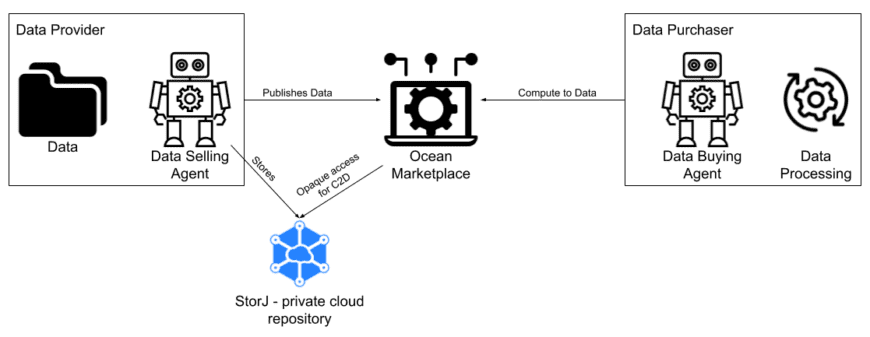
Datarella has joined forces with Fetch.ai and Ocean protocol over the last few months to build an Ocean Connection Agent to take private data available to itself, store it confidentially, and then spin up a fixed-rate exchange on the Ocean Market or with compute to data enabled as shown in the previous figure. You can imagine that in the near future, this might be your current location data or data about your preferences or searches performed locally within an app (the MOBIX app for example). This data never leaves the sovereign control of the user and the user doesn’t have to worry about handling or organizing or authorizing the data because the AEA does that on behalf of the user well, autonomously! The same applies to companies running AEAs on IoT devices too. You might be asking now why this is even beneficial. It’s useful because it solves the problems associated with those vast data lakes that are driving the recommendation engines behind all sorts of “smart” services.
The Solution for Automating Private Business Intelligence
Ocean Marketplace is an open-source decentralized market that you can fork to develop your own marketplace. It comes equipped with all the features right out of the box. The “Compute to Data” part enables the person, or in this case, AEA is posting the data to stipulate that it cannot be downloaded in the clear – but rather that you’re selling the results of selected algorithms which you or your agent will run (automatically) against the private data on behalf of a purchasing entity (person or AEA). They get the results of the computation – the basis for those context-aware recommendations, but they don’t have the opportunity to abuse the data because they never actually see it despite gaining actionable business intelligence based on the contents of said data. That’s what we mean by “Automating Private Business Intelligence”.
The world we’re building is one where your data remains yours but the results of computations on your data will enable a host of new context-aware smart services that respect your privacy by design but still feel like magic. Bringing the unique properties of the Ocean Marketplace together with Fetch.ai Agents means for the everyday person that it’s increasingly going to be possible that you can have your cake and eat it too. You won’t have to choose between amazing functionality and privacy – you’ll be able to have both – and get paid for it. Your data – your profits!
Developer Resources
If you’re a developer and want to dive into the code there are two spots you’ll want to check out. First of all, you’ll find the code open-sourced on github here. Additionally, if you’re already an AEA developer you’ll want to check out the package in the AEA registry. In the near future, we’re also planning to release the Storj AEA but for now, you can take any S3-compatible storage you choose. Let’s start automating private business intelligence generation!
by Simon Zehentreiter | 28 November 2022 | Blockchain, COSMIC-X, ESCOM, Featured, Gaia-X, KOSMoS, moveID, Ocean Protocol, Partnerships, SSI
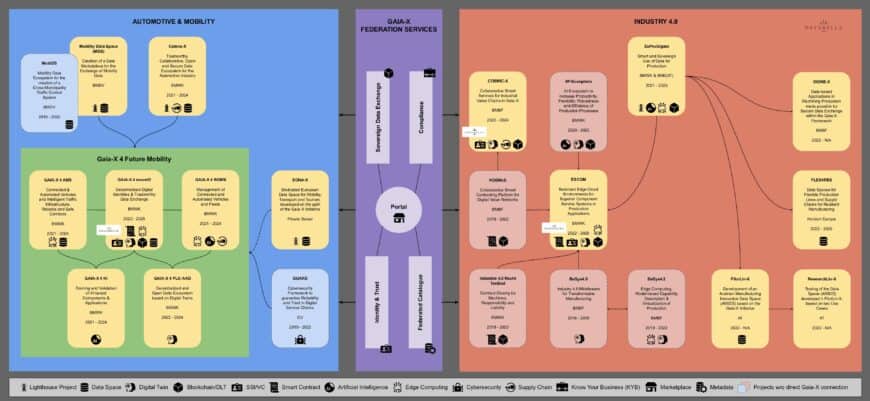
To visualize and structure ongoing Gaia-X projects and their thematically related studies, Datarella created a project landscape that comprises the three domains Gaia-X Federation Services, Automotive & Mobility and Industry 4.0. The relations between projects are modeled as directed edges, the technologies that are associated with each project are represented as icons – the Gaia-X Project Landscape:
The overarching goal of Gaia-X is to create a federated and secure data infrastructure for Europe and beyond that allows companies and citizens to share data without giving up control over it. Every ecosystem participant decides what happens to their data, where it is stored and thus always retains absolute data sovereignty. To achieve this, the Gaia-X architecture follows the principle of decentralization, with a multitude of individual platforms all following a common standard based on openness, transparency and trust.
The Gaia-X Federation Services, at the center of the visualization, are the implementation toolbox and minimum technical requirements and services that enable Gaia-X Federations to become operational and work together. Federations are individual participants that team up to create value for all participants and to open up new market potentials.
- The Identity & Trust service closes the trust gap by enabling federations to authenticate and authorize participants. This is achieved by utilizing Self-Sovereign Identity (SSI), specifically Decentralized Digital Identifiers (DIDs), Verifiable Credentials (VCs) and Verifiable Presentations (VPs), which ensure that every participant is in full control of their identity at all times.
- The Federated Catalogue service allows federations to set up a repository, in which participants can search for and discover information and services of other participants based on their aforementioned credentials.
- The Sovereign Data Exchange service helps participants in keeping sovereignty over their data by providing functionalities for specifying and tracking how their data is used.
- The Compliance service ensures that every participant and service is complying with the Gaia-X principles. Together with a number of decentralized services that are part of the Gaia-X policy, it provides decentralized, sovereign and immutable governance and control mechanisms that enable trustworthy transactions between participants.
- Lastly, the Gaia-X Portal provides user friendly access to the Federation Services and supports the onboarding and accreditation of participants as well as the discovery of services.
The Gaia-X Federation Services are co-developed by the GXFS-DE project, funded by the German Ministry of Economic Affairs and Climate Action (BMWK) and coordinated by eco – Association of the Internet Industry.
The Automotive & Mobility domain harbors three Gaia-X lighthouse projects, the Mobility Data Space, Catena-X and EONA-X. The Mobility Data Space is funded by the Federal Ministry for Digital and Transport (BMDV) and deals with the creation of a data marketplace that allows for the sovereign exchange of mobility data in Europe, Catena-X is funded by the BMWK and is tasked with establishing a trustworthy, collaborative, open and secure data ecosystem for the automotive industry. The objective of EONA-X is to establish a dedicated European data space for mobility, transport and tourism, developed on the path of the Gaia-X initiative. Funding is mostly provided by the private sector.
Datarella, as previously announced, is working on the moveID project, which, together with four related ventures, is part of the Gaia-X 4 Future Mobility project family. The goal of moveID is to develop a digital identity infrastructure and trustworthy data exchange process for the mobility of the future. Feasibility will be shown on the basis of two use cases, V2X services in heterogenous, decentralized mobility infrastructures and vehicle data sharing. moveID is funded by the BMWK and the interdisciplinary consortium of mobility enterprises, Web3 companies and research facilities is lead by BOSCH.
The Industry 4.0 sector features a German-Austrian joint Gaia-X lighthouse project, EuProGigant. It’s intention is to establish an ecosystem that enables the smart and sovereign use of data for production. Funding is provided by the BMWK and the Austrian Federal Ministry for Climate Action, Environment, Energy, Mobility, Innovation and Technology (BMK).
With KOSMoS, Datarella has already successfully finished a research project in the Industry 4.0 space by realizing a collaborative smart contracting platform for digital value networks. Now, based on these results, Datarella is also involved in the two followup Gaia-X projects Cosmic-X and ESCOM. Cosmic-X is funded by the Federal Ministry of Education and Research (BMBF) and deals with advanced smart services in the context of spare part supply chain automation and optimization. The specific use cases that will be explored are digital twins, trusted supply chains and platform-based maintenance. ESCOM is funded by the BMWK and seeks to make a demonstrable contribution to a responsible manufacturing industry regarding resource consumption and sustainable resource use. The project will demonstrate that the use and balancing of edge and cloud data spaces allows for the flexible, load- and energy demand-dependent use of services as a know-how offering of component manufacturers with high utility value for the end application. Both projects are carried out in collaboration with leading industry partners and research facilities.
We are incredibly proud to be contributing to the development of the Gaia-X ecosystem in two critical domains and hope that our illustration sheds some light on the work that has already been done and will continue to be done towards an open, transparent and secure data infrastructure for everyone.

by Michael Reuter | 18 November 2022 | Blockchain, Featured, Ocean Protocol, Partnerships, Web3 Company Builder
In a world premiere, Datarella, Biennale de Paris, and Ocean Protocol, present DIAM, the Decentralised Invisual Art Marketplace. DIAM allows buying invisual art in a totally new way, by combining the international art market with Web3, the latest technological development. DIAm is the latest member of the Datarella Web3 Company Builder model.
DIAM is the Decentralized Invisual Art Marketplace. It intends to value a new form of creativity, a new form of art: Invisual Art. The idea of DIAM is to unleash creativity on a global scale. DIAM’s dream is to augment human beings through art. On DIAM, art lovers can purchase invisual art experiences using $OCEAN, a crypto-currency that uniquely and in an unforgeable way guarantees the purchase of art experiences. DIAM’s decentralized architecture allows artists to showcase their work and present their art in a completely autonomous process, guaranteeing them a fair share of income.
Invisual Art
Invisual art is art that exists other than in the form of artworks. The practices of invisual art have in common the fact of existing other than in the form of a work of art. There is no definition of invisual art, if not this common point. Invisual art is an art that exists most often as an experience and not as an object. The invisual practices are extremely varied: lifestyle, behaviors, experiments, state of mind
DIAM Goals
- To enable invisual artists to make a living from their work;
- To enable anyone to become an artist through the valuation of their invisual creativity;
- To provide a tool to encourage inventiveness in art by mixing the latest technologies with the latest form of art in order to build the next-generation art market;
- To encourage the emergence of new types of collectors and investors in art;
- Marketing art as an experience.
How To Buy Invisual Art?
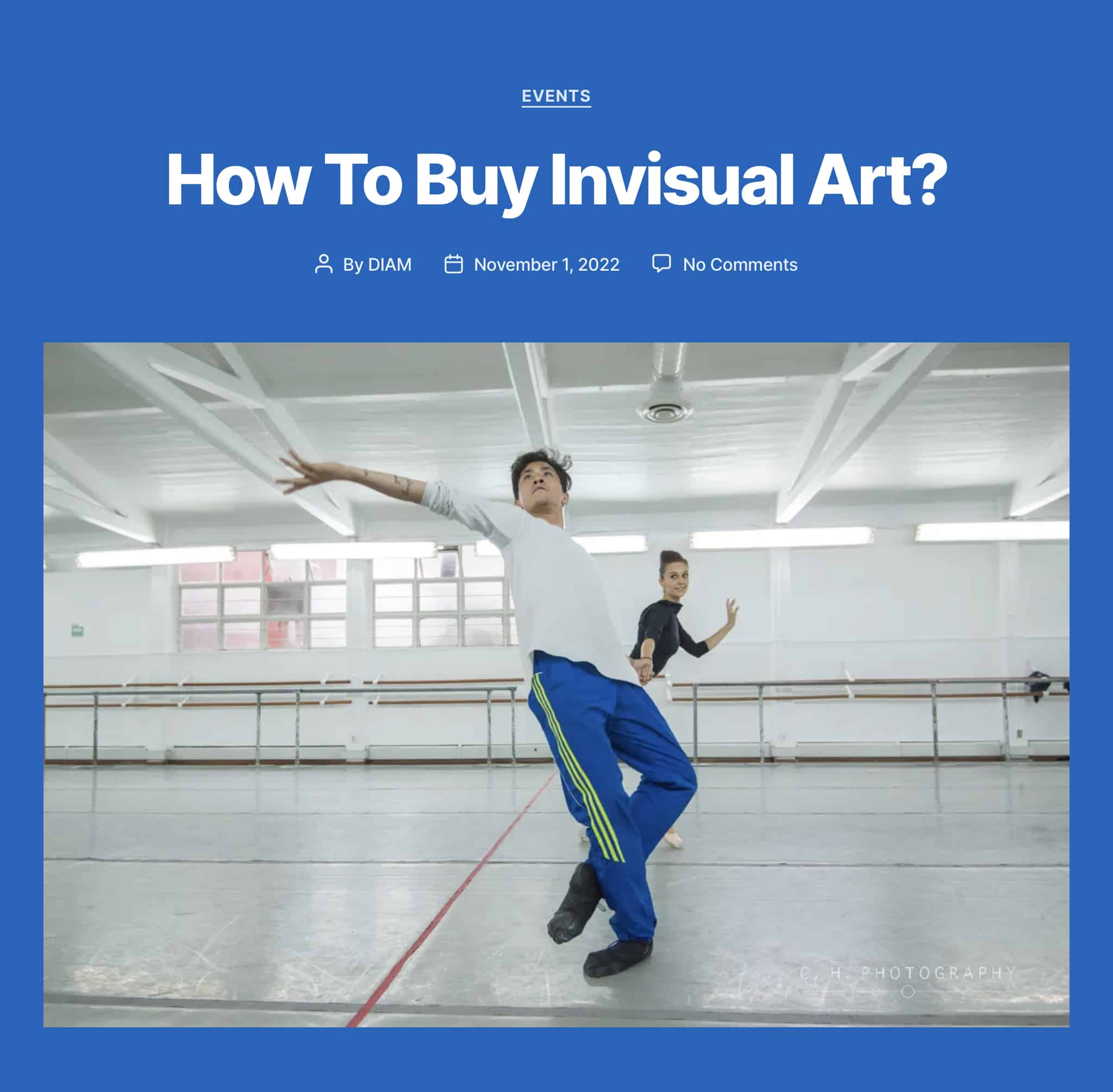
At the official DIAM launch event on 11 November 2022, Alexandre Gurita, Director of the Biennale de Paris and of the Ecole Nationale d’Art (ENDA), and Corina Mila, Enseignante-Chercheuse at the University of Paris-Sorbonne, introduced the audience to the concept of Invisual Art. Michael Reuter, Co-founder & CEO of Datarella, and Rebecca L. Johnson, CTO of Datarella, have demonstrated how to buy invisual art at DIAM using datatokens. Special guest Casey Herd, Artistic Director of BALLET RISING, has explained how DIAM enables Ballet lovers all over the world to immerse in the ballet experience using DIAM datatokens.
Feel free to register for free and experience the latest development at the intersection of technology and art!
If you are interested to learn more about the Decentralized Invisual Art Marketplace, feel free to follow DIAM on Twitter, and LinkedIn and discuss all things invisual art with the DIAM team – see you there!
by Michael Reuter | 22 August 2022 | Blockchain, Featured, Ocean Protocol, Partnerships, SSI
Datarella GmbH, a Web3 company builder, is joining forces with deltaDAO AG, a Web3 engineering and integration company, to expand the open data economy in the mobility and identity sectors. Both companies leverage their extensive experience in creating Web3 solutions for real-world use cases. The partners aim to allow corporate and individual users to monetize data while preserving their privacy. The first project is inspired by the partners’ collaboration in moveID, a Gaia-X 4 Future Mobility project. It will allow the monetization of mobility service provider data.
Datarella and deltaDAO will use their enterprise Web3 tools and consumer apps to jointly build solutions for the monetization of data featuring Fetch.AI and Ocean Protocol technologies. This combined tech stack serves as the foundational underlying protocol for digital business transformation with converging technologies, s.a. AI, and autonomous machines. Given the natural synergies between Datarella and deltaDAO, this cooperation will drive enterprise adoption across the partners’ client bases.
For Datarella, the purpose of technology is to increase the quality of living, by supporting human beings in professional activities and private lifestyles. The growing complexity and diversity of our ecosystem require technological infrastructures that facilitate collaboration and cooperation. By creating Web3 solutions for a global user base, Datarella illustrates the real-world benefits of its Web3 technology stack, and with deltaDAO, we will show how individual and professional users can turn the table and monetize their data, instead of “being the product”, .
Michael Reuter, CEO of Datarella
deltaDAO has become a trusted advisor for building sovereign, privacy-preserving, and secure data economy solutions. We seek to give freedom of choice and control back to data owners. As a DAO we create a new kind of data economy that is owned by no one – and open to everyone. Our partnership with Datarella will lead to many impactful real-world use cases and is a great example of how two companies can leverage each other’s strengths and experience to create real-world solutions for both individual and professional users alike. We are excited about building towards a decentralized data economy together with Datarella!
Frederic Schwill, Co–Founder of deltaDAO
About Datarella
Datarella GmbH is a Web3 company builder. Leveraging its technology stack of Blockchains, Self-Sovereign Identity SSI, Autonomous Agents, and Artificial Intelligence AI, as the tech hub for Web3 projects and companies like MOBIX, MOBIX family, IMMOBIX, or NOMIX, Datarella creates applications with real-world benefits. The Munich-based company was founded in 2013. With its decentralized teams in Munich, Gdansk (Poland), and Skopje (North Macedonia), Datarella develops bespoke Web3 innovations for their partners and clients, s.a. United Nations, World Food Programme, UKAid, ESA, Siemens, BMW, BOSCH, and Airbus.
About deltaDAO
deltaDAO AG is a software development, integration, and consulting company based in Hamburg, Germany. Its focus is to enable a transparent, secure, and decentralized data economy in which enterprises, SMEs, and public institutions can keep full technical control over their private data. As specialists in distributed ledger technologies (DLT) we are engaged in Gaia-X and built the first Minimal Viable Gaia-X (https://minimal-gaia-x.eu/) in 2021, based on open-source software and Web3 technology.
