Last October during the Outlier Ventures Diffusion Hackathon, we built a Proof of Concept of a Parking Agent System – Effortless Parking, which could solve the coordination problem of parking in crowded cities. In this post, we will look at the individual components of the promising technology stack upon which we build this project – Fetch.ai.
Do you remember Agent Smith from the Matrix trilogy? If not, let us fresh up your memory. The Matrix is a science fiction movie in which mankind almost lost the war against the machines. Most of the living human population is stacked up in energy farming towers by machines overloads in order to harvest their biologically produced energy. The consciousness of these “human batteries” is hooked up into “the Matrix”, a computer program that simulates the experience of the world how we know it today. This keeps the “human batteries” docile, sedated, and entertained. Agent Smith is a software agent living in the Matrix. His job is to hunt down humans, like the protagonist Neo and other individuals of the last reminding human resistance, which reenter the Matrix to free other individuals. Mr. Smith and other agents act autonomously to reach their goals. Further, over the trilogy, he even manages to learn a new skill, which allows him to transform other “Matrix inhabitants” into copies of himself to fight Neo.
You might be asking, what does this have to do Fetch.Ai?
Autonomous Economic Agents
The core element of Fetch.Ai is software agents, so-called Autonomous Economic Agents (AEA) which are living in Fetch’s digital world, the Open Economic Framework (OEF). Similar to Agent Smith, these software agents operate, interact, and even learn new skills autonomously. However, the goal of these agents is to actively search and discover other agents to generate economic value. An agent can represent an actor or thing in today’s economy. They can serve as a data provider, such as a sensor, which offers its data to other agents. Vise versa, agents can request data from these sources and do computations to generate valuable information. All the search and discovery takes place in Fetch.Ai’s Matrix, the Open Economic Framework. As the world ”Open” in OEF reveals, it is open, so any business or individual can join the network to offer information and services. To establish trust in a network without a gatekeeper, Fetch.ai included a Self Sovereign Identity solution (SSI) for its software agents. This allows agents to earn a good, respectively bad reputation, depending on the quality of service they provided to other network participants.
Fetch’s software agents can independently acquire new skills, which are required to conduct their tasks. Let’s say, an agent has been tasked with buying concert tickets at the cheapest price on your behalf. It already has the negotiation skill but can autonomously acquire a betting skill to participate in an auction for you. These agents are not, however, General Artificial Intelligent (AGI), since their capabilities are limited to a certain field of activity.
Fetch Ledger & Token
The legal tender in the world of Fetch.ai is the native token FET. It is used as a digital currency to pay for all transactions, e.g. buying/selling of data, network operations, e.g. deploying new agents or conduction computations, and secure communication. The state of the Fetch.Ai world – the answers to who owns what and who is who to a given point in time – is documented by its Smart Ledger. This state-of-the-art ledger technology uses 6 separate chains that synchronize in order to ensure state consensus. Using multiple synchronized blockchains makes the Smart Ledger highly scalable and capable of processing over 30k transactions per second.
As a consensus mechanism, Fetch uses Proof-of-Stake – in which any token holder can participate to secure the network. Token owners can stake their FET to secure the network and earn staking rewards paid in FET:
Participate in a staking auction directly.
Fetch.Ai offers 200 staking slots, which can be won through actions. The winners are entitled to run one or more validator nodes for which they are rewarded with 7500 FET per slot. For participating at the auction, a minimum amount of over 750k FET is required
Join a staking pool
FET owners, who don’t want to run a validator node or not have sufficient tokens to participate in the action, can delegate their stake and join a staking pool. Participants will be rewarded with a 10% annual return on their delegated stake.
Binance
Also, it is possible to earn staking rewards, by holding tokens in your Binance account. This option is probably the most convenient and is rewarded with a 1-4% annual yield.
Fetch.Ai is made up of three core elements, the Autonomous Economic Agents, which generate value by acting as a data provider or consumer, the Open Economic Framework, the digital world, which connects agents with each other and a highly scalable Smart Ledger, keeping track of the current state. In the next post, we will look at possible use cases, and elaborate on how networks built on Fetch.ai can offer lower transaction costs than today’s web2.0 multi-sided markets.
Faced with the imminent Wirecard accounting scandal, and an apparent lack of diligence by audit firms, regulatory bodies, and the government have realized that financial accounting must be improved significantly. However, previous improvements in financial accounting were aimed at an intensification of financial controls that, in turn, led corporations to intensify their internal bookkeeping creativity, and limited positive results. However, we need something different: We need Traceable Accounting -A blockchain-based automated real-time accounting approach.
A new approach to financial accounting is needed. An approach that eliminates fraudulent behavior from the start. Traceable, immutable financial transactions, processed on secure, transparent distributed ledgers – this is what governments should require from all publicly listed companies.
Blockchain technology may represent the next level of accounting: Instead of keeping separate records based on transaction receipts, companies can write their transactions directly into a shared ledger, creating a system of historically consistent, enduring accounting records. All entries are distributed and cryptographically sealed, therefore falsifying or destroying them to conceal activity is practically impossible.
Benefits Companies would benefit in many ways from this real-time traceable auditing:
Automation: A high degree of standardization enables auditors to verify a large portion of the most critical data behind the financial statements automatically
Minimized Costs: The cost and time necessary to conduct an audit would decline considerably
Value Add: Companies and auditors could spend freed-up time adding value to the company’s controlling: e.g. data analysis and algorithmic predictions on the future company (and market) development
Inclusion: The auditor and compliance officer can be included in the entire accounting process by running a trust node
It is not feasible to start with a joint register for all accounting entries. The Blockchain, as a source of trust, can also be beneficial in today’s accounting structures. It can be gradually integrated with typical accounting procedures: starting from securing the integrity of records to completely traceable audit trails. At the end of the road, fully automated audits may be the reality.
Trust in Public and Private Blockchains Whereas Public Blockchains are designed as truly decentralized, or ‘trust-less” systems; i.e. networks that don’t need a specific trust anchor since they come with integrated trust through algorithm-based consensus mechanisms, Private Blockchains are lacking this integral trust. Private Blockchains are mostly run as centralized networks, by companies or organizations, that have full control of the data flow. Blockchain technology provides historically consistent immutable data records – but under the sole responsibility and control of the respective company. Governance Models, in which rules and processes of the Blockchain are defined, allow for a wide acceptance of the system with all participants. However, third parties that are prevented from participating in the permissioned network, can’t falsify or verify the data output.
Step 1: Adding Trust With A Trust Node Datarella’s Traceable Accounting concept adds trust to Private Blockchains by integrating a ‘trust node’ run by a trusted third party, s.a. an audit firm or compliance officer. Additionally to the nodes run by the company itself, an audit firm runs a node with full access to the network, therefore servicing as a notary in the first place. The auditor conducts a real-time audit to verify a large portion of the most critical data. Through smart contracts, this audit can be automated to a high degree and save time and money. The audit engagement is mapped in a Governance Model, which allows for full transparency among the network’s participants as well as towards external stakeholders, s.a. stockholders, etc..
By adding trust to a Private Blockchain system through a trust node, a key inherent weakness of a partly-decentralized system is eliminated: Through the integration of audit firms in the company’s data flow, its accounting becomes trustworthy, and innovative at the same time: Traceable Accounting allows companies to run AI-based data analyses that provide valuable data to the finance department for improved controlling capabilities.
Step 2: A Fully Trustless System At a later stage, the Private Blockchain should be morphed into a Public Blockchain that provides all interested parties with access and audit opportunities. The architecture and mechanisms of a Public Blockchain allow for the participation of entities in the network that do not have to trust each other – a Public Blockchain is designed as a ‘trustless’ system: it works without the existence of trust between the parties.
A Public Blockchain can be designed as a permissioned or a permissionless system. In a permissioned system, there is a regulatory body that sets-up a governance model defining the rules for access and behavior in the network. In a permissionless system, anyone can participate.
Traceable Accounting – A Blockchain-Based Automated Real-time Accounting Approach
Developing a fully trustless system must be the final goal for regulatory and legal bodies when envisioning a new framework for financial auditing. It meets all due diligence criteria, especially those that have fraudulently been bypassed in the Wirecard scandal.
Last week, Martin Schäffner gave an introduction to blockchain-enabled Self-Sovereign Identity at the Crypto and Blockchain Meetup bdvb HG Bayreuth. Did you miss it? No problem! Re-watch his webinar on YouTube (link below).
Self-Sovereign Identity is a trending topic in the blockchain-scene. It aims to take away dependency on classic online identity providers such as Google, Facebook, or common online services that require to create an account to use it. This is achieved by letting the user create and manage its own identifiers through independently creating decentralized identifiers (DID), that don’t require a centralized institution. Information can be asserted to these identifiers by issuing Verifiable Credentials to the identity owner, which can then be presented with third parties in a privacy-preserving and fully automated manner.
In the webinar, Martin speaks about the differences between conventional online- and self-sovereign identities. He further introduces key elements in relation to Self-Sovereign Identity and reflects an overall picture of the SSI architecture and process flows for issuing and presenting verifiable credentials. He also gives an outlook on which use cases can benefit from implementing SSI.
Are you hooked? Watch it here again on YouTube:
For more content about Self-Sovereign Identity, I can recommend reading my series about Self-Sovereign Identity, starting with the first part.
Do you have questions about SSI or just want to leave feedback? Contact me!
On 8 June, the Proof-of-Stake EUPos Working Group within the European Blockchain Association EBA has published its Staking Infrastructure Position Paper (PDF) over the course of a website relaunch with a new, fresh look & feel. The Position Paper aims to give policymakers the tools necessary to craft wise regulation of blockchain infrastructure that benefits the European Union and its member states.
The Position Paper’s goal is to achieve a level of regulation that incentivises blockchain infrastructure providers to choose the EU over competing jurisdictions, as in particular China, Russia, or the USA. This will allow the EU to shape the development of globally relevant blockchain networks according to its federal values. As all EBA Working Groups, the EUPoS Working Group is open for all aspiring participants, willing to comply with the general EBA Governance and respective working group requirements.
Empowering The European Blockchain Ecosystem
The European Blockchain Association aims to become a partner of choice for organisations, corporations, institutions, and policymakers working in the field of blockchain and DLT in the European Union. We combine, synchronize, and leverage blockchain-related activities of European corporations, startups, venture capitalists, and scientific institutes. We serve as a superior, neutral body to aggregate and coordinate blockchain activities throughout Europe and to provide Non-European parties access into the European blockchain ecosystem. By building bridges, s.a. by creating the EUPos Position Paper, the EBA lowers hurdles and reduces obstacles that stand in the way of innovation in the field of decentralisation.
The New EBA Website
Besides the publication of the EUPoS Position Paper, EBA has launched its new website. Great EBA features, s.a. EBA Engagements, EBAx, or EBA Tenders, have achieved higher visibility and better access for interested visitors. We at Datarella like the new look & feel very much and love to support EBA as active members in several working groups!
Since 2015, Datarella has been active in building enterprise blockchain solutions in the humanitarian sector, in the fields of supply chain and mobility, and in finance and real estate. Leveraging combined resources from Munich, Germany, and its Gdansk, Poland, Baltic Data Science team, has allowed for highly agile, interdisciplinary teamwork which has been a significant success factor especially during the Coronavirus crisis. Now, Datarella expands the blockchain development team to Macedonia.
Blockchain and distributed ledger technology are emerging technologies that will have a significant impact on the economy and society. The implications of Blockchain technologies are expected to be industry spanning and are not restricted by geographical boundaries. To raise the awareness and potential of this technology in my home country Macedonia last year on 02 August 2019 I create the meetup group “Macedonia Blockchain Group”.The first presentation was in December at the Faculty of Computer Science and Engineering in Skopje. The Interest of the students about the topic was impressive. For the students to get practical knowledge, they need to be exposed to Blockchain projects. To do this, we were searching for industry partners that will cooperate with the group and allow the students to work on blockchain projects.
I am happy to announce that we now have finalized cooperation with our industry partner Datarella from Munich, Germany. Datarella is a company that is an early adopter of the blockchain technology and already has finished successful projects in this domain. We started the cooperation this month, and the developers will work on three different projects additionally represented in the form of seminar work. We are looking forward to a successful partnership!
Datarella’s Munich and Gdansk teams have already started with the integration of the Skopje team and are delighted about this significant strengthening of our development stack. We would like to thank Dimche Risteski and his Macedonian team for entering this cooperation and look forward to a our joined journey!
Last week we started a series of articles for an introduction to Self-Sovereign Identity components. In the first article, we have taken a look at some of the fundamental elements of SSI – Decentralized Identifiers (DIDs), their corresponding DID Documents and Verifiable Credentials. We now understand that DIDs are the digital and sovereign representation of an identity, that is further described in the DID Document and from and to which we can issue Verifiable Credentials. Part 2 of the series, we face the question of how DID Documents are technically associated with a DID and how we can authenticate using DIDs.
If you want to know what SSI is in general and how it could affect our online environment and behavior, take a look at the introduction article to SSI.
DID Resolution
DID resolution describes the process of getting from the DID to its associated DID Document. It is the basis for creating connections, initiating interactions, and proving ownership via DID Auth (see below). DIDs should be globally resolvable, allowing others to look up the DID document, for example, to start an interaction. Since every DID method works somehow differently and has different ways of creating and storing a DID document, resolving them works differently for each DID method.
There are three main ways of how DID Methods, which define how to create a DID, and manage DID Documents. They could either be publicly stored somewhere and referenced in the transaction itself – like in Bitcoin Reference (did:btcr:) or generated by gathering events of a transaction to an authorized account – like in uPort’s ETHR DID Method (did:ethr:). The third way is to automatically generate the DID Document by the ledger itself like in Sovrin (did:sov:).
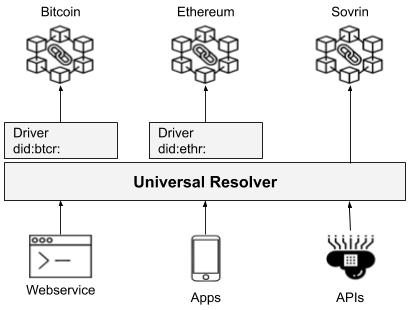
To create an interoperable SSI ecosystem, it would be useful to dynamically resolve the DIDs of any DID method. By doing so, DIDs from different blockchains could interact with each other. One system that does this is the “Universal Resolver”, which is illustrated in the following figure. Here, Webservices, Apps, or other services can resolve any DID Document that has a driver implemented in the Universal Resolver.
Model of the Universal Resolver
DID Auth
Cryptographically authenticating an identity owner, is a central goal in the SSI ecosystem. To establish trusted connections, proving control over a specific DID as long as the DID exists. In SSI, this specification is called DID Auth and relies on a challenge-response authentication protocol where the identity owner signs the response to authenticate. DID Auth uses the authorized public keys listed in the DID Document for authentication.
The challenge-response cycle can be implemented with multiple protocols. One of the preferred ones is using a JSON Web Token. However, it also works with other protocols such as the TLS handshake protocol, OpenID Connect, or even HTTP.
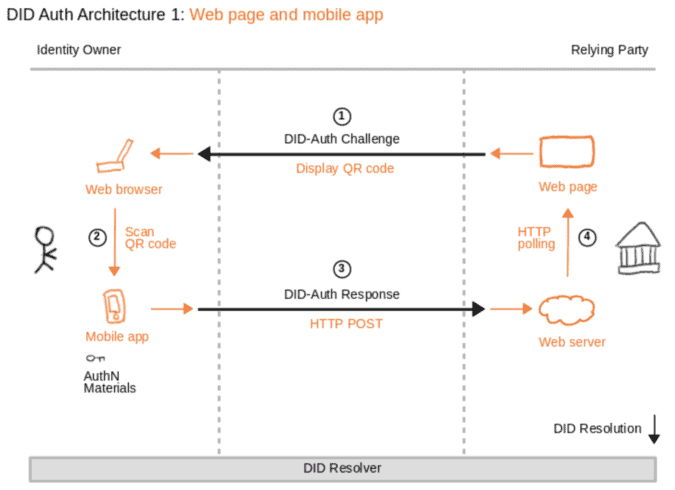
The following figure shows a simplified process of DID Auth.
Source: Introduction to DID Auth (Sabadello, et al.)
At first, the Web-Site of a relying party displays a QR on the Identity Owner’s Web browser that contains the DID-Auth Challenge. In the next step, the Identity Owner scans the QR Code and sends a DID-Auth Response with the signature of the Identity Owner’s private key to the Relying Party’s web server. Based on this private key signature, the creation of an proof signature indicates control over a DID. The web server receives the response and can validate that the identity owner controls the DID by resolving the DID document and validate the public key. After the successful authentication, the relying party’s web page polls this information and displays its content. For a more detailed description of DID Auth, I recommend taking a look at this document.
Conclusion
In this second article about the introduction to Self-Sovereign Identity components, we got to know DID Resolution and DID Auth.
To summarize, DID Resolution describes the process of getting from a DID to a DID Document. This process is essential as the DID Document contains important information about the DID, such as authorized public keys or service endpoints. This information is crucial to start an interaction like proving ownership or control over a DID, which describes the process of DID Auth. By implementing a challenge-response cycle, an identity owner can prove ownership or control over a DID and therefore creates trust between both parties. It’s worth mentioning that, in this case, only requires these two parties, and no additional identity provider needs to be involved. As a result, DID Auth creates a trusted fundament for further interactions, such as issuing credentials or other data exchange.
In the third part of this series, we will take a more in-depth look at Verifiable Credentials. How can these be issued, how can they be trusted, or how can they be managed will be questions we are going to face and answer.
If you have any questions about SSI or want to leave feedback, feel free to contact me.
World Food Programme’s Building Blocks system is one of the best examples to understand how Blockchain technology can help to fight against COVID-19. Building Blocks is a Blockchain-based fully digitalized payment and bookkeeping system for any types of cashless transactions developed and further scaled up by Datarella and its subsidiary Baltic Data Science. Today, the Building Blocks is successfully up and running in Jordan since 2017 and expanded to Bangladesh by the end of 2019 by serving hundreds of thousands refugees in WFP’s refugee camps. Here’s how Datarella is leveraging Blockchain to support UN WFP in fighting COVID-19.
It’s been a while since Datarella successfully applied for an open call initiated by the WFP innovator programme in 2016. With this tender, WFP was evaluating whether Blockchain technology can help to improve the inefficiencies they were facing with paper vouchers issued to refugees in their camps for daily groceries. At that time, nobody was aware of a virus called “COVID-19” and working exclusively from home was simply unimaginable. But times have rapidly changed since the beginning of 2020. Today, we are facing probably the most severe economic downturn and human tragedy, affecting hundreds of thousands of people since WW2. .
So how can the Building Blocks system help against the coronavirus? For this to understand, you need to know what the system does. As said, Building Blocks is a payment and bookkeeping system for any cashless transactions helping refugees in camps to make their daily shoppings. Every month, the refugees receive a certain amount by WFP as digital food vouchers that can be used in the village’s supermarket.
There are two aspects to the Building Blocks system that helps to fight against the coronavirus. Both has to do with contactless interactions amongst the participants:
Cashless Payments The Building Blocks system is built on a private Ethereum network. Every single transaction between a refugee and the supermarket is validated and recorded on the blockchain. The advantages are apparent. With the help of Blockchain, these transactions are executed cashless, meaning fully digitized without the need to get in physical contact with the other person. By the way, after the World Health Organization WHO released a statement on March 9 recommending that people turn to cashless transactions to fight the spread of COVID-19, a number of governments and retailers across the world took action. Not directly related to the fight against the coronavirus, other benefits of a Blockchain-based payment system include minimized risk of fraud and data mismanagement.
Contactless Identification: In both countries Jordan and Bangladesh, where Building Blocks is up and running, refugees are able to authorize themselves for cashless payments without getting in direct physical contact with the counterpart. In Jordan, the authentication is performed through a system called IrisGuard. IrisGuard is an end-to-end iris recognition, verification, financial authentication and targeted cash transfer platform which removes the need for any form of ID such as username, password, card or pin. In Bangladesh, the Building Blocks system uses a different method for the identification. It was originally a fingerprint-based process, i.e. it was touch-based. However, due to the coronavirus pandemic, we changed the authentication procedure from a touch-based to a contactless system. Today, a QR code is issued to every single refugee who is entitled to receive aid by WFP.
In this recent article published by WFP, you can read more about the story of Building Blocks in Bangladesh and how leveraging blockchain to support UN WFP fighting COVID-19.
Please stay healthy and safe in these challenging times!
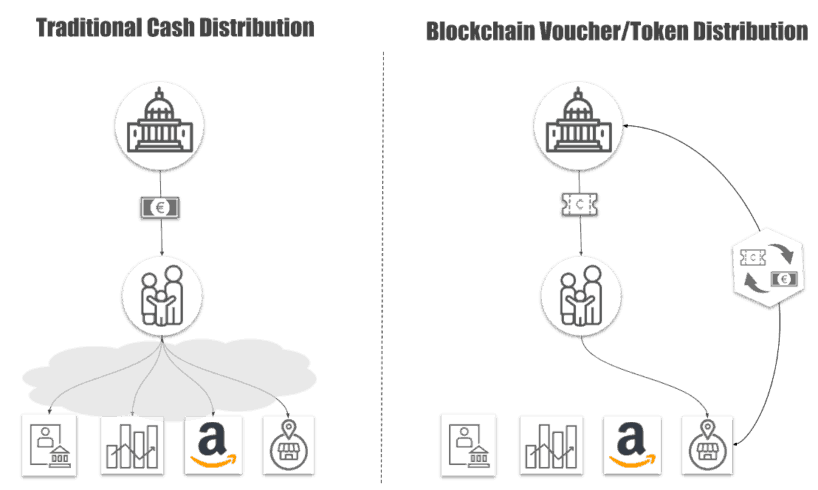
The Bavarian government is promising EUR 10 billion, the German government EUR 600 billion, and the US-American promised USD 1000 billion in financial aid as a countermeasure to fight the economic effects of the Corona crisis. This is a huge effort and we all hope that it will soften the economic consequences of global lockdowns. However, where will all this money go? What criteria is used to distribute it? Who reviews the applications? What will be the impact of injecting vast amounts of money into the market while the effects of the pandemic are highly limiting the production of goods and services? Here’s how Blockchain technology could help: Tokens vs Corona – A blockchain voucher system to distribute grants.
As we described, a payment distribution system like WFP uses to deliver cash to over 500.000 refugees in Jordan, could also be used to distribute financial aid of governments to citizens and businesses efficiently. In this post, however, we want to take a look at an alternative that could be distributed instead of traditional national currencies, let’s call them blockchain vouchers or tokens.
Tokens vs Corona – A Blockchain Voucher System To Distribute Grants
Distributing EUR or USD directly to businesses and citizens grants beneficiaries the ability to use the funds how they want. They might spend it locally, to support local business, they might put it in their bank account and save it for better days, they might invest it into the company shares or buy stuff at Amazon. Due to a lack of traceability, it’s impossible to measure the usage nor the impact of helicopter money precisely. Tokens, however, are programmable. This characteristic allows the issuing entity to predefine limiting spending parameters. For example, the government could define that it is only possible to spend these tokens on small and medium-sized businesses, located close to the consumer and within the next three months. Therefore, programmable tokens allows to create a more precise and target-orientated tool of governmental economic development aid.
dgE Krisengeld
An interesting concept of implementing blockchain vouchers was proposed during the WIRVSVIRUS hackathon, which has been organized by the German government to find innovative solutions to encounter the corona crisis. The project goes under the name dgE-Krisengeld, dgE stands for “dezentraler gemeinschaftlicher Euro” (decentral common Euro). However, informally the project is known under the term “Diggi”, a homonymous which predominantly German teenagers use as a form of address, like dude or mate.
The concept and can be summarized in three steps.
Distribution
Spending
Redemption
The government could distribute Diggis to citizens via a letter using their tax ID. Consumers could then scan a QR Code and set up a wallet, which allows manage their Diggis. In the next step, citizens could spend their received Diggis at participating businesses. Therefore, the consumer could scan a QR code provided by the cashier to conduct a payment. However, since most companies cannot welcome customers at the moment, an online alternative point of sale for small businesses is required. A solution could be an opensource e-marketplace, like Openbazaar, which enables small businesses to sell their goods and future services for Diggis without paying any fees. In the last step, businesses could then redeem their received Diggis at the fiscal authority for real Euros.
The overall concept received positive resonance by German politicians. Dorothee Bär, the German State Minister for Digitalization, called the Euro token an interesting complementary system to a blockchain-based business register, which would allow especially smaller companies to participate in aid programs.In summary, the Diggi concept provides two main benefits:
Decentral empowerment
Local impact
Since consumers decide at which businesses they want to spend their Diggis, governmental aid would be automatically allocated to companies, perceived as valuable by the market. Diggi tokens could be programmed in a manner, that they are only spendable at business registered close to the consumer, thus creating a local impact.
Local Currencies
The concept of having a medium of exchange, which only can be “spend in a particular geographical locality at participating organizations,” is by no means novel nor innovative. It reflects the ancient concept of local currencies. Through limiting spending opportunities, these currencies stay and continue circulating in a particular community, which has economic benefits for this group. However, the limited spending opportunities, a lack of exchangeability, and relatively high cost related to managing these currencies are also their major drawbacks.
Luckily, Blockchain technology allows us to eliminate these weaknesses:
The costs of issuing and managing a digital currency becomes marginal and requires only a couple lines of code.
A common reserve allows to connect multiple local currencies, making them interchangeable and automatically adjusting their exchange rates. This is enabled by bonding curve contracts (next to the word “token” my favorite term at all), which will be the topic of a future blog post.
A concept of interconnected blockchain-based community currencies is brilliantly implemented by Will Rudick and his team at Grassroots Economics to inject liquidity into poor areas of Kenya and other African countries.
The Future of Donations
I am very proud to announce that we at Datarella are working at full speed together with two partners of the financial and the humanitarian sectors, to develop a solution to support the fight against the Coronavirus in Africa. This solution will be using tokens to add transparency to the field of donations – providing the donor with the certainty that her contribution was received by the people who need it. An official press release describing our Traceable Donations product will follow shortly. Stay tuned!
Self-Sovereign Identity (SSI) is increasingly mentioned in connection with innovations and digital identities. Even in the context of the coronavirus crisis, SSI finds possible applications, such as the possible use of a tracking app for infected people or as a digital staff “passport” in hospitals that respects each user’s privacy. To support others in classifying SSI correctly, we are now publishing a series of blog posts that explain components of SSI. The first part of the introduction to Self-Sovereign Identity focuses on the three essential components – DIDs, DID Documents and Verifiable Credentials.
As already described in detail in the first blog post, Self-Sovereign Identity offers the user the possibility to manage their own digital identities completely autonomously. There is no platform or provider, such as an email address provider or a social network that controls identity. This is achieved using an underlying blockchain or a DLT on which key pairs can easily be generated that serve as identity representation.
Decentralized Identifiers
Now we come to the first component – the Decentralized Identifiers (DIDs). Their purpose is to act as a unique identifier of the person or object. These are derived from the public keys and can be identified over various blockchains. An example DID is shown below.
DIDs follow a general syntax: the schema (did:), the method (sov:) and the method-specific identifier (WRfXPg8dantKVubE3HX8pw). While the scheme is always the same, the method that describes how a DID is derived from a blockchain (here: Sovrin) and the method-specific identifier bo depend on the underlying blockchain. However, DIDs alone don’t bring any value.
DID Document
What fills a DID with life is the DID Document. This piece of data describes the DID object and its properties. By default, it contains the associated public key to a DID. However, it is also possible to add more public keys to the DID document that are authorized to perform actions in the name of a DID. Moreover, a DID can contain different types of attributes and service endpoints that allow the actual interaction with a DID. Changes to a DID Document can only be made by authorized public keys defined in the DID Document. An example DID Document with authorized public keys.
Verifiable Credentials
Now, that it is possible to identify an entity and to interact with it, is possible to attach information to the digital identity. This can be done with Verifiable Credentials (VCs) that act as an attestation or a digital representation of a credential such as an ID, a driver’s license or a club membership card. A VC consists of three main values:
The issuer’s DID and signature
The entity’s DID
The information that is attached
Based on these three fragments, third-party verifiers can immediately determine the authenticity of the object by looking up the issuer’s DID. Verifiable Credentials are in possession of the DID owner that it was issued to and can be stored in a wallet. However, the issuer can always revoke the VC and adding it to the revocation registry that should be publicly visible.
These three components serve as the basis for a decentralized, trustless identity ecosystem that doesn’t rely on centralized authorities. DIDs identify an identity over, the DID Document describes the DID and a Verifiable Credential attaches verifiable information to a DID. Users are in sole control of their identity and can decide how information is shared and with whom.
However, this was only a small part of the entire SSI infrastructure. Part 2 of the Introduction to Self-Sovereign Identity components is about DID resolution, the process of resolving a DID Document from the DID, and DID authentication.
If you have any questions about SSI or want to leave feedback, feel free to contact me.