The Building Blocks payment system that Datarella has developed for the UN World Food Programme may serve as a blueprint for highly efficient distribution of financial transfers during the Corona crisis. The Building Blocks system was launched on 1 May, 2017, and since has supported several hundreds of thousands of Syrian refugees with their payments in Jordanian camp supermarkets. We at Datarella envision a similar system for disbursements of Corona-induced money transfers by governments and state agencies: Datarella can deploy a blockchain disbursement system for Coronavirus aid at short notice.
How Building Blocks Works Donor countries provide the UN High Commission with funds for specific use in refugee aid. The UN High Commission forwards the funds to the WFP. The WFP administration in Rome is part of the Building Blocks Blockchain, through which all transactions in refugee camp supermarkets are processed. Every refugee receives a certain amount on their account each month, which they can spend for certain purposes. The refugee identifies herself at the supermarket checkout using the iris scan or ID app and has the amount incurred during his purchase debited from his account. The supermarket operator carries out a weekly transaction with the WFP administration in Rome and receives his money in local currency. Up to this point, all transactions have been carried out purely digitally in the form of blockchain transactions. With this process, savings of millions in bank and transfer fees are achieved. In addition to the highly efficient billing, there is no need for an additional audit by an auditor, since the building blocks system has been certified and blockchain technology guarantees the correctness of the transaction history.
Building Blocks for Corona Financial Transfers A system inspired by theBuilding Blocks system can be used for financial transfers in the corona crisis. The federal and state ministries of economics and finance operate system nodes and thus have full control. Other nodes could – but do not have to be – operated by process-relevant organizations such as BaFin, Landesbanken, IHK, chambers of handicrafts, auditing companies, etc..The complete set of rules, including all levels, conditions and dependencies, are programmed as smart contracts. The final payouts can also be automated.
For Citizens and Companies – For All Types of Corona Aid Every citizen and every company downloads an app that works as a wallet and that can be used to receive and send funds. The wallet also serves as an identification tool for the citizen or the company. The user fills out the application form for Corona emergency aid, loans, basic security or protection funds provided via the wallet. She uploads the necessary documents such as ID card via the wallet and sends the complete application. The user’s identity can be determined with a high degree of certainty via an additional ID function. If the authorized transfer recipient has been determined beyond doubt and automatically, the payment will be transferred to his account – also automatically.
We at Datarella are ready and working on a Building Blocks inspired version of a Corona Aid Disbursement System to be used in Germany, and the EU, we can deploy a Blockchain disbursement system for Coronavirus aid at short notice.
Other Approaches to Corona Aid Disbursements There are other approaches to address the urgent need for efficient distribution of Corona-based aid. We can’t evaluate them in the same way we can assess our above described own system, but in one of our next posts we will describe one of them – the project “Diggi” which was created during a hackathon organised by the German Bundeskanzleramt a week ago.
Today, our company starts the security token sale of Connex Coin, the first tokenised investment token compliant with EU regulations. In essence, Connex Coin represents a loan towards the managing entity of a fully leased, premium commercial property, named Connex, in central Munich.
Since the token qualifies as investment token (“Vermögensanlage” in german), it is not tradeable on crypto currency exchanges. Token holders receive a fixed interest of 3% and may sell the token back at nominal value.
Why Tokenisation?
Traditionally, real estate has been financed by owners, banks or external investors participating in real estate funds. The investment process in real estate is complex, takes time and effort. By using blockchain technology and crypto currencies or tokens, this process can be simplified and made much more efficient.
Liquidity
First, there is the securitisation aspect of tokenisation:: by making an illiquid real estate asset completely liquid, this type of investment is made accessible for a much larger target group of potential investors. Traditionally, mainly wealthy individuals or companies could invest in real estate. With a liquid asset, such as the Connex Coin, an individual can become a real estate investor starting with a 10 EUR investment.
Beside having a bank account in an EU country and a registration, nothing else is required to buy this investment token. Since Connex Coin is a non-tradeable, stable investment token, the token holder receives 3% interest paid directly to her bank account. Information about the personal holdings are displayed in the personal account. By using tokens, securitisation is made easy and efficient.
Programmability
Tokenisation is much more than securitisation: a token can be described as programmable money. In other words: tokenisation adds programmability to an asset. This way, business logic can be introduced, reducing the need for manual settlements and smart contracts can have functions for automatic transactions, formulas for calculating asset prices and other specific features at marginal costs. So, what kind of business logic can you add? Simple answer: any. And exactly this large number of degree of freedom makes it somewhat challenging to start with.
At RAAY RE, we have started by leveraging our proprietary (Crypto) Smart Wallet by adding features that allow token holders making use of specific property-related functions, such as granting access, or allowing for the use and payment of facilities. We will elaborate more on this aspect of programmability in a next post. From our perspective, programmability of formerly static assets provides great opportunities for the real estate industry.
Immutability
A digital, integer trail of transactions proves history of ownership and eliminates data misuse and fraud, such as double-spending. Furthermore, the consistent historical record of all transactions allows for a realtime, frictionless reporting. Just ask your asset managers and CFOs about their administrative headaches that traditionally could only be healed by tremendous accounting efforts. With a guaranteed complete historic data set of all transactions, this headache can be eliminated completely. Tokenisation helps to minimise administrative efforts, time- and costwise.
For RAAY RE, the tokenisation of a share of the Connex building is the first proof of functionality in our tokenisation module, that is one part of our Digital Operating System for the real estate industry. There will be more assets tokenised – as well as in terms of securitisation, and, specifically regarding the programmability aspect of tokenisation: our tokens will come with built-in business logic that will unleash the full value of real estate assets.
This week, our partner company RAAY Real Estate GmbH, launches Connex Coin, its first security token.Connex Coin is Germany‘s first security token that qualifies as a productive investment and is fully compliant with EU regulations.
At EXPO REAL 2019, Europe’s largest real estate fair, RAAY RE presented first details of this project. In February, the token received final approval by German financial regulatory body BaFin. The very first phase of the STO, the sale of Connex Coin, to friends and family, has already begun.
The idea of Connex Coin was born in 2018. Then, we discussed digitisation projects in the field of real estate funds with Thomas Meyer, founder and CEO of Wertgrund Immobilien AG, a residential real estate fund manager. Shortly afterwards, we started a similar conversation with Hans Hammer, founder and CEO of Hammer AG, a commercial real estate developer. It became clear within weeks: we should have these conversations together, as a team.
Fast forward: In July 2019, we founded our new partner company RAAY Real Estate (RAAY RE) as a joint venture of Hammer, Wertgrund and Datarella. The purpose of RAAY RE is to offer blockchain-based products and solutions to the real estate industry, which itself is a late adopter regarding digitisation efforts. We decided to start RAAY RE with the tokenisation of a Hammer-owned property, located in central Munich. With the Connex building, we have a first class property in one of the best real estate locations in Europe, with first class tenants — in short: the best product you can imagine for the start of a product category in your company!
By tokenising this property, we provide the perfect investment opportunity — especially for retail investors — since individuals can become real estate investors starting at 10 EUR. The Connex Coin token sale will take place from March to May 2020. Connex Coin owners will receive an interest of 3% on their investments and can sell Connex Coin back to the issuer. In the first phase, there will be no public trading of Connex Coin, since at the moment there are no EU-compliant cryptocurrency exchanges that offer trading security tokens. As soon as there is approval from financial regulators, Connex Coin will be one of the first security tokens listed on exchanges in Europe.
Connex Coin is the first token issued by RAAY RE, others will follow. RAAY RE is planning to launch more token sales for self-owned real estate properties in 2020. Additionally, tokenisation will be offered as a service to players on the real estate industry. This offering comprises the complete tokenisation process, including technical, legal and regulatory elements, based on an existing long-term real estate expertise.
In addition to tokenisation services RAAY RE offers a variety of tools and products that can be used by real estate developers, owners and funds, ranging from KYC onboarding processes, to smart digital (crypto) wallets. With the launch of Connex Coin, RAAY RE proves that blockchain technology can be leveraged to make payment and transaction processes within real estate more efficient, thus paving the way to a digitised future for the real estate industry.
The acquisition of this investment involves considerable risks and can lead to the complete loss of the invested assets.
After visiting and experiencing the extremely poor circumstances at a Rohingya refugee camp in Bangladesh, Gerd Müller, Germany’s Federal Minister of Economic Cooperation and Development, decided to stop financial aid for Myanmar and to provide funds instead to improve the situation Bangladesh. UN aid agencies are calling for a package worth millions. Blockchain technology offers a way to ensure that these millions indeed arrive at the people in need, it is a tool that allows the economic inclusion of – and even the creation of a digital identity for – the stateless Rohingya.
The Rohingya are an Indo-Aryan ethnic group, who has been living as a Muslim minority in the northern part of Myanmar. According to the 1982 Citizenship Act, the Rohingya are not considered to be one of the 135 indigenous people and are therefore not entitled to Myanmar citizenship. The situation between the mainly Buddhist nation and the Rohingya people escalated on August 25, 2017, when various targets in Myanmar were attacked simultaneously and the Arakan Rohingya Salvation Army took responsibility for the attacks. This has been followed by coordinated military attacks against the Rohingya population. United Nations mediators speak of a “continuing genocide” in which soldiers have murdered thousands of people and committed various war crimes against the Rohingya population. Correspondingly, more than 1,3 million felt to Bangladesh, over 400.000 to Myanmar and thousands to other countries in Asia.
Unfortunately, the misery continues in the countries the Rohingyan refugees fled. Bangladesh, where major Rohingya refugee camps are located, permits the construction of permanent houses to prevent the transition to be permanent. Living conditions are miserable due to a lack of sanitation. Furthermore, schooling isn’t always available, which diminishes the future prospects of the 600.000 children living in the camps. Also, the situation in Malaysia, where the second-largest Rohingya population lives, is difficult. The refugees are tolerated but excluded from social life – they aren’t granted a legal identity.
Some of the consequences of not having a legal status are:
The inability to work, legally.
The exclusion from the financial system by not being allowed to open a bank account.
The denial of public services, such as education and healthcare.
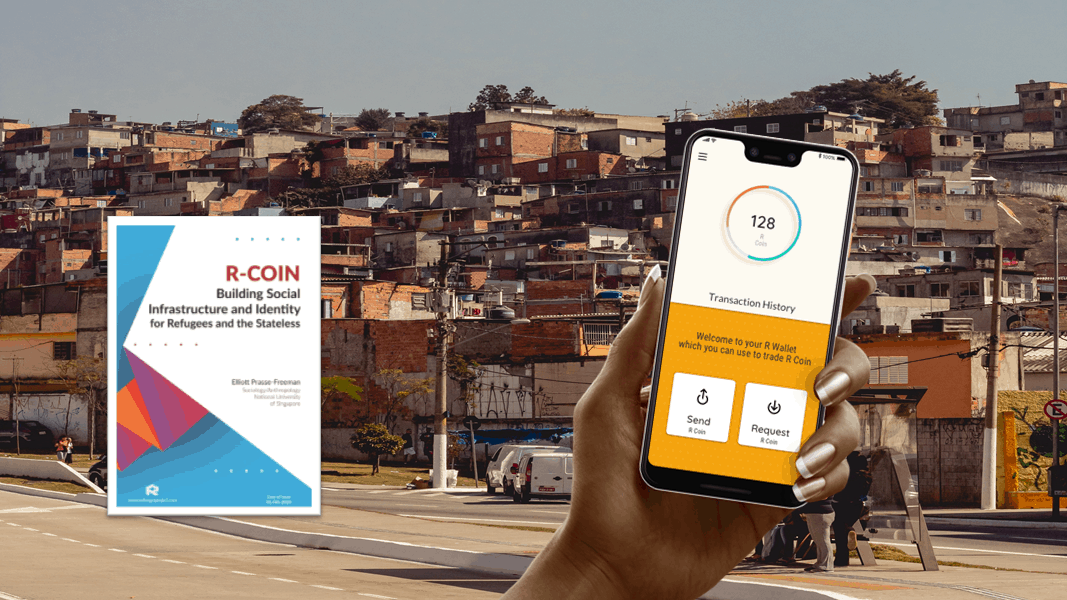
R-Coin, short for Refugee Coin, is an ERC20 based token that is hosted on a private, permissioned Ethereum blockchain network. Therefore, R-Coins can’t be traded on public exchanges, thus they aren’t vulnerable to any volatility. The associated R-Wallet, a mobile app, stores the private/public keys, which allows interacting with the blockchain, or in plain English: to store, send and receive R-Coins.
R-Coins are used to reward refugees for community work, such as teaching, care-taking of children, cooking, cleaning, transportation services. For every hour of voluntary work, the refugee gets 1,0 R-Coin transferred to his wallet. At the end of the pilot phase, the participants will be able to redeem the collected coins for goods and services, from Starbucks gift cards to ATM cards, accident insurance, and health services.
The short and medium-term goals of the R-Project are to include refugees in the society, to increase their working skills and to provide them with a financial tool, the R-Coin and the R-Wallet. The transfers of R-Coins for voluntary work serve as “proof-of-work” and, therefore, can be taken as the basis of a digital identity, providing a digital CV, for the stateless Rohingya.
Currently, the R-Ecosystem includes four stakeholders:
Providers: NGOs who organize (and verify) volunteer activities
Refugees: Complete volunteer activities and earn R-Coins
Vendors: Accept R-Coins and them for exchange goods and services
Donors: Circulate R-Coins within the economy: distribute them to providers and then ‘buy them back’ from vendors who had accepted it from refugees in the first place
Blockchain technology can also be used to ensure that donations arrive where they are intended to arrive. To enable donors to trace the whereabouts of their donations and to directly support such impactful projects like the R-Project, we are working with financial services provider Wirecard AG on a respective project called “Traceble Donations”. If you’re interested in learning more about this value-creating project, stay tuned for our forthcoming blog posts or you visit our next Blockchain Meetup on 31 March in Munich!
This is a guest post by Maria Lema, the co-founder of Weaver Labs, a tech start-up building a Blockchain platform for the Telecommunications industry.
Connectivity is what allows us to exchange information real-time across the globe thanks to the existing infrastructure we call the Internet. Us as individuals and all our businesses rely on connectivity for the majority of our daily activities, we do everything online and it has become a utility: it’s an essential tool to create, develop and grow. With 5G being deployed, the telecoms sector must focus on innovation in the business models and supply chain dynamics to deliver the networks of the future.
Innovation: long time no see
Technological development in the communications sector hasn’t stopped since the creation of the telegraph, and we have learned to communicate faster and more efficiently across the Internet thanks to the creation of communications systems, standards, protocols and infrastructure such as fiber, antennas, switches and gateways.
Although we have changed the way we interact with the Internet and online applications, we haven’t changed much the way we deliver connectivity. Most will agree that, while we have undergone (and are probably still undergoing) a data and communications revolution, networks haven’t yet adapted to this new way of online interactions. We have adopted the smartphone and we have seen technologies grow from 2G to 4G, but the traditional supply chain and investment models in telecoms have achieved the tipping point. We need a transformation, one that is able to support and deliver the spectacular developments in emerging technologies: AI, Big Data, Robotics, Autonomous Vehicles, and more.
The Network Revolution
5G is the new generation of mobile networks and is purely software-based, so more than just another generation, it is an opportunity to innovate in the way we deliver connectivity with an infrastructure that supports the future cities and the explosion of data.
Following this transformation, networks are becoming a commodity: open source based and with a growing diversity in the equipment sector – in other words: competitive. This competitiveness is motivating new players to deploy and own network infrastructure: factories, hospitals and even whole cities are investing in infrastructure with a variety of applications in mind that require high bandwidth and support for a massive number of devices.
However, there are still challenges to realising the dream of open and diverse networks: convergence and integration is still something not fully solved. Despite being built around existing standards like the Internet Protocol (IP), there’s still a need for rigorous standardisation to allow for easy interoperability across network elements and all the actors involved – chip/device manufacturers, equipment vendors, operators, etc. From a service provider perspective, some of the key hurdles when building diverse and interoperable networks are:
Simple: to create end to end services across the infrastructure targeting interoperability across multiple network elements.
Open: to integrate new infrastructure and service offerings, with built-in security mechanisms that allows critical components to be onboarded faster.
Scalable: grow horizontally with minimum interaction of the Service Provider.
Weaving Telecoms with Web 3.0: the fundamental shift
Decentralisation and tokenised economies are a solution to complex cross-actor engagements with mechanisms to reward network participants in exchange for contributions. Leveraging innovative P2P and Blockchain technology, we are a software and protocol stack that provides a simple, open and scalable solution that enables the horizontal integration much needed in networks. We create a marketplace of connectivity assets that replaces the Service Provider as a central point of trust to aggregate network resources.
Weaver is a P2P network created specifically for telecommunications, equipped with a new Messaging System (WireMQ) designed to manage real-time communications traffic across the network infrastructure. It builds on the horizontal integration of networks by adding a software layer on top that enables interoperability and convergence.
How does Weaver help to advance in the Network Revolution?
We create a connectivity platform that integrates any communications system and leverages existing infrastructure to communicate across all technologies in the P2P network. A great example is the mesh network Weaver built for the Track and Trust supply chain project with Datarella. We used WireMQ to route traffic from IoT devices into a Satellite base station, and it can be scaled up including 4G antennas, WiFi and more IoT technologies – which allows us to bring this directly into Smart Cities. We innovate in the supply chain, creating a platform for connectivity with mechanisms to exchange network resources and incentivise all network participants. The new business models are based on infrastructure sharing and revenue sharing where all contributors can capitalise on existing assets and create a viable return on investment in infrastructure for connectivity.
When Macky Sall, President of the Republic of Senegal, personally launched the project ‚Cité Baraka‘ on April 27, 2017, few had thought that in March, 2018, the construction of the first six buildings would be started, and in February, 2020, the Soreba Manager, a blockchain-based payment solution, would be in place to allow for secure, traceable community fees.
Cité Baraka, a project by German-based YOU Stiftung, headed by UNESCO Special Ambassador Ute Ohoven and her daughter Claudia Jerger, is supported by its technical and financial partner Orascom Group, headed by Mr. Samih Sawiris and its subsidiary Casa Orascom, headed by Alex Calderoni and Stefan Zingerle. The Minister of Urban Renewal and Living Environment Senegal is responsible for monitoring this project in Dakar.
Anna Gueye, Finance Director United Teams (Alliance YOU Stiftung & HOPE87)
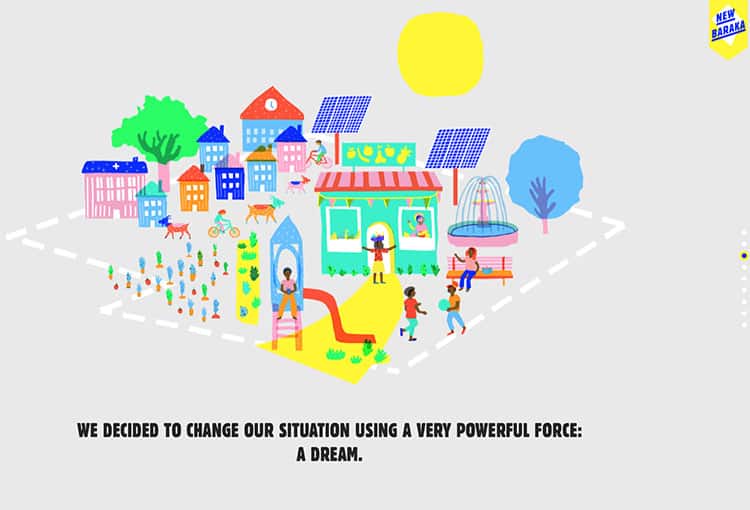
Baraka has evolved as a slum in the outskirts of Dakar. Senegal‘s capital has grown dramatically over the last decades, and Baraka’s inhabitants found themselves living in the city center, surrounded by high income neighborhoods. YOU Stiftung’s Ute Ohoven and her daughter Claudia Jerger, who have supported Baraka by building a school, planting trees and organizing social and cultural events came up with the idea of the slum‘s rehabilitation in 2016. With the support of the Senegalese government, HOPE87-Senegal, Orascom, Casa Orascom, the Association of German Architects (“Bund Deutscher Architekten”) and the Peter Behrens School of Architecture in Düsseldorf, „Blonde Mum“ – as Ute Ohoven is called in Senegal – started the construction work of 210 apartments for 1.600 dwellers. Additionally, a training program was started for all 215 craftsmen, semi-skilled workers and service providers of Baraka to enhance their capacities in strategic management and marketing and to make them fit to stabilise or to enlarge their economic activities.
Since Datarella has closely worked with the YOU Stiftung and Casa Orascom on several projects in the past and we are fascinated by the Baraka project and the commitment of all supporters, we agreed to create a blockchain-based payment solution to allow for community fees.. In late January 2020, the operations team in Baraka was provided with the Soreba Manager, named after the organisation responsible for all administrative aspects of Cité Baraka. Starting in March, first rental payments will be processed through the Soreba Manager. Cité Baraka dwellers now have a high-tech tool that allows for safe and trusted payments.
“We are very proud to launch another pilot in the pilot project Baraka with this Blockchain solution. Our big thanks goes to Datarella who made it possible and who supports the Baraka project on a pro-bono basis”, says Claudia Jerger of YOU Stiftung.
Stefan Zingerle, Co-CEO of Casa Orascom, adds: „As a leading developer of affordable housing communities, Casa Orascom is always searching for ways to optimize its projects and to simplify processes. We seek to leverage new technologies to increase the quality of life for residents. Datarella is a partner who continues to produce tools allowing us to achieve this mission”.
After the first use of the Soreba Manager as a payment rental management tool, more services will be added. We at Datarella are looking forward to developing the Soreba Manager further, jointly with the Soreba staff and Cité Baraka dwellers.
In the past years, we have built numerous blockchain projects – most of them private permissioned networks with Proof of Authority (PoA: A defined number of nodes “control” the network). Every now and then, we encounter the question “Are private permissioned blockchain systems less safe?“. We sat down to clarify this question on a high level.
We won’t jump into technical details. Instead, let’s look at how a private permissioned blockchain network comes into existence: Someone gets the brilliant idea to create a shared network for a specific case in which data must be effectively shared between multiple parties. She might go to other parties and ask them to join her case and present them a beautiful Big Picture. Most likely, the others will react tentatively – they might have to turn larger wheels within their environment in order to join. So, our lone blockchain pioneer might collect loose commitments from those parties and have them intend to join (after the system has been created and proven, of course) and start out on her own.
Hence, the first step is taken to create a private permissioned blockchain network. And, as all first steps, it costs some effort and is in the beginning just – a step. A blockchain network with perhaps 2-3 nodes for a start. Very small, controlled by one entity and – admittedly – vulnerable. “Less safe”. In terms of security, there is no great difference here compared to a traditional centralized network with “a server”.
But, dear reader, we are forgetting something cruical: The Big Picture.
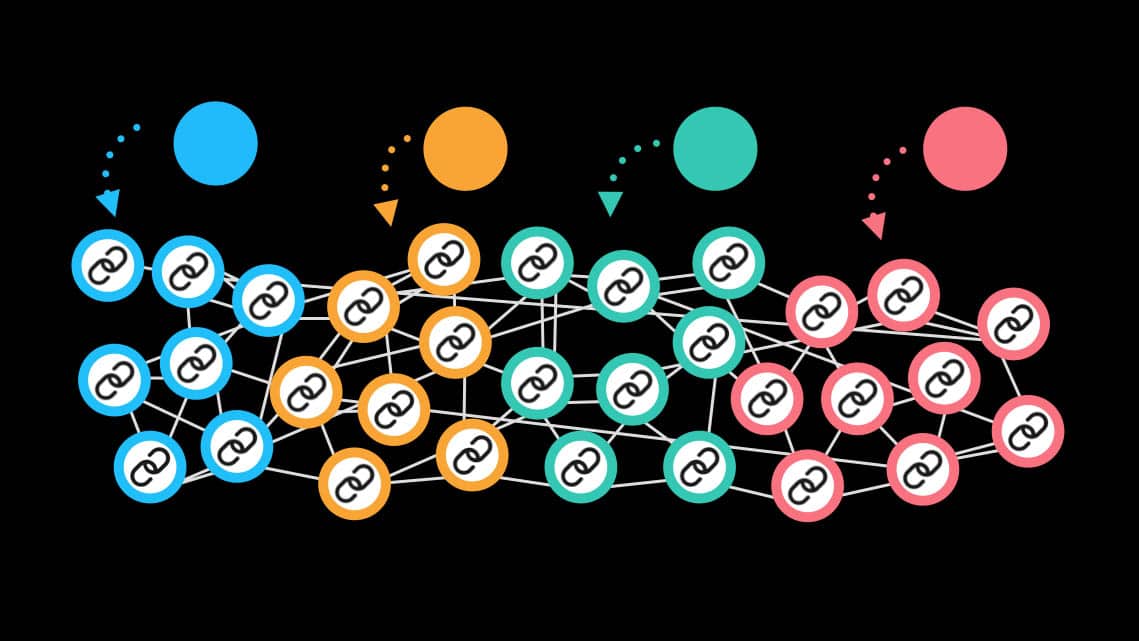
A seed does not make a forest, but it can start one. Our pioneer now will go to the parties she has collected commitments from. One or two will agree in testing. In an ideal case, they will see the benefit (usually it’s largely increased efficiency and/or cost savings) and better understand the Big Picture. With this lever, they will be able to turn the wheels in their environment – and add their own nodes to the network. With more parties joining the network over time, we have a consortium of real world entities which controls the network. They will create a governance model in order to set down the rules for the network. And of course, with the added nodes the network becomes safer.
So, on top of the technology (consensus algorithms, encryption, blocks, keys, distribution, zero knowledge proofs, channels… you name it) exists a real world layer to the network which is typically ignored by people who are fresh to the idea of private permissioned blockchains. This real world layer ideally contains
a consortium (often found in form of a foundation),
a governance model (set of rules agreed upon by the consortium)
arbitration (to some extent automated within the network)
auditing (possibly even through nodes of a neutral audit company for real-time auditing)
Can a large private permissioned blockchain network still be captured by a malicious party? Yes. BUT: This party will knowingly risk its reputation within the consortium, since it is transparent who holds which nodes. Imagine a humanitarian supply blockchain in which a number of humanitarian organizations make up the consortium. Would it make sense for one of these to risk their reputation? Imagine a money-transfer blockchain network held by a consortium of banks – would a bank want to risk its reputation? Or, think universities issuing degrees on a blockchain?
Are private permissioned blockchain systems less safe? It depends. Next time you encounter one, take a step back and challenge yourself: What could the big picture look like?
This is the second post in which we are going to examine blockchain protocols and their tokens. First up, we wanted to start with Ethereum and its native token, Ether, which allows a network of thousands of independent computers to form a single supercomputer.
The beauty of blockchain lies in the possibility to create, securely maintain and transfer digital units, so-called “tokens“. These tokens can serve the purpose of a medium of exchange, which is redeemable for something specific from someone specific. Generally spoken, this is what gives tokens their underlying value. As a consequence, these value units can be used to incentivize certain behavior.
Bitcoin, the first blockchain protocol uses its native token, BTC, to incentivize its network participants in competing to solving a cryptographic puzzle. Whoever solves the puzzle first is rewarded with new BTC and eligible to add a new block of transactions to the ledger.
Ethereum is a network protocol, which uses Ether to incentivize individual computers to act as a single supercomputer, called Ethereum Virtual Machine (EVM). This computer is capable of running any code, written in the native, Turing complete programming language Solidity. The code on the Ethereum Network follows an if/then logic is called a “Smart Contract”.
Smart Contracts are executed on all computers of the network simultaneously, therefore, in a decentralized manner. Once a Smart Contract is deployed to the network it is theoretically impossible to alter or delete it. To perform any changes the majority of the network would need to be convinced to rewrite the underlying code.
Imoratbillity brings the benefits of censorship resistance and prevents any manipulation through malicious actors. Further, running the code simultaneously on all computers of the network eliminates a single point of failure and prevents, therefore, any downtime. These prosperities make code that is running on the Ethereum network highly trustable. However, the downside of immutability arises through the missing opportunity to fix bugs within a Smart Contract once it is deployed.
Just like traditional programming code, Smart Contracts can be used for various purposes.
For example, a Smart Contract can express all the required rules to define ownership and the transfer of ownership, which are required to issue and manage a new token.
Further, Smart Contracts can be used to create computer programs, so-called decentralized applications (Dapps).
Also, it is possible to reproduce organizational rules and structures with Smart Contracts. These constructs are then referred to as Decentralized Autonomous Organizations (DAOs) and are managed over their specific tokens, which grant ownership rights such as voting or dividends.
However, you might ask yourself why people are buying computers, paying for running them and then contribute them to the Ethereum network?
Here is where Ether (ETH), the native token of the Ethereum network comes into play.
For performing any transactions on the Ethereum Virtual Machine a fee is charged and paid out to the validating network participants. Transactions on the network include:
The transfer of tokens
The deployment of a new Smart Contract
Triggering of a Smart Contract
The fees for these transactions are price in priced in “Gas”, the medium of account of the network. The amount of Gas charged for any transaction is predefined and derived from the computing power required to perform it. However, while the charged amount of Gas for a transaction is fixed, its price is variable and depends on the current degree of network utilization. The price of Gas expressed GigaWei (GWei), which accounts for 1/1.000.000.000 ETH.
As stated, Ethereum can be described as infrastructure to host the code of thousands of different tokens, Dapps or even DAOs, eliminating the need for developing and maintaining an individual blockchain for each project.
For exchanges and wallets to deal with this great variety of tokens Ethereum offers different token standards, which will be examined in depth in the following blog posts.
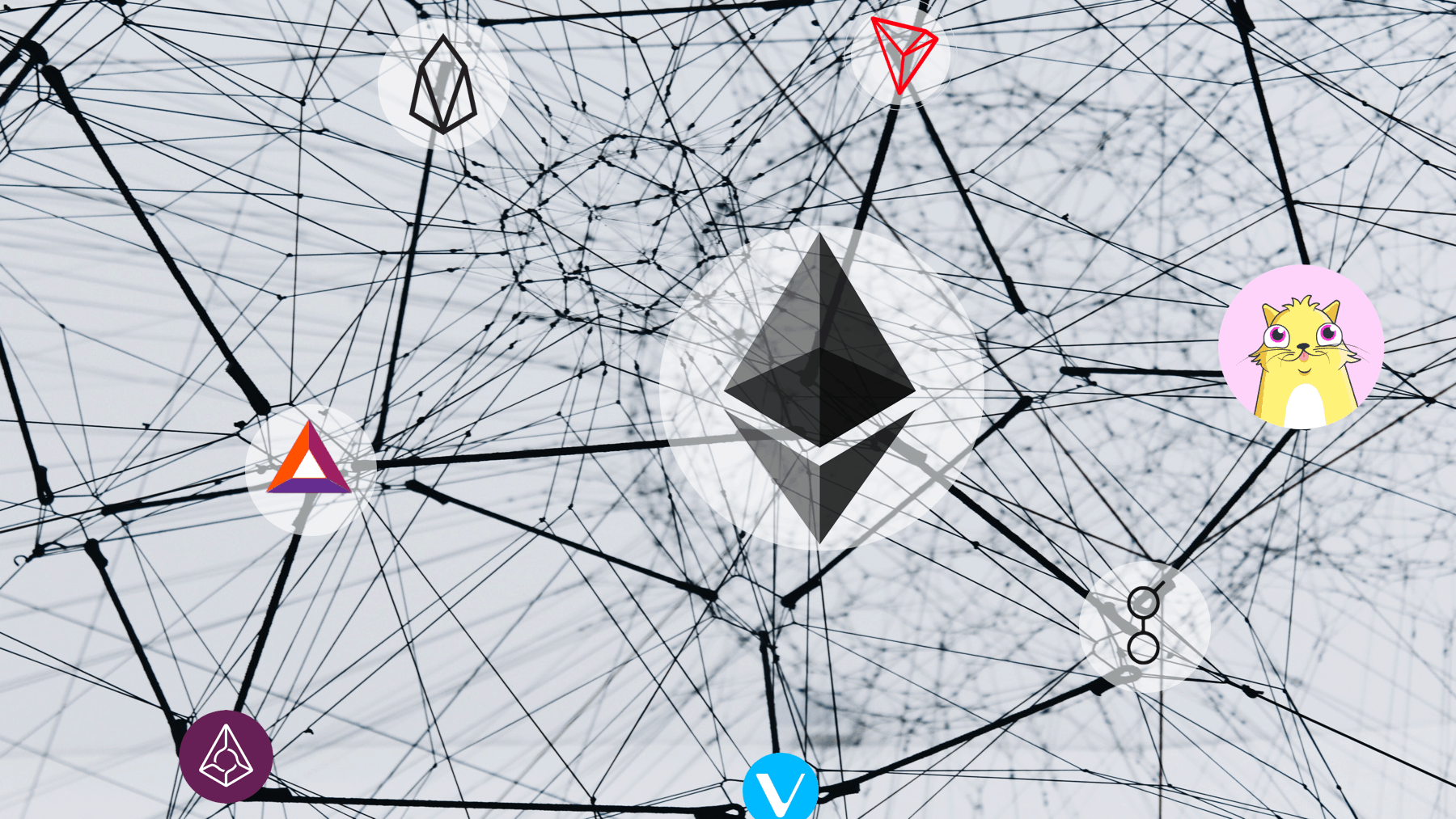
The most prominent one is probably the ERC20 standard, a fungible token, which has be frequently used as a financing method in initial coin offerings (ICOs). Examples for application-specific ERC20 tokens are:
– GNT, the currency token of the Golem.network, a cloud computing platform.
– REP, a token is used to place bets on the prediction market Augur. – BAT, of the Brave internet browser, which is paid to users for receiving adds. – EOS, a smart contract platform.
Another popular token type is the ERC-721 standard, which allows creating non-fungible tokens. These tokens are unique and can be therefore used to represent real-world assets, such as fin art, real estate or digital collectibles. A good example of the use of ERC-721 tokens is the blockchain game Cryptokitties, in which players can own, breed and trade digital cats. The cats are priced in ETH and sold for up to 140.000 USD.
Ethereum is a great example of how blockchain and tokens can be used to create applications and new markets.
In the following posts, we will further explore the use cases of Ethereum.
Climate crisis has made environmental, social and governance factors a force in investing: Asset managers managing over $3 trillion of institutional assets use ESG scoring systems to track their potential investment targets’ behaviour regarding environmental, social and governance factors.
Chris Hohn, the head of hedge fund ICI, has announced to vote against the directors of companies that fail to reveal their carbon emissions. European Central Bank’s new head, Christine Lagarde, considers using monetary policy and bank supervision to actively fight climate crisis; a move that would involve assessing which firms are dirtier than others. A big challenge in using ESG scores is that, unlike credit ratings, ESG scores used by different ESG rating companies are poorly correlated with each other.
And, interestingly enough, tobacco and alcohol companies rank near the top of many ESG rankings – since it does not matter what the companies are selling, it only has to be done in a sustainable way. For instance, in FTSE Russel’s ESG rating, electric auto manufacturer Tesla performs worse than companies that produce gas-guzzlers.
In short – a standard is needed. Over the last few years, big credit ratings firms have either built their ESG ratings in-house, or acquired smaller ESG rating systems. That allows to hope that ESG scores will be usable in the near future.
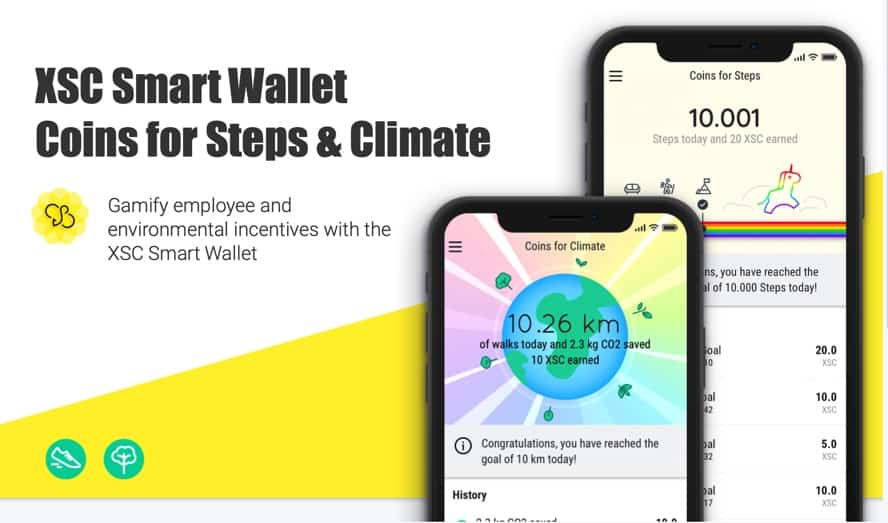
With its XSC Smart Wallet, Datarella is offering a handy solution for enterprises to measure the CO2 emissions of its employees, and the CO2 savings of employees who use public transport, ride their bikes or choose another emission-friendly approach to transit to and from work. The XSC Smart Wallet can measure employees’ CO2 emissions, as well as activity data, and incentivises them to behave in a good manner by rewarding them with digital coins – hence “XSC” – that can be exchanged with food and beverages in the company’s cafeteria. By providing both, a measurement of environmental and activity data of its workforce, a company is able to use the XSC Smart Wallet as a handy, reliable and fun-to-use instrument to improve its ESG score.
If you want to know more about the XSC Smart Wallet, where its is already in use and how you could use it for your company, please contact us!