by Michael Reuter | 14 September 2020 | Blockchain, SmartAid
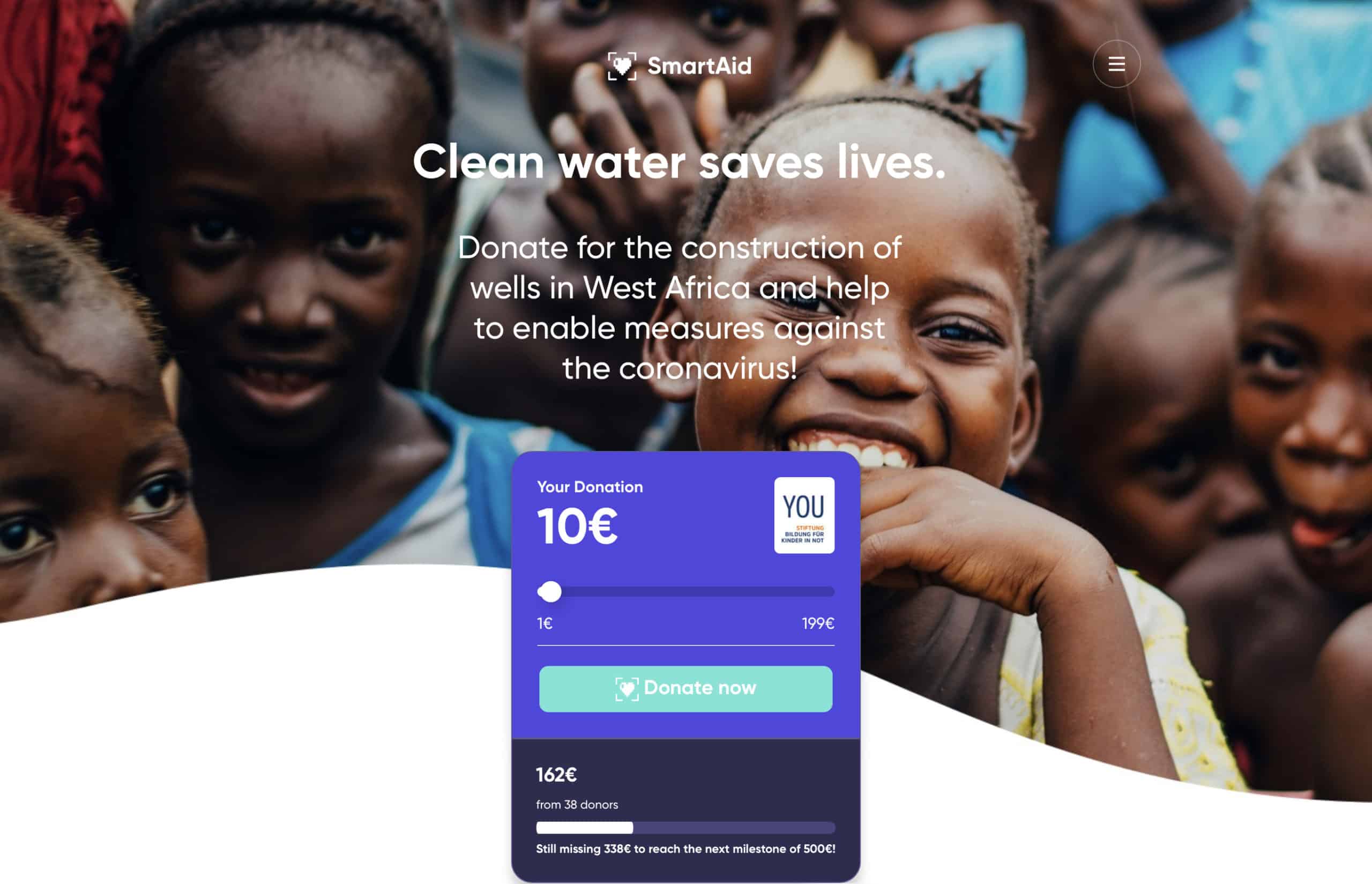
Last week, Datarella and YOU Foundation have launched SmartAid, the first digital donation app that allows for traceable donations based on blockchain technology. SmartAid offers immediate support in crisis situations and lets its donors track their donations until they reached beneficiaries. SmartAid’s first project is “Clean Water for West Africa”, a charity project initiated and managed by YOU Foundation, led by UNESCO Special Ambassador Dr. h.c. Ute-Henriette Ohoven.
Why Donating Must Be Changed!
Time and again, potential donors wonder how difficult it still is, to donate to the right cause, and in an efficient and fun way. Often, you can’t donate using your mobile, or can’t even donate online. Then, you would donate to a certain general topic, rather than to a specific project. Last, but not least, as a donor, you can’t track and trace the path of your donation. Many potential donors are put off by clunky, complex, and intransparent donation processes. Given a huge amount of spare money many people in the rich parts of our world have available for being spent to a good cause, this is a wasted opportunity.
Enter SmartAid!
Efficient, and easy-to-use, the blockchain-based web app does not only make donating fun, but offers fervently desired transparency of the money flows: Right after having donated between 1 – 199 Euro, the donation will be stored on the SmartAid blockchain. The donor receives a tracking code to trace her donation until it reaches its destination. This so-called “traceable donation” is a world first. Secure and immutable blockchain technology guarantees that all donations will reach the right beneficiary by making the flow of money transparent to the donor.
Security, Transparency, and Fun
Donating via SmartAid is not only secure, efficient, and transparent – it’s fun! A direct connection to a donor’s credit card or PayPal account allows for an easy process that even lets donors share their donations via Social Media, thus motivating others to share this experience and jointly support the charity project.
“For a long time, we at YOU Foundation have been looking for a way to enable individuals to donate to our charity projects all around the world. Therefore, we can’t wait to see SmartAid in action!”, says Ute-Henriette Ohoven, founder of YOU Foundation.
“Since 2015, we at Datarella have been working on Blockchain projects with our corporate partners, such as Bosch, Siemens, BMW, Merck, and international humanitarian organizations, such as the UN World Food Programme WFP, or UK Aid. We are very happy to launch SmartAid, together with YOU Foundation, and we are highly curious how donors will perceive the new transparency of their donations”, adds Michael Reuter, CEO of Datarella.
Now – feel free to donate! www.smartaid.digital
by Martin Schäffner | 8 September 2020 | Blockchain
“Not Your Keys – Not Your Bitcoin!”
Maybe you came across this quote from the Bitcoin advocate Andreas Antonopoulos. With “keys” he is referring to the private keys, which allow users to transfer bitcoins and other crypto assets.
This is the first post of Datarella’s “Blockchain Bites” in which we want to dive in blockchain terms, bite by bite, in a visualized way.
First up, we will have a look at what is actually a private key:

by Rebecca Johnson | 27 August 2020 | Blockchain
When people start talking about blockchain they often mix up the security models with consensus algorithms. If you’ve ever scratched your head when these terms start getting thrown, around this post is for you.
Every IT system has some type of security model. Security models answer the question, “how will this system grant access to “good” actors and limit the damage that “bad” actors can do”. In the traditional world of networked computing, this is often achieved through a role-based access control (RBAC) model. Typically these systems rely on establishing shared communal trust in a trusted certificate authority and X.509 certificates.
The internet domain name system is somewhat more complex but follows this basic paradigm with the Internet Corporation for Assigned Names and Numbers (ICANN) being responsible for the central issuance of certificates that enable your browser to resolve human-readable internet addresses. As with Blockchain systems here, governance is key to the functioning of the security model. There are many other types of centralized security which are regularly used for military command and control systems as well as access control for civilian infrastructure.
Common Centralized Security Models:
As you can see, these are large categories that describe how access control is organized and how computer systems in the system arrive at their individual or collective states. These models do not however stipulate the specific technologies or algorithms to be used. Proof-of-Work, Proof-of-Stake, and Proof-of-Authority are types of security models, not actually consensus algorithms.
Consensus Algorithms Enabling Blockchains with a Proof-of-Work Security Model:
There are at least half a dozen popular implementations of consensus algorithms that utilize a PoW model. Check out this post from Jan Vermuelen to learn more about the varieties of PoW algorithms. The main thing that changes between these algorithms is the Hashing algorithm that they rely upon. Usually, the algorithms are named after the hashing algorithm they employ.
Consensus Algorithms Enabling Blockchains with a Proof-of-Stake Security Model:
Consensus Algorithms Enabling Blockchains with a Proof-of-Authority Security Model:
Although PoS, PoW, and PoA are the primary security models in the blockchain space there’s no limit on the type of security models that is possible and each of the security models has dozens of different implementations (and hybrids).
by Martin Schäffner | 20 August 2020 | Blockchain
We are proud to announce, that Datarella is now an official member of the Alastria Network.
Alastria is a non-profit association that promotes the digital economy through the development of Blockchain and Distributed Ledger Technology (DLT).
We are looking forward to developing sustainable use cases and to providing valuable solutions to industry partners.
Further, we are joining the Alastria Identity Committee to thrive the development of SSI solutions with our expertise.

by Martin Schäffner | 10 August 2020 | Blockchain, KOSMoS
How can a blockchain-based system without a central authority be managed in a well-organized manner? Often, problems like a limited amount of trust or missing rules and processes make it easy to create chaos in such an ecosystem. The challenge is to define processes and a binding set of rules while leaving enough space for potential changes. We faced this challenge of governing the KOSMoS consortium blockchain.
The KOSMoS ecosystem runs on a Hyperledger-based consortium blockchain. It enables private channels between a defined subset of actors that allows them to work on a shared database that is not accessible from not authorized parties. Usually, the industrial partner provides one Hyperledger-Framework with individual channels for each customer. This collaboration needs a governing framework with a set of defining rules and obligations for each participant and managing and working processes inside the system. At KOSMoS, we faced this challenge and summarized it in a governance model.
In the first step, we defined the stakeholders of the ecosystem and described their roles, such as the roles of the industrial partner, their customers, and potential trust stewards that can act on behalf of one party. Furthermore, we defined universal voting rights and a general voting scheme that says that all parties are equal, and decisions are only valid if all parties agree.
After defining and describing the stakeholders, we determined the governance structure that acts as the basis for decision making. Since the industrial partner actively runs the Hyperledger network, we defined a semi-decentralized structure with a slightly more powerful industrial partner than the customers. Furthermore, we added processes for changing the governance policy.
In the next step, the Hyperledger network and channel policy needed to be defined. We established procedures for changes in organizations or the infrastructure, such as adding or removing a node from the system.
Last but not least, we defined basic rules for generating, transferring, processing, and interpreting machine and production data. These rules provide information on who can write and read the data and contains a set of penalties for breaking the rules.
We further left the industrial partner the possibility to change the governance model for their specific purposes in their systems. Therefore, this governance model will act as a reference implementation and can moreover be used for other blockchain-based consortiums.
These pillars create the fundament for the KOSMoS Governance Model. Even though we received a lot of positive feedback from the project partners, there will likely be changes to the future’s governance model. Once finished, the governance model will be released at the end of the project.
The KOSMoS research project aims to provide a blockchain-based collaboration platform for industrial partners and their customers. Besides Datarella, there are eight consortium partners from the sector research, machine maintenance, and IT-service providers. Read more about KOSMoS on our Datarella website or visit the project website.
by Martin Schäffner | 10 August 2020 | Blockchain
Datarella successfully applied for the Blockpool program and is very proud to announce that it was selected into the 25 companies working on promising Blockpool solutions. The Blockpool call received over 100 proposals from 27 European countries, in more than 11 different DLT-technologies and directly affecting 8 economic sectors.
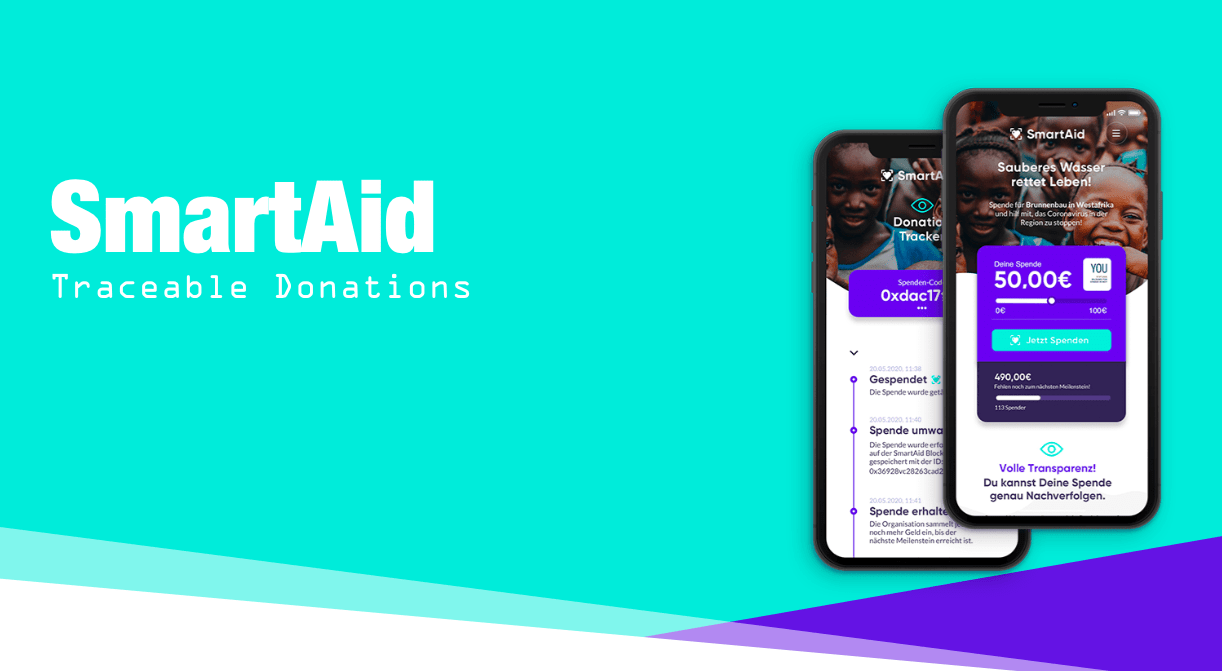
At Blockpool, Datarella will work on an important Blockchain feature supporting our product called SmartAid. SmartAid is an innovative donation platform that leverages the advantages of blockchain to bring efficiency, transparency, and trust into the world of donations. SmartAid is the world’s first fully digital application for donating and tracing the way of your money to selected charity projects. Projects all over the world can participate and receive donations through SmartAid. The use of Blockchain technology allows for
- Secure transactions,
- Traceability,
- Intuitive handling and navigation,
- Simple overview of donations, and
- Transparent transaction history.
The goal of the Blockpool program is to support cross-border DLT-based initiatives and deployment in a broad industry range. It’s primary ambition is to lead to a more cutting-edge and competitive European industry as well as to the structuring of the emerging value chain of DLTs beyond financial markets. This program is funded by the European Union’s Horizon 2020 research and innovation program.
We are very much looking forward to further developing our product SmartAid in close cooperation with the partners backing the Blockpool initiative.

by Rebecca Johnson | 5 August 2020 | Ask Datarella, Blockchain
People in the blockchain space often throw around the words Byzantine Fault Tolerant (BFT) as though it was self-explanatory. Additionally, BFT often pops up in discussions about consensus mechanisms. If you look closer, in the consensus algorithm space there are lots of variants. there’s pBFT, Tendermint BFT, BFT Raft, IBFT, and Lisk BFT to name just a few. This short post seeks to clear up the confusion.
Let’s start with what BFT isn’t. BFT, or Byzantine Fault Tolerance is not a consensus method. It is not a security model. It is not a specific technology. It is not exclusive to blockchain or exclusively useful in blockchain systems.
A system can be described as Byzantine Fault Tolerant if it provides a method for solving the byzantine general’s problem. This is a problem in computer science wherein, the system handles malfunctioning or unreliable components that give conflicting information to different parts of the system.
Lamport, Shostak and Pease described it in a Microsoft research paper in 1982 thusly:
This situation can be expressed abstractly in terms of a group of generals of the Byzantine army camped with their troops around an enemy city. Communicating only by messenger, the generals must agree upon a common battle plan. However, one or more of them may be traitors who will try to confuse the others. The problem is to find an algorithm to ensure that the loyal generals will reach agreement.
Byzantine Fault Tolerant, is at its core, a term that works as an adjective, and which as we have seen is often integrated into the names of various technologies to describe what they do. Any technology or system that has mechanisms for disregarding unreliable inputs from dishonest participants and reliably agreeing on a global state with only valid inputs from honest players can be seen as Byzantine Fault Tolerant. As such there are many security models and consensus algorithms that can be said to be Byzantine Fault Tolerant.
Additionally, underlining the fact that BFT isn’t a security model or blockchain specific consensus algorithm, BFT architectures are commonly used in military command and control as well as spaceflight and aircraft control systems. Two prominent real-life examples of BFT systems outside the blockchain space include the ARINC 659 SAFEbus network used for flight control on the Boeing 777 and 787 aircraft and SpaceX Dragon Capsule systems for approaching the International Space Station in case of multiple computer failures.

by Rebecca Johnson | 3 August 2020 | Blockchain
You may have heard people in the blockchain space throwing the term Inter-Blockchain Communication or IBC around lately. This term refers to any technology that allows transactions across multiple blockchains.
It’s not that simple though. There are actually two sub-categories of cross-chain transactions that need to be differentiated.
- Homogeneous IBC: transactions across two different operating on the same core protocol.
- Heterogeneous IBC: transactions across two different chains on different core protocols.
This is really a rabbit hole! What’s a core protocol? Essentially if two chains share the same core protocol which can natively verify and utilize the state of another blockchain using that core protocol. This is more complex than it appears at first glance.
Homogeneous IBC:
In chains such as Cosmos, all have different security models and do not all share the same consensus mechanism. Despite this, all Cosmos Blockchains are compatible with the inter-blockchain communication protocol which provides “reliable & secure inter-module communication between deterministic processes that running on independent distributed ledgers”. Additionally in chains such as Polkodot there IS a shared security module. In that case, a relay chain makes it possible for state changes on one Polkodot “parachain” to be ingested by and compatible with another parachain.
Heterogeneous IBC:
Most Blockchain ecosystems that offer Homogeneous IBC between chains operating on the same core protocol also offer some possibility for interacting with external chains that are “economically and technically sovereign”. In the case of Polkodot these chains are called Bridges. The Cosmos ecosystem uses a functionality called the “peg zone” to enable Heterogeneous IBC.
An in-depth discussion of how these functionalities work deserves its own post.

by Martin Schäffner | 27 July 2020 | Blockchain
Will my donation arrive at the people in need? Or will it get lost, somewhere in the administration costs of a humanitarian organization? Today, intransparent systems confront donors with a high degree of uncertainty, which diminishes their overall willingness to donate. Therefore, we at Datarella teamed up with the YOU Stiftung to create the next generation of donation platform for sustainable aid projects – SmartAid.
SmartAid is reinventing online charitable giving by implementing our Traceable Donation Technology – powered by Blockchain. SmartAid offers its users a unique donation experience with three distinct key value propositions:
-
- An effortless donation experience
- An engaging donation experience
- A trustless donation experience
An Effortless Donation Experience
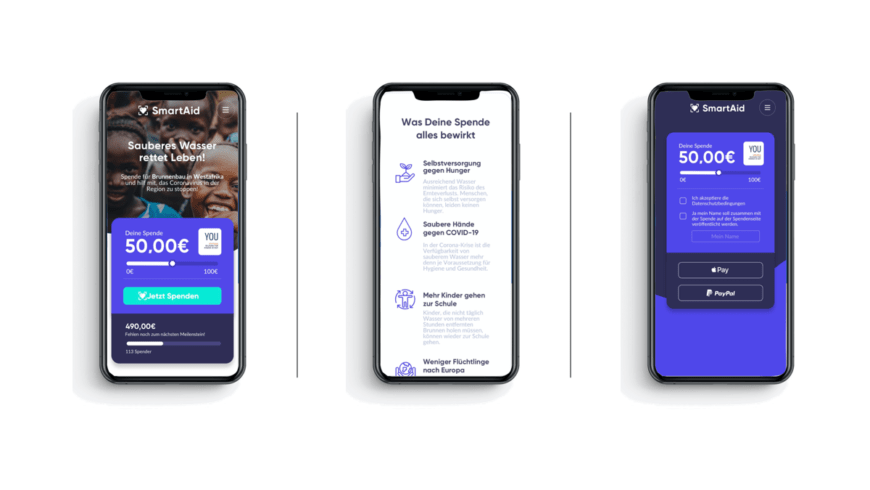
The first barrier, which hinders people from supporting impactful aid projects is the haze related to donating. Our goal is to make supporting these projects, which are often located on the other side of the world, as easy as buying a coffee. No login, no IBANS, no SWIFTs, no hidden fees, no subscriptions, no minimum amount, no bs. Simply scan a QR-Code, whether it is on a billboard at the metro station or on your computer screen or click a link and you will find yourself on the highly intuitive donation home page of SmartAid. Just a few clicks are required to conduct your good deed. Simply choose your favorite payment method and you help to create prospects for less privileged people.
An Engaging Donation Experience
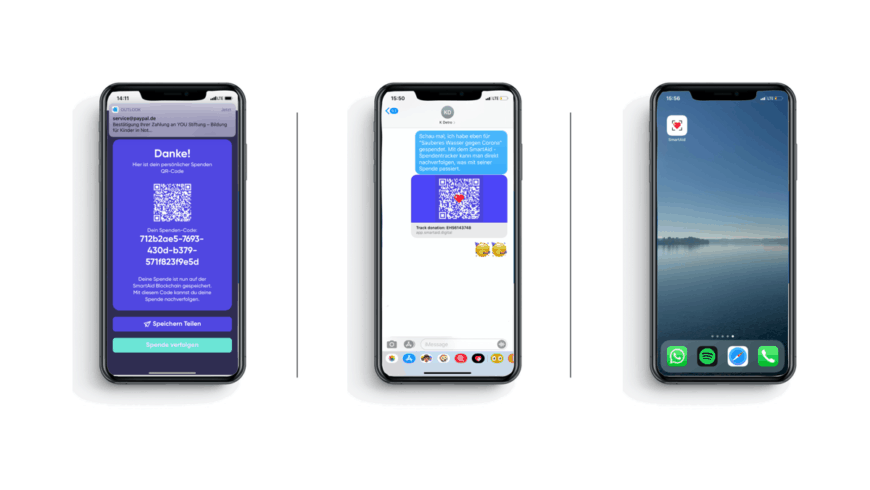
After your payment was processed, you will be rewarded with a unique QR-Code. Share this code and the attached link with your friends and family to show them the journey of your donation. Sending it to your community will also make it easy for you to find it back in your messaging history. Also, since SmartAid is a web app, you can download it to your home screen – just like a traditional app but without the hassle of downloading it from the app store.
A Trustless Donation Experience
The received QR-Code makes it not only easy to find your donation ID back in your message history, but it holds all the information required to track your very own donation among all others. At this point, SmartAid differentiates to traditional donation platforms – no trust is required since everything is documented immutably and transparently on the SmartAid Blockchain.

Traditional donation systems vs. SmartAid’s traceable donations
As illustrated in the graphic above, traditional donation systems allocate fiat currencies, like EUR, USD, in one pot, and distributed to different cost centers of an aid organization. Therefore, traditional donation platforms cannot provide donors visibility about the usage of their funds.
In contrast, on SmartAid each incoming donation is documented on the private Ethereum SmartAid Blockchain. To enable full transparency of the whereabout and usage of each individual donation, each payment will be represented by its own ERC-20 token contract. Each of these token contracts are distinguishable by their contract address. As visualized in the graphic above by different colors, this allows granting SmartAid donors blockchain secured clarity about how their funds will be used.
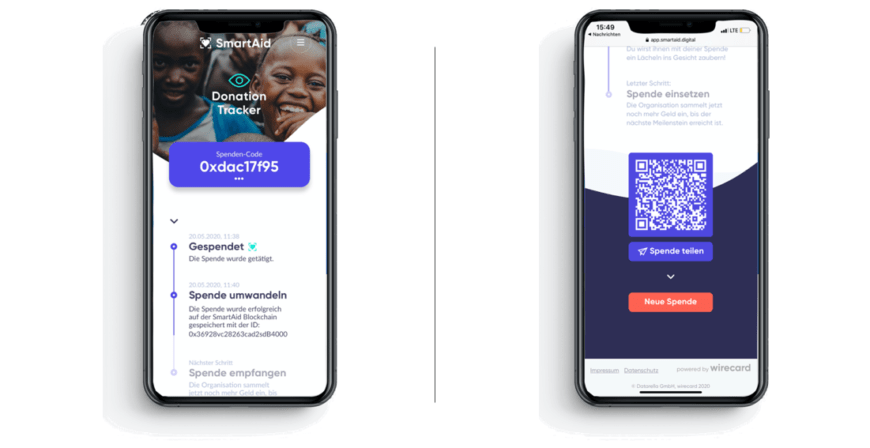
The donation tracker then provides the user an overview of the status of his donation. Here she will also be informed about the actual usage of her kind donation.
Donating hard-earned money to charity is a noble gesture. It requires a high amount of trust and transfers a significant amount of responsibility to the receiving party. Unfortunately, intransparent systems confront donors, as well as aid organizations, with a high degree of opaqueness. Donors face a high degree of uncertainty about the usage of their givings, which in turn diminishes their overall willingness to donate. At the same time, aid organizations are suffering from high costs of reporting to and providing their donors with formal audits. In both cases, the value which arrives at the people in need is significantly reduced. Therefore, we at Datarella are working with our partners on SmartAid to create the next generation of donation platform.
We are proud to announce that SmartAid is also among the winners of the EU funded H2020 accelerator Blockchers. Here we are going to extend the functionalities of SmartAid for aid organizations.
Stay tuned!

