A bug bounty program is used to inspect protocol code and rewards inspectors if bugs are found successfully. Code and product quality can be increased significantly by such swarm intelligence. Therefore, MOBIX stands on a solid foundation as it leverages the Fetch.ai blockchain.
Even the best developers make mistakes. In order to gradually eliminate resulting bugs, a good solution is to motivate numerous competent inspectors to search through protocol code and identify weak spots in the code. Such vulnerabilities may be lucrative for blackhat hackers, so it is important to create appropriate incentives for whitehat inspectors to work as thoroughly as possible. Considering the follow-up costs that programing errors can result in, this can often be a very sensible investment.
Bug bounty programs are open to the public for this purpose, in order to acquire as many technically skilled inspectors as possible for a bug hunt. So-called “Full Disclosure” documentation discloses the program bugs completely publicly, while in the “Responsible Disclosure” model, only the originator is informed about the bugs for a limited time to have enough time to solve the problem. Responsible Disclosure is usually utilized when bug concerns a severe vulnerability to a live system which has not yet been exploited by attackers. One such case was the Zcash Counterfeiting bug discovered by the Electric Coin Co. in 2019.
Our partner, Fetch.ai launched a bug bounty program which ran from mid-2019 until the recent migration to the mainnet, which took place on 20 September 2021. There was a public call to inspect the code on Fetch.ai‘s Github ledger repository and report bugs as a Github issue, ranging from critical to low risk level. Depending on the severity of the bug, a reward of up to $10,000 in FET was available.
We mention this because our latest project, MOBIX is deployed to the Fetch.ai blockchain. In essence we’re able to leverage both the Cosmos SDK and Fetch.ai as a foundation for MOBIX. Due to the bug bounties run by Fetch and by the Interchain Foundation to assure code quality the chances of any kind of problem is significantly minimized.
Supporting charity projects is a great thing to do. Donors deserve to know for what their contributions were used. We are happy to announce the launch of a new, central feature, our SmartAid Token Management System (TMS). Projects on SmartAid can now use the dashboard of the TMS to allocate received donation tokens to their cost centres. These transactions are made visible to donors on their individual donation trackers, creating a transparent donation experience.
Recap: Traceable Donations with SmartAid
SmartAd’s mission is to make donating more transparent and engaging. As described in this previous blog posts, SmartAid uses a private permission Ethereum Blockchain to document each donation of its users. When you donate via the integrated PayPal API, we deploy a new ERC20 contract for you and send your donation tokens to the project’s address. The “Donation Code”, which is displayed on the top of your donation tracker, is the smart contract address of your donation token. With this address, you can identify and follow your donation within the SmartAid system.
SmartAid Token Management System (TMS)
Now the journey of your donation tokens can continue. With the support of the EU-funded accelerator program, Blockpool, we developed our Token Management System, which allows projects to allocate the received tokens transparently to their various costs centres.
The budget allocation is enabled by our simplistic and user-friendly dashboard.
Project dashboard with dummy data
On the dashboard, project managers gets an overview on the most important stats of their SmartAid projects. In the “Budget” widget, the SmartAid project can create a new cost centre. After entering the budget name and amount, the budget is saved as open budget. In this state, project managers can still alter budgets. When the budget is finalized, the project manager closes the budget. At this point, the magic happens and transactions on the SmartAid Blockchain are triggered. The same percentage amount of each donation tokens in the “available budget” is transferred to a new address, representing the cost centre.
Let’s picture this:
Alice donated 200 EUR, Bob 500 EUR and Charles 300 EUR to the Water projects. A funding milestone is reached and the SmartAid project can start. The first money was spent (500€) on a report, evaluating the best place to build a water well. The project creates a 500 EUR budget on the SmartAid dashboard. Once the payment is conducted, the project manager closes the “Location Evaluation” budget. 50%(500EUR/1000EUR) of the available budget/donations tokens are spent. 100 EUR/ (200*50%) of Alice, 250 EUR of Bob and 150EUR of Charle’s donation tokens are distributed to the address representing the location assessment.
Benefits of the TMS
The TMS provides projects on SmartAid three main benefits, a clear overview on the current funding situation, a tool to dynamically plan budgets and for reporting to donors. All of them are important, however, we hope that reporting to donors can solve one of the mayor issues for charity organizations, which we identified during surveys. Currently, projects can only spend donors’ money on previously defined activities. However, not everything can be planned in advance and circumstances occur, in which the donors’ money can create more impact if spend on something else then specified before. The TMS can solve this issue by giving projects the freedom to spend donations on the most relevant causes, while keeping their donors happy by reporting closely.
The information on the fund usage is made available for donors on the SmartAid web app. The project page displays the overall allocation of project funds. Further, each donor can review the spending of her individual donation usage on her donation tracker page. Together with blog posts, this provides transparency for the donors, which are rarely by any other donation platform.
Conclusion
SmartAid’s new Token Management System provides projects with a tool for budget planning and reporting to donors. All transactions are documented tamper resistant on the SmartAid blockchain. By having donation trackers, reading from the blockchain, donors can follow their donation and answer the important question of “what happened with my donation?”. While this brings an advantage over most other online donation tools, we are still at the beginning. Users need to trust that projects honestly allocated the token representations of their donations the same way the allocated fiat funds. We are keen to migrate SmartAid to a public blockchain network to eliminate the required trust, when handling with legacy fiat systems.
Datarella is joining forces with Ocean Protocol to expand the Open Data Economy. moveID, our first project will be under the umbrella of GAIA-X, the European Association for Data & Cloud, as part of the GAIA-X 4 Future Mobility Project, which aims at bringing cloud applications to autonomous & networked vehicles.
The project’s overall goal will be the creation of a decentralized ecosystem of data & services that allows autonomous & networked vehicles to integrate into smart infrastructures and third-party services, following GAIA-X’s design principles. With mutual trust as its core concept, its stated goal will be achieving data sovereignty.
For Datarella, technology is an instrument to increase the quality of living, by supporting human beings in all kinds of professional and private activities. The growing complexity and diversity of our ecosystem require technological infrastructures that facilitate collaboration and cooperation. By planning, developing and implementing blockchain solutions worldwide, Datarella meets this requirement: in the fields of Finance, Supply Chain, and Mobility, we enable industry participants to join forces and create sustainable, crisis-proof business models. GAIA-X is the perfect environment for true collaboration. – Michael Reuter, CEO of Datarella
Data generated by network actors or Autonomous Economic Agents (AEAs) in the ecosystem can be useful to 3rd parties, and thus has value as an asset. Ocean Market unlocks the value of these by enabling every authenticated user to put their data up for sale and to monetize it. Vehicle data, for example, could be (re)used for traffic analysis for the generation of better traffic models such as optimized traffic light switching.
Different market actors will price data differently, depending on the method of data generation, data quality, and its utility to the potential buyer. Ocean Market allows for dynamic pricing and thus for optimal value generation for data generators and data curators, in a privacy-preserving manner.
This project will use Datarella’s Enterprise Blockchain Solutions, which serve as the foundational, underlying protocol for digital business transformation with converging technologies such as AI and autonomous machines. Datarella’s future mobility solutions are fueled by blockchain technology, real-time decentralized data management, transparency and GDPR compliance. Given the natural synergies between Ocean and Datarella, this partnership is the first of many that will drive enterprise adoption of Ocean Protocol technology in Datarella’s client base.
Our mission is for data to be treated as an asset. By tapping into underutilized data from mobility IoT sensors, AI can uncover mobility patterns and optimize services / reduce waste. Machines can speak to each other and algorithms can make optimizations – all in real-time. Ocean can tokenize mobility data from devices, thereby creating an opportunity for these tokens to be used as instruments in DeFi projects. This is one of the many ways in which we enable data owners to share in the value their data creates. – Razvan Olteanu, COO of Ocean Protocol
Ocean Protocol is a Day 1 Member of GAIA-X Association AISBL, an international non-profit organisation established to achieve the GAIA-X project goals for the development of an efficient, competitive, secure and trustworthy federation of data infrastructure and service providers for Europe – fostering digital sovereignty of European cloud service users.
—-
About Ocean Protocol Ocean Protocol’s mission is to kickstart a Web3 Data Economy that reaches the world, giving power back to data owners and enabling people to capture value from data to better our world. Data is a new asset class; Ocean Protocol unlocks its value. Data owners and consumers use the Ocean Market app to publish, discover, and consume data assets in a secure, privacy-preserving fashion. Ocean datatokens turn data into data assets. This enables data wallets, data exchanges, and data co-ops by leveraging crypto wallets, exchanges, and other DeFi tools. Projects use Ocean libraries and OCEAN in their own apps to help drive the Web3 Data Economy. The Ocean token is used to stake on data, to govern Ocean Protocol’s community funding, and to buy & sell data. Its supply is disbursed over time to drive near-term growth and long-term sustainability. OCEAN is designed to increase with a rise in usage volume.
It is no secret, Ethereum, the by market cap and adoption most successful smart contract blockchain, is at its limit. Various DeFi apps, like Uniswap, Aave, games, like Axie Infinity, NFT marketplaces and issuing protocols, like OpenSea and Rarible and countless transactions and other smart contract interactions are clocking up the network. Sidechains and Layer 2 solutions are here to tackle the scaling problem of Ethereum until its transition to Ethereum 2.0 in completed.
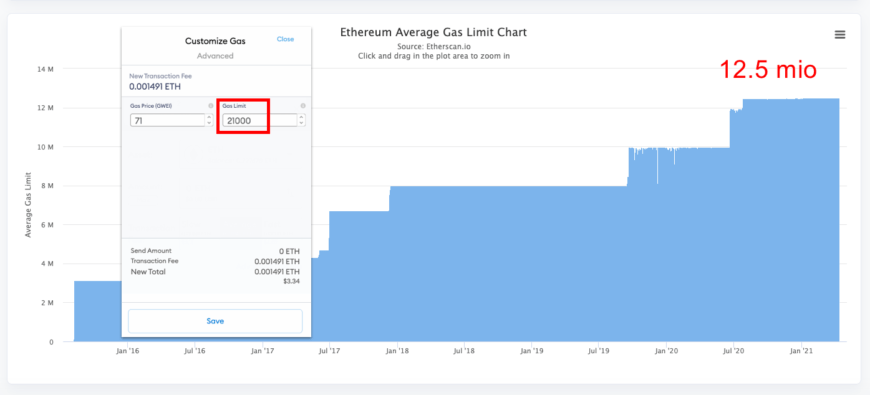
For each transaction on Ethereum a certain amount of Gas needs to be paid. The amount depends on the computational effort. A simple transfer of ETH costs 21.000 Gas while a trade on Uniswap can cost 250.000 Gas. Miners of the network set the Block Gas Limit, which specifies the amount of how much Gas can be included within one block. This limit is currently set to around 12.5 million. A new block is minted roughly every 13 seconds. Which transaction is getting in the next block is determined by the Gas Price the sender is willing to pay. To make an example, at the current Block Gas Limit 595 simple ETH transactions could be process, rounding to 45 transactions per second.
Solving the scaling issue of Ethereum
Since ETH 2.0 is still under development various teams are working on solutions to solve the scaling problem of Ethereum. Most scaling solutions can be categorized into Sidechains or Layer 2 solutions. The main difference between Sidechains Layer 2 solutions lies in their security mechanisms.
Sidechains
The term Sidechains describe blockchains with own consensus mechanisms, which are compatible with Ethereum. Examples are the xDai and Polygon network. xDai used a delegated proof of stake consensus mechanism, which allows for fast and inexpensive stable transactions. A transaction does not take longer than 5 seconds and 500 of them cost only around $0.01. A bridge between xDai and Ethereum makes it possible to transfer any ERC20/677/827 tokens between the networks. This scaling solution is used from various NFT minting platforms, like Nifty Ink, or DAO infrastructure providers.
Layer 2
In contrast, Layer 2 solution do not have their own consensus mechanism but rely on the security of Ethereum. An example of Layer 2s are Roll-ups, which describe off-chain aggregation of transactions inside a Ethereum Smart Contract. You can differentiate between ZK-Rollups and Optimistic Roll-ups. With ZK-Rollups, funds are hold by the smart contract on the mainchain. Computation and storage are done off-chain while validity is ensured using zero-knowledge proofs. A project with works on ZK-Rollups is Loopring. Optimistic Rollups, are using a challenge period of 1-2 weeks to challenge fraud in case the aggregator has submitted an incorrect transaction. Therefore, you are “optimistic” on the submitted transactions. A project using Optimitic Rollups to scale Ethereum is Optimism. Its launch is planned for July 2021. Uniswap is currently running a demo version, Unipig, on Optimism, which only required 143x gas costs and allows for transaction in milliseconds.
Conslusion
Sidechains and Layer 2 solutions are an essential element to solve the scaling problem of Layer 1 protocols. It will be interesting to see what will happen to them when hyper scalable Layer 1 solutions arise, like Ethereum 2.0, Solana, Elrond, and many more.
Uniswap, a Decentralized Exchange (DEX), generates every 24h around $3.5m in fees for liquidity providers of the protocol. A recent proposal suggests, taking 0.005% of the 0.03% fee to distribute it to the Uniswap DAO, to fund further development of the protocol. If implemented, holders of UNI, Uniswap’s governance token, are going to have control over these funding streams, $600k a day, $219m a year. Continue reading, to learn more about DAO governance tools, the use cases of governance tokens and the major DAO infrastructure providers.
What is Governance, and why do we need it?
Your friends and you need to make a decision to which bar to go (at least before corona). Multinational companies need to decide whether to put BTC on their balance sheet or not. And the United Nations need to reach agreement how to reduce CO2 emissions. Different types of organized groups require and use different governance tools to come to a collective decisions. Governance includes processes, like discussions and voting, tools, like laws and contracts, and structures, like democracies or hierarchies. While your friend and family language and informal hierarchies are sufficient to reach agreements, nation states require laws and formal voting processes. With the Bitcoin Network a new type of self-organized society arose, which don’t have a centralized entity responsible for decision-making. These novel types of organizations bring up their own governance primitives, which allows them governing and maintaining their underlying computer protocols.
Governance of Decentralized Autonomous Organizations
DAOs started with Bitcoin and developed since then. Today, we see different types of DAOs in the blockchain space. From people to come together to govern a layer one protocol, to Decentralized Application (dApp), to tokenized investment funds. In general, DAOs are stateless, open and not controlled by any single entity. The centre of DAOs are smart contract which control the funds of the organization. When it comes to DAO governance, you can differentiate between two main types, Off-Chain and On-Chain governance.
Off-Chain Governance
Bitcoin and Ethereum use an informal governance process. Proposals are made mainly by core developers and discussed in the community. When they reach consensus, miners, the entities which run the machines of the protocol, update the software of their nodes and thereby the underlying protocol. This process can be very time costly and can lead to hard forks if only a part of the network decides implementing the changes. A prominent example is the hard fork of Ethereum and Ethereum Classic, as a result of “The DAO” hack, or Bitcoin and Bitcoin Cash, which implemented a bigger block size.
On-Chain Governance
As the name indicates, the voting process of on-chain governance takes place on the blockchain, using some form of governance tokens. Hereby, three different types are common.
1. Company Model One governance token represents one vote. These tokens can be transferred and traded on open market. 2. Membership Model Each member of an organization gets assigned only one vote via a membership token. These tokens are non-transferable and in most cases even revocable. 3. Reputation model This system can be seen as a mix of the company and membership model. One reputation token represents one vote, like a company token. However, reputation tokens are not transferable, like membership tokens.
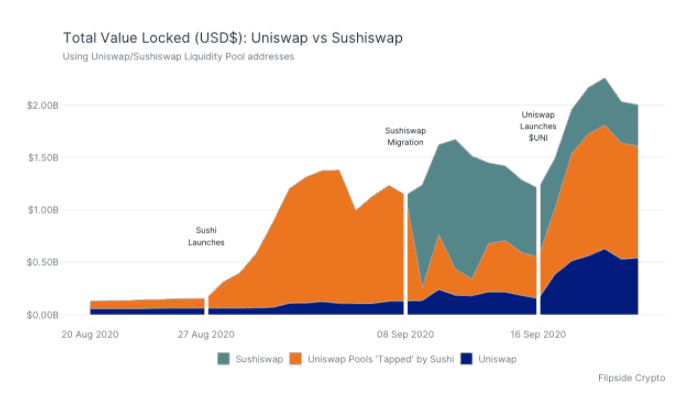
Governance tokens find application in modern layer 1 blockchain protocols, like Tezos, Cosmos and Polkadot. Further, blockchains built using the Pariy’s Substrate Framework facilitate on-chain voting. On-chain voting brings various advantages for layer 1 protocols since it significantly reduce the possibility of hard-forks and allow for faster turnaround time to implement changes. Further, governance tokens are extremely popular for Dapps, especially in decentralized finance (DeFi). One of the earliest examples is MKR, the governance token of the Maker DAO, which allows holders to vote on decisions on the protocol the stable coin DAI runs on. Today, most of the DeFi protocol have their governance tokens like COMP or AAVE, of the lending platforms Compound and Aave, or Automated Market Makers, Balancer (BAL) and Uniswap (UNI). Governance tokens do not only find a utility in allowing voting rights on proposals. They prove as a very effective marketing tool to attract users to actively use DeFi protocol. A great example is, how Sushiswap, a Uniswap clone, attracted over $1b of liquidity by introducing their $SUSHI governance token as a reward for users providing liquidity. Much of this liquidity came from Uniswap and went back to Uniswap after their launch of their own governance token $UNI.
DAO Infrastructure Providers
But how does voting and governance now work in detail? Most DAOs are made of three layers. The first layer are often web2 primitives to discuss proposals, like forums and communication tools, like Discord or Slack. The second layer contains a voting mechanism, involving governance tokens. The third layer involves the fund management of the DAO.
Aragon DAO is by far the most developed DAO infrastructure project. It hosts over 1700 DAOs which have around $900m crypto assets under management. Aragon offers a wide range of apps, for managing funds, projects, DAO specific governance tokens, permissions and voting. The sky’s the limit with Aragon. Custom apps can be developed using Aragon CLI. Further, Aragon offers the Aragon Court, a human based arbitration service. Aragon itself has two tokens, ART for voting on proposals and ANJ which need to be minted with ART and staked to become an Aragon Court judge. Aragon DAOs are only currently available on the Ethereum Mainnet. Since this made voting very expensive, Balancer Labs developed Snapshot, a gas-less off-chain voting tool, which leverages IPFS and Arweave to verifiable count votes. The latest integration of Aragon Agreement allows for off-chain voting on Snapshot with on-chain execution. Further, Aragon is developing an own blockchain, using the Cosmos SDKR, to migrate the platform risk caused by building on Ethereum.
Moloch DAO is a framework, which is used, for example, by MetaCartel DAO or The LAO. Moloch DAOs also have a proposal, voting and fund management template. This DAO framework features two types of tokens, Loots and Shares. Loots are economic shares in the funding pool of the DAO, without any voting rights. In contrast, Shares inherent also voting rights. The Pokemol app provides a frontend for Moloch DAOs and on DAOhaus you can find an overview on all Moloch DAOs. On special feature of Moloch DAOs is the “Ragequit” feature, which allows users to take their funds and leave a DAO if they not agree with decisions made by the community. Moloch DAOs can be launched on Ethereum Mainnet and also on xDai, a second layer solution with substantially lower fees.
DAOstack is used, for example, by The Genisis DAO and over 50 smaller organizations. Alchemy is the fund and proposal manager of the framework. The DAOstack introduced the GEN token to direct attention to the most relevant proposals. GEN can be bought by anyone and staked on any proposal of any DAO. However, GEN itself does not have any voting power, it is used as a signal for high quality proposals. Voting takes place using REP tokens of each DAO. When a proposal is passed, GEN stakers will be rewarded with GEN. This concept is called “Holographic Consensus”. Like a Moloch DAO, DAOstack is available on Ethereum Mainnet and the xDai network.
Community.xyz is the DAO framework of Arweave. Arweave itself is a new type of storage blockchain, which allows the creation of fully decentralized application. These dApps are governed by Profit Sharing Communities (PSCs) which can be created and managed using the Community.xyz dashboard. These DAOs leverage a super exciting token model, called Profit Sharing Tokens (PSTs). The utility of these tokens is two-fold: 1. Voting Like other governance tokens, the PSTs can be used to vote on proposals. For example, to reward contributors with newly minted PSTs for accomplishing tasks, written out on the community.xyz job board. 2. Monetization What makes PSTs especially interesting is, that they grant holders a share of the transaction fees (gas fees), paid by users while using the application. This model allows creators of dApps on the Arweave network to fund and continuously monetize on the usage of their applicaitons.
Conclusion
For the first time in history, Bitcoin granted mankind full control over their money. No centralized issuer. No single entity, which could hinder you from transferring your assets. This sovereignty is enabled by a new organizational form, often referred to as Decentralized Autonomous Organizations (DAOs). Modern DAOs come with governance tokens, which allow their holders to take part in the decision-making process of these organizations. DAOs and governance tokens form a new framework for organizing human collaboration. Most DAOs are open and operate boarderlessly. Anyone to join and to earn money for contributing to a common goal. Funds of these organizations are hold in Smart Contracts in a secure and transparent way. Currently, we are at the very beginning of this novel organization form. Time will tell how these communities will develop and integrate with existing legal frameworks.
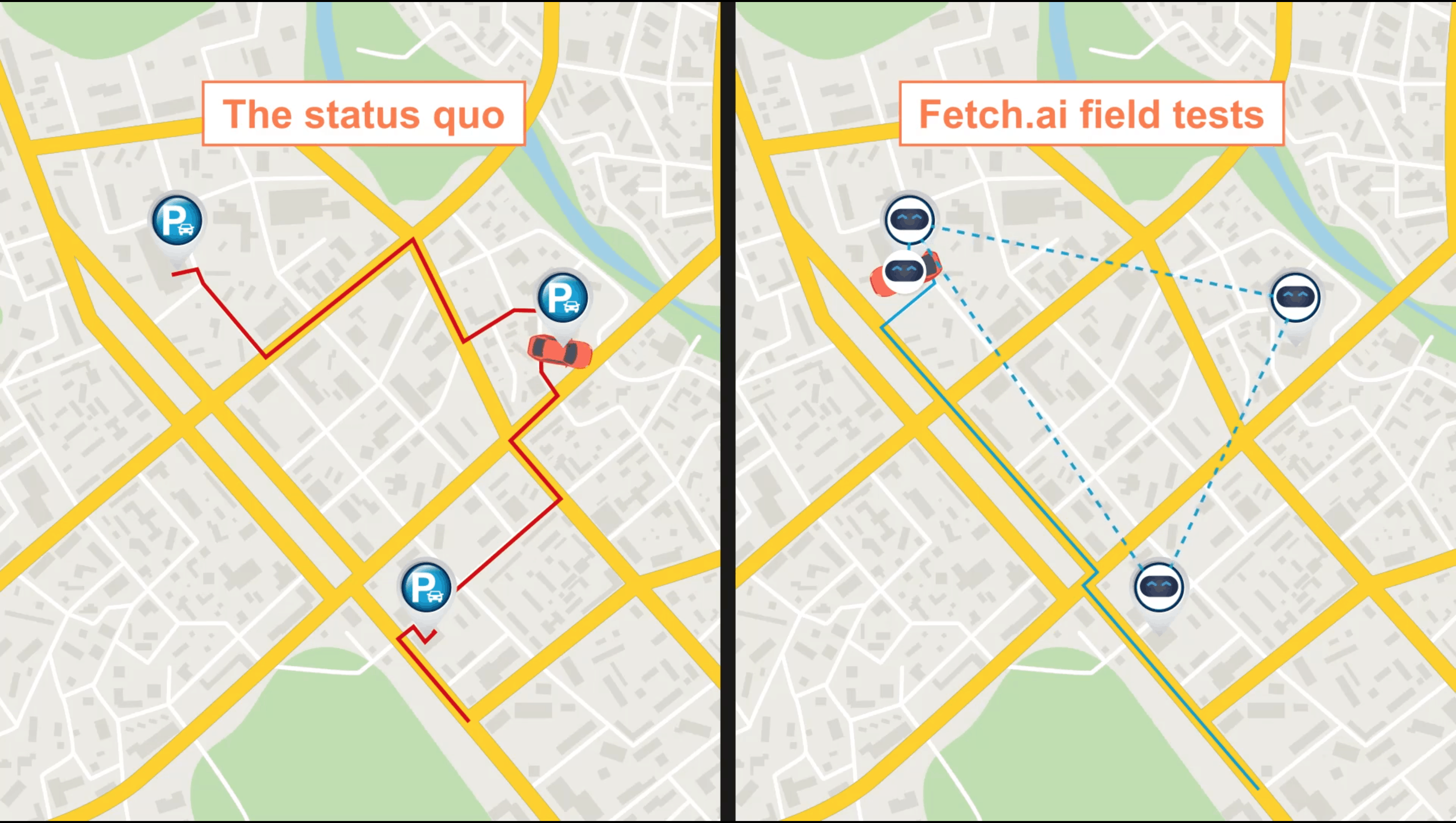
Earlier this week, together with our partners at fetch.ai we released a driver walkthrough video that lets you come along for the ride during the M-Zone Field trials. For the first time, Datarella and Fetch.ai have field-tested an AI-powered Deep Parking solution installed at the Connex building complex in Munich. M-Zone provides automated incentives for efficient smart parking in metropolitan areas. It cuts C02 emissions by providing drivers with real-time options for parking and nudging them with tokenized incentives to park when and where demand is lowest without wasting time or energy driving in circles looking for a spot. Lots of people have asked for more details on how the system works so we decided to draft a technical deep-dive post explain how we built the system and what’s next for M-Zone.
First, let’s dive into a description of the hardware we used to make the M-Zone Smart Parking field trials possible. After that, we’ll delve into the software components and architecture as well as taking a look into how the fetch.ai agents interact with one another and what those interactions mean for cities, parking infrastructure providers, drivers, and the environment.
Edge Nodes
Two edge nodes powered up and scanning for plates. The display between them displays images captured during testing.
For the M-Zone field trials, we deployed two edge computers running computer vision software and fetch.ai autonomous economic agents to the Connex buildings at Frankfurter Ring 81 and 15. These edge computers have two main jobs. The first job is to monitor incoming and outgoing traffic and to read the license plates on incoming vehicles. The second job of the edge nodes is to keep track of the fill state of the parking lot and to publish data about available parking to their associated coordinator agent which is in turn registered on fetch.ai’s Simple Open Economic Framework.
Hardware
Compute: Raspberry Pi 4 Model B
Power: Uninterruptible Power Supply (Pi hat) and 1000 mAH Battery Pack
Connectivity: 4G router with OpenWrt
Cooling: Heat Sink with GPIO Risers and fans
Optional Video Output: 7” Display attached to casing with magnets
Enclosures: Waterproof aluminum boxes that have been modified for cable and camera routing as well as the addition of a plexiglass window for better LTE connectivity
Various USB A, C, and Micro HDMI cables for routing power and video
The hardware used in the field trials is based on cheap and ubiquitous raspberry pi computers and is intended to provide a plug and play upgrade to “dumb” parking infrastructure. Deployment is as simple as mounting the waterproof enclosures in a position where they have a good view of the entrances and exits of the parking garage allowing them to compute the fill level of the lot by observing the comings and goings of autos on a constant basis. Our computer vision solution uses the OpenALPR libraries to accomplish plate detection, edge recognition, binarization, deskewing, character segmentation, and finally optical character recognition to read out the license plates. This enables the nodes to authenticate autos on-the-fly. Future versions will contain a few hardware upgrade options include ruggedized custom enclosures and an improved embedded connectivity solution. The current version performed admirably and passed the field trial with flying colors.
Software Architecture
The real secret sauce doesn’t really come from the hardware though but rather through the software. One of the most critical design choices we made with M-Zone is to host all the cloud-based portions of the system using a Kubernetes cluster for orchestration. This design choice allows the Postgres database and our swagger API to be deployed in a distributed fashion, running on multiple pods within the cluster. This has multiple long term advantages.
It provides options for redundancy at the data state and application layers across multiple nodes located in multiple geographies and using multiple centralized and decentralized cloud/storage options simultaneously. Currently, our K8 cluster is hosted on an AWS EC2 instance but it could be hosted simultaneously across a number of infrastructures in the future. Another key benefit of this approach is the built-in ability to do auto-scaling the database to match load and available resources within the cluster. Building out the system for the M-Zone field trials would have been a lot easier if we had used a less elaborate traditional architecture without orchestration but we believe the investment will really pay off especially regarding the deployment of the IoT nodes. In our field trial, we only had to manage two parking agent nodes but we plan to scale the system and open source it so that such systems can be scaled to cover entire cities. At that scale, it becomes really critical to have an industrial orchestration system that allows you to deploy devices as fast as you can flash SD cards and then never touch them again. Our use of Kubernetes means that we can push updates to the nodes anytime we need to via an “over the air” 4G connection eliminating the need to interact with nodes physically once they’re deployed.
Your micro incentives and real-time parking lot states visualized.
Parking Agents: The parking agent is responsible for the edge processing. Each one runs as a fetch.aiautonomous economic agent inside a docker container running on a Kubernetes pod which is registered as part of the same cluster. The Parking Agents are responsible for identifying the autos that enter and exit the lot by their license plate and matching those plates against the accounts of registered drivers in a privacy-preserving manner. All the image data remains at the edge to eliminate any possibility for centralized malfeasance and prevents data siloization by design. You can check out our privacy design concept for M-Zone here.
Coordinator Agent: The coordinator registers as a service on fetch.ai’s search and discovery mechanism for autonomous economic agents (SOEF). This allows for the parking agents to find the coordinator. The agent also has responsibility for dynamically calculating the incentive payments due to the registered vehicles and executing these payments on the fetch.ai V2 Testnet. It also has the responsibility of periodically converting the issued V2 Testnet micro incentives into FET and sending settlement transactions out to wallet holders.
Settlement Wallet: We built a custom version of our XSC Smart Wallet to handle the receipt of FET settlement transactions.
Fetch V2 Testnet CLI Wallet & Account Visualization Web App: In order to handle the micro incentives on the Fetch V2 testnet we utilized a CLI wallet and visualized inputs from both our API and from the current wallet state to provide drivers with a real-time view of which parking lots have the most space and provide the best incentives.
Dashboard: Just for fun we also built a dashboard that provides an overview of the overall system. This is connected directly to the Postgres Database hosted within the cluster.
API: A swagger API provides the information consumed by the Account Visualization Web App.
High-Level Sequence Diagram
In the above sequence diagram, you can see that the Parking Agent edge nodes continually look for new images provided by our Kubernetes cluster. Next, they search for available agents on fetch.ai’s Open Economic Forum (OEF), the search and discovery mechanism for autonomous economic agents. The OEF returns the Coordinator Agent address to the Parking Agents after which the Parking Agents are able to register themselves with the coordinator. At that point, these agents start scanning for license plates. When they recognize the entry or exit of vehicles, they send a parking event to the Coordinator Agent which acts on the information by updating parking availability broadcast to the wallet via API and also dynamically adjusting the reward ratios and sending the rewards as needed (micro incentives & settlement transactions).
Parking Agent Skills
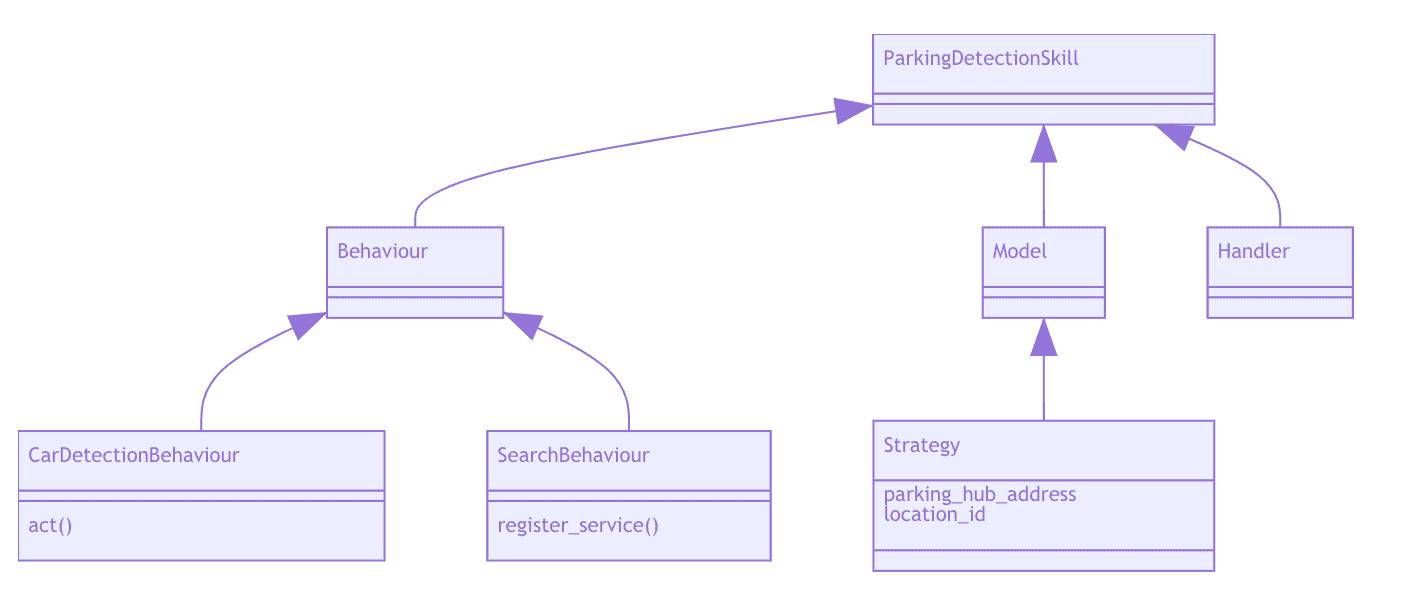
The parking agents are responsible for all the edge processing. License plate recognition is handled by the third-party library Open Alpr Upon agent instantiation. After the agent starts it performs an OEF search to locate the coordinator node. Once the agent has successfully located the coordinator agent, the agent sends an event packet to the coordinator agent. There are 2 types of events that parking agents can currently trigger.
Parking events: This event type provides information to link the entrance or exit of autos in the parking agent field of view to timestamps and map those autos to registered user addresses on the fetch blockchain.
Agent Update: This event type contains a status update from the parking agent. Within its main act function, the agent checks the most recent image saved from the raspberry camera. Any license plates are temporarily stored within the agent memory and deleted following processing. The size of the license plate detected relevant to the frame is also temporarily stored on the edge. Based on whether this frame size is increasing between snapshots or decreasing we can calculate whether a car is entering or exiting the garage. On each iteration, this memory bank is compared with the current image and if the agent detects a new plate, it sends an event update to the coordinator.
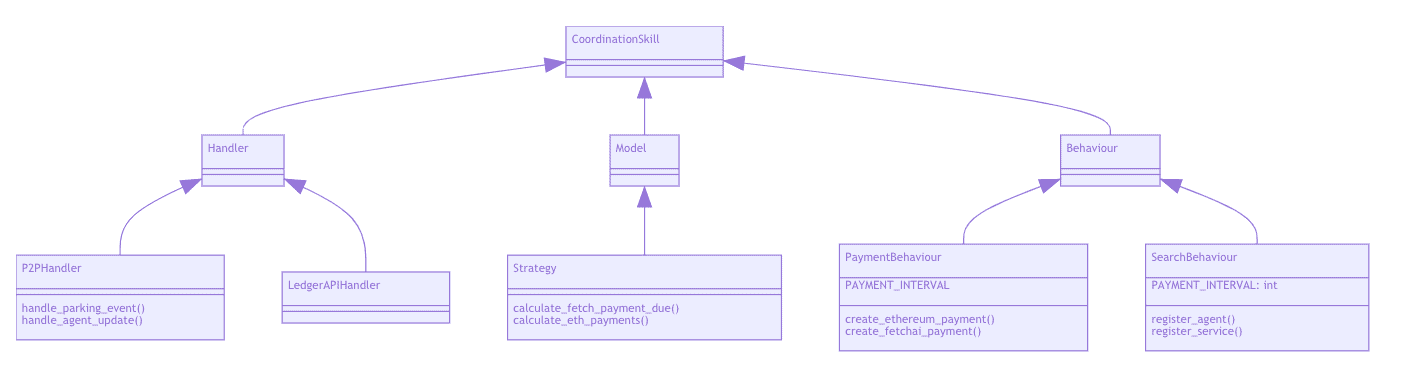
Coordinator Agent Skills
The coordinator registers as a service on the OEF which allows for the parking agents to find the coordinator. The agent also has responsibility for calculating the incentive payments due to the registered vehicles. Payments are incrementally made using the Fetchai v2 ledger due to low transaction costs and speed of settlement. Settlement payments are then periodically aggregated at a pre-determined interval to be batched and sent. Through this process, drivers receive payments of FET that are directly driven by their recent driving and parking behavior.
What’s the Economic Theory at Work?
Neoclassical economic models make a great of assumptions that often don’t hold up in the real world. Particularly under conditions of information asymmetry and in areas where public goods and externalities are present, “perfect competition” usually breaks down and inefficient markets are the outcome. This is what we currently observe in the parking market and it’s a big part of the reason why parking in cities is so annoying.
Public goods are defined as goods that are both non-excludable and non-rivalrous. Externalities are costs or benefits that are imposed on a third party who did not agree to incur that cost or benefit as part of an economic transaction. Market-based economies struggle to contain negative externalities like pollution and struggle to allocate public goods such as physical infrastructure because the assumptions of “perfect competition” don’t hold in the real world and markets don’t lead to efficient outcomes in the presence of these real-world issues.
At the risk of glossing over too much economic detail, essentially, in order for anything close to an efficient market for parking to exist, we need much better information. The M-Zone parking liquidity protocol is at its core a machine for improving market information levels and providing market participants on both the demand and supply sides of the parking equation with appropriate nudges to incentivize market participants toward more efficient market outcomes. The result is less CO2 emissions, better utilization of existing parking infrastructure, more efficient permitting processes and less time spent driving in circles looking for parking.
What’s Next for M-Zone Technically?
We’re currently in the process of defining the roadmap for building out M-Zone. The exact steps aren’t yet locked-in but there are some major topical areas that we can say are on the agenda.
Self Sovereign Identity-based Authentication
Payment gateways
Reservation pathways
Multichain search and discovery
Hardware “in the car”
More strategies for mobile agents and wallets
Improved UI and driver registration processes
Stay tuned over the next few months. There’s much more to come!
We’ve all been there. It seems like every time you go downtown you end up stuck in traffic and then have to drive in circles for ten minutes searching blindly for a parking spot. Even if you have one of the “digital” parking apps you can only park in a limited number of “in-network” spots. We think we’ve got a solution for this mess. In the video, above you’ll ride along with a real driver during one of our field tests leveraging fetch.ai autonomous economic agents and AI-enabled smart parking garages. Further down in this article we’ll examine the environmental, social, and technical aspects of our “M-Zone Parking Liquidity Protocol” approach to solving the parking riddle in cities.
Currently, Parking is Like Flying Half Empty Planes
Today, the vast majority of parking spaces in cities are locked up in various forms of reserved parking. Much of this capacity is reserved 100% of the time regardless of whether it is needed which leads to parking spaces sitting unoccupied mere meters away from where demand for parking is very high. High demand leads to more parking infrastructure being built. This in turn causes massive CO2 emissions for the building materials required (namely cement which requires 900 kg of CO2 per ton to produce). Cement is the source of about 8% of the world’s carbon dioxide (CO2) emissions. In addition drivers Just in Germany, drivers spend an average of 41 hours a year searching for the elusive parking spot at a cost of €896 per driver in wasted time, fuel, and emissions and the country as a whole €40.4 billion. One of our basic assumptions is that if parking infrastructure must be built it should be used as intensively and efficiently as possible to prevent additional unnecessary infrastructure from being constructed. For this to be possible we need intelligent parking systems that provide the correct incentives and nearly perfect information about usage without sacrificing privacy.
Most people wouldn’t compare parking infrastructure to airplanes but it’s actually a relatively good comparison. We all know that aviation is a major contributor to C02 emissions and airlines make every effort to ensure that every flight is as full as possible including “codesharing” where two airlines sell tickets on the same plane to ensure the flight doesn’t fly empty. They also use dynamic pricing to alter customers’ demand curves for particular flights at a particular time and price. What we’re proposing is analogous in the world of parking. Currently, the world of parking could be compared to flying all the planes half empty all the time and adding more capacity constantly despite increasing costs and environmental impact.
In this context, we can define waste as being any time that parking spaces are empty despite there being demand for those spots. Our Parking Liquidity Protocol allows us to recycle already existing capacity to meet current and future expected demand for parking instead of building new parking infrastructure and capacity.
Bringing the Vision of a Parking Liquidity Protocol to Life
Parking lots need to become aware of their full state and become able to communicate their fill state to users directly over a mobile wallet app AND to automatically incentivize these users to drive and park less by rewarding behaviors that are more sustainable. This vision led us to leverage the fetch.ai blockchain. The fetch blockchain includes “autonomous economic agents” which are essentially AI-powered programs that make economic decisions on behalf of users or machines and then execute economic transactions without human intervention on the blockchain. In partnership with the fetch.ai team, we conceived and built a number of edge computing devices with integrated uninterruptable power supplies, 4G modems for connectivity, and high-resolution cameras that can be deployed quickly and easily at parking garage entrances and exits.
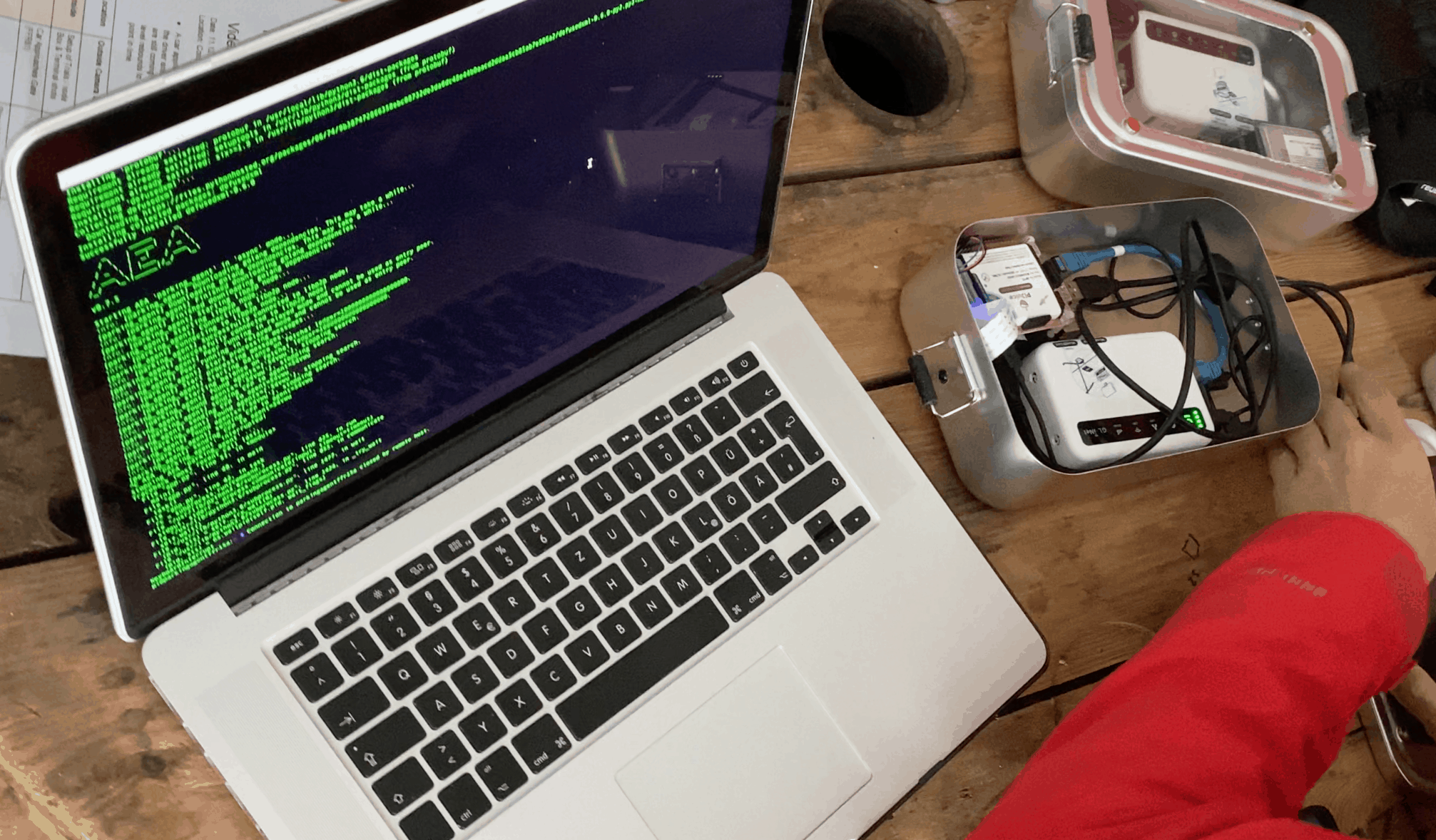
Here we’re preparing the Autonomous Economic Agents for deployment on-site at the Connex buildings.
These edge computing devices (raspberry pi – based) are running computer vision algorithms that allow them to identify license plates on incoming and outgoing vehicles and to calculate how full the parking lot itself is. They are networked together with one another and with a “coordinator” agent which aggregates the information from daughter nodes and determines dynamically which micro-incentives should be sent to any individual driver at any one time. We’ve also built a web app that allows drivers to see the fill status of the lots how much their earned micro incentives, reward rate, and how much this earning rate will be reduced by parking in a particular lot at a particular time. Not parking at all is rewarded most but parking where and when parking demand is low also gets some rewards. Last but not least there is a settlement layer that sums up the micro-incentives that a driver has earned through parking less and parking more efficiently and makes payments in FET tokens to the driver wallet. These tokens are tradeable on the open market and are directly exchangeable for Euros or USD. It goes without saying that privacy by design is at the core of our system architechture.
Critically, these edge nodes are managed by a Kubernetes-based container orchestration system which allows us to do over-the-air updates to the hardware without retrieving it from the field. This greatly increases the scalability of our system because it allows us to install the hardware which provides intelligence to the parking garages once and never touch it again unless physical maintenance is required.
A two-node system has been field-tested successfully at the Connex building complex in Munich. These buildings are owned by Datarella Partner Hammer AG with whom we ready partnered to execute one of the first regulatory-compliant real estate tokenization projects last year (ConnexCoin). The money for the driver micro-incentives comes from the savings of both commercial real estate developers like Hammer AG and their tenants. Now with our system, they have the means to share parking capacity across nearby buildings. Hammer AG alone has 5 buildings on the same street in Munich within the Connex complex so it’s really realistic to encourage drivers to distribute parking load across the neighborhood and walk a few minutes further to reach their end destination.
What’s next?
We’ve got a lot on our plate for the next months. We’re looking to build on the success of the field trials to augment the parking liquidity protocol with a bunch of new components. We’re working on integrating a self-sovereign identity framework to beef up the privacy of our authentication methods. Parallel to this, we’re building out the user interfaces and onboarding processes working with our partners to expand the M-Zone parking liquidity protocol for payment and reservation. On top of that, we’re designing an open protocol tech stack to enable the search and discovery of parking lot ID’s and states in a chain agnostic manner. Keep an eye out for a technical deep dive in the coming days where we’ll get into the nitty-gritty of how the system works!
Today, we trust Instagram, to keep track of our followers, likes, and chat histories. We trust banks, to document our balances and depots. We rely on Amazon, to maintain the lists of our past purchases. However, by trusting them we give up control and privacy. Slowly we are seeing adoption in Blockchain Technology as a decentralized and user-controlled trust machine. Similar to how banking software doesn’t keep track of your Instagram followers, it is likely that we will see a multi-chain future, in which use-case-specific blockchain networks are used to keep track of domain-specific states. Substrate by Parity Technologies allows for a first principle approach to creating these state machines.
Blockchain As State Machine
How much money did refugees spend in the markets of Jordanian refugee camps last month? #BuildingBlocks Which stakeholder within the long and complex humanitarian supply currently has custody of the emergency medical supplies? #Track&Trust Which parking credentials have been issued to my wallet, allowing me to park at the airport car park? #M-Zone Blockchain technology allows answering the above-stated questions in a trustless manner. Various components are required to allow individual participants of a decentralized computer network to reach an agreement over the state of a system. However, depending on the use case slightly different requirements arise for their underlying components. Some Blockchains need to be more secure, some faster, some more decentralized, some more private, and so on. Developing custom blockchains from scratch, with use-case optimized components, is very expensive. Imagine the costs for finding and bringing together experts of various computer science fields such as distributed databases, P2P networking, cryptography, and so on, to create a new Blockchain.
So wouldn’t it be great if there would a “Blockchain Kit”, which allows building custom, use-case optimized blockchain, using existing building blocks?
Substrate by Parity Technologies
And it turns out, there is Substrate by Parity Technologies, a modular and extensible framework for building blockchains from performant composable modules, called Pallets.
But let’s dive into the history of Party Technologies to get a better understanding of how Substrate evolved. Parity Technologies was founded by Dr Gavin Wood. Gavin is well known in the blockchain space for being the CTO and Co-Founder of Ethereum, cocreator of Ethereum’s Smart Contract programming language, Solidity, as well as its corresponding runtime environment, the Ethereum Virtual Machine (EVM). Since 2015 Parity Technologies built various blockchain clients, like parity Bitcoin, for Bitcoin (BTC) and Bitcoin Cash (BTH) mining, parity Zcash for the privacy blockchain Zcash, and OpenEthereum.
In 2017 Gavin published the Polkadot white paper stating the ambitions to create a heterogeneous multi-chain network, which connects various blockchains. During the development of the Polkadot Network, the engineers at Party Technologies noticed, that blockchains share many components and only some are unique. As a result, the Polkadot GitHub repo was forked to create a framework called Substrate.
So what is Substrate?
Substrate can be described as an open-source community, a modular software development framework, and a developer platform. The substrate framework allows the modular development of fast, secure, and socially scalable blockchains using substrate pallets.
1. Fast
Blockchains build on substrate reached up to 15k transactions per second.
2. Secure
The code of the framework is audited by top-tier blockchain auditing companies.
3. Socially Scalable
One major advantage of Blockchains build on the Substrate Framework is that they are upgradable without causing a hard fork. This is what’s meant by “socially Scaleable”. Hard forks are slow, inefficient, and costly since they require tremendous “cat herding” of node operators. Let’s take Bitcoin as an example. To update the network, the majority node operators, aka. Miners, need to be, first, convinced and, second, install the software update manually to their machines. In contrast, using Substrate, the business logic, which defines the behavior of a blockchain, is stored on-chain in the binary instruction format called WebAssembly, short Wasm. This allows automatically updating the whole network at a certain block height. So, let’s say some supervillain gets his hands on a Quantum Computer and you need to exchange the hashing algorithm of your blockchain for a quantum-proof one. The update can be done by sending a transaction. All the nodes will be updated automatically at a certain block height if they did not choose to leave the network.
The second benefit of using Wasm is that it can be run hardware-agnostic, which is a major benefit for node operators. Last but not least, Substrate Blockchains are interoperable with each other, as well as with other blockchain networks, like Ethereum, since they can be connected via the Polkadot Relay Chain.
4. Substrate Pallets
Substrate Pallets are the atomic building blocks of each Substrate Blockchain. A collection of pallets result in what is called runtime or simply the business logic of a blockchain. Each Pallet itself contains a domain-specific logic. The cool thing is, developers can discover, use and create Pallets on the Substrate Marketplace. Here are some Pallet examples from different categories you can use for building your own blockchain.
Category
Pallet
Accounts
Balances, for managing tokens
Recovery, social multi-sig recovery
Vesting, for looking tokens
Assets
(Non)-Fungible assets
Transfer
Destroy
Atomic Swaps, for exchange tokens
Consensus
Proof-of-Work
Aura (authority round)
BABE, slot-based block authoring with a known set of validates with on-chain randomness.
GRANDPA, finality gadget, if 2/3 of the GRANDPA authorities have voted for a particular block, it is considered final.
Governance
Democracy, for stakeholder voting
Election
Treasury
Identity
Superusers, which can remove accounts and slash balances
Smart Contracts
EVM, allowing for Ethereum compatible Smart Contracts
WASM, allowing fast, secure and efficient Smart Contracts
Conclusion
Substrate drastically reduces the costs of developing use-case optimized Blockchain infrastructure. Polkadot Network, which itself is mainly based on the substrate framework allows connecting these specialized blockchains, granting interoperability. Only time will tell how many Blockchains we will need in the end, but Substrate seems like a promising bridge to a decentralized state-keeping future.
Admittedly, it’s a German original: The “Adventskalender”. Every year on December 1st, children’s eyes in Germany start to shine – the Christmas countdown starts! This tradition has been going on on for decades. In the last few years, advent calendars have grown more and more elaborate, heating up the greed for consumption.
This year at SmartAid, the team thinks it’s time for an advent calendar that grounds us all in the Christmas frenzy and lets us rediscover the essentials of the Advent season.
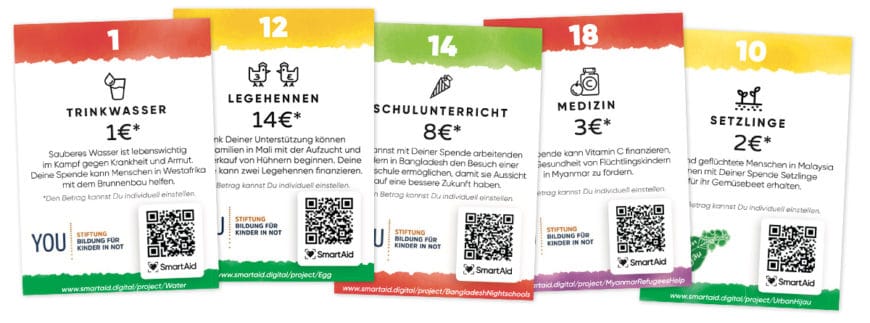
As a result, you find here SmartAid Advent Calendar: Every day, starting December 1st to December 24th, you can perform a good deed. With a small contribution you have the opportunity to make the world a little better – by donating for food, school materials, medicine or hygiene.
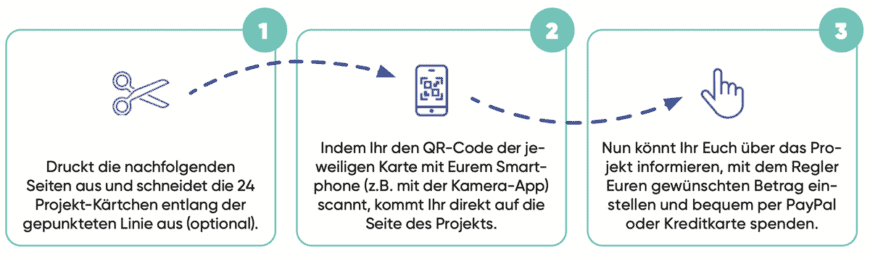
Print out the pages with the cards and cut out the 24 project cards along the dotted line (optional).
By scanning the QR code of the respective card with your smartphone (e.g. with the camera app), you will be taken directly to the project page.
Now you can find out more about the project, set your desired amount with the controller and donate comfortably via PayPal or credit card.
The nice thing about donating with SmartAid: With the blockchain based donation tracker, you can precisely track your donation. You can adjust the amount of your donation yourself!
So, get ready for December 1st – we wish you lots of fun donating!