The term “Token” is frequently used in the blockchain space. Shermin Voshmgir, the director of the Research Institute for Cryptoeconomics at the Vienna University of Economics, calls them even “the killer application of Blockchains“. This blog post aims to give you a better understanding of what a Token/Token Contract is.
A Token Contract is a special type of Smart Contract, which maps blockchain addresses to balances of value units – aka tokens. These software programs hold code, which specifies a set of functions and attributes of the value units, created and managed by the contract. Just like other Smart Contracts, Token Contracts are:
1. Censorship-resistant and Tamperproof
These computer programs are hosted on Smart Contract platforms, like Ethereum. Therefore, they are maintained and executed by all nodes of the blockchain network at the same time, which makes them censorship-resistant and tamperproof. Once they are deployed to the network, they cannot be changed.
2. Reactive
Smart contracts cannot initiate transactions themselves, they need to be called by an External Owned Account (EOA) or another Smart Contract. Therefore, they are mostly created by EOAs, which are controlled by private keys. However, Smart Contracts can send messages to call functions of other contracts, which allows creating a Smart Contract with another Smart Contract.
3. Controlled by their Code
Unlike EOAs, Smart Contracts do not have a private key. These programs are solely controlled by the code they hold in their persistent internal storage. Their code specifies functions, from which they can read and write to. Read functions: allow retrieving information from the contract, for example, the balanceOf(account) function, which allows reading the balance of a certain address, or the name() function, which provides the name of a token. Write functions: enable, surprise, to write new information to a Smart Contract. Most common is probably the transferFrom () function, which allows subtracting from the balance of the sender’s address and add to the balance of the recipient. Another interesting write function is mint(account, amount) which allows, when called, to create new tokens and send them to a specific address, respectively, the burn(account, amount) function, to destroy tokens. Calling these functions can be restricted, so that, for example, only the address which deployed the contract can call the mint() function.
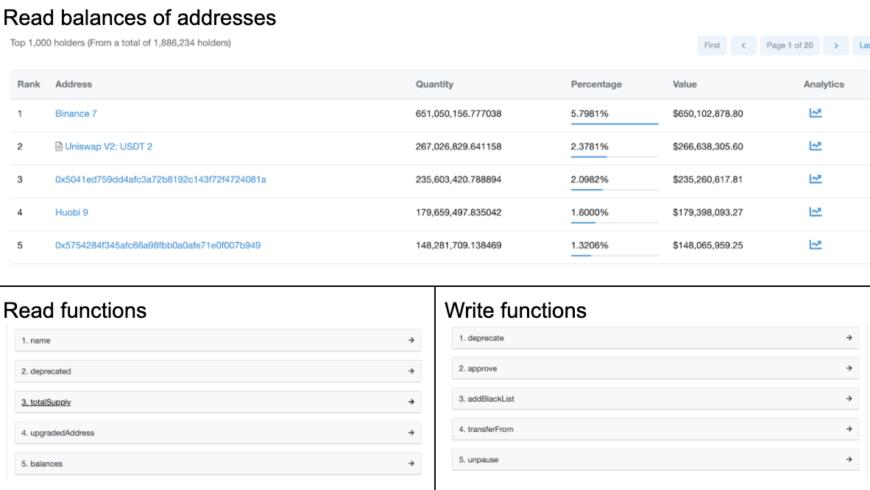
Have a look at Etherescan to check out token contracts deployed to the Ethereum Blockchain. For example, the Smart Contract of the popular stable coin Tether (USDT). As you can see in the image below you can read from the contract, e.g. to see which addresses hold USDT or write to the contract to send tokens.
Types of Token Contracts
In general, you can differentiate between two major groups of token contracts by the properties of the value units they create and keep track of, fungible tokens and non-fungible tokens (NFTs).
1. Fungible Tokens
The value units of these smart contracts are interchangeable. Further, the Token Contract specifies the number of decimals – thus the divisibility of a token. For example, 1.000000 USDT is, divisible to six decimal places. However, one might argue that the fungibility of value units recorded on public blockchains is reduced if the transaction history is publicly available. For example, if certain tokens are sent from an address, which is known for being related to criminal activity, like a hack, they might not be accepted by exchanges anymore and therefore are not fully fungible. Therefore, only privacy tokens, like Monero (XMR), which transaction history is not traceable, can be seen as fully fungible. Another example of fungible value units created by Token Contracts, next to the monetary use case, are equal voting rights represented by tokens.
2. Non-fungible Token Contracts
These token contracts create unique – thus clearly distinguishable value units, which are not divisible. Each token created by such a program has a unique tokenID, which makes it identifiable. Non-fungible tokens (NFT) are often used to represent real-world assets, like art or real estate. Further, popular use cases for this token type are digital collectibles, like crypto kitties, digital art or digital land. Also, an interesting use case is Blockchain Domains, like Unstoppable Domains, which use NFTs to represent “.crypto” domains on the Ethereum blockchain.
ERC – Token Standards
With the rise of Ethereum, Token Contract Standards have been established, which enable wallet applications to hold and manage any type of tokens, complying with the standard. Therefore, the rise of standards allowed for great usability advancements. Ethereum’s standards are titled as “ERC” which stands for Ethereum Request for Comments and refers to a document that specifies rules Ethereum-based tokens must comply with.
ERC20 Standard
The most popular token standard is probably the ERC20, which creates fungible tokens, mostly used most initial coin offerings (ICOs). It is fairly easy to create an on ERC20 contract since it only requires a couple of lines of code. By today, over 333,500 ERC20 contracts are listed on Etherescan. These Smart Contracts have optional functions, like a Name, Symbol or Decimal, and 6 mandatory functions:
totalSupply()
Can be fixed or variable. If it is variable it can be calculated and return the total amount
balanceOf(address_owner)
Shows amount of tokens held by a provided address
approve()
Authorizes a contract to do something e.g. withdraw tokens
Similar like approve but checks for sufficient balance of an address
ERC721
The predominant standard for Non-Fungible Tokens is the ERC-721 standard. Over 7,500 contracts emitting this type of tokens are listed on Etherscan.
Popular tokens created by ERC-721 are, for example, digital football player cards of sorare, blockchain domains of unstoppable, and also the famous cryptokitties as mentioned above.
Conclusion
Token Contracts are computer programs, which create and manage value units and are deployed to Smart Contract Platforms. These code snippets are at-will programmable and can be designed to fit any kind of use case, from digital currency to collectible. Further, they can be programmed to create self-reinforcing positive feedback loops to bootstrap Web3 platforms and are the basis of any Token Economy. Stay tuned!
Datarella, in partnership with Fetch.ai, a Cambridge-based artificial intelligence lab building an open-access decentralized machine learning network for smart infrastructure, announced today the launch of M-ZONE, their smart city zoning infrastructure trials in Munich, Germany. Using their AI-powered software agents to optimize resource usage and reduce the city’s carbon footprint Datarella and Fetch.ai predict mass implementation of smart city infrastructure will result in 34,000t annual CO2 emission reduction.
M-ZONE will be launched in the Connex Buildings and will utilize multi-agent blockchain-based AI digitization services to unlock data and provide smart mobility solutions in its commercial real estate properties in the city center.
“Landlords, as well as the City Council, are interested in optimizing the parking space management, to allow for available parking for all employees of corporate tenants while organizing the traffic flow and preventing commuter traffic jams,” said Michael Reuter, CEO of Datarella. “Our system incentivizes community use of public transport through a tokenized incentive system while reducing the congestion that accounts for a great deal of Munich’s CO2 emissions.”
M-ZONE will solve the needs of various stakeholders:
Individual commuters and drivers: save time, money, and reduces driver stress
Property owners: simplified approval for new development projects
Tenants: lower rent through dynamic parking spot sharing
City Council: optimized traffic flows
Environment: less negative impact through saved CO2
Upon implementation, AEAs (Autonomous Economic Agents) will support the sustainable and efficient use of city infrastructure in Munich through an application where they will autonomously negotiate the ‘price’ of parking spaces between the holders of parking spots, and those looking for parking spaces. Users can earn rewards in the digital currency if they choose less popular or in-demand parking spaces (or do not use the parking lot at all on some days). The Carpark AEA determines the reward levels to maximize resource usage.
“Fetch.ai provides a decentralized framework for building and customizing autonomous AI agents to carry out complex coordination tasks,” said Humayun Sheikh, CEO of Fetch.ai. “Our vision is to connect digital and real-life economies in order to enable automation over a decentralized network and change the way we use data.”
Users are incentivized to reduce their number of car trips to the Connex and adjacent corporate offices through a reward system which is measured by the utilization of parking spaces. Each registered user who is a regular car park user will be rewarded with a certain amount of tokens per minute for not parking at the parking lot. As soon as a car or its related wallet address is registered as parked by the Carpark AEA, the token airdrops to this wallet stop/slow. The number of tokens rewarded per wallet and minute depends on the current utilization of the parking lot.
“Assuming there is a 10% reduction in car usage across Munich alone, the city would see a 34.000 tonnes annual CO2 emission reduction,” continued Reuter. “Scaled up to cover all of Germany, that equates to 1.7 million tonnes CO2 reduction, annually. This smart city solution has the potential to penetrate huge markets simply by tapping into wasted data and utilizing it efficiently.”
Track and Trust successfully completed the BlockStart accelerator program, which initially started in March 2020. We want to look back on the last six months and share how we upgraded Track & Trust from an MVP to a market-ready product.
It all started at the ideation Kick-Off in March, where many startups presented their innovative products and solutions. It was an excellent chance for us to see how so many different companies intend to use blockchain for their services and gave us the opportunity to talk to startups that could be interested in testing our blockchain-based supply chain solution. As it turned out, we would see three of them back in September during the Pilot Stage.
Scope and Implementation Phase
Our goal during the BlockStart accelerator program was ambitious – we wanted to upgrade Track & Trust from an MVP to a market-ready product. After we successfully made it to the next round, we defined our four KPIs:
Implement an onboarding process in which users can self-register. During the MVP, we created the Keystore files by ourselves and sent it to our test-users. A self-registration process is one of the main requirements in a decentralized system. In addition to that, we also created profiles that are linked to a specific address.
Enable Multi-tenancy in the system. We want to limit the accessibility of information to only the respective users and their respective data. This increases privacy, security, and provides a clearer and smoother user-journey.
Make the Track and Trust interface dynamic. There were many hard-coded processes and interface-artifacts developed for the MVP. The contents on the different interfaces should dynamically show the data for the respective shipment.
Enable mobile-signing. In order to reduce data load and improve usability, we need a mobile app that contains the identity information as well as the private keys of the actor. As a result, handovers can be processed by scanning QR-Codes of the shipment without the need to document this on a computer.
During the implementation phase, we talked with many potential adopters that could perform tests with us in the pilot stage. These talks and the progress of implementation were the main topics in frequent calls with our mentor Joao Fernandes.
Testing with Adopters
After we successfully finished the implementation stage, we had the chance to test Track and Trust together with three adopters that we talked to during the implementation phase. This was Albicchiere, an Italy-based startup that runs a supply chain for refill packages of their wine dispenser, Go Limpets, a Portuguese-based company that sells sea food to the gastronomy, and Zelena Tocka, a Slovenian company whose supply chains manage the production and selling of local agriculture goods.
The objectives of the test were to perform a test with all three adopters through every stage of Track and Trust. As a result, we were very happy to see that they had no issues in testing Track and Trust and that the system would bring an advantage over their competitors. Another main takeaway for us was recognizing the versatility of the use cases Track and Trust can apply.
Take a look at our newest product video of Track & Trust:
The BlockStart accelerator program gave us the best chances to improve our product, get to know potential adopters, and receive valuable feedback that we will implement in the future. We thank the BlockStart organizers, and especially our mentor, Joao, for the smooth and successful guidance and communication during the program, as well as the three adopters for testing Track and Trust.
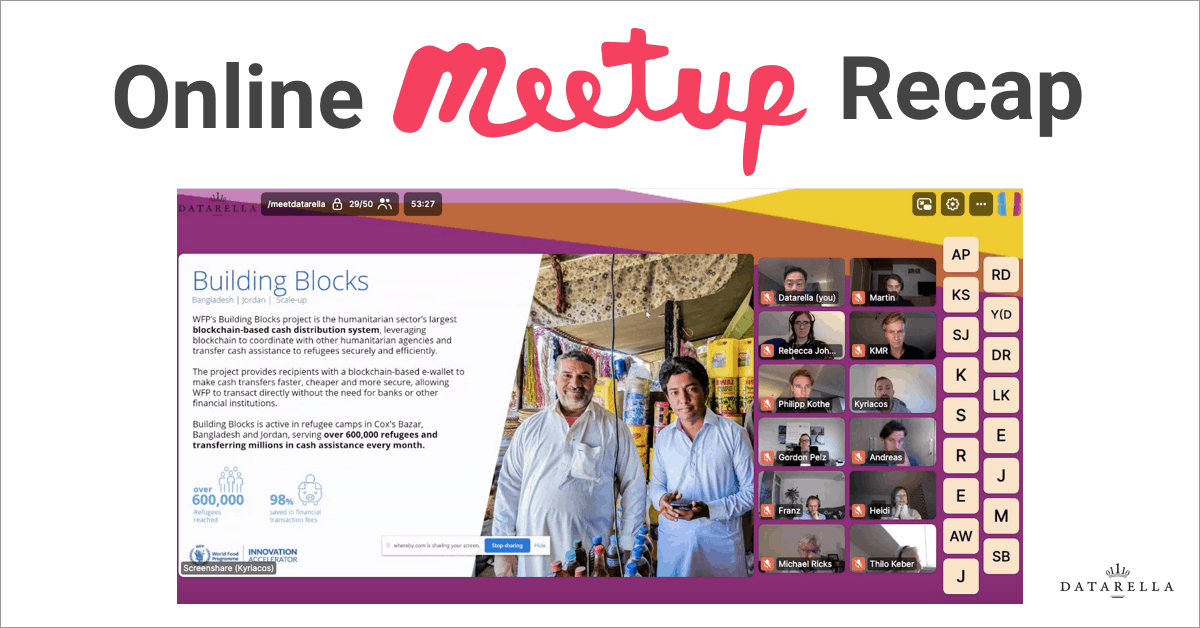
Not even COVID-19 can stop our meetups. However, since we did not want to risk the health of our audience, we decided to hold our 22nd Blockchain Munich Meetup online. No pizza, no beer, but insightful presentations of the application of blockchain technology in the aid industry.
First up was Kyriacos Koupparis, head of Frontier Innovations, WFP’s innovation accelerator. After we briefly celebrated that the World Food Program recently won the Nobel Peace Prize, Kyriacos gave us an overview of the various blockchain projects at his organization. Starting with our beloved Building Blocks project, which supports over 600k refugees in Jordan and Malaysia with cash vouchers for everyday purchases. Our blockchain-based system saved WFT millions of USD in foreign bank transfer costs. We at Datarella are very glad to help to maximize the value which arrives at the people in need. Next to using blockchain for finance, WFT sees the high potential in the application of blockchain technology to increase supply chain traceability. Here, we also completely agree with WFP. As demonstrated with our Track & Trust project, Blockchain Technology allows bringing clarity to complex supply chains by documenting each handover in the T&T Blockchain.
The next speaker was Franz von Weizsäcker, Head of Blockchain Lab at Deutsche Gesellschaft für Internationale Zusammenarbeit (GIZ). The GIZ is leveraging blockchain technology for real-world use cases. Franz presented a project in Georgia, in which the Bitcoin Blockchain is used to document hashes of land registry titles. Also, the GIZ is applying blockchain technology for supply chain solutions. On the one hand, to enable tracking the origin of organic spaces, on the other hand, for digital certification, which aims for trade facilitation at customs offices. Further, it was very interesting to learn about a community currency project the GIZ has started in Cameroon. The project was inspired by the work of the Grassroots Economics Foundation in Kenya, which uses complementary currencies to overcome the shortage of national currencies in poor communities.
Our last guest speaker this evening was Gordon Pelz, who is on the Board of Trustees of the YOU Stiftung. Gordon presented to two projects, in which the YOU Stiftung leverages blockchain technology, New Baraka and SmartAid. At the New Baraka project, a slum close to Dakar, the capital of Senegal, has been turned into attractive apartment buildings. The inhabitants of the prior slum moved into the new houses. Ownership of the living spaces will be transferred after a certain period to its new residences. Here, blockchain technology comes into play and is used to document symbolic rental payments of the previous slum inhabitants. Saving the data about the payees and payments into a blockchain serves as evidence at the time of transfer of ownership of the apartments. The second use case Gordon presented was SmartAid, our next generation donation platform the YOU Stiftung had launched together with Datarella. By today, the YOU Stiftung has collected over 1150 EUR via the SmartAid web app. The first steps of building a water well in Ghana are initiated. More details about the project status are going to be communicated soon via the project’s donation tracker. For more information on SmartAid and the water project please checkout SmartAid or our news blog news.smartaid.digital.
We were very happy to hear that blockchain technology is applied in so many real use cases in the aid industry, allowing for efficiency gains, where they are most needed. Let’s leverage the benefits of blockchain technology to make our world a better place for everyone.
We are looking forward to seeing you at our next meetup again.
Why do we sign a contract or a bill? In our everyday life, signatures are often used as a handwritten mark to make proof of identity and intent. In public blockchain networks, participants cannot necessarily trust each other. Everyone can potentially claim to be the owner of a blockchain address and initiate a token transfer. Further, even if the message is from the owner of a blockchain address, corrupt nodes can manipulate the content, e.g. changing the beneficiary to their benefit. That’s why we need digital signatures, which allow confirming the authenticity and integrity of a message.
In this slideshow, you will learn about what digital signatures are and how they are created, using asymmetric cryptography and hash functions. Enjoy!
During this study, we will work on a concept for an emissions trading register based on DLT. We will make recommendations to the Federal Environmental Agency with regards to the requirements to a DLT trading platform such as usability, scalability, performance, interoperability, security and sustainability.
Ongoing climate change is one of the major global challenges we face today. As a result, a cross-border European emission trading system (EU-ETS) is one of the EU’s most relevant tools against global warming. So far, its success is threatened by fraud and lack of transparency. Stakeholders acting in this system also complain about the absence of incentives to actually reduce emissions. With this study we will prove that by the use of Blockchain technology most of these issues will be solved thanks to the decentralized and transparent characteristics of a DLT system.
We are very much looking forward to working on this study with our partners CapGemini and FSBC in close cooperation with the German Federal Environmental Agency. We will of course keep you updated on any results we achieve.
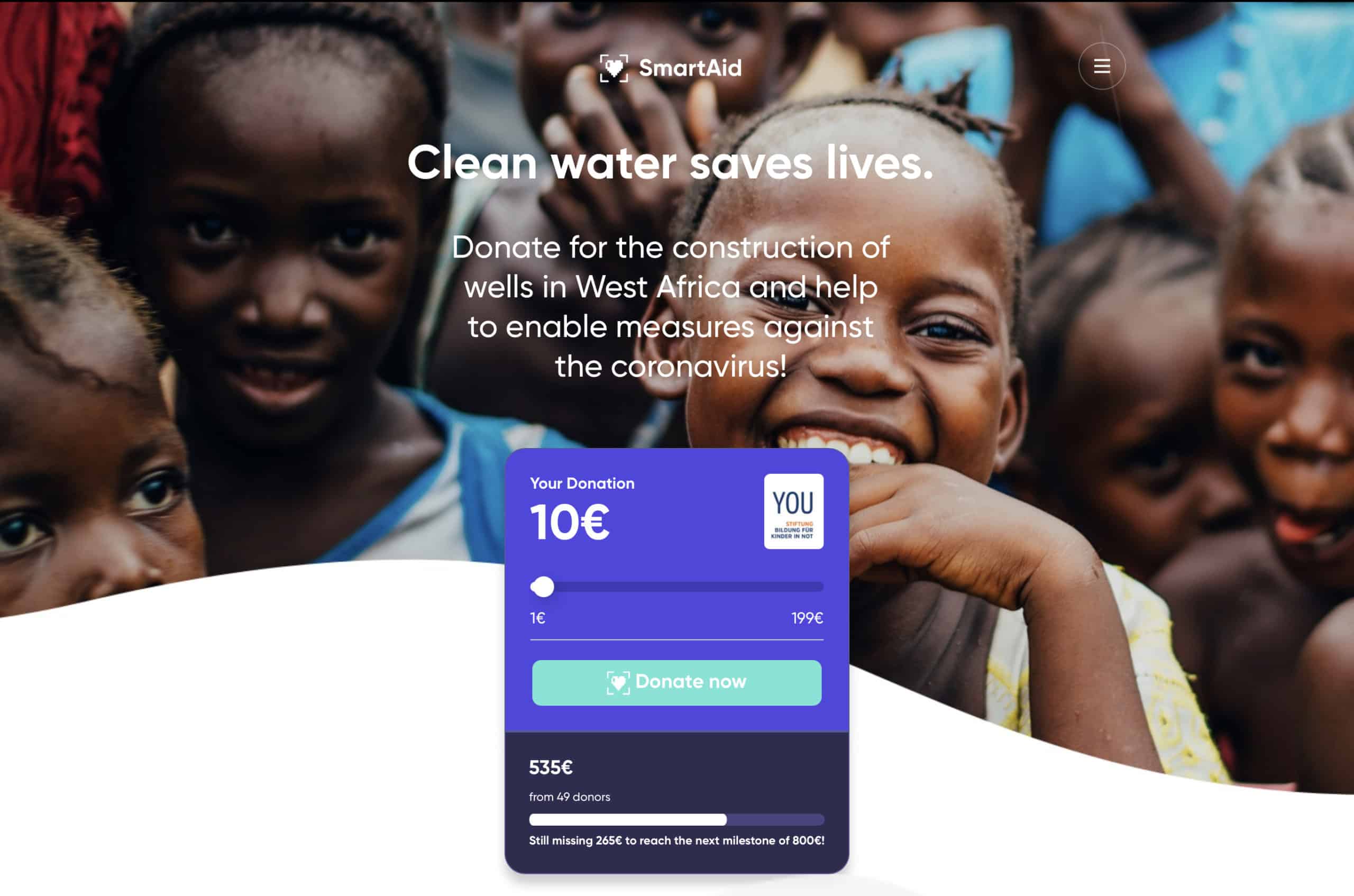
A few days ago, we launched our new blockchain-based donation app SmartAid that allows for traceable donations to charity projects all over the world. The first charity project is YOU Foundation’s “Water for West Africa”, collecting money for the construction of freshwater wells that provide West African communities with drinking water and allows for improving hygienic standards fighting the coronavirus.
SmartAid has been designed as a web app; i.e. you don’t have to download it from an app store but you simply surf to the URL www.smartaid.digital in your mobile or desktop browser and start donating, immediately. The donation process is very simple and (should be) self-explaining: you choose the amount you want to donate, you select the PayPal or credit card payment option, and confirm your donation. Done.
Since in 2020, there are thousands of different smartphones, running on millions of different versions of operating systems, even the most simple online process can result in unexpected effects; s.a. a page not loading, or a text not showing up.Since we want to make the donation experience as pleasant as possible, we’d like to invite you, and your friends, to join us and help to improve SmartAid! Donate – you could start with just 1 EUR – and send us your feedback. Although we are most interested in potential bugs or any inconveniences you might experience, of course, we’re also very happy to hear about positive experiences while donating!
It would be great if you could support us in refining and optimising SmartAid – and our friends over at YOU Foundation will be grateful for your donations that support West African rural communities! Thank you!
We are proud to announce that SmartAid is under the winning team of two EU funded Horizon 2020 programs: Blockchers and Blockpool.
SmartAid is the next generation marketing, funding and reporting tool for non-profit organizations, seamlessly connecting donors with charitable projects. Blockchain technology allows SmartAid to introduce a new era of transparency, efficiency and effectiveness within the aid industry. By drastically reducing costs, SmartAid maximizes the value, which arrives at the people in need.
The Background
Our world is facing global challenges. Next to the almost ordinary crisis, like natural disasters, the effects of climate change, and wars, we need to deal with the pandemic outbreak of COVID-19, which has been tragic and costs many lives. However, while the economic consequences are going to hurt developed countries, they are going to be devastating for the developing world. Already before the pandemic, over 200 million people were assessed in need of humanitarian assistance. To fight sorrow and misery, to create perspectives for humans living in less privileged countries and to turn our world into a better place for everyone, requires the help of the wealthy population. In the year 2019, over 25.3 billion EUR have been donated worldwide for international humanitarian assistance, almost 2 billion EUR from EU institutions alone, and over 2.5 billion EUR from Germany. (1)
The Problem
In poor countries, even small amounts of money can make the difference between sending your kid to school or sending them hungry to bed. Unfortunately, any type of costs diminish the value, which arrives at the people in need. SmartAid addresses the high costs, arising through a lack of transparency and automation in the charity industry. Opaque and outdated systems result in high expenses for both donors and aid projects. For receiving organizations, financial reporting to their sponsors is related to substantial efforts. In return, the financiers also need to invest money to audit their aid projects. Manual reporting is not only costly but also vulnerable to human error and even fraud. Corruption is often an issue in aid-receiving countries. Furthermore, uncertainty about whether their donations indeed arrive at the intended destination might reduce the willingness of private donors to contribute. In addition, the costs related to foreign fiat currency transfer are exorbitantly high. Bank fees, which eat up to 30% of the transaction volume, are no rarity. Furthermore, once donations are transferred and covered into the local currency, funds are exposed to high inflation risk, possibly making them worthless within weeks. Last but not least, measuring the impact of a donation today is very costly and can be only vaguely estimated through long term studies and surveys.
The Solution
Transparency and automation allow the creation of efficiency gains. SmartAid eliminates unnecessary cost drivers, caused through manual reporting systems, in the charity and non-profit industry. In the current development phase, SmartAid uses a pull approach to mirror donations in fiat currency, like Euro, on the SmartAid blockchain. A PayPal API connects the traditional fiat payment world with our blockchain system, where all funding streams are documented tamper-proof, transparent and in historical order. For each donor, an individual token contract is deployed, a matching amount of tokens minted, and transferred to an address, representing the beneficiary’s bank account. By representing individual donations through a unique – thus distinguishable token, full transparency about the usage of each donor fund can be provided. This allows users of SmartAid to trace the journey of their very own donation. Certainly, also, outgoing payments are documented on the SmartAid Blockchain fully automated via the PayPal API without the costs and risks of manual accounting.
In future development stages, SmartAid can switch to a push approach. In that case, aid projects can use tokens received in multiple ways and leverage their utility. Tokens will be redeemable as vouchers at the SmartAid platform for national currency.
Further, these value units are going to be transferable to addresses, representing cost centres within an organization. Also, tokens will be usable as a medium of exchange between the charity organizations, aid implementing projects and final recipients without intermediaries, bank fees or inflation risks and fully transparent. Lastly, it will be possible to create new project tokens, leveraging a donor fund backed reserve to increase the liquidity. The digital documentation of newly created project tokens allows non-profits and their financiers to automatically measure the impact and the value created by a donation. This will allow an effective fund allocation in the future, maximizing the generated value.
Why Blockchain
Blockchain technology allows SmartAid to document transactions in a transparent, tamper-proof, and trustless way. Distributing copies of the ledger, which keeps track of the past and current state of the SmartAid ecosystem, makes it secure and eliminates the risk of any single actor manipulating the history. Also, blockchain allows creating and managing new vouchers aka. tokens in a secure manner at neglectable costs.
Join SmartAid
If you want to learn more about SmartAid, check out our previous posts. Please feel free to contact us if you want support SmartAid by becoming a sponsor or have interesting project proposals.
Just like your home address, bank address, or email address a blockchain address is a unique and secure identifier. This identifier, saved on a blockchain, can be used for sending and receiving cryptocurrencies. However, in contrast to traditional addresses, blockchain addresses are not assigned by centralized authorities. These addresses are mathematically derived from a user-generated private key.
Learn more about blockchain addresses and the two types, which exits in the Ethereum Network, in our Datarella Blockchain Bites slideshow of this week: Blockchain Addresses.


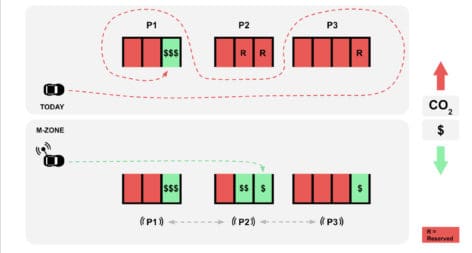 Upon implementation, AEAs (Autonomous Economic Agents) will support the sustainable and efficient use of city infrastructure in Munich through an application where they will autonomously negotiate the ‘price’ of parking spaces between the holders of parking spots, and those looking for parking spaces. Users can earn rewards in the digital currency if they choose less popular or in-demand parking spaces (or do not use the parking lot at all on some days). The Carpark AEA determines the reward levels to maximize resource usage.