
by SPR | 25 August 2023 | Autonomous Agents, Blockchain, Events, Featured, moveID, Partnerships, SSI
The Convergence of AI and Web3 in Decentralized Mobility Solutions
As noted by the venture capital firm Andreessen Horowitz, AI and Web3 are converging technologies that leverage decentralized networks, self-sovereign identities (SSI), autonomous agents, and machine learning. These innovations enable new business models and streamline business processes, particularly in the realm of decentralized mobility solutions. A crucial success factor lies in integrating these technologies with existing business processes. Collaboration between innovative AI and Web3 startups and established industry leaders is essential for driving impact and fostering innovation.
At IAA Mobility, AI and Web3 startups collaborate with industry players and universities in the moveID consortium. They are showcasing a state-of-the-art smart city solution called MOBIX Park & Charge. To meet the project’s goals, positioning innovative cutting-edge solutions is vital. These solutions leverage data to redefine the technological landscape, heralding a data-driven revolution. The synergistic trio of Fetch.ai, a long-time partner of Datarella, along with peaq and Ocean Protocol as moveID partners, is making significant strides forward. This initiative is further supported by solution providers and integrators like Datarella, DeltaDAO, 51Nodes, and university teams from htw saar and Zeppelin University.
Fetch.ai: Bridging AI and Blockchain
Datarella partner Fetch.ai seamlessly combines artificial intelligence (AI) with blockchain technology, unlocking new possibilities across various sectors. These possibilities include autonomous machine economies, smart cities, and efficient resource management. The Fetch.ai platform provides a decentralized infrastructure for Microagents capable of executing tasks autonomously.
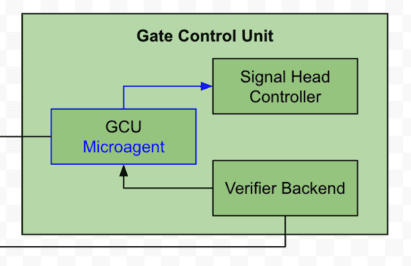
In the context of MOBIX Park & Charge, Microagents act as bridges between different software components on edge devices. This setup enables autonomous control over various systems, such as traffic lights.
Microagents in Action
Fetch.ai Microagents serve as multifunctional intermediaries. They communicate and initiate processes in external systems, handling complex tasks like:
- Managing crypto wallets
- Ensuring secure payment transfers
- Verifying events
- Controlling access to hardware such as gates, traffic lights, and chargers
In essence, Fetch.ai Microagents automate tasks on behalf of human clients, streamlining processes and enhancing efficiency. These functionalities contribute significantly to the development of decentralized mobility solutions.
peaq: Empowering the Economy of Things
As automation surges, the peaq network emerges as a key player in sharing its benefits with everyone. It fosters the Economy of Things by establishing a crucial layer-one blockchain infrastructure for decentralized mobility applications.
Peaq’s technology stack and economic incentives enable the development of applications for machines in this emerging economy. For instance, it powers electric vehicle (EV) charging applications. The peaq token fuels the entire ecosystem, facilitating digital identities for machines and enabling seamless payments.
In MOBIX Park & Charge, peaq allows communication with charging points, using peaq tokens to initiate and pay for EV charging processes.

Ocean Protocol: A New Data Economy
Ocean Protocol aims to unleash its potential for individuals and organizations alike. It empowers secure data sharing (Compute-to-Data), selling, and monetization while ensuring control and privacy. Users retain the power to determine who accesses their data and how it is used.
This establishes a novel paradigm in the data economy, especially for AI models in the mobility sector. In MOBIX Park & Charge, Ocean Protocol integrates its decentralized data marketplace technology. This facilitates sovereign and privacy-preserving data exchange within mobility applications.
Key Components of Ocean Protocol
Key components of Ocean’s data pricing mechanisms include Compute-to-Data and a Gaia-X-compliant Self-Sovereign Identity (SSI) approach. Additionally, Ocean solution provider DeltaDAO collaborates to implement the Ocean Tech Stack. In future versions of MOBIX Park & Charge, the goal is to simplify data sales for IoT devices. These devices will automatically sell data directly on the Ocean Marketplace or through Compute to Data. Fetch.ai agents possess built-in intelligence, allowing IoT devices in cars to decide when and how to post data to the Ocean Marketplace based on traffic situations.
Conclusion: Paving the Way for a Data-Driven Future
The versatile infrastructure of peaq, the automated decision-making capabilities of Fetch.ai’s Microagents, and Ocean Protocol’s sovereign data exchange mechanism synergistically converge to facilitate MOBIX Park & Charge. As we stride toward a data-driven future, these technologies pave the way for decentralized mobility solutions that could profoundly reshape mobility.

by SPR | 4 July 2023 | Blockchain, Featured, Track and Trust
Datarella and its partners Weaver Labs and OroraTech are proud to announce: Track & Trust has successfully passed the Factory Acceptance Test of the European Space Agency (ESA)! The development of Track & Trust has been successfully completed, undergoing rigorous testing procedures. Now, it is time for Track & Trust to showcase its capabilities and create value in a real-world deployment.
*** Visit our new Track & Trust website for more information ***
Track & Trust combines modern Web3, communication, and satellite technologies, creating a robust supply chain solution that caters to the actual needs of users. By leveraging these cutting-edge advancements, Track & Trust allows logistics companies and humanitarian organizations to navigate complex scenarios, such as aid supply coordination in regions with compromised or non-existent communications infrastructure. Even in remote and disconnected areas, Track & Trust provides the transparency and authentic data required for efficient operations.
From the very beginning, efforts were made to understand the requirements in the field of logistics precisely. Real logistic processes were examined to identify their weaknesses. We have dedicated ourselves to developing a robust system that ultimately had to meet high stress criteria in the testing procedures required by the ESA, which funded the project with about EUR 1.5 million. We went through a complex development process where partners with three different technologies had to position their core competencies appropriately while integrating them seamlessly to become more than the sum of their parts.
The product – introducing Probabilistic Supply Chain Tracking
Unlike traditional supply chain solutions, Track & Trust offers a probabilistic approach to tracking goods. Any interaction with the shipment, including scanning a Track & Trust QR code, triggers a status update, providing as much information about the shipment as possible! It is ultimately up to the client which information to utilize. Track & Trust’s emphasis on data collection unlocks a world of possibilities for process innovation. By leveraging the data obtained from the operational area, logisticians can complement and expand their services in new and exciting ways. This data-driven approach opens doors to potential future extensions, such as training AI models to predict delivery shrinkage, stock levels, and route recommendations. By harnessing the power of data, Track & Trust generates added value for logistic companies’ customers, offering new competitive advantages in the industry
What lies ahead in the journey of Track & Trust?
We have successfully completed a significant milestone with the Factory Acceptance Test. Concrete processes with our partners are already being planned for the upcoming pilot phase. In the coming weeks, these plans will be further refined, and the delivery of Track & Trust system components will be carried out in the most suitable deployment area where it can achieve the greatest impact and benefit. We will announce the specific deployment scenario in our future blog posts. So, stay tuned!
Our next milestone is the Site Acceptance Test. Here we will conduct another series of tests under real conditions before the system is used for the first time by logisticians and partners.
We are excited to demonstrate the impact and benefits of Track & Trust very soon and to revolutionize the supply chain sector with its technological potential!

by SPR | 13 February 2023 | Blockchain, Featured, Track and Trust
Track & Trust – the satellite-powered supply chain solution by Datarella is coming! Track & Trust combines a set of modern Web3, communication, and satellite technologies and aims to address major unsolved challenges of today’s supply chains. Once completed, it seeks to prove its reliability in the most challenging regions of the world.
The supply chain industry is facing massive changes through technological evolution. Led by Datarella, a consortium with our partners Weaver Labs and OroraTech has realized the opportunity to merge blockchain, network and satellite technologies to create a unique supply chain solution that meets the actual needs of its users. With its investment in Track & Trust, the European Space Agency (ESA) underlines the potential of this unique project. We at Datarella are proud of the progress the project has made since its kick-off in 2021. Track & Trust is currently in its late development phase and is scheduled to be ready for deployment by 2023!
What makes Track & Trust so innovative?
Today’s delivery processes face complex challenges – especially when dealing with crisis scenarios involving aid supplies and when the technical conditions on the ground are poor, but the demands for reliability and accountability are high. Logistics companies and humanitarian organizations, like our partner Aid Pioneers, are then faced with the challenge of coordinating aid supplies in regions where the communications infrastructure has most likely been destroyed. To ensure that goods arrive where they are supposed to, sufficient transparency, especially in these remote and disconnected areas, is required. Ultimately, it is not only a matter of transmitting information about the aid supplies but also of ensuring authentic undistorted data that reflects the actual facts on the ground.
What impact can Track & Trust have?
With the help of satellite technology and network technology, we intend to span the Internet over those separate areas that have no or insufficient Internet connection due to the crisis. In other words, we are putting a lot of effort into tracking deliveries right down to the last mile, which is unique in this way. Emerging from such a challenging demonstration, Track & Trust ultimately proves its suitability for any commercial application. Track & Trust holds the potential to change the logistics industry by increasing efficiency, transparency, and security.
So, it stays exciting! Stay tuned for updates on Track & Trust!

by SPR | 5 May 2022 | Blockchain
The German Environment Agency (UBA) commissioned the Frankfurt School Blockchain Center, Capgemini and Datarella to elaborate a feasibility study on the use of DLT in today’s emissions trading registries. Datarella is happy to announce its successful completion.
The aim was to evaluate whether the DLT is suited to efficiently represent the current European emissions trading system (EU ETS). The insights generated by the project partners will support policymakers in informed decision making with regards to the question of whether to remain with a traditional architecture or with a central relational database. For this purpose, the technical concept of an emissions trading DLT and the consideration of the efficiency and sustainability of an emissions trading DLT were explored. As a result, we were able to demonstrate how Emission Allowances can be represented on the blockchain. Hereby, the scope of an emissions trading system can be significantly expanded without extensively altering users’ current user experience .
As a key benefit, our DLT solution offers a robust infrastructure that is secure against manipulation attempts. Additionally, with DLT, well-known advantages such as transparency and traceability can be established in emission trading systems. Our concept also provides sustainable and energy-saving operability of a DLT-based emissions trading system.
The Frankfurt School Blockchain Center, as coordinator of the project, has contributed dedicated scientific blockchain expertise. Capgemini provided a rich set of expertise in carbon trading, registries, and private blockchain implementation. Datarella as a Web3 solution provider contributed comprehensive implementation expertise of enterprise blockchain solutions.
The result of the feasibility study was highly satisfactory for the client. In the future, the result will be presented to a larger circle of interested stakeholders.
by SPR | 27 October 2021 | Autonomous Agents, Blockchain, Featured, MOBIX, SSI
In this blog post, we look at the potential of service automation through autonomous economic agents in Blockchain-based systems. Datarella’s partner Fetch.ai has made it their mission to combine intelligent agents with blockchain technology in several use cases. Deep Parking is one of them, and using a specific example from MOBIX here you can get a feel for the potential of autonomous agents.
The path to the fourth industrial age is being paved by the interplay of Big Data-driven automation, robotics, IoT and Distributed Ledger Technologies, aka Blockchain. Given the increasing amount of data, and the number of digital services that go hand in hand with this progress, the need to automate them is also growing. Users should be relieved of unnecessary work and offered optimal results.
Agents take on the role of autonomously performing tasks on behalf of their clients (individuals or objects). For this purpose, they can also interact with each other. Intelligent agents can make complex decisions by using ML, i.e. AI-powered algorithms, based on large amounts of data.
A blockchain, with its data supply, offers a particularly favourable environment for intelligent agents. The data of a blockchain are permanently available and are logically related to each other. Decentralisation can offer robustness (no single point of failure) and lower transaction costs. Agents can assume a fully autonomous identity on a blockchain through private keys. They can use it to authenticate themselves and communicate their suitability for certain tasks. Agents can use shared protocols (possibly through smart contracts) to coordinate, collaborate efficiently, e.g. by distributing complex tasks among themselves. They can negotiate and make distributed decisions (even though voting processes use their blockchain). Tasks, goals or motives of agents can be recorded in the blockchain and economic incentives can be set for optimal task performance.
With regard to the IoT, a blockchain (as a single point of truth) can integrate various sub-systems, s.a. smart household appliances, smart buildings, smart districts and smart cities, and create added value for all agents participating in the network. Fetch.ai is an example of how intelligent agents can realize automated services based on blockchain technology.
Among the use cases of Fetch.ai, we would like to highlight agents for mobility services – traffic sign agents, parking agents for Deep Parking, agents for eMobility, agents for trains and stations that could even form a decentralised train network. In the process, increasingly intelligent autonomous agents interact on behalf of people or infrastructure, searching for each other, negotiating with each other in the interest of offering their users optimal solutions. In such a case, an autonomous agent of a car could, on behalf of its owner, seek and negotiate with agents working on behalf of parking lots to navigate the car and its owner to a quick and cheap place to park. With Deep Parking at the IAA in Munich 2021, the potential of agents for such use cases becomes clear.
There it was demonstrated how agents negotiate their resources on behalf of vehicles, their owners and the infrastructure to find an optimal solution for everyone without further efforts for the users. The following graphics show an excerpt from the exemplary communication between the agents involved.
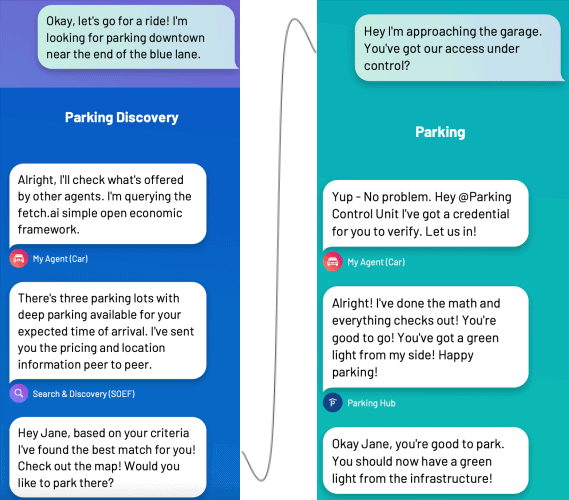
In this case, a user named Jane is looking for available parking space in the city centre. Without Jane having to do this herself, the agent in her car (My Agent (Car)) looks for another agent who offers a parking space via a specific (agent-)network (SOEF). Using Blockchain technology, agents handle authentication, price negotiation, reservation and even payment, autonomously according to their client’s preferences. When Jane approaches the parking lot, access is automatically granted to her car without further ado.
As shown, the scope of tasks autonomous agents can perform and the added value they can contribute is without limits. So, by using autonomous agents, the potential of Blockchain technology can be leveraged for all use cases where handling of huge amounts of data in real-time or near-time is needed.
by SPR | 30 September 2021 | Ask Datarella, Blockchain
A bug bounty program is used to inspect protocol code and rewards inspectors if bugs are found successfully. Code and product quality can be increased significantly by such swarm intelligence. Therefore, MOBIX stands on a solid foundation as it leverages the Fetch.ai blockchain.
Even the best developers make mistakes. In order to gradually eliminate resulting bugs, a good solution is to motivate numerous competent inspectors to search through protocol code and identify weak spots in the code. Such vulnerabilities may be lucrative for blackhat hackers, so it is important to create appropriate incentives for whitehat inspectors to work as thoroughly as possible. Considering the follow-up costs that programing errors can result in, this can often be a very sensible investment.
Bug bounty programs are open to the public for this purpose, in order to acquire as many technically skilled inspectors as possible for a bug hunt. So-called “Full Disclosure” documentation discloses the program bugs completely publicly, while in the “Responsible Disclosure” model, only the originator is informed about the bugs for a limited time to have enough time to solve the problem. Responsible Disclosure is usually utilized when bug concerns a severe vulnerability to a live system which has not yet been exploited by attackers. One such case was the Zcash Counterfeiting bug discovered by the Electric Coin Co. in 2019.
Our partner, Fetch.ai launched a bug bounty program which ran from mid-2019 until the recent migration to the mainnet, which took place on 20 September 2021. There was a public call to inspect the code on Fetch.ai‘s Github ledger repository and report bugs as a Github issue, ranging from critical to low risk level. Depending on the severity of the bug, a reward of up to $10,000 in FET was available.
We mention this because our latest project, MOBIX is deployed to the Fetch.ai blockchain. In essence we’re able to leverage both the Cosmos SDK and Fetch.ai as a foundation for MOBIX. Due to the bug bounties run by Fetch and by the Interchain Foundation to assure code quality the chances of any kind of problem is significantly minimized.
