World Food Programme’s Building Blocks system is one of the best examples to understand how Blockchain technology can help to fight against COVID-19. Building Blocks is a Blockchain-based fully digitalized payment and bookkeeping system for any types of cashless transactions developed and further scaled up by Datarella and its subsidiary Baltic Data Science. Today, the Building Blocks is successfully up and running in Jordan since 2017 and expanded to Bangladesh by the end of 2019 by serving hundreds of thousands refugees in WFP’s refugee camps. Here’s how Datarella is leveraging Blockchain to support UN WFP in fighting COVID-19.
It’s been a while since Datarella successfully applied for an open call initiated by the WFP innovator programme in 2016. With this tender, WFP was evaluating whether Blockchain technology can help to improve the inefficiencies they were facing with paper vouchers issued to refugees in their camps for daily groceries. At that time, nobody was aware of a virus called “COVID-19” and working exclusively from home was simply unimaginable. But times have rapidly changed since the beginning of 2020. Today, we are facing probably the most severe economic downturn and human tragedy, affecting hundreds of thousands of people since WW2. .
So how can the Building Blocks system help against the coronavirus? For this to understand, you need to know what the system does. As said, Building Blocks is a payment and bookkeeping system for any cashless transactions helping refugees in camps to make their daily shoppings. Every month, the refugees receive a certain amount by WFP as digital food vouchers that can be used in the village’s supermarket.
There are two aspects to the Building Blocks system that helps to fight against the coronavirus. Both has to do with contactless interactions amongst the participants:
Cashless Payments The Building Blocks system is built on a private Ethereum network. Every single transaction between a refugee and the supermarket is validated and recorded on the blockchain. The advantages are apparent. With the help of Blockchain, these transactions are executed cashless, meaning fully digitized without the need to get in physical contact with the other person. By the way, after the World Health Organization WHO released a statement on March 9 recommending that people turn to cashless transactions to fight the spread of COVID-19, a number of governments and retailers across the world took action. Not directly related to the fight against the coronavirus, other benefits of a Blockchain-based payment system include minimized risk of fraud and data mismanagement.
Contactless Identification: In both countries Jordan and Bangladesh, where Building Blocks is up and running, refugees are able to authorize themselves for cashless payments without getting in direct physical contact with the counterpart. In Jordan, the authentication is performed through a system called IrisGuard. IrisGuard is an end-to-end iris recognition, verification, financial authentication and targeted cash transfer platform which removes the need for any form of ID such as username, password, card or pin. In Bangladesh, the Building Blocks system uses a different method for the identification. It was originally a fingerprint-based process, i.e. it was touch-based. However, due to the coronavirus pandemic, we changed the authentication procedure from a touch-based to a contactless system. Today, a QR code is issued to every single refugee who is entitled to receive aid by WFP.
In this recent article published by WFP, you can read more about the story of Building Blocks in Bangladesh and how leveraging blockchain to support UN WFP fighting COVID-19.
Please stay healthy and safe in these challenging times!
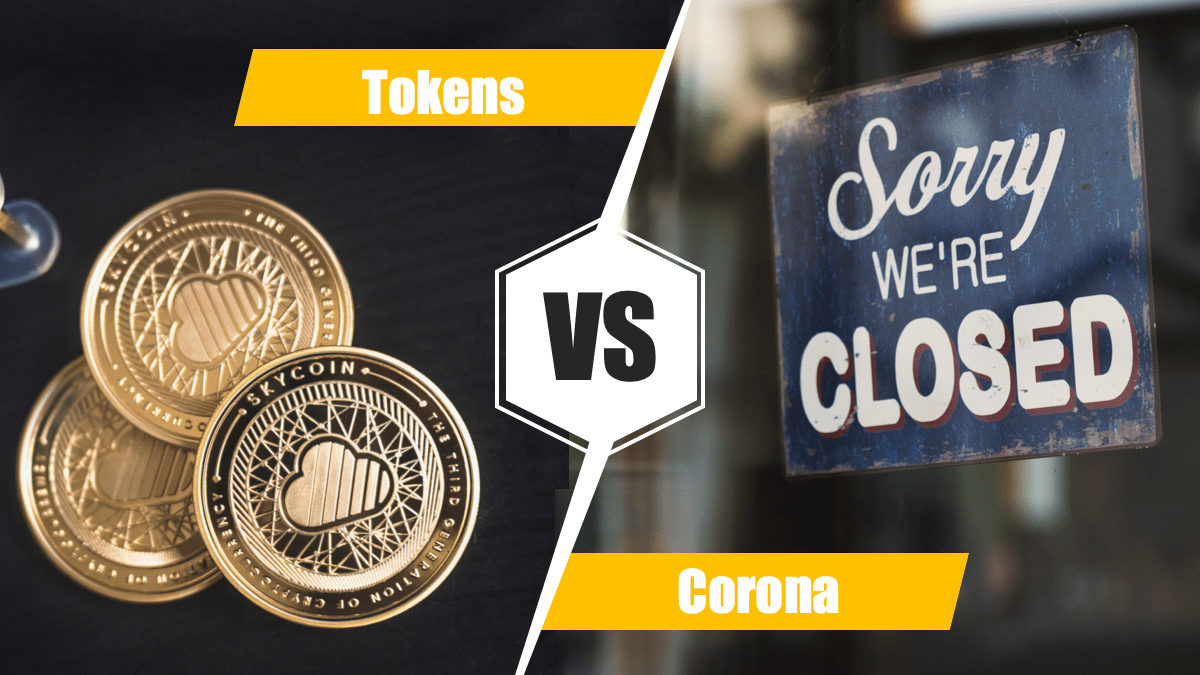
The Bavarian government is promising EUR 10 billion, the German government EUR 600 billion, and the US-American promised USD 1000 billion in financial aid as a countermeasure to fight the economic effects of the Corona crisis. This is a huge effort and we all hope that it will soften the economic consequences of global lockdowns. However, where will all this money go? What criteria is used to distribute it? Who reviews the applications? What will be the impact of injecting vast amounts of money into the market while the effects of the pandemic are highly limiting the production of goods and services? Here’s how Blockchain technology could help: Tokens vs Corona – A blockchain voucher system to distribute grants.
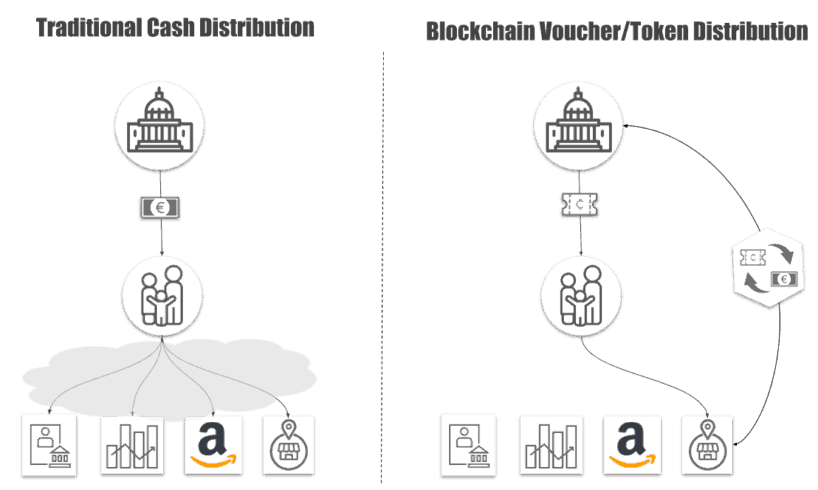
As we described, a payment distribution system like WFP uses to deliver cash to over 500.000 refugees in Jordan, could also be used to distribute financial aid of governments to citizens and businesses efficiently. In this post, however, we want to take a look at an alternative that could be distributed instead of traditional national currencies, let’s call them blockchain vouchers or tokens.
Tokens vs Corona – A Blockchain Voucher System To Distribute Grants
Distributing EUR or USD directly to businesses and citizens grants beneficiaries the ability to use the funds how they want. They might spend it locally, to support local business, they might put it in their bank account and save it for better days, they might invest it into the company shares or buy stuff at Amazon. Due to a lack of traceability, it’s impossible to measure the usage nor the impact of helicopter money precisely. Tokens, however, are programmable. This characteristic allows the issuing entity to predefine limiting spending parameters. For example, the government could define that it is only possible to spend these tokens on small and medium-sized businesses, located close to the consumer and within the next three months. Therefore, programmable tokens allows to create a more precise and target-orientated tool of governmental economic development aid.
dgE Krisengeld
An interesting concept of implementing blockchain vouchers was proposed during the WIRVSVIRUS hackathon, which has been organized by the German government to find innovative solutions to encounter the corona crisis. The project goes under the name dgE-Krisengeld, dgE stands for “dezentraler gemeinschaftlicher Euro” (decentral common Euro). However, informally the project is known under the term “Diggi”, a homonymous which predominantly German teenagers use as a form of address, like dude or mate.
The concept and can be summarized in three steps.
Distribution
Spending
Redemption
The government could distribute Diggis to citizens via a letter using their tax ID. Consumers could then scan a QR Code and set up a wallet, which allows manage their Diggis. In the next step, citizens could spend their received Diggis at participating businesses. Therefore, the consumer could scan a QR code provided by the cashier to conduct a payment. However, since most companies cannot welcome customers at the moment, an online alternative point of sale for small businesses is required. A solution could be an opensource e-marketplace, like Openbazaar, which enables small businesses to sell their goods and future services for Diggis without paying any fees. In the last step, businesses could then redeem their received Diggis at the fiscal authority for real Euros.
The overall concept received positive resonance by German politicians. Dorothee Bär, the German State Minister for Digitalization, called the Euro token an interesting complementary system to a blockchain-based business register, which would allow especially smaller companies to participate in aid programs.In summary, the Diggi concept provides two main benefits:
Decentral empowerment
Local impact
Since consumers decide at which businesses they want to spend their Diggis, governmental aid would be automatically allocated to companies, perceived as valuable by the market. Diggi tokens could be programmed in a manner, that they are only spendable at business registered close to the consumer, thus creating a local impact.
Local Currencies
The concept of having a medium of exchange, which only can be “spend in a particular geographical locality at participating organizations,” is by no means novel nor innovative. It reflects the ancient concept of local currencies. Through limiting spending opportunities, these currencies stay and continue circulating in a particular community, which has economic benefits for this group. However, the limited spending opportunities, a lack of exchangeability, and relatively high cost related to managing these currencies are also their major drawbacks.
Luckily, Blockchain technology allows us to eliminate these weaknesses:
The costs of issuing and managing a digital currency becomes marginal and requires only a couple lines of code.
A common reserve allows to connect multiple local currencies, making them interchangeable and automatically adjusting their exchange rates. This is enabled by bonding curve contracts (next to the word “token” my favorite term at all), which will be the topic of a future blog post.
A concept of interconnected blockchain-based community currencies is brilliantly implemented by Will Rudick and his team at Grassroots Economics to inject liquidity into poor areas of Kenya and other African countries.
The Future of Donations
I am very proud to announce that we at Datarella are working at full speed together with two partners of the financial and the humanitarian sectors, to develop a solution to support the fight against the Coronavirus in Africa. This solution will be using tokens to add transparency to the field of donations – providing the donor with the certainty that her contribution was received by the people who need it. An official press release describing our Traceable Donations product will follow shortly. Stay tuned!
Self-Sovereign Identity (SSI) is increasingly mentioned in connection with innovations and digital identities. Even in the context of the coronavirus crisis, SSI finds possible applications, such as the possible use of a tracking app for infected people or as a digital staff “passport” in hospitals that respects each user’s privacy. To support others in classifying SSI correctly, we are now publishing a series of blog posts that explain components of SSI. The first part of the introduction to Self-Sovereign Identity focuses on the three essential components – DIDs, DID Documents and Verifiable Credentials.
As already described in detail in the first blog post, Self-Sovereign Identity offers the user the possibility to manage their own digital identities completely autonomously. There is no platform or provider, such as an email address provider or a social network that controls identity. This is achieved using an underlying blockchain or a DLT on which key pairs can easily be generated that serve as identity representation.
Decentralized Identifiers
Now we come to the first component – the Decentralized Identifiers (DIDs). Their purpose is to act as a unique identifier of the person or object. These are derived from the public keys and can be identified over various blockchains. An example DID is shown below.
DIDs follow a general syntax: the schema (did:), the method (sov:) and the method-specific identifier (WRfXPg8dantKVubE3HX8pw). While the scheme is always the same, the method that describes how a DID is derived from a blockchain (here: Sovrin) and the method-specific identifier bo depend on the underlying blockchain. However, DIDs alone don’t bring any value.
DID Document
What fills a DID with life is the DID Document. This piece of data describes the DID object and its properties. By default, it contains the associated public key to a DID. However, it is also possible to add more public keys to the DID document that are authorized to perform actions in the name of a DID. Moreover, a DID can contain different types of attributes and service endpoints that allow the actual interaction with a DID. Changes to a DID Document can only be made by authorized public keys defined in the DID Document. An example DID Document with authorized public keys.
Verifiable Credentials
Now, that it is possible to identify an entity and to interact with it, is possible to attach information to the digital identity. This can be done with Verifiable Credentials (VCs) that act as an attestation or a digital representation of a credential such as an ID, a driver’s license or a club membership card. A VC consists of three main values:
The issuer’s DID and signature
The entity’s DID
The information that is attached
Based on these three fragments, third-party verifiers can immediately determine the authenticity of the object by looking up the issuer’s DID. Verifiable Credentials are in possession of the DID owner that it was issued to and can be stored in a wallet. However, the issuer can always revoke the VC and adding it to the revocation registry that should be publicly visible.
These three components serve as the basis for a decentralized, trustless identity ecosystem that doesn’t rely on centralized authorities. DIDs identify an identity over, the DID Document describes the DID and a Verifiable Credential attaches verifiable information to a DID. Users are in sole control of their identity and can decide how information is shared and with whom.
However, this was only a small part of the entire SSI infrastructure. Part 2 of the Introduction to Self-Sovereign Identity components is about DID resolution, the process of resolving a DID Document from the DID, and DID authentication.
If you have any questions about SSI or want to leave feedback, feel free to contact me.
The Building Blocks payment system that Datarella has developed for the UN World Food Programme may serve as a blueprint for highly efficient distribution of financial transfers during the Corona crisis. The Building Blocks system was launched on 1 May, 2017, and since has supported several hundreds of thousands of Syrian refugees with their payments in Jordanian camp supermarkets. We at Datarella envision a similar system for disbursements of Corona-induced money transfers by governments and state agencies: Datarella can deploy a blockchain disbursement system for Coronavirus aid at short notice.
How Building Blocks Works Donor countries provide the UN High Commission with funds for specific use in refugee aid. The UN High Commission forwards the funds to the WFP. The WFP administration in Rome is part of the Building Blocks Blockchain, through which all transactions in refugee camp supermarkets are processed. Every refugee receives a certain amount on their account each month, which they can spend for certain purposes. The refugee identifies herself at the supermarket checkout using the iris scan or ID app and has the amount incurred during his purchase debited from his account. The supermarket operator carries out a weekly transaction with the WFP administration in Rome and receives his money in local currency. Up to this point, all transactions have been carried out purely digitally in the form of blockchain transactions. With this process, savings of millions in bank and transfer fees are achieved. In addition to the highly efficient billing, there is no need for an additional audit by an auditor, since the building blocks system has been certified and blockchain technology guarantees the correctness of the transaction history.
Building Blocks for Corona Financial Transfers A system inspired by theBuilding Blocks system can be used for financial transfers in the corona crisis. The federal and state ministries of economics and finance operate system nodes and thus have full control. Other nodes could – but do not have to be – operated by process-relevant organizations such as BaFin, Landesbanken, IHK, chambers of handicrafts, auditing companies, etc..The complete set of rules, including all levels, conditions and dependencies, are programmed as smart contracts. The final payouts can also be automated.
For Citizens and Companies – For All Types of Corona Aid Every citizen and every company downloads an app that works as a wallet and that can be used to receive and send funds. The wallet also serves as an identification tool for the citizen or the company. The user fills out the application form for Corona emergency aid, loans, basic security or protection funds provided via the wallet. She uploads the necessary documents such as ID card via the wallet and sends the complete application. The user’s identity can be determined with a high degree of certainty via an additional ID function. If the authorized transfer recipient has been determined beyond doubt and automatically, the payment will be transferred to his account – also automatically.
We at Datarella are ready and working on a Building Blocks inspired version of a Corona Aid Disbursement System to be used in Germany, and the EU, we can deploy a Blockchain disbursement system for Coronavirus aid at short notice.
Other Approaches to Corona Aid Disbursements There are other approaches to address the urgent need for efficient distribution of Corona-based aid. We can’t evaluate them in the same way we can assess our above described own system, but in one of our next posts we will describe one of them – the project “Diggi” which was created during a hackathon organised by the German Bundeskanzleramt a week ago.
Despite the novel coronavirus pandemic and partial lockdown in Germany, the KOSMoS consortium held the fourth consortial meeting. Initially planned to take place in Munich, all participants joined a shared video conference from their safe places at home. Despite the circumstances to not be physically present, the two-day consortial meeting turned out to be a success.
The two days of the workshop each had a different focus. While the first day was all about working together on common topics, each consortial partner presented their progress and future tasks in short presentations.
On the first day, Datarella presented blockchain impacts for KOSMoS. In particular about the Node- and Client infrastructure, transactions and signatures in Hyperledger, and proposed open questions for a governance model in KOSMoS that are going to be answered in the next weeks and months. With a very interesting guest presentation from CashOnLedger, the topic of regulative questions regarding cryptocurrencies was faced in the afternoon, followed by discussions about identification and key management of actors inside a consortial blockchain. These topics lead to multiple constructive discussions that left a fair amount of valuable inputs for the consortial partners and Datarella. In the afternoon, Datarella was asked to hold a presentation about itself, where we presented some of our innovative products like Track and Trust, the XSC Smart Wallet or the recently released Connex Coin.
In parallel to these topics in the first workshop, a second workshop took place that focused on a common KOSMoS system architecture. Here, important aspects like information exchange and availability were being discussed.
On the second day, there were interesting topics by the consortial partners such as identity management in KOSMoS, standardized formats for transmission of machine data, defining tasks in apps, time series analysis and many more. These topics will have a major impact on the final KOSMoS system.
As a result, it’s fair to say that we had very productive days even though it was held remotely. We had a great exchange of information and collaborated efficiently during the workshops that leave us happy with the overall result. However, we are already looking forward to our next consortial meeting that will be held in September 2020 to see all consortial partners in person.
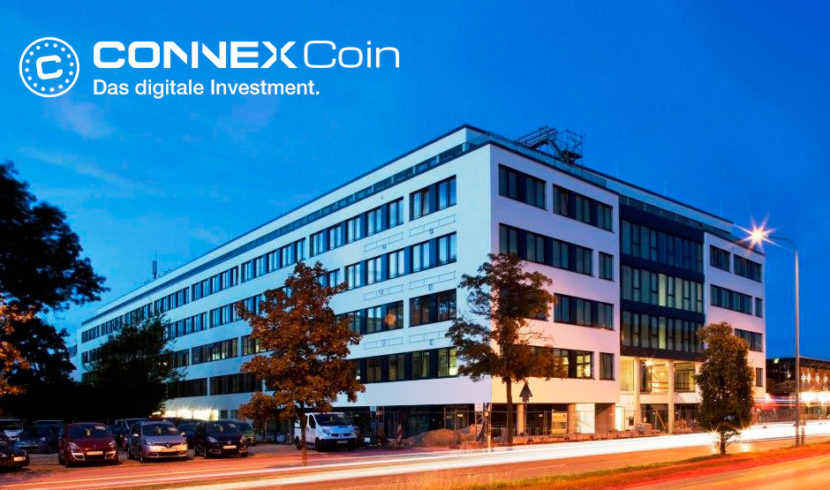
Today, our company starts the security token sale of Connex Coin, the first tokenised investment token compliant with EU regulations. In essence, Connex Coin represents a loan towards the managing entity of a fully leased, premium commercial property, named Connex, in central Munich.
Since the token qualifies as investment token (“Vermögensanlage” in german), it is not tradeable on crypto currency exchanges. Token holders receive a fixed interest of 3% and may sell the token back at nominal value.
Why Tokenisation?
Traditionally, real estate has been financed by owners, banks or external investors participating in real estate funds. The investment process in real estate is complex, takes time and effort. By using blockchain technology and crypto currencies or tokens, this process can be simplified and made much more efficient.
Liquidity
First, there is the securitisation aspect of tokenisation:: by making an illiquid real estate asset completely liquid, this type of investment is made accessible for a much larger target group of potential investors. Traditionally, mainly wealthy individuals or companies could invest in real estate. With a liquid asset, such as the Connex Coin, an individual can become a real estate investor starting with a 10 EUR investment.
Beside having a bank account in an EU country and a registration, nothing else is required to buy this investment token. Since Connex Coin is a non-tradeable, stable investment token, the token holder receives 3% interest paid directly to her bank account. Information about the personal holdings are displayed in the personal account. By using tokens, securitisation is made easy and efficient.
Programmability
Tokenisation is much more than securitisation: a token can be described as programmable money. In other words: tokenisation adds programmability to an asset. This way, business logic can be introduced, reducing the need for manual settlements and smart contracts can have functions for automatic transactions, formulas for calculating asset prices and other specific features at marginal costs. So, what kind of business logic can you add? Simple answer: any. And exactly this large number of degree of freedom makes it somewhat challenging to start with.
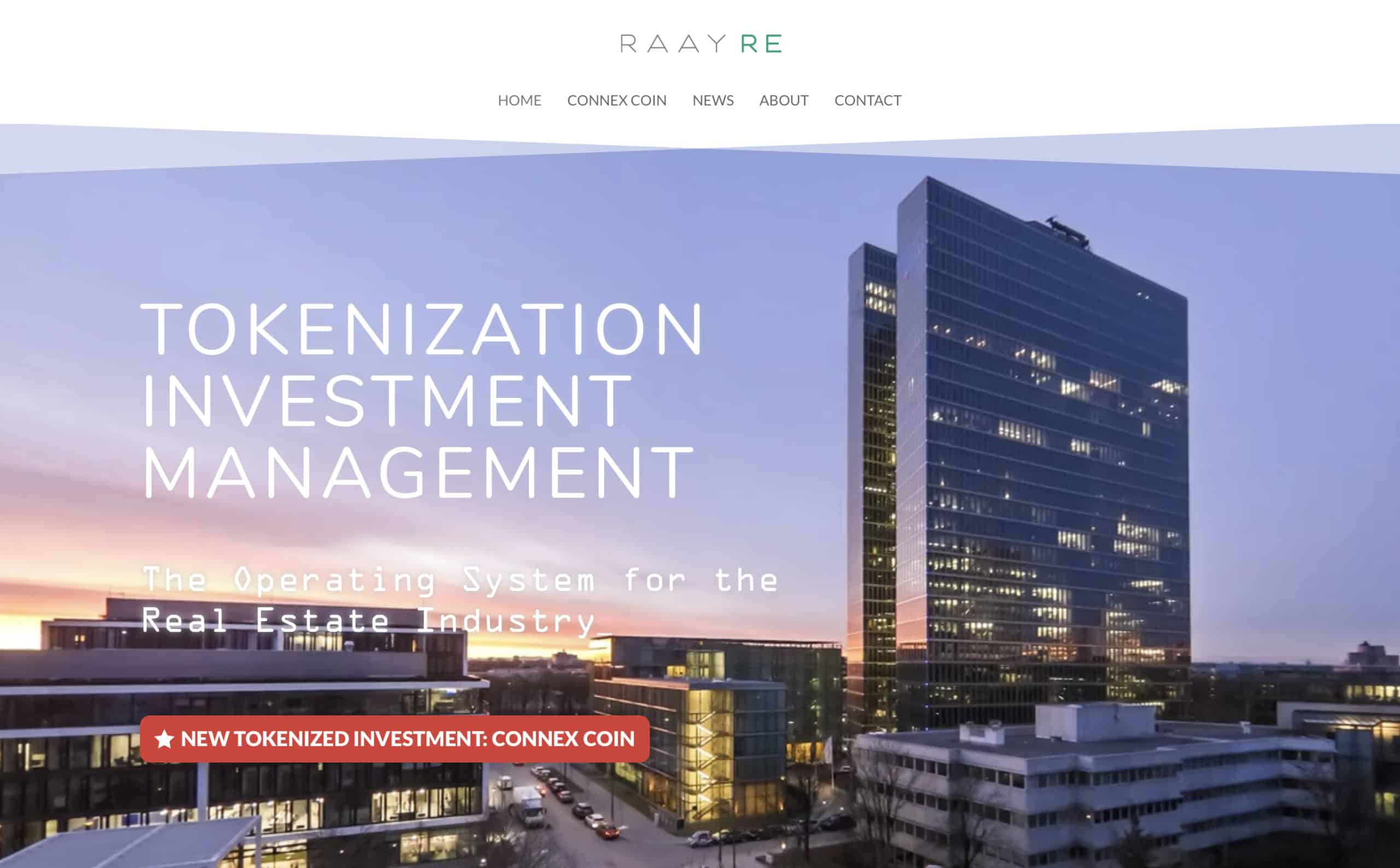
At RAAY RE, we have started by leveraging our proprietary (Crypto) Smart Wallet by adding features that allow token holders making use of specific property-related functions, such as granting access, or allowing for the use and payment of facilities. We will elaborate more on this aspect of programmability in a next post. From our perspective, programmability of formerly static assets provides great opportunities for the real estate industry.
Immutability
A digital, integer trail of transactions proves history of ownership and eliminates data misuse and fraud, such as double-spending. Furthermore, the consistent historical record of all transactions allows for a realtime, frictionless reporting. Just ask your asset managers and CFOs about their administrative headaches that traditionally could only be healed by tremendous accounting efforts. With a guaranteed complete historic data set of all transactions, this headache can be eliminated completely. Tokenisation helps to minimise administrative efforts, time- and costwise.
For RAAY RE, the tokenisation of a share of the Connex building is the first proof of functionality in our tokenisation module, that is one part of our Digital Operating System for the real estate industry. There will be more assets tokenised – as well as in terms of securitisation, and, specifically regarding the programmability aspect of tokenisation: our tokens will come with built-in business logic that will unleash the full value of real estate assets.
This week, our partner company RAAY Real Estate GmbH, launches Connex Coin, its first security token.Connex Coin is Germany‘s first security token that qualifies as a productive investment and is fully compliant with EU regulations.
At EXPO REAL 2019, Europe’s largest real estate fair, RAAY RE presented first details of this project. In February, the token received final approval by German financial regulatory body BaFin. The very first phase of the STO, the sale of Connex Coin, to friends and family, has already begun.
The idea of Connex Coin was born in 2018. Then, we discussed digitisation projects in the field of real estate funds with Thomas Meyer, founder and CEO of Wertgrund Immobilien AG, a residential real estate fund manager. Shortly afterwards, we started a similar conversation with Hans Hammer, founder and CEO of Hammer AG, a commercial real estate developer. It became clear within weeks: we should have these conversations together, as a team.
Fast forward: In July 2019, we founded our new partner company RAAY Real Estate (RAAY RE) as a joint venture of Hammer, Wertgrund and Datarella. The purpose of RAAY RE is to offer blockchain-based products and solutions to the real estate industry, which itself is a late adopter regarding digitisation efforts. We decided to start RAAY RE with the tokenisation of a Hammer-owned property, located in central Munich. With the Connex building, we have a first class property in one of the best real estate locations in Europe, with first class tenants — in short: the best product you can imagine for the start of a product category in your company!
By tokenising this property, we provide the perfect investment opportunity — especially for retail investors — since individuals can become real estate investors starting at 10 EUR. The Connex Coin token sale will take place from March to May 2020. Connex Coin owners will receive an interest of 3% on their investments and can sell Connex Coin back to the issuer. In the first phase, there will be no public trading of Connex Coin, since at the moment there are no EU-compliant cryptocurrency exchanges that offer trading security tokens. As soon as there is approval from financial regulators, Connex Coin will be one of the first security tokens listed on exchanges in Europe.
Connex Coin is the first token issued by RAAY RE, others will follow. RAAY RE is planning to launch more token sales for self-owned real estate properties in 2020. Additionally, tokenisation will be offered as a service to players on the real estate industry. This offering comprises the complete tokenisation process, including technical, legal and regulatory elements, based on an existing long-term real estate expertise.
In addition to tokenisation services RAAY RE offers a variety of tools and products that can be used by real estate developers, owners and funds, ranging from KYC onboarding processes, to smart digital (crypto) wallets. With the launch of Connex Coin, RAAY RE proves that blockchain technology can be leveraged to make payment and transaction processes within real estate more efficient, thus paving the way to a digitised future for the real estate industry.
The acquisition of this investment involves considerable risks and can lead to the complete loss of the invested assets.
After visiting and experiencing the extremely poor circumstances at a Rohingya refugee camp in Bangladesh, Gerd Müller, Germany’s Federal Minister of Economic Cooperation and Development, decided to stop financial aid for Myanmar and to provide funds instead to improve the situation Bangladesh. UN aid agencies are calling for a package worth millions. Blockchain technology offers a way to ensure that these millions indeed arrive at the people in need, it is a tool that allows the economic inclusion of – and even the creation of a digital identity for – the stateless Rohingya.
The Rohingya are an Indo-Aryan ethnic group, who has been living as a Muslim minority in the northern part of Myanmar. According to the 1982 Citizenship Act, the Rohingya are not considered to be one of the 135 indigenous people and are therefore not entitled to Myanmar citizenship. The situation between the mainly Buddhist nation and the Rohingya people escalated on August 25, 2017, when various targets in Myanmar were attacked simultaneously and the Arakan Rohingya Salvation Army took responsibility for the attacks. This has been followed by coordinated military attacks against the Rohingya population. United Nations mediators speak of a “continuing genocide” in which soldiers have murdered thousands of people and committed various war crimes against the Rohingya population. Correspondingly, more than 1,3 million felt to Bangladesh, over 400.000 to Myanmar and thousands to other countries in Asia.
Unfortunately, the misery continues in the countries the Rohingyan refugees fled. Bangladesh, where major Rohingya refugee camps are located, permits the construction of permanent houses to prevent the transition to be permanent. Living conditions are miserable due to a lack of sanitation. Furthermore, schooling isn’t always available, which diminishes the future prospects of the 600.000 children living in the camps. Also, the situation in Malaysia, where the second-largest Rohingya population lives, is difficult. The refugees are tolerated but excluded from social life – they aren’t granted a legal identity.
Some of the consequences of not having a legal status are:
The inability to work, legally.
The exclusion from the financial system by not being allowed to open a bank account.
The denial of public services, such as education and healthcare.
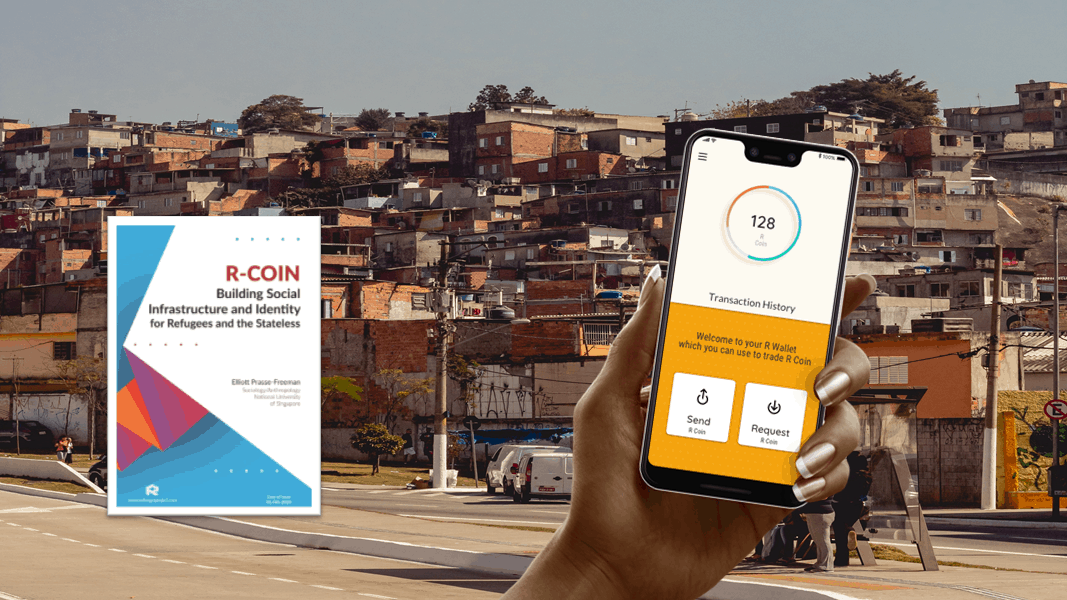
R-Coin, short for Refugee Coin, is an ERC20 based token that is hosted on a private, permissioned Ethereum blockchain network. Therefore, R-Coins can’t be traded on public exchanges, thus they aren’t vulnerable to any volatility. The associated R-Wallet, a mobile app, stores the private/public keys, which allows interacting with the blockchain, or in plain English: to store, send and receive R-Coins.
R-Coins are used to reward refugees for community work, such as teaching, care-taking of children, cooking, cleaning, transportation services. For every hour of voluntary work, the refugee gets 1,0 R-Coin transferred to his wallet. At the end of the pilot phase, the participants will be able to redeem the collected coins for goods and services, from Starbucks gift cards to ATM cards, accident insurance, and health services.
The short and medium-term goals of the R-Project are to include refugees in the society, to increase their working skills and to provide them with a financial tool, the R-Coin and the R-Wallet. The transfers of R-Coins for voluntary work serve as “proof-of-work” and, therefore, can be taken as the basis of a digital identity, providing a digital CV, for the stateless Rohingya.
Currently, the R-Ecosystem includes four stakeholders:
Providers: NGOs who organize (and verify) volunteer activities
Refugees: Complete volunteer activities and earn R-Coins
Vendors: Accept R-Coins and them for exchange goods and services
Donors: Circulate R-Coins within the economy: distribute them to providers and then ‘buy them back’ from vendors who had accepted it from refugees in the first place
Blockchain technology can also be used to ensure that donations arrive where they are intended to arrive. To enable donors to trace the whereabouts of their donations and to directly support such impactful projects like the R-Project, we are working with financial services provider Wirecard AG on a respective project called “Traceble Donations”. If you’re interested in learning more about this value-creating project, stay tuned for our forthcoming blog posts or you visit our next Blockchain Meetup on 31 March in Munich!
This is a guest post by Maria Lema, the co-founder of Weaver Labs, a tech start-up building a Blockchain platform for the Telecommunications industry.
Connectivity is what allows us to exchange information real-time across the globe thanks to the existing infrastructure we call the Internet. Us as individuals and all our businesses rely on connectivity for the majority of our daily activities, we do everything online and it has become a utility: it’s an essential tool to create, develop and grow. With 5G being deployed, the telecoms sector must focus on innovation in the business models and supply chain dynamics to deliver the networks of the future.
Innovation: long time no see
Technological development in the communications sector hasn’t stopped since the creation of the telegraph, and we have learned to communicate faster and more efficiently across the Internet thanks to the creation of communications systems, standards, protocols and infrastructure such as fiber, antennas, switches and gateways.
Although we have changed the way we interact with the Internet and online applications, we haven’t changed much the way we deliver connectivity. Most will agree that, while we have undergone (and are probably still undergoing) a data and communications revolution, networks haven’t yet adapted to this new way of online interactions. We have adopted the smartphone and we have seen technologies grow from 2G to 4G, but the traditional supply chain and investment models in telecoms have achieved the tipping point. We need a transformation, one that is able to support and deliver the spectacular developments in emerging technologies: AI, Big Data, Robotics, Autonomous Vehicles, and more.
The Network Revolution
5G is the new generation of mobile networks and is purely software-based, so more than just another generation, it is an opportunity to innovate in the way we deliver connectivity with an infrastructure that supports the future cities and the explosion of data.
Following this transformation, networks are becoming a commodity: open source based and with a growing diversity in the equipment sector – in other words: competitive. This competitiveness is motivating new players to deploy and own network infrastructure: factories, hospitals and even whole cities are investing in infrastructure with a variety of applications in mind that require high bandwidth and support for a massive number of devices.
However, there are still challenges to realising the dream of open and diverse networks: convergence and integration is still something not fully solved. Despite being built around existing standards like the Internet Protocol (IP), there’s still a need for rigorous standardisation to allow for easy interoperability across network elements and all the actors involved – chip/device manufacturers, equipment vendors, operators, etc. From a service provider perspective, some of the key hurdles when building diverse and interoperable networks are:
Simple: to create end to end services across the infrastructure targeting interoperability across multiple network elements.
Open: to integrate new infrastructure and service offerings, with built-in security mechanisms that allows critical components to be onboarded faster.
Scalable: grow horizontally with minimum interaction of the Service Provider.
Weaving Telecoms with Web 3.0: the fundamental shift
Decentralisation and tokenised economies are a solution to complex cross-actor engagements with mechanisms to reward network participants in exchange for contributions. Leveraging innovative P2P and Blockchain technology, we are a software and protocol stack that provides a simple, open and scalable solution that enables the horizontal integration much needed in networks. We create a marketplace of connectivity assets that replaces the Service Provider as a central point of trust to aggregate network resources.
Weaver is a P2P network created specifically for telecommunications, equipped with a new Messaging System (WireMQ) designed to manage real-time communications traffic across the network infrastructure. It builds on the horizontal integration of networks by adding a software layer on top that enables interoperability and convergence.
How does Weaver help to advance in the Network Revolution?
We create a connectivity platform that integrates any communications system and leverages existing infrastructure to communicate across all technologies in the P2P network. A great example is the mesh network Weaver built for the Track and Trust supply chain project with Datarella. We used WireMQ to route traffic from IoT devices into a Satellite base station, and it can be scaled up including 4G antennas, WiFi and more IoT technologies – which allows us to bring this directly into Smart Cities. We innovate in the supply chain, creating a platform for connectivity with mechanisms to exchange network resources and incentivise all network participants. The new business models are based on infrastructure sharing and revenue sharing where all contributors can capitalise on existing assets and create a viable return on investment in infrastructure for connectivity.