
by Michael Reuter | 18 November 2022 | Blockchain, Featured, Ocean Protocol, Partnerships, Web3 Company Builder
In a world premiere, Datarella, Biennale de Paris, and Ocean Protocol, present DIAM, the Decentralised Invisual Art Marketplace. DIAM allows buying invisual art in a totally new way, by combining the international art market with Web3, the latest technological development. DIAm is the latest member of the Datarella Web3 Company Builder model.
DIAM is the Decentralized Invisual Art Marketplace. It intends to value a new form of creativity, a new form of art: Invisual Art. The idea of DIAM is to unleash creativity on a global scale. DIAM’s dream is to augment human beings through art. On DIAM, art lovers can purchase invisual art experiences using $OCEAN, a crypto-currency that uniquely and in an unforgeable way guarantees the purchase of art experiences. DIAM’s decentralized architecture allows artists to showcase their work and present their art in a completely autonomous process, guaranteeing them a fair share of income.
Invisual Art
Invisual art is art that exists other than in the form of artworks. The practices of invisual art have in common the fact of existing other than in the form of a work of art. There is no definition of invisual art, if not this common point. Invisual art is an art that exists most often as an experience and not as an object. The invisual practices are extremely varied: lifestyle, behaviors, experiments, state of mind
DIAM Goals
- To enable invisual artists to make a living from their work;
- To enable anyone to become an artist through the valuation of their invisual creativity;
- To provide a tool to encourage inventiveness in art by mixing the latest technologies with the latest form of art in order to build the next-generation art market;
- To encourage the emergence of new types of collectors and investors in art;
- Marketing art as an experience.
How To Buy Invisual Art?
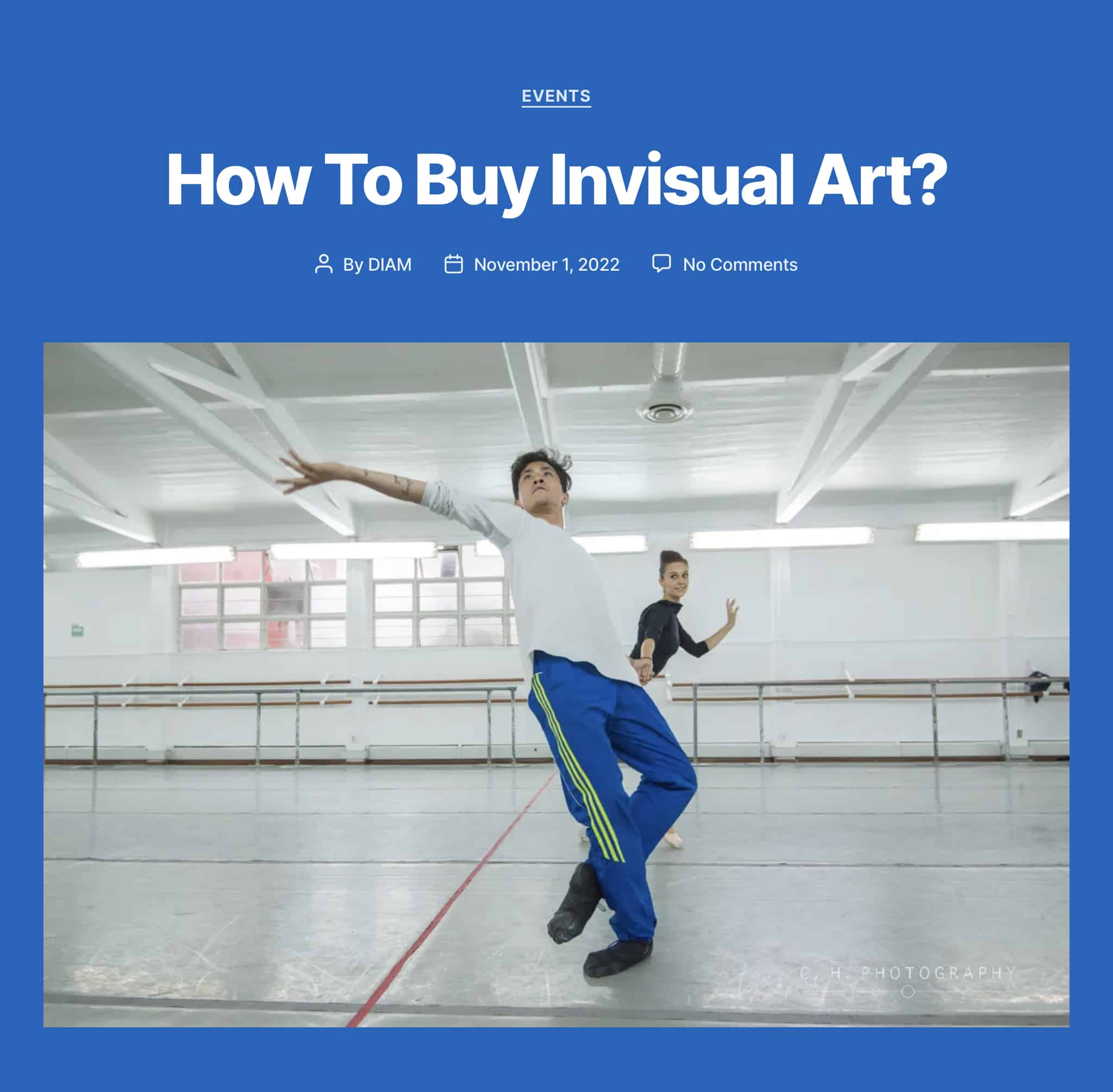
At the official DIAM launch event on 11 November 2022, Alexandre Gurita, Director of the Biennale de Paris and of the Ecole Nationale d’Art (ENDA), and Corina Mila, Enseignante-Chercheuse at the University of Paris-Sorbonne, introduced the audience to the concept of Invisual Art. Michael Reuter, Co-founder & CEO of Datarella, and Rebecca L. Johnson, CTO of Datarella, have demonstrated how to buy invisual art at DIAM using datatokens. Special guest Casey Herd, Artistic Director of BALLET RISING, has explained how DIAM enables Ballet lovers all over the world to immerse in the ballet experience using DIAM datatokens.
Feel free to register for free and experience the latest development at the intersection of technology and art!
If you are interested to learn more about the Decentralized Invisual Art Marketplace, feel free to follow DIAM on Twitter, and LinkedIn and discuss all things invisual art with the DIAM team – see you there!
by Michael Reuter | 31 October 2022 | Blockchain, Featured, moveID, Partnerships
Datarella has partnered with peaq, an Economy of Things network. The partnership will focus on leveraging both organizations’ vast expertise with real-world blockchain use cases to build decentralized applications and tools for the mobility space. It builds up on the momentum of the ongoing collaboration between the two parties within the €20+ mln. Gaia-X 4 Future Mobility moveID project.
A fragmented digital backbone remains a key stumbling block for the mobility industry as it works to transform itself for the era of data-driven business models. Besides various issues such as siloed electrical vehicle charging services or lacking integrations into larger smart infrastructures, the mobility space also often over-relies on the established Web2 tech platforms, putting its own evolution on a flawed foundation. Gaia-X, a pan-European consortium group bringing more than 300 companies and research institutions together, works to create a fairer, better alternative to Web2 cloud services. Its 4 Future Mobility moveID project, led by Bosch and involving a vast array of top industry names and leading Web3 projects, focuses on standards and infrastructure for Self-Sovereign Identities (SSIs) for the mobility space.
“Fragmentation has been a key stumbling block on the path towards the digitalization of mobility and transportation,” says Michael Reuter, CEO and co-founder of Datarella. “This makes for a clear-cut blockchain use case with a focus on real-world services, value, and sustainability. We are happy to collaborate with peaq and other moveID members to power this transformation with our Web3 know-how.”
Working together as part of the moveID project, peaq and Datarella will collaborate on various aspects of building the standards and digital infrastructure for mobility-focused SSIs. peaq and Datarella will also work on enabling Web3 use cases related to the moveID project, including Self-Sovereign Machine IDs, peer-to-peer transactions, and decentralized marketplaces for mobility services and data.
“Reclaiming our data and identity sovereignty is crucial for the future of mobility in Europe and beyond,” says Leonard Dorlöchter, co-founder of peaq. “Blockchain has a lot to offer to the transportation industry, including smoother interoperability, more privacy, and entire new business models. We are thrilled to be working toward this with Datarella and other consortium members such as Bosch, Continental, and Airbus.”
About peaq
peaq is the Web3 network powering the Economy of Things (EoT) on Polkadot, the most environmentally-friendly blockchain network. peaq enables entrepreneurs and developers to build decentralized applications for vehicles, robots, and devices, while empowering users to govern and earn as connected machines provide goods and services. Together with leading consortia, including Gaia-X and MOBI, peaq is co-creating the standards that will power the future of mobility and other connected industries while working to democratize abundance in the Age of Automation.

by Michael Reuter | 13 September 2022 | Blockchain, moveID, Partnerships, SSI
Together with 18 project partners in the Gaia-X 4 Future Mobility project moveID, Datarella develops the required digital identity infrastructure for the mobility of the future. With BOSCH heading the moveID consortium, leading mobility enterprises, Web3 companies, and research organizations create the foundation for autonomous driving and applications leveraging connected vehicles and devices.
Use Cases for the Mobility of the Future
The research project moveID comprises various scenarios of smart traffic management, s.a. parking, charging, or zoning. To create a trusted environment and connect all traffic participants, vehicles, and infrastructure components, s.a. traffic lights, access gates, and parking meters, obtain unique digital identities. All identities are managed as self-sovereign identities, a concept known as SSI, for maximum privacy and compliance with GDPR and the Gaia-X framework.
Datarella will co-create the standards and infrastructure for the future of mobility as part of the Gaia-X 4 Future Mobility moveID project, with an overall size of more than €20 million, by Gaia-X, the European Association for Data and Cloud. The three-year project brings together top industry players to build a sovereign digital infrastructure enabling secure, connected, and open mobility, with Datarella, conducting intense research and development as well as leveraging its expertise in creating successful mobility applications, s.a. Deep Parking, and MOBIX. To make moveID‘s decentralized digital identity infrastructure usable and to develop winning business models on top of it, B2B and B2C applications will be developed.
„With moveID, we will prove that European research projects like Gaia-X can be managed in an agile, dynamic way, and produce significant meaningful results for all mobility participants. Working with industry leaders like Bosch, or Continental on the one hand, and with Web3 projects and research institutes, on the other hand, collaboration is not a simple phrase – it‘s living reality“, says Datarella CEO Michael Reuter.
The Power of Web3
Besides Datarella, other project participants include Bosch, Ocean Protocol, Airbus, Continental, Fetch.ai, Materna, Denso, WOBCOM, ecsec, htw saar, Atos, Chainstep, ZU, peaq, 51nodes, ITK, DLR, and deltaDAO. The project will feature a strong Web3 component with contributions from leading projects in the space:
- peaq, the Web3 network powering the Economy of Things, will conduct intense research and development within the project. peaq will further build up its layer-one blockchain in line with the co-created requirements and standards, aiming to grant Gaia-X’s moveID the perfect infrastructure for decentralized mobility applications. peaq will also provide its core functions: peaq ID – Self-Sovereign Machine Identities (SSMIs), peaq access, and peaq pay. peaq is built using Substrate and will soon be live on both Kusama as well as Polkadot. It is working on enabling collaboration and interoperability with the Ethereum and Cosmos ecosystems for other Web3 consortia collaborators in Gaia-X.
- 51nodes, a Web3 developing and integration company brings to the project its experience with SSI architecture and implementation in the context of decentralized mobility infrastructure. In addition to the development and integration of various SSI technologies, the focus of work will be on SSI interoperability challenges.
- Through BigchainDB, Ocean Protocol – the Web3 platform to unlock data services for AI and business innovation – is providing key technical infrastructure for moveID to expedite the development of decentralized digital identity infrastructure for European mobility. Essential components of Ocean’s decentralized data marketplace technology, Compute-to-Data, and data pricing mechanisms are being leveraged to build a system architecture that ensures a seamless exchange of information between providers and customers of mobility applications.
- deltaDAO, a web3 software development, integration, and consulting company, will co-develop decentralized data infrastructure and federation services in the context of the broader Gaia-X ecosystem. deltaDAO contributes its extensive knowledge regarding Gaia-X compliance, interoperability, and integration
Peter Busch, Product Owner for Distributed Ledger Technologies (Mobility) at Bosch, said: “Web3 technologies offer a promising digital foundation for future mobility solutions. With moveID, we are setting the foundation for a hyper-connected mobility infrastructure by leveraging self-sovereign device identities and decentralized data sharing to enable hundreds of potential use cases. We are thrilled to be exploring this exciting prospect side by side with some of the leading projects in the decentralized space such as peaq, Ocean Protocol, Datarella, 51nodes, and Chainstep.”
by Michael Reuter | 22 August 2022 | Blockchain, Featured, Ocean Protocol, Partnerships, SSI
Datarella GmbH, a Web3 company builder, is joining forces with deltaDAO AG, a Web3 engineering and integration company, to expand the open data economy in the mobility and identity sectors. Both companies leverage their extensive experience in creating Web3 solutions for real-world use cases. The partners aim to allow corporate and individual users to monetize data while preserving their privacy. The first project is inspired by the partners’ collaboration in moveID, a Gaia-X 4 Future Mobility project. It will allow the monetization of mobility service provider data.
Datarella and deltaDAO will use their enterprise Web3 tools and consumer apps to jointly build solutions for the monetization of data featuring Fetch.AI and Ocean Protocol technologies. This combined tech stack serves as the foundational underlying protocol for digital business transformation with converging technologies, s.a. AI, and autonomous machines. Given the natural synergies between Datarella and deltaDAO, this cooperation will drive enterprise adoption across the partners’ client bases.
For Datarella, the purpose of technology is to increase the quality of living, by supporting human beings in professional activities and private lifestyles. The growing complexity and diversity of our ecosystem require technological infrastructures that facilitate collaboration and cooperation. By creating Web3 solutions for a global user base, Datarella illustrates the real-world benefits of its Web3 technology stack, and with deltaDAO, we will show how individual and professional users can turn the table and monetize their data, instead of “being the product”, .
Michael Reuter, CEO of Datarella
deltaDAO has become a trusted advisor for building sovereign, privacy-preserving, and secure data economy solutions. We seek to give freedom of choice and control back to data owners. As a DAO we create a new kind of data economy that is owned by no one – and open to everyone. Our partnership with Datarella will lead to many impactful real-world use cases and is a great example of how two companies can leverage each other’s strengths and experience to create real-world solutions for both individual and professional users alike. We are excited about building towards a decentralized data economy together with Datarella!
Frederic Schwill, Co–Founder of deltaDAO
About Datarella
Datarella GmbH is a Web3 company builder. Leveraging its technology stack of Blockchains, Self-Sovereign Identity SSI, Autonomous Agents, and Artificial Intelligence AI, as the tech hub for Web3 projects and companies like MOBIX, MOBIX family, IMMOBIX, or NOMIX, Datarella creates applications with real-world benefits. The Munich-based company was founded in 2013. With its decentralized teams in Munich, Gdansk (Poland), and Skopje (North Macedonia), Datarella develops bespoke Web3 innovations for their partners and clients, s.a. United Nations, World Food Programme, UKAid, ESA, Siemens, BMW, BOSCH, and Airbus.
About deltaDAO
deltaDAO AG is a software development, integration, and consulting company based in Hamburg, Germany. Its focus is to enable a transparent, secure, and decentralized data economy in which enterprises, SMEs, and public institutions can keep full technical control over their private data. As specialists in distributed ledger technologies (DLT) we are engaged in Gaia-X and built the first Minimal Viable Gaia-X (https://minimal-gaia-x.eu/) in 2021, based on open-source software and Web3 technology.

by Michael Reuter | 26 June 2022 | Blockchain, Featured, MOBIX, SSI, Track and Trust, Web3 Company Builder
With Datarella, we have been building software, tools, and applications for Web3 since 2015. Our first truly global project has been the Building Blocks application which enables users to securely pay with their smartphones in refugee camps.
We‘ve developed Track & Trust, a tracking solution for humanitarian aid logistics that leverages satellite communication. In the mobility sector, we have created SSI apps and smart parking solutions to enable secure P2P communications, streamline traffic flows, and minimize CO2 emissions. With 16 other companies, we’re part of Gaia-X consortium moveID that will create the decentralized digital infrastructure for mobility in Europe. And much more! And, in 2020, we decided to leverage our tech stack and create the Datarella Web3 Company Builder Model.
RAAY Real Estate
In 2020, we have launched RAAY Real Estate (RAAY RE) as our first standalone project, together with two partners from the real estate industry. Our RAAY RE joint venture with Hammer AG and Wertgrund Immobilien AG was the first to tokenize a commercial property, fully licensed by German regulator BaFin – Connex Coin was a breakthrough! RAAY RE will become the legal framework of our future IMMOBIX project and token.
MOBIX Marketplace
In 2021, we launched our micromobility marketplace MOBIX. By using the MOBIX app, more than 350,000 daily active users in over 120 countries are earning MOBIX Miles while riding eco-friendly vehicles, such as scooters, bikes, eBikes, eMopeds, or cargo bikes. By incentivizing users to swap their combustion engines with zero-emission transportation, MOBIX helps to decrease CO2 emissions and to make cities more liveable. In the meantime, MOBIX has evolved into the MOBIX Marketplace GmbH, a Munich-based company owned by Datarella, and Fetch.ai.
MOBIX family
The latest brainchild of Datarella’s Web3 Company Builder Model is MOBIX family – a decentralized gig economy network. MOBIX family is the first project in the Company Builder Model that will be driven with the support of an external team. Whereas RAAY RE and MOBIX have been built by internal Datarella resources, a young team of aspiring entrepreneurs from the Technical University of Munich (TUM) has taken care of the Family’s first steps. The team has presented the first MOBiX family MVP during START Ideasprint 2022, a 4-day hackathon based out of Munich.
NOMIX
In 2023, the next project – NOMIX – will launch its BIOCLOCK app. Leveraging the same tech stack as other Datarella Web3 companies, NOMIX will help users around the world maximize their healthspans, i.e. living longer while staying healthy!
We at Datarella are very happy to see more and more teams using our Web3 tools and applications, and creating new ventures! Are you interested in joining an existing Web3 team or do you want to pitch your own idea? Do you want to become part of the Web3 world but prefer to participate from the sideline, you might be interested in owning DREX, our Datarella token which entitles the holder to receive tokens of Web3 projects. In either case, please contact us!
by Michael Reuter | 16 April 2021 | Blockchain
Datarella is joining forces with Ocean Protocol to expand the Open Data Economy. moveID, our first project will be under the umbrella of GAIA-X, the European Association for Data & Cloud, as part of the GAIA-X 4 Future Mobility Project, which aims at bringing cloud applications to autonomous & networked vehicles.
The project’s overall goal will be the creation of a decentralized ecosystem of data & services that allows autonomous & networked vehicles to integrate into smart infrastructures and third-party services, following GAIA-X’s design principles. With mutual trust as its core concept, its stated goal will be achieving data sovereignty.
For Datarella, technology is an instrument to increase the quality of living, by supporting human beings in all kinds of professional and private activities. The growing complexity and diversity of our ecosystem require technological infrastructures that facilitate collaboration and cooperation. By planning, developing and implementing blockchain solutions worldwide, Datarella meets this requirement: in the fields of Finance, Supply Chain, and Mobility, we enable industry participants to join forces and create sustainable, crisis-proof business models. GAIA-X is the perfect environment for true collaboration. – Michael Reuter, CEO of Datarella
Data generated by network actors or Autonomous Economic Agents (AEAs) in the ecosystem can be useful to 3rd parties, and thus has value as an asset. Ocean Market unlocks the value of these by enabling every authenticated user to put their data up for sale and to monetize it. Vehicle data, for example, could be (re)used for traffic analysis for the generation of better traffic models such as optimized traffic light switching.
Different market actors will price data differently, depending on the method of data generation, data quality, and its utility to the potential buyer. Ocean Market allows for dynamic pricing and thus for optimal value generation for data generators and data curators, in a privacy-preserving manner.
This project will use Datarella’s Enterprise Blockchain Solutions, which serve as the foundational, underlying protocol for digital business transformation with converging technologies such as AI and autonomous machines. Datarella’s future mobility solutions are fueled by blockchain technology, real-time decentralized data management, transparency and GDPR compliance. Given the natural synergies between Ocean and Datarella, this partnership is the first of many that will drive enterprise adoption of Ocean Protocol technology in Datarella’s client base.
Our mission is for data to be treated as an asset. By tapping into underutilized data from mobility IoT sensors, AI can uncover mobility patterns and optimize services / reduce waste. Machines can speak to each other and algorithms can make optimizations – all in real-time. Ocean can tokenize mobility data from devices, thereby creating an opportunity for these tokens to be used as instruments in DeFi projects. This is one of the many ways in which we enable data owners to share in the value their data creates. – Razvan Olteanu, COO of Ocean Protocol
Ocean Protocol is a Day 1 Member of GAIA-X Association AISBL, an international non-profit organisation established to achieve the GAIA-X project goals for the development of an efficient, competitive, secure and trustworthy federation of data infrastructure and service providers for Europe – fostering digital sovereignty of European cloud service users.
—-
About Ocean Protocol
Ocean Protocol’s mission is to kickstart a Web3 Data Economy that reaches the world, giving power back to data owners and enabling people to capture value from data to better our world. Data is a new asset class; Ocean Protocol unlocks its value. Data owners and consumers use the Ocean Market app to publish, discover, and consume data assets in a secure, privacy-preserving fashion. Ocean datatokens turn data into data assets. This enables data wallets, data exchanges, and data co-ops by leveraging crypto wallets, exchanges, and other DeFi tools. Projects use Ocean libraries and OCEAN in their own apps to help drive the Web3 Data Economy. The Ocean token is used to stake on data, to govern Ocean Protocol’s community funding, and to buy & sell data. Its supply is disbursed over time to drive near-term growth and long-term sustainability. OCEAN is designed to increase with a rise in usage volume.
by Michael Reuter | 12 November 2020 | Blockchain, Smart Wallet
Datarella, in partnership with Fetch.ai, a Cambridge-based artificial intelligence lab building an open-access decentralized machine learning network for smart infrastructure, announced today the launch of M-ZONE, their smart city zoning infrastructure trials in Munich, Germany. Using their AI-powered software agents to optimize resource usage and reduce the city’s carbon footprint Datarella and Fetch.ai predict mass implementation of smart city infrastructure will result in 34,000t annual CO2 emission reduction.
M-ZONE will be launched in the Connex Buildings and will utilize multi-agent blockchain-based AI digitization services to unlock data and provide smart mobility solutions in its commercial real estate properties in the city center.
“Landlords, as well as the City Council, are interested in optimizing the parking space management, to allow for available parking for all employees of corporate tenants while organizing the traffic flow and preventing commuter traffic jams,” said Michael Reuter, CEO of Datarella. “Our system incentivizes community use of public transport through a tokenized incentive system while reducing the congestion that accounts for a great deal of Munich’s CO2 emissions.”
M-ZONE will solve the needs of various stakeholders:
-
Individual commuters and drivers: save time, money, and reduces driver stress
-
Property owners: simplified approval for new development projects
-
Tenants: lower rent through dynamic parking spot sharing
-
City Council: optimized traffic flows
-
Environment: less negative impact through saved CO2
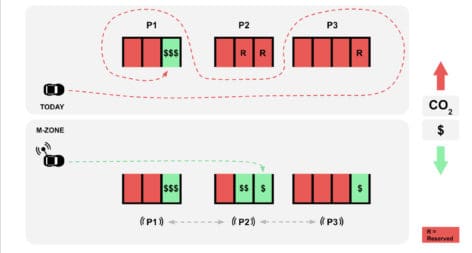 Upon implementation, AEAs (Autonomous Economic Agents) will support the sustainable and efficient use of city infrastructure in Munich through an application where they will autonomously negotiate the ‘price’ of parking spaces between the holders of parking spots, and those looking for parking spaces. Users can earn rewards in the digital currency if they choose less popular or in-demand parking spaces (or do not use the parking lot at all on some days). The Carpark AEA determines the reward levels to maximize resource usage.
“Fetch.ai provides a decentralized framework for building and customizing autonomous AI agents to carry out complex coordination tasks,” said Humayun Sheikh, CEO of Fetch.ai. “Our vision is to connect digital and real-life economies in order to enable automation over a decentralized network and change the way we use data.”
Users are incentivized to reduce their number of car trips to the Connex and adjacent corporate offices through a reward system which is measured by the utilization of parking spaces. Each registered user who is a regular car park user will be rewarded with a certain amount of tokens per minute for not parking at the parking lot. As soon as a car or its related wallet address is registered as parked by the Carpark AEA, the token airdrops to this wallet stop/slow. The number of tokens rewarded per wallet and minute depends on the current utilization of the parking lot.
“Assuming there is a 10% reduction in car usage across Munich alone, the city would see a 34.000 tonnes annual CO2 emission reduction,” continued Reuter. “Scaled up to cover all of Germany, that equates to 1.7 million tonnes CO2 reduction, annually. This smart city solution has the potential to penetrate huge markets simply by tapping into wasted data and utilizing it efficiently.”
For more information, please contact us!
by Michael Reuter | 29 September 2020 | Blockchain, SmartAid
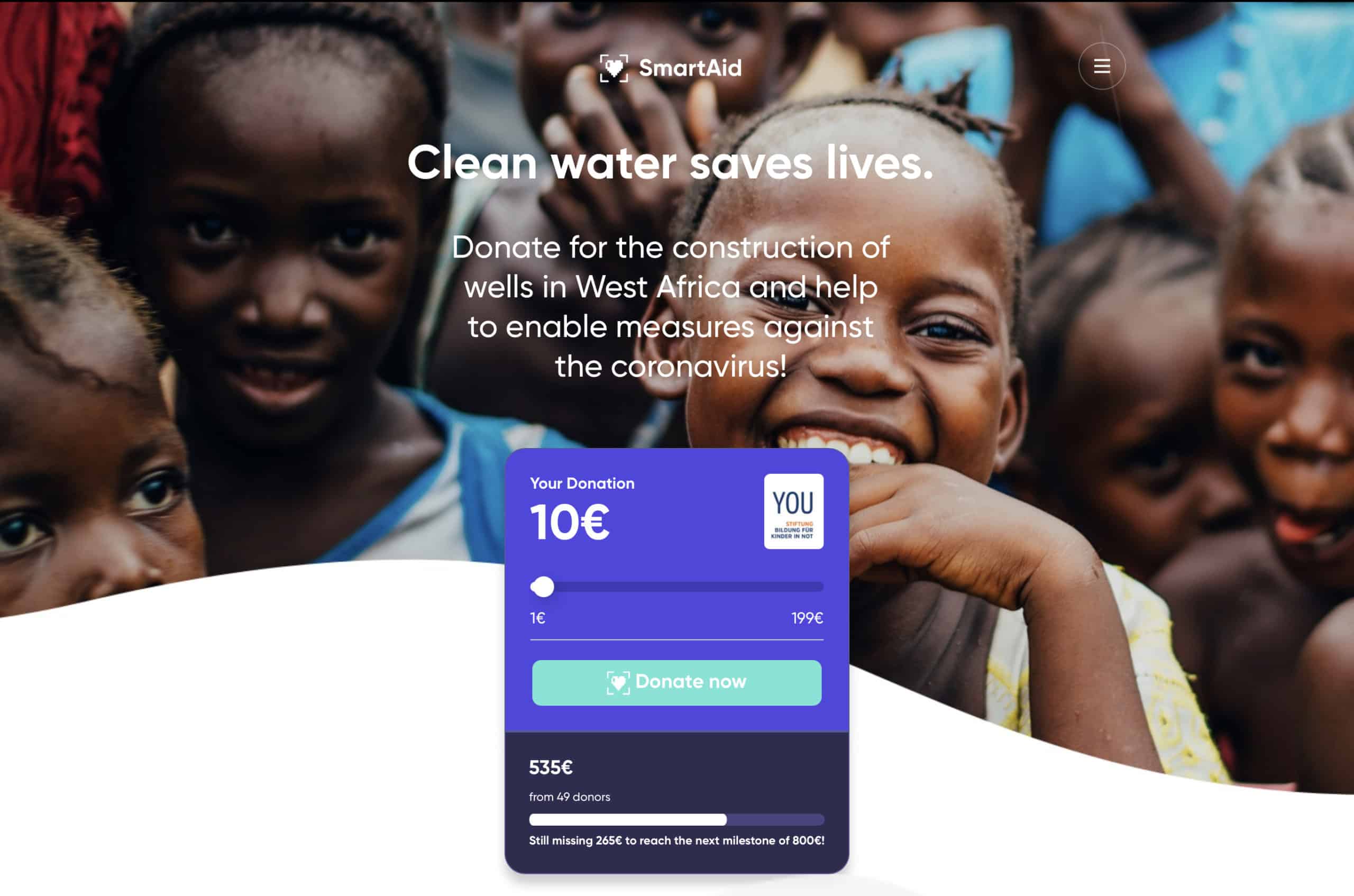
A few days ago, we launched our new blockchain-based donation app SmartAid that allows for traceable donations to charity projects all over the world. The first charity project is YOU Foundation’s “Water for West Africa”, collecting money for the construction of freshwater wells that provide West African communities with drinking water and allows for improving hygienic standards fighting the coronavirus.
SmartAid has been designed as a web app; i.e. you don’t have to download it from an app store but you simply surf to the URL www.smartaid.digital in your mobile or desktop browser and start donating, immediately. The donation process is very simple and (should be) self-explaining: you choose the amount you want to donate, you select the PayPal or credit card payment option, and confirm your donation. Done.
Since in 2020, there are thousands of different smartphones, running on millions of different versions of operating systems, even the most simple online process can result in unexpected effects; s.a. a page not loading, or a text not showing up. Since we want to make the donation experience as pleasant as possible, we’d like to invite you, and your friends, to join us and help to improve SmartAid! Donate – you could start with just 1 EUR – and send us your feedback. Although we are most interested in potential bugs or any inconveniences you might experience, of course, we’re also very happy to hear about positive experiences while donating!
Please send your feedback to smartaid (at) datarella (dot) com
It would be great if you could support us in refining and optimising SmartAid – and our friends over at YOU Foundation will be grateful for your donations that support West African rural communities! Thank you!
by Michael Reuter | 14 September 2020 | Blockchain, SmartAid
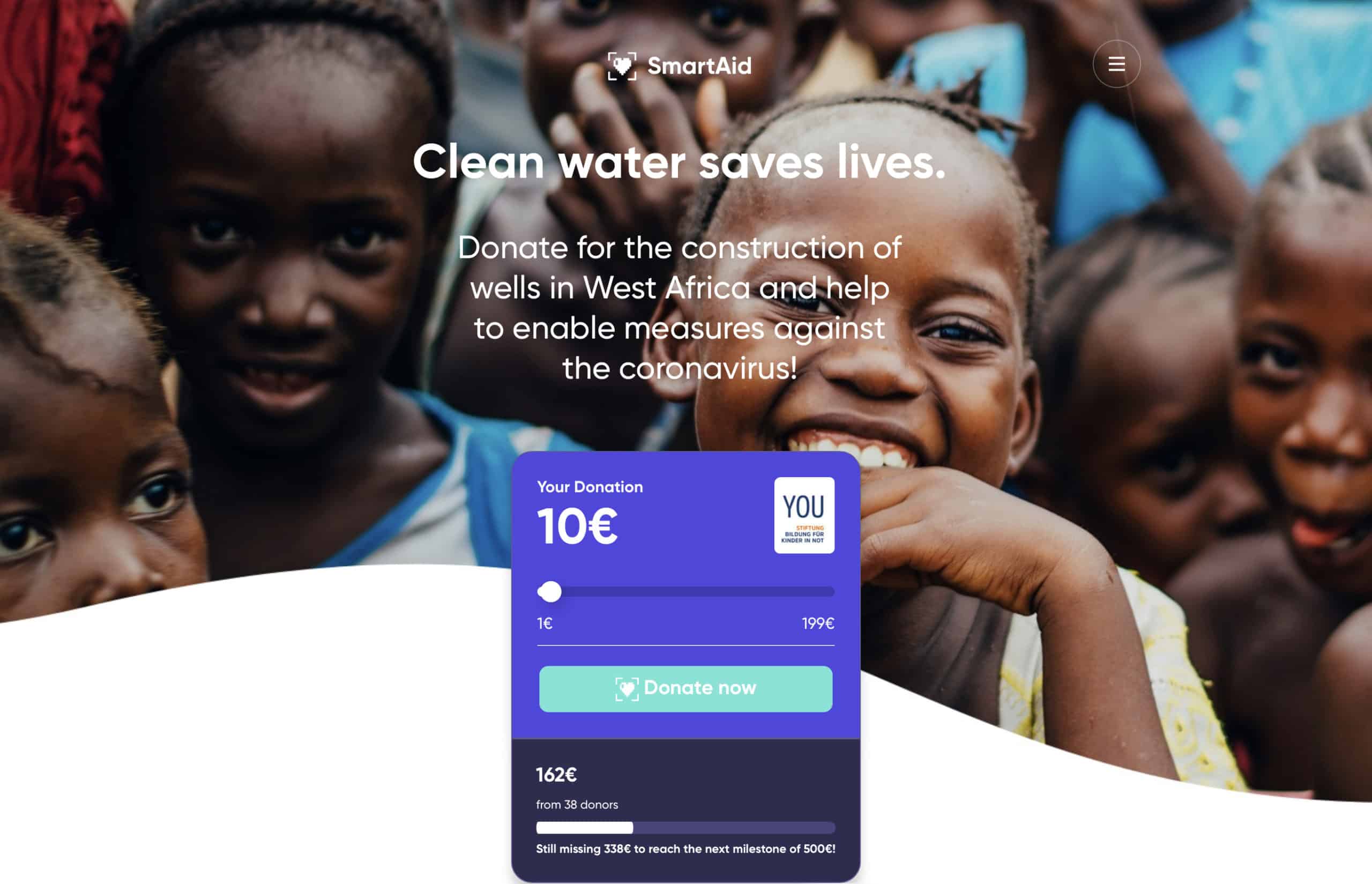
Last week, Datarella and YOU Foundation have launched SmartAid, the first digital donation app that allows for traceable donations based on blockchain technology. SmartAid offers immediate support in crisis situations and lets its donors track their donations until they reached beneficiaries. SmartAid’s first project is “Clean Water for West Africa”, a charity project initiated and managed by YOU Foundation, led by UNESCO Special Ambassador Dr. h.c. Ute-Henriette Ohoven.
Why Donating Must Be Changed!
Time and again, potential donors wonder how difficult it still is, to donate to the right cause, and in an efficient and fun way. Often, you can’t donate using your mobile, or can’t even donate online. Then, you would donate to a certain general topic, rather than to a specific project. Last, but not least, as a donor, you can’t track and trace the path of your donation. Many potential donors are put off by clunky, complex, and intransparent donation processes. Given a huge amount of spare money many people in the rich parts of our world have available for being spent to a good cause, this is a wasted opportunity.
Enter SmartAid!
Efficient, and easy-to-use, the blockchain-based web app does not only make donating fun, but offers fervently desired transparency of the money flows: Right after having donated between 1 – 199 Euro, the donation will be stored on the SmartAid blockchain. The donor receives a tracking code to trace her donation until it reaches its destination. This so-called “traceable donation” is a world first. Secure and immutable blockchain technology guarantees that all donations will reach the right beneficiary by making the flow of money transparent to the donor.
Security, Transparency, and Fun
Donating via SmartAid is not only secure, efficient, and transparent – it’s fun! A direct connection to a donor’s credit card or PayPal account allows for an easy process that even lets donors share their donations via Social Media, thus motivating others to share this experience and jointly support the charity project.
“For a long time, we at YOU Foundation have been looking for a way to enable individuals to donate to our charity projects all around the world. Therefore, we can’t wait to see SmartAid in action!”, says Ute-Henriette Ohoven, founder of YOU Foundation.
“Since 2015, we at Datarella have been working on Blockchain projects with our corporate partners, such as Bosch, Siemens, BMW, Merck, and international humanitarian organizations, such as the UN World Food Programme WFP, or UK Aid. We are very happy to launch SmartAid, together with YOU Foundation, and we are highly curious how donors will perceive the new transparency of their donations”, adds Michael Reuter, CEO of Datarella.
Now – feel free to donate! www.smartaid.digital

