by Martin Schäffner | 6 April 2020 | Ask Datarella, Blockchain, SSI
Self-Sovereign Identity (SSI) is increasingly mentioned in connection with innovations and digital identities. Even in the context of the coronavirus crisis, SSI finds possible applications, such as the possible use of a tracking app for infected people or as a digital staff “passport” in hospitals that respects each user’s privacy. To support others in classifying SSI correctly, we are now publishing a series of blog posts that explain components of SSI. The first part of the introduction to Self-Sovereign Identity focuses on the three essential components – DIDs, DID Documents and Verifiable Credentials.
As already described in detail in the first blog post, Self-Sovereign Identity offers the user the possibility to manage their own digital identities completely autonomously. There is no platform or provider, such as an email address provider or a social network that controls identity. This is achieved using an underlying blockchain or a DLT on which key pairs can easily be generated that serve as identity representation.
Decentralized Identifiers
Now we come to the first component – the Decentralized Identifiers (DIDs). Their purpose is to act as a unique identifier of the person or object. These are derived from the public keys and can be identified over various blockchains. An example DID is shown below.

DIDs follow a general syntax: the schema (did:), the method (sov:) and the method-specific identifier (WRfXPg8dantKVubE3HX8pw). While the scheme is always the same, the method that describes how a DID is derived from a blockchain (here: Sovrin) and the method-specific identifier bo depend on the underlying blockchain. However, DIDs alone don’t bring any value.
DID Document
What fills a DID with life is the DID Document. This piece of data describes the DID object and its properties. By default, it contains the associated public key to a DID. However, it is also possible to add more public keys to the DID document that are authorized to perform actions in the name of a DID. Moreover, a DID can contain different types of attributes and service endpoints that allow the actual interaction with a DID. Changes to a DID Document can only be made by authorized public keys defined in the DID Document. An example DID Document with authorized public keys.
Verifiable Credentials
Now, that it is possible to identify an entity and to interact with it, is possible to attach information to the digital identity. This can be done with Verifiable Credentials (VCs) that act as an attestation or a digital representation of a credential such as an ID, a driver’s license or a club membership card. A VC consists of three main values:
-
- The issuer’s DID and signature
- The entity’s DID
- The information that is attached
Based on these three fragments, third-party verifiers can immediately determine the authenticity of the object by looking up the issuer’s DID. Verifiable Credentials are in possession of the DID owner that it was issued to and can be stored in a wallet. However, the issuer can always revoke the VC and adding it to the revocation registry that should be publicly visible.
These three components serve as the basis for a decentralized, trustless identity ecosystem that doesn’t rely on centralized authorities. DIDs identify an identity over, the DID Document describes the DID and a Verifiable Credential attaches verifiable information to a DID. Users are in sole control of their identity and can decide how information is shared and with whom.
However, this was only a small part of the entire SSI infrastructure. Part 2 of the Introduction to Self-Sovereign Identity components is about DID resolution, the process of resolving a DID Document from the DID, and DID authentication.
If you have any questions about SSI or want to leave feedback, feel free to contact me.
by Martin Schäffner | 5 March 2020 | Blockchain
After visiting and experiencing the extremely poor circumstances at a Rohingya refugee camp in Bangladesh, Gerd Müller, Germany’s Federal Minister of Economic Cooperation and Development, decided to stop financial aid for Myanmar and to provide funds instead to improve the situation Bangladesh. UN aid agencies are calling for a package worth millions. Blockchain technology offers a way to ensure that these millions indeed arrive at the people in need, it is a tool that allows the economic inclusion of – and even the creation of a digital identity for – the stateless Rohingya.
The Rohingya are an Indo-Aryan ethnic group, who has been living as a Muslim minority in the northern part of Myanmar. According to the 1982 Citizenship Act, the Rohingya are not considered to be one of the 135 indigenous people and are therefore not entitled to Myanmar citizenship. The situation between the mainly Buddhist nation and the Rohingya people escalated on August 25, 2017, when various targets in Myanmar were attacked simultaneously and the Arakan Rohingya Salvation Army took responsibility for the attacks. This has been followed by coordinated military attacks against the Rohingya population. United Nations mediators speak of a “continuing genocide” in which soldiers have murdered thousands of people and committed various war crimes against the Rohingya population. Correspondingly, more than 1,3 million felt to Bangladesh, over 400.000 to Myanmar and thousands to other countries in Asia.
Unfortunately, the misery continues in the countries the Rohingyan refugees fled. Bangladesh, where major Rohingya refugee camps are located, permits the construction of permanent houses to prevent the transition to be permanent. Living conditions are miserable due to a lack of sanitation. Furthermore, schooling isn’t always available, which diminishes the future prospects of the 600.000 children living in the camps. Also, the situation in Malaysia, where the second-largest Rohingya population lives, is difficult. The refugees are tolerated but excluded from social life – they aren’t granted a legal identity.
Some of the consequences of not having a legal status are:
- The inability to work, legally.
- The exclusion from the financial system by not being allowed to open a bank account.
- The denial of public services, such as education and healthcare.
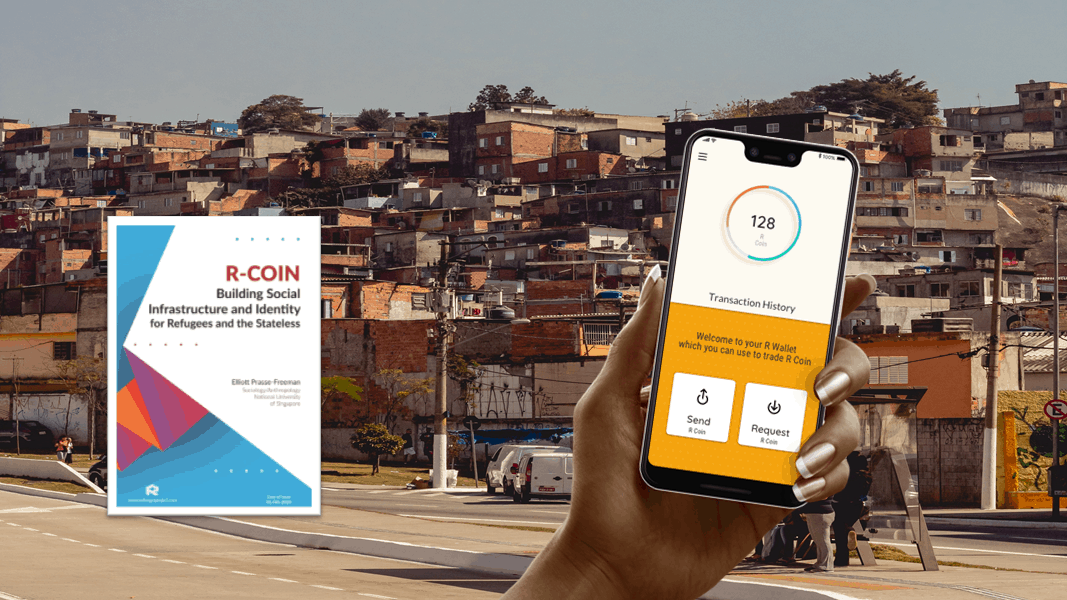
Datarella is very proud to be working with the Malaysia-based grassroots Rohingya Project which just recently has been rewarded with the Malaysian National Recognition Reward for their work, leveraging the advantages of blockchain technology through the R-Wallet and R-Coin.
R-Coin, short for Refugee Coin, is an ERC20 based token that is hosted on a private, permissioned Ethereum blockchain network. Therefore, R-Coins can’t be traded on public exchanges, thus they aren’t vulnerable to any volatility. The associated R-Wallet, a mobile app, stores the private/public keys, which allows interacting with the blockchain, or in plain English: to store, send and receive R-Coins.
R-Coins are used to reward refugees for community work, such as teaching, care-taking of children, cooking, cleaning, transportation services. For every hour of voluntary work, the refugee gets 1,0 R-Coin transferred to his wallet. At the end of the pilot phase, the participants will be able to redeem the collected coins for goods and services, from Starbucks gift cards to ATM cards, accident insurance, and health services.
The short and medium-term goals of the R-Project are to include refugees in the society, to increase their working skills and to provide them with a financial tool, the R-Coin and the R-Wallet. The transfers of R-Coins for voluntary work serve as “proof-of-work” and, therefore, can be taken as the basis of a digital identity, providing a digital CV, for the stateless Rohingya.
Currently, the R-Ecosystem includes four stakeholders:
- Providers: NGOs who organize (and verify) volunteer activities
- Refugees: Complete volunteer activities and earn R-Coins
- Vendors: Accept R-Coins and them for exchange goods and services
- Donors: Circulate R-Coins within the economy: distribute them to providers and then ‘buy them back’ from vendors who had accepted it from refugees in the first place
Blockchain technology can also be used to ensure that donations arrive where they are intended to arrive. To enable donors to trace the whereabouts of their donations and to directly support such impactful projects like the R-Project, we are working with financial services provider Wirecard AG on a respective project called “Traceble Donations”. If you’re interested in learning more about this value-creating project, stay tuned for our forthcoming blog posts or you visit our next Blockchain Meetup on 31 March in Munich!

by Admin | 18 February 2020 | Blockchain, Track and Trust
This is a guest post by Maria Lema, the co-founder of Weaver Labs, a tech start-up building a Blockchain platform for the Telecommunications industry.
Connectivity is what allows us to exchange information real-time across the globe thanks to the existing infrastructure we call the Internet. Us as individuals and all our businesses rely on connectivity for the majority of our daily activities, we do everything online and it has become a utility: it’s an essential tool to create, develop and grow. With 5G being deployed, the telecoms sector must focus on innovation in the business models and supply chain dynamics to deliver the networks of the future.
Innovation: long time no see
Technological development in the communications sector hasn’t stopped since the creation of the telegraph, and we have learned to communicate faster and more efficiently across the Internet thanks to the creation of communications systems, standards, protocols and infrastructure such as fiber, antennas, switches and gateways.
Although we have changed the way we interact with the Internet and online applications, we haven’t changed much the way we deliver connectivity. Most will agree that, while we have undergone (and are probably still undergoing) a data and communications revolution, networks haven’t yet adapted to this new way of online interactions. We have adopted the smartphone and we have seen technologies grow from 2G to 4G, but the traditional supply chain and investment models in telecoms have achieved the tipping point. We need a transformation, one that is able to support and deliver the spectacular developments in emerging technologies: AI, Big Data, Robotics, Autonomous Vehicles, and more.
The Network Revolution
5G is the new generation of mobile networks and is purely software-based, so more than just another generation, it is an opportunity to innovate in the way we deliver connectivity with an infrastructure that supports the future cities and the explosion of data.
Following this transformation, networks are becoming a commodity: open source based and with a growing diversity in the equipment sector – in other words: competitive. This competitiveness is motivating new players to deploy and own network infrastructure: factories, hospitals and even whole cities are investing in infrastructure with a variety of applications in mind that require high bandwidth and support for a massive number of devices.
However, there are still challenges to realising the dream of open and diverse networks: convergence and integration is still something not fully solved. Despite being built around existing standards like the Internet Protocol (IP), there’s still a need for rigorous standardisation to allow for easy interoperability across network elements and all the actors involved – chip/device manufacturers, equipment vendors, operators, etc. From a service provider perspective, some of the key hurdles when building diverse and interoperable networks are:
- Simple: to create end to end services across the infrastructure targeting interoperability across multiple network elements.
- Open: to integrate new infrastructure and service offerings, with built-in security mechanisms that allows critical components to be onboarded faster.
- Scalable: grow horizontally with minimum interaction of the Service Provider.
Weaving Telecoms with Web 3.0: the fundamental shift
Decentralisation and tokenised economies are a solution to complex cross-actor engagements with mechanisms to reward network participants in exchange for contributions. Leveraging innovative P2P and Blockchain technology, we are a software and protocol stack that provides a simple, open and scalable solution that enables the horizontal integration much needed in networks. We create a marketplace of connectivity assets that replaces the Service Provider as a central point of trust to aggregate network resources.
Weaver is a P2P network created specifically for telecommunications, equipped with a new Messaging System (WireMQ) designed to manage real-time communications traffic across the network infrastructure. It builds on the horizontal integration of networks by adding a software layer on top that enables interoperability and convergence.
How does Weaver help to advance in the Network Revolution?
We create a connectivity platform that integrates any communications system and leverages existing infrastructure to communicate across all technologies in the P2P network. A great example is the mesh network Weaver built for the Track and Trust supply chain project with Datarella. We used WireMQ to route traffic from IoT devices into a Satellite base station, and it can be scaled up including 4G antennas, WiFi and more IoT technologies – which allows us to bring this directly into Smart Cities. We innovate in the supply chain, creating a platform for connectivity with mechanisms to exchange network resources and incentivise all network participants. The new business models are based on infrastructure sharing and revenue sharing where all contributors can capitalise on existing assets and create a viable return on investment in infrastructure for connectivity.
by Martin Schäffner | 4 February 2020 | Track and Trust
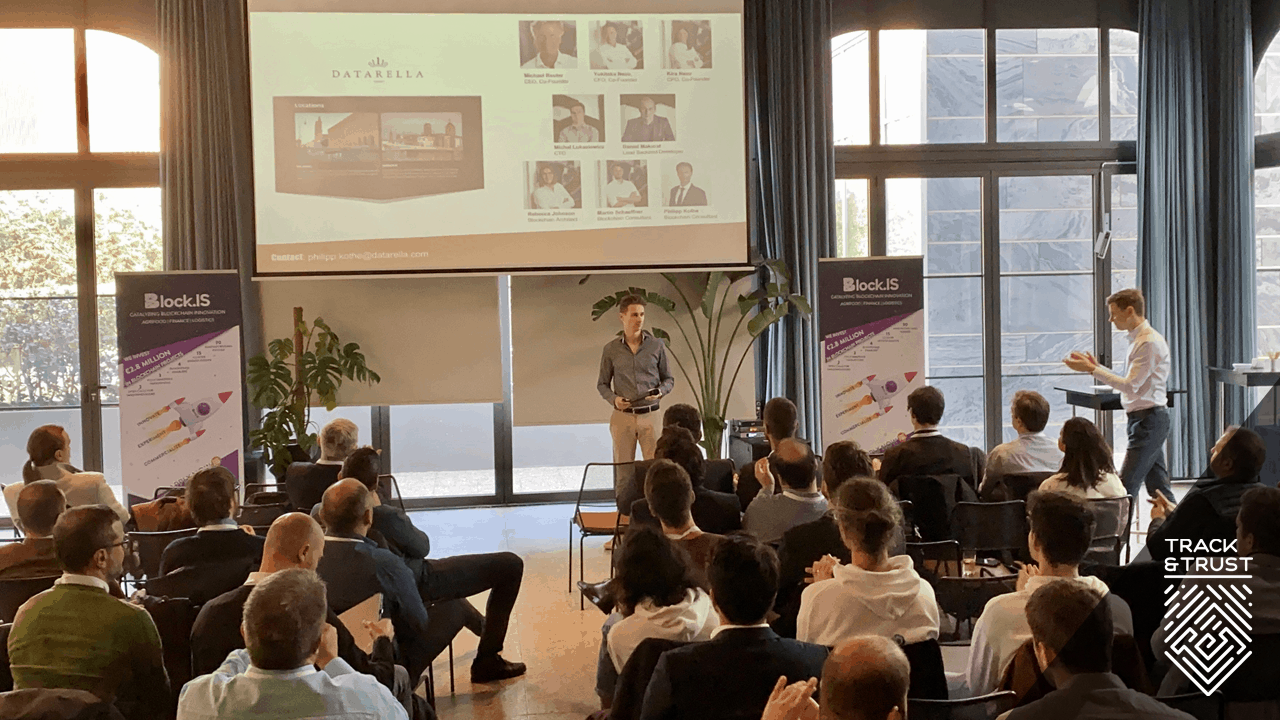
Track & Trust by Datatrella has been selected by the European innovation program Block.IS as one of the best blockchain logistics solutions. After two days of evaluation by experts from the business and technical domain in Istanbul, we are proud to announce that our project was selected to enter the next phase of the blockchain accelerator program funded by the European Union. The jury saw the tremendous impact of Track & Trust, bringing light into the logistic black box of complex, global supply chains.
The bushfires in Australia, the war in Libya or the Coronavirus outbreak in China. Our world is facing various challenges. However, besides the crises which are present in our daily news, over 200 million people in 81 countries are assessed for being in need of humanitarian assistance. A large percentage of these are concentrated in a small number of countries. For example in the Democratic Republic of Congo or Yemen, where millions of people are starving, have been displaced from their homes by war and suffer epidemic outbreaks of Ebola and Cholera took place.
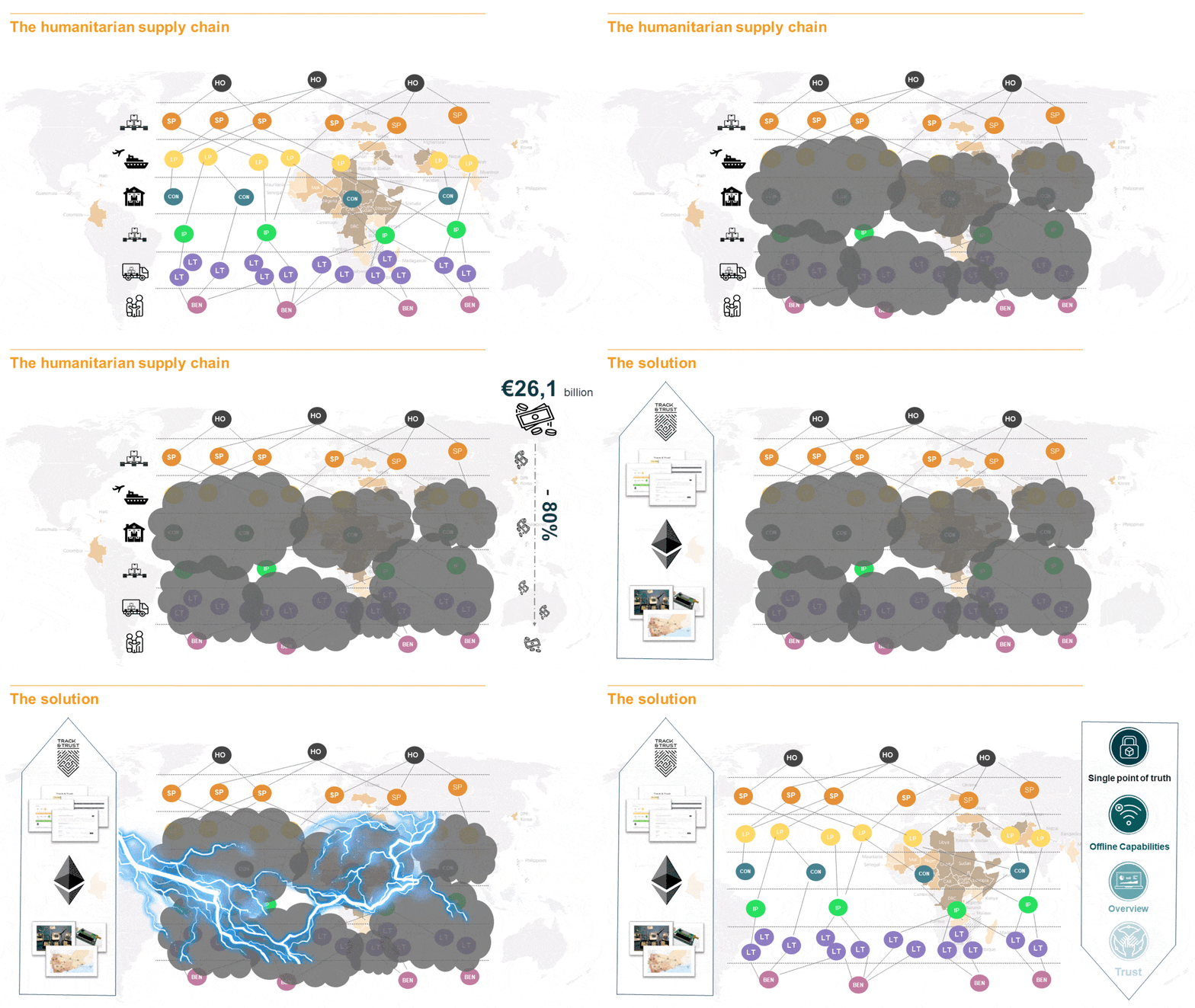
But how do life-saving supplies – like food, water, medicine, and shelter – reach the people in need? Here is where the humanitarian supply chain comes into play. In the GIF below we tried to illustrate one, in a simplified way, but as you will see these networks are complex.
Just to give you some characteristics on these networks:
- They are composed of multiple stakeholders from NGOs, governments, and military to private corporations
- They operate over multiple countries/continents
- They are ad-hoc and work under high time pressure
- They operate in the most demanding environments, like warzones, and after natural disasters
- Its is very hard to forecast their demand since:
- Every crisis is unique
- A lack of historical data
Further, if tracking of goods and shipments is done at all, it’s documented by organizations individually and manually. This makes the humanitarian supply chain vulnerable to human error and fraud.
All these characteristics result in tremendous costs. It is estimated that around 80 percent of the expenditures of aid agencies are in the area of supply chain management.
Luckily, we offer a unique solution that allows the tracking of shipments from the beginning to the very end of the supply chain, bring transparency, trust, and collaboration to the humanitarian supply chain. We call it Track & Trust.
Our solution is made up of three key components:
- A user-friendly interface, proving the supply chain stakeholders an overview of the actual state and details of a shipment.
- A Private Ethereum Blockchain, which allows the immutable and tamper-resilient documentation of handover data and serves as a single point of truth. Noteworthy, data is managed and governed by the involved stakeholders themself, no external intermediary is needed.
- A hardware kit, composed of LoRa nodes and satellite communication technology, which allow the creation of an asynchronous mesh network, which enables to broadcast changes in custody of goods without being dependent on existing telecommunication infrastructure.
Our goal is to minimize the cost related to human error and fraud of these life-saving supply chains to maximize the value which arrives at the people in need.
Track & Trust was created to address the problems of the humanitarian supply chain. However, these supply chains are by far the only ones facing challenges like transparency and accountability in times of globalization. Just consider the supply chains of pharmaceutical, food or luxury products that are fighting against a multi-billion dollar counterfeit industry, demolishing profits and the trust of their customers.
If you want to learn more about our Track & Trust system feel free to contact us or to read more on our company blog.
“This project is funded by Block.IS (Blockchain Innovation Spaces) Horizon 2020 research and innovation programme Project No. 824509, under the funding framework of the European Commission.”
by Kira Nezu | 30 January 2020 | Blockchain
In the past years, we have built numerous blockchain projects – most of them private permissioned networks with Proof of Authority (PoA: A defined number of nodes “control” the network). Every now and then, we encounter the question “Are private permissioned blockchain systems less safe?“. We sat down to clarify this question on a high level.
We won’t jump into technical details. Instead, let’s look at how a private permissioned blockchain network comes into existence: Someone gets the brilliant idea to create a shared network for a specific case in which data must be effectively shared between multiple parties. She might go to other parties and ask them to join her case and present them a beautiful Big Picture. Most likely, the others will react tentatively – they might have to turn larger wheels within their environment in order to join. So, our lone blockchain pioneer might collect loose commitments from those parties and have them intend to join (after the system has been created and proven, of course) and start out on her own.
Hence, the first step is taken to create a private permissioned blockchain network. And, as all first steps, it costs some effort and is in the beginning just – a step. A blockchain network with perhaps 2-3 nodes for a start. Very small, controlled by one entity and – admittedly – vulnerable. “Less safe”. In terms of security, there is no great difference here compared to a traditional centralized network with “a server”.
But, dear reader, we are forgetting something cruical: The Big Picture.
A seed does not make a forest, but it can start one. Our pioneer now will go to the parties she has collected commitments from. One or two will agree in testing. In an ideal case, they will see the benefit (usually it’s largely increased efficiency and/or cost savings) and better understand the Big Picture. With this lever, they will be able to turn the wheels in their environment – and add their own nodes to the network. With more parties joining the network over time, we have a consortium of real world entities which controls the network. They will create a governance model in order to set down the rules for the network. And of course, with the added nodes the network becomes safer.
So, on top of the technology (consensus algorithms, encryption, blocks, keys, distribution, zero knowledge proofs, channels… you name it) exists a real world layer to the network which is typically ignored by people who are fresh to the idea of private permissioned blockchains. This real world layer ideally contains
- a consortium (often found in form of a foundation),
- a governance model (set of rules agreed upon by the consortium)
- arbitration (to some extent automated within the network)
- auditing (possibly even through nodes of a neutral audit company for real-time auditing)
Can a large private permissioned blockchain network still be captured by a malicious party? Yes. BUT: This party will knowingly risk its reputation within the consortium, since it is transparent who holds which nodes. Imagine a humanitarian supply blockchain in which a number of humanitarian organizations make up the consortium. Would it make sense for one of these to risk their reputation? Imagine a money-transfer blockchain network held by a consortium of banks – would a bank want to risk its reputation? Or, think universities issuing degrees on a blockchain?
Are private permissioned blockchain systems less safe? It depends. Next time you encounter one, take a step back and challenge yourself: What could the big picture look like?
by Martin Schäffner | 13 January 2020 | Blockchain
This is the second post in which we are going to examine blockchain protocols and their tokens. First up, we wanted to start with Ethereum and its native token, Ether, which allows a network of thousands of independent computers to form a single supercomputer.
The beauty of blockchain lies in the possibility to create, securely maintain and transfer digital units, so-called “tokens“. These tokens can serve the purpose of a medium of exchange, which is redeemable for something specific from someone specific. Generally spoken, this is what gives tokens their underlying value. As a consequence, these value units can be used to incentivize certain behavior.
Bitcoin, the first blockchain protocol uses its native token, BTC, to incentivize its network participants in competing to solving a cryptographic puzzle. Whoever solves the puzzle first is rewarded with new BTC and eligible to add a new block of transactions to the ledger.
Ethereum is a network protocol, which uses Ether to incentivize individual computers to act as a single supercomputer, called Ethereum Virtual Machine (EVM). This computer is capable of running any code, written in the native, Turing complete programming language Solidity. The code on the Ethereum Network follows an if/then logic is called a “Smart Contract”.
Smart Contracts are executed on all computers of the network simultaneously, therefore, in a decentralized manner. Once a Smart Contract is deployed to the network it is theoretically impossible to alter or delete it. To perform any changes the majority of the network would need to be convinced to rewrite the underlying code.
Imoratbillity brings the benefits of censorship resistance and prevents any manipulation through malicious actors. Further, running the code simultaneously on all computers of the network eliminates a single point of failure and prevents, therefore, any downtime. These prosperities make code that is running on the Ethereum network highly trustable. However, the downside of immutability arises through the missing opportunity to fix bugs within a Smart Contract once it is deployed.
Just like traditional programming code, Smart Contracts can be used for various purposes.
For example, a Smart Contract can express all the required rules to define ownership and the transfer of ownership, which are required to issue and manage a new token.
Further, Smart Contracts can be used to create computer programs, so-called decentralized applications (Dapps).
Also, it is possible to reproduce organizational rules and structures with Smart Contracts. These constructs are then referred to as Decentralized Autonomous Organizations (DAOs) and are managed over their specific tokens, which grant ownership rights such as voting or dividends.
However, you might ask yourself why people are buying computers, paying for running them and then contribute them to the Ethereum network?
Here is where Ether (ETH), the native token of the Ethereum network comes into play.
For performing any transactions on the Ethereum Virtual Machine a fee is charged and paid out to the validating network participants.
Transactions on the network include:
- The transfer of tokens
- The deployment of a new Smart Contract
- Triggering of a Smart Contract
The fees for these transactions are price in priced in “Gas”, the medium of account of the network. The amount of Gas charged for any transaction is predefined and derived from the computing power required to perform it. However, while the charged amount of Gas for a transaction is fixed, its price is variable and depends on the current degree of network utilization. The price of Gas expressed GigaWei (GWei), which accounts for 1/1.000.000.000 ETH.
As stated, Ethereum can be described as infrastructure to host the code of thousands of different tokens, Dapps or even DAOs, eliminating the need for developing and maintaining an individual blockchain for each project.
For exchanges and wallets to deal with this great variety of tokens Ethereum offers different token standards, which will be examined in depth in the following blog posts.
The most prominent one is probably the ERC20 standard, a fungible token, which has be frequently used as a financing method in initial coin offerings (ICOs).
Examples for application-specific ERC20 tokens are:
– GNT, the currency token of the Golem.network, a cloud computing platform.
– REP, a token is used to place bets on the prediction market Augur.
– BAT, of the Brave internet browser, which is paid to users for receiving adds.
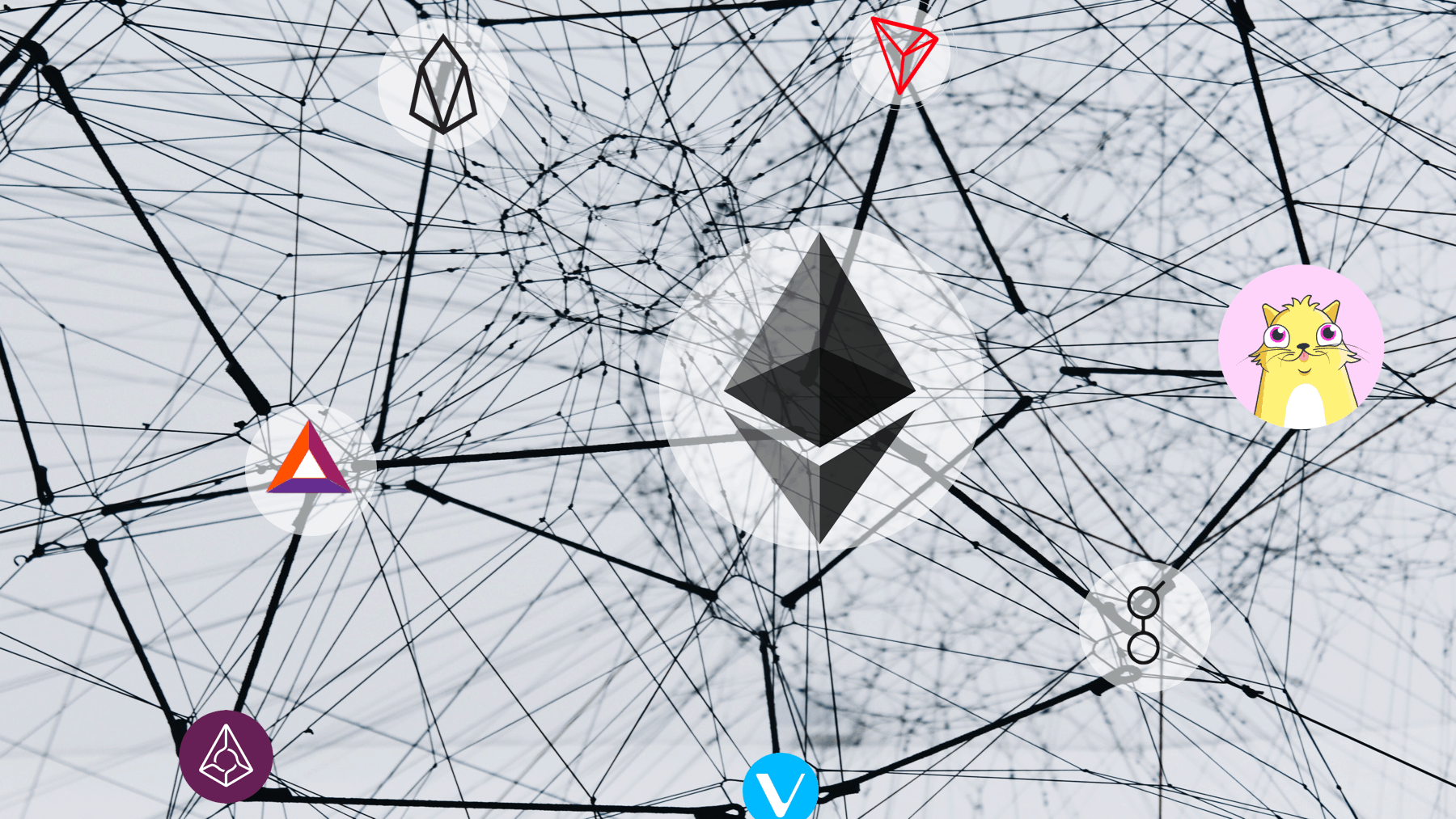
– EOS, a smart contract platform.
Another popular token type is the ERC-721 standard, which allows creating non-fungible tokens. These tokens are unique and can be therefore used to represent real-world assets, such as fin art, real estate or digital collectibles. A good example of the use of ERC-721 tokens is the blockchain game Cryptokitties, in which players can own, breed and trade digital cats. The cats are priced in ETH and sold for up to 140.000 USD.
Ethereum is a great example of how blockchain and tokens can be used to create applications and new markets.
In the following posts, we will further explore the use cases of Ethereum.
Stay tuned!
by Martin Schäffner | 16 December 2019 | Blockchain
This is our first in a series of blog posts dealing with the topic blockchain token, what they are, and how they can be used.
Historically, the term “token” has been used to describe a physical object, like coins, made of base metals or other low-value substitutes (such as wood, ceramic, plastic or paper). These tokens are a form of private replacement money and serve the purpose of a medium of exchange for goods and services. Further, the concept of tokens has been studied and approved as a method of behavioral therapy in mental health facilities to incentive and reinforce desired behavior.
In the blockchain space, a token describes a qualifiable and programmable unit within a blockchain network. Sometimes a distinction is made between tokens and coins, in which coins refer to the native unit of a blockchain network while tokens don’t have an own underlying blockchain but are hosted on another one.
Tokens within a blockchain network are associated with addresses. These addresses are mathematically derived from a private key. A private key refers to a random created string of characters, 64 in the case of Bitcoin. To transfer a token from one address to another, the initiator of the transaction of needs to identify and authenticate himself to the network, that he is indeed the legitimate owner of these tokens. This is done by signing the transaction with the correlated private key of address from which the tokens shall be transferred.
While the digital nature of blockchain tokens makes transferring them more complicated, in comparison to their physical ancestors, however, it grants them also with distinct advantages.
First, the cost of issuing and maintaining blockchain tokens is marginal. For example, only a couple lines of solidity code and a fraction of 1 Ether, the native token of Ethereum, are required to create a new token on Ethereum. The token is then secured by the blockchain network its hosted on.
Second, tokens are programmable. This allows to create various distinct types of tokens and to implement special features, allowing to tailor them to serve countless purposes. For example, a token can be programmed to be either fungible or non-fungible. Fungible tokens, just like a 1EUR coin are, identical, interchangeable and divisible into smaller units, e.g. two 50ct coins.
In contrast, a non-fungible token is unique and therefore neither interchangeable nor divisible.A real-world example for a non-fungible token would be a one of a kind art piece like a painting of Pablo Picasso. Also, a token can be programmed to be transferable or non-transferable. Further, it is possible to connect tokens to another asset or a basket of assets, which allows, for example, to tokenize a security or to create a stable token.
Today already plenty of different tokens exist with use cases varying from currency and supply chain traceability to digital collectibles and countless more are going to be discovered in the following years. Time will show if blockchain tokens will have a similar impact on our financial system like the internet and e-mail had on the postal one as being considered by Dr. Shermin Voshmgir, the director of the Institute for Crypto-Economics at the Vienna University of Economics and Business.
In the following post, we will examine the use of blockchain tokens in-depth based on real-world use cases.
Stay tuned!
by Kira Nezu | 3 December 2019 | Blockchain, Track and Trust
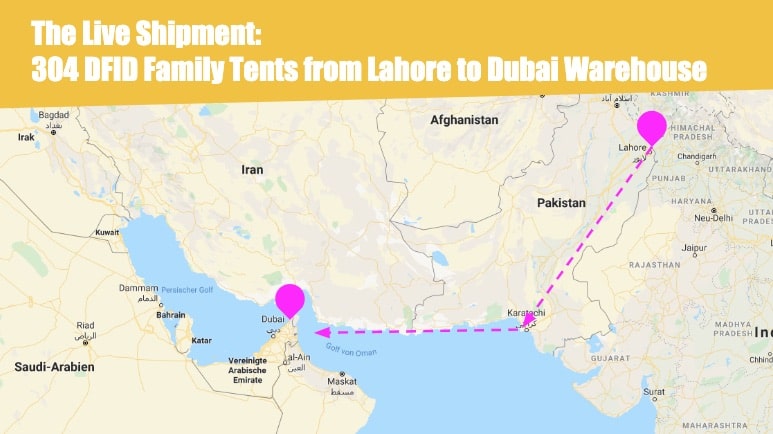
In 2018, we at Datarella started developing the Track & Trust System – the humanitarian supply chain on blockchain – for DFID. The first issue for Track & Trust Proof of Technology to tackle was to track custodianship of shipped goods. This test shipment was a replenishment of family tents, to be delivered from the supplier in Lahore, Pakistan, to Dubai. It took several weeks and was completed in July 2019. We created this presentation to show the Proof of Technology, including a demo on how a blockchain transaction is completed. Listen closely 😉
by Martin Schäffner | 8 November 2019 | Blockchain, Track and Trust
We at Datarella are working together with the UK Department for International Development’s (DFID) innovation and future technology program, Frontier Technology Livestreaming (FTL) and the European Space Agency (ESA) to increase efficiency within humanitarian supply chain.
Our goal is to maximize the value, which is arriving at the people in need by establishing transparency and collaboration between the responsible supply chain stakeholders. In part one of our blog post series, we described how we tested our Track and Trust System. For testing, we tracked a live shipment of 304 family tents from Pakistan to Dubai between the first four parties of DFID’s supply chain. In part two, we described the challenges, which occur when tracking the last-mile of the deliveries. In this post, we are going to go further down the rabbit hole and dive into the technology, which will enable us to overcome the Sisyphean task of last-mile supply chain tracking.
The story starts after the implementing partner received the goods, loaded the trucks and the driver starts his way to the destination in the crisis area.
The environmental circumstances surrounding humanitarian missions are highly heterogeneous and can range from tropical islands after a hurricane to newly built refugee camps close to a war zone. However, the one thing they have in common is that within the first few weeks after the disaster took place telecommunication infrastructure mostly is not available.
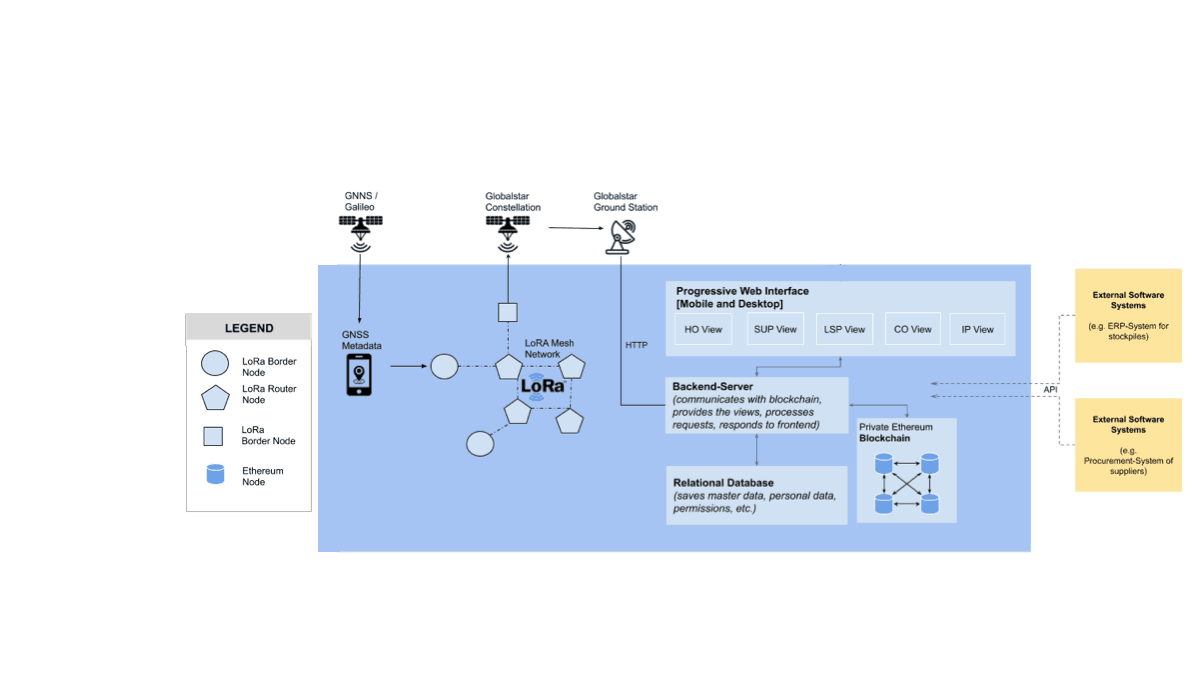
Despite these difficulties, to provide stakeholders within the supply chain with an overview about the current status of the deliveries, we at Datarella are working to test the usability of a LoRa-based Mesh Network which transmits the transaction data offline until it’s finally able to be posted to the blockchain via a satellite uplink. We’re partnering with our friends at Orora Tech who know the ins and outs of the satellite technology quite well since their main business involves the manufacture of nanosatellites.
Our solution consists of the following components:
1. A user interface implemented as a progressive web app with offline capability
2. A LoRa-based Mesh Network
3. A Globalstar satellite uplink
4. A private permissioned Ethereum Blockchain
Whenever a transfer of goods occurs, the involved parties, e.g. the truck driver and the consignee in a base camp, will use their mobile phones to prepare the necessary blockchain handoff transactions offline. Data about location, time and custody will then be saved within the progressive web app interface (including pre-signed Ethereum transactions when possible).
Then, to transmit this data without having an internet connection, we are planning to use a LoRa-based mesh network.
A LoRa network can be described by its two main characteristics.
1. As the name indicates, it allows long-range transmissions with a reach of approximately 12km in rural areas.
2. It operates at low power consumption.
Further, the term “mesh network” describes a network composed of nodes, which connect in a direct, dynamically and non-hierarchical manner. Therefore, these networks are also referred to as “self-healing” since nodes can organize and configure themselves, which allows the network to persist even if some nodes are not available.
For creating a Pymesh LoRa Mesh, we are planning to use LoPy4, a 4-network (WiFi, BLE, LoRa, and Sigfox) and MicroPython combination controller. Further, we are considering to either equip some of them with Pytrack carrier boards, for very accurate GNSS Glonass GPS. An alternative method of geolocation is to feed in GPS data from the mobile phones of the drivers.
The network is implemented using OpenThread, an IPv6-based networking protocol. The reasons why we decided for this network type are its following features:
- Simplicity — Simple installation, start-up, and operation
- Security — All devices in a Thread network are authenticated and all communications are encrypted
- Reliability — Self-healing mesh networking, with no single point of failure, and spread-spectrum techniques to provide immunity to interference
- Efficiency — Low-power Thread devices can sleep and operate on battery power for years (Dependent on how often they wake to transmit)
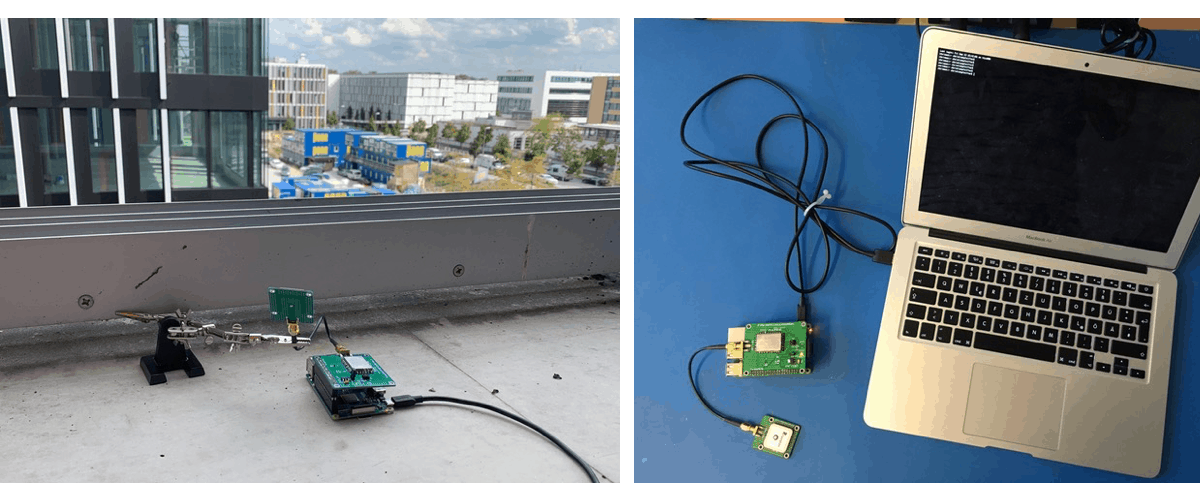
To create the Pymesh network, we are planning to install LoPy4s on the trucks, which are used to deliver the humanitarian goods to their destination. As soon a truck gets within the reach of another network node, it will transmit the offline transaction to the next router. The transaction will travel through the network node by node in this manner. Here you see a prototype
Since the reach of the LoRa routers is limited to approximately 12km we are also playing with the idea to install an air-based router, using a fixed-wing drone or a weather balloon, which would extend the reach up to 500km.
So far so good. Now the transaction data will be transmitted from truck to truck until it reaches a border router, which is connected to a satellite network. So far we have tested an uplink for a very basic JSON RPC transaction over a Globalstar simplex transmitter and successfully sent two data packets to the Globalstar constellation. Each contained a portion of the data needed to make an Ethereum transaction.
After the transaction data is sent via short bursts to the Globalstar constellation it will be received from a ground station, which is connected to the internet and executes the signed transaction in a live blockchain.
Together all of these components should enable a humanitarian agency to roll out tracking for their assets and provide transparency across their entire supply chain despite the total absence of telecommunications infrastructure in the last mile environment. All of this will be backed by a blockchain ledger providing the stakeholders in the humanitarian supply chain a single source of truth regarding custody all the way up until the final aid delivery.