by Martin Schäffner | 24 October 2019 | Blockchain
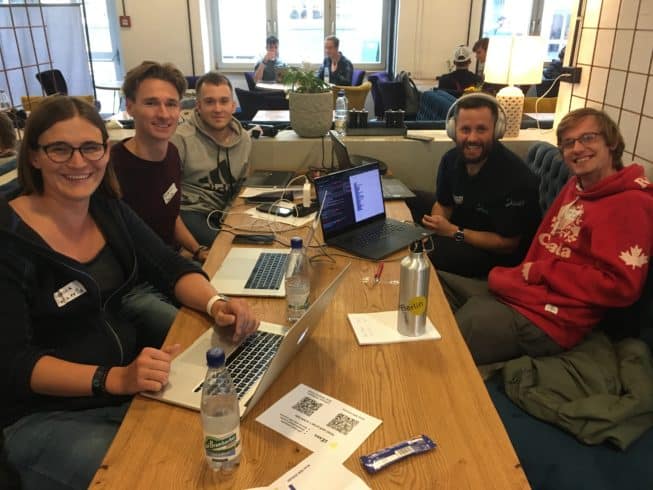
For the last year, we at Datarella have been working together with two leading sensor, IoT and infrastructure providers to collectively set technological standards and build distributed ledger technology to shape the future of mobility. On 19th and 20th of October Datarella participated at the Diffusion Hackathon by Outlier Ventures to experience live the 20 most exciting Web 3 protocols. We had the opportunity to dive deep into the Fetch.ai tech stack during the event and were able to leverage those tools to build a PoC over the course of two days. Fetch offers a unique agent-based approach to allow developers to turbocharge the matchmaking capabilities enabled by converging blockchain and AI. We proudly announce that our team of Rebecca Johnson (Datarealla), Tom Rae (Agent3), Idan Portal (2key), Tomasz Gęsior (Baltic Data Science) and Philipp Kothe (Datarella) won with our project “Effortless Parking” in two tracks.
During the hackathon, we built a project on top of a real-world use case in development within our consortium. Our Diffusion 2019 project is meant to extend and build on top of our current prototypes for improving coordination between parking lot operators, cars and the IoT & infrastructure providers whose systems make up the mobility landscape in which parking transactions take place.
Our goal was to increase the efficiency in the parking market by reducing the transaction costs which occur between the driver and the parking lot owner. Further, we wanted to prove that an open and collaborative market, enabled by web3 technologies, would be beneficial for both sides of this market. To strengthen our argument we will refer in this post to two economic theories, the transaction cost, and economic surplus theory.
1. Transaction costs
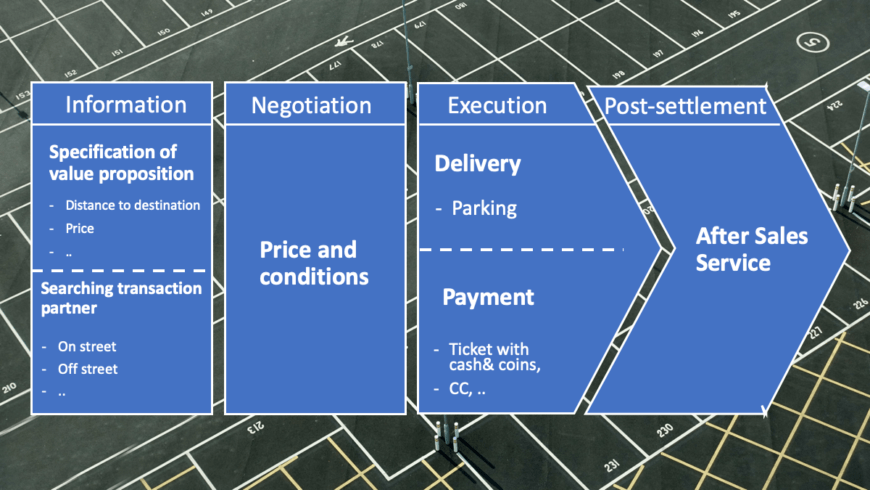
According to a study, car drivers spend around 40 hours a year searching for a parking space. This is not only a waste of time but is also responsible for one-third of all traffic, respectively traffic-related air pollution in inner cities. At the moment drivers have to download multiple apps and compare the offers of various parking garage operators to evaluate what is the best parking option close to the destination. Alternatively, many drives just drive around looking visually for an opportunity to park. However, both approaches are related to high opportunity and searching costs for the consumer.
These costs together are also referred to as transactions costs and occur whenever a good or service is transferred via a technologically separable interface. Transaction costs describe both monetary and indirect costs such as time or effort. For a systematic approach, these costs can be divided by the time they take place in the transaction process. For example, prior to the conclusion of a contract, time needs to be spent searching and evaluating information, negotiating price and drafting/reviewing contracts, adjusting the contract/s, and finally, after contract execution, time must be spent to resolve any post-settlement disputes.
Like all costs, transaction costs have a limiting effect on economic growth. As a result, technological and organizational innovations that reduce transactions costs for users are becoming increasingly important for macroeconomic development.
2. Economic Surplus
Also, on the other side of the market, we identified high inefficiencies. In contrast to airlines or hotels, car park providers currently do not usually implement any kind of capacity utilization-based pricing. This, in combination with a lack of coordination and information among drivers, leads to a system of suboptimal asset utilization since some car parks are overbooked and while others are still nearly empty. The consequence is a limitation of the economic surplus created in the parking industry.
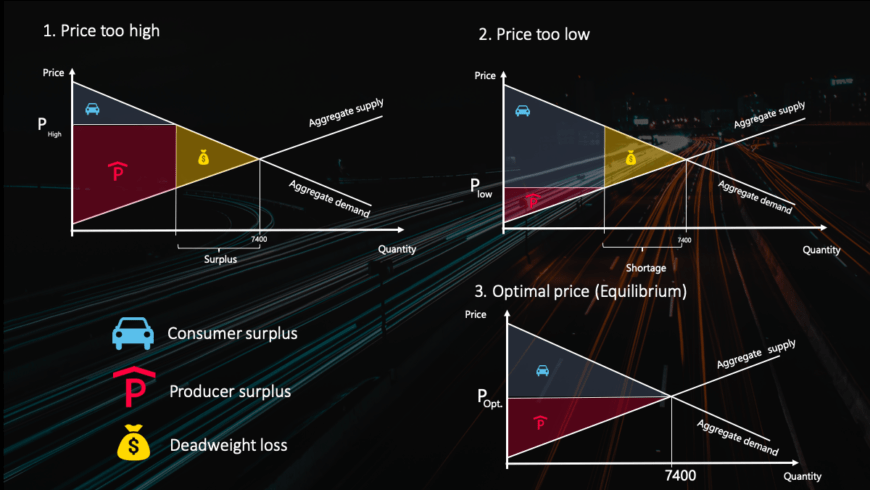
Economic surplus is a macroeconomic concept established and framed by the economist Alfred Marshall in the mid-19th century. Together with Karl Heinrich Rau, he developed a diagram, which shows the relation of demand and supply in dependency on price and available quantities of an economic good.
But let’s take this into practice and look at an example. The paid parking market in Munich consists of over 24 parking garages which offer about 7400 parking spaces.
In this simplified example, three scenarios are possible as shown in the graphic.
1. If the price is too high, there is not enough demand and we face a surplus in parking spaces.
2. If the price is too low a shortage occurs because there would be more people willing to park than operators offering lots.
-> In both cases, a deadweight loss is created and value is lost since the full market potential cannot be captured.
3. The equilibrium price is found. Hereby, the price is set where demand exactly meets supply, which allows to capture the full market potential. Important to note is that this system is referring to the average price, which is composed of the individual prices of each parking garage.
3. The Fetch.ai Solution
To solve this dilemma of coordination and optimal pricing our team used Fetch.ai, a system designed to increase market efficiency by helping to match supply and demand.
So, during this hackathon, we used Fetch.ai to build a software simulation that would allow us to model the revenue generated by the parking providers under both optimal and suboptimal coordination conditions. Our first model simulated the revenue of each parking lot operator without any cooperation between the different provider, coordination or dynamic capacity utilization based pricing. In that model, drivers just attempt to find the closest spot (which is close to the real behavior of inner-city drivers). The second model simulates a smart network in which the different operators collaborate and drivers are coordinated to the available parking spaces, which match their preferences for distance and price. Autonomous economic agents powered by AI negotiate to achieve economically efficient outcomes.
We implemented our project using Fecht.AI prebuild SDK library, which allowed us to run a local ledger and a local IEF node. Further, we implement a custom data service to represent the parking garages. In this model, the parking garages acted as data provider and the drivers compared then the data they saved as preference vector (like distance to destination, price..) with all of the available data from the garages. After all options are evaluated, the agents choose the best option for the driver and sets a deposit in Fetch (FET), the native token of the ecosystem, to reserve the parking spot. We then used Fetch.ai smart contracts to represent the tickets which are sold and bought.
This system allows to discover the equilibrium of the whole parking market dynamically, reacting to any changes in capacity utilization in real time. Practically it can be used to demonstrate to parking lot operators that they are leaving significant money on the table by not using a fair and neutral DLT based coordination and booking system alongside their competitors. Everyone’s better off in this model as deadweight loss and negative externalities are removed from the system while maximizing both parking operator revenues and net economic surplus.
We are absolutely thrilled to further discover the endless possibilities Fetch.ai offers. The best part of the system is the fact that these “simulations” are intended to be implemented within production systems in the future. This means that the same system we’re using to simulate the future economic and environmental effects can then be put into use to actually achieve those outcomes in a real-world system.

by Martin Schäffner | 15 October 2019 | Blockchain, SSI
We from Datarella are always encouraged to be experts in the field of blockchain-related concepts and technologies and also to share our knowledge with the blockchain community. This blogpost should raise awareness about Self-Sovereign Identity (SSI), a fundamentally new approach of digital ID enabling users to have autonomy about their decentralized identifiers (DIDs) on the internet.
Managing identities on the internet is a problem since its early days as it doesn’t have an integrated identity layer. Conventional identities are represented by identifiers provided by identity providers, such as an e-mail or a social media account like Facebook. The problem with these is that the identifier is not owned but only borrowed. The identity provider remains in control of the identifier and not the actual user. Although registration at new services is an annoying process already, the major problem is that websites store this personal information on their servers to determine who their users are. Based on the user information, data is generated and passed on to third parties without the explicit knowledge of the user. Besides, it often happens that this information is not sufficiently protected against criminal attacks.
DIDs as the fundamental component in Self-Sovereign Identity
The new digital ID concept “Self-Sovereign Identity” should allow users to have full autonomy about their identifier and control over how related personal information is shared and used and with whom. The fundamental component which makes it possible is the so-called decentralized identifier (DID). A DID represents the user in a pseudo-anonymous way and is derived from a public key generated on a blockchain or other distributed ledger technologies. Users can create and register their DIDs without the need for a central authority.
DIDs serve to create lifetime relationships with others in a decentralized and privacy-preserving manner. Only the information that is needed should be disclosed. A popular example is that a verifier doesn’t care about the actual date of birth but only if the user is old enough to use or access a service. By using zero-knowledge proofs, the verifier only sees this information, derived from the date of birth.
Self-Sovereign Identity further faces the challenge to merge the real-world identity closer to the offline world. This should be achieved by integrating verifiable credentials that can be issued to assert personal information to the DID. Credentials could contain any information, depending on the issuer, such as a valid digital ID, an attestation about a relationship like a club membership, or a digital diploma. By gathering such credentials, a user could integrate real-world identity characteristics to the online identity.
Still a long way to go for SSI
Even though the concept of SSI is very promising, and standardized formats, such as DID, exist, there are still big hurdles to take.
One challenge will be how this concept should be integrated on the internet. The usability has to be intuitive, so users tend to use their DIDs instead of a username and password combination. Then all actors have to be on-boarded. This is the typical chicken and egg problem. It requires a significant amount of services and authorities to accept or issue credentials but it also needs enough users to incentivize authorities to offer credentials first.
However, there are already several projects running that provide this technology. The Sovrin Network, for instance, provides an advanced identity ecosystem that allows users or authorities to form relationships with others and issue or receive credentials. The uPort project also provides a full SDK to implement Self-Sovereign Identity solutions on the Ethereum blockchain.
If you are interested in more information about Self-Sovereign Identity feel free to contact me via E-Mail or read into already existing documentation, such as the DID primer.
by Kira Nezu | 11 September 2019 | Ask Datarella, Blockchain
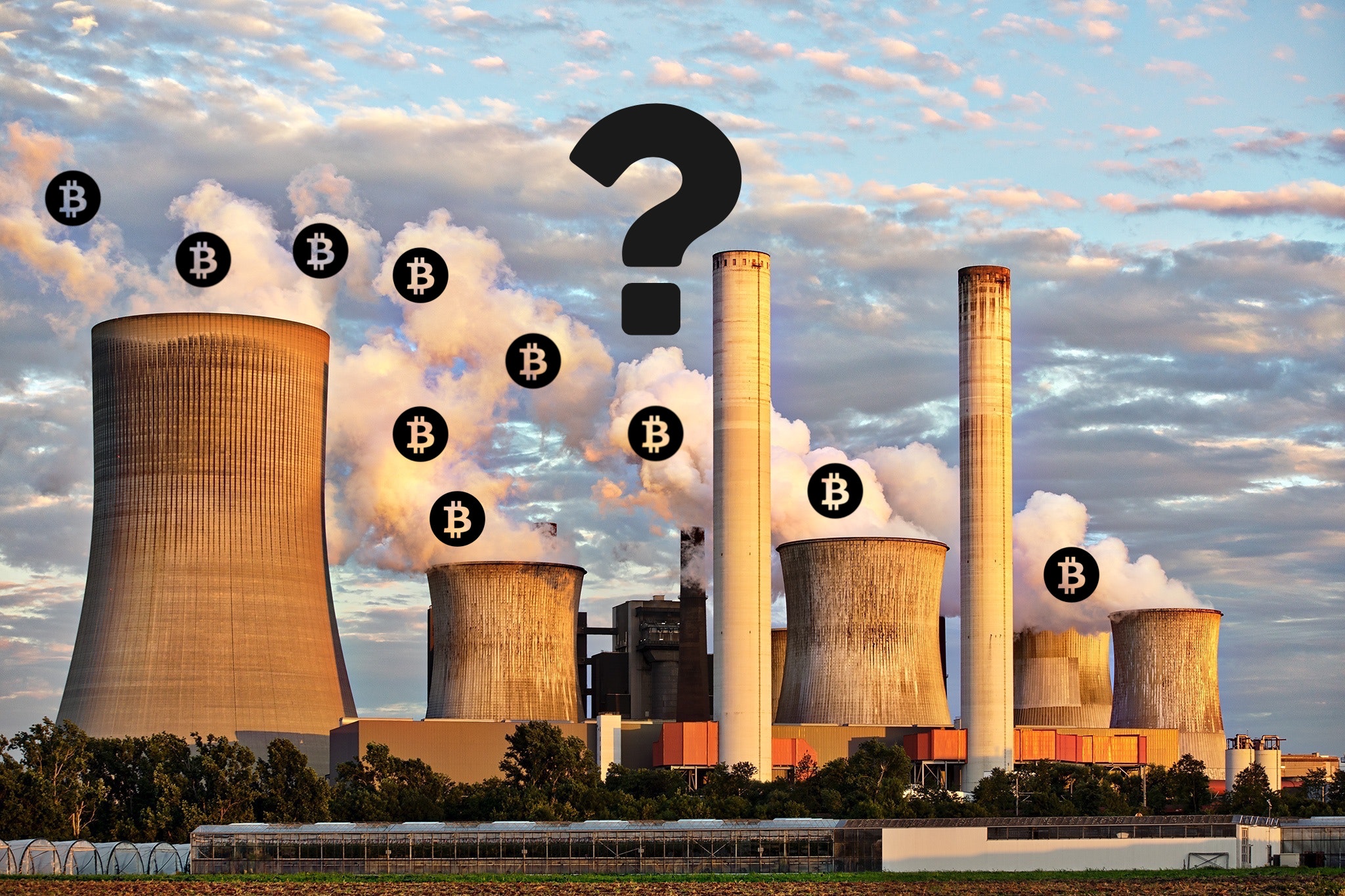
If you’re wondering why a blockchain company like us is writing a blog post about killing vampires, or if you’re confused because you’d think that meat products good for barbecue have nothing to do with our core competencies, you’ve landed in the right place!
This is a short explainer and introduction to proof-of-stake (PoS), which in the context of blockchain and distributed systems is a method for agreeing upon what is the true informational state of a distributed system. This is called the consensus mechanism in blockchain-talk and is often compared to proof-of-work (PoW), which is based on the simultaneous computation of many, many relatively simple calculations.
How does it work?
Proof-of-Stake is a process which starts with a pseudo-random number. This number is used to perform a lottery to see which node gets to validate the next block. And this is where the stake comes in. The probability of a node being allowed to validate a block can be based on the percentage of tokens that node has staked. The chosen validator then proposes a block. Some types of PoS allow for nodes with more stake to have more votes on the validity of this block.
In order to motivate nodes to participate honestly in the validation process, there are rewards and penalties in most PoS-models. The rewards are there so that someone will perform the common good of validating transactions, and the penalties are there to prevent corruption or attacks on the blockchain. One widely discussed attack is the nothing-at-stake attack which is when a node attempts to create blocks, or vote for all blocks, on top of many or all of the competing chains in an non-finalised state. It is in fact even in the interest of all rational nodes to do this, since the marginal cost is very low. For a penalty to be able to control for this type of behaviour, we need to know the full set of validators which are allowed to stake before the fork takes place, but then it’s easy to create a negative reward for those voting for multiple blocks. Another method of penalising validators for misbehaving is to create so conditions for when a validator is deemed dishonest beyond reasonable doubt. If this happens to a validator, the staked tokens are slashed. More here and here.
Why is PoS an improvement for blockchains?
Two reasons mainly:
- It requires less energy. The wasted-energy argument of many blockchain discussions is based on the assumption that blockchains use PoW. I won’t get into the details of how PoW works here, but since PoS doesn’t require any racing to find a special key between different nodes like PoW, the energy consumption is drastically improved.
- Economic incentives can be programmed into the model in a more certain way than in PoW. For example, centralisation cartels can be prevented by improved game-theoretic design and 51% attacks can be made incredibly expensive.
It should be noted that just as with many other parts of blockchain technology, there is room for development and innovation in staking protocols. There is already many different types of PoS with each having their own benefits and drawbacks. Hopefully, after having read this introduction, you feel empowered to dive deeper in other aspects of consensus mechanisms and blockchain!
by Michael Reuter | 5 August 2019 | Blockchain
Since the advent of the internet aka Web 1.0, internet users have been enabled to shop online and to receive information from all over the world with a few mouse clicks. Since Web 2.0, users could actively participate by producing and sharing content, information and opinions over the web, and through this build their own personal online brands. With Web 3.0, we have now approached the next evolutionary phase: users can capitalize on their online brands by executing peer-to-peer (P2P) transactions, while keeping full sovereignty of their data.
There are two key technologies that allow for a more evenly distributed value creation: Distributed Ledger Technologies – aka Blockchain – and Artificial Intelligence AI. Whereas in Web 20, there were systemic errors, such as data silos, breaches and hacks, as well as data being hoarded or not utilized at all, the promise of Web 3.0 is becoming a distributed, silo-free, open source, non-discriminating framework to allow for a full sovereignty of individuals as well as enterprises. Blockchain is the best suited foundational technology layer for this purpose. A distributed network of ledgers can be used by machines to communicate with each other, and participate as autonomous entities in the global economy.
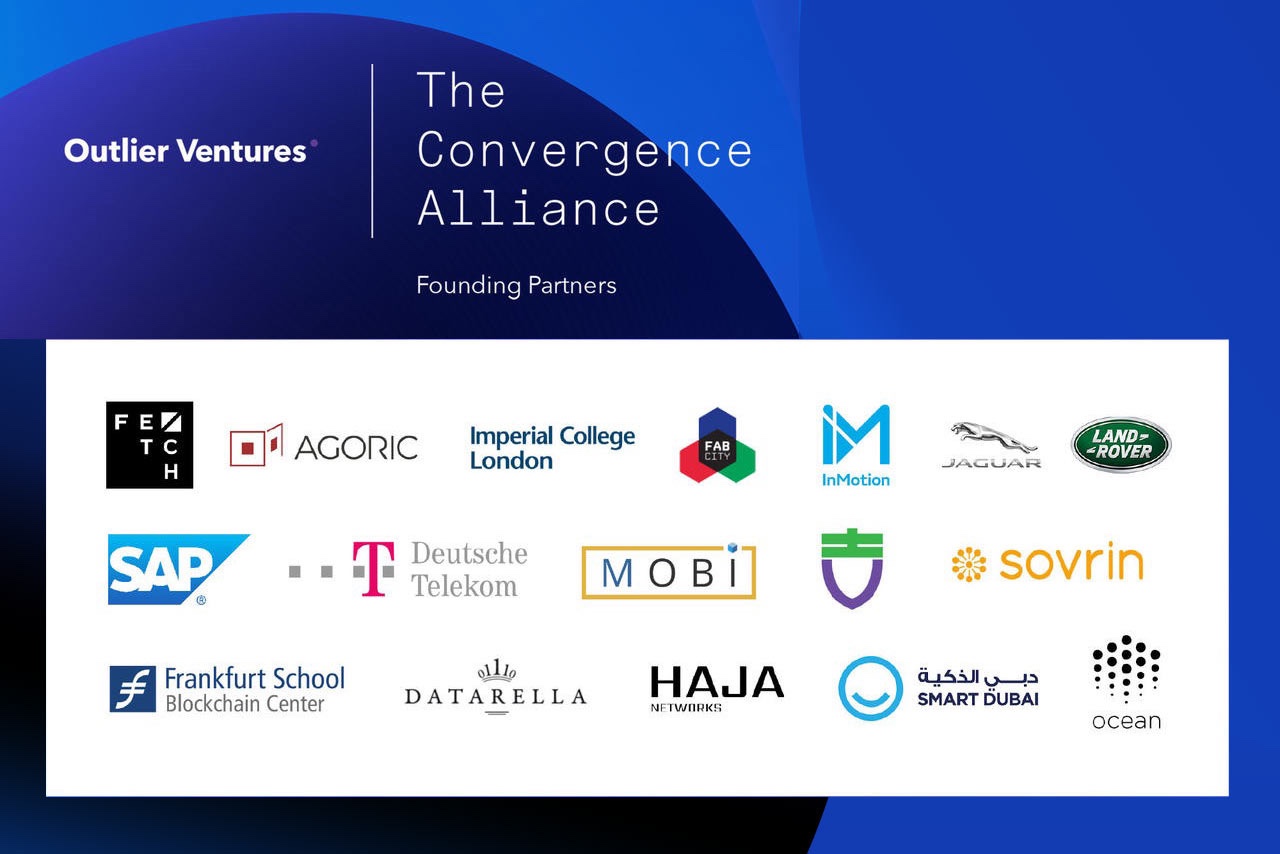
As we have learned from the history of the Internet, a technology itself is a necessary but not a sufficient condition for becoming a non-discriminating, open source technology layer. Beside technology, there must be a governance model including smart incentive schemes that allow for a sustainable, non-discriminating behavior of participants in the system. Ideally, many participants across a variety of industries agree upon. finding and setting these rules, regulations and incentives. With Datarella, we are honored to become a founding member of the Convergence Alliance, together with Deutsche Telekom Innovation Laboratories T-Labs, Jaguar Land Rover’s InMotion Ventures, SAP, Imperial College London, Frankfurt School Blockchain Center, MOBI, Smart Dubai, the Fab City Global Initiative and Outlier Ventures. The Convergence Alliance is a unique community of open source protocols, enterprise, start-ups, government bodies and academia leading the next phase of the Web.
Our role Datarella in the Convergence Alliance is to focus on onboarding and supporting small and medium-sized businesses SMB that aim for entering the fields of blockchain amd AI. Whereas other technology pushes come with huge financial investments, to work with Blockchain and AI means pushing your company to the next level with small investments and contained risks. And, with the Convergence Alliance, teaming up with the ideal partner to invent new business models by capitalizing on thie innovative technologies blockchain and AI, it should be a no-brainer for SMBs to start working on it! Looking forward to seeing many SMBs joining the Convergence Alliance!

by Martin Schäffner | 1 August 2019 | Blockchain
We are proud to announce that Datarella, WERTGRUND and Hammer have established the Munich-based PropTech Joint Venture RAAY Real Estate. Our objective is to develop and sell blockchain-based products and services to the real estate industry.
RAAY Real Estate, a 33/33/33 Joint Venture between Datarella, WERTGRUND and Hammer is headquartered in Munich, Germany. Through this partnership, the three partners deliver innovative solutions for the European real estate market. Both WERTGRUND and Hammer are well-established and Munich-based real estate companies with strong financial backgrounds. We are starting the venture off with a tokenization product for one of our Joint Venture partners. RAAY Real Estate will design the token, build a platform for the sale of the tokens and add other products and services, allowing for new business models and streamlining complex inefficient processes in the real estate industry. RAAY Real Estate is legally supported by CMS, one of the leading commercial law firms in Germany.
We are very excited and proud to be part of this Joint Venture. We will keep you updated about the progress. Stay tuned!

About Wertgrund: WERTGRUND Immobilien AG is an investment and management company for residential real estate in Germany. WERTGRUND offers its institutional and private clients the entire range of services in the field of residential real estate – from investments through the accompanying of transactions and project development to asset management, property management, leasing, as well as privatization.
About Hammer: Hammer AG is a family-run property business based in Munich. Since 1951 the company is an active player in the development and management of commercial real estate within their own portfolio and for third party investors. As of to date, Hammer AG has ongoing developments with an investment volume of 1.2 billion euros and currently 220.000 m2 under management.

by Martin Schäffner | 30 July 2019 | Blockchain

We are happy to announce that Datarella is part of a pan-European study initiated by the European Commission. The European Commission wants to understand blockchain developments and its impact on society and the economy. Our study will provide evidence and suggestions for possible policy measures concerning blockchain. Our consortium is led by Spark Legal Network in partnership with tech4i2 Limited and consists of a total of 10 experts. Datarella has been mandated as the technical blockchain expert.
In October 2017, the European Council asked the European Commission to work on an European approach to evaluate the impact of blockchain on different aspects for Europe on society and economy. In the following year 2018, the European Commission formally underlined its commitment to blockchain in the FinTech Action Plan. This action plan outlines 23 steps to enable innovative business models to scale up, support the uptake of new technologies, and to enhance cybersecurity and the integrity of the financial system. Blockchain is a major part of this initiative.
Our study enquires for legal and regulatory aspects related to blockchain-based technologies and their business applications as well as for socio-economic impacts of the blockchain technology. The results of our study should enable mobilizing ad-hoc expertise and to collect facts and figures in a flexible way to support the EU blockchain initiative. To achieve this, our study will address:
- A comprehensive assessment of the legislative framework for Blockchain use, responsibilities and liabilities
- Policy choices and analyze their socio-economic impacts
- Experience sharing and validation of policy choices
- Timeline for the development of legal or non-legal EU initiatives
Together with our international partners, we will work on these tasks for the next 6 months. Our results will be summarized in a formal report, which will be issued to the European Commission and presented at the Commission’s premises in Brussels, Belgium.
We are very excited and proud to be part of this study. We will keep you updated about the progress. Stay tuned!
by Rebecca Johnson | 16 July 2019 | Ask Datarella, Blockchain
People often ask us if our our blockchain solutions are energy efficient. There’s a lot of articles and good research out there indicating that the most famous blockchain, Bitcoin, uses as much energy per year as a small country. Let’s take a quick look at the myths and the reality in industrial settings.
The Myth: “All blockchains use large quantities of energy.”
The Reality: All blockchains DO NOT use large quantities of energy. Not all blockchains are the same and not all use cases require the same “blockchain”.
Bitcoin uses a consensus mechanism known as Proof-of-Work (PoW) to secure the network. While this approach has some advantages, there are other options for both, private and public blockchains, which don’t cost significant energy and still result in a secure network. For industry, it usually makes sense to utilize a private consortium blockchain with Proof-of-Authority (PoA) validators operated by consortium members. This approach effectively cuts the electrical consumption to almost zero. The level of decentralization, trustlessness and security that Bitcoin provides is way over the top for the vast majority of practical blockchain applications in industrial settings.
Additionally, even in situations where a public permissionless system is needed, there are a myriad of options regarding the choice of consensus algorithms which don’t consume exorbitant amounts of energy. Modern Proof-of-Stake (PoS) systems secure the network by requiring network validators to put up a “stake” (i.e. reserve) of tokens which can be automatically taken away or “slashed” if validator nodes attempt to cheat the system.
Bottom line: energy consumption isn’t an issue for us when working with industry partners. Consider the myth debunked.
by Martin Schäffner | 24 May 2019 | Blockchain, Events
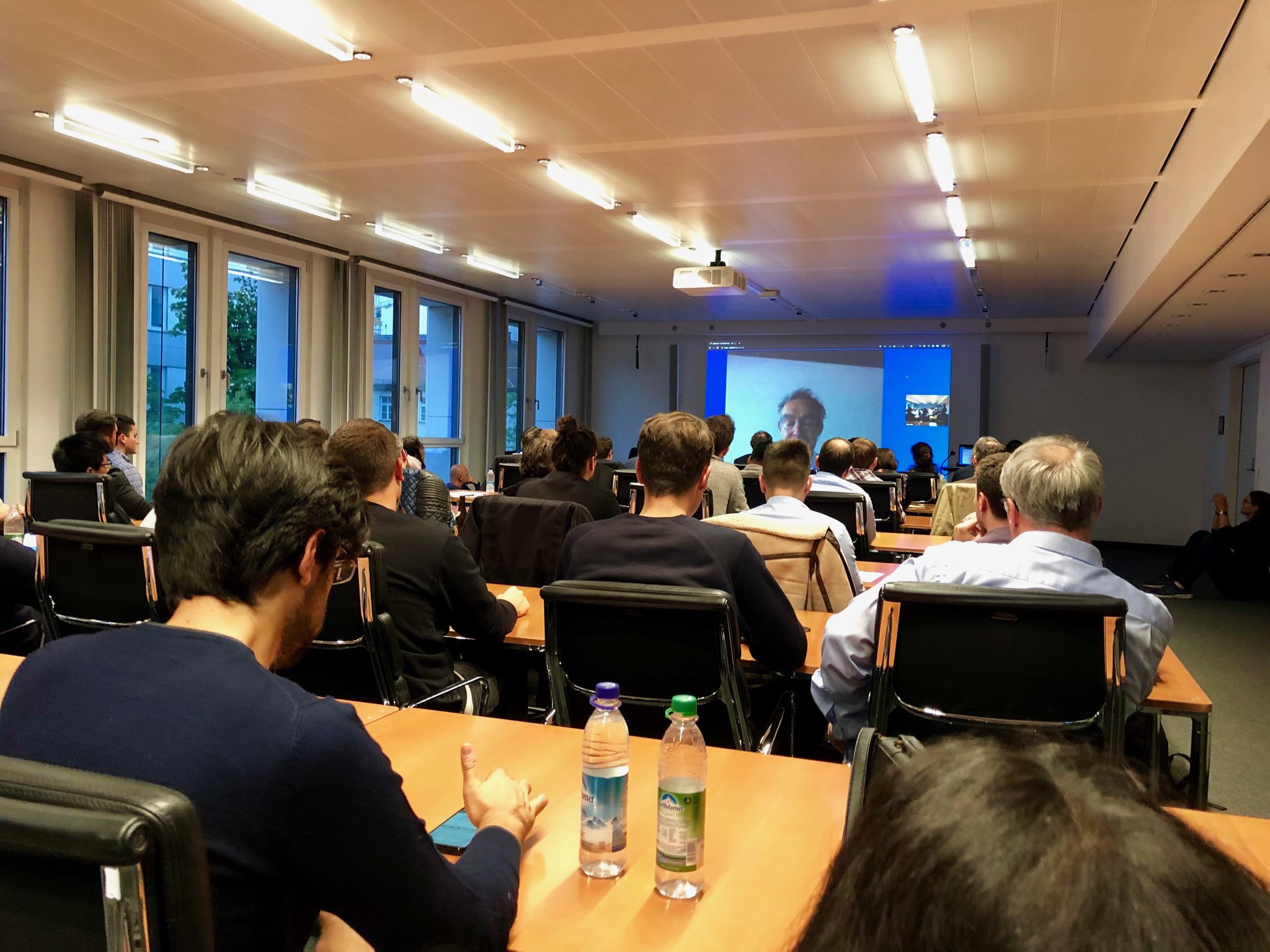
The number of and capital raised through ICOs have been in steep decline since mid-2018. Non-existing regulatory frameworks, fraud, and the decline of cryptocurrency prices were among the reasons. So called security token offerings promise to fill the gap approaches to compliant offerings based on actual assets. Will asset-backed STOs initiate a second wave of token offerings? How do typical STO projects look like, and where will security tokens be traded? For this meetup, we invited Richard Olsen, Founder, and CEO of Lykke as well as Dr. Markus Kaulartz, Senior Attorney at CMS Hasche Sigle to talk about the impact of security tokens on financial assets markets and regulatory aspects of STOs, respectively.
After the hype about ICOs in 2017 with billions of dollars raised, ICOs became less popular in 2018 due to missing regulatory frameworks as well as quite a number of fraudulent projects and the decline of overall cryptocurrency prices. ICO’s were initially attractive to projects because they enabled project teams to raise relatively large amounts of capital in an unregulated environment mostly based on white papers and promises of future project/product development. This changed rapidly following the beginning of the “Crypto Winter”.
Since then, security tokens have become more popular as token-based capital markets have continued to mature. In contrast to utility tokens from “traditional” ICOs, security tokens represent real physical value, such as a share in the company who issued them or specific assets like a power plant for instance. Security Tokens are comparable to actual shares on the stock markets, which represent partial ownership, have a price and sometimes provisions for profit sharing schemes such as dividends.
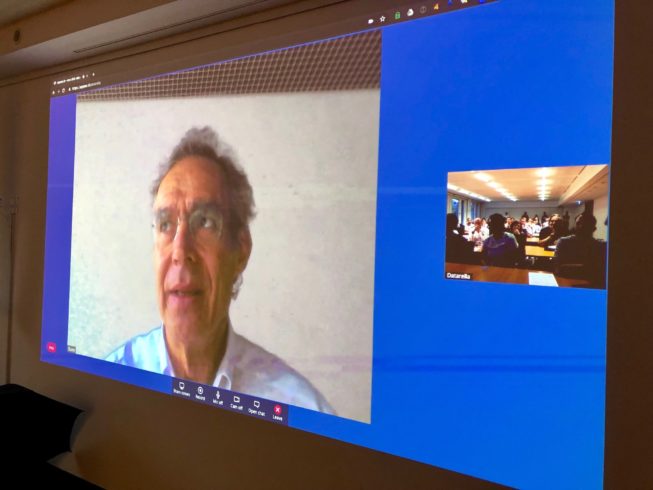
Richard Olsen
The first speaker of the event was Richard Olsen, Founder, and CEO of Lykke, a Swiss-based exchange for financial assets targeting B2B and B2C clients. He presented the development of the Lykke exchange and its transformation from a ‘prototypical startup’ to a mature ‘regulated entity with global potential’.
Richard calls himself the “grandfather” of crypto both due to his age and his experience. Richard can boast of decades of experience on the leading edge of global finance. He founded the forex company, Oanda in 1985 with the goal of forecasting financial markets using computers, before moving into innovating the provision of second by second interest payments and some of the earliest frequency trading facilities.
After an “Aha” moment in 2011 where he realized that bitcoin wasn’t just bitcoin but rather the first DLT and a concept which would transform the world, Richard began planning to build the Lykke exchange. Since Oanda’s board wasn’t ready to enter the world of crypto, Richard needed to raise money. Of course, he then looked to crypto. Once the market was ripe the Lykke STO was ready to go. While most projects were offering promises of future development in exchange for money as part of their ICOs, Lykke was already doing an STO. Few people can report from first-hand experience about the benefits and risks of executing a security token offering. Richard has done this three times in as compliant a manner as possible. Lykke’s first STO was with the LKK token which promises the delivery of Lykke company equity to bearers of the token. The first STO brought in 1.8 million USD. Further rounds included LKK-1y and LKK-2y forwards which raised more than 4 million additional USD.
Licenses, Liquidity and High-Frequency Trading
Richard brought up a very important question – namely, why were they allowed to sell these security tokens? In this case, they were selling their own equity. In order to provide an exchange for third-party security tokens, they will need an Organised Trading Facility (OTF) license which Richard sees as the next logical step for the company. OTF licenses are part of the MiFID II EU financial regulations and according to the Dutch Authority for the Financial Markets (AFM), OTF’s are intended level the playing field between the various venues for the execution of orders.
Specifically, once Lykke obtains an OTF license, they will be “a multilateral trading venue in which third-party buying and selling interests in bonds, derivatives or structured products are able to interact in the system in a way which results in a contract”. OTF’s have all the compliance regulations of an investment firm. In contrast to multilateral trading facilities (MTF) however, according to AFM, the “definition of OTF is intentionally broad, so that it can contain as many (future) forms of organized execution of transactions as possible”, which leaves space for innovation by exchanges and market makers such as Lykke.
Richard also discussed the macroeconomic aspects of the current financial system, in particular pointing out that liquidity and transparency are sorely lacking in much of the system and that blockchain-based solutions can make processes faster, easier and more transparent. Richard claimed, that tokenization will get more and more popular as soon as regulation catches up with the technology Everything that can be tokenized is going to be tokenized. One of the reasons for this is that tokenization enables risk sharing. Exchanging tokens instead of cash spreads the risk on multiple parties. That’s why it’s so important that any token be exchangeable for any other token. The more liquid the market the greater the likelihood that systemic risks are shared widely and unwound quickly before they grow to massively disruptive proportions.
He also dispelled a myth about high-frequency trading or rather clarified it with a metaphor. A question came up about whether or not high-speed trading was necessary or could be healthy for a system. Richard argued essentially that while the high-speed arbitrage-based trading of the past years was quite destructive, overall, trading in a financial system is much like blood circulation in a human body. Just as blood needs to move relatively rapidly through the body to enable waste removal and homeostasis, a financial system needs deep markets with lots of high-speed trading in order to clear the gunk and keep things competitive.
At the exchange level, he noted, the key is liquidity, which means that there should be enough tokens available to trade. This is currently made by bots all over the exchange business but there’s a lot of inefficiency in this model. Richard argues for well-designed matching engines which efficiency earn their keep. Moreover, people should be empowered through technology and crowd intelligence while staying within the legal system. Richard pointed out the self-regulatory success of Airbnb’s reputation system as a model for this kind of feedback system. He further emphasized that the laws and regulations have to be designed to incentivize the right behavior in spite of the corrupting effect of money.
In the same vein, Richard cautioned that at the moment it is difficult to determine which actors in the STO market are legit and which may be rather dubious. Essentially many say that they are issuing an STO but due to the lack of clear standards and transparency, it’s difficult to separate the wheat from the chaff. According to Richard, investors should pay attention to the jurisdiction of the asset, the reputation of the company issuing the asset, the rigor of the regulatory structures where that company is based and finally the question of where the secondary market for the asset takes place. If these aspects aren’t all covered within a reputable regulated environment, it’s pretty clear that something may be fishy with the STO or the platform involved.
If you want to learn more about Lykke and its products, go on their website or download the Lykke wallet.
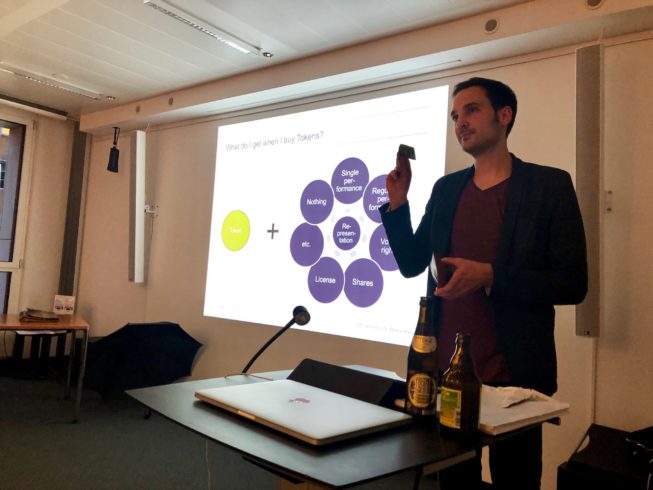
Markus Kaulartz
Following Richard’s presentation, Dr. Markus Kaulartz presented the legal implications of STOs as the second speaker of the night. He is a senior attorney at CMS Hasche Sigle and specializes in IT-Law, IT-Security, and Privacy.
Markus firstly explained that tokens generally always incorporate a connection between the token and a representation of ‘something else’, for example, a voting right, shares or licenses. In the case of security tokens, the underlying asset is generally either equity in an enterprise or debt. The only exception to this is tokens and coins which serve a pure currency function with no underlying value underlying utility or asset.
First a Slight of Hand
As a result, a critical legal issue is the separation between the token itself and the rights “granted” by the token. It may be possible that the token and the rights associated with it might be separated.
Markus illustrated this with a simple example involving his physical leather wallet. For his example he let the leather wallet stand-in in for a security token and a 5 euro bill inside illustrate an underlying security. He noted that if he as the token issuer were to sell the wallet with it’s included right to the underlying security (and thereby dividends) to someone it might be possible that they could subsequently sell the token onward to a third party (Just the empty wallet) without also passing along the underlying linked security. That would result in a situation with two potential claimants for the dividends issued by the security issuer. In such a situation, the token issuer might end up paying a dividend twice.
One legal approach is to limit the original buyer contractually and prevent them from selling the rights to the underlying token to a third party without also selling the token. There is not however currently any clear solution to this problem at a systemic level inside the German legal system. It’s currently being discussed on both the legislative and regulatory levels but is not yet solved. Essentially you can issue a security token at this time but it’s not possible to definitively link the token to the security it represents without some significant contractual acrobatics. Markus is hoping for changes to the law which would essentially make blockchain transactions equivalent legally to a written contract transaction transferring ownership of a given security.
Prospectus or No Prospectus? That is the question.
Markus also outlined the legal options available currently for organisations who wish to issue a security token. The first significant question for prospective STO issuers is whether or not they will need a prospectus for the project. This prospectus contains potential risk factors, information about the issuer and a description of the security as well as deep financial disclosures about the issuing company. Such documentation must be approved by Bundesanstalt für Finanzdienstleistungsaufsicht – BaFin (German Federal Financial Supervisory Authority).
The process is pretty much the same as for issuing any other kind of stock or blond and is very expensive. Legal costs for producing such a document are likely to exceed 100,000 Euros at a minimum and getting a prospectus approved by BaFIN often takes months of waiting and working through numerous drafts prior to approval. The idea of a prospectus is that it is a document which contains reliable information regarding the risks and benefits of an asset and serves to protect “mom and pop” investors from unknowingly spending too much money on projects they know essentially nothing about. The major advantage for issuers if they choose to issue a security with a prospectus is that it can be rapidly “passported” into all other EU jurisdictions and traded in a compliant manner without further examination by the individual member states.
Exceptions, Alternatives and SPVs
The alternative to this process is to issue the STO under one of three exceptions designed to allow funds to be raised without offering consumers the “protection” of a prospectus. The rules are designed to protect the mass of average investors and there is some flexibility for situations which don’t have a substancial impact on everyday asset consumers.
- Exception 1: If the token will be sold to less that 150 people. This is intended to support startups by allowing investment by small groups of friends and family.
- Exception 2: If the token is sold exclusively to investors who each invest over 100,000 euros. Individuals rich enough to invest more than 100k are deemed to be defacto professional investors who don’t require state protection and “know what they’re doing”.
- Exception 3: If the token sale raises less than 8 million euro. This is the exception under which most crowd investing happens. The logic is that at this level the damage from such an issuance can’t become significant at a structural level.
Lastly, Markus described the process of buying tokens and approaches to token issuance. Classical approaches follow the simple structure that the investor buys and gets the token and the right directly from the emitter who runs the business.
One new approach to token issuances uses a Special Purpose Vehicle (SPV) which has the right from the emitter to sale the tokens. For the issuer, this guarantees that the emitter is completely disconnected from the investor in a contractual manner. Despite the fact that this strategy reduces the risks for the token issuer, it increases the risks to the investor because the investor has no legal claim on the underlying assets being securitized. Markus essentially said that the use of an SPV could be a red flag for investors especially when in conjunction with the issuance of STOs from jurisdictions with lax regulatory oversight.
Another approach is to securitize subordinated loans either with or without an SPV. This is a common approach within the crowdinvesting area but it’s rapidly being adopted for STOs as well due to the relatively lax regulations on this type of debt and to the established procedures / regulatory framework for ordinary subordinated debt. Investors should be aware however that subordinated debts are services last behind all other commercial obligations in the case of a bankruptcy.
Thank you very much to Richard and Markus for giving these interesting presentations! Also, thank you to Deloitte for hosting our Meetup. Also, a big thank you again to our community for coming and participating! We hope you enjoyed the meetup and we encourage you to give feedback over the known channels!
Our next meetup will be about Blockchain in PropTech on July 23rd and we would love to see you again there!
by Martin Schäffner | 30 April 2019 | Blockchain
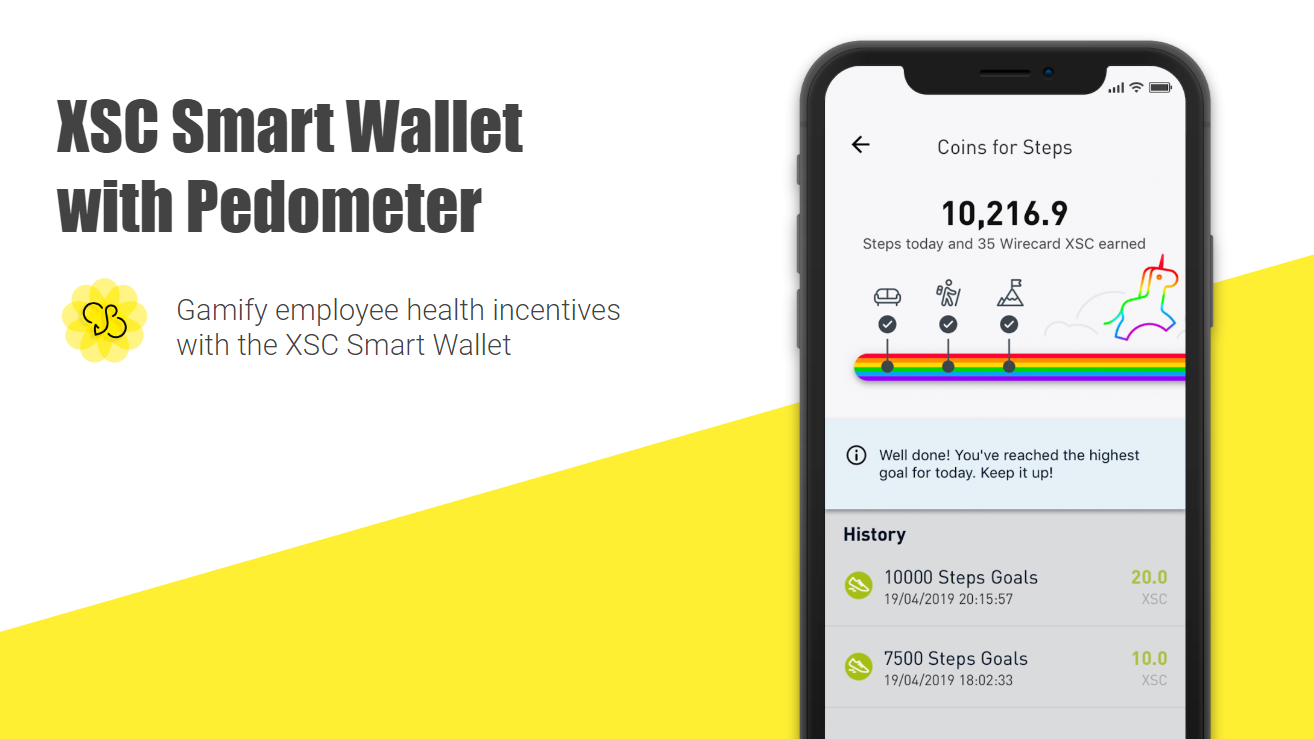
The successful XSC Wallet for Android and iOS just got a new pedometer function! You can now incentivise your employees to move more and stay healthier with automatic coin rewards.
Everyone knows regular physical activity is good for your health. The more a person moves on a daily basis, the healthier she tends to be. Exercise helps to reduce stress, makes you happy and promotes mental as well as physical performance.
Using the XSC-Wallet with Pedometer results in more movement, more health and more fun at work:
- Integrated pedometer gives feedback on your own activity
- Stay motivated by earning coins when you meet your goals
- Higher health, lower absenteeism due to sick days

Staggered goals reward the employee with XSC
Office workers quickly fall into the trap of living a largely sedentary lifestyle. Everyone wants healthy innovative employees but we all easily fall into just sitting in front of the computer all day. The extra kilos pile on and employee health and innovation are slowly eroded.
With the new pedometer function of the XSC Smart Wallet employees can be motivated to be more active both at work and during their leisure time.The XSC Smart Wallet uses sensor data to determine the number of steps a user takes over the course of the day.
The great thing about this is that after a certain number of steps, rewards are given out to the employee in the form of coins, which can then, for example, be exchanged for coffee, smoothies, or other benefits in the company cafeteria.
This simple and clear incentive encourages employees to move. In addition to the benefits of improved health and wellbeing, employees enjoy trading their coins in for perks like free coffee or fruit.
Employers gain an extremely cost effective tool for improving employee morale, encouraging innovation though greater employee fitness and engagement and perhaps most importantly by reducing employee absenteeism due to sickness.
