by Martin Schäffner | 15 October 2020 | Blockchain
Why do we sign a contract or a bill? In our everyday life, signatures are often used as a handwritten mark to make proof of identity and intent. In public blockchain networks, participants cannot necessarily trust each other. Everyone can potentially claim to be the owner of a blockchain address and initiate a token transfer. Further, even if the message is from the owner of a blockchain address, corrupt nodes can manipulate the content, e.g. changing the beneficiary to their benefit. That’s why we need digital signatures, which allow confirming the authenticity and integrity of a message.
In this slideshow, you will learn about what digital signatures are and how they are created, using asymmetric cryptography and hash functions. Enjoy!
by Martin Schäffner | 22 September 2020 | Blockchain, SmartAid
We are proud to announce that SmartAid is under the winning team of two EU funded Horizon 2020 programs: Blockchers and Blockpool.
SmartAid is the next generation marketing, funding and reporting tool for non-profit organizations, seamlessly connecting donors with charitable projects. Blockchain technology allows SmartAid to introduce a new era of transparency, efficiency and effectiveness within the aid industry. By drastically reducing costs, SmartAid maximizes the value, which arrives at the people in need.
The Background
Our world is facing global challenges. Next to the almost ordinary crisis, like natural disasters, the effects of climate change, and wars, we need to deal with the pandemic outbreak of COVID-19, which has been tragic and costs many lives. However, while the economic consequences are going to hurt developed countries, they are going to be devastating for the developing world. Already before the pandemic, over 200 million people were assessed in need of humanitarian assistance.
To fight sorrow and misery, to create perspectives for humans living in less privileged countries and to turn our world into a better place for everyone, requires the help of the wealthy population. In the year 2019, over 25.3 billion EUR have been donated worldwide for international humanitarian assistance, almost 2 billion EUR from EU institutions alone, and over 2.5 billion EUR from Germany. (1)
The Problem
In poor countries, even small amounts of money can make the difference between sending your kid to school or sending them hungry to bed. Unfortunately, any type of costs diminish the value, which arrives at the people in need.
SmartAid addresses the high costs, arising through a lack of transparency and automation in the charity industry. Opaque and outdated systems result in high expenses for both donors and aid projects. For receiving organizations, financial reporting to their sponsors is related to substantial efforts. In return, the financiers also need to invest money to audit their aid projects. Manual reporting is not only costly but also vulnerable to human error and even fraud. Corruption is often an issue in aid-receiving countries. Furthermore, uncertainty about whether their donations indeed arrive at the intended destination might reduce the willingness of private donors to contribute.
In addition, the costs related to foreign fiat currency transfer are exorbitantly high. Bank fees, which eat up to 30% of the transaction volume, are no rarity. Furthermore, once donations are transferred and covered into the local currency, funds are exposed to high inflation risk, possibly making them worthless within weeks. Last but not least, measuring the impact of a donation today is very costly and can be only vaguely estimated through long term studies and surveys.
The Solution
Transparency and automation allow the creation of efficiency gains. SmartAid eliminates unnecessary cost drivers, caused through manual reporting systems, in the charity and non-profit industry.
In the current development phase, SmartAid uses a pull approach to mirror donations in fiat currency, like Euro, on the SmartAid blockchain. A PayPal API connects the traditional fiat payment world with our blockchain system, where all funding streams are documented tamper-proof, transparent and in historical order. For each donor, an individual token contract is deployed, a matching amount of tokens minted, and transferred to an address, representing the beneficiary’s bank account. By representing individual donations through a unique – thus distinguishable token, full transparency about the usage of each donor fund can be provided. This allows users of SmartAid to trace the journey of their very own donation. Certainly, also, outgoing payments are documented on the SmartAid Blockchain fully automated via the PayPal API without the costs and risks of manual accounting.
In future development stages, SmartAid can switch to a push approach. In that case, aid projects can use tokens received in multiple ways and leverage their utility. Tokens will be redeemable as vouchers at the SmartAid platform for national currency.
Further, these value units are going to be transferable to addresses, representing cost centres within an organization. Also, tokens will be usable as a medium of exchange between the charity organizations, aid implementing projects and final recipients without intermediaries, bank fees or inflation risks and fully transparent. Lastly, it will be possible to create new project tokens, leveraging a donor fund backed reserve to increase the liquidity.
The digital documentation of newly created project tokens allows non-profits and their financiers to automatically measure the impact and the value created by a donation. This will allow an effective fund allocation in the future, maximizing the generated value.
Why Blockchain
Blockchain technology allows SmartAid to document transactions in a transparent, tamper-proof, and trustless way. Distributing copies of the ledger, which keeps track of the past and current state of the SmartAid ecosystem, makes it secure and eliminates the risk of any single actor manipulating the history. Also, blockchain allows creating and managing new vouchers aka. tokens in a secure manner at neglectable costs.
Join SmartAid
If you want to learn more about SmartAid, check out our previous posts. Please feel free to contact us if you want support SmartAid by becoming a sponsor or have interesting project proposals.
(1) http://devinit.org/wp-content/uploads/2019/09/GHA-report-2019.pdf

by Martin Schäffner | 22 September 2020 | Blockchain
What Is A Blockchain Address?
Just like your home address, bank address, or email address a blockchain address is a unique and secure identifier. This identifier, saved on a blockchain, can be used for sending and receiving cryptocurrencies. However, in contrast to traditional addresses, blockchain addresses are not assigned by centralized authorities. These addresses are mathematically derived from a user-generated private key.
Learn more about blockchain addresses and the two types, which exits in the Ethereum Network, in our Datarella Blockchain Bites slideshow of this week: Blockchain Addresses.
by Martin Schäffner | 8 September 2020 | Blockchain
“Not Your Keys – Not Your Bitcoin!”
Maybe you came across this quote from the Bitcoin advocate Andreas Antonopoulos. With “keys” he is referring to the private keys, which allow users to transfer bitcoins and other crypto assets.
This is the first post of Datarella’s “Blockchain Bites” in which we want to dive in blockchain terms, bite by bite, in a visualized way.
First up, we will have a look at what is actually a private key:
by Martin Schäffner | 20 August 2020 | Blockchain
We are proud to announce, that Datarella is now an official member of the Alastria Network.
Alastria is a non-profit association that promotes the digital economy through the development of Blockchain and Distributed Ledger Technology (DLT).
We are looking forward to developing sustainable use cases and to providing valuable solutions to industry partners.
Further, we are joining the Alastria Identity Committee to thrive the development of SSI solutions with our expertise.
by Martin Schäffner | 10 August 2020 | Blockchain
Datarella successfully applied for the Blockpool program and is very proud to announce that it was selected into the 25 companies working on promising Blockpool solutions. The Blockpool call received over 100 proposals from 27 European countries, in more than 11 different DLT-technologies and directly affecting 8 economic sectors.
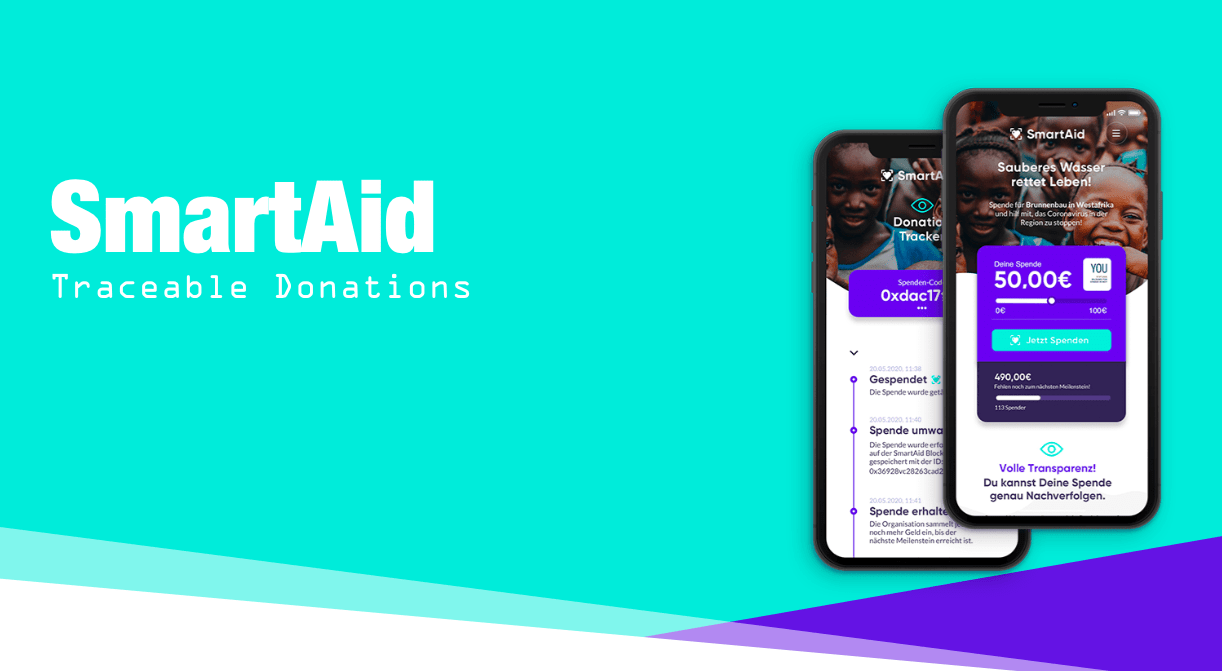
At Blockpool, Datarella will work on an important Blockchain feature supporting our product called SmartAid. SmartAid is an innovative donation platform that leverages the advantages of blockchain to bring efficiency, transparency, and trust into the world of donations. SmartAid is the world’s first fully digital application for donating and tracing the way of your money to selected charity projects. Projects all over the world can participate and receive donations through SmartAid. The use of Blockchain technology allows for
- Secure transactions,
- Traceability,
- Intuitive handling and navigation,
- Simple overview of donations, and
- Transparent transaction history.
The goal of the Blockpool program is to support cross-border DLT-based initiatives and deployment in a broad industry range. It’s primary ambition is to lead to a more cutting-edge and competitive European industry as well as to the structuring of the emerging value chain of DLTs beyond financial markets. This program is funded by the European Union’s Horizon 2020 research and innovation program.
We are very much looking forward to further developing our product SmartAid in close cooperation with the partners backing the Blockpool initiative.

by Martin Schäffner | 27 July 2020 | Blockchain
Will my donation arrive at the people in need? Or will it get lost, somewhere in the administration costs of a humanitarian organization? Today, intransparent systems confront donors with a high degree of uncertainty, which diminishes their overall willingness to donate. Therefore, we at Datarella teamed up with the YOU Stiftung to create the next generation of donation platform for sustainable aid projects – SmartAid.
SmartAid is reinventing online charitable giving by implementing our Traceable Donation Technology – powered by Blockchain. SmartAid offers its users a unique donation experience with three distinct key value propositions:
-
- An effortless donation experience
- An engaging donation experience
- A trustless donation experience
An Effortless Donation Experience
The first barrier, which hinders people from supporting impactful aid projects is the haze related to donating. Our goal is to make supporting these projects, which are often located on the other side of the world, as easy as buying a coffee. No login, no IBANS, no SWIFTs, no hidden fees, no subscriptions, no minimum amount, no bs. Simply scan a QR-Code, whether it is on a billboard at the metro station or on your computer screen or click a link and you will find yourself on the highly intuitive donation home page of SmartAid. Just a few clicks are required to conduct your good deed. Simply choose your favorite payment method and you help to create prospects for less privileged people.
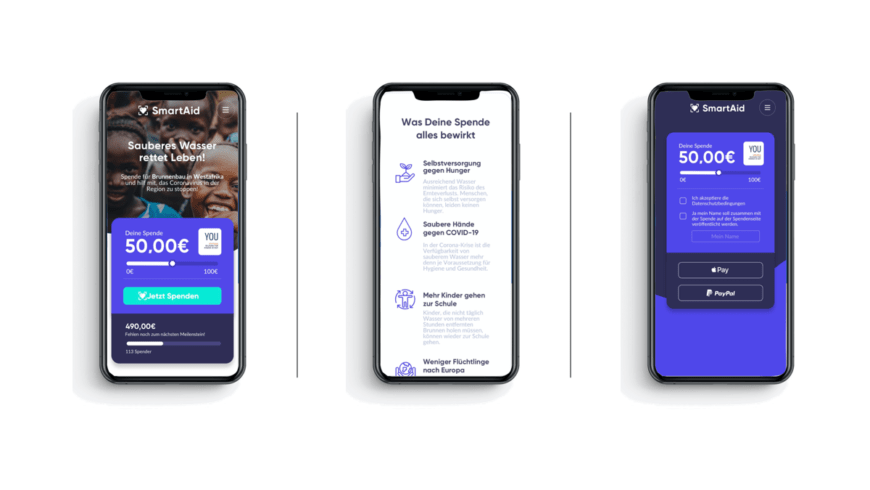
An Engaging Donation Experience
After your payment was processed, you will be rewarded with a unique QR-Code. Share this code and the attached link with your friends and family to show them the journey of your donation. Sending it to your community will also make it easy for you to find it back in your messaging history. Also, since SmartAid is a web app, you can download it to your home screen – just like a traditional app but without the hassle of downloading it from the app store.
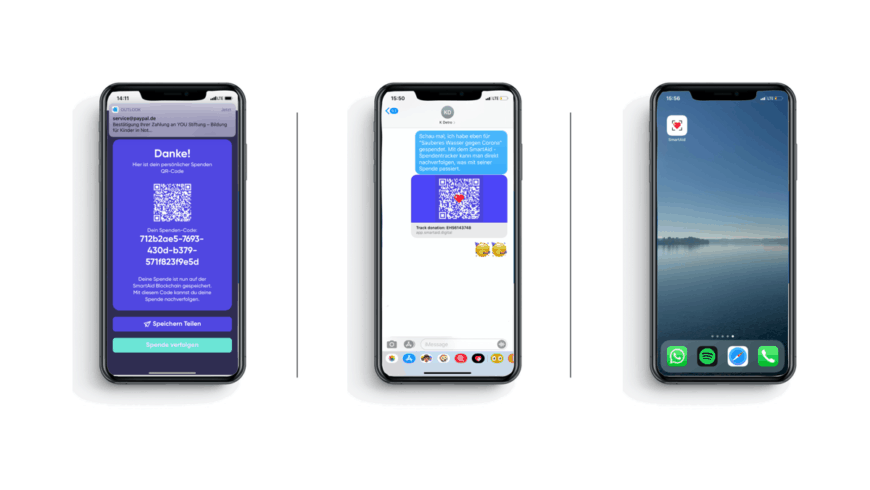
A Trustless Donation Experience
The received QR-Code makes it not only easy to find your donation ID back in your message history, but it holds all the information required to track your very own donation among all others. At this point, SmartAid differentiates to traditional donation platforms – no trust is required since everything is documented immutably and transparently on the SmartAid Blockchain.

Traditional donation systems vs. SmartAid’s traceable donations
As illustrated in the graphic above, traditional donation systems allocate fiat currencies, like EUR, USD, in one pot, and distributed to different cost centers of an aid organization. Therefore, traditional donation platforms cannot provide donors visibility about the usage of their funds.
In contrast, on SmartAid each incoming donation is documented on the private Ethereum SmartAid Blockchain. To enable full transparency of the whereabout and usage of each individual donation, each payment will be represented by its own ERC-20 token contract. Each of these token contracts are distinguishable by their contract address. As visualized in the graphic above by different colors, this allows granting SmartAid donors blockchain secured clarity about how their funds will be used.
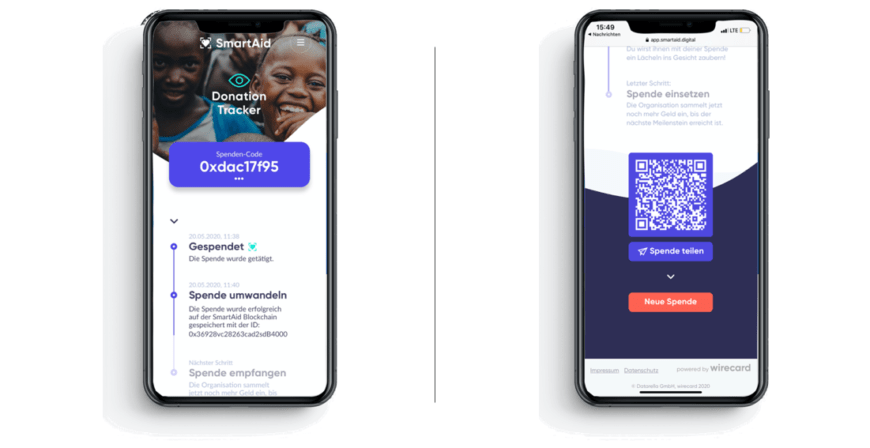
The donation tracker then provides the user an overview of the status of his donation. Here she will also be informed about the actual usage of her kind donation.
Donating hard-earned money to charity is a noble gesture. It requires a high amount of trust and transfers a significant amount of responsibility to the receiving party. Unfortunately, intransparent systems confront donors, as well as aid organizations, with a high degree of opaqueness. Donors face a high degree of uncertainty about the usage of their givings, which in turn diminishes their overall willingness to donate. At the same time, aid organizations are suffering from high costs of reporting to and providing their donors with formal audits. In both cases, the value which arrives at the people in need is significantly reduced. Therefore, we at Datarella are working with our partners on SmartAid to create the next generation of donation platform.
We are proud to announce that SmartAid is also among the winners of the EU funded H2020 accelerator Blockchers. Here we are going to extend the functionalities of SmartAid for aid organizations.
Stay tuned!
by Martin Schäffner | 21 July 2020 | Blockchain
Last October during the Outlier Ventures Diffusion Hackathon, we built a Proof of Concept of a Parking Agent System – Effortless Parking, which could solve the coordination problem of parking in crowded cities. In this post, we will look at the individual components of the promising technology stack upon which we build this project – Fetch.ai.
Do you remember Agent Smith from the Matrix trilogy? If not, let us fresh up your memory. The Matrix is a science fiction movie in which mankind almost lost the war against the machines. Most of the living human population is stacked up in energy farming towers by machines overloads in order to harvest their biologically produced energy. The consciousness of these “human batteries” is hooked up into “the Matrix”, a computer program that simulates the experience of the world how we know it today. This keeps the “human batteries” docile, sedated, and entertained. Agent Smith is a software agent living in the Matrix. His job is to hunt down humans, like the protagonist Neo and other individuals of the last reminding human resistance, which reenter the Matrix to free other individuals. Mr. Smith and other agents act autonomously to reach their goals. Further, over the trilogy, he even manages to learn a new skill, which allows him to transform other “Matrix inhabitants” into copies of himself to fight Neo.
You might be asking, what does this have to do Fetch.Ai?
Autonomous Economic Agents
The core element of Fetch.Ai is software agents, so-called Autonomous Economic Agents (AEA) which are living in Fetch’s digital world, the Open Economic Framework (OEF). Similar to Agent Smith, these software agents operate, interact, and even learn new skills autonomously. However, the goal of these agents is to actively search and discover other agents to generate economic value. An agent can represent an actor or thing in today’s economy. They can serve as a data provider, such as a sensor, which offers its data to other agents. Vise versa, agents can request data from these sources and do computations to generate valuable information. All the search and discovery takes place in Fetch.Ai’s Matrix, the Open Economic Framework. As the world ”Open” in OEF reveals, it is open, so any business or individual can join the network to offer information and services. To establish trust in a network without a gatekeeper, Fetch.ai included a Self Sovereign Identity solution (SSI) for its software agents. This allows agents to earn a good, respectively bad reputation, depending on the quality of service they provided to other network participants.
Fetch’s software agents can independently acquire new skills, which are required to conduct their tasks. Let’s say, an agent has been tasked with buying concert tickets at the cheapest price on your behalf. It already has the negotiation skill but can autonomously acquire a betting skill to participate in an auction for you. These agents are not, however, General Artificial Intelligent (AGI), since their capabilities are limited to a certain field of activity.
Fetch Ledger & Token
The legal tender in the world of Fetch.ai is the native token FET. It is used as a digital currency to pay for all transactions, e.g. buying/selling of data, network operations, e.g. deploying new agents or conduction computations, and secure communication. The state of the Fetch.Ai world – the answers to who owns what and who is who to a given point in time – is documented by its Smart Ledger. This state-of-the-art ledger technology uses 6 separate chains that synchronize in order to ensure state consensus. Using multiple synchronized blockchains makes the Smart Ledger highly scalable and capable of processing over 30k transactions per second.
As a consensus mechanism, Fetch uses Proof-of-Stake – in which any token holder can participate to secure the network. Token owners can stake their FET to secure the network and earn staking rewards paid in FET:
- Participate in a staking auction directly.
Fetch.Ai offers 200 staking slots, which can be won through actions. The winners are entitled to run one or more validator nodes for which they are rewarded with 7500 FET per slot. For participating at the auction, a minimum amount of over 750k FET is required
- Join a staking pool
FET owners, who don’t want to run a validator node or not have sufficient tokens to participate in the action, can delegate their stake and join a staking pool. Participants will be rewarded with a 10% annual return on their delegated stake.
- Binance
Also, it is possible to earn staking rewards, by holding tokens in your Binance account. This option is probably the most convenient and is rewarded with a 1-4% annual yield.
Fetch.Ai is made up of three core elements, the Autonomous Economic Agents, which generate value by acting as a data provider or consumer, the Open Economic Framework, the digital world, which connects agents with each other and a highly scalable Smart Ledger, keeping track of the current state. In the next post, we will look at possible use cases, and elaborate on how networks built on Fetch.ai can offer lower transaction costs than today’s web2.0 multi-sided markets.
Stay tuned!
by Martin Schäffner | 9 April 2020 | Blockchain, Smart Wallet
The Bavarian government is promising EUR 10 billion, the German government EUR 600 billion, and the US-American promised USD 1000 billion in financial aid as a countermeasure to fight the economic effects of the Corona crisis. This is a huge effort and we all hope that it will soften the economic consequences of global lockdowns. However, where will all this money go? What criteria is used to distribute it? Who reviews the applications? What will be the impact of injecting vast amounts of money into the market while the effects of the pandemic are highly limiting the production of goods and services? Here’s how Blockchain technology could help: Tokens vs Corona – A blockchain voucher system to distribute grants.
As we described, a payment distribution system like WFP uses to deliver cash to over 500.000 refugees in Jordan, could also be used to distribute financial aid of governments to citizens and businesses efficiently. In this post, however, we want to take a look at an alternative that could be distributed instead of traditional national currencies, let’s call them blockchain vouchers or tokens.
Tokens vs Corona – A Blockchain Voucher System To Distribute Grants
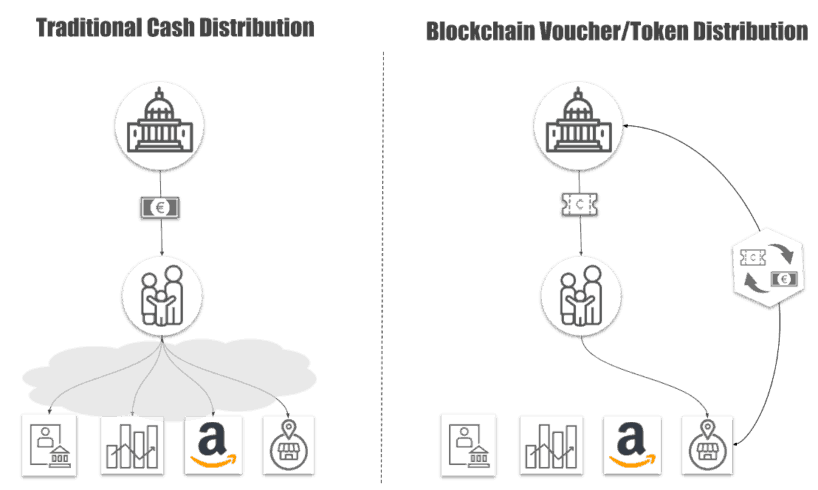
Distributing EUR or USD directly to businesses and citizens grants beneficiaries the ability to use the funds how they want. They might spend it locally, to support local business, they might put it in their bank account and save it for better days, they might invest it into the company shares or buy stuff at Amazon. Due to a lack of traceability, it’s impossible to measure the usage nor the impact of helicopter money precisely. Tokens, however, are programmable. This characteristic allows the issuing entity to predefine limiting spending parameters. For example, the government could define that it is only possible to spend these tokens on small and medium-sized businesses, located close to the consumer and within the next three months. Therefore, programmable tokens allows to create a more precise and target-orientated tool of governmental economic development aid.
dgE Krisengeld
An interesting concept of implementing blockchain vouchers was proposed during the WIRVSVIRUS hackathon, which has been organized by the German government to find innovative solutions to encounter the corona crisis. The project goes under the name dgE-Krisengeld, dgE stands for “dezentraler gemeinschaftlicher Euro” (decentral common Euro). However, informally the project is known under the term “Diggi”, a homonymous which predominantly German teenagers use as a form of address, like dude or mate.
The concept and can be summarized in three steps.
- Distribution
- Spending
- Redemption
The government could distribute Diggis to citizens via a letter using their tax ID. Consumers could then scan a QR Code and set up a wallet, which allows manage their Diggis. In the next step, citizens could spend their received Diggis at participating businesses. Therefore, the consumer could scan a QR code provided by the cashier to conduct a payment. However, since most companies cannot welcome customers at the moment, an online alternative point of sale for small businesses is required. A solution could be an opensource e-marketplace, like Openbazaar, which enables small businesses to sell their goods and future services for Diggis without paying any fees. In the last step, businesses could then redeem their received Diggis at the fiscal authority for real Euros.
The overall concept received positive resonance by German politicians. Dorothee Bär, the German State Minister for Digitalization, called the Euro token an interesting complementary system to a blockchain-based business register, which would allow especially smaller companies to participate in aid programs.In summary, the Diggi concept provides two main benefits:
- Decentral empowerment
- Local impact
Since consumers decide at which businesses they want to spend their Diggis, governmental aid would be automatically allocated to companies, perceived as valuable by the market. Diggi tokens could be programmed in a manner, that they are only spendable at business registered close to the consumer, thus creating a local impact.
Local Currencies
The concept of having a medium of exchange, which only can be “spend in a particular geographical locality at participating organizations,” is by no means novel nor innovative. It reflects the ancient concept of local currencies. Through limiting spending opportunities, these currencies stay and continue circulating in a particular community, which has economic benefits for this group. However, the limited spending opportunities, a lack of exchangeability, and relatively high cost related to managing these currencies are also their major drawbacks.
Luckily, Blockchain technology allows us to eliminate these weaknesses:
- The costs of issuing and managing a digital currency becomes marginal and requires only a couple lines of code.
- A common reserve allows to connect multiple local currencies, making them interchangeable and automatically adjusting their exchange rates. This is enabled by bonding curve contracts (next to the word “token” my favorite term at all), which will be the topic of a future blog post.
A concept of interconnected blockchain-based community currencies is brilliantly implemented by Will Rudick and his team at Grassroots Economics to inject liquidity into poor areas of Kenya and other African countries.
The Future of Donations
I am very proud to announce that we at Datarella are working at full speed together with two partners of the financial and the humanitarian sectors, to develop a solution to support the fight against the Coronavirus in Africa. This solution will be using tokens to add transparency to the field of donations – providing the donor with the certainty that her contribution was received by the people who need it. An official press release describing our Traceable Donations product will follow shortly. Stay tuned!
