Datarella is proud to announce the signing of a piloting agreement with Aid Pioneers e.V. (Aid Pioneers) to further work on a shipment with the space-linked supply chain product Track and Trust (T&T). Track and Trust is funded by the European Space Agency as a 2-year Demonstration Project. In this regard, Datarella, as prime contractor, together with its partners Weaver Labs and OroraTech, recently successfully completed a significant milestone with ESA.
The consortium led by Datarella is currently working on a Blockchain-based enterprise solution to tackle complex supply chain challenges that humanitarian agencies across the world face in order to track aid in locations that lack access to reliable communications infrastructure. At the end of two years of development and commercial trials, Track & Trust aims to deliver a scalable cost-efficient communications platform & network combining satellite, IoT mesh and blockchain components serving mostly supply chain use cases.
Aid Pioneers agreed to join the Track and Trust initiative as a shipment partner. They will initiate and organize an aid supply for the demonstration of the Track and Trust service. The first shipment is planned for 2023 with the goal to support people in Ukraine. Aid Pioneers is a German association joining other NGOs to build logistics to foreign countries helping people in need.
“We are very proud to have Aid Pioneers on board as our piloting partner for Track and Trust. Aid Pioneers is a young but well-established aid organization active for aid shipments to various regions including Africa, Middle-East including Balkan and Ukraine. With Aid Pioneers as our shipment partner, we have a strong setup to make a success story out of Track and Trust.” Yukitaka Nezu, Co-Founder and CFO at Datarella.
We are very excited to have a piloting agreement with Aid Pioneers and are very much looking forward to a successful shipment with them, leveraging the integration of blockchain, space and network infrastructure technology into our product Track & Trust.
As an expression of our recent progress, we can also announce: Datarella, together with its partners, successfully passed the Critical Design Review (CDR) as one of the significant milestones with ESA. Our design for Track & Trust has been assessed as valid by ESA. We are looking forward to entering the development phase next, together with our partners, in order to start piloting soon!
With Datarella, we have been building software, tools, and applications for Web3 since 2015. Our first truly global project has been the Building Blocks application which enables users to securely pay with their smartphones in refugee camps.
We‘ve developed Track & Trust, a tracking solution for humanitarian aid logistics that leverages satellite communication. In the mobility sector, we have created SSI apps and smart parking solutions to enable secure P2P communications, streamline traffic flows, and minimize CO2 emissions. With 16 other companies, we’re part of Gaia-X consortium moveID that will create the decentralized digital infrastructure for mobility in Europe. And much more! And, in 2020, we decided to leverage our tech stack and create the Datarella Web3 Company Builder Model.
RAAY Real Estate
In 2020, we have launched RAAY Real Estate (RAAY RE) as our first standalone project, together with two partners from the real estate industry. Our RAAY RE joint venture with Hammer AG and Wertgrund Immobilien AG was the first to tokenize a commercial property, fully licensed by German regulator BaFin – Connex Coin was a breakthrough! RAAY RE will become the legal framework of our future IMMOBIX project and token.
MOBIX Marketplace
In 2021, we launched our micromobility marketplace MOBIX. By using the MOBIX app, more than 350,000 daily active users in over 120 countries are earning MOBIX Miles while riding eco-friendly vehicles, such as scooters, bikes, eBikes, eMopeds, or cargo bikes. By incentivizing users to swap their combustion engines with zero-emission transportation, MOBIX helps to decrease CO2 emissions and to make cities more liveable. In the meantime, MOBIX has evolved into the MOBIX Marketplace GmbH, a Munich-based company owned by Datarella, and Fetch.ai.
MOBIX family
The latest brainchild of Datarella’s Web3 Company Builder Model is MOBIX family – a decentralized gig economy network. MOBIX family is the first project in the Company Builder Model that will be driven with the support of an external team. Whereas RAAY RE and MOBIX have been built by internal Datarella resources, a young team of aspiring entrepreneurs from the Technical University of Munich (TUM) has taken care of the Family’s first steps. The team has presented the first MOBiX family MVP during START Ideasprint 2022, a 4-day hackathon based out of Munich.
NOMIX
In 2023, the next project – NOMIX – will launch its BIOCLOCK app. Leveraging the same tech stack as other Datarella Web3 companies, NOMIX will help users around the world maximize their healthspans, i.e. living longer while staying healthy!
We at Datarella are very happy to see more and more teams using our Web3 tools and applications, and creating new ventures! Are you interested in joining an existing Web3 team or do you want to pitch your own idea? Do you want to become part of the Web3 world but prefer to participate from the sideline, you might be interested in owning DREX, our Datarella token which entitles the holder to receive tokens of Web3 projects. In either case, please contact us!
Datarella is proud to announce the signing of a two-year contract with the European Space Agency (ESA) to further work on the space-linked supply chain product Track & Trust (T&T). As the main contractor to ESA, Datarella is supported by Weaver Labs and OroraTech.
The consortium will jointly work on a Blockchain-based enterprise solution to tackle complex supply chain challenges that humanitarian agencies across the world face in order to track aid in locations that lack access to reliable communications infrastructure.
At the end of two years of development and commercial trials, Track & Trust aims to deliver a scalable cost-efficient communications platform & network combining satellite, IoT mesh and blockchain components serving mostly supply chain use cases. The end solution will be a modular product that will provide a plug and play communication network that allows for end-to-end tracking of the supply chain. This will start from the initial supply of humanitarian aid goods, and extend all the way to the last-mile shipments even when limited or no telecommunication infrastructure is available.
Track and Trust is a unique opportunity to combine Blockchain technology with SatCom and telecom technology to expand the range of offerings for a supply chain monitoring system. With Weaver Labs and OroraTech as our consortium partners and with the technical and financial support by ESA, we have a strong setup to make a success story out of Track and Trust.
Yukitaka Nezu, Co-Founder and CFO at Datarella.
We are thrilled to expand our work with the European Space Agency and play a vital role in the Track and Trust project with our product Cell-Stack. Our innovative telecoms solution will ensure connectivity across the supply chain, making it possible for goods to be tracked in a trusted way.
Maria Lema, Co-Founder at Weaver Labs
We are looking forward to bringing in our satellite technology expertise in Track and Trust. With our IoT communication modules we will connect the products developed by the consortium via satellite networks. This allows the global tracking of deliveries, even in very remote areas.
Rupert Amann, Co-Founder and Head of Satellite Development at OroraTech
We are very excited to be backed by the ESA Business Applications and Space Solutions Program and are very much looking forward to the successful integration of blockchain, space and network infrastructure technology into our product Track & Trust.
About Datarella’s Consortium Partners
About Weaver Labs
At Weaver Labs, we are creating an open and shared marketplace of connectivity assets, with an extensive focus on security, to accelerate innovation by enabling connectivity. Our innovative software layer called Cell-Stack aggregates and digitises all the necessary assets to build Networks and access connectivity on-demand.
Weaver Labs believes that an open marketplace of connectivity assets can truly democratise access to reliable networks and stimulate innovative applications, making networks accessible to new industries and citizens that require reliable connectivity. Through prioritising security in a diverse supply chain and building trust with an open infrastructure model, we believe that these are the fundamental foundations needed to foster innovation and thus, create a positive impact on society. More about Weaver Labs: https://weaverlabs.io/
About OroraTech
OroraTech is a NewSpace start-up headquartered in Munich, Germany, providing a global satellite-based wildfire detection and monitoring service by processing data from various available satellite sources. In parallel, the company is developing its own nanosatellite constellation specialized in wildfire detection, with the first satellite launching at the end of 2021. Founded in 2018 by Thomas Grübler, Björn Stoffers, Florian Mauracher, and Rupert Amann as a spin-off from the Technical University of Munich (TUM), the company has grown to an international team of 50 employees. OroraTech has been supported by research grants from the Bavarian and German government, the European Space Agency and the European Commission, and graduated accelerator programs at Google, Samsung, Plug&Play, ESA BIC, and the German Accelerator Silicon Valley. More about OroraTech: https://ororatech.com/
Track and Trust successfully completed the BlockStart accelerator program, which initially started in March 2020. We want to look back on the last six months and share how we upgraded Track & Trust from an MVP to a market-ready product.
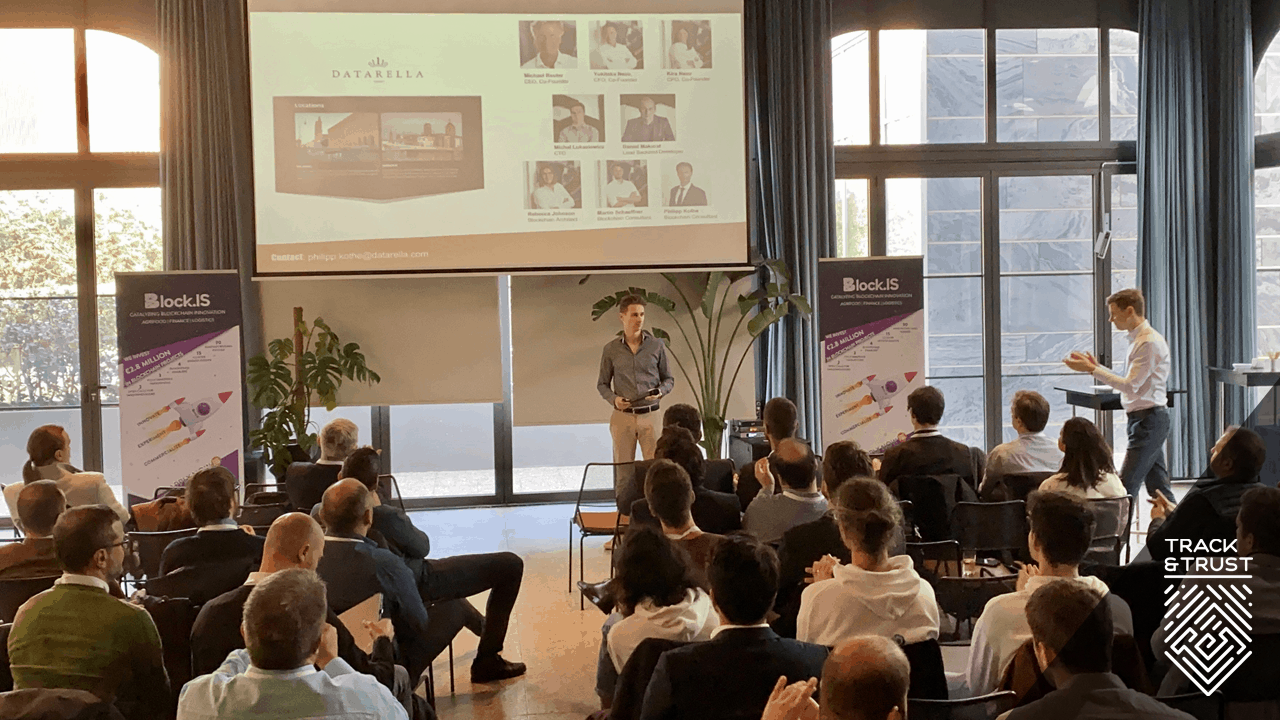
It all started at the ideation Kick-Off in March, where many startups presented their innovative products and solutions. It was an excellent chance for us to see how so many different companies intend to use blockchain for their services and gave us the opportunity to talk to startups that could be interested in testing our blockchain-based supply chain solution. As it turned out, we would see three of them back in September during the Pilot Stage.
Scope and Implementation Phase
Our goal during the BlockStart accelerator program was ambitious – we wanted to upgrade Track & Trust from an MVP to a market-ready product. After we successfully made it to the next round, we defined our four KPIs:
Implement an onboarding process in which users can self-register. During the MVP, we created the Keystore files by ourselves and sent it to our test-users. A self-registration process is one of the main requirements in a decentralized system. In addition to that, we also created profiles that are linked to a specific address.
Enable Multi-tenancy in the system. We want to limit the accessibility of information to only the respective users and their respective data. This increases privacy, security, and provides a clearer and smoother user-journey.
Make the Track and Trust interface dynamic. There were many hard-coded processes and interface-artifacts developed for the MVP. The contents on the different interfaces should dynamically show the data for the respective shipment.
Enable mobile-signing. In order to reduce data load and improve usability, we need a mobile app that contains the identity information as well as the private keys of the actor. As a result, handovers can be processed by scanning QR-Codes of the shipment without the need to document this on a computer.
During the implementation phase, we talked with many potential adopters that could perform tests with us in the pilot stage. These talks and the progress of implementation were the main topics in frequent calls with our mentor Joao Fernandes.
Testing with Adopters
After we successfully finished the implementation stage, we had the chance to test Track and Trust together with three adopters that we talked to during the implementation phase. This was Albicchiere, an Italy-based startup that runs a supply chain for refill packages of their wine dispenser, Go Limpets, a Portuguese-based company that sells sea food to the gastronomy, and Zelena Tocka, a Slovenian company whose supply chains manage the production and selling of local agriculture goods.
The objectives of the test were to perform a test with all three adopters through every stage of Track and Trust. As a result, we were very happy to see that they had no issues in testing Track and Trust and that the system would bring an advantage over their competitors. Another main takeaway for us was recognizing the versatility of the use cases Track and Trust can apply.
Take a look at our newest product video of Track & Trust:
The BlockStart accelerator program gave us the best chances to improve our product, get to know potential adopters, and receive valuable feedback that we will implement in the future. We thank the BlockStart organizers, and especially our mentor, Joao, for the smooth and successful guidance and communication during the program, as well as the three adopters for testing Track and Trust.
World Food Programme’s Building Blocks system is one of the best examples to understand how Blockchain technology can help to fight against COVID-19. Building Blocks is a Blockchain-based fully digitalized payment and bookkeeping system for any types of cashless transactions developed and further scaled up by Datarella and its subsidiary Baltic Data Science. Today, the Building Blocks is successfully up and running in Jordan since 2017 and expanded to Bangladesh by the end of 2019 by serving hundreds of thousands refugees in WFP’s refugee camps. Here’s how Datarella is leveraging Blockchain to support UN WFP in fighting COVID-19.
It’s been a while since Datarella successfully applied for an open call initiated by the WFP innovator programme in 2016. With this tender, WFP was evaluating whether Blockchain technology can help to improve the inefficiencies they were facing with paper vouchers issued to refugees in their camps for daily groceries. At that time, nobody was aware of a virus called “COVID-19” and working exclusively from home was simply unimaginable. But times have rapidly changed since the beginning of 2020. Today, we are facing probably the most severe economic downturn and human tragedy, affecting hundreds of thousands of people since WW2. .
So how can the Building Blocks system help against the coronavirus? For this to understand, you need to know what the system does. As said, Building Blocks is a payment and bookkeeping system for any cashless transactions helping refugees in camps to make their daily shoppings. Every month, the refugees receive a certain amount by WFP as digital food vouchers that can be used in the village’s supermarket.
There are two aspects to the Building Blocks system that helps to fight against the coronavirus. Both has to do with contactless interactions amongst the participants:
Cashless Payments The Building Blocks system is built on a private Ethereum network. Every single transaction between a refugee and the supermarket is validated and recorded on the blockchain. The advantages are apparent. With the help of Blockchain, these transactions are executed cashless, meaning fully digitized without the need to get in physical contact with the other person. By the way, after the World Health Organization WHO released a statement on March 9 recommending that people turn to cashless transactions to fight the spread of COVID-19, a number of governments and retailers across the world took action. Not directly related to the fight against the coronavirus, other benefits of a Blockchain-based payment system include minimized risk of fraud and data mismanagement.
Contactless Identification: In both countries Jordan and Bangladesh, where Building Blocks is up and running, refugees are able to authorize themselves for cashless payments without getting in direct physical contact with the counterpart. In Jordan, the authentication is performed through a system called IrisGuard. IrisGuard is an end-to-end iris recognition, verification, financial authentication and targeted cash transfer platform which removes the need for any form of ID such as username, password, card or pin. In Bangladesh, the Building Blocks system uses a different method for the identification. It was originally a fingerprint-based process, i.e. it was touch-based. However, due to the coronavirus pandemic, we changed the authentication procedure from a touch-based to a contactless system. Today, a QR code is issued to every single refugee who is entitled to receive aid by WFP.
In this recent article published by WFP, you can read more about the story of Building Blocks in Bangladesh and how leveraging blockchain to support UN WFP fighting COVID-19.
Please stay healthy and safe in these challenging times!
This is a guest post by Maria Lema, the co-founder of Weaver Labs, a tech start-up building a Blockchain platform for the Telecommunications industry.
Connectivity is what allows us to exchange information real-time across the globe thanks to the existing infrastructure we call the Internet. Us as individuals and all our businesses rely on connectivity for the majority of our daily activities, we do everything online and it has become a utility: it’s an essential tool to create, develop and grow. With 5G being deployed, the telecoms sector must focus on innovation in the business models and supply chain dynamics to deliver the networks of the future.
Innovation: long time no see
Technological development in the communications sector hasn’t stopped since the creation of the telegraph, and we have learned to communicate faster and more efficiently across the Internet thanks to the creation of communications systems, standards, protocols and infrastructure such as fiber, antennas, switches and gateways.
Although we have changed the way we interact with the Internet and online applications, we haven’t changed much the way we deliver connectivity. Most will agree that, while we have undergone (and are probably still undergoing) a data and communications revolution, networks haven’t yet adapted to this new way of online interactions. We have adopted the smartphone and we have seen technologies grow from 2G to 4G, but the traditional supply chain and investment models in telecoms have achieved the tipping point. We need a transformation, one that is able to support and deliver the spectacular developments in emerging technologies: AI, Big Data, Robotics, Autonomous Vehicles, and more.
The Network Revolution
5G is the new generation of mobile networks and is purely software-based, so more than just another generation, it is an opportunity to innovate in the way we deliver connectivity with an infrastructure that supports the future cities and the explosion of data.
Following this transformation, networks are becoming a commodity: open source based and with a growing diversity in the equipment sector – in other words: competitive. This competitiveness is motivating new players to deploy and own network infrastructure: factories, hospitals and even whole cities are investing in infrastructure with a variety of applications in mind that require high bandwidth and support for a massive number of devices.
However, there are still challenges to realising the dream of open and diverse networks: convergence and integration is still something not fully solved. Despite being built around existing standards like the Internet Protocol (IP), there’s still a need for rigorous standardisation to allow for easy interoperability across network elements and all the actors involved – chip/device manufacturers, equipment vendors, operators, etc. From a service provider perspective, some of the key hurdles when building diverse and interoperable networks are:
Simple: to create end to end services across the infrastructure targeting interoperability across multiple network elements.
Open: to integrate new infrastructure and service offerings, with built-in security mechanisms that allows critical components to be onboarded faster.
Scalable: grow horizontally with minimum interaction of the Service Provider.
Weaving Telecoms with Web 3.0: the fundamental shift
Decentralisation and tokenised economies are a solution to complex cross-actor engagements with mechanisms to reward network participants in exchange for contributions. Leveraging innovative P2P and Blockchain technology, we are a software and protocol stack that provides a simple, open and scalable solution that enables the horizontal integration much needed in networks. We create a marketplace of connectivity assets that replaces the Service Provider as a central point of trust to aggregate network resources.
Weaver is a P2P network created specifically for telecommunications, equipped with a new Messaging System (WireMQ) designed to manage real-time communications traffic across the network infrastructure. It builds on the horizontal integration of networks by adding a software layer on top that enables interoperability and convergence.
How does Weaver help to advance in the Network Revolution?
We create a connectivity platform that integrates any communications system and leverages existing infrastructure to communicate across all technologies in the P2P network. A great example is the mesh network Weaver built for the Track and Trust supply chain project with Datarella. We used WireMQ to route traffic from IoT devices into a Satellite base station, and it can be scaled up including 4G antennas, WiFi and more IoT technologies – which allows us to bring this directly into Smart Cities. We innovate in the supply chain, creating a platform for connectivity with mechanisms to exchange network resources and incentivise all network participants. The new business models are based on infrastructure sharing and revenue sharing where all contributors can capitalise on existing assets and create a viable return on investment in infrastructure for connectivity.
Track & Trust by Datatrella has been selected by the European innovation program Block.IS as one of the best blockchain logistics solutions. After two days of evaluation by experts from the business and technical domain in Istanbul, we are proud to announce that our project was selected to enter the next phase of the blockchain accelerator program funded by the European Union. The jury saw the tremendous impact of Track & Trust, bringing light into the logistic black box of complex, global supply chains.
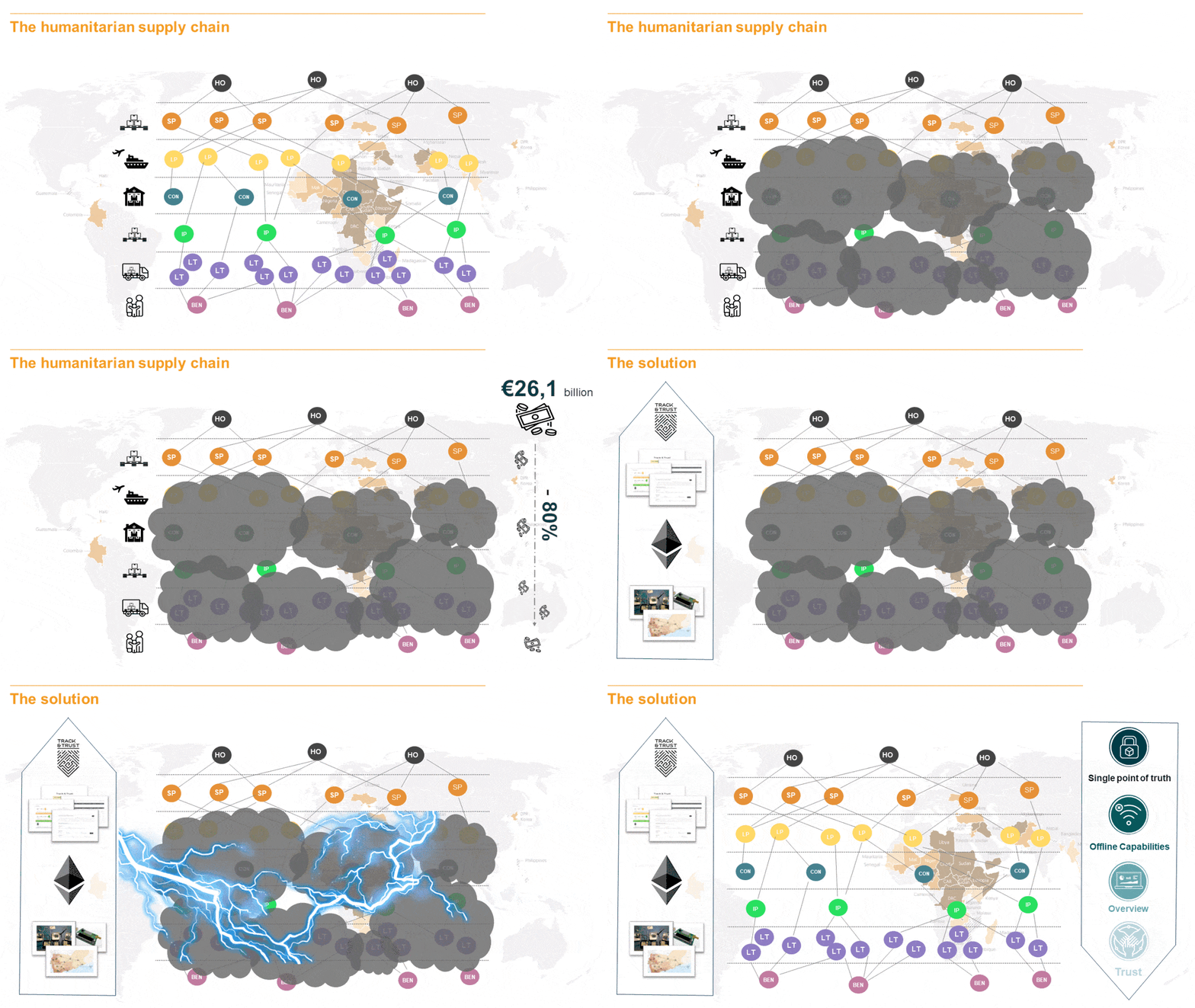
The bushfires in Australia, the war in Libya or the Coronavirus outbreak in China. Our world is facing various challenges. However, besides the crises which are present in our daily news, over 200 million people in 81 countries are assessed for being in need of humanitarian assistance. A large percentage of these are concentrated in a small number of countries. For example in the Democratic Republic of Congo or Yemen, where millions of people are starving, have been displaced from their homes by war and suffer epidemic outbreaks of Ebola and Cholera took place.
But how do life-saving supplies – like food, water, medicine, and shelter – reach the people in need? Here is where the humanitarian supply chain comes into play. In the GIF below we tried to illustrate one, in a simplified way, but as you will see these networks are complex.
Just to give you some characteristics on these networks:
They are composed of multiple stakeholders from NGOs, governments, and military to private corporations
They operate over multiple countries/continents
They are ad-hoc and work under high time pressure
They operate in the most demanding environments, like warzones, and after natural disasters
Its is very hard to forecast their demand since:
Every crisis is unique
A lack of historical data
Further, if tracking of goods and shipments is done at all, it’s documented by organizations individually and manually. This makes the humanitarian supply chain vulnerable to human error and fraud. All these characteristics result in tremendous costs. It is estimated that around 80 percent of the expenditures of aid agencies are in the area of supply chain management.
Luckily, we offer a unique solution that allows the tracking of shipments from the beginning to the very end of the supply chain, bring transparency, trust, and collaboration to the humanitarian supply chain. We call it Track & Trust.
Our solution is made up of three key components:
Auser-friendly interface, proving the supply chain stakeholders an overview of the actual state and details of a shipment.
APrivate Ethereum Blockchain, which allows the immutable and tamper-resilient documentation of handover data and serves as a single point of truth. Noteworthy, data is managed and governed by the involved stakeholders themself, no external intermediary is needed.
A hardware kit, composed of LoRa nodes and satellite communication technology, which allow the creation of an asynchronous mesh network, which enables to broadcast changes in custody of goods without being dependent on existing telecommunication infrastructure.
Our goal is to minimize the cost related to human error and fraud of these life-saving supply chains to maximize the value which arrives at the people in need.
Track & Trust was created to address the problems of the humanitarian supply chain. However, these supply chains are by far the only ones facing challenges like transparency and accountability in times of globalization. Just consider the supply chains of pharmaceutical, food or luxury products that are fighting against a multi-billion dollar counterfeit industry, demolishing profits and the trust of their customers.
If you want to learn more about our Track & Trust system feel free to contact us or to read more on our company blog.
“This project is funded by Block.IS (Blockchain Innovation Spaces) Horizon 2020 research and innovation programme Project No. 824509, under the funding framework of the European Commission.”
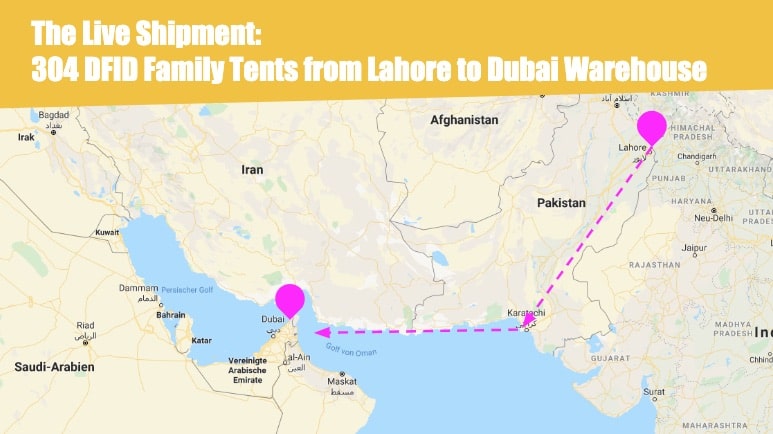
In 2018, we at Datarella started developing the Track & Trust System – the humanitarian supply chain on blockchain – for DFID. The first issue for Track & Trust Proof of Technology to tackle was to track custodianship of shipped goods. This test shipment was a replenishment of family tents, to be delivered from the supplier in Lahore, Pakistan, to Dubai. It took several weeks and was completed in July 2019. We created this presentation to show the Proof of Technology, including a demo on how a blockchain transaction is completed. Listen closely 😉
We at Datarella are working together with the UK Department for International Development’s (DFID) innovation and future technology program, Frontier Technology Livestreaming (FTL) and the European Space Agency (ESA) to increase efficiency within humanitarian supply chain.
Our goal is to maximize the value, which is arriving at the people in need by establishing transparency and collaboration between the responsible supply chain stakeholders. In part one of our blog post series, we described how we tested our Track and Trust System. For testing, we tracked a live shipment of 304 family tents from Pakistan to Dubai between the first four parties of DFID’s supply chain. In part two, we described the challenges, which occur when tracking the last-mile of the deliveries. In this post, we are going to go further down the rabbit hole and dive into the technology, which will enable us to overcome the Sisyphean task of last-mile supply chain tracking.
The story starts after the implementing partner received the goods, loaded the trucks and the driver starts his way to the destination in the crisis area. The environmental circumstances surrounding humanitarian missions are highly heterogeneous and can range from tropical islands after a hurricane to newly built refugee camps close to a war zone. However, the one thing they have in common is that within the first few weeks after the disaster took place telecommunication infrastructure mostly is not available.
Despite these difficulties, to provide stakeholders within the supply chain with an overview about the current status of the deliveries, we at Datarella are working to test the usability of a LoRa-based Mesh Network which transmits the transaction data offline until it’s finally able to be posted to the blockchain via a satellite uplink. We’re partnering with our friends at Orora Tech who know the ins and outs of the satellite technology quite well since their main business involves the manufacture of nanosatellites.
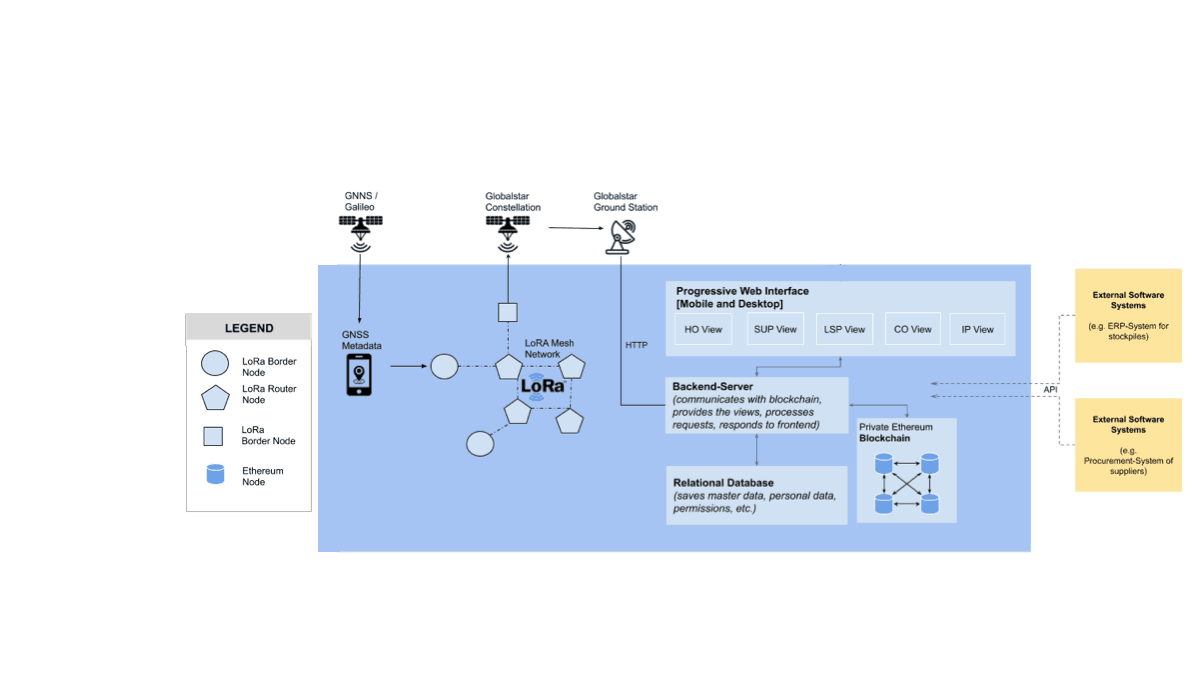
Our solution consists of the following components: 1. A user interface implemented as a progressive web app with offline capability 2. A LoRa-based Mesh Network 3. A Globalstar satellite uplink 4. A private permissioned Ethereum Blockchain
Whenever a transfer of goods occurs, the involved parties, e.g. the truck driver and the consignee in a base camp, will use their mobile phones to prepare the necessary blockchain handoff transactions offline. Data about location, time and custody will then be saved within the progressive web app interface (including pre-signed Ethereum transactions when possible).
Then, to transmit this data without having an internet connection, we are planning to use a LoRa-based mesh network. A LoRa network can be described by its two main characteristics.
1. As the name indicates, it allows long-range transmissions with a reach of approximately 12km in rural areas. 2. It operates at low power consumption.
Further, the term “mesh network” describes a network composed of nodes, which connect in a direct, dynamically and non-hierarchical manner. Therefore, these networks are also referred to as “self-healing” since nodes can organize and configure themselves, which allows the network to persist even if some nodes are not available. For creating a Pymesh LoRa Mesh, we are planning to use LoPy4, a 4-network (WiFi, BLE, LoRa, and Sigfox) and MicroPython combination controller. Further, we are considering to either equip some of them with Pytrack carrier boards, for very accurate GNSS Glonass GPS. An alternative method of geolocation is to feed in GPS data from the mobile phones of the drivers.
The network is implemented using OpenThread, an IPv6-based networking protocol. The reasons why we decided for this network type are its following features:
Simplicity — Simple installation, start-up, and operation
Security — All devices in a Thread network are authenticated and all communications are encrypted
Reliability — Self-healing mesh networking, with no single point of failure, and spread-spectrum techniques to provide immunity to interference
Efficiency — Low-power Thread devices can sleep and operate on battery power for years (Dependent on how often they wake to transmit)
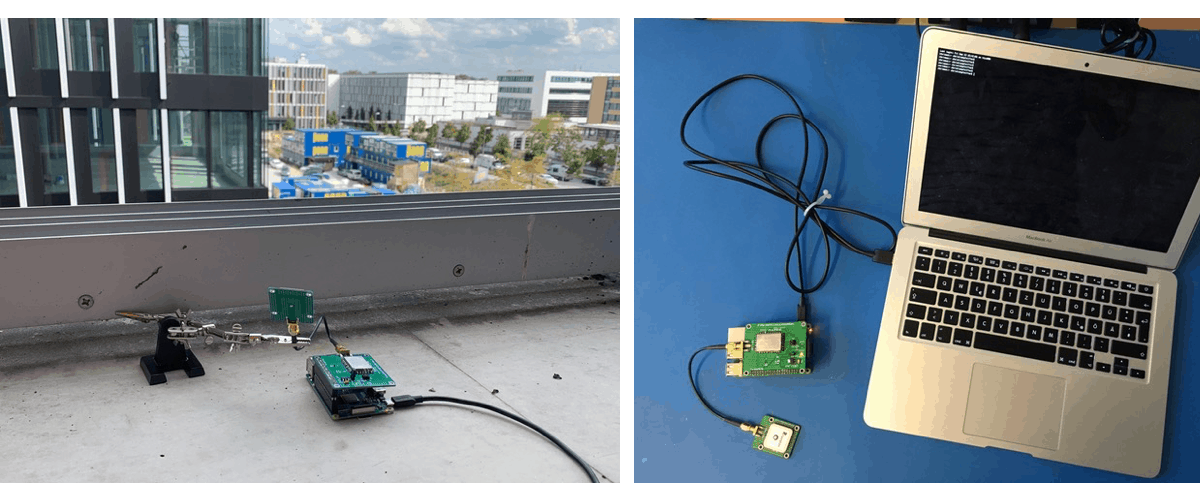
To create the Pymesh network, we are planning to install LoPy4s on the trucks, which are used to deliver the humanitarian goods to their destination. As soon a truck gets within the reach of another network node, it will transmit the offline transaction to the next router. The transaction will travel through the network node by node in this manner. Here you see a prototype
Since the reach of the LoRa routers is limited to approximately 12km we are also playing with the idea to install an air-based router, using a fixed-wing drone or a weather balloon, which would extend the reach up to 500km.
So far so good. Now the transaction data will be transmitted from truck to truck until it reaches a border router, which is connected to a satellite network. So far we have tested an uplink for a very basic JSON RPC transaction over a Globalstar simplex transmitter and successfully sent two data packets to the Globalstar constellation. Each contained a portion of the data needed to make an Ethereum transaction.
After the transaction data is sent via short bursts to the Globalstar constellation it will be received from a ground station, which is connected to the internet and executes the signed transaction in a live blockchain.
Together all of these components should enable a humanitarian agency to roll out tracking for their assets and provide transparency across their entire supply chain despite the total absence of telecommunications infrastructure in the last mile environment. All of this will be backed by a blockchain ledger providing the stakeholders in the humanitarian supply chain a single source of truth regarding custody all the way up until the final aid delivery.