
by Michael Reuter | 31 January 2023 | Blockchain, European Blockchain Association, Featured
Datarella, a founding member of the European Blockchain Association, is thrilled that Dr. Clara Guerra, Deputy Director of the Office for Financial Market Innovation and Digitalisation (SFID) of the Government of the Principality of Liechtenstein, will contribute her exemplary expertise to the EBA as its new board member. Effective January 1, 2023, Dr. Guerra has taken over the position of Kent Gärtner, who stepped down from the EBA board.
As a lawyer by training with a focus on high-tech and innovation, Dr. Guerra previously worked in the private sector and is active as a board member in higher education and Medtech. She lectures and regularly publishes emerging tech and other innovation topics from a governmental perspective. With her unique insight into one of the most crypto-friendly markets in Europe, and her experience with regulation and policy work in the DeFi and blockchain, digitalization, and technology education field, she is a perfect fit for the association and its goal to empower the European blockchain ecosystem.
Adding a unique European viewpoint
“We could not be happier about Clara’s decision to join our board. She has a wealth of expertise and brings fresh ideas, insights, and points of view to the continuing conversations taking place within the blockchain and cryptocurrency ecosystem. In the current era of the industry, when nuanced and pragmatic dialogue is needed more than ever before, her skills in regulation and policy will be extremely beneficial. We are looking forward to working together with the other members of the EBA board to advance our mission of enhancing and bolstering the capabilities of the European blockchain ecosystem”, says Dr. Michael Gebert, Chairman of the European Blockchain Association.
“With its semi-autonomous, decentralized operating model, the European Blockchain Association is quite different from other associations. Our goal is to provide a platform for people who want to make an impact. Clara joining our board explicitly because she shares our vision and is willing to actively contribute to our various projects and working groups is a big win for the EBA and its members. We are thrilled to be working with her”, Datarella CEO Michael Reuter, Co-Chair of the European Blockchain Association, adds.
Policy and regulation – an EBA strong suit
After three years of building a base for the association, establishing working groups from Proof of Stake to SSI, Custody, Education, Tokenization, and NFT, and giving its members a voice in relevant industry discussions, in 2023 the European Blockchain Association will add a focus on regulatory and policy work. With the appointment of Erwin Voloder as Senior Policy Fellow last year and Dr. Clara Guerra as a new board member, the association is best equipped to contribute strong expertise to public discussions, regulatory bodies, and across European projects.
“Fostering innovation has always been my passion. Innovation is conventionally associated with strength. However, most of the time it is a rather fragile transition state that relies on enabling circumstances. Regulation is a key enabler for technological innovation, especially in the finance sector, and must be approached with deliberate consideration. I am very excited to join the European Blockchain Association. The active and very knowledgeable community, the pragmatic mindset, and the decentralized approach to achieving its goals are perfect frameworks for me. I am looking forward to collaborating with my fellow board members and the whole EBA community”, says Dr. Clara Guerra.
Kent Gärtner, who was a board member of the EBA since its inception is stepping down from his position for personal reasons. The board would like to thank him for his invaluable contributions in the start-up phase of the association.

by Martin Schäffner | 2 December 2022 | Blockchain, Featured
Datarella is happy to announce that Paul Viehauser is joining as a Blockchain Working Student. He is enthusiastic about a more decentralized future and has experience in information systems and digital transformation. Please welcome him on 1 December 2022 as part of the Datarella team.
Paul Viehauser: “My name is Paul Viehauser, and I will be a Working Student at Datarella from December 2022.
I believe blockchain has the potential to upend many industries. The fact that we can deploy purely code-based systems to eliminate intermediaries gives me hope for a more decentralized and democratized future. I am convinced that the blockchain use cases will expand even further as the maturity of the technology advances.
My technical understanding and entrepreneurial drive help me to understand and grasp the blockchain fundamentals and the community behind it. Previous work experiences and curiosity led me to this fantastic and fascinating technology. I’m eager to build this technology and community and thereby transform our society in a positive manner.
Datarella stood out to me as one of the few established web3 companies that had proven themselves successful in the past and had a bright vision for the future. I am happy to be part of the journey and look forward to shaping a more decentralized future with the Datarella team.”
by Simon Zehentreiter | 28 November 2022 | Blockchain, COSMIC-X, ESCOM, Featured, Gaia-X, KOSMoS, moveID, Ocean Protocol, Partnerships, SSI
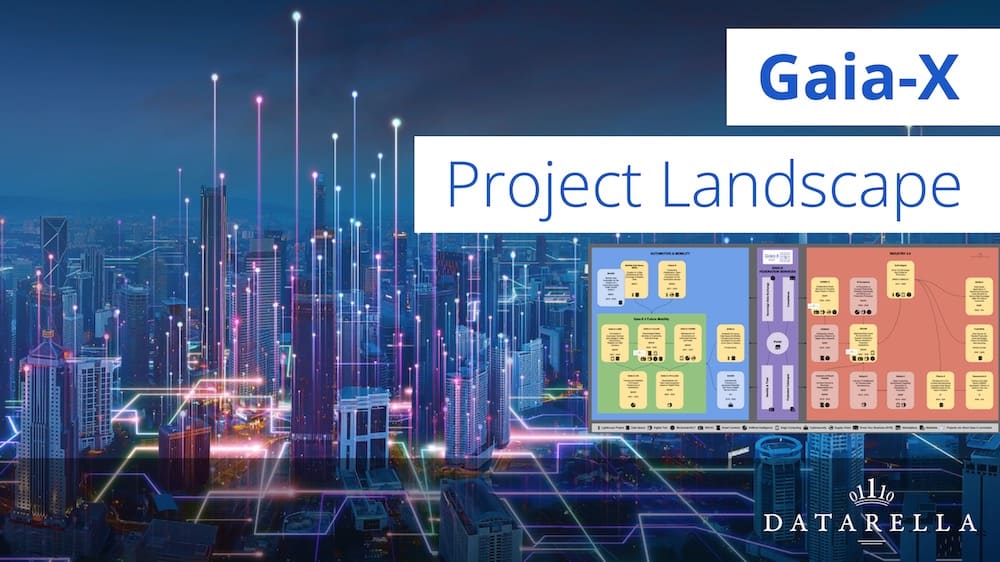
To visualize and structure ongoing Gaia-X projects and their thematically related studies, Datarella created a project landscape that comprises the three domains Gaia-X Federation Services, Automotive & Mobility and Industry 4.0. The relations between projects are modeled as directed edges, the technologies that are associated with each project are represented as icons – the Gaia-X Project Landscape:
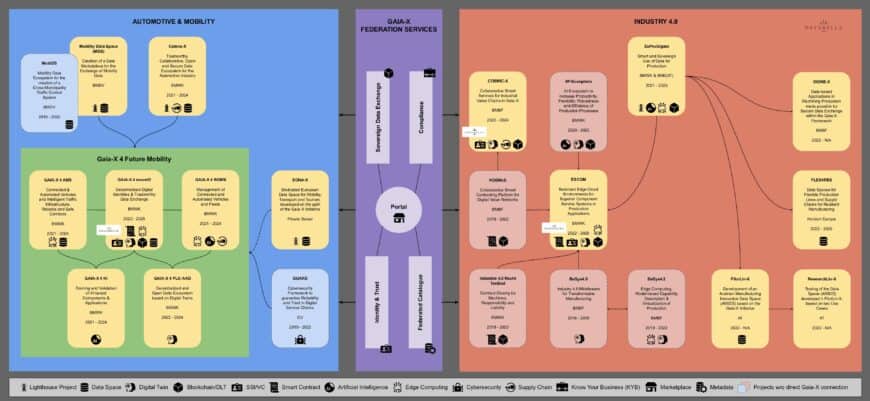
The overarching goal of Gaia-X is to create a federated and secure data infrastructure for Europe and beyond that allows companies and citizens to share data without giving up control over it. Every ecosystem participant decides what happens to their data, where it is stored and thus always retains absolute data sovereignty. To achieve this, the Gaia-X architecture follows the principle of decentralization, with a multitude of individual platforms all following a common standard based on openness, transparency and trust.
The Gaia-X Federation Services, at the center of the visualization, are the implementation toolbox and minimum technical requirements and services that enable Gaia-X Federations to become operational and work together. Federations are individual participants that team up to create value for all participants and to open up new market potentials.
- The Identity & Trust service closes the trust gap by enabling federations to authenticate and authorize participants. This is achieved by utilizing Self-Sovereign Identity (SSI), specifically Decentralized Digital Identifiers (DIDs), Verifiable Credentials (VCs) and Verifiable Presentations (VPs), which ensure that every participant is in full control of their identity at all times.
- The Federated Catalogue service allows federations to set up a repository, in which participants can search for and discover information and services of other participants based on their aforementioned credentials.
- The Sovereign Data Exchange service helps participants in keeping sovereignty over their data by providing functionalities for specifying and tracking how their data is used.
- The Compliance service ensures that every participant and service is complying with the Gaia-X principles. Together with a number of decentralized services that are part of the Gaia-X policy, it provides decentralized, sovereign and immutable governance and control mechanisms that enable trustworthy transactions between participants.
- Lastly, the Gaia-X Portal provides user friendly access to the Federation Services and supports the onboarding and accreditation of participants as well as the discovery of services.
The Gaia-X Federation Services are co-developed by the GXFS-DE project, funded by the German Ministry of Economic Affairs and Climate Action (BMWK) and coordinated by eco – Association of the Internet Industry.
The Automotive & Mobility domain harbors three Gaia-X lighthouse projects, the Mobility Data Space, Catena-X and EONA-X. The Mobility Data Space is funded by the Federal Ministry for Digital and Transport (BMDV) and deals with the creation of a data marketplace that allows for the sovereign exchange of mobility data in Europe, Catena-X is funded by the BMWK and is tasked with establishing a trustworthy, collaborative, open and secure data ecosystem for the automotive industry. The objective of EONA-X is to establish a dedicated European data space for mobility, transport and tourism, developed on the path of the Gaia-X initiative. Funding is mostly provided by the private sector.
Datarella, as previously announced, is working on the moveID project, which, together with four related ventures, is part of the Gaia-X 4 Future Mobility project family. The goal of moveID is to develop a digital identity infrastructure and trustworthy data exchange process for the mobility of the future. Feasibility will be shown on the basis of two use cases, V2X services in heterogenous, decentralized mobility infrastructures and vehicle data sharing. moveID is funded by the BMWK and the interdisciplinary consortium of mobility enterprises, Web3 companies and research facilities is lead by BOSCH.
The Industry 4.0 sector features a German-Austrian joint Gaia-X lighthouse project, EuProGigant. It’s intention is to establish an ecosystem that enables the smart and sovereign use of data for production. Funding is provided by the BMWK and the Austrian Federal Ministry for Climate Action, Environment, Energy, Mobility, Innovation and Technology (BMK).
With KOSMoS, Datarella has already successfully finished a research project in the Industry 4.0 space by realizing a collaborative smart contracting platform for digital value networks. Now, based on these results, Datarella is also involved in the two followup Gaia-X projects Cosmic-X and ESCOM. Cosmic-X is funded by the Federal Ministry of Education and Research (BMBF) and deals with advanced smart services in the context of spare part supply chain automation and optimization. The specific use cases that will be explored are digital twins, trusted supply chains and platform-based maintenance. ESCOM is funded by the BMWK and seeks to make a demonstrable contribution to a responsible manufacturing industry regarding resource consumption and sustainable resource use. The project will demonstrate that the use and balancing of edge and cloud data spaces allows for the flexible, load- and energy demand-dependent use of services as a know-how offering of component manufacturers with high utility value for the end application. Both projects are carried out in collaboration with leading industry partners and research facilities.
We are incredibly proud to be contributing to the development of the Gaia-X ecosystem in two critical domains and hope that our illustration sheds some light on the work that has already been done and will continue to be done towards an open, transparent and secure data infrastructure for everyone.

by Michael Reuter | 24 November 2022 | Blockchain, Featured, Gaia-X, moveID
We’re happy to invite you to our upcoming Live AMA “Building the Digital Identity Infrastructure for Mobility” on 7 December 2022, 17:00 CET (16:00 UTC).
Moderated by John Hildebrandt, our CEO Michael Reuter, and our CTO Rebecca L. Johnson will explain the role and goal of Datarella in moveID, the €20M+ Gaia-X project. This AMA will be hosted as a Twitter Space on the moveID Twitter account. If you want to learn more about moveID, Gaia-X, and how it feels to work in this consortium consisting of 19 large corporations, SMEs, Web3 projects, and research institutes, tune in!
If you already have questions, feel free to add them in the comment section. We’ll try to pick them up and answer during the Live session! Feel also free to follow us on Twitter, and LinkedIn and discuss all things Web3 with the Datarella team – see you there!

by Michael Reuter | 18 November 2022 | Blockchain, Featured, Ocean Protocol, Partnerships, Web3 Company Builder
In a world premiere, Datarella, Biennale de Paris, and Ocean Protocol, present DIAM, the Decentralised Invisual Art Marketplace. DIAM allows buying invisual art in a totally new way, by combining the international art market with Web3, the latest technological development. DIAm is the latest member of the Datarella Web3 Company Builder model.
DIAM is the Decentralized Invisual Art Marketplace. It intends to value a new form of creativity, a new form of art: Invisual Art. The idea of DIAM is to unleash creativity on a global scale. DIAM’s dream is to augment human beings through art. On DIAM, art lovers can purchase invisual art experiences using $OCEAN, a crypto-currency that uniquely and in an unforgeable way guarantees the purchase of art experiences. DIAM’s decentralized architecture allows artists to showcase their work and present their art in a completely autonomous process, guaranteeing them a fair share of income.
Invisual Art
Invisual art is art that exists other than in the form of artworks. The practices of invisual art have in common the fact of existing other than in the form of a work of art. There is no definition of invisual art, if not this common point. Invisual art is an art that exists most often as an experience and not as an object. The invisual practices are extremely varied: lifestyle, behaviors, experiments, state of mind
DIAM Goals
- To enable invisual artists to make a living from their work;
- To enable anyone to become an artist through the valuation of their invisual creativity;
- To provide a tool to encourage inventiveness in art by mixing the latest technologies with the latest form of art in order to build the next-generation art market;
- To encourage the emergence of new types of collectors and investors in art;
- Marketing art as an experience.
How To Buy Invisual Art?
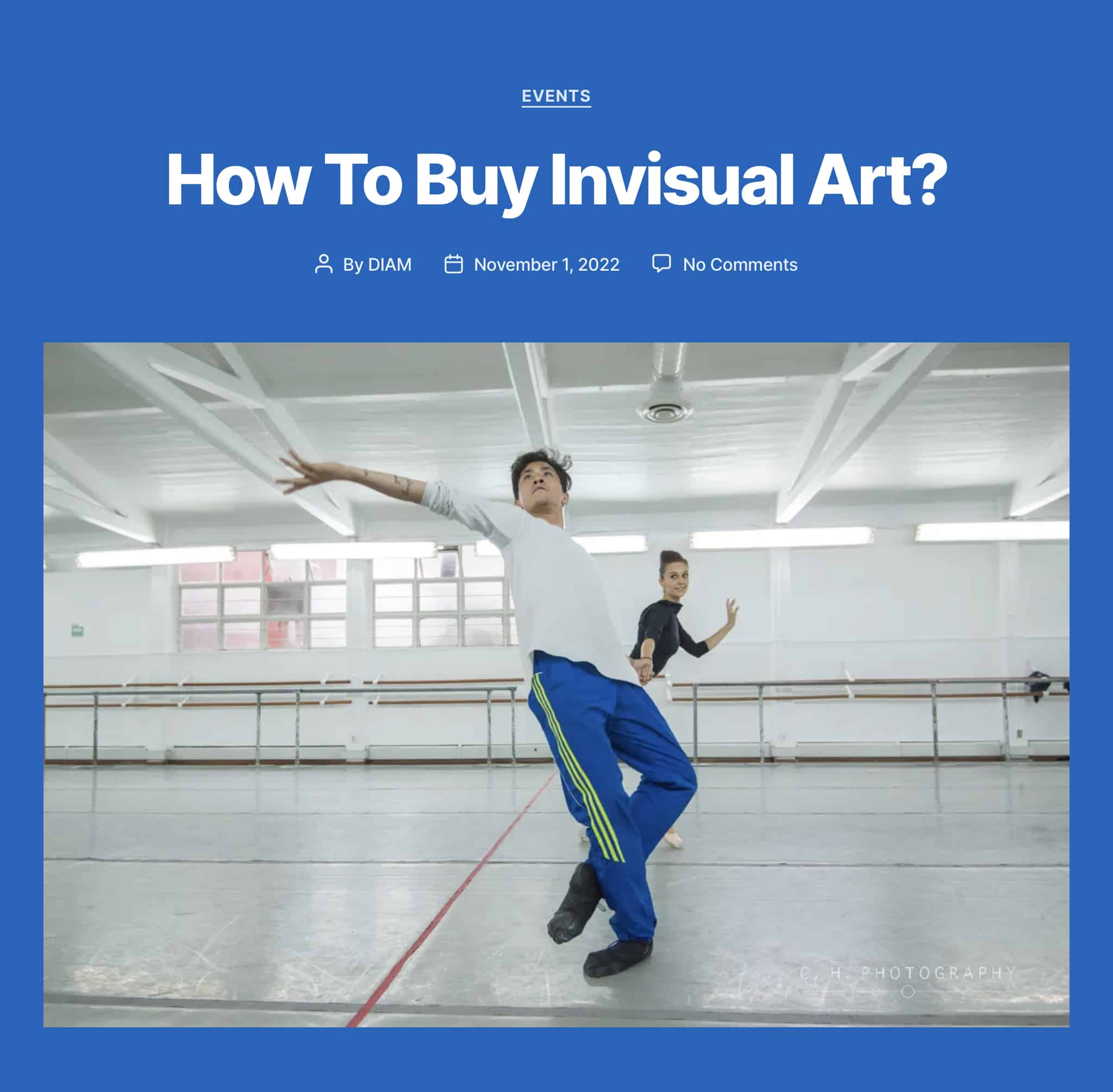
At the official DIAM launch event on 11 November 2022, Alexandre Gurita, Director of the Biennale de Paris and of the Ecole Nationale d’Art (ENDA), and Corina Mila, Enseignante-Chercheuse at the University of Paris-Sorbonne, introduced the audience to the concept of Invisual Art. Michael Reuter, Co-founder & CEO of Datarella, and Rebecca L. Johnson, CTO of Datarella, have demonstrated how to buy invisual art at DIAM using datatokens. Special guest Casey Herd, Artistic Director of BALLET RISING, has explained how DIAM enables Ballet lovers all over the world to immerse in the ballet experience using DIAM datatokens.
Feel free to register for free and experience the latest development at the intersection of technology and art!
If you are interested to learn more about the Decentralized Invisual Art Marketplace, feel free to follow DIAM on Twitter, and LinkedIn and discuss all things invisual art with the DIAM team – see you there!

by Simon Zehentreiter | 11 November 2022 | Blockchain, ESCOM, Featured, SSI
Datarella, as part of a consortium of leading industry manufacturers and research facilities, is beginning work on the feasibility study “ESCOM – Balanced Edge Cloud Environments for Superior Component Service Systems in Production Applications”, funded by the Federal Ministry for Economic Affairs and Climate Action.
With the project, the consortium plans to make a demonstrable contribution to a responsible manufacturing industry regarding resource consumption and sustainable resource use. The project seeks to actively strengthen the innovative power of European industry and infrastructure providers and promote the emergence of socially relevant, freely consumable qualification offerings in the industrial and academic sectors. In this way, the consortium intends to provide an incentive for the relocation of global production capacities back to Europe.
The sustainable value proposition of a future configurable digital product instance is formulated as a digital twin of any machine component to reduce resource consumption via component information and increase machine availability and process reliability with condition and process information. The interdisciplinary consortium will demonstrate that the use and balancing of edge and cloud data spaces allows for the flexible, load- and energy demand-dependent use of services as a know-how offering of component manufacturers with high utility value for the end application. For this purpose, the consortium will use standards and open source software on the basis of the Gaia-X data infrastructure, which in the future will enable the exchange of smart service offerings of component manufacturers via the product service representation under the management shell concept of Plattform Industrie 4.0.
Owing to its experience in leveraging blockchain technology for real-world use cases (e.g. KOSMoS), Datarella is responsible for identifying relevant components, processes, data and blockchain plattforms as well as developing and implementing the services and sovereign data exchange processes that will enable an open, transparent and secure infrastructure.
We are very proud to be part of this project and looking forward to collaborating with all of the partners involved.
Project consortium

by Michael Reuter | 31 October 2022 | Blockchain, Featured, moveID, Partnerships
Datarella has partnered with peaq, an Economy of Things network. The partnership will focus on leveraging both organizations’ vast expertise with real-world blockchain use cases to build decentralized applications and tools for the mobility space. It builds up on the momentum of the ongoing collaboration between the two parties within the €20+ mln. Gaia-X 4 Future Mobility moveID project.
A fragmented digital backbone remains a key stumbling block for the mobility industry as it works to transform itself for the era of data-driven business models. Besides various issues such as siloed electrical vehicle charging services or lacking integrations into larger smart infrastructures, the mobility space also often over-relies on the established Web2 tech platforms, putting its own evolution on a flawed foundation. Gaia-X, a pan-European consortium group bringing more than 300 companies and research institutions together, works to create a fairer, better alternative to Web2 cloud services. Its 4 Future Mobility moveID project, led by Bosch and involving a vast array of top industry names and leading Web3 projects, focuses on standards and infrastructure for Self-Sovereign Identities (SSIs) for the mobility space.
“Fragmentation has been a key stumbling block on the path towards the digitalization of mobility and transportation,” says Michael Reuter, CEO and co-founder of Datarella. “This makes for a clear-cut blockchain use case with a focus on real-world services, value, and sustainability. We are happy to collaborate with peaq and other moveID members to power this transformation with our Web3 know-how.”
Working together as part of the moveID project, peaq and Datarella will collaborate on various aspects of building the standards and digital infrastructure for mobility-focused SSIs. peaq and Datarella will also work on enabling Web3 use cases related to the moveID project, including Self-Sovereign Machine IDs, peer-to-peer transactions, and decentralized marketplaces for mobility services and data.
“Reclaiming our data and identity sovereignty is crucial for the future of mobility in Europe and beyond,” says Leonard Dorlöchter, co-founder of peaq. “Blockchain has a lot to offer to the transportation industry, including smoother interoperability, more privacy, and entire new business models. We are thrilled to be working toward this with Datarella and other consortium members such as Bosch, Continental, and Airbus.”
About peaq
peaq is the Web3 network powering the Economy of Things (EoT) on Polkadot, the most environmentally-friendly blockchain network. peaq enables entrepreneurs and developers to build decentralized applications for vehicles, robots, and devices, while empowering users to govern and earn as connected machines provide goods and services. Together with leading consortia, including Gaia-X and MOBI, peaq is co-creating the standards that will power the future of mobility and other connected industries while working to democratize abundance in the Age of Automation.
by Simon Zehentreiter | 18 October 2022 | Blockchain, COSMIC-X, Featured, SSI
Datarella, together with leading industry partners and research facilities have been awarded a contract for the feasibility study titled “Collaborative Smart Services for Industrial Value Chains in Gaia-X (COSMIC-X)”, funded by the German Federal Ministry of Education and Research.
Building on the results of joint project KOSMoS, the goal of the two year project is to use the Gaia-X industry data space (IDS) for provisioning advanced smart services (ASS) in the context of spare part supply chain automation and optimization.
The target group of COSMIC-X are machine tool manufacturers, component suppliers and machine operators, with a special focus given to assisting small and medium-sized enterprises (SMEs) in taking part in and profiting off of the Gaia-X ecosystem. The specific use cases that will be explored in close collaboration with industry partners SW, HAWE und KROHNE are digital twins, trusted supply chains and platform-based maintenance.
With its expertise in blockchain technology and self-sovereign identity (SSI), Dataralla is tasked with defining the technical requirements of the use cases and, based on these, develop a blockchain-based system architecture in conformance with the Gaia-X framework. This will ensure an open, transparent and secure infrastructure for data sharing and collaboration.
We are looking forward to working on this project with all of our partners and will keep you updated on the results.
Project consortium
- Schwäbische Werkzeugmaschinen GmbH
- HAWE Hydraulik SE
- Krohne Innovation GmbH
- Universität Stuttgart – ISW
- Hochschule Furtwangen – IDACUS
- Datarella GmbH
- inovex GmbH
- Stackable GmbH

by Michael Reuter | 13 September 2022 | Blockchain, moveID, Partnerships, SSI
Together with 18 project partners in the Gaia-X 4 Future Mobility project moveID, Datarella develops the required digital identity infrastructure for the mobility of the future. With BOSCH heading the moveID consortium, leading mobility enterprises, Web3 companies, and research organizations create the foundation for autonomous driving and applications leveraging connected vehicles and devices.
Use Cases for the Mobility of the Future
The research project moveID comprises various scenarios of smart traffic management, s.a. parking, charging, or zoning. To create a trusted environment and connect all traffic participants, vehicles, and infrastructure components, s.a. traffic lights, access gates, and parking meters, obtain unique digital identities. All identities are managed as self-sovereign identities, a concept known as SSI, for maximum privacy and compliance with GDPR and the Gaia-X framework.
Datarella will co-create the standards and infrastructure for the future of mobility as part of the Gaia-X 4 Future Mobility moveID project, with an overall size of more than €20 million, by Gaia-X, the European Association for Data and Cloud. The three-year project brings together top industry players to build a sovereign digital infrastructure enabling secure, connected, and open mobility, with Datarella, conducting intense research and development as well as leveraging its expertise in creating successful mobility applications, s.a. Deep Parking, and MOBIX. To make moveID‘s decentralized digital identity infrastructure usable and to develop winning business models on top of it, B2B and B2C applications will be developed.
„With moveID, we will prove that European research projects like Gaia-X can be managed in an agile, dynamic way, and produce significant meaningful results for all mobility participants. Working with industry leaders like Bosch, or Continental on the one hand, and with Web3 projects and research institutes, on the other hand, collaboration is not a simple phrase – it‘s living reality“, says Datarella CEO Michael Reuter.
The Power of Web3
Besides Datarella, other project participants include Bosch, Ocean Protocol, Airbus, Continental, Fetch.ai, Materna, Denso, WOBCOM, ecsec, htw saar, Atos, Chainstep, ZU, peaq, 51nodes, ITK, DLR, and deltaDAO. The project will feature a strong Web3 component with contributions from leading projects in the space:
- peaq, the Web3 network powering the Economy of Things, will conduct intense research and development within the project. peaq will further build up its layer-one blockchain in line with the co-created requirements and standards, aiming to grant Gaia-X’s moveID the perfect infrastructure for decentralized mobility applications. peaq will also provide its core functions: peaq ID – Self-Sovereign Machine Identities (SSMIs), peaq access, and peaq pay. peaq is built using Substrate and will soon be live on both Kusama as well as Polkadot. It is working on enabling collaboration and interoperability with the Ethereum and Cosmos ecosystems for other Web3 consortia collaborators in Gaia-X.
- 51nodes, a Web3 developing and integration company brings to the project its experience with SSI architecture and implementation in the context of decentralized mobility infrastructure. In addition to the development and integration of various SSI technologies, the focus of work will be on SSI interoperability challenges.
- Through BigchainDB, Ocean Protocol – the Web3 platform to unlock data services for AI and business innovation – is providing key technical infrastructure for moveID to expedite the development of decentralized digital identity infrastructure for European mobility. Essential components of Ocean’s decentralized data marketplace technology, Compute-to-Data, and data pricing mechanisms are being leveraged to build a system architecture that ensures a seamless exchange of information between providers and customers of mobility applications.
- deltaDAO, a web3 software development, integration, and consulting company, will co-develop decentralized data infrastructure and federation services in the context of the broader Gaia-X ecosystem. deltaDAO contributes its extensive knowledge regarding Gaia-X compliance, interoperability, and integration
Peter Busch, Product Owner for Distributed Ledger Technologies (Mobility) at Bosch, said: “Web3 technologies offer a promising digital foundation for future mobility solutions. With moveID, we are setting the foundation for a hyper-connected mobility infrastructure by leveraging self-sovereign device identities and decentralized data sharing to enable hundreds of potential use cases. We are thrilled to be exploring this exciting prospect side by side with some of the leading projects in the decentralized space such as peaq, Ocean Protocol, Datarella, 51nodes, and Chainstep.”
