by Kira Nezu | 9 October 2019 | Blockchain
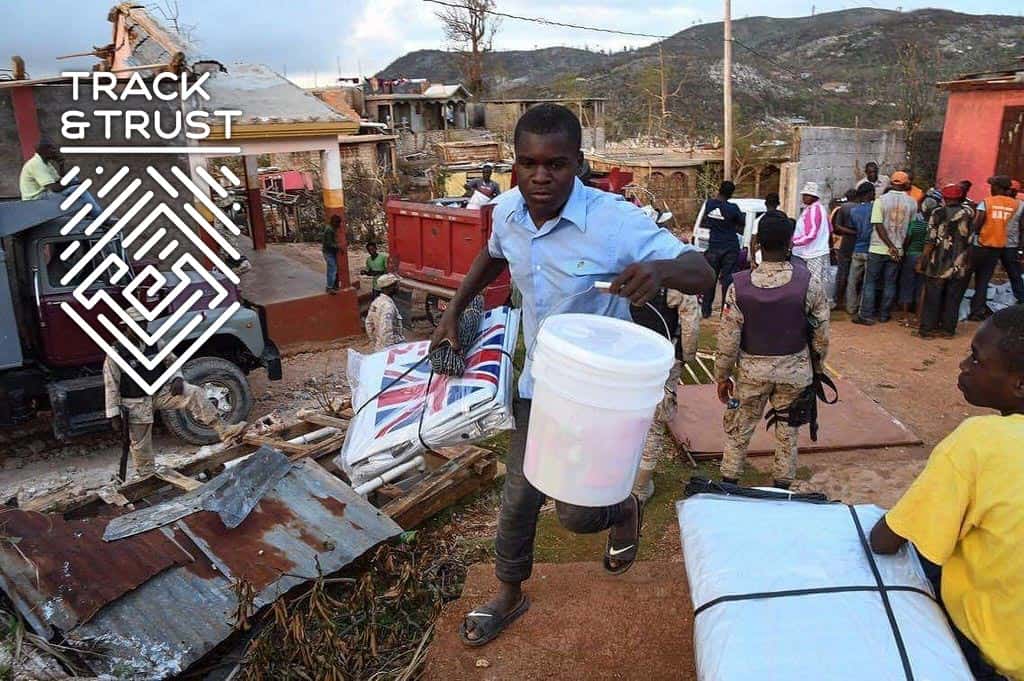
October last year in London, we kicked off the Humanitarian Supply Blockchain Proof of Technology with members of Britain’s Department for International Development (DFID) and their Frontier Technology Livestreaming (FTL) programme. The technology to be “proven” in this case was blockchain, specifically within the setting of humanitarian supply chain management. Over the last months, we have developed this system, named it “Track & Trust”, and successfully tracked the first shipment from Pakistan to Dubai.
The project essentially was concluded in three phases:
- Concept
- Development
- Live shipment
In the concept phase we tried to figure out the actors and their common denominator within the humanitarian supply chain. For this we identified and interviewed the actors involved in the DFID’s supply chain. As a result, we identified four actors: Humanitarian organization (in this case DFID), the supplier (SUP), the logistics service provider (LSP) and the implementing partner (IP – who also acted as consignee). The system was to be able to track the actor accountable for the shipped goods:

Process: Tracking accountability of a shipment.
After the development phase was completed, all we needed was: a shipment. Since the Mozambique flooding had just happened a few weeks earlier, a first potential candidate was tracking a special vehicle used for loading and unloading aircrafts freight during the event. Unfortunately the time was too short for onboarding the involved actors. So the choice fell on a far calmer event: We were to track a delivery from a supplier located in Pakistan to a warehouse in Dubai. The warehouse serves as stock and enables fast distribution to disaster areas in the region.
This last chapter took place this summer, with a DFID-scheduled shipment of goods. An amount of 304 DFID family tents were to be sent to the warehouse. The logistics organization was done by the domain experts and officers at DFID, who also had managed to source the parties involved. Before the shipment took place, the actors had to be onboarded to the system. For this we created user manuals and scheduled screencasts (varying from 20 to 60 minutes) for each participating party where questions could be clarified.
As expected, the most difficult part for the users was the ones where interaction with blockchain was required. In our case, that meant uploading a key-file and entering the password to unlock the key-file into the user interface. We received most questions on this aspect during the demos, and in the follow-up survey this was the source of the most uncertainty with respect to the usability.
The actual shipment started with us learning about something we could improve, which was the whole purpose of the testing phase! Luckily it was a rather minor detail, namely that goods to be shipped need to be inspected before they can be marked as ready for pick-up. The implementation of this was nothing more than adding an option in a drop-down menu, but the time the goods were waiting to be inspected was significant. As the goods were handed over from the supplier to the logistics service provider we received our first question on how to use the key-file. However, even before we could respond to the email, they figured it out themselves, so no intervention was necessary.

Screenshot from the Track & Trust shipment overview – status: Completed
From there on the shipment flowed like expected, the last handover was frictionless and all goods arrived safely. But since one of the goals was that we learn as much as possible and try to get our partners to share as much of their insider knowledge about the supply chain as possible, we decided to issue a survey to them. There we collected impressions and scores on usability, perception of blockchain in the system and general feedback. All of the partners responded to the survey, including the logistics officer from DFID. All of the respondents found the briefing beforehand to have been relevant, sufficient, clear and precise. Although, one could say we should have put more focus on the key-file and it’s importance.
The usability overall was rated highly with an average score of 4.2/5. Potential improvements noted as comments were mainly about added information points such as ETA and increased visibility. Additionally, the relatively high security was perceived by one respondent as confusing. However, not a single party found that any necessary functionality was missing, which meant that we’d set the level of prototype-abstraction correctly.
According to the survey, it was clear to all actors how the blockchain improved accountability across the supply chain, which meant that we’d achieved one of our goals: to have blockchain only where needed and empower the user.
As a technical partner, creating Track & Trust has been a great experience and learning process – applying the blockchain to an important pain point of the humanitarian supply chain. Working with the participants in this project has been delightful – everyone was extremely helpful in discussions (on- and offline) as well as workshops.
For Track & Trust, the ending of this phase is the beginning of a new one: Tracking the last mile in the humanitarian supply chain has been described by leading humanitarian organizations as the most murky. Therefor we decided to tackle this next pain point as we applied for a grant by the European Space Agency. We are continuing the development of Track & Trust and taking it to the next level – literally.
by Michael Reuter | 2 October 2019 | Blockchain
In its purest form, a blockchain is a public, permissionless network. Equipped with a consensus mechanism and an underlying incentive scheme that motivates participants to act in a fair and healthy way, making the network robust.
However, most so-called enterprise blockchains, i.e. DLT networks built in and for companies, are neither public, nor permissionless. Nearly all enterprise blockchains are designed as private, permissioned networks, i.e. only a specific set of participants is invited and each of them has to be permitted by the network’s operator. In case of blockchains with more than one operator or initiator, we speak of consortium blockchains.
When two or more organisations partner with the objective of operating a common blockchain, this consortium sets up rules that define the structure and processes of the network. In particular, the consensus mechanism and the underlying governance model must be defined, in order to allow for a decentralised decision making. Depending on the consortium’s specific purpose, a blockchain technology will be selected. Sometimes, you read about specific blockchain technologies as synonyms for consortium blockchains. Our understanding is that a consortium can use such diverse systems as Ethereum, Hyperledger, Corda, or Qtum, amongst others, to create consortium blockchains.
by Kira Nezu | 2 October 2019 | Blockchain, Track and Trust
In October 2018, we started developing a blockchain based supply chain solution for UK government’s DFID. The system was supposed to track accountability of goods on their way to disaster areas. In June 2019 we successfully tracked a shipment from Pakistan to Dubai, involving four parties managing and handing over the shipped items. With this delivery, the first pilot was successfully concluded. We are continuing to develop the system – which now carries the name „Track & Trust“.
So, naturally, a system under continuous development needs some kind of visual identity – starting with the logo. Having a strong graphical background, anything that needs to be visually enhanced at Datarella ends up on my desk – be it websites, visuals or: Logos. To be honest, this kind of work is a real treat for me! It allows for deep concentration on one single task (opposed to fast communication of everyday work). So, I indulged in some meditative work for a few hours and came up with the Track & Trust logo.
At the beginning of the logo design process, we brainstormed on which qualities, objects and attributes we connect with the Track & Trust system. We came up with: Accountability, security, location, path, road, ID, fingerprint, authenticity, address tag, technology – and the letter „T“.
After completing this list, I chose 1-3 aspects and started scribbling with pencil and a good deal of paper. The winning idea of this scribble contest then was replicated in vectors (I prefer Adobe Illustrator for this work).
The result combines several attributes: The sense of security is transported through the shield form of the logo. The lines represent authenticity and digitalization through their fingerprint- and circuit-like appearance. And lastly, even the letter “T” made it into the logo!
by Martin Schäffner | 20 September 2019 | Blockchain
On 18 September 2019, the German government issued a 24-page strategy paper called “Blockchain-Strategie der Bundesregierung”, an official statement outlining the initiatives Germany together with other EU states plan to support Blockchain-technology. This paper was published shortly after the EU published its “Blockchain Now and Tomorrow” paper, which summarizes the EU initiatives regarding Blockchain application. It is worth mentioning, that the paper by Germany is much more extensive and specific when comparing both statements.
Blockchain is one of the most discussed technological topics within the German Cabinet. This is due to the fact that this technology will impact many different areas including economy, society, international trade and environment. The Cabinet states that Blockchain is “one of the technologies which is anticipated to have a profound impact over the next 10-15 years.”, mainly due to an increase of Blockchain activities within startups but also established companies. Therefore, the Germany government reached out to 168 prestigious experts with different backgrounds to elaborate the potential of Blockchain. The outcome of this initiative was the base for this strategy paper. The very good news is that in general the German government fully supports Blockchain technology. However, there are some limitations. The paper outlines that the Cabinet will not support private stablecoins as an alternative to sovereign currency. This implies that initiatives like Facebook’s Libra will be clearly blocked.
So, what are the key initiatives according to this paper?
Ensuring stability and stimulating innovation with Blockchain in the financial sector
The German Government plans to open German law for electronic securities as early as this year. In its first iteration, only digital bonds will be covered. If this turns well, electronic shares and investment funds on the Blockchain will be considered as a next step. The paper outlines “The regulation of electronic securities should be technology-neutral, so that future electronic value papers can also be issued on a Blockchain.”. That’s great, in particular for our new company RAAY Real Estate, which supports the issuance of digital tokens for the real estate industry.
Establishing a token exchange
The Cabinet will work on laws on the regulation for exchange for non-traditional securities, i.e. security tokens and cryptocurrencies. A new “BaFin” permit for exchanges will allow the trading of crypto-assets on German exchanges.
Enhancing and supporting Blockchain innovations
The German Government will promote and financially support Blockchain projects. As an example they plan to pilot a Blockchain-based energy system connected to a public database. Also, they mention that they will promote the testing of Blockchain-based verification of higher education certificates.
Applying Blockchain in digital ID
Germany will seriously explore the use of Blockchain for digital identity. Timing is unclear, but the Cabinet announced that they plan to explore the benefits of Blockchain in use cases like maintaining the records of civil status, document registration, passports and ID cards.
Blocking private stablecoins
The strategy paper clearly states that the German Government will not support the establishment of any private stablecoin to get dominance in the country, as well as in the EU.
Overall, the Blockchain strategy paper published by the German government clearly proves that Germany is very serious about becoming the leading state for Blockchain technology. Surprisingly, the paper is very extensive and covers a broad range starting from finance to industrial applications. According to CoinDesk, the German parliament member Thomas Heilmann stated: “The home of the emerging token economy will be in Germany, just as Silicon Valley became a hotspot for previous innovations.”
This is great to hear – let Germany become the Silicon Valley for Blockchain in Europe!
by Kira Nezu | 11 September 2019 | Ask Datarella, Blockchain
If you’re wondering why a blockchain company like us is writing a blog post about killing vampires, or if you’re confused because you’d think that meat products good for barbecue have nothing to do with our core competencies, you’ve landed in the right place!
This is a short explainer and introduction to proof-of-stake (PoS), which in the context of blockchain and distributed systems is a method for agreeing upon what is the true informational state of a distributed system. This is called the consensus mechanism in blockchain-talk and is often compared to proof-of-work (PoW), which is based on the simultaneous computation of many, many relatively simple calculations.
How does it work?
Proof-of-Stake is a process which starts with a pseudo-random number. This number is used to perform a lottery to see which node gets to validate the next block. And this is where the stake comes in. The probability of a node being allowed to validate a block can be based on the percentage of tokens that node has staked. The chosen validator then proposes a block. Some types of PoS allow for nodes with more stake to have more votes on the validity of this block.
In order to motivate nodes to participate honestly in the validation process, there are rewards and penalties in most PoS-models. The rewards are there so that someone will perform the common good of validating transactions, and the penalties are there to prevent corruption or attacks on the blockchain. One widely discussed attack is the nothing-at-stake attack which is when a node attempts to create blocks, or vote for all blocks, on top of many or all of the competing chains in an non-finalised state. It is in fact even in the interest of all rational nodes to do this, since the marginal cost is very low. For a penalty to be able to control for this type of behaviour, we need to know the full set of validators which are allowed to stake before the fork takes place, but then it’s easy to create a negative reward for those voting for multiple blocks. Another method of penalising validators for misbehaving is to create so conditions for when a validator is deemed dishonest beyond reasonable doubt. If this happens to a validator, the staked tokens are slashed. More here and here.
Why is PoS an improvement for blockchains?
Two reasons mainly:
- It requires less energy. The wasted-energy argument of many blockchain discussions is based on the assumption that blockchains use PoW. I won’t get into the details of how PoW works here, but since PoS doesn’t require any racing to find a special key between different nodes like PoW, the energy consumption is drastically improved.
- Economic incentives can be programmed into the model in a more certain way than in PoW. For example, centralisation cartels can be prevented by improved game-theoretic design and 51% attacks can be made incredibly expensive.
It should be noted that just as with many other parts of blockchain technology, there is room for development and innovation in staking protocols. There is already many different types of PoS with each having their own benefits and drawbacks. Hopefully, after having read this introduction, you feel empowered to dive deeper in other aspects of consensus mechanisms and blockchain!

by Michael Reuter | 7 August 2019 | Blockchain, MIA
Banking the Unbanked always refers to human beings and their enablement to participate in the global financial system by providing them with bank accounts. In this post, I argue for banking unbanked devices, i.e. machines, that are connected through the internet — the Internet of Things IoT.
Globalization has made our world a smaller place: through the internet we know everything what happens somewhere within minutes, through air travel we can personally experience the other side of the world within hours. We, in this case, means the rich world. The majority of people, however, may have access to the internet but is far from being able to travel around the world. However, there are other means of enabling them to participate in and get a fair share of globalization — by banking them; i.e. by providing people without access to the financial system with either proper bank accounts, or with alternative means of payment, such as the Libra project that Facebook has announced this summer.
This idea originates from my colleague with Bosch, Nik Scharmann, who leads the Economy of Things project, and from a Datarella project in the field of banking. As so often, evolutionary development is the result of combining ideas from different industries, – or – a “cross-sectoral” approach.
Machine-to-Machine Transactions
Having been active in the field of machine-to-machine communication (M2M) for quite a time, and working in several projects including machine-to-machine transactions, such as pricing negotiations and settlements between machines automated by smart contracts, I‘d like to point out the huge impact banking the unbanked IoT will have on the global economy. As Julian Simon claimed in his )controversial) thesis ot the „Ultimate Resource“ (The “ultimate resource” is not any particular physical object but the capacity for humans to invent and adapt), that there is no resource crisis since when a particular resource becomes more scarce, its price rises. This price rise creates an incentive for people to discover more of the resource, ration and recycle it, and eventually, develop substitutes.
Economy of Things
And as Ronald Coase defined and described transaction costs in his „The Nature of the Firm“: the lower the costs of organising and the slower these costs rise with an increase in the number of transactions, the less likely the human being is prone to erroneous behavior and the smaller the increase in human errors with an increase in the number of transactions.
The ultimate modern way of bringing down transaction costs is to have machines managing all transactions, without any interference of human error. That said, the Economy of Things EoT will most probably be the best description of our future global economy, with interconnected devices managing all economicl haggling, negotioans and settlements — even disputes will be handled by machines, supported by automated dispute resolution procedures, such as smart contract based arbitration.
The Development Of World Populations vs Connected Devices

Letting devices, machines, or things participate in economic transactions can be described as Banking the Unbanked IoT. From the perspective of the actual accessible install base and future growth, the economic impact of banking unbanked people is negligible compared with the impact of banking unbanked devices, as can be seen in the two charts above and below:

Looking at Facebook‘s Libra project and comparing its economic impact with Banking the Unbanked IoT described here, we can conclude that it makes much economic sense to work on the future Economy of Things. In our next post we will elaborate more on our plans with Datarella of being an active part of this fascinating journey together with our great partners in the field of mobility infrastructures. And I will explain, why and how the Enterprise Evolution Protocol model is a good framework for building a sustainable, ethical Economy of Things.
This article was originally publishes at michaelreuter.org
by Michael Reuter | 5 August 2019 | Blockchain
Since the advent of the internet aka Web 1.0, internet users have been enabled to shop online and to receive information from all over the world with a few mouse clicks. Since Web 2.0, users could actively participate by producing and sharing content, information and opinions over the web, and through this build their own personal online brands. With Web 3.0, we have now approached the next evolutionary phase: users can capitalize on their online brands by executing peer-to-peer (P2P) transactions, while keeping full sovereignty of their data.
There are two key technologies that allow for a more evenly distributed value creation: Distributed Ledger Technologies – aka Blockchain – and Artificial Intelligence AI. Whereas in Web 20, there were systemic errors, such as data silos, breaches and hacks, as well as data being hoarded or not utilized at all, the promise of Web 3.0 is becoming a distributed, silo-free, open source, non-discriminating framework to allow for a full sovereignty of individuals as well as enterprises. Blockchain is the best suited foundational technology layer for this purpose. A distributed network of ledgers can be used by machines to communicate with each other, and participate as autonomous entities in the global economy.
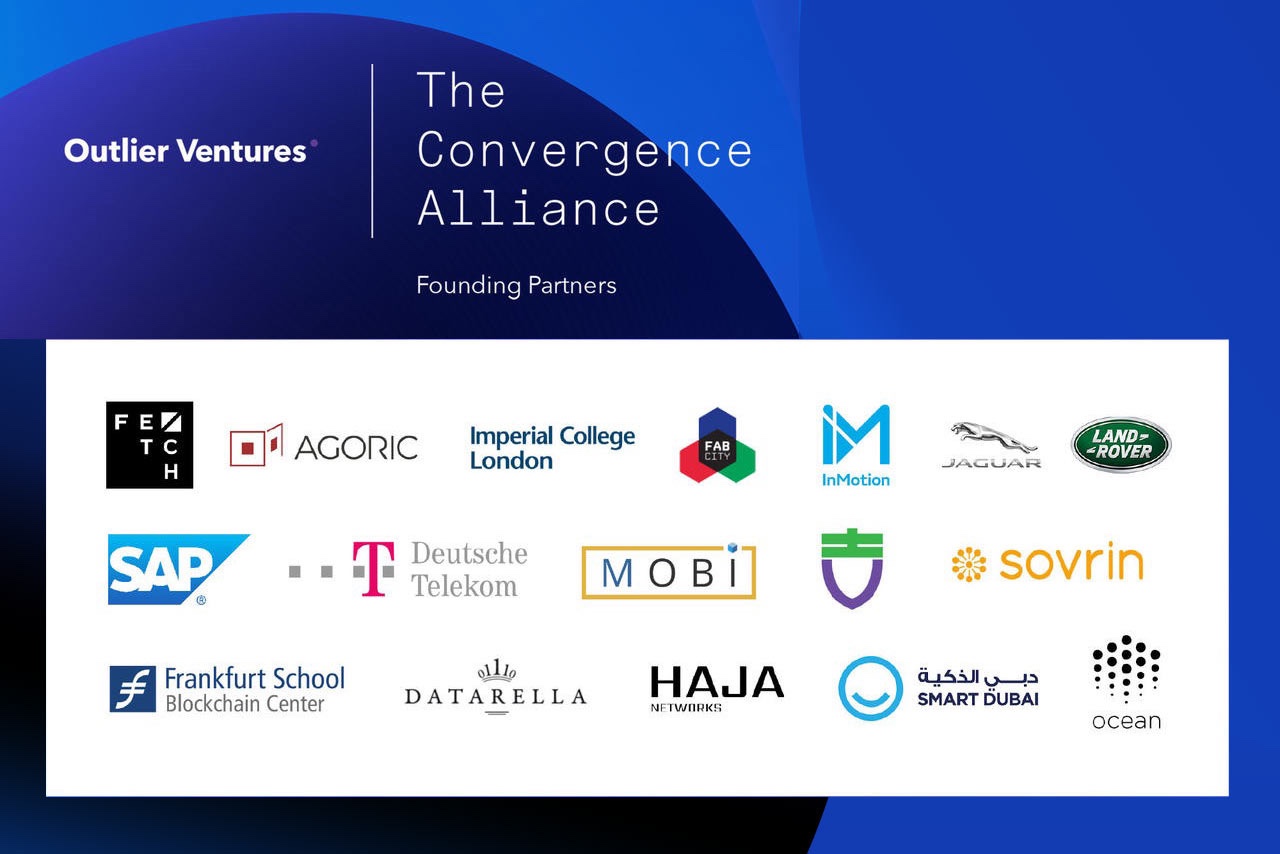
As we have learned from the history of the Internet, a technology itself is a necessary but not a sufficient condition for becoming a non-discriminating, open source technology layer. Beside technology, there must be a governance model including smart incentive schemes that allow for a sustainable, non-discriminating behavior of participants in the system. Ideally, many participants across a variety of industries agree upon. finding and setting these rules, regulations and incentives. With Datarella, we are honored to become a founding member of the Convergence Alliance, together with Deutsche Telekom Innovation Laboratories T-Labs, Jaguar Land Rover’s InMotion Ventures, SAP, Imperial College London, Frankfurt School Blockchain Center, MOBI, Smart Dubai, the Fab City Global Initiative and Outlier Ventures. The Convergence Alliance is a unique community of open source protocols, enterprise, start-ups, government bodies and academia leading the next phase of the Web.
Our role Datarella in the Convergence Alliance is to focus on onboarding and supporting small and medium-sized businesses SMB that aim for entering the fields of blockchain amd AI. Whereas other technology pushes come with huge financial investments, to work with Blockchain and AI means pushing your company to the next level with small investments and contained risks. And, with the Convergence Alliance, teaming up with the ideal partner to invent new business models by capitalizing on thie innovative technologies blockchain and AI, it should be a no-brainer for SMBs to start working on it! Looking forward to seeing many SMBs joining the Convergence Alliance!

by Martin Schäffner | 1 August 2019 | Blockchain
We are proud to announce that Datarella, WERTGRUND and Hammer have established the Munich-based PropTech Joint Venture RAAY Real Estate. Our objective is to develop and sell blockchain-based products and services to the real estate industry.
RAAY Real Estate, a 33/33/33 Joint Venture between Datarella, WERTGRUND and Hammer is headquartered in Munich, Germany. Through this partnership, the three partners deliver innovative solutions for the European real estate market. Both WERTGRUND and Hammer are well-established and Munich-based real estate companies with strong financial backgrounds. We are starting the venture off with a tokenization product for one of our Joint Venture partners. RAAY Real Estate will design the token, build a platform for the sale of the tokens and add other products and services, allowing for new business models and streamlining complex inefficient processes in the real estate industry. RAAY Real Estate is legally supported by CMS, one of the leading commercial law firms in Germany.
We are very excited and proud to be part of this Joint Venture. We will keep you updated about the progress. Stay tuned!

About Wertgrund: WERTGRUND Immobilien AG is an investment and management company for residential real estate in Germany. WERTGRUND offers its institutional and private clients the entire range of services in the field of residential real estate – from investments through the accompanying of transactions and project development to asset management, property management, leasing, as well as privatization.
About Hammer: Hammer AG is a family-run property business based in Munich. Since 1951 the company is an active player in the development and management of commercial real estate within their own portfolio and for third party investors. As of to date, Hammer AG has ongoing developments with an investment volume of 1.2 billion euros and currently 220.000 m2 under management.

by Martin Schäffner | 30 July 2019 | Blockchain
We are happy to announce that Datarella is part of a pan-European study initiated by the European Commission. The European Commission wants to understand blockchain developments and its impact on society and the economy. Our study will provide evidence and suggestions for possible policy measures concerning blockchain. Our consortium is led by Spark Legal Network in partnership with tech4i2 Limited and consists of a total of 10 experts. Datarella has been mandated as the technical blockchain expert.
In October 2017, the European Council asked the European Commission to work on an European approach to evaluate the impact of blockchain on different aspects for Europe on society and economy. In the following year 2018, the European Commission formally underlined its commitment to blockchain in the FinTech Action Plan. This action plan outlines 23 steps to enable innovative business models to scale up, support the uptake of new technologies, and to enhance cybersecurity and the integrity of the financial system. Blockchain is a major part of this initiative.
Our study enquires for legal and regulatory aspects related to blockchain-based technologies and their business applications as well as for socio-economic impacts of the blockchain technology. The results of our study should enable mobilizing ad-hoc expertise and to collect facts and figures in a flexible way to support the EU blockchain initiative. To achieve this, our study will address:
- A comprehensive assessment of the legislative framework for Blockchain use, responsibilities and liabilities
- Policy choices and analyze their socio-economic impacts
- Experience sharing and validation of policy choices
- Timeline for the development of legal or non-legal EU initiatives
Together with our international partners, we will work on these tasks for the next 6 months. Our results will be summarized in a formal report, which will be issued to the European Commission and presented at the Commission’s premises in Brussels, Belgium.
We are very excited and proud to be part of this study. We will keep you updated about the progress. Stay tuned!
