
by Kira Nezu | 8 April 2024 | Blockchain, Featured, Gaia-X, Partnerships, SSI, Track and Trust
Datarella’s Blockchain Solutions for Supply Chain Management: Streamlining CSDDD Compliance
Datarella has been at the forefront of deploying blockchain solutions for supply chain management. The introduction of the European Union’s Corporate Supply Chain Due Diligence Directive (CSDDD, or CS3D) presents a significant regulatory milestone. This article examines the directive’s implications and showcases how Datarella’s blockchain technology offers a streamlined path to compliance for businesses.
What is the EU Corporate Supply Chain Due Diligence Directive (CSDDD)?
The CSDDD is a critical component of the EU’s strategy to enhance supply chain sustainability and ethics. It mandates companies to actively prevent human rights and environmental abuses within their supply chains. The directive sets forth a phased compliance timeline, with larger corporations facing earlier deadlines. By 2028, entities with over 1,000 employees and a net worldwide turnover exceeding 450 million EUR must adhere to the directive. Non-compliance penalties could reach up to 5% of global turnover.
Navigating CSDDD Compliance with Blockchain Technology
Many companies are uncertain about how to address these new requirements. The answer lies in robust reporting, backed by verifiable data. Traditional compliance methods might overwhelm businesses with paperwork and lead to inefficiencies. However, blockchain technology presents a solution: by digitizing and securely logging every transaction and document in the supply chain, blockchain can simplify the compliance process.
How Blockchain Simplifies Compliance
Unlike traditional methods reliant on paperwork, blockchain ensures secure, transparent tracking of transactions. This technology can reduce the compliance burden by offering secure data storage and easy accessibility. Since records on the blockchain cannot be modified, it ensures data integrity and accurate documentation for compliance purposes. Integrating blockchain with digital identity solutions like the vLEI and the EU Digital Identity Regulation further strengthens this process. Companies can easily verify responsibilities and transactions, making blockchain an essential tool for CSDDD compliance.
Datarella’s Expertise in Blockchain for Supply Chain Management
Datarella has an impressive track record in implementing blockchain solutions to address complex supply chain challenges. From facilitating blockchain-based document handovers in humanitarian contexts to ensuring the integrity of 3D-printed parts for global suppliers, Datarella’s innovative projects demonstrate our expertise. Our involvement in initiatives like the Gaia-X consortia (ESCOM and Cosmic-X) and the European Space Agency’s Track & Trust initiative shows our commitment to advancing blockchain technology for supply chain management.
Partnering with Datarella for CSDDD Compliance
As the EU moves toward greater supply chain accountability, partnering with Datarella can help businesses navigate the complexities of CSDDD compliance. With our blockchain solutions, we not only help companies meet regulatory requirements but also drive efficiency and transparency. Choosing Datarella means collaborating with a leader in blockchain innovation, ready to transform today’s challenges into tomorrow’s successes.
The Future of Supply Chain Management with Blockchain
The CSDDD represents a pivotal shift towards responsible supply chain practices within the EU. For companies aiming to align with these new regulations, Datarella’s blockchain solutions offer a practical and efficient path to compliance. As the regulatory and business landscapes evolve, Datarella remains dedicated to empowering companies with the technology and expertise they need to thrive in this new era of supply chain management.
Interested in simplifying your CSDDD compliance with blockchain technology?
Contact us to learn more.
*On Feb. 29, 2024, the EU voted positive on the Digital Identity Regulation, paving way for EU citizens to truly own and control their data – a step towards secure, decentralized applications within the EU.

by Simon Zehentreiter | 11 November 2022 | Blockchain, ESCOM, Featured, SSI
Datarella, as part of a consortium of leading industry manufacturers and research facilities, is beginning work on the feasibility study “ESCOM – Balanced Edge Cloud Environments for Superior Component Service Systems in Production Applications”, funded by the Federal Ministry for Economic Affairs and Climate Action.
With the project, the consortium plans to make a demonstrable contribution to a responsible manufacturing industry regarding resource consumption and sustainable resource use. The project seeks to actively strengthen the innovative power of European industry and infrastructure providers and promote the emergence of socially relevant, freely consumable qualification offerings in the industrial and academic sectors. In this way, the consortium intends to provide an incentive for the relocation of global production capacities back to Europe.
The sustainable value proposition of a future configurable digital product instance is formulated as a digital twin of any machine component to reduce resource consumption via component information and increase machine availability and process reliability with condition and process information. The interdisciplinary consortium will demonstrate that the use and balancing of edge and cloud data spaces allows for the flexible, load- and energy demand-dependent use of services as a know-how offering of component manufacturers with high utility value for the end application. For this purpose, the consortium will use standards and open source software on the basis of the Gaia-X data infrastructure, which in the future will enable the exchange of smart service offerings of component manufacturers via the product service representation under the management shell concept of Plattform Industrie 4.0.
Owing to its experience in leveraging blockchain technology for real-world use cases (e.g. KOSMoS), Datarella is responsible for identifying relevant components, processes, data and blockchain plattforms as well as developing and implementing the services and sovereign data exchange processes that will enable an open, transparent and secure infrastructure.
We are very proud to be part of this project and looking forward to collaborating with all of the partners involved.
Project consortium
by Simon Zehentreiter | 18 October 2022 | Blockchain, COSMIC-X, Featured, SSI
Datarella, together with leading industry partners and research facilities have been awarded a contract for the feasibility study titled “Collaborative Smart Services for Industrial Value Chains in Gaia-X (COSMIC-X)”, funded by the German Federal Ministry of Education and Research.
Building on the results of joint project KOSMoS, the goal of the two year project is to use the Gaia-X industry data space (IDS) for provisioning advanced smart services (ASS) in the context of spare part supply chain automation and optimization.
The target group of COSMIC-X are machine tool manufacturers, component suppliers and machine operators, with a special focus given to assisting small and medium-sized enterprises (SMEs) in taking part in and profiting off of the Gaia-X ecosystem. The specific use cases that will be explored in close collaboration with industry partners SW, HAWE und KROHNE are digital twins, trusted supply chains and platform-based maintenance.
With its expertise in blockchain technology and self-sovereign identity (SSI), Dataralla is tasked with defining the technical requirements of the use cases and, based on these, develop a blockchain-based system architecture in conformance with the Gaia-X framework. This will ensure an open, transparent and secure infrastructure for data sharing and collaboration.
We are looking forward to working on this project with all of our partners and will keep you updated on the results.
Project consortium
- Schwäbische Werkzeugmaschinen GmbH
- HAWE Hydraulik SE
- Krohne Innovation GmbH
- Universität Stuttgart – ISW
- Hochschule Furtwangen – IDACUS
- Datarella GmbH
- inovex GmbH
- Stackable GmbH
by Martin Schäffner | 4 October 2022 | Featured, KOSMoS
As part of a German consortium, Datarella has successfully finished the research project KOSMoS. KOSMoS was a joint research project aiming to build a collaborative smart contract platform for the digital value chain in the field of Industry 4.0. This research and development project was funded by the German Federal Ministry of Education and Research (BMBF) and managed by the Project Management Agency Karlsruhe (PTKA).
In addition to Datarella, the consortium consisted of Schwäbische Werkzeugmaschinen, the Institute for Control Engineering of Machine Tools and Manufacturing Equipment (ISW), the Frankfurt School Blockchain Center, inovex, ONDICS, Schütte, and Asys Group.
KOSMoS worked to develop a collaborative platform for small and medium-sized companies (SMEs) in the manufacturing sector based on distributed ledger technology (DLT). DLT is a family of innovative, decentralized technologies with blockchain technology being the most popular member of the family. Within the KOSMoS project, two different industrial use cases were realized on a DLT-based platform: 1) dynamic leasing, and 2) transparent maintenance.
The primary goal of KOSMoS was to develop a platform for the cross-company networking of production and process data using blockchain technology. The platform is able to integrate new offerings and business models. Examples include transparent maintenance concepts, dynamic leasing, and proof of quality for delivered products. Through these business models, all cooperating companies should gain an advantage. Examples of such improvements include lower prices, lower maintenance costs, and easier product distribution. In summary, the project should facilitate better cooperation amongst companies in the industry sector.
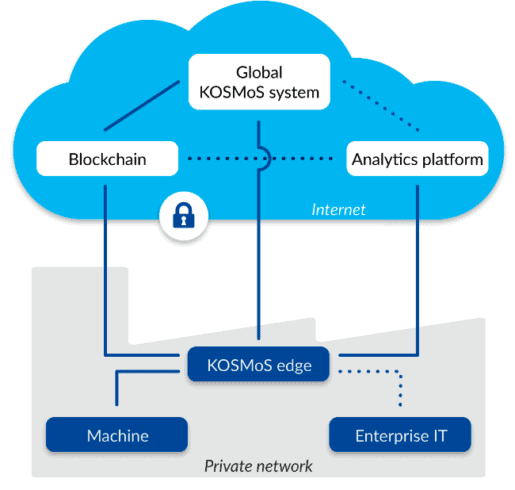
The Hyperledger Fabric DLT used in this project was part of the following logical system, where most of the individual components are accessible over standardized ports, and others were only available in private networks:
The final results of KOSMoS were presented at a full-day workshop in March including all three initiatives of the InKoWe association.
We from Datarella were very proud to be part of this innovative research project and happy to make a major contribution to the consortium with its DLT experience.
by SPR | 5 May 2022 | Blockchain
The German Environment Agency (UBA) commissioned the Frankfurt School Blockchain Center, Capgemini and Datarella to elaborate a feasibility study on the use of DLT in today’s emissions trading registries. Datarella is happy to announce its successful completion.
The aim was to evaluate whether the DLT is suited to efficiently represent the current European emissions trading system (EU ETS). The insights generated by the project partners will support policymakers in informed decision making with regards to the question of whether to remain with a traditional architecture or with a central relational database. For this purpose, the technical concept of an emissions trading DLT and the consideration of the efficiency and sustainability of an emissions trading DLT were explored. As a result, we were able to demonstrate how Emission Allowances can be represented on the blockchain. Hereby, the scope of an emissions trading system can be significantly expanded without extensively altering users’ current user experience .
As a key benefit, our DLT solution offers a robust infrastructure that is secure against manipulation attempts. Additionally, with DLT, well-known advantages such as transparency and traceability can be established in emission trading systems. Our concept also provides sustainable and energy-saving operability of a DLT-based emissions trading system.
The Frankfurt School Blockchain Center, as coordinator of the project, has contributed dedicated scientific blockchain expertise. Capgemini provided a rich set of expertise in carbon trading, registries, and private blockchain implementation. Datarella as a Web3 solution provider contributed comprehensive implementation expertise of enterprise blockchain solutions.
The result of the feasibility study was highly satisfactory for the client. In the future, the result will be presented to a larger circle of interested stakeholders.

by Martin Schäffner | 13 October 2020 | Blockchain, Smart Wallet
Datarella, together with CapGemini and Frankfurt School Blockchain Center, successfully applied for a feasibility study funded by the German Federal Environmental Agency (Umweltbundesamt) to explore the benefits of Blockchain technology for an emission trading system based on smart contracts.
During this study, we will work on a concept for an emissions trading register based on DLT. We will make recommendations to the Federal Environmental Agency with regards to the requirements to a DLT trading platform such as usability, scalability, performance, interoperability, security and sustainability.
Ongoing climate change is one of the major global challenges we face today. As a result, a cross-border European emission trading system (EU-ETS) is one of the EU’s most relevant tools against global warming. So far, its success is threatened by fraud and lack of transparency. Stakeholders acting in this system also complain about the absence of incentives to actually reduce emissions. With this study we will prove that by the use of Blockchain technology most of these issues will be solved thanks to the decentralized and transparent characteristics of a DLT system.
We are very much looking forward to working on this study with our partners CapGemini and FSBC in close cooperation with the German Federal Environmental Agency. We will of course keep you updated on any results we achieve.

by Martin Schäffner | 22 September 2020 | Blockchain
What Is A Blockchain Address?
Just like your home address, bank address, or email address a blockchain address is a unique and secure identifier. This identifier, saved on a blockchain, can be used for sending and receiving cryptocurrencies. However, in contrast to traditional addresses, blockchain addresses are not assigned by centralized authorities. These addresses are mathematically derived from a user-generated private key.
Learn more about blockchain addresses and the two types, which exits in the Ethereum Network, in our Datarella Blockchain Bites slideshow of this week: Blockchain Addresses.
by Martin Schäffner | 10 August 2020 | Blockchain
Datarella successfully applied for the Blockpool program and is very proud to announce that it was selected into the 25 companies working on promising Blockpool solutions. The Blockpool call received over 100 proposals from 27 European countries, in more than 11 different DLT-technologies and directly affecting 8 economic sectors.
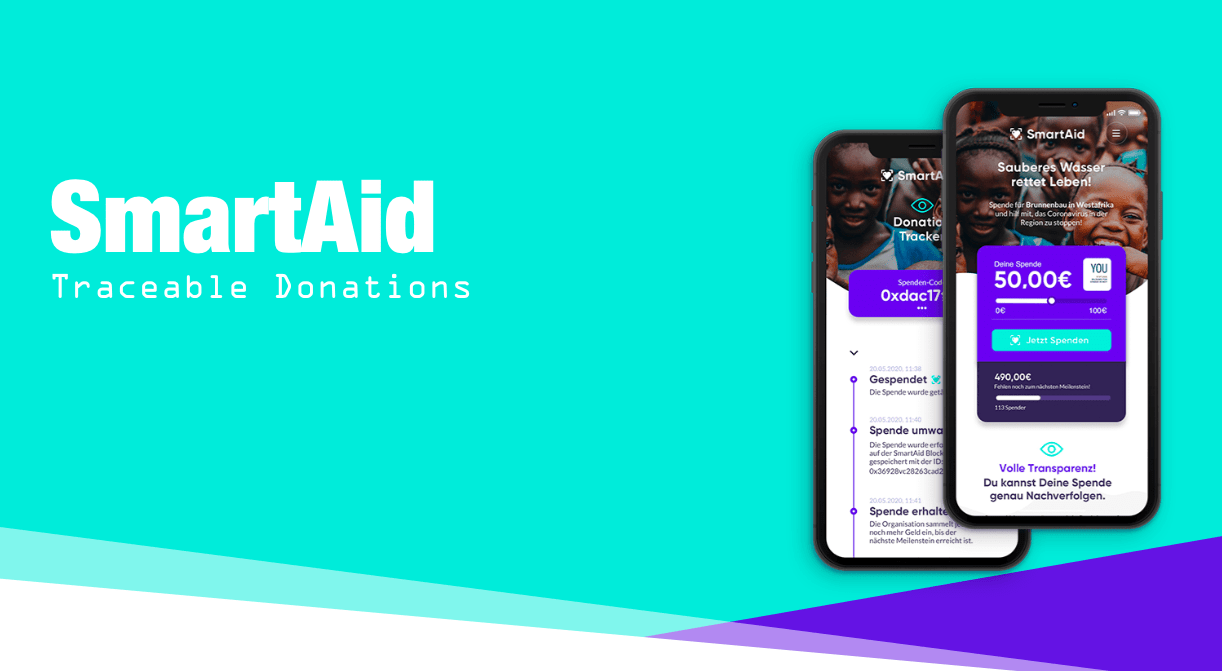
At Blockpool, Datarella will work on an important Blockchain feature supporting our product called SmartAid. SmartAid is an innovative donation platform that leverages the advantages of blockchain to bring efficiency, transparency, and trust into the world of donations. SmartAid is the world’s first fully digital application for donating and tracing the way of your money to selected charity projects. Projects all over the world can participate and receive donations through SmartAid. The use of Blockchain technology allows for
- Secure transactions,
- Traceability,
- Intuitive handling and navigation,
- Simple overview of donations, and
- Transparent transaction history.
The goal of the Blockpool program is to support cross-border DLT-based initiatives and deployment in a broad industry range. It’s primary ambition is to lead to a more cutting-edge and competitive European industry as well as to the structuring of the emerging value chain of DLTs beyond financial markets. This program is funded by the European Union’s Horizon 2020 research and innovation program.
We are very much looking forward to further developing our product SmartAid in close cooperation with the partners backing the Blockpool initiative.
