moveID, the identity-focused project within the Gaia-X 4 Future Mobility family, unveils the MOBIX app, its live demonstrator at the IAA MOBILITY 2023. MOBIX allows for peer-to-peer parking and EV charging and IAA Mobility visitors can experience a first glimpse of its vision of a decentralized mobility service ecosystem.
The demonstration involving Tesla and Jaguar electric vehicles will allow the visitors to experience the moveID’s vision of a vendor-neutral open ecosystem of data-driven mobility services with integrated payment capabilities. The live demo will show how autonomous transactions between connected devices streamline expenses and add new revenue streams.
In preparation for the big event, several moveID consortium members, namely BOSCH, DENSO, ITK Engineering,peaq, htw saar, Ocean, and 51Nodes, have met for integration workshops in the Datarella offices in Munich. The goal of the first integration workshop was to connect the different software and hardware components provided by the partners and test the first set of workflows for the IAA demo from a user’s perspective. Datarella was entrusted with the planning and organization of the event as well as the integration of the different workflows into a seamless user experience via the MOBIX app.
The critical path that was completed, included three workflows, namely issuance of a Verifiable Credential to a vehicle, access to a parking space via a Verifiable Presentation to a Signal Head, and checkout of a parking space via a Verifiable Presentation to a Signal Head. The workflows are enabled by state-of-the-art Self-Sovereign Identity (SSI), Vehicle-to-Everything (V2X) as well as Fetch.aI micro-agent technology, all controlled via the MOBIX mobile application.
“Leveraging our long-time partner Fetch.ai’s micro-agents to connect different technologies and seeing the distilled result of the agent’s work in our MOBIX app is living proof of the power of the moveID tech stack,” says Datarella CEO Michael Reuter.
While the demonstration focuses on the mobility industry, the business model behind it can be implemented in a wide array of industries, such as Public-to-Private power grid interplay and smart supply chain management. The moveID project invites all stakeholders in the EV charging ecosystem to participate and make their charging solution part of the overall charging network. If you are interested in test drives, please contact our IAA Mobility team!
Datarella has partnered with peaq, an Economy of Things network. The partnership will focus on leveraging both organizations’ vast expertise with real-world blockchain use cases to build decentralized applications and tools for the mobility space. It builds up on the momentum of the ongoing collaboration between the two parties within the €20+ mln. Gaia-X 4 Future Mobility moveID project.
A fragmented digital backbone remains a key stumbling block for the mobility industry as it works to transform itself for the era of data-driven business models. Besides various issues such as siloed electrical vehicle charging services or lacking integrations into larger smart infrastructures, the mobility space also often over-relies on the established Web2 tech platforms, putting its own evolution on a flawed foundation. Gaia-X, a pan-European consortium group bringing more than 300 companies and research institutions together, works to create a fairer, better alternative to Web2 cloud services. Its 4 Future Mobility moveID project, led by Bosch and involving a vast array of top industry names and leading Web3 projects, focuses on standards and infrastructure for Self-Sovereign Identities (SSIs) for the mobility space.
“Fragmentation has been a key stumbling block on the path towards the digitalization of mobility and transportation,” says Michael Reuter, CEO and co-founder of Datarella. “This makes for a clear-cut blockchain use case with a focus on real-world services, value, and sustainability. We are happy to collaborate with peaq and other moveID members to power this transformation with our Web3 know-how.”
Working together as part of the moveID project, peaq and Datarella will collaborate on various aspects of building the standards and digital infrastructure for mobility-focused SSIs. peaq and Datarella will also work on enabling Web3 use cases related to the moveID project, including Self-Sovereign Machine IDs, peer-to-peer transactions, and decentralized marketplaces for mobility services and data.
“Reclaiming our data and identity sovereignty is crucial for the future of mobility in Europe and beyond,” says Leonard Dorlöchter, co-founder of peaq. “Blockchain has a lot to offer to the transportation industry, including smoother interoperability, more privacy, and entire new business models. We are thrilled to be working toward this with Datarella and other consortium members such as Bosch, Continental, and Airbus.”
About peaq
peaq is the Web3 network powering the Economy of Things (EoT) on Polkadot, the most environmentally-friendly blockchain network. peaq enables entrepreneurs and developers to build decentralized applications for vehicles, robots, and devices, while empowering users to govern and earn as connected machines provide goods and services. Together with leading consortia, including Gaia-X and MOBI, peaq is co-creating the standards that will power the future of mobility and other connected industries while working to democratize abundance in the Age of Automation.
Datarella GmbH, a Web3 company builder, is joining forces with deltaDAO AG, a Web3 engineering and integration company, to expand the open data economy in the mobility and identity sectors. Both companies leverage their extensive experience in creating Web3 solutions for real-world use cases. The partners aim to allow corporate and individual users to monetize data while preserving their privacy. The first project is inspired by the partners’ collaboration in moveID, a Gaia-X 4 Future Mobility project. It will allow the monetization of mobility service provider data.
Datarella and deltaDAO will use their enterprise Web3 tools and consumer apps to jointly build solutions for the monetization of data featuring Fetch.AI and Ocean Protocol technologies. This combined tech stack serves as the foundational underlying protocol for digital business transformation with converging technologies, s.a. AI, and autonomous machines. Given the natural synergies between Datarella and deltaDAO, this cooperation will drive enterprise adoption across the partners’ client bases.
For Datarella, the purpose of technology is to increase the quality of living, by supporting human beings in professional activities and private lifestyles. The growing complexity and diversity of our ecosystem require technological infrastructures that facilitate collaboration and cooperation. By creating Web3 solutions for a global user base, Datarella illustrates the real-world benefits of its Web3 technology stack, and with deltaDAO, we will show how individual and professional users can turn the table and monetize their data, instead of “being the product”, .
Michael Reuter, CEO of Datarella
deltaDAO has become a trusted advisor for building sovereign, privacy-preserving, and secure data economy solutions. We seek to give freedom of choice and control back to data owners. As a DAO we create a new kind of data economy that is owned by no one – and open to everyone. Our partnership with Datarella will lead to many impactful real-world use cases and is a great example of how two companies can leverage each other’s strengths and experience to create real-world solutions for both individual and professional users alike. We are excited about building towards a decentralized data economy together with Datarella!
Frederic Schwill, Co–Founder of deltaDAO
About Datarella
Datarella GmbH is a Web3 company builder. Leveraging its technology stack of Blockchains, Self-Sovereign Identity SSI, Autonomous Agents, and Artificial Intelligence AI, as the tech hub for Web3 projects and companies like MOBIX, MOBIX family, IMMOBIX, or NOMIX, Datarella creates applications with real-world benefits. The Munich-based company was founded in 2013. With its decentralized teams in Munich, Gdansk (Poland), and Skopje (North Macedonia), Datarella develops bespoke Web3 innovations for their partners and clients, s.a. United Nations, World Food Programme, UKAid, ESA, Siemens, BMW, BOSCH, and Airbus.
About deltaDAO
deltaDAO AG is a software development, integration, and consulting company based in Hamburg, Germany. Its focus is to enable a transparent, secure, and decentralized data economy in which enterprises, SMEs, and public institutions can keep full technical control over their private data. As specialists in distributed ledger technologies (DLT) we are engaged in Gaia-X and built the first Minimal Viable Gaia-X (https://minimal-gaia-x.eu/) in 2021, based on open-source software and Web3 technology.
With Datarella, we have been building software, tools, and applications for Web3 since 2015. Our first truly global project has been the Building Blocks application which enables users to securely pay with their smartphones in refugee camps.
We‘ve developed Track & Trust, a tracking solution for humanitarian aid logistics that leverages satellite communication. In the mobility sector, we have created SSI apps and smart parking solutions to enable secure P2P communications, streamline traffic flows, and minimize CO2 emissions. With 16 other companies, we’re part of Gaia-X consortium moveID that will create the decentralized digital infrastructure for mobility in Europe. And much more! And, in 2020, we decided to leverage our tech stack and create the Datarella Web3 Company Builder Model.
RAAY Real Estate
In 2020, we have launched RAAY Real Estate (RAAY RE) as our first standalone project, together with two partners from the real estate industry. Our RAAY RE joint venture with Hammer AG and Wertgrund Immobilien AG was the first to tokenize a commercial property, fully licensed by German regulator BaFin – Connex Coin was a breakthrough! RAAY RE will become the legal framework of our future IMMOBIX project and token.
MOBIX Marketplace
In 2021, we launched our micromobility marketplace MOBIX. By using the MOBIX app, more than 350,000 daily active users in over 120 countries are earning MOBIX Miles while riding eco-friendly vehicles, such as scooters, bikes, eBikes, eMopeds, or cargo bikes. By incentivizing users to swap their combustion engines with zero-emission transportation, MOBIX helps to decrease CO2 emissions and to make cities more liveable. In the meantime, MOBIX has evolved into the MOBIX Marketplace GmbH, a Munich-based company owned by Datarella, and Fetch.ai.
MOBIX family
The latest brainchild of Datarella’s Web3 Company Builder Model is MOBIX family – a decentralized gig economy network. MOBIX family is the first project in the Company Builder Model that will be driven with the support of an external team. Whereas RAAY RE and MOBIX have been built by internal Datarella resources, a young team of aspiring entrepreneurs from the Technical University of Munich (TUM) has taken care of the Family’s first steps. The team has presented the first MOBiX family MVP during START Ideasprint 2022, a 4-day hackathon based out of Munich.
NOMIX
In 2023, the next project – NOMIX – will launch its BIOCLOCK app. Leveraging the same tech stack as other Datarella Web3 companies, NOMIX will help users around the world maximize their healthspans, i.e. living longer while staying healthy!
We at Datarella are very happy to see more and more teams using our Web3 tools and applications, and creating new ventures! Are you interested in joining an existing Web3 team or do you want to pitch your own idea? Do you want to become part of the Web3 world but prefer to participate from the sideline, you might be interested in owning DREX, our Datarella token which entitles the holder to receive tokens of Web3 projects. In either case, please contact us!
The German Environment Agency (UBA) commissioned the Frankfurt School Blockchain Center, Capgemini and Datarella to elaborate a feasibility study on the use of DLT in today’s emissions trading registries. Datarella is happy to announce its successful completion.
The aim was to evaluate whether the DLT is suited to efficiently represent the current European emissions trading system (EU ETS). The insights generated by the project partners will support policymakers in informed decision making with regards to the question of whether to remain with a traditional architecture or with a central relational database. For this purpose, the technical concept of an emissions trading DLT and the consideration of the efficiency and sustainability of an emissions trading DLT were explored. As a result, we were able to demonstrate how Emission Allowances can be represented on the blockchain. Hereby, the scope of an emissions trading system can be significantly expanded without extensively altering users’ current user experience .
As a key benefit, our DLT solution offers a robust infrastructure that is secure against manipulation attempts. Additionally, with DLT, well-known advantages such as transparency and traceability can be established in emission trading systems. Our concept also provides sustainable and energy-saving operability of a DLT-based emissions trading system.
The Frankfurt School Blockchain Center, as coordinator of the project, has contributed dedicated scientific blockchain expertise. Capgemini provided a rich set of expertise in carbon trading, registries, and private blockchain implementation. Datarella as a Web3 solution provider contributed comprehensive implementation expertise of enterprise blockchain solutions.
The result of the feasibility study was highly satisfactory for the client. In the future, the result will be presented to a larger circle of interested stakeholders.
Since 2015, Datarella has been active in building enterprise blockchain solutions in the humanitarian sector, in the fields of supply chain and mobility, and in finance and real estate. Leveraging combined resources from Munich, Germany, and its Gdansk, Poland, Baltic Data Science team, has allowed for highly agile, interdisciplinary teamwork which has been a significant success factor especially during the Coronavirus crisis. Now, Datarella expands the blockchain development team to Macedonia.
Blockchain and distributed ledger technology are emerging technologies that will have a significant impact on the economy and society. The implications of Blockchain technologies are expected to be industry spanning and are not restricted by geographical boundaries. To raise the awareness and potential of this technology in my home country Macedonia last year on 02 August 2019 I create the meetup group “Macedonia Blockchain Group”.The first presentation was in December at the Faculty of Computer Science and Engineering in Skopje. The Interest of the students about the topic was impressive. For the students to get practical knowledge, they need to be exposed to Blockchain projects. To do this, we were searching for industry partners that will cooperate with the group and allow the students to work on blockchain projects.
I am happy to announce that we now have finalized cooperation with our industry partner Datarella from Munich, Germany. Datarella is a company that is an early adopter of the blockchain technology and already has finished successful projects in this domain. We started the cooperation this month, and the developers will work on three different projects additionally represented in the form of seminar work. We are looking forward to a successful partnership!
Datarella’s Munich and Gdansk teams have already started with the integration of the Skopje team and are delighted about this significant strengthening of our development stack. We would like to thank Dimche Risteski and his Macedonian team for entering this cooperation and look forward to a our joined journey!
We are proud to announce that Datarella, WERTGRUND and Hammer have established the Munich-based PropTech Joint Venture RAAY Real Estate. Our objective is to develop and sell blockchain-based products and services to the real estate industry.
RAAY Real Estate, a 33/33/33 Joint Venture between Datarella, WERTGRUND and Hammer is headquartered in Munich, Germany. Through this partnership, the three partners deliver innovative solutions for the European real estate market. Both WERTGRUND and Hammer are well-established and Munich-based real estate companies with strong financial backgrounds. We are starting the venture off with a tokenization product for one of our Joint Venture partners. RAAY Real Estate will design the token, build a platform for the sale of the tokens and add other products and services, allowing for new business models and streamlining complex inefficient processes in the real estate industry. RAAY Real Estate is legally supported by CMS, one of the leading commercial law firms in Germany.
We are very excited and proud to be part of this Joint Venture. We will keep you updated about the progress. Stay tuned!
About Wertgrund: WERTGRUND Immobilien AG is an investment and management company for residential real estate in Germany. WERTGRUND offers its institutional and private clients the entire range of services in the field of residential real estate – from investments through the accompanying of transactions and project development to asset management, property management, leasing, as well as privatization.
About Hammer: Hammer AG is a family-run property business based in Munich. Since 1951 the company is an active player in the development and management of commercial real estate within their own portfolio and for third party investors. As of to date, Hammer AG has ongoing developments with an investment volume of 1.2 billion euros and currently 220.000 m2 under management.
Today, we have launched our new Datarella website. Over the course of several months, we discussed how to re-fresh or re-build our existing standard WordPress template which was more text-heavy than eye-catching. In some conversations, we realised that not only our grandmas had their issues with understanding what Datarella actually offers, but also some potential clients – something we ought to change if our goal is to convert website visitors into satisfied clients.
When building enterprise blockchain solutions, one very important aspect of the work is to show the actual outcome of the projects More specifically, it is key to clearly demonstrate why and which blockchain technology has been used and how it benefits the participants in the use case. The best way to bring a smile on the executive’s face is to either make her an active participant in a live demo, shoot a respective video or use photos of a real life showcase. You can’t beat the power of images and a live experience!
With these experiences in mind, we decided to strip our blockchain technology heavy content down to a minimum and use it more as an explainer of images that describe actual live use cases. In other words: we planned an image-heavy website that should induce a feeling of physical reality – visitors should easily understand the implications and benefits of Datarella’s work. In addition, we ignored side projects and focused on our three key areas of enterprise blockchain applications: Finance, Mobility and Supply Chain.
With this topical focus, a new, fresh look, with many images and symbols, we hope to make it clearer and easy to understand what our Enterprise Blockchain Solutions work is about and what our fantastic target-oriented teams in Munich and Gdansk create. Of course, we highly appreciate your feedback – either as comments, emails or in person at one of our Blockchain Meetups!
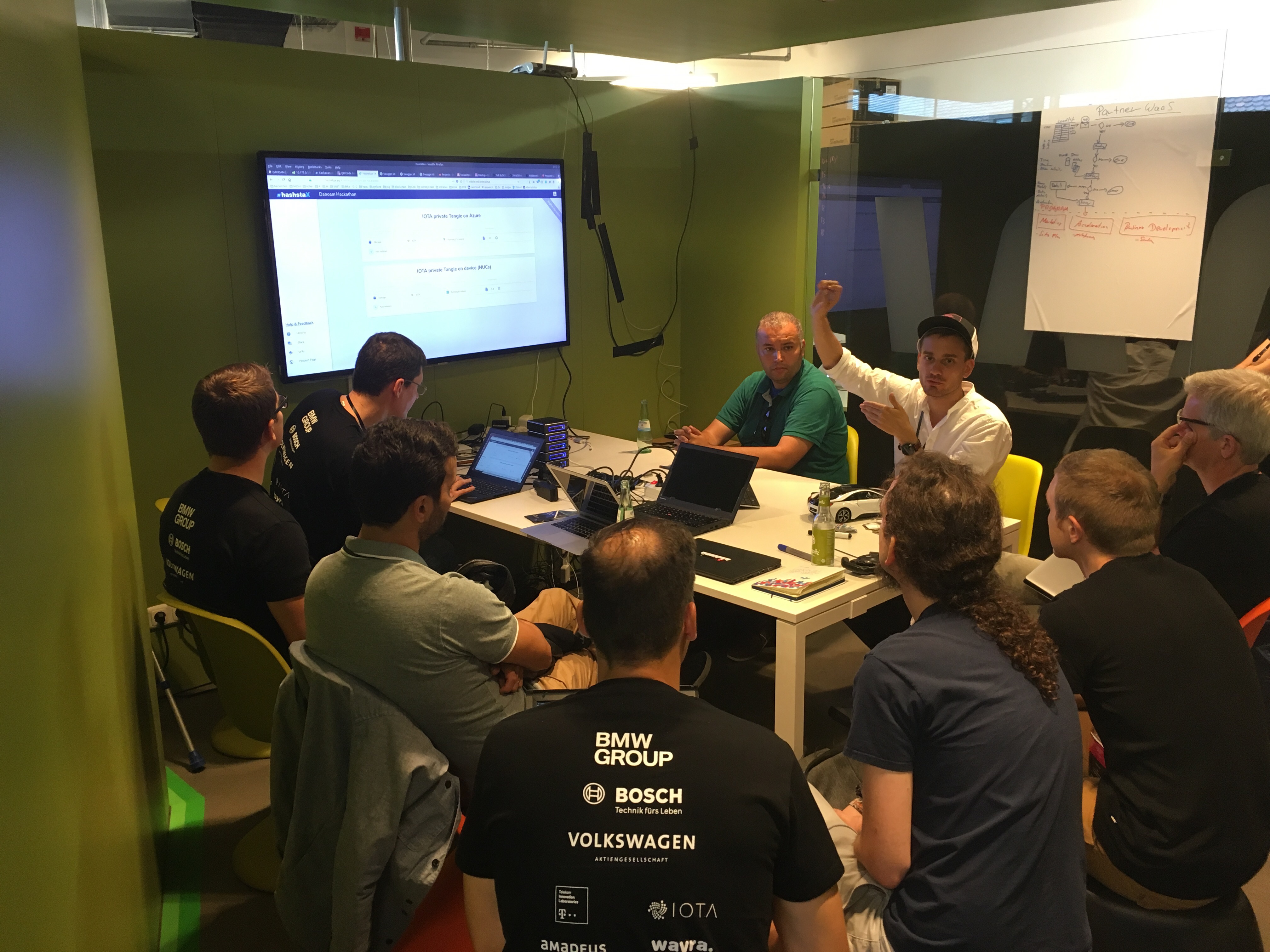
Over the weekend of 20-22 July, heavy rain poured on the streets of Munich. Which did not prevent 20,000 people to demonstrate against xenophobia at Königsplatz, also went more or less unnotced by the 150 participants of the BlockchainedMobility hackathon who met to create blockchain-based mobility solutions.
Hacker teams of leading European mobility players, such as BMW, Volkswagen Group, Bosch, Deutsche Bahn, Deutsche Telekom, Amadeus, and others mixed with freelance developers, designers and business experts to work on IOTA and Ethereum. On Sunday afternoon, the jury saw 18 project teams presenting a broad variety of mobility solutions, from specific applications, such as a EV charging station finder, to more generic solutions like a mobility API to match offerings of mobility providers with the needs of the end user.
Georg Eisenreich, Minister of the State of Bavaria
The hackathon started on Friday with a keynote by the Minister of State for Digital, Media and Europe, Georg Eisenreich, who highlighted the importance for collaboration of the State of Bavaria with on the one hand corporations, such as the hackathon‘s sponsors, on the other hand with the technology – or more specifically – the blockchain community. Minister Eisenreich emphasised the role of the State of Bavaria in providing a sound economical framework for blockchain startups and projects. He encouraged the participants to be creative and dare to found companies in order to foster Bavaria‘s and Europe‘s competitive advantage in the area of blockchain.
Michael Reuter (Datarella), Peter Busch (Bosch), Dominik Pietsch (BMW) Alisa Maas (IOTA) Klaus Schaaf (Volkswagen Group), Herbert Mangesius (Vito Ventures)
After the keynote, the representatives of the main sponsors Dominik Pietsch (BMW), Klaus Schaaf (Volkswagen Group), Peter Busch (Bosch), and Alisa Maas (IOTA) discussed the state of mobility and the expectations of the mobility players for the hackathon with Herbert Mangesius (Vito Ventures) and Michael Reuter (Datarella). At BMW, Volkswagen Group and Bosch, blockchain has obtained an important role within the areas of technology to work on. Dominik Pietsch, Klaus Schaaf and Peter Busch all agreed upon the importance their companies put in blockchain as a foundational layer for mobility solutions. Particularly in regard to the complex regulatory requirements for large corporations in any case of collaboration, blockchain serves as a neutral technological layer that allows for a joint use of mobility data provided by different players within the ecosystem.
Deutsche Telekom. Breakout Session
During Saturday and Sunday, hackers worked highly concentrated and steadily to create their applications they had to present towards the jury. Breakout sessions by the sponsor teams and Yoga interludes gave variety in the workflows. Some teams, e.g. Bosch and Deutsche Telekom, provided not only APIs but sensor-driven hardware the hackers could integrate into their projects.
Sunday evening, the jury announced 3 winners out of 18 projects, who received IOTA’s in worth of USD 5,000 (#1), USD 2,000 (#2) and USD 1,000 (#3) as well as 50,000 XSC (#1), 30,000 XSC (#2) and 15,000 XSC (#3). Additionally, Lewis Freiberg of the IOTA Foundation announced a special prize: the opportunity to receive USD 50,000 in IOTA tokens provided by the IOTA ecosystem fund for the best open-source project.The hackathon‘s winners were:
#1 OMS – Open Mobility API: USD 5,000+ 50,000 XSC + the opportunity to receive USD 50,000 from the IOTA ecosystem fund
OMS – Open Mobility API
#2 AgentFinder – EV Charging Station Finder USD 2,000 + 30,000 XSC
AgentFinder – EV Charging Station Finder
#3 Pac-Man On Wheels – Crowdsourced Incentive Scheme For Privately Collected Driving Data USD 1,000 + 15,000 XSC
Pac-Man On Wheels
We will publish short interviews with each project team over the next few days.
After the jury‘s decision, the hacker crowd gathered for a few more hours to get themselves the last drinks and discuss next steps: since everybody enjoyed this weekend and we received so much positive feedback from the community, we have already started thinking about how to build upon the success of the BlockchainedMobility hackathon. Hopefully we – and new sponsors and participants– will meet again, soon!


 The critical path that was completed, included three workflows, namely issuance of a Verifiable Credential to a vehicle, access to a parking space via a Verifiable Presentation to a Signal Head, and checkout of a parking space via a Verifiable Presentation to a Signal Head. The workflows are enabled by state-of-the-art Self-Sovereign Identity (SSI), Vehicle-to-Everything (V2X) as well as Fetch.aI micro-agent technology, all controlled via the MOBIX mobile application.