In this blog post, we look at the potential of service automation through autonomous economic agents in Blockchain-based systems. Datarella’s partner Fetch.ai has made it their mission to combine intelligent agents with blockchain technology in several use cases. Deep Parking is one of them, and using a specific example from MOBIX here you can get a feel for the potential of autonomous agents.
The path to the fourth industrial age is being paved by the interplay of Big Data-driven automation, robotics, IoT and Distributed Ledger Technologies, aka Blockchain. Given the increasing amount of data, and the number of digital services that go hand in hand with this progress, the need to automate them is also growing. Users should be relieved of unnecessary work and offered optimal results.
Agents take on the role of autonomously performing tasks on behalf of their clients (individuals or objects). For this purpose, they can also interact with each other. Intelligent agents can make complex decisions by using ML, i.e. AI-powered algorithms, based on large amounts of data.
A blockchain, with its data supply, offers a particularly favourable environment for intelligent agents. The data of a blockchain are permanently available and are logically related to each other. Decentralisation can offer robustness (no single point of failure) and lower transaction costs. Agents can assume a fully autonomous identity on a blockchain through private keys. They can use it to authenticate themselves and communicate their suitability for certain tasks. Agents can use shared protocols (possibly through smart contracts) to coordinate, collaborate efficiently, e.g. by distributing complex tasks among themselves. They can negotiate and make distributed decisions (even though voting processes use their blockchain). Tasks, goals or motives of agents can be recorded in the blockchain and economic incentives can be set for optimal task performance.
With regard to the IoT, a blockchain (as a single point of truth) can integrate various sub-systems, s.a. smart household appliances, smart buildings, smart districts and smart cities, and create added value for all agents participating in the network. Fetch.ai is an example of how intelligent agents can realize automated services based on blockchain technology.
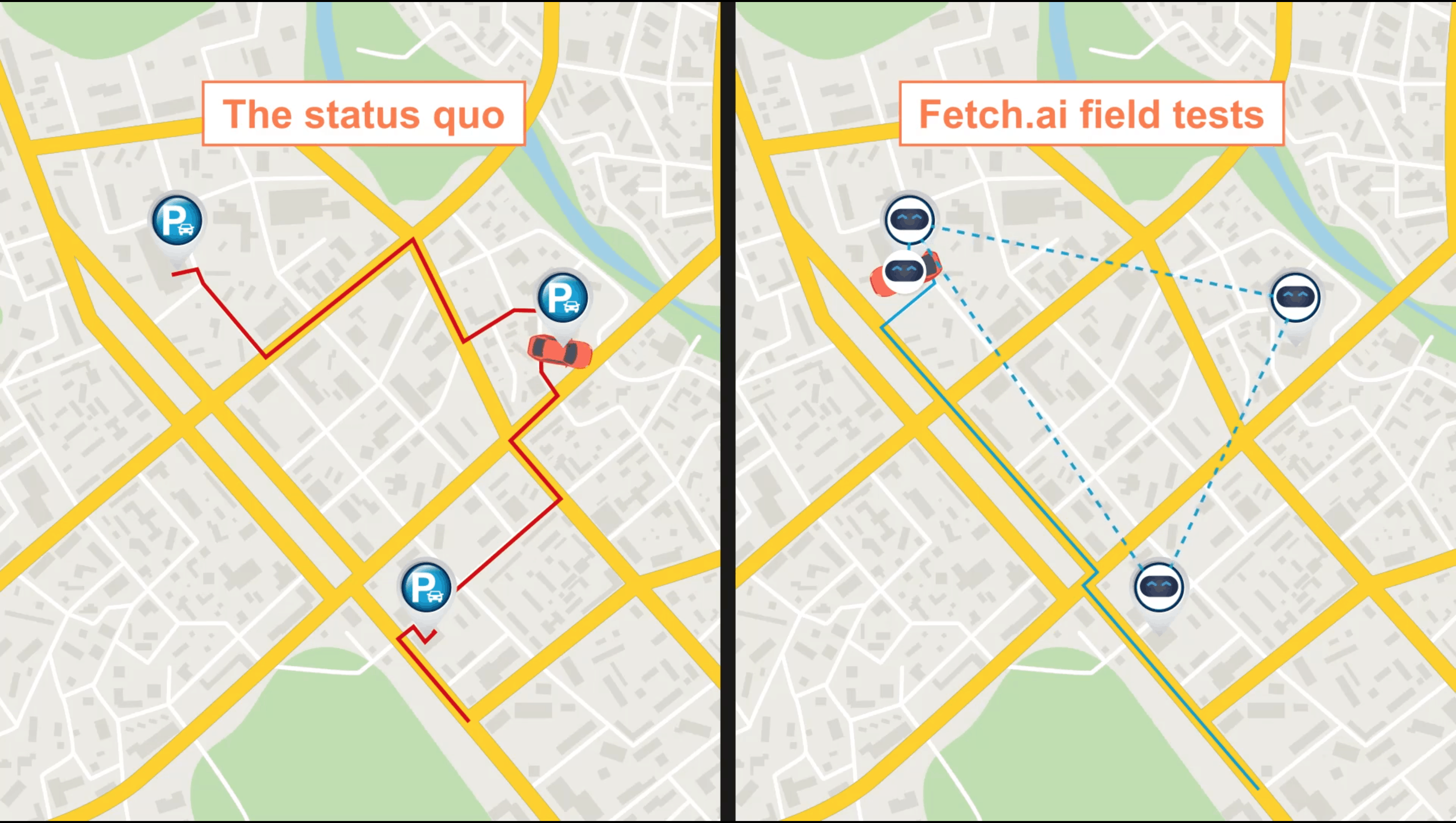
Among the use cases of Fetch.ai, we would like to highlight agents for mobility services – traffic sign agents, parking agents for Deep Parking, agents for eMobility, agents for trains and stations that could even form a decentralised train network. In the process, increasingly intelligent autonomous agents interact on behalf of people or infrastructure, searching for each other, negotiating with each other in the interest of offering their users optimal solutions. In such a case, an autonomous agent of a car could, on behalf of its owner, seek and negotiate with agents working on behalf of parking lots to navigate the car and its owner to a quick and cheap place to park. With Deep Parking at the IAA in Munich 2021, the potential of agents for such use cases becomes clear.
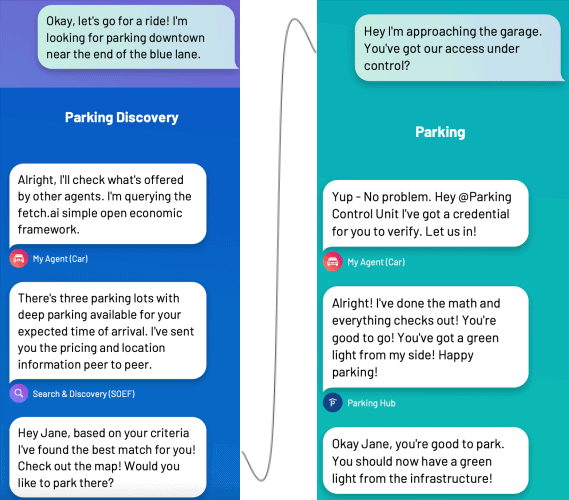
There it was demonstrated how agents negotiate their resources on behalf of vehicles, their owners and the infrastructure to find an optimal solution for everyone without further efforts for the users. The following graphics show an excerpt from the exemplary communication between the agents involved.
In this case, a user named Jane is looking for available parking space in the city centre. Without Jane having to do this herself, the agent in her car (My Agent (Car)) looks for another agent who offers a parking space via a specific (agent-)network (SOEF). Using Blockchain technology, agents handle authentication, price negotiation, reservation and even payment, autonomously according to their client’s preferences. When Jane approaches the parking lot, access is automatically granted to her car without further ado.
As shown, the scope of tasks autonomous agents can perform and the added value they can contribute is without limits. So, by using autonomous agents, the potential of Blockchain technology can be leveraged for all use cases where handling of huge amounts of data in real-time or near-time is needed.
Earlier this week, together with our partners at fetch.ai we released a driver walkthrough video that lets you come along for the ride during the M-Zone Field trials. For the first time, Datarella and Fetch.ai have field-tested an AI-powered Deep Parking solution installed at the Connex building complex in Munich. M-Zone provides automated incentives for efficient smart parking in metropolitan areas. It cuts C02 emissions by providing drivers with real-time options for parking and nudging them with tokenized incentives to park when and where demand is lowest without wasting time or energy driving in circles looking for a spot. Lots of people have asked for more details on how the system works so we decided to draft a technical deep-dive post explain how we built the system and what’s next for M-Zone.
First, let’s dive into a description of the hardware we used to make the M-Zone Smart Parking field trials possible. After that, we’ll delve into the software components and architecture as well as taking a look into how the fetch.ai agents interact with one another and what those interactions mean for cities, parking infrastructure providers, drivers, and the environment.
Edge Nodes
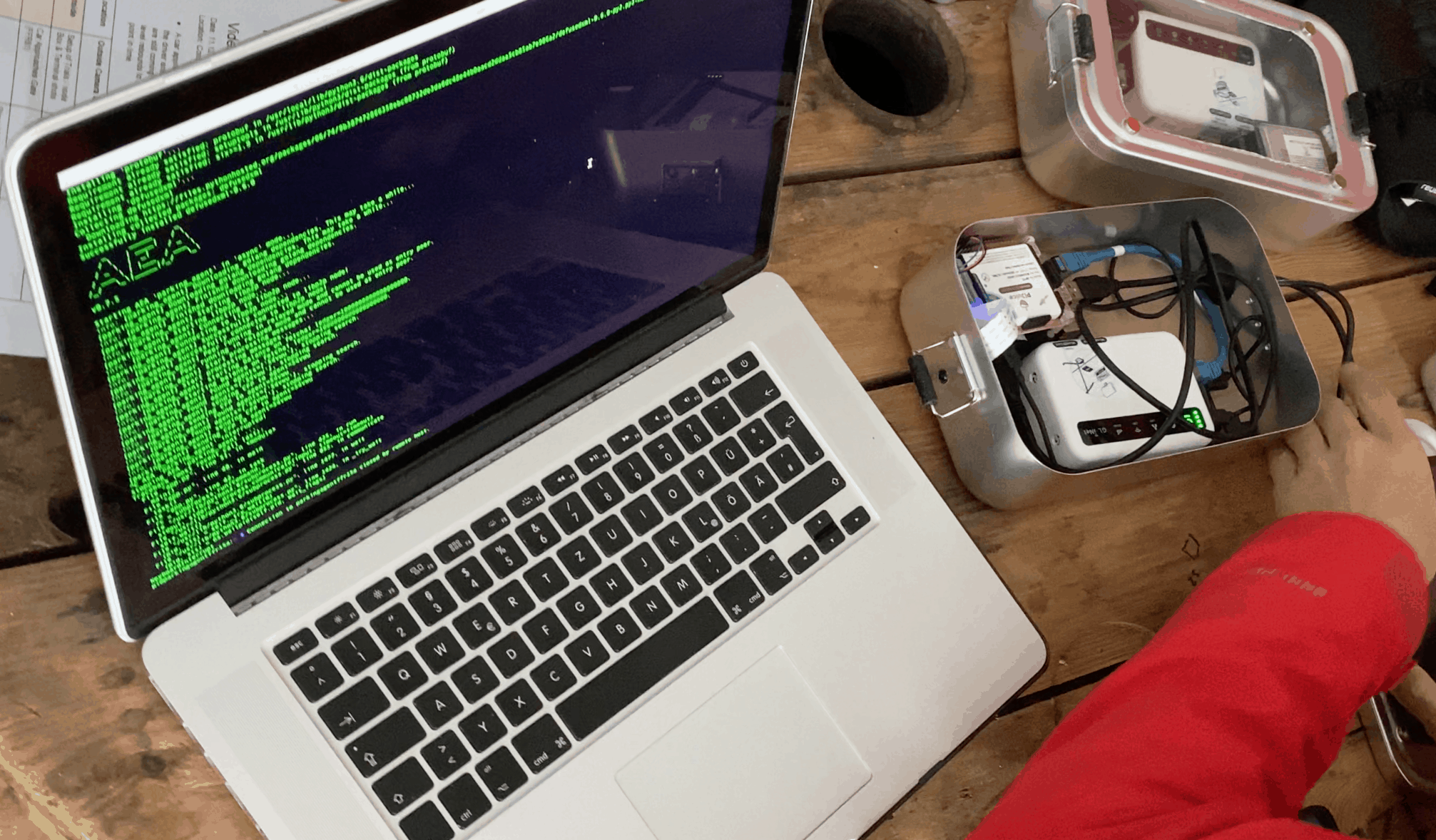
Two edge nodes powered up and scanning for plates. The display between them displays images captured during testing.
For the M-Zone field trials, we deployed two edge computers running computer vision software and fetch.ai autonomous economic agents to the Connex buildings at Frankfurter Ring 81 and 15. These edge computers have two main jobs. The first job is to monitor incoming and outgoing traffic and to read the license plates on incoming vehicles. The second job of the edge nodes is to keep track of the fill state of the parking lot and to publish data about available parking to their associated coordinator agent which is in turn registered on fetch.ai’s Simple Open Economic Framework.
Hardware
Compute: Raspberry Pi 4 Model B
Power: Uninterruptible Power Supply (Pi hat) and 1000 mAH Battery Pack
Connectivity: 4G router with OpenWrt
Cooling: Heat Sink with GPIO Risers and fans
Optional Video Output: 7” Display attached to casing with magnets
Enclosures: Waterproof aluminum boxes that have been modified for cable and camera routing as well as the addition of a plexiglass window for better LTE connectivity
Various USB A, C, and Micro HDMI cables for routing power and video
The hardware used in the field trials is based on cheap and ubiquitous raspberry pi computers and is intended to provide a plug and play upgrade to “dumb” parking infrastructure. Deployment is as simple as mounting the waterproof enclosures in a position where they have a good view of the entrances and exits of the parking garage allowing them to compute the fill level of the lot by observing the comings and goings of autos on a constant basis. Our computer vision solution uses the OpenALPR libraries to accomplish plate detection, edge recognition, binarization, deskewing, character segmentation, and finally optical character recognition to read out the license plates. This enables the nodes to authenticate autos on-the-fly. Future versions will contain a few hardware upgrade options include ruggedized custom enclosures and an improved embedded connectivity solution. The current version performed admirably and passed the field trial with flying colors.
Software Architecture
The real secret sauce doesn’t really come from the hardware though but rather through the software. One of the most critical design choices we made with M-Zone is to host all the cloud-based portions of the system using a Kubernetes cluster for orchestration. This design choice allows the Postgres database and our swagger API to be deployed in a distributed fashion, running on multiple pods within the cluster. This has multiple long term advantages.
It provides options for redundancy at the data state and application layers across multiple nodes located in multiple geographies and using multiple centralized and decentralized cloud/storage options simultaneously. Currently, our K8 cluster is hosted on an AWS EC2 instance but it could be hosted simultaneously across a number of infrastructures in the future. Another key benefit of this approach is the built-in ability to do auto-scaling the database to match load and available resources within the cluster. Building out the system for the M-Zone field trials would have been a lot easier if we had used a less elaborate traditional architecture without orchestration but we believe the investment will really pay off especially regarding the deployment of the IoT nodes. In our field trial, we only had to manage two parking agent nodes but we plan to scale the system and open source it so that such systems can be scaled to cover entire cities. At that scale, it becomes really critical to have an industrial orchestration system that allows you to deploy devices as fast as you can flash SD cards and then never touch them again. Our use of Kubernetes means that we can push updates to the nodes anytime we need to via an “over the air” 4G connection eliminating the need to interact with nodes physically once they’re deployed.
Your micro incentives and real-time parking lot states visualized.
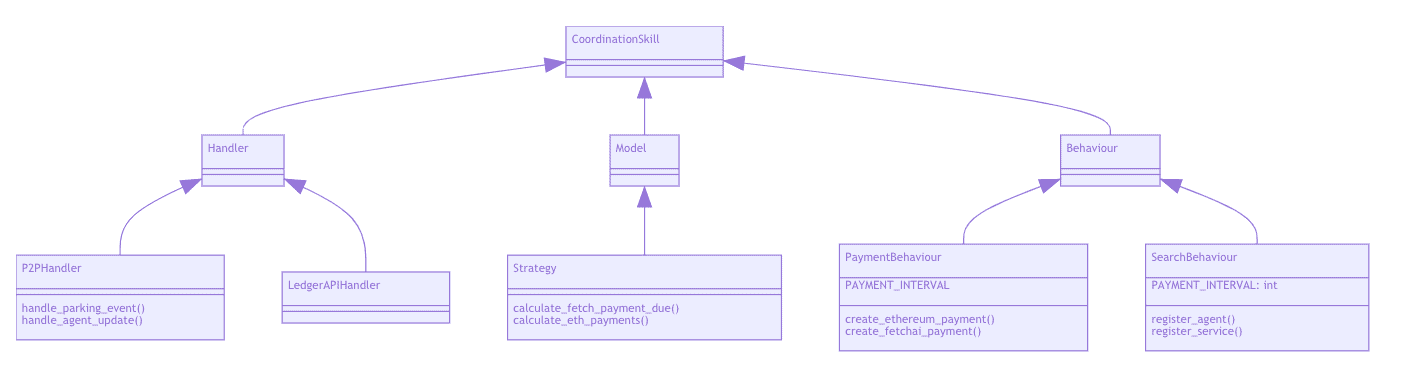
Parking Agents: The parking agent is responsible for the edge processing. Each one runs as a fetch.aiautonomous economic agent inside a docker container running on a Kubernetes pod which is registered as part of the same cluster. The Parking Agents are responsible for identifying the autos that enter and exit the lot by their license plate and matching those plates against the accounts of registered drivers in a privacy-preserving manner. All the image data remains at the edge to eliminate any possibility for centralized malfeasance and prevents data siloization by design. You can check out our privacy design concept for M-Zone here.
Coordinator Agent: The coordinator registers as a service on fetch.ai’s search and discovery mechanism for autonomous economic agents (SOEF). This allows for the parking agents to find the coordinator. The agent also has responsibility for dynamically calculating the incentive payments due to the registered vehicles and executing these payments on the fetch.ai V2 Testnet. It also has the responsibility of periodically converting the issued V2 Testnet micro incentives into FET and sending settlement transactions out to wallet holders.
Settlement Wallet: We built a custom version of our XSC Smart Wallet to handle the receipt of FET settlement transactions.
Fetch V2 Testnet CLI Wallet & Account Visualization Web App: In order to handle the micro incentives on the Fetch V2 testnet we utilized a CLI wallet and visualized inputs from both our API and from the current wallet state to provide drivers with a real-time view of which parking lots have the most space and provide the best incentives.
Dashboard: Just for fun we also built a dashboard that provides an overview of the overall system. This is connected directly to the Postgres Database hosted within the cluster.
API: A swagger API provides the information consumed by the Account Visualization Web App.
High-Level Sequence Diagram
In the above sequence diagram, you can see that the Parking Agent edge nodes continually look for new images provided by our Kubernetes cluster. Next, they search for available agents on fetch.ai’s Open Economic Forum (OEF), the search and discovery mechanism for autonomous economic agents. The OEF returns the Coordinator Agent address to the Parking Agents after which the Parking Agents are able to register themselves with the coordinator. At that point, these agents start scanning for license plates. When they recognize the entry or exit of vehicles, they send a parking event to the Coordinator Agent which acts on the information by updating parking availability broadcast to the wallet via API and also dynamically adjusting the reward ratios and sending the rewards as needed (micro incentives & settlement transactions).
Parking Agent Skills
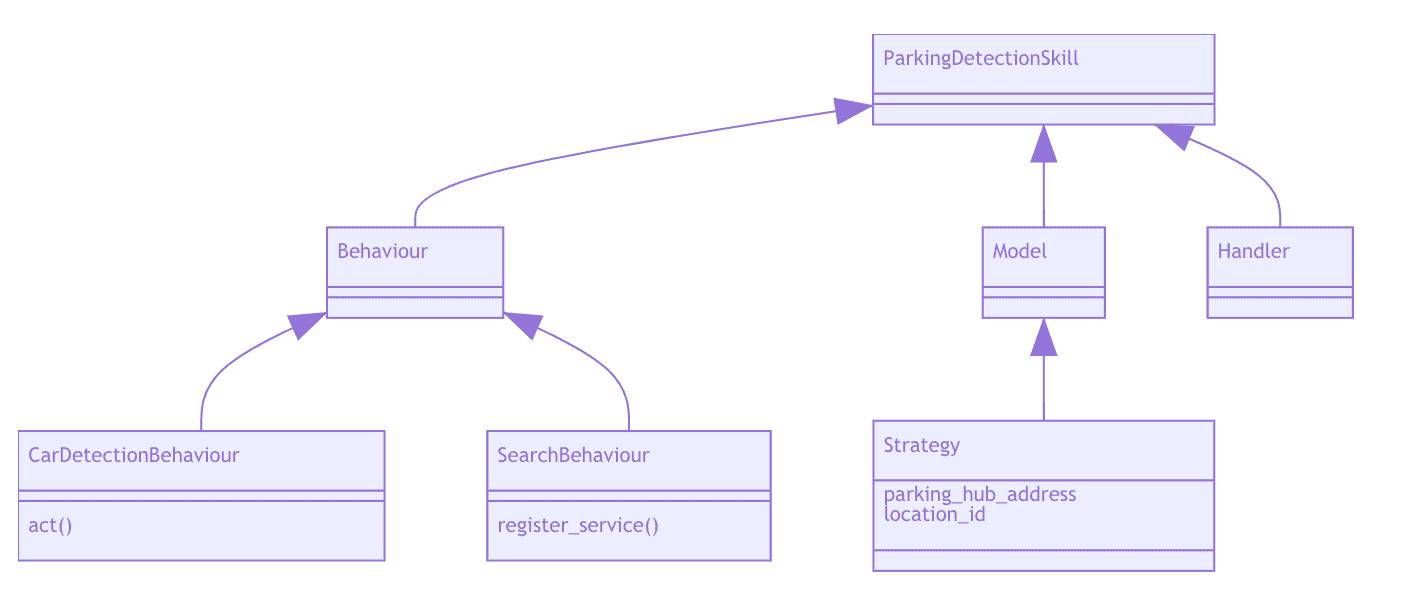
The parking agents are responsible for all the edge processing. License plate recognition is handled by the third-party library Open Alpr Upon agent instantiation. After the agent starts it performs an OEF search to locate the coordinator node. Once the agent has successfully located the coordinator agent, the agent sends an event packet to the coordinator agent. There are 2 types of events that parking agents can currently trigger.
Parking events: This event type provides information to link the entrance or exit of autos in the parking agent field of view to timestamps and map those autos to registered user addresses on the fetch blockchain.
Agent Update: This event type contains a status update from the parking agent. Within its main act function, the agent checks the most recent image saved from the raspberry camera. Any license plates are temporarily stored within the agent memory and deleted following processing. The size of the license plate detected relevant to the frame is also temporarily stored on the edge. Based on whether this frame size is increasing between snapshots or decreasing we can calculate whether a car is entering or exiting the garage. On each iteration, this memory bank is compared with the current image and if the agent detects a new plate, it sends an event update to the coordinator.
Coordinator Agent Skills
The coordinator registers as a service on the OEF which allows for the parking agents to find the coordinator. The agent also has responsibility for calculating the incentive payments due to the registered vehicles. Payments are incrementally made using the Fetchai v2 ledger due to low transaction costs and speed of settlement. Settlement payments are then periodically aggregated at a pre-determined interval to be batched and sent. Through this process, drivers receive payments of FET that are directly driven by their recent driving and parking behavior.
What’s the Economic Theory at Work?
Neoclassical economic models make a great of assumptions that often don’t hold up in the real world. Particularly under conditions of information asymmetry and in areas where public goods and externalities are present, “perfect competition” usually breaks down and inefficient markets are the outcome. This is what we currently observe in the parking market and it’s a big part of the reason why parking in cities is so annoying.
Public goods are defined as goods that are both non-excludable and non-rivalrous. Externalities are costs or benefits that are imposed on a third party who did not agree to incur that cost or benefit as part of an economic transaction. Market-based economies struggle to contain negative externalities like pollution and struggle to allocate public goods such as physical infrastructure because the assumptions of “perfect competition” don’t hold in the real world and markets don’t lead to efficient outcomes in the presence of these real-world issues.
At the risk of glossing over too much economic detail, essentially, in order for anything close to an efficient market for parking to exist, we need much better information. The M-Zone parking liquidity protocol is at its core a machine for improving market information levels and providing market participants on both the demand and supply sides of the parking equation with appropriate nudges to incentivize market participants toward more efficient market outcomes. The result is less CO2 emissions, better utilization of existing parking infrastructure, more efficient permitting processes and less time spent driving in circles looking for parking.
What’s Next for M-Zone Technically?
We’re currently in the process of defining the roadmap for building out M-Zone. The exact steps aren’t yet locked-in but there are some major topical areas that we can say are on the agenda.
Self Sovereign Identity-based Authentication
Payment gateways
Reservation pathways
Multichain search and discovery
Hardware “in the car”
More strategies for mobile agents and wallets
Improved UI and driver registration processes
Stay tuned over the next few months. There’s much more to come!
We’ve all been there. It seems like every time you go downtown you end up stuck in traffic and then have to drive in circles for ten minutes searching blindly for a parking spot. Even if you have one of the “digital” parking apps you can only park in a limited number of “in-network” spots. We think we’ve got a solution for this mess. In the video, above you’ll ride along with a real driver during one of our field tests leveraging fetch.ai autonomous economic agents and AI-enabled smart parking garages. Further down in this article we’ll examine the environmental, social, and technical aspects of our “M-Zone Parking Liquidity Protocol” approach to solving the parking riddle in cities.
Currently, Parking is Like Flying Half Empty Planes
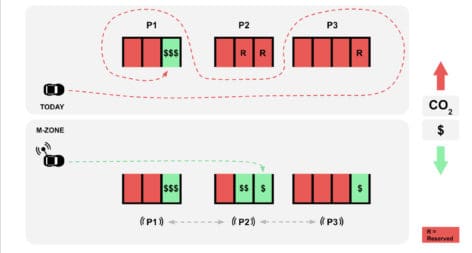
Today, the vast majority of parking spaces in cities are locked up in various forms of reserved parking. Much of this capacity is reserved 100% of the time regardless of whether it is needed which leads to parking spaces sitting unoccupied mere meters away from where demand for parking is very high. High demand leads to more parking infrastructure being built. This in turn causes massive CO2 emissions for the building materials required (namely cement which requires 900 kg of CO2 per ton to produce). Cement is the source of about 8% of the world’s carbon dioxide (CO2) emissions. In addition drivers Just in Germany, drivers spend an average of 41 hours a year searching for the elusive parking spot at a cost of €896 per driver in wasted time, fuel, and emissions and the country as a whole €40.4 billion. One of our basic assumptions is that if parking infrastructure must be built it should be used as intensively and efficiently as possible to prevent additional unnecessary infrastructure from being constructed. For this to be possible we need intelligent parking systems that provide the correct incentives and nearly perfect information about usage without sacrificing privacy.
Most people wouldn’t compare parking infrastructure to airplanes but it’s actually a relatively good comparison. We all know that aviation is a major contributor to C02 emissions and airlines make every effort to ensure that every flight is as full as possible including “codesharing” where two airlines sell tickets on the same plane to ensure the flight doesn’t fly empty. They also use dynamic pricing to alter customers’ demand curves for particular flights at a particular time and price. What we’re proposing is analogous in the world of parking. Currently, the world of parking could be compared to flying all the planes half empty all the time and adding more capacity constantly despite increasing costs and environmental impact.
In this context, we can define waste as being any time that parking spaces are empty despite there being demand for those spots. Our Parking Liquidity Protocol allows us to recycle already existing capacity to meet current and future expected demand for parking instead of building new parking infrastructure and capacity.
Bringing the Vision of a Parking Liquidity Protocol to Life
Parking lots need to become aware of their full state and become able to communicate their fill state to users directly over a mobile wallet app AND to automatically incentivize these users to drive and park less by rewarding behaviors that are more sustainable. This vision led us to leverage the fetch.ai blockchain. The fetch blockchain includes “autonomous economic agents” which are essentially AI-powered programs that make economic decisions on behalf of users or machines and then execute economic transactions without human intervention on the blockchain. In partnership with the fetch.ai team, we conceived and built a number of edge computing devices with integrated uninterruptable power supplies, 4G modems for connectivity, and high-resolution cameras that can be deployed quickly and easily at parking garage entrances and exits.
Here we’re preparing the Autonomous Economic Agents for deployment on-site at the Connex buildings.
These edge computing devices (raspberry pi – based) are running computer vision algorithms that allow them to identify license plates on incoming and outgoing vehicles and to calculate how full the parking lot itself is. They are networked together with one another and with a “coordinator” agent which aggregates the information from daughter nodes and determines dynamically which micro-incentives should be sent to any individual driver at any one time. We’ve also built a web app that allows drivers to see the fill status of the lots how much their earned micro incentives, reward rate, and how much this earning rate will be reduced by parking in a particular lot at a particular time. Not parking at all is rewarded most but parking where and when parking demand is low also gets some rewards. Last but not least there is a settlement layer that sums up the micro-incentives that a driver has earned through parking less and parking more efficiently and makes payments in FET tokens to the driver wallet. These tokens are tradeable on the open market and are directly exchangeable for Euros or USD. It goes without saying that privacy by design is at the core of our system architechture.
Critically, these edge nodes are managed by a Kubernetes-based container orchestration system which allows us to do over-the-air updates to the hardware without retrieving it from the field. This greatly increases the scalability of our system because it allows us to install the hardware which provides intelligence to the parking garages once and never touch it again unless physical maintenance is required.
A two-node system has been field-tested successfully at the Connex building complex in Munich. These buildings are owned by Datarella Partner Hammer AG with whom we ready partnered to execute one of the first regulatory-compliant real estate tokenization projects last year (ConnexCoin). The money for the driver micro-incentives comes from the savings of both commercial real estate developers like Hammer AG and their tenants. Now with our system, they have the means to share parking capacity across nearby buildings. Hammer AG alone has 5 buildings on the same street in Munich within the Connex complex so it’s really realistic to encourage drivers to distribute parking load across the neighborhood and walk a few minutes further to reach their end destination.
What’s next?
We’ve got a lot on our plate for the next months. We’re looking to build on the success of the field trials to augment the parking liquidity protocol with a bunch of new components. We’re working on integrating a self-sovereign identity framework to beef up the privacy of our authentication methods. Parallel to this, we’re building out the user interfaces and onboarding processes working with our partners to expand the M-Zone parking liquidity protocol for payment and reservation. On top of that, we’re designing an open protocol tech stack to enable the search and discovery of parking lot ID’s and states in a chain agnostic manner. Keep an eye out for a technical deep dive in the coming days where we’ll get into the nitty-gritty of how the system works!
Datarella, in partnership with Fetch.ai, a Cambridge-based artificial intelligence lab building an open-access decentralized machine learning network for smart infrastructure, announced today the launch of M-ZONE, their smart city zoning infrastructure trials in Munich, Germany. Using their AI-powered software agents to optimize resource usage and reduce the city’s carbon footprint Datarella and Fetch.ai predict mass implementation of smart city infrastructure will result in 34,000t annual CO2 emission reduction.
M-ZONE will be launched in the Connex Buildings and will utilize multi-agent blockchain-based AI digitization services to unlock data and provide smart mobility solutions in its commercial real estate properties in the city center.
“Landlords, as well as the City Council, are interested in optimizing the parking space management, to allow for available parking for all employees of corporate tenants while organizing the traffic flow and preventing commuter traffic jams,” said Michael Reuter, CEO of Datarella. “Our system incentivizes community use of public transport through a tokenized incentive system while reducing the congestion that accounts for a great deal of Munich’s CO2 emissions.”
M-ZONE will solve the needs of various stakeholders:
Individual commuters and drivers: save time, money, and reduces driver stress
Property owners: simplified approval for new development projects
Tenants: lower rent through dynamic parking spot sharing
City Council: optimized traffic flows
Environment: less negative impact through saved CO2
Upon implementation, AEAs (Autonomous Economic Agents) will support the sustainable and efficient use of city infrastructure in Munich through an application where they will autonomously negotiate the ‘price’ of parking spaces between the holders of parking spots, and those looking for parking spaces. Users can earn rewards in the digital currency if they choose less popular or in-demand parking spaces (or do not use the parking lot at all on some days). The Carpark AEA determines the reward levels to maximize resource usage.
“Fetch.ai provides a decentralized framework for building and customizing autonomous AI agents to carry out complex coordination tasks,” said Humayun Sheikh, CEO of Fetch.ai. “Our vision is to connect digital and real-life economies in order to enable automation over a decentralized network and change the way we use data.”
Users are incentivized to reduce their number of car trips to the Connex and adjacent corporate offices through a reward system which is measured by the utilization of parking spaces. Each registered user who is a regular car park user will be rewarded with a certain amount of tokens per minute for not parking at the parking lot. As soon as a car or its related wallet address is registered as parked by the Carpark AEA, the token airdrops to this wallet stop/slow. The number of tokens rewarded per wallet and minute depends on the current utilization of the parking lot.
“Assuming there is a 10% reduction in car usage across Munich alone, the city would see a 34.000 tonnes annual CO2 emission reduction,” continued Reuter. “Scaled up to cover all of Germany, that equates to 1.7 million tonnes CO2 reduction, annually. This smart city solution has the potential to penetrate huge markets simply by tapping into wasted data and utilizing it efficiently.”
Last October during the Outlier Ventures Diffusion Hackathon, we built a Proof of Concept of a Parking Agent System – Effortless Parking, which could solve the coordination problem of parking in crowded cities. In this post, we will look at the individual components of the promising technology stack upon which we build this project – Fetch.ai.
Do you remember Agent Smith from the Matrix trilogy? If not, let us fresh up your memory. The Matrix is a science fiction movie in which mankind almost lost the war against the machines. Most of the living human population is stacked up in energy farming towers by machines overloads in order to harvest their biologically produced energy. The consciousness of these “human batteries” is hooked up into “the Matrix”, a computer program that simulates the experience of the world how we know it today. This keeps the “human batteries” docile, sedated, and entertained. Agent Smith is a software agent living in the Matrix. His job is to hunt down humans, like the protagonist Neo and other individuals of the last reminding human resistance, which reenter the Matrix to free other individuals. Mr. Smith and other agents act autonomously to reach their goals. Further, over the trilogy, he even manages to learn a new skill, which allows him to transform other “Matrix inhabitants” into copies of himself to fight Neo.
You might be asking, what does this have to do Fetch.Ai?
Autonomous Economic Agents
The core element of Fetch.Ai is software agents, so-called Autonomous Economic Agents (AEA) which are living in Fetch’s digital world, the Open Economic Framework (OEF). Similar to Agent Smith, these software agents operate, interact, and even learn new skills autonomously. However, the goal of these agents is to actively search and discover other agents to generate economic value. An agent can represent an actor or thing in today’s economy. They can serve as a data provider, such as a sensor, which offers its data to other agents. Vise versa, agents can request data from these sources and do computations to generate valuable information. All the search and discovery takes place in Fetch.Ai’s Matrix, the Open Economic Framework. As the world ”Open” in OEF reveals, it is open, so any business or individual can join the network to offer information and services. To establish trust in a network without a gatekeeper, Fetch.ai included a Self Sovereign Identity solution (SSI) for its software agents. This allows agents to earn a good, respectively bad reputation, depending on the quality of service they provided to other network participants.
Fetch’s software agents can independently acquire new skills, which are required to conduct their tasks. Let’s say, an agent has been tasked with buying concert tickets at the cheapest price on your behalf. It already has the negotiation skill but can autonomously acquire a betting skill to participate in an auction for you. These agents are not, however, General Artificial Intelligent (AGI), since their capabilities are limited to a certain field of activity.
Fetch Ledger & Token
The legal tender in the world of Fetch.ai is the native token FET. It is used as a digital currency to pay for all transactions, e.g. buying/selling of data, network operations, e.g. deploying new agents or conduction computations, and secure communication. The state of the Fetch.Ai world – the answers to who owns what and who is who to a given point in time – is documented by its Smart Ledger. This state-of-the-art ledger technology uses 6 separate chains that synchronize in order to ensure state consensus. Using multiple synchronized blockchains makes the Smart Ledger highly scalable and capable of processing over 30k transactions per second.
As a consensus mechanism, Fetch uses Proof-of-Stake – in which any token holder can participate to secure the network. Token owners can stake their FET to secure the network and earn staking rewards paid in FET:
Participate in a staking auction directly.
Fetch.Ai offers 200 staking slots, which can be won through actions. The winners are entitled to run one or more validator nodes for which they are rewarded with 7500 FET per slot. For participating at the auction, a minimum amount of over 750k FET is required
Join a staking pool
FET owners, who don’t want to run a validator node or not have sufficient tokens to participate in the action, can delegate their stake and join a staking pool. Participants will be rewarded with a 10% annual return on their delegated stake.
Binance
Also, it is possible to earn staking rewards, by holding tokens in your Binance account. This option is probably the most convenient and is rewarded with a 1-4% annual yield.
Fetch.Ai is made up of three core elements, the Autonomous Economic Agents, which generate value by acting as a data provider or consumer, the Open Economic Framework, the digital world, which connects agents with each other and a highly scalable Smart Ledger, keeping track of the current state. In the next post, we will look at possible use cases, and elaborate on how networks built on Fetch.ai can offer lower transaction costs than today’s web2.0 multi-sided markets.




 Upon implementation, AEAs (Autonomous Economic Agents) will support the sustainable and efficient use of city infrastructure in Munich through an application where they will autonomously negotiate the ‘price’ of parking spaces between the holders of parking spots, and those looking for parking spaces. Users can earn rewards in the digital currency if they choose less popular or in-demand parking spaces (or do not use the parking lot at all on some days). The Carpark AEA determines the reward levels to maximize resource usage.