by Rebecca Johnson | 14 October 2024 | Blockchain, Track and Trust
This is the third article in a series of technical posts about how Track & Trust works at a component level. The world today is full of fake news and dubious “facts.” Consequently, we face a significant challenge in verifying the accuracy of the data we receive. Moreover, a major part of this challenge is identifying the source of this data. We can’t predict who the end users of the Track & Trust system will be or exactly what they will want to communicate, which makes this task even more difficult. To address this issue, we must ensure that data entering our system are valid. This post explores how the “Trust” part of Track & Trust works. It explains exactly how we maintain the chain of data authenticity.
Quick navigation links to the follow-up articles will be provided at the bottom of each article once the series is complete. For now, let’s jump in.
Establishing a foundation for the data authenticity chain
We designed our system to accommodate key requirements that establish a foundation for data authenticity. Specifically, our goal was to create a flexible system. This system can work with any logistics company, regardless of their internal processes. Notably, we achieved this flexibility, which is a key benefit of Track and Trust. This allows us to collaborate with a wide range of partners. Furthermore, logistics companies can increase the number of data points they receive about their shipments from the field by using Track & Trust.
This, in turn, enables them to achieve probabilistic 360° supply chain tracking. Our team structured the Track & Trust data to integrate easily into any logistics database. In particular, we use a series of linked cryptographic signatures and blockchain transactions to create this data authenticity chain. Finally, this chain of custody has a specific purpose. It ensures that we can authenticate and validate offline events once they reach our servers.
How does the data authenticity chain work?
TLDR: We leverage APIs to take inputs from our customers (Logistics Firms) as well as to give them valuable probabilistic 360° supply chain tracking data back. For demonstration purposes we have built a front-end website to make the system tangible but the magic happens via our swagger API.
The processes surrounding our data authenticity chain are pretty technical. To make it easier to understand we’ve formated the workflow into a sequence diagram that anyone can understand.
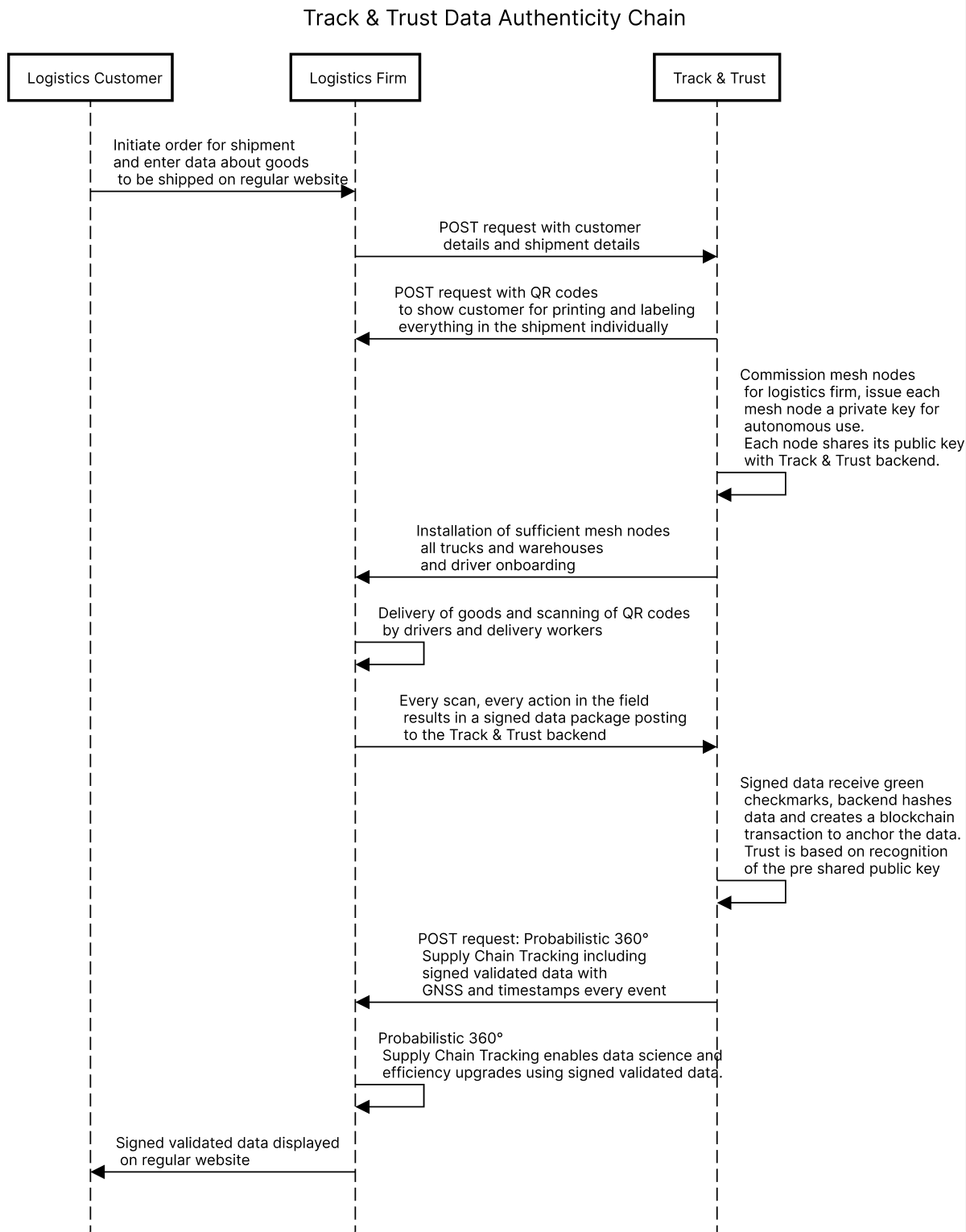
In summary, our data authenticity chain is simply a way of validating, recording and making messy data from the field trustworthy. Once that’s accomplished leverage our blockchain toolkit to make those data immutable and highly tamper resistant. It’s a chain of custody for that data that includes built-in proof of origin. This, in turn, enables traceability and trust beyond the current state of the art.
Our next post will cover all of the ways that we can view this information. We’ll also be covering the orchestration systems operating in the background that enable us to do over the air updates to the hardware. There will be dashboards, monitoring and CI/CD galore for your perusal.
<< Previous Post
Next Post >>
by Rebecca Johnson | 7 October 2024 | Blockchain, Track and Trust
This is the second article in a series of technical posts about how Track & Trust works at a component level. Building on your understanding of our mesh network technology, this post asks the question – what if everything starts going wrong? The answer as you will see lies in our Satellite-enabled Mesh Network nodes. Quick navigation links to the follow-up articles will be provided at the bottom of each article once the series is complete. For now, let’s jump in. The mesh network technology alone can’t get the job done. To make it work, we want the Track & Trust logistics tracking and communication to function even in the most challenging circumstances. However, addressing a few more challenges is necessary to achieve this. Additionally, we need to consider the limitations of the technology.
The Challenges
What if 4G doesn’t work at all? Remote logistics operations or external circumstances like war or political instability can cause this issue. In such cases, tracking becomes a challenge, especially when the electrical power is unreliable. Consequently, we need to find alternative solutions. We spent quite some time solving these issues. Fortunately, we did indeed find a way. With funding from the European Space Agency, we built a Satellite-enabled Mesh Network. Some mesh nodes now have more super powers, enabling them to do everything they could before, and more. Moreover, these special satellite-enabled mesh nodes are more expensive, but they have a special trick up their sleeves. They can post data to our servers even without 4G internet. Here’s how it works.
Satellite-Enabled Mesh Nodes
 The yellow box in the picture represents a satellite enabled mesh node. By adding an Iridium short burst data (SBD) transmitter to it, we gave it superpowers. Connecting this node to a mesh node via waterproof cables turns it into a super node. Our partners at OroraTech built this part of the system. Data arrives at this node using peer to peer communication over wifi-direct. The Iridium short burst data (SBD) Transmitter consumes information from cellmesh, finding out what data didn’t get posted to the internet via 4g. To make this work, a clear view of the sky is necessary. That’s why we waterproofed the enclosures. Strategic placement of these nodes is crucial. A good position is one where many other nodes will pass by, and it should also have a relatively solid electrical power supply. In our pilot, the roof of a local school with a solar power installation already in place proved to be an ideal location. Furthermore, this location allowed us to test the system in a real-world setting. Breaking down each data package into smaller packages is essential. These packages must be small enough to send over Iridium short burst data. As a result, each user action results in 8-9 individual satellite messages. These messages are encoded and transmitted individually, error checked, and then recombined. Finally, they can post to our backend systems.
 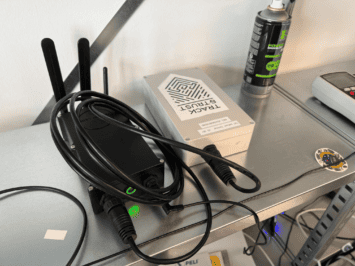 Here’s what it looks like in real life – a shot from our labs. In addition to the technical details, we will also cover the practical applications of the system.
What about electrical outages?
We anticipated that the nodes would need to be robust. Ensuring they have enough on-board power was crucial. This compensates for electrical outages, as delivery trucks can only supply 12v power when the ignition is on. Fortunately, our hardware engineer friends at Weaver Labs provided a solid solution to this issue inside these boxes. They equipped the nodes with integrated backup power systems and implemented a battery management system and software. This helps the nodes recover from power outages and situations where the on-board battery is fully depleted. Moreover, this ensures that the system remains operational even in challenging conditions. The result is a combination of hardware and software, enabled by mesh network technology, 4g, and satellite communication. This combination allows the system to stand up to difficult conditions and still work. In conclusion, our system is designed to provide reliable tracking and communication in even the most challenging environments. In our next post, I’ll address how the system handles security, covering the authentication and blockchain details backed into Track & Trust.
<<Previous Post
Next Post>>

by Rebecca Johnson | 4 October 2024 | Blockchain
This is the first in a series of technical posts about how Track & Trust works at a component level. To start, we’ll outline how our mesh network technology works in this post. Additionally, I’ll provide quick navigation links to the follow-up articles at the bottom of each article once the series is complete. For now, let’s jump in.
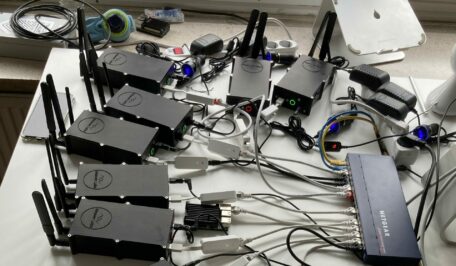
In the photo above we’re showcasing part of our fleet of mesh nodes. As you may recall, you may have seen them before in our recent post announcing that we passed our site acceptance tests with the European Space Agency. Our mesh nodes contain a lot inside. So, what kind of communications superpowers do they possess?
What’s mesh network technology ?
Mesh network technology can be a bit confusing but we’ll demystify the jargon. These black boxes are “mesh nodes,” which in our case means they can communicate with one another using wifi-direct. We also use this protocol to send data from Android phones directly to the nodes without a need for any additional gateways nor internet connectivity.
Why wifi-direct?
We chose wifi-direct because it’s really fast. In fact, nodes can detect one another and negotiate a wireless data connection even at highway speeds. Furthermore, they can do this with only a brief moment of communication.
We serve our application directly from the mesh node to a logistics employee’s phone using wifi-direct. This is useful because we don’t need an internet connection. Afterall we designed the system to cope with the worst conditions imaginable – and lack of network connectivity is where that starts.
Layer 1: Cellmesh Layer
Our partners at Weaver Labs contributed their cellmesh software. Cellmesh controls automatic detection, negotiation, and handling of communication between nodes. Additionally, it continually searches for communication resources like 4G or satcom and routes data to our servers which ensures continuity of operations in adverse conditions.
Layer 2: Mesh Node Layer
Datarella built a software layer on top of the lower-level networking technology from Weaver Labs. Consequently, we call this layer the Mesh Node layer. It has several big jobs:
- Manage data piped into cellmesh from user interactions
- Manage incoming data from cellmesh originating from other nodes
- Maintain efficient data replication between nodes
- Manage deletion of data already posted to the backend
In addition, the Mesh Node layer prevents our data pipelines from growing too large with redundant data. Together, the cellmesh and Mesh Node layers enable individual mesh nodes to connect with one another seamlessly. These nodes automatically authenticate their identities cryptographically and freely pass authenticated data back and forth. Nodes can also post this data directly to our backend servers.

In the image, the blue boxes represent nodes. The boxes provide service continuity for users in the field who want to post information like deliveries, pickups, damage, delays, and more. Sometimes they’re connected to one another but not always. Every box has two 4G cellular antennas and continuously searches for an exit to our Track & Trust cloud.
Patient and Resilient Mesh Network Technology
Our boxes are patient. If they’re offline, they wait until they’re online to post data. Alternatively, if they can’t do that, they wait for another node to come along. When connected, they play a game of telephone. For instance, if one node receives a message from another, it queues that message to pass along when it meets another box.
As we add more nodes to the system, it becomes more resilient. Meanwhile, our cellmesh and mesh node services mean that rollout is zero-configuration. Therefore, we simply plug the nodes into the trucks, and they start communicating with one another and the internet. They serve up mobile interfaces for drivers and warehouse workers to provide the most up-to-date information about what’s happening in the field.
Whenever a node connects with the cloud, it shares everything it knows. Moreover, it tells its “colleagues” which messages it successfully passed on. As a result, this allows them to forget information that they know a “colleague” node has already posted. This is technically known as a “gossip protocol” and it’s at the heart of how our Mesh Network Technology manages the information lifecycle.
In the next post, we’ll explore what happens if 4G isn’t working for some reason. There, we’ll discuss how satellite communications come into play as well as the critical role that GNSS plays.
Next Post >>
by Rebecca Johnson | 1 October 2024 | Blockchain
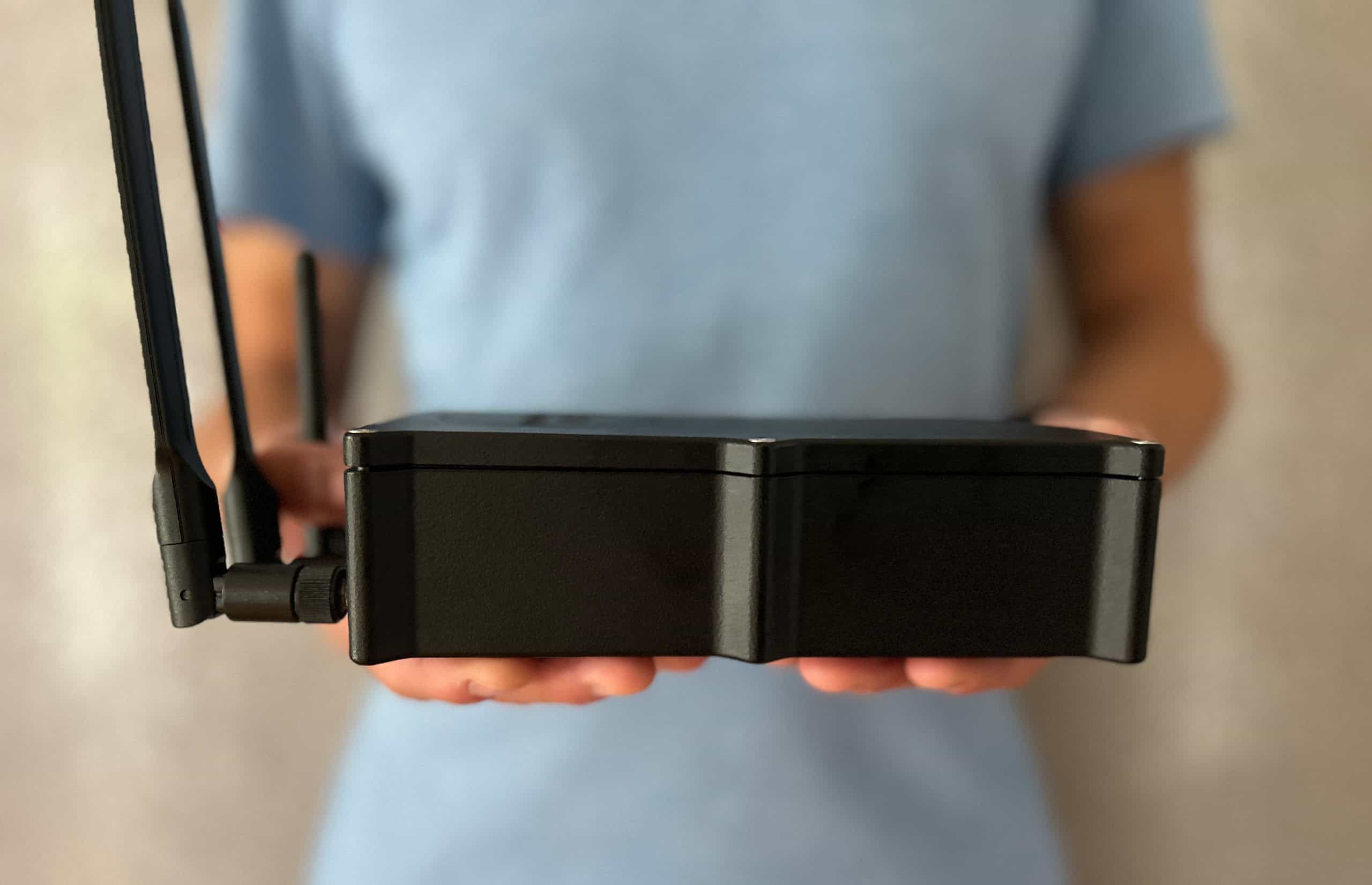
We’re excited today to reveal the hardware and a bit of software magic behind Track & Trust and announce a milestone achievement on our way to commercializing the product! Track & Trust is a logistics tracking and communication suite toolset. This post dives into basics of the hardware and the software that drives it as well as some of the unique capabilities of the system. We’ll be following up with a series of posts on the tech and also on the pilot in the field!

We’ve just passed our “Site Acceptance Test” with the European Space Agency. This test evaluates the entire technical range of functionalities expected for the Track & Trust system. Consequently, we’re proud to announce that we passed all the tests in the three-day site acceptance test inspection. We tested all thirty-four formal technical requirements of the system. Although the testing took place in June, we had to keep quiet about it for operational reasons. Meanwhile, our team has been working hard to prepare for the next phase.
We’re building the ultimate communications system with our partners at Weaver Labs and Ororatech. Specifically, Track & Trust relies on “magical” black boxes that make logistics tracking and communication possible in the worst conditions. These boxes can withstand internet outages, power outages, and wet conditions. You can plug them into a truck and they’ll keep working. In addition, they’re designed to be user-friendly and easy to integrate with existing systems.
What’s in the black box?
Our partners at Weaver Labs built hardware with a Swiss Army knife of multi-bearer communications capabilities. It doesn’t need the internet to load the software. The boxes pack 4G radios, two WiFi radios, and Weaver Labs clever cellmesh software capabilities. These capabilities enable them to talk to each other offline, exchange information, and post when possible. They can post using traditional 4G or the included satcom uplink from Ororatech. Furthermore, this technology allows for seamless communication between devices, even in areas with limited connectivity.
We at Datarella have built a suite of interfaces into Track & Trust that any user can leverage to contribute cryptographically signed inputs about logistics events. Our system has real-time monitoring and CI/CD capabilities that enable us to fix issues on the fly. This is a plug-and-play solution for gathering more information about shipments. We can funnel this information directly into logistics service providers’ databases using our APIs. As a result, our customers can enjoy greater visibility and control over their supply chains.
Value for Logistics Tracking Organizations
Track & Trust generates secure, validated events with every user interaction. These events are geolocated with GNSS and timestamped. We anchor them to the fetch.ai blockchain via a hashing mechanism, resulting in a powerful combination of privacy and immutability. Moreover, this ensures that all data is tamper-proof and transparent.
We delayed posting about it publicly because we needed to move quickly and get the devices into our planned piloting environment in Lebanon. This required sensitive handling. Now we’re making progress on the pilot operations in the field, despite difficult conditions. Finally, we’re excited to share more details from the summer and look forward to continuing our work on this groundbreaking project.

by Michael Reuter | 8 July 2024 | AI, Blockchain, Featured
In the digital transformation era, the concept of digital twins has gained significant attention. Meanwhile, companies are creating virtual replicas of physical objects or systems, enabling real-time monitoring, analysis, and optimization. However, as the reliance on digital twins increases, it becomes clear that robust digital twin security measures are needed to ensure authenticity and trustworthiness. Consequently, our innovative approach secures digital twins with cutting-edge event-tracking technology.
Cyber-Physical Trust: The Future of M2M Communication
We’re revolutionizing the security landscape by integrating blockchain technology and M2M communication to provide trust and authenticity. In addition, blockchain technology ensures the integrity and transparency of digital twins, enabling secure interactions between machines and humans. As a result, we envision a future where cyber-physical trust becomes the standard, surpassing traditional processes. Notably, this shift will have a significant impact on the way we approach security.
Firm-Specific Track & Trace Tools
We empower companies to create applications without requiring extensive technical knowledge. Specifically, our SDK seamlessly integrates into existing infrastructure and embeds the digital twin with necessary code for secure interactions. Furthermore, we provide comprehensive setup guides and API references for smooth onboarding. Meanwhile, developers can choose their desired authentication hardware, extract the required code, and embed it into the app environment. Subsequently, our system tracks digital twin usage, maintaining high security. In the future, we plan to implement additional business logic via smart contracts, enabling data provision and payments. Additionally, event tracking creates an immutable record for decision-making.
The Future of Trust and Authenticity in Digital Twin Security
To summarize, digital twins are essential for real-time monitoring, analysis, and optimization of physical objects. As their use increases, it becomes clear that robust security measures are needed. In response, our innovative approach secures digital twins with advanced event-tracking technology, integrating blockchain and M2M communication to ensure trust and authenticity. Moreover, we provide an SDK that integrates into existing infrastructure, allowing companies to create secure applications easily. Ultimately, our system tracks digital twin usage to maintain high security, with plans for smart contracts and payments. In conclusion, event tracking creates an immutable record for informed decision-making.

by Michael Reuter | 8 July 2024 | AI, Blockchain
In the digital age, data has become the cornerstone of innovation. However, this surge in data-driven innovation is not without its challenges. Concerns about user confidentiality and the potential misuse of personal information are increasingly being highlighted. The ever-present risk of breaches also poses a significant threat. Additionally, our interconnected digital ecosystems have exacerbated the rise of misinformation and fake news. There is hope though through the convergence of Web3 and AI.
Two European non-profit organizations, INATBA and EBA, have unveiled the Report on AI and Blockchain Convergence. This report serves as a starting point for further discussions on the tensions surrounding Web3.
What’s in the Report?
The convergence of Web3 and AI can help segregate authentic from inauthentic content. Blockchain technology has matured beyond its initial cryptocurrency applications. It is now a fundamental tool in enhancing security, transparency, and efficiency across various industries. Blockchain has played a key role in redefining supply chain management and financial services. It has also enabled secure digital transactions.
Meanwhile, AI has progressed from theoretical concepts to practical applications. Major strides in machine learning have enabled AI to process and analyze data at unprecedented speeds and accuracy. This has led to innovations in fields such as autonomous driving and personalized medicine. The integration of AI and blockchain technologies can create a transformative synergy.
AI can enhance the flexibility of smart contracts. Blockchain’s decentralized architecture can diversify AI data sources, reducing inadvertent biases in AI outputs. AI can also streamline and enhance blockchain’s scalability. It can detect and rectify anomalous behaviors, and potentially prevent hacks and other illegal activities.
However, the convergence of AI and Web3 also raises significant challenges. The methodologies these AI models employ have raised questions about data source reliability and information quality. The ownership of this access is also a concern. The journey of blockchain adoption is laden with challenges, including scalability issues and integration complexities.
Navigating the regulatory landscape is also a complex task. In light of these advancements and challenges, it is essential to recognize the need for meticulous regulatory and ethical considerations. The integration of AI and blockchain technologies has the potential to elevate transparency and reduce the role of intermediaries.
Unlocking the Potential of AI and Blockchain Convergence
However, ensuring the credibility of AI decisions and the accountability of blockchain transactions is necessary for operational excellence and public trust. In conclusion, the convergence of AI and Web3 represents a transformative step towards creating more ethical and effective technological solutions. By combining the strengths of each technology, we can address pressing challenges faced by digital innovations today.
These challenges include concerns around privacy, security, and ethical decision-making. AI brings unparalleled capabilities in data processing and pattern recognition. It drives efficiency and innovation across various sectors. However, its limitations, such as potential biases and lack of transparency, highlight the need for a complementary solution.
Web3 offers the perfect counterbalance to AI’s limitations. It ensures transparency, enhances data security, and empowers users with control over their information. Together, AI and Web3 are transforming industries and setting new standards for ethical technology development. Their integration fosters a more accountable and trustworthy digital ecosystem.
Decisions are not only data-driven but also socially responsible and aligned with ethical standards. The historical parallel of the Internet’s convergence with various technologies underscores the potential of this combination. The integration of AI and blockchain has the potential to bring about significant social transformations in the coming years and decades.
A Future of Sustainable Technological Advancements
However, global institutions and national governments must work together to mitigate fragmentation risks. They must ensure that AI model development inputs are complementary to human flourishing. The road to global coordination for blockchain standards and regulatory treatment is far more advanced. The same approach should be applied to AI.
As we look to the future, the synergy between AI and Web3 holds the key to unlocking sustainable technological advancements. Emerging trends such as decentralized finance and smart healthcare show promising applications. We encourage stakeholders in the AI and blockchain ecosystems to come together and leverage their collective expertise.
By working together, we can tackle the challenges and harness the opportunities discussed throughout the INATBA / EBA report. Ultimately, the integration of AI and blockchain encourages us to reimagine the possibilities of digital innovation. This journey towards integrating AI and blockchain propels us towards technological excellence and ensures that our advancements contribute positively to society and the environment.

by Michael Reuter | 25 June 2024 | AI, Blockchain, Featured, Ocean Protocol
The transition from Web2 to Web3 represents a significant shift in how we manage and control information online. Web3 offers a potential solution to issues like privacy, surveillance, and misinformation by utilizing blockchain technology. This technology gives users more control over their data. Together, AI and Blockchain can be even more powerful.
However, user friction has slowed Web3’s adoption. To accelerate adoption, we can integrate AI and blockchain technology. Consequently, this integration improves the user experience and reduces user friction. Additionally, decentralized AI built on blockchain can offer users personalized online experiences while protecting their privacy and control over their data.
Blockchain and AI are complementary technologies that address each other’s limitations. Specifically, blockchain’s built-in consensus protocol ensures data accuracy and integrity because it verifies data at multiple points. When AI is trained on flawed data, it produces flawed results. Therefore, we can design blockchain platforms to distribute power more evenly, reducing the risk of a few AI companies or models making opaque but consequential decisions. To leverage the power of AI and blockchain cohesively, we must overcome technical challenges. Next, we can track the co-development of these two technologies by examining their progression in three phases:
Data, Information, and Knowledge
Meanwhile, AI can accelerate Web3 adoption by offering personalized experiences based on user prompts. For Web3 to go mainstream, the next generation of consumer-facing applications must match the user experiences of Web2. To achieve this, we must prioritize personalization, which optimizes marketing spend. Decentralized knowledge graphs – as they are developed in the Artificial Superintelligence Alliance ASI – may be the key to bringing personalized experiences from Web2 into Web3. Knowledge graphs map relationships between objects, facts, events, situations, and other data. In addition, we can make knowledge graphs more accessible and verifiable by using decentralized knowledge graphs and open, permissionless blockchain networks. By integrating AI and Blockchain, we can create a foundation for Web3 built on trustworthy data. As a result, this new decentralized internet addresses issues prevalent in our current centralized internet.
AI and Blockchain Together Improve Internet Governance
- Decentralization: Web3 is built on blockchain technology, which is decentralized and transparent. We can use AI to ensure that data is stored and processed securely and transparently, reducing the risk of a single entity controlling or manipulating data. In this way, we can promote a more democratic and equitable Internet governance.
- Trust and Transparency: AI verifies the authenticity and accuracy of data on the blockchain, ensuring that information is trustworthy and transparent. With this information, users can make informed decisions and reduce the spread of misinformation. Moreover, AI can detect and prevent malicious behavior, ensuring that the internet remains a safe and trustworthy environment.
- Autonomy and Agency: Web3’s decentralized architecture and AI’s ability to automate decision-making processes empower users to take control of their personal data and online experiences. Users can then make choices that align with their values and preferences. Consequently, users have more autonomy and agency over their online experiences.
- Security and Privacy: AI detects and prevents cyber threats, ensuring that Web3 applications are secure and private. By doing so, AI protects users’ sensitive information and prevents unauthorized access or manipulation. Additionally, AI optimizes Web3 applications, enabling them to scale efficiently and process vast amounts of data in real time.
- Scalability and Efficiency: As a result of AI optimization, the internet’s overall performance and responsiveness improve. Furthermore, AI helps design and optimize token-based incentive systems that encourage desired behavior and promote a healthier internet ecosystem.
- Data-Driven Decision-Making: AI analyzes data generated by Web3 applications, providing insights that inform data-driven decision-making. With these insights, we can make decisions based on objective data rather than personal biases or assumptions. Therefore, we can make more informed decisions that benefit users.
- Accountability and Governance: AI ensures accountability and transparency in Web3’s decentralized governance models by detecting and preventing malicious behavior. As a result, the internet remains a safe and trustworthy environment.
In conclusion, by combining AI and Web3, we can create a more decentralized, transparent, and secure internet that prioritizes user autonomy, privacy, and agency. We can make decisions based on objective data and respond more effectively to the needs of users. Ultimately, this new decentralized internet can promote a healthier and more equitable online ecosystem.

by Kira Nezu | 25 April 2024 | Blockchain, Featured, Track and Trust
In this article, we explore how the Track & Trust system ensures predictive maintenance in offline environments, enabling organizations to maintain equipment efficiently even without internet connectivity.
In today’s industrial landscape, predictive maintenance is crucial for efficiency and reducing downtime. However, challenges arise when equipment operates in areas with limited or no internet. This is where Track & Trust steps in, enabling predictive maintenance online, even in offline environments.
Bringing Predictive Maintenance Online, Anywhere
Track & Trust uses a mesh network to collect data from sensors and machinery in offline environments. Once collected, the system sends this data to a device with internet connectivity. From there, it integrates into the operational data infrastructure. As a result, organizations can access real-time insights despite any connectivity challenges.
Enhancing Asset Reliability and Efficiency
Track & Trust enables predictive maintenance in offline environments, helping organizations reduce breakdowns. Moreover, it minimizes reactive maintenance for machinery without internet access. This is particularly beneficial in industries like smart mining, asteroid mining, and smart farming. In these industries, connectivity limitations are common. With Track & Trust, organizations can proactively address equipment issues, reduce downtime, and optimize operational efficiency.
Empowering Industries to Thrive
Track & Trust acts as a catalyst for industries aiming to enhance their capabilities in offline environments. In addition, it bridges the gap between offline monitoring and online systems. Therefore, organizations can make data-driven decisions and improve overall asset reliability.
Key Takeaways
In an era where connectivity is not always guaranteed, Track & Trust offers a reliable solution for bringing predictive maintenance online, even in offline environments. Through its seamless integration of offline monitoring with online systems, organizations can gain real-time insights. Consequently, they can drive operational efficiency even when facing connectivity challenges. As industries continue to evolve, Track & Trust helps them stay ahead of the curve, maximizing operational performance.
Track & Trust is funded by the European Space Agency. It is a joint development project by Ororatech, Weaverlabs, and Datarella.

by Kira Nezu | 8 April 2024 | Blockchain, Featured, Gaia-X, Partnerships, SSI, Track and Trust
Datarella’s Blockchain Solutions for Supply Chain Management: Streamlining CSDDD Compliance
Datarella has been at the forefront of deploying blockchain solutions for supply chain management. The introduction of the European Union’s Corporate Supply Chain Due Diligence Directive (CSDDD, or CS3D) presents a significant regulatory milestone. This article examines the directive’s implications and showcases how Datarella’s blockchain technology offers a streamlined path to compliance for businesses.
What is the EU Corporate Supply Chain Due Diligence Directive (CSDDD)?
The CSDDD is a critical component of the EU’s strategy to enhance supply chain sustainability and ethics. It mandates companies to actively prevent human rights and environmental abuses within their supply chains. The directive sets forth a phased compliance timeline, with larger corporations facing earlier deadlines. By 2028, entities with over 1,000 employees and a net worldwide turnover exceeding 450 million EUR must adhere to the directive. Non-compliance penalties could reach up to 5% of global turnover.
Navigating CSDDD Compliance with Blockchain Technology
Many companies are uncertain about how to address these new requirements. The answer lies in robust reporting, backed by verifiable data. Traditional compliance methods might overwhelm businesses with paperwork and lead to inefficiencies. However, blockchain technology presents a solution: by digitizing and securely logging every transaction and document in the supply chain, blockchain can simplify the compliance process.
How Blockchain Simplifies Compliance
Unlike traditional methods reliant on paperwork, blockchain ensures secure, transparent tracking of transactions. This technology can reduce the compliance burden by offering secure data storage and easy accessibility. Since records on the blockchain cannot be modified, it ensures data integrity and accurate documentation for compliance purposes. Integrating blockchain with digital identity solutions like the vLEI and the EU Digital Identity Regulation further strengthens this process. Companies can easily verify responsibilities and transactions, making blockchain an essential tool for CSDDD compliance.
Datarella’s Expertise in Blockchain for Supply Chain Management
Datarella has an impressive track record in implementing blockchain solutions to address complex supply chain challenges. From facilitating blockchain-based document handovers in humanitarian contexts to ensuring the integrity of 3D-printed parts for global suppliers, Datarella’s innovative projects demonstrate our expertise. Our involvement in initiatives like the Gaia-X consortia (ESCOM and Cosmic-X) and the European Space Agency’s Track & Trust initiative shows our commitment to advancing blockchain technology for supply chain management.
Partnering with Datarella for CSDDD Compliance
As the EU moves toward greater supply chain accountability, partnering with Datarella can help businesses navigate the complexities of CSDDD compliance. With our blockchain solutions, we not only help companies meet regulatory requirements but also drive efficiency and transparency. Choosing Datarella means collaborating with a leader in blockchain innovation, ready to transform today’s challenges into tomorrow’s successes.
The Future of Supply Chain Management with Blockchain
The CSDDD represents a pivotal shift towards responsible supply chain practices within the EU. For companies aiming to align with these new regulations, Datarella’s blockchain solutions offer a practical and efficient path to compliance. As the regulatory and business landscapes evolve, Datarella remains dedicated to empowering companies with the technology and expertise they need to thrive in this new era of supply chain management.
Interested in simplifying your CSDDD compliance with blockchain technology?
Contact us to learn more.
*On Feb. 29, 2024, the EU voted positive on the Digital Identity Regulation, paving way for EU citizens to truly own and control their data – a step towards secure, decentralized applications within the EU.
