This article is the fifth in a series of posts about how our probabilistic 360° supply chain tracking product, Track & Trust, works. We described how the system works at a component level in our previous articles. Now, we dive into the challenging environment where our pilot operations have been executed. We selected Lebanon, one of the most difficult operational locations in the world, for our first pilot shipments to really prove the mettle of the system.
Aid Pioneers – an Ideal Pilot Partner
We have been working with our humanitarian partner Aid Pioneers for many months to prepare for these shipments. Aid Pioneers connects available resources from donors directly to recipient organizations. Through close collaboration with on the ground initiatives and the private sector, Aid Pioneers connects resources from donors directly with local organizations to foster sustainable, community-led change. They do this in places that need them most, making them a highly innovative humanitarian agency. They take an end-to-end approach to the supply chain, which we believe suits Track & Trust perfectly. Aid Pioneers needs to extend tracking of supplies beyond what typical supply chain tracking products can accomplish. We are helping them achieve this.
Supply Chain Tracking Challenges
Aid Pioneers‘ logistics environment provides a perfect showcase for what Track & Trust can do. When Aid Pioneers ships a container full of medical supplies or solar power generation equipment to a Lebanese clinic or school, they hire a freight forwarder to pick up the goods. The freight forwarder then organizes the delivery to a local port via semi-truck. After that, a freight forwarder loads the container onto a ship. The ship travels to a port of entry in Lebanon, and we track its progress using a typical tracking link. However, once the container clears customs, we take over. We actively track it and pick up where traditional systems stop working.
At this point we encounter tricky conditions. Aid Pioneers local lebanese partner Al-Manhaj breaks down containers into multiple pallets or depalletizes them. They do this before final delivery. After that they deliver goods to one location while others go to other locations at different times. To keep track of what was delivered when, we use probabilistic 360° supply chain tracking. We also developed strategies to deal with power and connectivity outages.
Outwitting Outages
These outages always happen at the wrong time so it’s important that the system is able to handle them. We do this with built in backup batteries and a battery management system. On top of that, the communications landscape is very challenging. Sometimes there’s 4G connectivity and at other times there’s outages. Our mesh nodes can operate no matter, though, by caching incoming data locally. The nodes just wait until the data can be posted or handed off to other mesh nodes. This approach multiplies the effectiveness of our communications assets. On top of that, we positioned one of our satellite uplinks at a local school. As a result, every event is (at the minimum) recorded and transmitted asynchronously – even when conditions are at their worst.
These logistics challenges are not unique to Aid Pioneers’ operations. However, they are particularly pronounced in the places where they work. We believe that if our system works there and brings value to freight forwarders and humanitarian organizations, it will work anywhere. As a result of this testing we’re confident in the capabilities of Track & Trust.
In our next post we’ll describe exactly how the our pilot operations went – and what the big value drivers are.
Datarella’s Blockchain Solutions for Supply Chain Management: Streamlining CSDDD Compliance
Datarella has been at the forefront of deploying blockchain solutions for supply chain management. The introduction of the European Union’s Corporate Supply Chain Due Diligence Directive (CSDDD, or CS3D) presents a significant regulatory milestone. This article examines the directive’s implications and showcases how Datarella’s blockchain technology offers a streamlined path to compliance for businesses.
What is the EU Corporate Supply Chain Due Diligence Directive (CSDDD)?
The CSDDD is a critical component of the EU’s strategy to enhance supply chain sustainability and ethics. It mandates companies to actively prevent human rights and environmental abuses within their supply chains. The directive sets forth a phased compliance timeline, with larger corporations facing earlier deadlines. By 2028, entities with over 1,000 employees and a net worldwide turnover exceeding 450 million EUR must adhere to the directive. Non-compliance penalties could reach up to 5% of global turnover.
Navigating CSDDD Compliance with Blockchain Technology
Many companies are uncertain about how to address these new requirements. The answer lies in robust reporting, backed by verifiable data. Traditional compliance methods might overwhelm businesses with paperwork and lead to inefficiencies. However, blockchain technology presents a solution: by digitizing and securely logging every transaction and document in the supply chain, blockchain can simplify the compliance process.
How Blockchain Simplifies Compliance
Unlike traditional methods reliant on paperwork, blockchain ensures secure, transparent tracking of transactions. This technology can reduce the compliance burden by offering secure data storage and easy accessibility. Since records on the blockchain cannot be modified, it ensures data integrity and accurate documentation for compliance purposes. Integrating blockchain with digital identity solutions like the vLEI and the EU Digital Identity Regulation further strengthens this process. Companies can easily verify responsibilities and transactions, making blockchain an essential tool for CSDDD compliance.
Datarella’s Expertise in Blockchain for Supply Chain Management
Datarella has an impressive track record in implementing blockchain solutions to address complex supply chain challenges. From facilitating blockchain-based document handovers in humanitarian contexts to ensuring the integrity of 3D-printed parts for global suppliers, Datarella’s innovative projects demonstrate our expertise. Our involvement in initiatives like the Gaia-X consortia (ESCOM and Cosmic-X) and the European Space Agency’s Track & Trust initiative shows our commitment to advancing blockchain technology for supply chain management.
Partnering with Datarella for CSDDD Compliance
As the EU moves toward greater supply chain accountability, partnering with Datarella can help businesses navigate the complexities of CSDDD compliance. With our blockchain solutions, we not only help companies meet regulatory requirements but also drive efficiency and transparency. Choosing Datarella means collaborating with a leader in blockchain innovation, ready to transform today’s challenges into tomorrow’s successes.
The Future of Supply Chain Management with Blockchain
The CSDDD represents a pivotal shift towards responsible supply chain practices within the EU. For companies aiming to align with these new regulations, Datarella’s blockchain solutions offer a practical and efficient path to compliance. As the regulatory and business landscapes evolve, Datarella remains dedicated to empowering companies with the technology and expertise they need to thrive in this new era of supply chain management.
Interested in simplifying your CSDDD compliance with blockchain technology? Contact us to learn more.
Datarella is proud to announce the signing of a two-year contract with the European Space Agency (ESA) to further work on the space-linked supply chain product Track & Trust (T&T). As the main contractor to ESA, Datarella is supported by Weaver Labs and OroraTech.
The consortium will jointly work on a Blockchain-based enterprise solution to tackle complex supply chain challenges that humanitarian agencies across the world face in order to track aid in locations that lack access to reliable communications infrastructure.
At the end of two years of development and commercial trials, Track & Trust aims to deliver a scalable cost-efficient communications platform & network combining satellite, IoT mesh and blockchain components serving mostly supply chain use cases. The end solution will be a modular product that will provide a plug and play communication network that allows for end-to-end tracking of the supply chain. This will start from the initial supply of humanitarian aid goods, and extend all the way to the last-mile shipments even when limited or no telecommunication infrastructure is available.
Track and Trust is a unique opportunity to combine Blockchain technology with SatCom and telecom technology to expand the range of offerings for a supply chain monitoring system. With Weaver Labs and OroraTech as our consortium partners and with the technical and financial support by ESA, we have a strong setup to make a success story out of Track and Trust.
Yukitaka Nezu, Co-Founder and CFO at Datarella.
We are thrilled to expand our work with the European Space Agency and play a vital role in the Track and Trust project with our product Cell-Stack. Our innovative telecoms solution will ensure connectivity across the supply chain, making it possible for goods to be tracked in a trusted way.
Maria Lema, Co-Founder at Weaver Labs
We are looking forward to bringing in our satellite technology expertise in Track and Trust. With our IoT communication modules we will connect the products developed by the consortium via satellite networks. This allows the global tracking of deliveries, even in very remote areas.
Rupert Amann, Co-Founder and Head of Satellite Development at OroraTech
We are very excited to be backed by the ESA Business Applications and Space Solutions Program and are very much looking forward to the successful integration of blockchain, space and network infrastructure technology into our product Track & Trust.
About Datarella’s Consortium Partners
About Weaver Labs
At Weaver Labs, we are creating an open and shared marketplace of connectivity assets, with an extensive focus on security, to accelerate innovation by enabling connectivity. Our innovative software layer called Cell-Stack aggregates and digitises all the necessary assets to build Networks and access connectivity on-demand.
Weaver Labs believes that an open marketplace of connectivity assets can truly democratise access to reliable networks and stimulate innovative applications, making networks accessible to new industries and citizens that require reliable connectivity. Through prioritising security in a diverse supply chain and building trust with an open infrastructure model, we believe that these are the fundamental foundations needed to foster innovation and thus, create a positive impact on society. More about Weaver Labs: https://weaverlabs.io/
About OroraTech
OroraTech is a NewSpace start-up headquartered in Munich, Germany, providing a global satellite-based wildfire detection and monitoring service by processing data from various available satellite sources. In parallel, the company is developing its own nanosatellite constellation specialized in wildfire detection, with the first satellite launching at the end of 2021. Founded in 2018 by Thomas Grübler, Björn Stoffers, Florian Mauracher, and Rupert Amann as a spin-off from the Technical University of Munich (TUM), the company has grown to an international team of 50 employees. OroraTech has been supported by research grants from the Bavarian and German government, the European Space Agency and the European Commission, and graduated accelerator programs at Google, Samsung, Plug&Play, ESA BIC, and the German Accelerator Silicon Valley. More about OroraTech: https://ororatech.com/
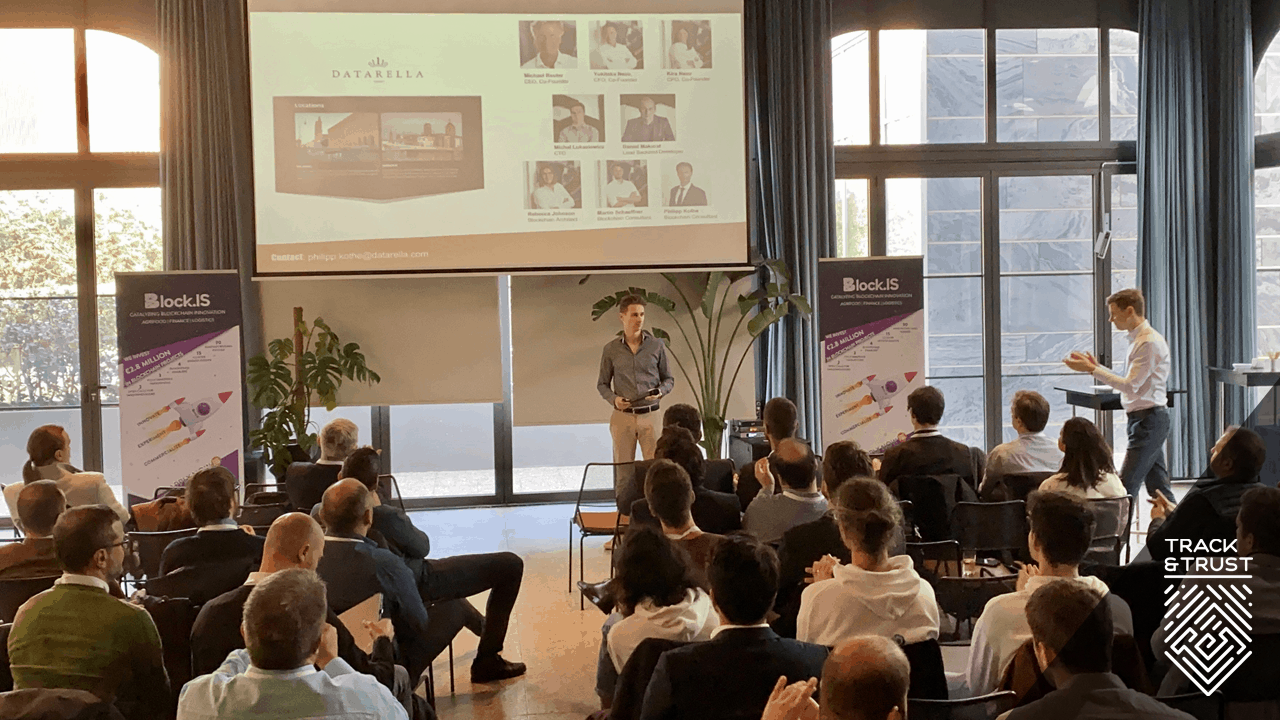
Track & Trust by Datatrella has been selected by the European innovation program Block.IS as one of the best blockchain logistics solutions. After two days of evaluation by experts from the business and technical domain in Istanbul, we are proud to announce that our project was selected to enter the next phase of the blockchain accelerator program funded by the European Union. The jury saw the tremendous impact of Track & Trust, bringing light into the logistic black box of complex, global supply chains.
The bushfires in Australia, the war in Libya or the Coronavirus outbreak in China. Our world is facing various challenges. However, besides the crises which are present in our daily news, over 200 million people in 81 countries are assessed for being in need of humanitarian assistance. A large percentage of these are concentrated in a small number of countries. For example in the Democratic Republic of Congo or Yemen, where millions of people are starving, have been displaced from their homes by war and suffer epidemic outbreaks of Ebola and Cholera took place.
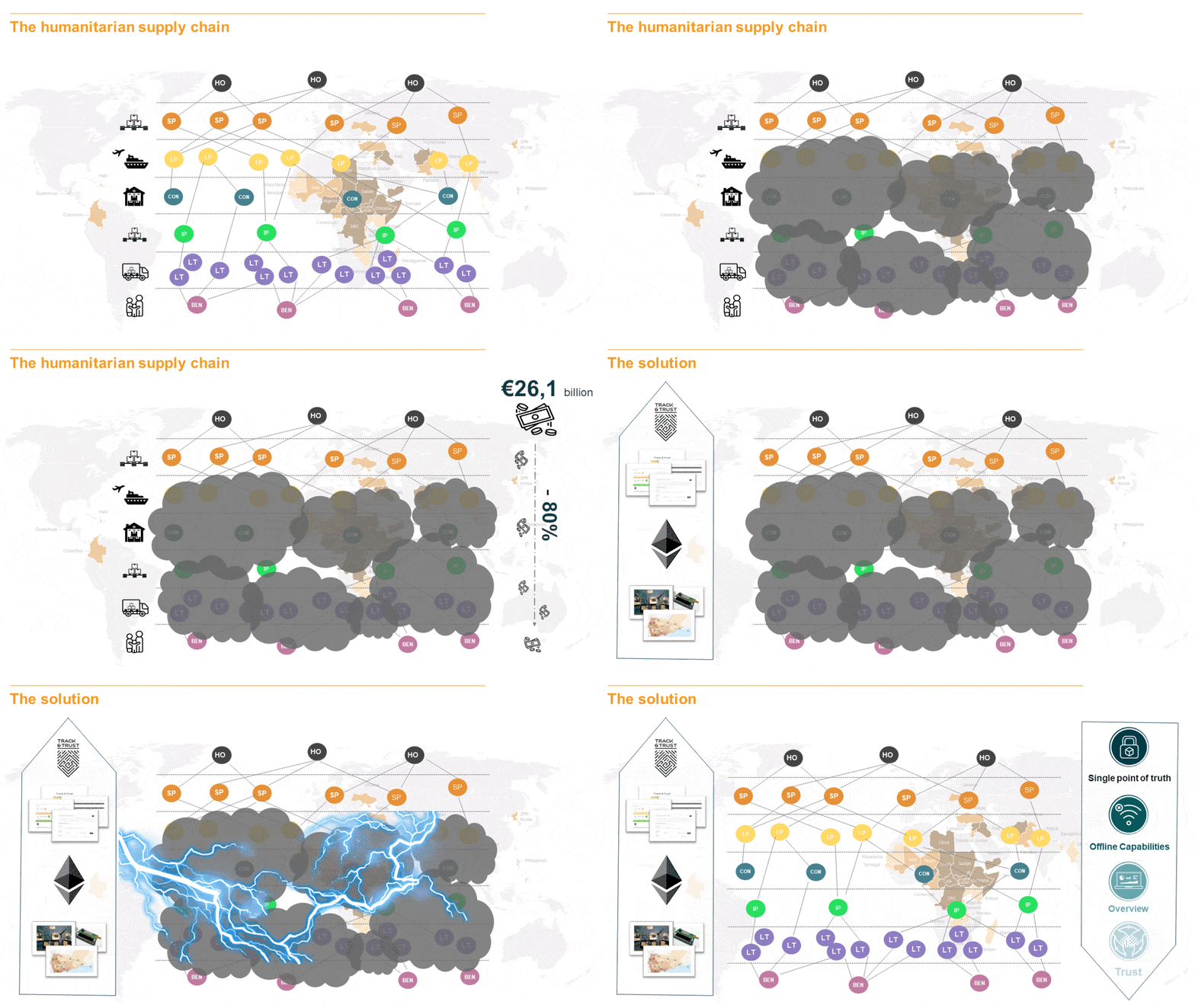
But how do life-saving supplies – like food, water, medicine, and shelter – reach the people in need? Here is where the humanitarian supply chain comes into play. In the GIF below we tried to illustrate one, in a simplified way, but as you will see these networks are complex.
Just to give you some characteristics on these networks:
They are composed of multiple stakeholders from NGOs, governments, and military to private corporations
They operate over multiple countries/continents
They are ad-hoc and work under high time pressure
They operate in the most demanding environments, like warzones, and after natural disasters
Its is very hard to forecast their demand since:
Every crisis is unique
A lack of historical data
Further, if tracking of goods and shipments is done at all, it’s documented by organizations individually and manually. This makes the humanitarian supply chain vulnerable to human error and fraud. All these characteristics result in tremendous costs. It is estimated that around 80 percent of the expenditures of aid agencies are in the area of supply chain management.
Luckily, we offer a unique solution that allows the tracking of shipments from the beginning to the very end of the supply chain, bring transparency, trust, and collaboration to the humanitarian supply chain. We call it Track & Trust.
Our solution is made up of three key components:
Auser-friendly interface, proving the supply chain stakeholders an overview of the actual state and details of a shipment.
APrivate Ethereum Blockchain, which allows the immutable and tamper-resilient documentation of handover data and serves as a single point of truth. Noteworthy, data is managed and governed by the involved stakeholders themself, no external intermediary is needed.
A hardware kit, composed of LoRa nodes and satellite communication technology, which allow the creation of an asynchronous mesh network, which enables to broadcast changes in custody of goods without being dependent on existing telecommunication infrastructure.
Our goal is to minimize the cost related to human error and fraud of these life-saving supply chains to maximize the value which arrives at the people in need.
Track & Trust was created to address the problems of the humanitarian supply chain. However, these supply chains are by far the only ones facing challenges like transparency and accountability in times of globalization. Just consider the supply chains of pharmaceutical, food or luxury products that are fighting against a multi-billion dollar counterfeit industry, demolishing profits and the trust of their customers.
If you want to learn more about our Track & Trust system feel free to contact us or to read more on our company blog.
“This project is funded by Block.IS (Blockchain Innovation Spaces) Horizon 2020 research and innovation programme Project No. 824509, under the funding framework of the European Commission.”
In the past years, we have built numerous blockchain projects – most of them private permissioned networks with Proof of Authority (PoA: A defined number of nodes “control” the network). Every now and then, we encounter the question “Are private permissioned blockchain systems less safe?“. We sat down to clarify this question on a high level.
We won’t jump into technical details. Instead, let’s look at how a private permissioned blockchain network comes into existence: Someone gets the brilliant idea to create a shared network for a specific case in which data must be effectively shared between multiple parties. She might go to other parties and ask them to join her case and present them a beautiful Big Picture. Most likely, the others will react tentatively – they might have to turn larger wheels within their environment in order to join. So, our lone blockchain pioneer might collect loose commitments from those parties and have them intend to join (after the system has been created and proven, of course) and start out on her own.
Hence, the first step is taken to create a private permissioned blockchain network. And, as all first steps, it costs some effort and is in the beginning just – a step. A blockchain network with perhaps 2-3 nodes for a start. Very small, controlled by one entity and – admittedly – vulnerable. “Less safe”. In terms of security, there is no great difference here compared to a traditional centralized network with “a server”.
But, dear reader, we are forgetting something cruical: The Big Picture.
A seed does not make a forest, but it can start one. Our pioneer now will go to the parties she has collected commitments from. One or two will agree in testing. In an ideal case, they will see the benefit (usually it’s largely increased efficiency and/or cost savings) and better understand the Big Picture. With this lever, they will be able to turn the wheels in their environment – and add their own nodes to the network. With more parties joining the network over time, we have a consortium of real world entities which controls the network. They will create a governance model in order to set down the rules for the network. And of course, with the added nodes the network becomes safer.
So, on top of the technology (consensus algorithms, encryption, blocks, keys, distribution, zero knowledge proofs, channels… you name it) exists a real world layer to the network which is typically ignored by people who are fresh to the idea of private permissioned blockchains. This real world layer ideally contains
a consortium (often found in form of a foundation),
a governance model (set of rules agreed upon by the consortium)
arbitration (to some extent automated within the network)
auditing (possibly even through nodes of a neutral audit company for real-time auditing)
Can a large private permissioned blockchain network still be captured by a malicious party? Yes. BUT: This party will knowingly risk its reputation within the consortium, since it is transparent who holds which nodes. Imagine a humanitarian supply blockchain in which a number of humanitarian organizations make up the consortium. Would it make sense for one of these to risk their reputation? Imagine a money-transfer blockchain network held by a consortium of banks – would a bank want to risk its reputation? Or, think universities issuing degrees on a blockchain?
Are private permissioned blockchain systems less safe? It depends. Next time you encounter one, take a step back and challenge yourself: What could the big picture look like?
We at Datarella are working together with the UK Department for International Development’s (DFID) innovation and future technology program, Frontier Technology Livestreaming (FTL) and the European Space Agency (ESA) to increase efficiency within humanitarian supply chain.
Our goal is to maximize the value, which is arriving at the people in need by establishing transparency and collaboration between the responsible supply chain stakeholders. In part one of our blog post series, we described how we tested our Track and Trust System. For testing, we tracked a live shipment of 304 family tents from Pakistan to Dubai between the first four parties of DFID’s supply chain. In part two, we described the challenges, which occur when tracking the last-mile of the deliveries. In this post, we are going to go further down the rabbit hole and dive into the technology, which will enable us to overcome the Sisyphean task of last-mile supply chain tracking.
The story starts after the implementing partner received the goods, loaded the trucks and the driver starts his way to the destination in the crisis area. The environmental circumstances surrounding humanitarian missions are highly heterogeneous and can range from tropical islands after a hurricane to newly built refugee camps close to a war zone. However, the one thing they have in common is that within the first few weeks after the disaster took place telecommunication infrastructure mostly is not available.
Despite these difficulties, to provide stakeholders within the supply chain with an overview about the current status of the deliveries, we at Datarella are working to test the usability of a LoRa-based Mesh Network which transmits the transaction data offline until it’s finally able to be posted to the blockchain via a satellite uplink. We’re partnering with our friends at Orora Tech who know the ins and outs of the satellite technology quite well since their main business involves the manufacture of nanosatellites.
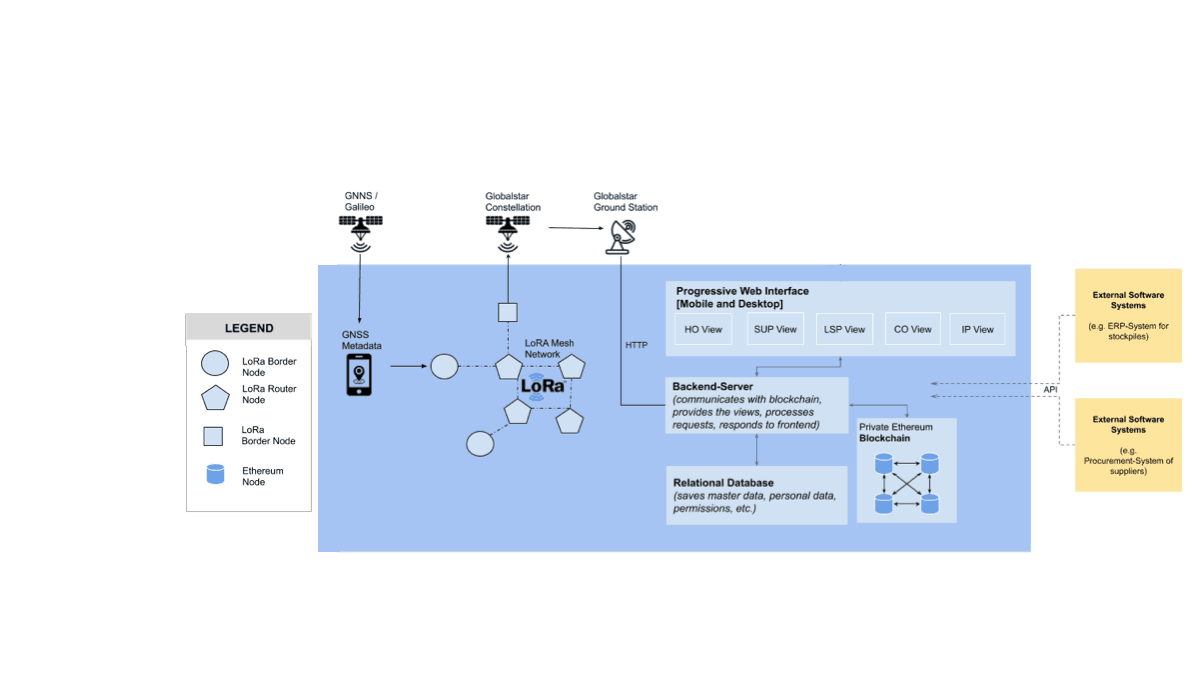
Our solution consists of the following components: 1. A user interface implemented as a progressive web app with offline capability 2. A LoRa-based Mesh Network 3. A Globalstar satellite uplink 4. A private permissioned Ethereum Blockchain
Whenever a transfer of goods occurs, the involved parties, e.g. the truck driver and the consignee in a base camp, will use their mobile phones to prepare the necessary blockchain handoff transactions offline. Data about location, time and custody will then be saved within the progressive web app interface (including pre-signed Ethereum transactions when possible).
Then, to transmit this data without having an internet connection, we are planning to use a LoRa-based mesh network. A LoRa network can be described by its two main characteristics.
1. As the name indicates, it allows long-range transmissions with a reach of approximately 12km in rural areas. 2. It operates at low power consumption.
Further, the term “mesh network” describes a network composed of nodes, which connect in a direct, dynamically and non-hierarchical manner. Therefore, these networks are also referred to as “self-healing” since nodes can organize and configure themselves, which allows the network to persist even if some nodes are not available. For creating a Pymesh LoRa Mesh, we are planning to use LoPy4, a 4-network (WiFi, BLE, LoRa, and Sigfox) and MicroPython combination controller. Further, we are considering to either equip some of them with Pytrack carrier boards, for very accurate GNSS Glonass GPS. An alternative method of geolocation is to feed in GPS data from the mobile phones of the drivers.
The network is implemented using OpenThread, an IPv6-based networking protocol. The reasons why we decided for this network type are its following features:
Simplicity — Simple installation, start-up, and operation
Security — All devices in a Thread network are authenticated and all communications are encrypted
Reliability — Self-healing mesh networking, with no single point of failure, and spread-spectrum techniques to provide immunity to interference
Efficiency — Low-power Thread devices can sleep and operate on battery power for years (Dependent on how often they wake to transmit)
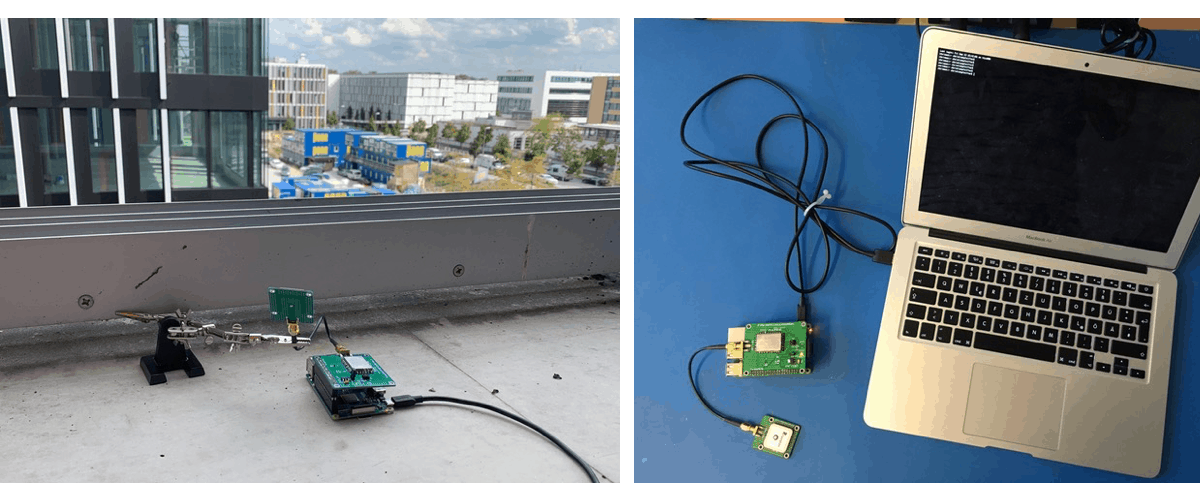
To create the Pymesh network, we are planning to install LoPy4s on the trucks, which are used to deliver the humanitarian goods to their destination. As soon a truck gets within the reach of another network node, it will transmit the offline transaction to the next router. The transaction will travel through the network node by node in this manner. Here you see a prototype
Since the reach of the LoRa routers is limited to approximately 12km we are also playing with the idea to install an air-based router, using a fixed-wing drone or a weather balloon, which would extend the reach up to 500km.
So far so good. Now the transaction data will be transmitted from truck to truck until it reaches a border router, which is connected to a satellite network. So far we have tested an uplink for a very basic JSON RPC transaction over a Globalstar simplex transmitter and successfully sent two data packets to the Globalstar constellation. Each contained a portion of the data needed to make an Ethereum transaction.
After the transaction data is sent via short bursts to the Globalstar constellation it will be received from a ground station, which is connected to the internet and executes the signed transaction in a live blockchain.
Together all of these components should enable a humanitarian agency to roll out tracking for their assets and provide transparency across their entire supply chain despite the total absence of telecommunications infrastructure in the last mile environment. All of this will be backed by a blockchain ledger providing the stakeholders in the humanitarian supply chain a single source of truth regarding custody all the way up until the final aid delivery.
In October 2018, we started developing a blockchain based supply chain solution for UK government’s DFID. The system was supposed to track accountability of goods on their way to disaster areas. In June 2019 we successfully tracked a shipment from Pakistan to Dubai, involving four parties managing and handing over the shipped items. With this delivery, the first pilot was successfully concluded. We are continuing to develop the system – which now carries the name „Track & Trust“.
So, naturally, a system under continuous development needs some kind of visual identity – starting with the logo. Having a strong graphical background, anything that needs to be visually enhanced at Datarella ends up on my desk – be it websites, visuals or: Logos. To be honest, this kind of work is a real treat for me! It allows for deep concentration on one single task (opposed to fast communication of everyday work). So, I indulged in some meditative work for a few hours and came up with the Track & Trust logo.
At the beginning of the logo design process, we brainstormed on which qualities, objects and attributes we connect with the Track & Trust system. We came up with: Accountability, security, location, path, road, ID, fingerprint, authenticity, address tag, technology – and the letter „T“.
After completing this list, I chose 1-3 aspects and started scribbling with pencil and a good deal of paper. The winning idea of this scribble contest then was replicated in vectors (I prefer Adobe Illustrator for this work).
The result combines several attributes: The sense of security is transported through the shield form of the logo. The lines represent authenticity and digitalization through their fingerprint- and circuit-like appearance. And lastly, even the letter “T” made it into the logo!
On Friday February 15th, 2019 Datarella took part at the kick-off meeting for the KOSMoS project at the headquarters of Schwäbische Werkzeugmaschinen, a consortional partner located in Waldmössingen in the Black Forest.
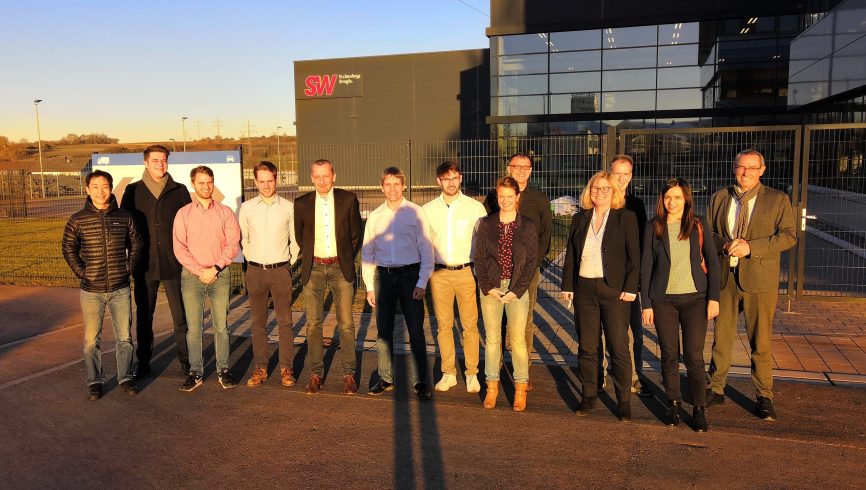
The representatives of the consortial partners of the KOSMoS Project
The primary goal of KOSMoS is developing a platform for the cross-company networking of production and process data using blockchain technology. The platform will be able to integrate new offerings and business models. Examples include transparent maintenance concepts, dynamic leasing and proof of quality for delivered products. Through these business models, all cooperating companies should gain an advantage. Examples of such improvements include lower prices, lower maintenance costs and easier product distribution. In summary, the project should facilitate better cooperation of several companies.
The purpose of the kick-off-meeting was the exact definition of the three use cases. Each industrial partner (Schwäbische Werkzeugmaschinen GmbH, Schütte GmbH and Asys Group GmbH) will develop exactly one use case in cooperation with the so-called “enablers” inovex GmbH, Frankfurt School Blockchain Center and Datarella. The industrial partners presented their use case and illuminated the most important aspects in the development plans as well as their individual goals. It was very interesting for Datarella to see how the partners plan to develop and cooperate in order to achieve the goals of the project.
For the next weeks and months, it will be important to define and align the different requirements of the each use case and determine how the blockchain can be leveraged to produce the most benefit for everyone. The first talks on this subject are already planned.
We from Datarella are very excited to be part of this innovative research project and can’t wait to see the first interim results. Stay tuned!
Blockchain is said to eliminate middlemen – just search for the purpose of distributed ledger technologies DLT, and you will end up with numerous predictions what kinds of middlemen will leave the playing field when blockchain arrives – disintermediation at its best. Although we have been developing blockchain solutions since 2015, we‘re somewhat sceptic about that disruption variant.
First – what is a middleman, and why does he actually exist, at all? Of course, there are many different kinds of middlemen in various industries, and their efforts are not necessarily compatible with each other. However, the common denominator of middlemen purposes is to facilitate relationships between two or more contracting partners. Be it a travel agent who connects a future traveler with hotels, airlines and other travel product suppliers, be it an auditor who audits financial processes of a company in order to prove the client’s correct and compliant behavior towards its shareholders – apparently there has been sufficient economic room for parties in between contracting partners.
Comes in blockchain and kills these middlemen? In theory: yes: blockchain technology provides a decentralized secure database and ledger that allows for individual access of all contracting partners without the formerly known risks and challenges of data sharing. In practice, we are sceptic. Sure, as a so-called trustless system, blockchain provides a decentralized notary function and therefore no external trust agent is needed any more. However, killing the trust agent results in a responsibility of each individual for everything the agent was responsible before.
Middlemen facilitators
Let‘s assume you are in the crypto trading business and you buy and sell your coins via a centralized crypto currency exchange. In this case, the exchange might help you recover your lost passwords that give you access to your account. If, alternatively, you trade via a decentralized crypto currency exchange, you are completely responsible for your passwords yourself – nobody will support you in case you lost access to your account. Same with any financial transaction on a blockchain: if you sent your Ether to your friend‘s wallet address, but unfortunately, you entered some transposed numbers into your transaction – your digital money is gone – unless the surprised unknown recipient sends it back to an account he doesn’t know himself. There is no bank (middleman) that could help to correct or withdraw your transaction.
These two examples alone show that predictions of fully occupied graveyards of middleman are exaggerated, if not simply wrong.
Let‘s look at a more differentiated case: in supply chains, there is a business run by middlemen that certify a product’s authenticity and provenance. With a blockchain system including a token that transports the product memory beside acting as a means of payment, theoretically there is no need for this kind of selective checks of materials or production processes. Since all network particpants have realtime access to the blockchain – and therefore to the complete product memory – everybody can be sure about correctness and consistency of the data in the supply chain.
However, who sets-up, runs, and maintains the blockchain? Who creates the governance model and acts as a contact entity for the network‘s participants? Who cares for the integration of the supply blockchain into legal and regulatory frameworks? If one of the participants would take that role – would everybody else trust the network? Would not the certification agent – the former middleman – be the best suited entity for this role? Isn‘t it the certification agent who already knows many, if not all, of the participants and therefore would be the one who could facilitate the blockchain in the best possible way?
Re-Intermediation
We at Datarella never have endorsed revolutionary disruption models that are based on 100% changes within industries. We think that gradual, evolutionary developments serve the needs of stakeholders in an industry better. Insofar, we expect blockchain technology to eliminate unnecessary and overpriced middlemen services, but at the same time blockchain can prove to be the ideal technology for all sorts of middlemen to re-invent themselves and bring their service offerings to the next level. This development would be then called re-intermediation, instead of dis-intermediation. No worries, middlemen: Blockchain might prove to be a proper business opportunity for you!