
by Rebecca Johnson | 4 July 2023 | Blockchain, Featured, Track and Trust
Datarella and its partners Weaver Labs and OroraTech are proud to announce: Track & Trust has successfully passed the Factory Acceptance Test of the European Space Agency (ESA)! The development of Track & Trust has been successfully completed, undergoing rigorous testing procedures. Now, it is time for Track & Trust to showcase its capabilities and create value in a real-world deployment.
*** Visit our new Track & Trust website for more information ***
Track & Trust combines modern Web3, communication, and satellite technologies, creating a robust supply chain solution that caters to the actual needs of users. By leveraging these cutting-edge advancements, Track & Trust allows logistics companies and humanitarian organizations to navigate complex scenarios, such as aid supply coordination in regions with compromised or non-existent communications infrastructure. Even in remote and disconnected areas, Track & Trust provides the transparency and authentic data required for efficient operations.
From the very beginning, efforts were made to understand the requirements in the field of logistics precisely. Real logistic processes were examined to identify their weaknesses. We have dedicated ourselves to developing a robust system that ultimately had to meet high stress criteria in the testing procedures required by the ESA, which funded the project with about EUR 1.5 million. We went through a complex development process where partners with three different technologies had to position their core competencies appropriately while integrating them seamlessly to become more than the sum of their parts.
The product – introducing Probabilistic Supply Chain Tracking
Unlike traditional supply chain solutions, Track & Trust offers a probabilistic approach to tracking goods. Any interaction with the shipment, including scanning a Track & Trust QR code, triggers a status update, providing as much information about the shipment as possible! It is ultimately up to the client which information to utilize. Track & Trust’s emphasis on data collection unlocks a world of possibilities for process innovation. By leveraging the data obtained from the operational area, logisticians can complement and expand their services in new and exciting ways. This data-driven approach opens doors to potential future extensions, such as training AI models to predict delivery shrinkage, stock levels, and route recommendations. By harnessing the power of data, Track & Trust generates added value for logistic companies’ customers, offering new competitive advantages in the industry
What lies ahead in the journey of Track & Trust?
We have successfully completed a significant milestone with the Factory Acceptance Test. Concrete processes with our partners are already being planned for the upcoming pilot phase. In the coming weeks, these plans will be further refined, and the delivery of Track & Trust system components will be carried out in the most suitable deployment area where it can achieve the greatest impact and benefit. We will announce the specific deployment scenario in our future blog posts. So, stay tuned!
Our next milestone is the Site Acceptance Test. Here we will conduct another series of tests under real conditions before the system is used for the first time by logisticians and partners.
We are excited to demonstrate the impact and benefits of Track & Trust very soon and to revolutionize the supply chain sector with its technological potential!
by Martin Schäffner | 22 September 2020 | Blockchain, SmartAid
We are proud to announce that SmartAid is under the winning team of two EU funded Horizon 2020 programs: Blockchers and Blockpool.
SmartAid is the next generation marketing, funding and reporting tool for non-profit organizations, seamlessly connecting donors with charitable projects. Blockchain technology allows SmartAid to introduce a new era of transparency, efficiency and effectiveness within the aid industry. By drastically reducing costs, SmartAid maximizes the value, which arrives at the people in need.
The Background
Our world is facing global challenges. Next to the almost ordinary crisis, like natural disasters, the effects of climate change, and wars, we need to deal with the pandemic outbreak of COVID-19, which has been tragic and costs many lives. However, while the economic consequences are going to hurt developed countries, they are going to be devastating for the developing world. Already before the pandemic, over 200 million people were assessed in need of humanitarian assistance.
To fight sorrow and misery, to create perspectives for humans living in less privileged countries and to turn our world into a better place for everyone, requires the help of the wealthy population. In the year 2019, over 25.3 billion EUR have been donated worldwide for international humanitarian assistance, almost 2 billion EUR from EU institutions alone, and over 2.5 billion EUR from Germany. (1)
The Problem
In poor countries, even small amounts of money can make the difference between sending your kid to school or sending them hungry to bed. Unfortunately, any type of costs diminish the value, which arrives at the people in need.
SmartAid addresses the high costs, arising through a lack of transparency and automation in the charity industry. Opaque and outdated systems result in high expenses for both donors and aid projects. For receiving organizations, financial reporting to their sponsors is related to substantial efforts. In return, the financiers also need to invest money to audit their aid projects. Manual reporting is not only costly but also vulnerable to human error and even fraud. Corruption is often an issue in aid-receiving countries. Furthermore, uncertainty about whether their donations indeed arrive at the intended destination might reduce the willingness of private donors to contribute.
In addition, the costs related to foreign fiat currency transfer are exorbitantly high. Bank fees, which eat up to 30% of the transaction volume, are no rarity. Furthermore, once donations are transferred and covered into the local currency, funds are exposed to high inflation risk, possibly making them worthless within weeks. Last but not least, measuring the impact of a donation today is very costly and can be only vaguely estimated through long term studies and surveys.
The Solution
Transparency and automation allow the creation of efficiency gains. SmartAid eliminates unnecessary cost drivers, caused through manual reporting systems, in the charity and non-profit industry.
In the current development phase, SmartAid uses a pull approach to mirror donations in fiat currency, like Euro, on the SmartAid blockchain. A PayPal API connects the traditional fiat payment world with our blockchain system, where all funding streams are documented tamper-proof, transparent and in historical order. For each donor, an individual token contract is deployed, a matching amount of tokens minted, and transferred to an address, representing the beneficiary’s bank account. By representing individual donations through a unique – thus distinguishable token, full transparency about the usage of each donor fund can be provided. This allows users of SmartAid to trace the journey of their very own donation. Certainly, also, outgoing payments are documented on the SmartAid Blockchain fully automated via the PayPal API without the costs and risks of manual accounting.
In future development stages, SmartAid can switch to a push approach. In that case, aid projects can use tokens received in multiple ways and leverage their utility. Tokens will be redeemable as vouchers at the SmartAid platform for national currency.
Further, these value units are going to be transferable to addresses, representing cost centres within an organization. Also, tokens will be usable as a medium of exchange between the charity organizations, aid implementing projects and final recipients without intermediaries, bank fees or inflation risks and fully transparent. Lastly, it will be possible to create new project tokens, leveraging a donor fund backed reserve to increase the liquidity.
The digital documentation of newly created project tokens allows non-profits and their financiers to automatically measure the impact and the value created by a donation. This will allow an effective fund allocation in the future, maximizing the generated value.
Why Blockchain
Blockchain technology allows SmartAid to document transactions in a transparent, tamper-proof, and trustless way. Distributing copies of the ledger, which keeps track of the past and current state of the SmartAid ecosystem, makes it secure and eliminates the risk of any single actor manipulating the history. Also, blockchain allows creating and managing new vouchers aka. tokens in a secure manner at neglectable costs.
Join SmartAid
If you want to learn more about SmartAid, check out our previous posts. Please feel free to contact us if you want support SmartAid by becoming a sponsor or have interesting project proposals.
(1) http://devinit.org/wp-content/uploads/2019/09/GHA-report-2019.pdf

by Martin Schäffner | 27 July 2020 | Blockchain
Will my donation arrive at the people in need? Or will it get lost, somewhere in the administration costs of a humanitarian organization? Today, intransparent systems confront donors with a high degree of uncertainty, which diminishes their overall willingness to donate. Therefore, we at Datarella teamed up with the YOU Stiftung to create the next generation of donation platform for sustainable aid projects – SmartAid.
SmartAid is reinventing online charitable giving by implementing our Traceable Donation Technology – powered by Blockchain. SmartAid offers its users a unique donation experience with three distinct key value propositions:
-
- An effortless donation experience
- An engaging donation experience
- A trustless donation experience
An Effortless Donation Experience
The first barrier, which hinders people from supporting impactful aid projects is the haze related to donating. Our goal is to make supporting these projects, which are often located on the other side of the world, as easy as buying a coffee. No login, no IBANS, no SWIFTs, no hidden fees, no subscriptions, no minimum amount, no bs. Simply scan a QR-Code, whether it is on a billboard at the metro station or on your computer screen or click a link and you will find yourself on the highly intuitive donation home page of SmartAid. Just a few clicks are required to conduct your good deed. Simply choose your favorite payment method and you help to create prospects for less privileged people.
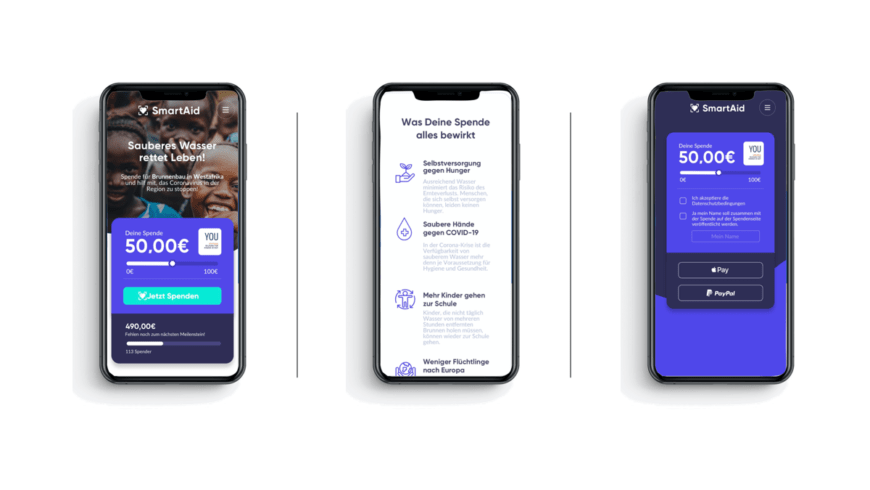
An Engaging Donation Experience
After your payment was processed, you will be rewarded with a unique QR-Code. Share this code and the attached link with your friends and family to show them the journey of your donation. Sending it to your community will also make it easy for you to find it back in your messaging history. Also, since SmartAid is a web app, you can download it to your home screen – just like a traditional app but without the hassle of downloading it from the app store.
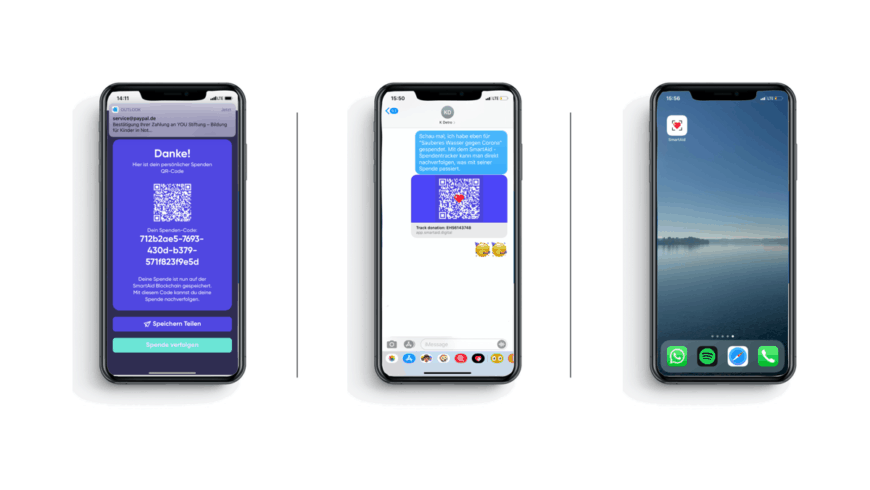
A Trustless Donation Experience
The received QR-Code makes it not only easy to find your donation ID back in your message history, but it holds all the information required to track your very own donation among all others. At this point, SmartAid differentiates to traditional donation platforms – no trust is required since everything is documented immutably and transparently on the SmartAid Blockchain.

Traditional donation systems vs. SmartAid’s traceable donations
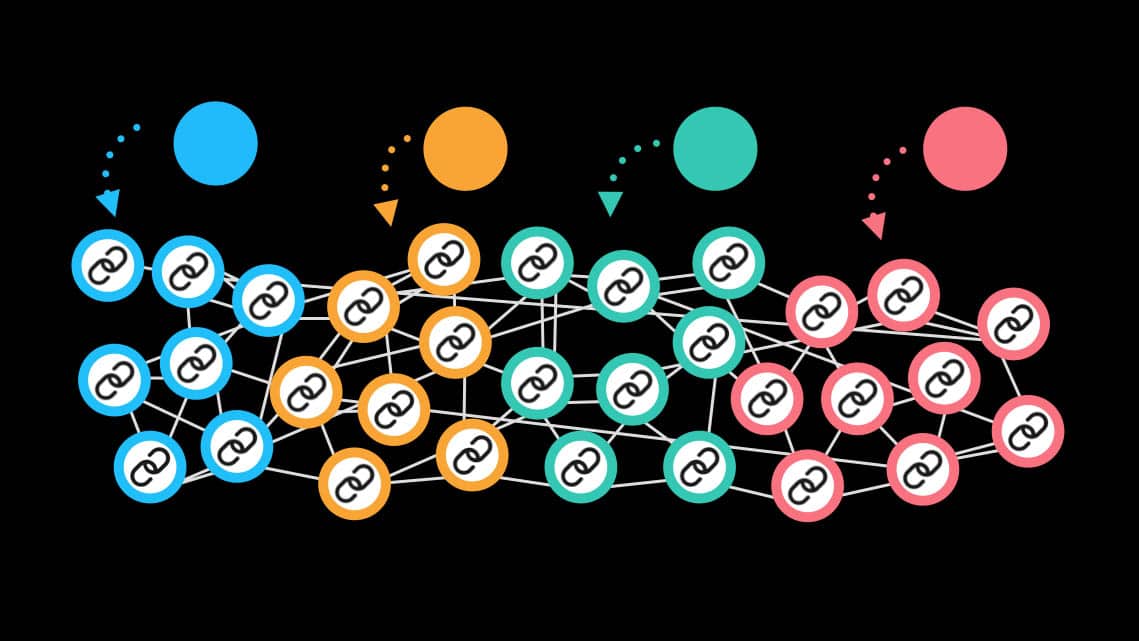
As illustrated in the graphic above, traditional donation systems allocate fiat currencies, like EUR, USD, in one pot, and distributed to different cost centers of an aid organization. Therefore, traditional donation platforms cannot provide donors visibility about the usage of their funds.
In contrast, on SmartAid each incoming donation is documented on the private Ethereum SmartAid Blockchain. To enable full transparency of the whereabout and usage of each individual donation, each payment will be represented by its own ERC-20 token contract. Each of these token contracts are distinguishable by their contract address. As visualized in the graphic above by different colors, this allows granting SmartAid donors blockchain secured clarity about how their funds will be used.
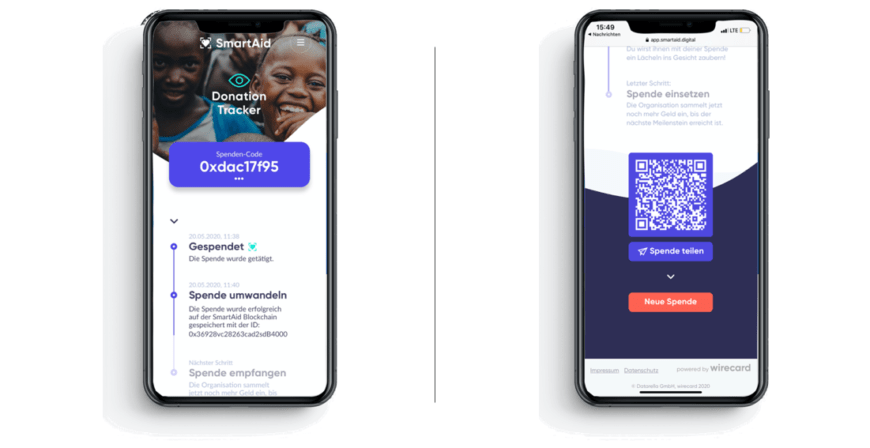
The donation tracker then provides the user an overview of the status of his donation. Here she will also be informed about the actual usage of her kind donation.
Donating hard-earned money to charity is a noble gesture. It requires a high amount of trust and transfers a significant amount of responsibility to the receiving party. Unfortunately, intransparent systems confront donors, as well as aid organizations, with a high degree of opaqueness. Donors face a high degree of uncertainty about the usage of their givings, which in turn diminishes their overall willingness to donate. At the same time, aid organizations are suffering from high costs of reporting to and providing their donors with formal audits. In both cases, the value which arrives at the people in need is significantly reduced. Therefore, we at Datarella are working with our partners on SmartAid to create the next generation of donation platform.
We are proud to announce that SmartAid is also among the winners of the EU funded H2020 accelerator Blockchers. Here we are going to extend the functionalities of SmartAid for aid organizations.
Stay tuned!
by Martin Schäffner | 5 March 2020 | Blockchain
After visiting and experiencing the extremely poor circumstances at a Rohingya refugee camp in Bangladesh, Gerd Müller, Germany’s Federal Minister of Economic Cooperation and Development, decided to stop financial aid for Myanmar and to provide funds instead to improve the situation Bangladesh. UN aid agencies are calling for a package worth millions. Blockchain technology offers a way to ensure that these millions indeed arrive at the people in need, it is a tool that allows the economic inclusion of – and even the creation of a digital identity for – the stateless Rohingya.
The Rohingya are an Indo-Aryan ethnic group, who has been living as a Muslim minority in the northern part of Myanmar. According to the 1982 Citizenship Act, the Rohingya are not considered to be one of the 135 indigenous people and are therefore not entitled to Myanmar citizenship. The situation between the mainly Buddhist nation and the Rohingya people escalated on August 25, 2017, when various targets in Myanmar were attacked simultaneously and the Arakan Rohingya Salvation Army took responsibility for the attacks. This has been followed by coordinated military attacks against the Rohingya population. United Nations mediators speak of a “continuing genocide” in which soldiers have murdered thousands of people and committed various war crimes against the Rohingya population. Correspondingly, more than 1,3 million felt to Bangladesh, over 400.000 to Myanmar and thousands to other countries in Asia.
Unfortunately, the misery continues in the countries the Rohingyan refugees fled. Bangladesh, where major Rohingya refugee camps are located, permits the construction of permanent houses to prevent the transition to be permanent. Living conditions are miserable due to a lack of sanitation. Furthermore, schooling isn’t always available, which diminishes the future prospects of the 600.000 children living in the camps. Also, the situation in Malaysia, where the second-largest Rohingya population lives, is difficult. The refugees are tolerated but excluded from social life – they aren’t granted a legal identity.
Some of the consequences of not having a legal status are:
- The inability to work, legally.
- The exclusion from the financial system by not being allowed to open a bank account.
- The denial of public services, such as education and healthcare.
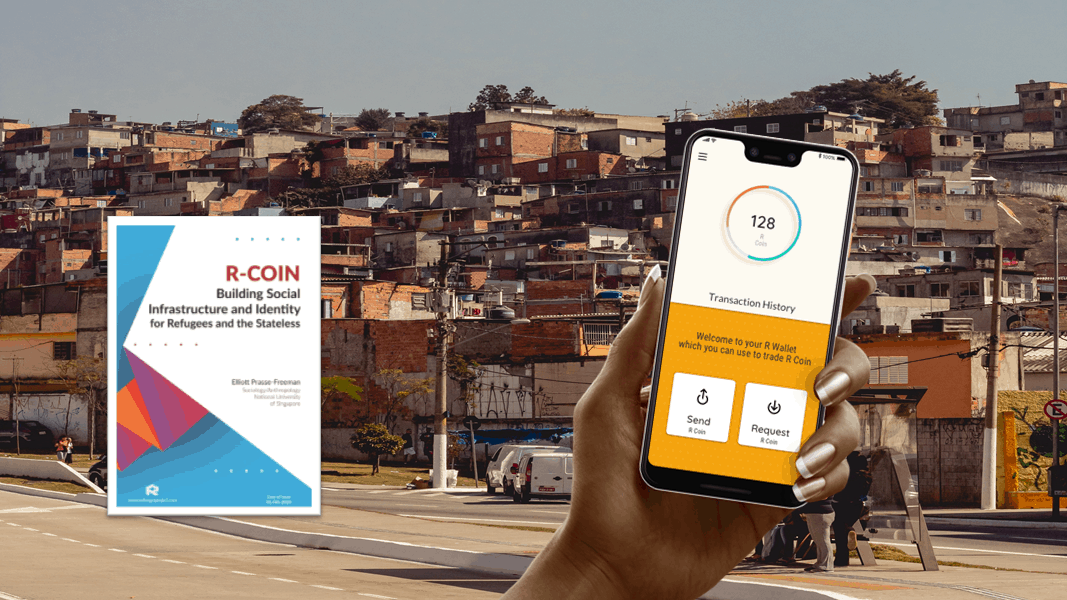
Datarella is very proud to be working with the Malaysia-based grassroots Rohingya Project which just recently has been rewarded with the Malaysian National Recognition Reward for their work, leveraging the advantages of blockchain technology through the R-Wallet and R-Coin.
R-Coin, short for Refugee Coin, is an ERC20 based token that is hosted on a private, permissioned Ethereum blockchain network. Therefore, R-Coins can’t be traded on public exchanges, thus they aren’t vulnerable to any volatility. The associated R-Wallet, a mobile app, stores the private/public keys, which allows interacting with the blockchain, or in plain English: to store, send and receive R-Coins.
R-Coins are used to reward refugees for community work, such as teaching, care-taking of children, cooking, cleaning, transportation services. For every hour of voluntary work, the refugee gets 1,0 R-Coin transferred to his wallet. At the end of the pilot phase, the participants will be able to redeem the collected coins for goods and services, from Starbucks gift cards to ATM cards, accident insurance, and health services.
The short and medium-term goals of the R-Project are to include refugees in the society, to increase their working skills and to provide them with a financial tool, the R-Coin and the R-Wallet. The transfers of R-Coins for voluntary work serve as “proof-of-work” and, therefore, can be taken as the basis of a digital identity, providing a digital CV, for the stateless Rohingya.
Currently, the R-Ecosystem includes four stakeholders:
- Providers: NGOs who organize (and verify) volunteer activities
- Refugees: Complete volunteer activities and earn R-Coins
- Vendors: Accept R-Coins and them for exchange goods and services
- Donors: Circulate R-Coins within the economy: distribute them to providers and then ‘buy them back’ from vendors who had accepted it from refugees in the first place
Blockchain technology can also be used to ensure that donations arrive where they are intended to arrive. To enable donors to trace the whereabouts of their donations and to directly support such impactful projects like the R-Project, we are working with financial services provider Wirecard AG on a respective project called “Traceble Donations”. If you’re interested in learning more about this value-creating project, stay tuned for our forthcoming blog posts or you visit our next Blockchain Meetup on 31 March in Munich!
by Kira Nezu | 30 January 2020 | Blockchain
In the past years, we have built numerous blockchain projects – most of them private permissioned networks with Proof of Authority (PoA: A defined number of nodes “control” the network). Every now and then, we encounter the question “Are private permissioned blockchain systems less safe?“. We sat down to clarify this question on a high level.
We won’t jump into technical details. Instead, let’s look at how a private permissioned blockchain network comes into existence: Someone gets the brilliant idea to create a shared network for a specific case in which data must be effectively shared between multiple parties. She might go to other parties and ask them to join her case and present them a beautiful Big Picture. Most likely, the others will react tentatively – they might have to turn larger wheels within their environment in order to join. So, our lone blockchain pioneer might collect loose commitments from those parties and have them intend to join (after the system has been created and proven, of course) and start out on her own.
Hence, the first step is taken to create a private permissioned blockchain network. And, as all first steps, it costs some effort and is in the beginning just – a step. A blockchain network with perhaps 2-3 nodes for a start. Very small, controlled by one entity and – admittedly – vulnerable. “Less safe”. In terms of security, there is no great difference here compared to a traditional centralized network with “a server”.
But, dear reader, we are forgetting something cruical: The Big Picture.
A seed does not make a forest, but it can start one. Our pioneer now will go to the parties she has collected commitments from. One or two will agree in testing. In an ideal case, they will see the benefit (usually it’s largely increased efficiency and/or cost savings) and better understand the Big Picture. With this lever, they will be able to turn the wheels in their environment – and add their own nodes to the network. With more parties joining the network over time, we have a consortium of real world entities which controls the network. They will create a governance model in order to set down the rules for the network. And of course, with the added nodes the network becomes safer.
So, on top of the technology (consensus algorithms, encryption, blocks, keys, distribution, zero knowledge proofs, channels… you name it) exists a real world layer to the network which is typically ignored by people who are fresh to the idea of private permissioned blockchains. This real world layer ideally contains
- a consortium (often found in form of a foundation),
- a governance model (set of rules agreed upon by the consortium)
- arbitration (to some extent automated within the network)
- auditing (possibly even through nodes of a neutral audit company for real-time auditing)
Can a large private permissioned blockchain network still be captured by a malicious party? Yes. BUT: This party will knowingly risk its reputation within the consortium, since it is transparent who holds which nodes. Imagine a humanitarian supply blockchain in which a number of humanitarian organizations make up the consortium. Would it make sense for one of these to risk their reputation? Imagine a money-transfer blockchain network held by a consortium of banks – would a bank want to risk its reputation? Or, think universities issuing degrees on a blockchain?
Are private permissioned blockchain systems less safe? It depends. Next time you encounter one, take a step back and challenge yourself: What could the big picture look like?
