by Rebecca Johnson | 27 October 2021 | Autonomous Agents, Blockchain, Featured, MOBIX, SSI
In this blog post, we look at the potential of service automation through autonomous economic agents in Blockchain-based systems. Datarella’s partner Fetch.ai has made it their mission to combine intelligent agents with blockchain technology in several use cases. Deep Parking is one of them, and using a specific example from MOBIX here you can get a feel for the potential of autonomous agents.
The path to the fourth industrial age is being paved by the interplay of Big Data-driven automation, robotics, IoT and Distributed Ledger Technologies, aka Blockchain. Given the increasing amount of data, and the number of digital services that go hand in hand with this progress, the need to automate them is also growing. Users should be relieved of unnecessary work and offered optimal results.
Agents take on the role of autonomously performing tasks on behalf of their clients (individuals or objects). For this purpose, they can also interact with each other. Intelligent agents can make complex decisions by using ML, i.e. AI-powered algorithms, based on large amounts of data.
A blockchain, with its data supply, offers a particularly favourable environment for intelligent agents. The data of a blockchain are permanently available and are logically related to each other. Decentralisation can offer robustness (no single point of failure) and lower transaction costs. Agents can assume a fully autonomous identity on a blockchain through private keys. They can use it to authenticate themselves and communicate their suitability for certain tasks. Agents can use shared protocols (possibly through smart contracts) to coordinate, collaborate efficiently, e.g. by distributing complex tasks among themselves. They can negotiate and make distributed decisions (even though voting processes use their blockchain). Tasks, goals or motives of agents can be recorded in the blockchain and economic incentives can be set for optimal task performance.
With regard to the IoT, a blockchain (as a single point of truth) can integrate various sub-systems, s.a. smart household appliances, smart buildings, smart districts and smart cities, and create added value for all agents participating in the network. Fetch.ai is an example of how intelligent agents can realize automated services based on blockchain technology.
Among the use cases of Fetch.ai, we would like to highlight agents for mobility services – traffic sign agents, parking agents for Deep Parking, agents for eMobility, agents for trains and stations that could even form a decentralised train network. In the process, increasingly intelligent autonomous agents interact on behalf of people or infrastructure, searching for each other, negotiating with each other in the interest of offering their users optimal solutions. In such a case, an autonomous agent of a car could, on behalf of its owner, seek and negotiate with agents working on behalf of parking lots to navigate the car and its owner to a quick and cheap place to park. With Deep Parking at the IAA in Munich 2021, the potential of agents for such use cases becomes clear.
There it was demonstrated how agents negotiate their resources on behalf of vehicles, their owners and the infrastructure to find an optimal solution for everyone without further efforts for the users. The following graphics show an excerpt from the exemplary communication between the agents involved.
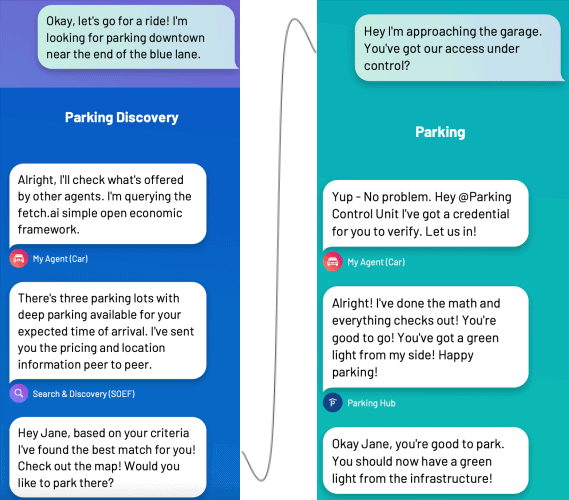
In this case, a user named Jane is looking for available parking space in the city centre. Without Jane having to do this herself, the agent in her car (My Agent (Car)) looks for another agent who offers a parking space via a specific (agent-)network (SOEF). Using Blockchain technology, agents handle authentication, price negotiation, reservation and even payment, autonomously according to their client’s preferences. When Jane approaches the parking lot, access is automatically granted to her car without further ado.
As shown, the scope of tasks autonomous agents can perform and the added value they can contribute is without limits. So, by using autonomous agents, the potential of Blockchain technology can be leveraged for all use cases where handling of huge amounts of data in real-time or near-time is needed.

by Martin Schäffner | 26 October 2021 | Blockchain, Featured
Since 1982 an extensive destruction of public records, documenting the Rohingya legacy, has taken place. The remaining documents are at high risk of getting lost and are spread among the widely distributed Rohingya population. Preserving these documents is of tremendous value since they stake historical claims to be citizens of Myanmar as well as to preserve the Rohingya heritage.
We are happy to announce that Datarella teamed up with the Rohingya Project, and researchers from UCLA and CUNY to build the Rohingya Archive (R-Archive). The R-Archive is a decentralized digital heritage archive to preserve the endangered legacy of the stateless Rohingya people. Documents will be stored permanently and securely encrypted on the decentralized storage network Arweave.
The Rohingya People
The term, Rohingya people, describes an ethical group, originated in Rakhine State, Myanmar, previously known as Burma. In 1982, Myanmar’s government decided to deny citizenship to the predominantly Islamic Rohingya minority. In 2016, the Rohingya people were forced to flee their home country to escape the genocide through Myanmar’s armed forces and police. Now, the remaining Rohingya people are dispersed mainly over Bangladesh, India, Pakistan, Thailand, Indonesia and Saudi Arabia.
The situation of Rohingya people stays problematic. Many are living in refugee camps and are not granted a legal identity by their hosting governments. Without a legal identity, many do not have access to public services, like schooling and insurance, and are not allowed to work. The absence of a legal status results in immense barriers to creating a brighter future for the Rohingya community.
If there would be just proof of their legal claims?
The immutable Rohingya-Archive
There are still old passports and documents distributed among members of the Rohingya community. The R-Archive is meant as a decentralized tool for preserving the Rohingya legacy.
It serves three main purposes:
- As a heritage and cultural archive for anthropologists and researchers.
- As a community archive for the distributed Rohingya people.
- As a trustworthy evidence archive for legal proceedings.
Rohingya documents, which are uploaded to the R-Archive, will be preserved forever.
Forever?
Yes, because the R-Archive is connected to Arweave, a decentralized storage protocol. Our web app allows uploading securely encrypted and systematically tagged Rohingya documents to the “Blockweave”. The Blockweave (take a deep breath) is a blockchain-inspired, open & permissionless (=censorship resistance) data structure, which allows storing vast amounts of data permanently at low cost.
Okay, okay, let’s take this bite by bite.
A blockchain for data storage? Yes, you are right, normally you don’t store vast amounts of data on a blockchain. That’s the case because, with “normal” Blockchains, every node stores the complete chain, from the first to the latest block. This results in very high costs for storage. Storing 1 MB on Ethereum would set you back at least 5000USD in gas fees. In contrast, storing a 1 MB on Arweave will cost you only less then 0,03 USD in $AR.
How?
Blockweave data structure allows nodes of the network to only store an arbitrary size of the data set on their machine. The total weave size doubled in the last month from 10 to 20TB. If the growth continues, it is likely that individual miners only store a small fraction of the whole weave. However, Arweave’s consensus algorithm, incentivizes miners to replicate data sets as often as possible. The more data a miner stores of the weave, the higher is her chance of mining the next block and earning rewards.
To store data permanently, a fee is paid in $AR. The majority of AR transaction costs go into an endowment value, which is released over time to the miner. This, in combination with a very conservative estimation of the development of storage costs, allows permanent storage.
But let’s go back to the R-Archive and save the mind-blowing details of the Arweave technology for an R-Archive tech deep-dive blog post.
The R-Archive Partners
The R-Archive is a collaboration between the three partners and an MVP is built with a grant provided by the Arweave Foundation. Thank you <3.
Rohingya Project, a humanitarian organization, based in Kuala Lumpur, which is empowering refugees, leveraging innovative technologies, such as blockchain. You might know them already from our joint R-Coin project. The R-Project, led by Noor Muhammad and Saqib Sheikh, who initiated the R-Archive. Further, they provide and train field officers who are collecting Rohingya documents in Bangladesh, Saudi Arabia and Malaysia, as well as the scanning and indexing.
University researchers, Anne Gilliland from Center for Information as Evidence, UCLA and James Lowry from the Archival Technologies Lab, Queens College, City University of New York. Our academic partners created a guide for compliant data collection and a metadata standard, which allows us to index collected Rohingya documents. Further, Anne and James help us to connect to the archival and academic society.
And last but not least Datarella. We are in charge of the technical design, project management and development of the R-Archive.
Conclusion
The R-Archive is a pilot for using Arweave decentralized storage technology for any kind of digital archive. We are confident to prove the benefits of using decentralized technology, like increased security, distributed custody and democratization, and a wider distribution of trust to the archival society. Stay tuned for more updates and insights on the R-Archive.

by Martin Schäffner | 18 October 2021 | Blockchain, Featured, Track and Trust
Datarella is proud to announce the signing of a two-year contract with the European Space Agency (ESA) to further work on the space-linked supply chain product Track & Trust (T&T). As the main contractor to ESA, Datarella is supported by Weaver Labs and OroraTech.
The consortium will jointly work on a Blockchain-based enterprise solution to tackle complex supply chain challenges that humanitarian agencies across the world face in order to track aid in locations that lack access to reliable communications infrastructure.
At the end of two years of development and commercial trials, Track & Trust aims to deliver a scalable cost-efficient communications platform & network combining satellite, IoT mesh and blockchain components serving mostly supply chain use cases. The end solution will be a modular product that will provide a plug and play communication network that allows for end-to-end tracking of the supply chain. This will start from the initial supply of humanitarian aid goods, and extend all the way to the last-mile shipments even when limited or no telecommunication infrastructure is available.
Track and Trust is a unique opportunity to combine Blockchain technology with SatCom and telecom technology to expand the range of offerings for a supply chain monitoring system. With Weaver Labs and OroraTech as our consortium partners and with the technical and financial support by ESA, we have a strong setup to make a success story out of Track and Trust.
Yukitaka Nezu, Co-Founder and CFO at Datarella.
We are thrilled to expand our work with the European Space Agency and play a vital role in the Track and Trust project with our product Cell-Stack. Our innovative telecoms solution will ensure connectivity across the supply chain, making it possible for goods to be tracked in a trusted way.
Maria Lema, Co-Founder at Weaver Labs
We are looking forward to bringing in our satellite technology expertise in Track and Trust. With our IoT communication modules we will connect the products developed by the consortium via satellite networks. This allows the global tracking of deliveries, even in very remote areas.
Rupert Amann, Co-Founder and Head of Satellite Development at OroraTech
We are very excited to be backed by the ESA Business Applications and Space Solutions Program and are very much looking forward to the successful integration of blockchain, space and network infrastructure technology into our product Track & Trust.
About Datarella’s Consortium Partners
About Weaver Labs
At Weaver Labs, we are creating an open and shared marketplace of connectivity assets, with an extensive focus on security, to accelerate innovation by enabling connectivity. Our innovative software layer called Cell-Stack aggregates and digitises all the necessary assets to build Networks and access connectivity on-demand.
Weaver Labs believes that an open marketplace of connectivity assets can truly democratise access to reliable networks and stimulate innovative applications, making networks accessible to new industries and citizens that require reliable connectivity. Through prioritising security in a diverse supply chain and building trust with an open infrastructure model, we believe that these are the fundamental foundations needed to foster innovation and thus, create a positive impact on society. More about Weaver Labs: https://weaverlabs.io/
About OroraTech
OroraTech is a NewSpace start-up headquartered in Munich, Germany, providing a global satellite-based wildfire detection and monitoring service by processing data from various available satellite sources. In parallel, the company is developing its own nanosatellite constellation specialized in wildfire detection, with the first satellite launching at the end of 2021. Founded in 2018 by Thomas Grübler, Björn Stoffers, Florian Mauracher, and Rupert Amann as a spin-off from the Technical University of Munich (TUM), the company has grown to an international team of 50 employees. OroraTech has been supported by research grants from the Bavarian and German government, the European Space Agency and the European Commission, and graduated accelerator programs at Google, Samsung, Plug&Play, ESA BIC, and the German Accelerator Silicon Valley. More about OroraTech: https://ororatech.com/
by Martin Schäffner | 22 June 2021 | Featured, Smart Wallet, SSI
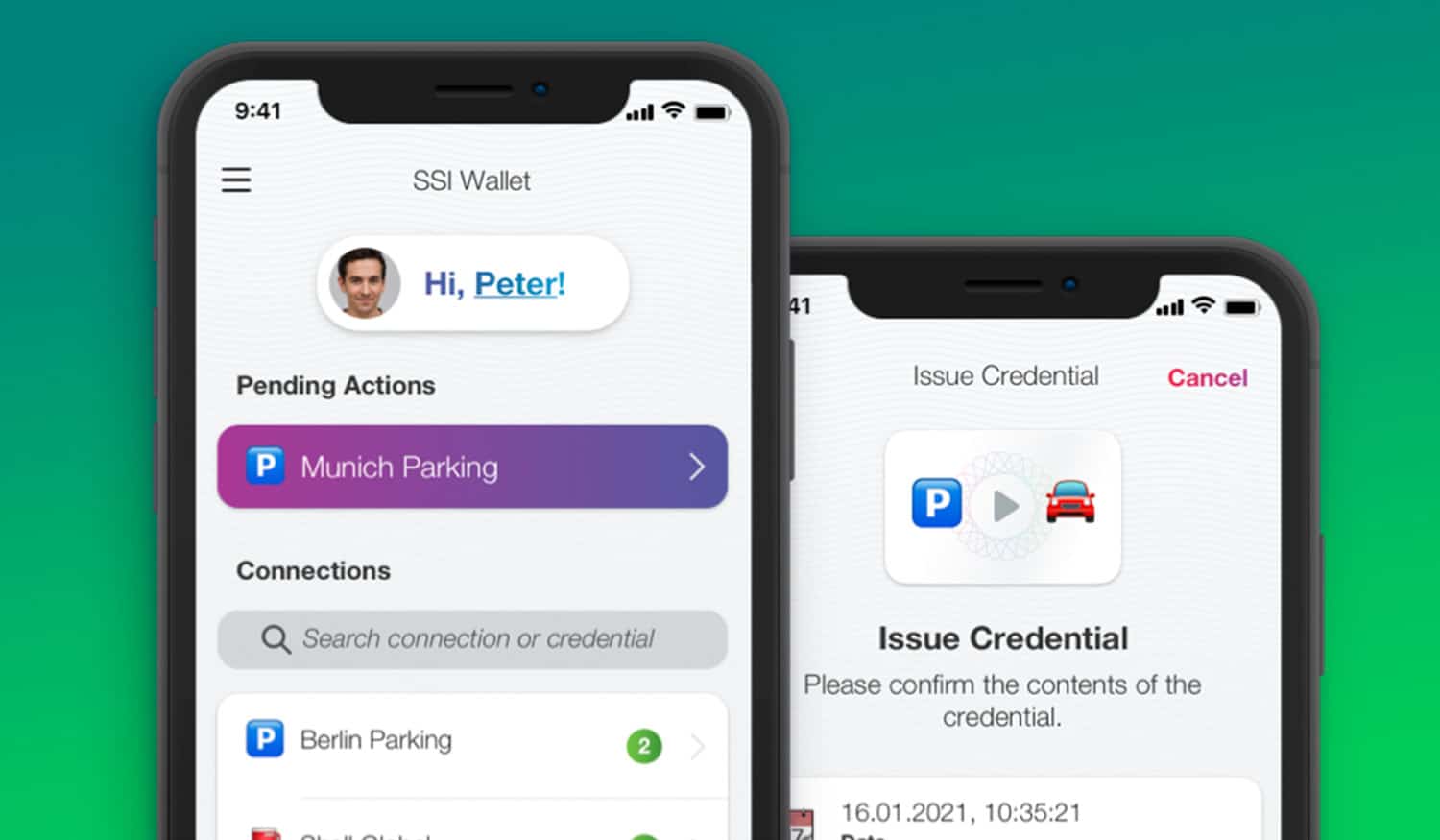
Datarella is offering its customers state-of-the-art Self-Sovereign Identity infrastructure with its SSI Wallet for innovative identity management. It can be integrated into new or existing ecosystems and provide fundamental decentralized identity infrastructure for users to authenticate, issue and receive Verifiable Credentials or transfer data. This allows for many innovative use cases like credential-based access management, automatic credential verification or trusted data transfer.
The Wallet
Having full control over an own digital identity is one of the fundamental principles for Self-Sovereign Identities. This includes that private keys and verifiable credentials are not stored on a centralized exchange or platform, but on the user’s very own devices in a decentralized manner. From this device, the user can issue or receive credentials and authenticate themselves by connecting with other SSI agents.
Like in the physical world where an identity is represented by an ID document which is often kept in a physical wallet, digital private keys and verifiable credentials are stored in a digital wallet. From here, the user can decide with whom the user interacts and shares information from its wallet. The user can ensure that private information is stored only on authorized devices and not in centralized databases which reduces the risk of data breaches tremendously. A wallet can have various forms, a browser extension, a hardware wallet or an entire app like Datarella’s SSI Wallet.
Technology
The SSI Wallet is meant to be deployed in ecosystems that allow users to interact with each other, with SSI compatible websites and IoT edge devices like micromobility vehicles. This is enabled by the Aries Framework Go, which supports a broad variety of edge- and cloud environments.
The wallet further provides a high level of privacy as it natively supports did:peer methods which creates pairwise pseudonymous DIDs for each individual connection and therefore avoids correlation by design. Even though did:peer does not require a ledger, the Aries-Framework Go supports public DID methods like did:web or DIF’s Sidetree protocol. It further allows selective disclosure of credentials thanks to its support for BBS+ signatures. The SSI wallet is therefore perfectly suited for public adoption as well.
It will soon also contain SDKR – a decentralized key backup and recovery mechanism that allows you to backup and recover your secrets with only your official eID. No need to remember passwords or the location of your backups thanks to eIDAS and decentralized and opaque storage capabilities from StorJ.
Conclusion
With our SSI Wallet, we are confident to demonstrate the benefits of Self-Sovereign Identity perfectly in a privacy-preserving and intuitive manner. By using the Aries-Framework Go, we can ensure that it works on web applications and mobile solutions as well as on proprietary IoT devices either without a ledger entirely (only P2P) or by using did:web or the Sidetree protocol.
