Admittedly, I borrowed this title from a recently published article on Forbes. The auther‘s point why investment in blockchain technology has never been so high is because an absolute majority of enterprises are actively working on use cases and solutions in the fields of utilities, healthcare, payments, supply-chain management, government and agriculture.
What is missing here: enteprises can afford to invest in Distributed Ledgers. Because these technologies have reached a certain degree of maturity – at least, kind of. Corporations can‘t play around with technology, they have to make sure that innovative tools and functionalities are secure, stable and reliable. These are tough requirements when it comes to a technology that was made usable for a broader range of use cases in 2015.
At Datarella, we are asked from time to time to explain our company‘s claim „Building the Enterprise Blockchain“. Essentially, our claim means to provide blockchain solutions that match the above mentioned requirements – our clients and partners must be able to rely on secure, scalable and resilient solutions.
Enterprise-ready Blockchain Solutions
This enterprise-readiness requires expertise and know-how in the fields of technology, business, regulatory and legal systems, as well as governance – especially in decentralized systems. In other words, it isn‘t sufficient to know how to technically build – e.g. – a smart contract, but it makes much sense to know about the preconditions of a compliant use of smart contracts by enterprises. Then, not everything in blockchain solutions is core blockchain: if it comes to security, we develop zero-knowledge proof (ZKP) solutions – like, ‘compute on data using Homomorphic Encryption’ – that can be based on blockchain, but doesn‘t have to. Often blockchain is the basis and the precondition for applications is heavily equipped with security aspects (e.g. ZKP), or artificial intelligence AI – aka machine learning.
Learning By Doing
At Datarella, we respond to these manifold requirements by learning by doing: most of the solutions we offer we have either implemented during our work with clients or we invest resources and create exemplary solutions for in-house use cases. With our applications CodeLegit (Compliant Smart Contracts), XSC Crypto Wallet, and Raw Coin (Supply Blockchain Solution as a JV with Wirecard), we demonstrate how things work, how reliable and usable they are and provide food for thought for digital innovation at our clients’ brains.
RAAY – The OS for Digital Ecosystems
Based on our work with the United Nations World Food Programme, we created our own blockchain-based payment and ledger platform, we call RAAY – The Operating System for Digital Ecosystems. We offer plug and play with RAAY especially to those clients who aren’t interested investing in technology development, but rather want to start doing blockchain-based business right away.
Fostering the Blockchain Community
Additionally, we organize one of the biggest Blockchain Meetups in Germany that takes place every eight weeks. For these meetups, we invite domain experts from all relevant blockchain solutions related areas to discuss the respective fields of expertise at a professional level. To ensure that these conversations will be continued, we co-founded the European Blockchain Association EBA, as well as the Blockchain Arbitration Forum BAF. At EBA, we support the synchronisation of blockchain-related activities throughout Europe. At BAF, we support building a database of arbitrators who can help with dispute resolution on the basis of smart contracts and other digitzed contracts.
Blockchain – A Foundational Technology That Kills Inefficiencies
From a superficial perspective, Blockchain technology has seen its hype and now enters a cooling-off phase – at least if you believe in the Gartner hype cycle. On a more practical and realistic level, we experience the opposite: key industry players have realized that Blockchain isn’t a hype at all, but rather is a foundational technology that can substitute many inefficient legacy processes and thus, save billions of Dollars. There is no need to look for specific „killer (d)apps“: if done right, blockchain kills inefficiencies all over the place.
Over the next few years, we most probably will face global economic downturns requiring cost cutting tactics. And this is the reason for large enterprises to invest in decentralized ledger technologies: blockchain kills inefficiencies, saves money, and makes business more robust against looming economic downturns.
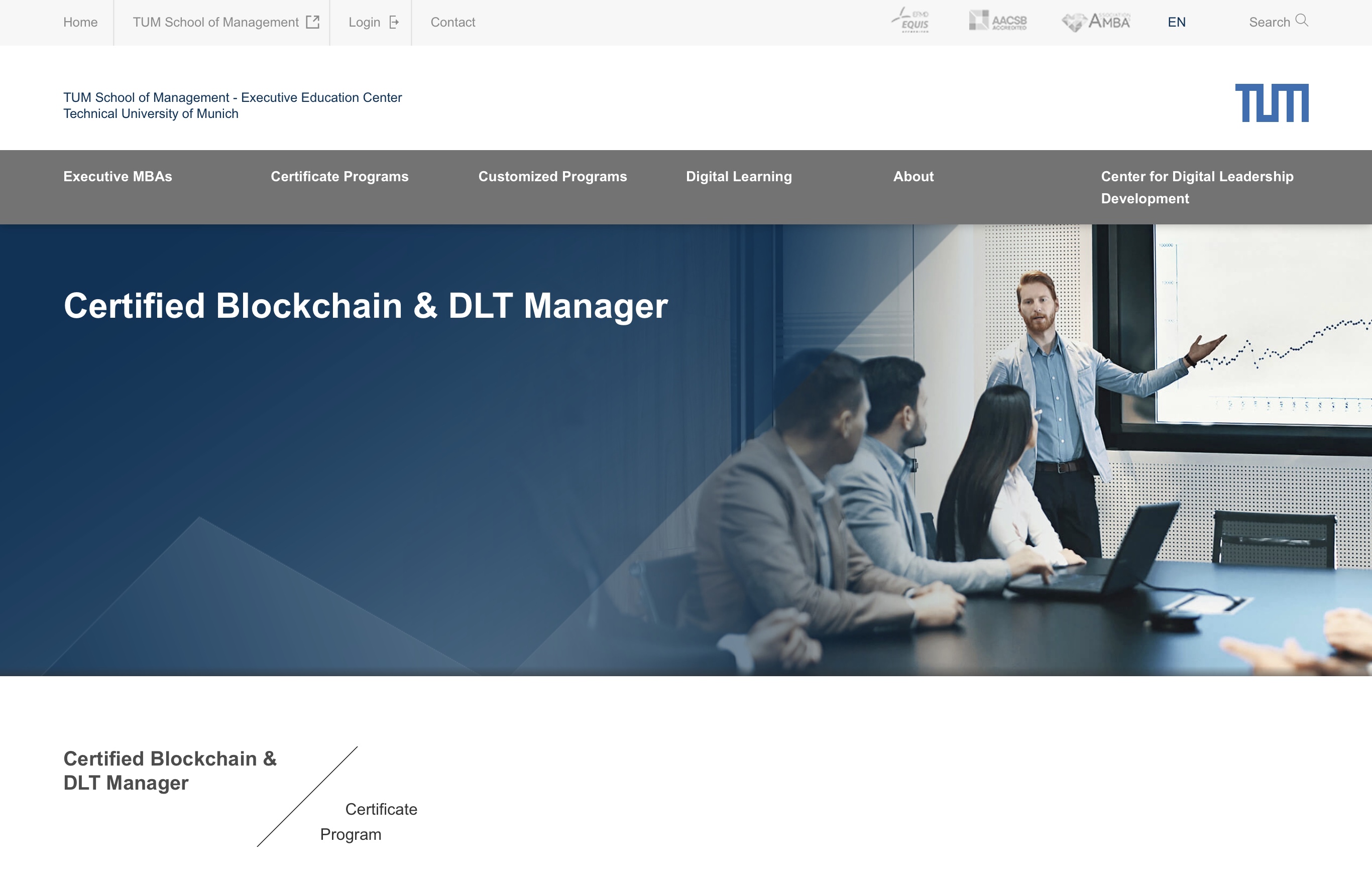
This program is aimed at professionals in corporations who want to achieve a clearer understanding of blockchains and other distributed ledger technologies in order to provide guidance in decentralized aspects of digitization within their companies.
The Certified Blockchain & DLT Manager consists of a 5-day program, provided in 2 modules. In the first module, participants will discuss technical, economic, legal and regulatory aspects of blockchain technology. In the second module, corporate representatives present case studies that participants work on and provide new solutions for. The lecturers line-up of TUM experts with Prof. Dr. othersProf. Dr. Florian Matthes, Prof. Dr. Joachim Henkel, Prof. Dr. Jürgen Ernstberger, and Prof. Dr. Isabell Welpe on the one hand, and practitioners, such as Florian Huber of chain.de / Paradigm Ventures, Datarella CEO Michael Reuter, and other corporate representatives, looks promising.
This combination of theoretical and practical contents facilitates perfect first steps into the decentralized aspects of corporate digitization processes. The program’s first module starts on 18 September, 2019. The second module will follow right after the Oktoberfest – aka Wiesn – on 7-8 Octoberk 2019. All lectures will be held at TUM Executive Education Center in Munich.
We are looking forward to this program and encourage IT-people as well as managers in corporations to participate!
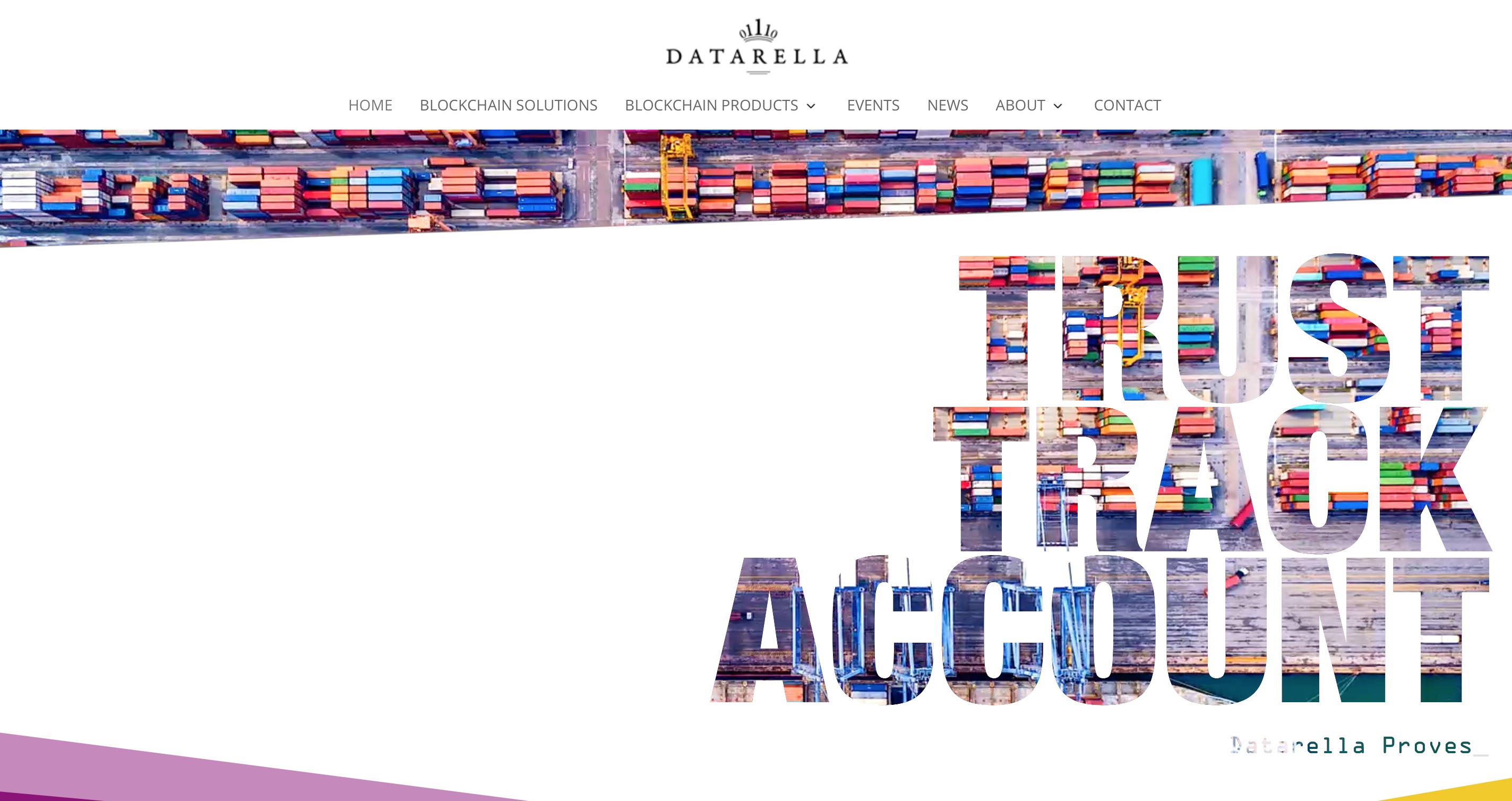
Today, we have launched our new Datarella website. Over the course of several months, we discussed how to re-fresh or re-build our existing standard WordPress template which was more text-heavy than eye-catching. In some conversations, we realised that not only our grandmas had their issues with understanding what Datarella actually offers, but also some potential clients – something we ought to change if our goal is to convert website visitors into satisfied clients.
When building enterprise blockchain solutions, one very important aspect of the work is to show the actual outcome of the projects More specifically, it is key to clearly demonstrate why and which blockchain technology has been used and how it benefits the participants in the use case. The best way to bring a smile on the executive’s face is to either make her an active participant in a live demo, shoot a respective video or use photos of a real life showcase. You can’t beat the power of images and a live experience!
With these experiences in mind, we decided to strip our blockchain technology heavy content down to a minimum and use it more as an explainer of images that describe actual live use cases. In other words: we planned an image-heavy website that should induce a feeling of physical reality – visitors should easily understand the implications and benefits of Datarella’s work. In addition, we ignored side projects and focused on our three key areas of enterprise blockchain applications: Finance, Mobility and Supply Chain.
With this topical focus, a new, fresh look, with many images and symbols, we hope to make it clearer and easy to understand what our Enterprise Blockchain Solutions work is about and what our fantastic target-oriented teams in Munich and Gdansk create. Of course, we highly appreciate your feedback – either as comments, emails or in person at one of our Blockchain Meetups!
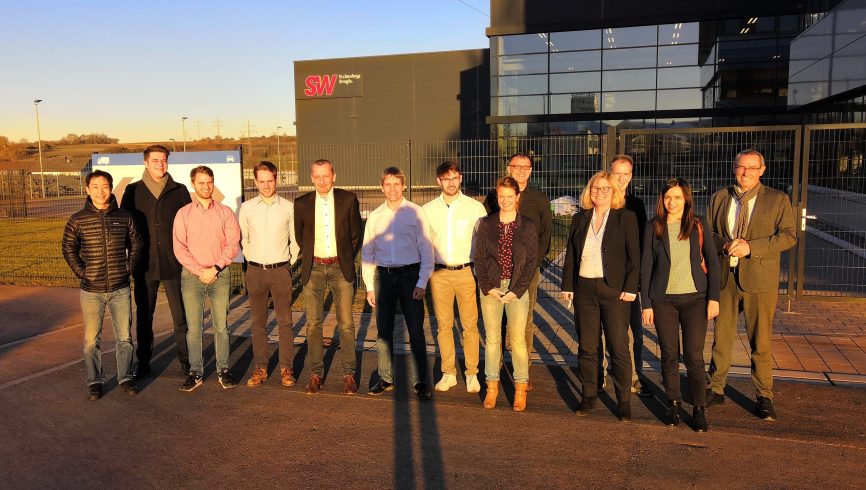
On Friday February 15th, 2019 Datarella took part at the kick-off meeting for the KOSMoS project at the headquarters of Schwäbische Werkzeugmaschinen, a consortional partner located in Waldmössingen in the Black Forest.
The representatives of the consortial partners of the KOSMoS Project
The primary goal of KOSMoS is developing a platform for the cross-company networking of production and process data using blockchain technology. The platform will be able to integrate new offerings and business models. Examples include transparent maintenance concepts, dynamic leasing and proof of quality for delivered products. Through these business models, all cooperating companies should gain an advantage. Examples of such improvements include lower prices, lower maintenance costs and easier product distribution. In summary, the project should facilitate better cooperation of several companies.
The purpose of the kick-off-meeting was the exact definition of the three use cases. Each industrial partner (Schwäbische Werkzeugmaschinen GmbH, Schütte GmbH and Asys Group GmbH) will develop exactly one use case in cooperation with the so-called “enablers” inovex GmbH, Frankfurt School Blockchain Center and Datarella. The industrial partners presented their use case and illuminated the most important aspects in the development plans as well as their individual goals. It was very interesting for Datarella to see how the partners plan to develop and cooperate in order to achieve the goals of the project.
For the next weeks and months, it will be important to define and align the different requirements of the each use case and determine how the blockchain can be leveraged to produce the most benefit for everyone. The first talks on this subject are already planned.
We from Datarella are very excited to be part of this innovative research project and can’t wait to see the first interim results. Stay tuned!
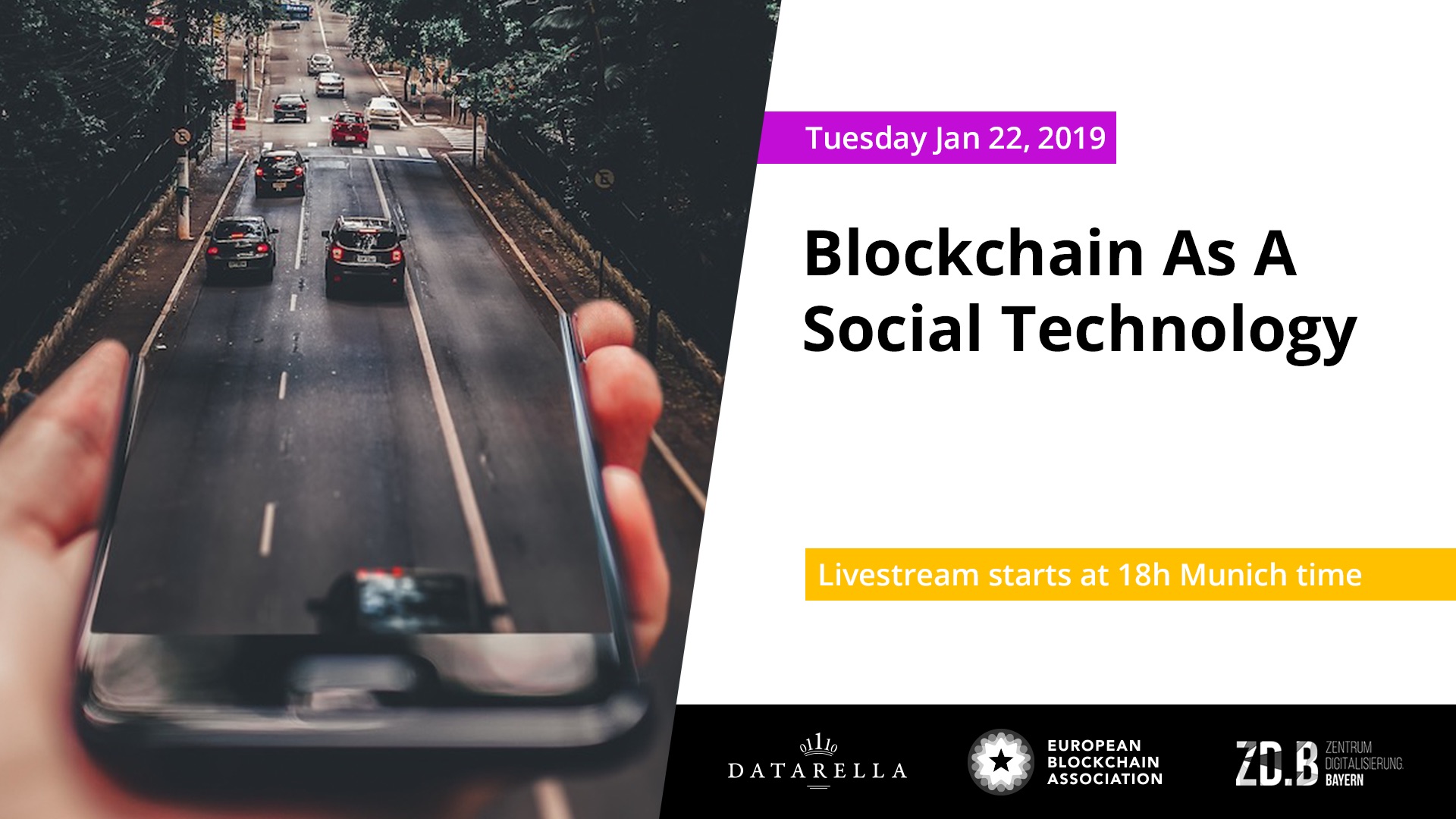
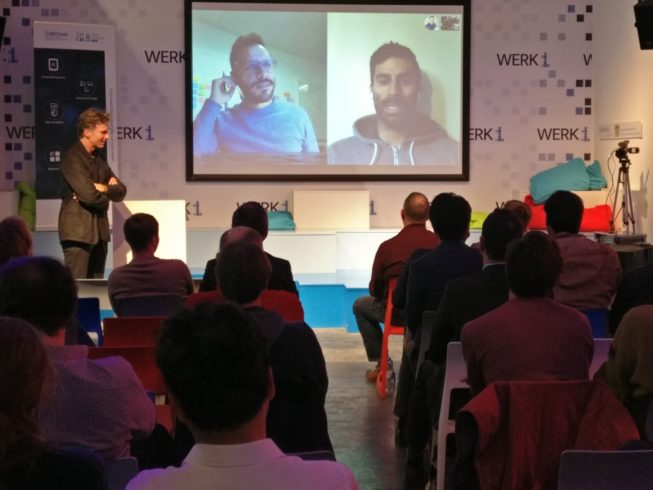
In our first Meetup of 2019, we invited people to Werk1 to listen to three presentations around the topic of “Blockchain as a Social Technology”. The special thing about this Meetup was the decentralized nature of the event. Parallel to the event in Munich there was a meetup hosted by the University of Bayreuth and Fraunhofer FIT. The two locations were linked via a live video feed. Additionally we piped in guest speakers from remote locations in Denmark and the USA. Everything was broadcast in real time via a live stream on our website. You can rewatch the video here!
The first presentation was held by Jon Hearty, Business Development Director of Origin Protocol. He gave us some insights about blockchain-based decentralized marketplaces and the many social implications of this innovation. Moreover he talked about his blockchain platform for building decentralized marketplaces ‘Origin Protocol’.
According to Jon, many of today’s marketplaces that seem to be fully P2P have central companies sitting in the middle of all transactions which hoard and swallow the data to monetize it later. With the use of a blockchain-based decentralized marketplace, problems like these can be avoided. He sees four major advantages to Origin’s approach to decentral marketplaces.
The drastic reduction of transaction costs. Companies who run the platforms often request high transaction fees for basically just matching a buyer and a seller. With the use of blockchain there is no need of an intermediary so that the transaction fees can be put back in the hands of the buyers and sellers.
Redistribute value more fairly throughout the networks. Users have a major impact on the success of the platform but hardly benefit from it compared to the platforms’ founders or directors. Cryptoeconomic incentives provided by a blockchain powered platform to distribute the value more fairly within the platform so users also benefit as a network effects set in.
Promote free and open commerce. Many marketplaces aren’t available all around the world, they are limited or banned to a special region or heavily regulated. In the face of regulation, a company who runs the platform is a single point of failure. Decentralized Platforms don’t have this characteristic which makes them able jump in where where platforms like Uber, AirBnB are banned or regulated.
Making services available to the unbanked. Billions of users worldwide don’t have access to financial services but they do have access to cheap smartphones and therefore wallets to store their values. The unbanked can leap from traditional financial system and make transactions over a blockchain-based network.
Origin Protocol itself just launched a blockchain-based marketplace as a dApp (decentralized App). As underlying technology Orgin Protocol uses the Ethereum Blockchain and IPFS (InterPlanetary File System) for identity management. Go and check it out on https://dapp.originprotocol.com/#/.
Our second speaker of the Meetup was Pablo Velasco from the University of Aarhus who focuses on the digital culture through its technical infrastructures including the political and social aspects of technology. In his research, he deals with topics such as how the development of social technology happens and how it contributes to micropolitics such as how social relationships modify the outcomes of certain technologies. As an example, technology can be used as a political tool for including or excluding relevant stakeholders in a system.
Regarding the blockchain technologies that rose up during the last years, Pablo said, that they can be merged together as a list of attempts of some sort of parallel payment system or decentralized, electronic money. In Bitcoin, for instance, the key element was the exchange of economic value using cryptography and this cryptography was a elementary need for the social integration of the technology.
He also pointed out how different technologies have impact on the social interaction. As an example, sending coins over a blockchain network requires a new and different trust paradigm and therefore builds up a new type of social interaction.
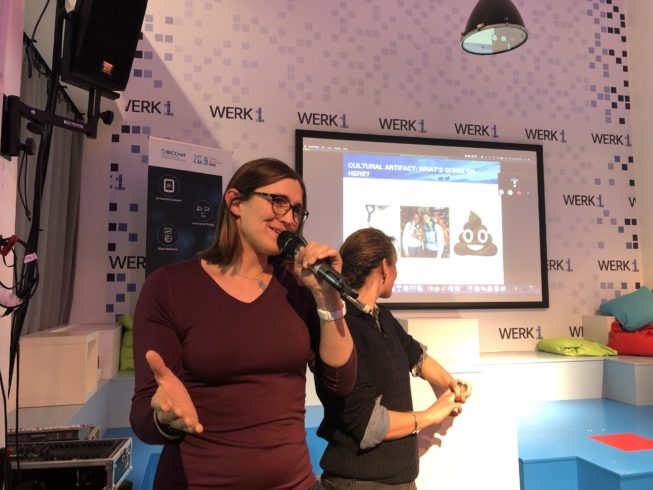
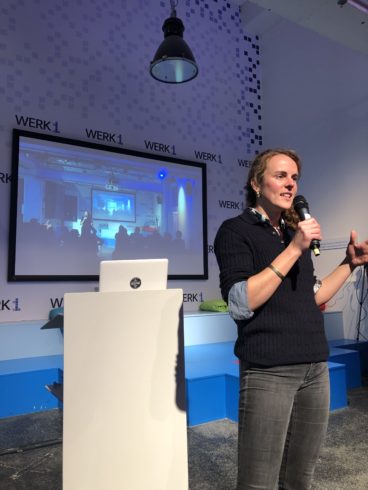
In the third presentation Anna-Laura Liebenstund and Rebecca Johnson from the European Blockchain Association presented the importance of a governance model in decentralized organizations.
They pointed out why it is important to have regulations in the use of technology and how the interaction impacts our social behaviour as well as the way we think.
A key aspect was that we have to be very careful about the inputs, design processes and implicit cultural assumptions behind our development of new technology. Artificially intelligent agents, for instance, will always be a reflection of the training sets to develop them.
Technology without principals will become antisocial sooner or later.
As a result, we need governance as a framework for techno-social interactions. Recent projects like ‘the DAO’ failed and Bitcoin and Ethereum got forked because of inconsistent governance.
Therefore it will be important for decentralized organizations to establish common principles, ethical code of conducts, membership rules and a solid basis in existing social networks to ensure the durable success of the organization.
We want to thank the speakers for their very interesting presentations on this, the opening meetup of 2019! Also, thank you to the team of Werk1 who provided the location, organized the catering as well as providing support for the A/V setup. And we thank ZD.B for supporting the meetup in general!
We also want to thank our audience in Munich and Bayreuth for attending. We hoped you enjoyed the Meetup. Feel free to give us your feedback.
Our next Meetup will take place on Tuesday March 19th, 2019 on the topic ‘Privacy by Design?’. We would be very happy to see you there again!
In his 1901 published article titled “The Scope of Social Technology“, Charles Henderson renamed social art as ‘social technology’, and described it as ‘a system of conscious and purposeful organization of persons in which every actual, natural social organization finds its true place, and all factors in harmony cooperate to realize an increasing aggregate and better proportions of the “health, wealth, beauty, knowledge, sociability, and rightness” desires.’
Later, the term social technology was given a wider meaning in the works of Ernest Burgess and Thomas D. Eliot,, who defined social technology to include the application, particularly in social work, of techniques developed by psychology and other social sciences.
As a result of its decentralised architecture, its openness, and its data immutability, Blockchain can be regarded as a social technology: New governance models, represented in DAOs and DSAOs, have demonstrated the social impact of Blockchain technology.
Zero-based budgeting ZBB isn’t the first thing you learn at the university, not even when specialising in controlling. However, developed by a practitioner in the 1970s, ZBB has evolved into a budgetary process that lives up to the promise of modern controlling: it supports not only cost-cutting, but also prepares the ground within an organisation for a profitable growth strategy.
Originally, ZBB was a process only large enterprises could implement, die to high initial investment and administrative costs. But digital transformation has allowed ZBB to be used for more organisations in a more efficient way. Blockchain technology, finally, may help ZBB to conquer at least the world of controlling. Below you find an article that was published first on our RAAY website. It explains how distributed ledger technologies could ba adapted for many more enterprises, and even SMBs.
Zero-based budgeting ZBB is a method of budgeting in which all expenses must be justified and approved for each new period. It was created in the 1970s by former TI controller and advisor to then Georgia’s governor Jimmy Carter, Peter Pyrrh, to embed top-level strategic objectives into the budgeting process by tying them to specific functional areas within the enterprise.
ZBB starts from a “zero base” at the beginning of every budget period, analysing needs and costs of every function within an organisation and allocating funds accordingly, regardless of how much money has previously been budgeted to any given line item. Costs are grouped and measured against previous results and current expectations, enabling management to allocate funds by current need instead of by historical expenditures.
Cost-cutting and profitable growth
ZBB is a very useful budgetary process, especially in economically challenging times, when enterprises need to make reductions, and when there are significant and rapid technological changes. Its extremely detailed approach to budgeting as an opportunity to capture operational efficiencies, stimulate growth, and boost performance. In other words, ZBB is fundamentally different from typical budgeting because it switches the burden of proof for spending from those managers tasked with driving cost reductions to the business leaders, who must contribute to both identifying unproductive costs and eliminating them in practice: targets aren’t debated until they disappear,, but business leaders ask: “What does it take to hit the target?”
Advantage Digitalisation
However, ZBB come with some serious challenges: When Peter Pyrrh developed ZBB in the 70s, it was regarded as a budgetary process for large enterprises exclusively, that could afford significant investments to optimise the management of myriads of separated organisational databases. Digitalisation has made ZBB less burdensome: instead of having numerous controllers coordinating thousands of spreadsheets, today data is available at the click of a mouse. Still, with mostly central databases in place, there are serious synchronisation and consistency challenges.
Enters Blockchain Technology
In a project using tools and functionality of our RAAY Operating System, we explore the impact of blockchain technology applied to a ZBB process. Leveraging blockchain-inherent features, such as immutability and consistency of data, the hypothesis of this project is to allow for a streamlined, efficient zero-based budgeting that could be used not only by large enterprises but also by SMB in order to drive profitable growth.
The essence of using blockchain technology for ZBB is not to sell old wine in new wineskins, but to leverage features that automatically come with decentralised distributed ledgers. Instead of looking for highly innovative new business or so-called ‘killer dApps’, we apply what we have in-depth experience in to what is an accepted budgetary process – and potentially save millions of Euros.
At Datarella, we had an extremely interesting year 2018: Our Building Blocks project that we have set-up on 1 May 2017 (and that we develop further), has received lots of credit, internationally. Since Building Blocks is one of the few global live blockchain solutions with apparent economic and social impact, has not only helped us to shape our profile as the Enterprise Blockchain solution company, but has motivated us to invest internal resources to develop RAAY, the new Operating System For Banking.
In 2019, we will leverage RAAY’s first applications, the RAAY Wallet and a real-estate backed security token to demonstrate the power and the variability of the RAAY OS. Together with partners, such as Wirecard and zeb, we will provide RAAY OS functionality to players in the finance industry helping them to streamline their processes, bring down informational and transactional costs and develop new business.
Supply Chain, Security, Mobility
On the level of our Datarella core business, we’ve made great progress in the fields of Supply Chain, Security, and Mobility. With our partner Wirecard, we co-developed the blockchain-based supply chain solution Raw Coin that is supposed to play a major role in some upcoming projects in early 2019. We invested a significant amount if time and resources in research around blockchain security, namely in the field of multi-party computation. Here, our learnings will help us to provide our clients with solutions that fully comply with GDPR and regulations, and make blockchain technology future-proof.
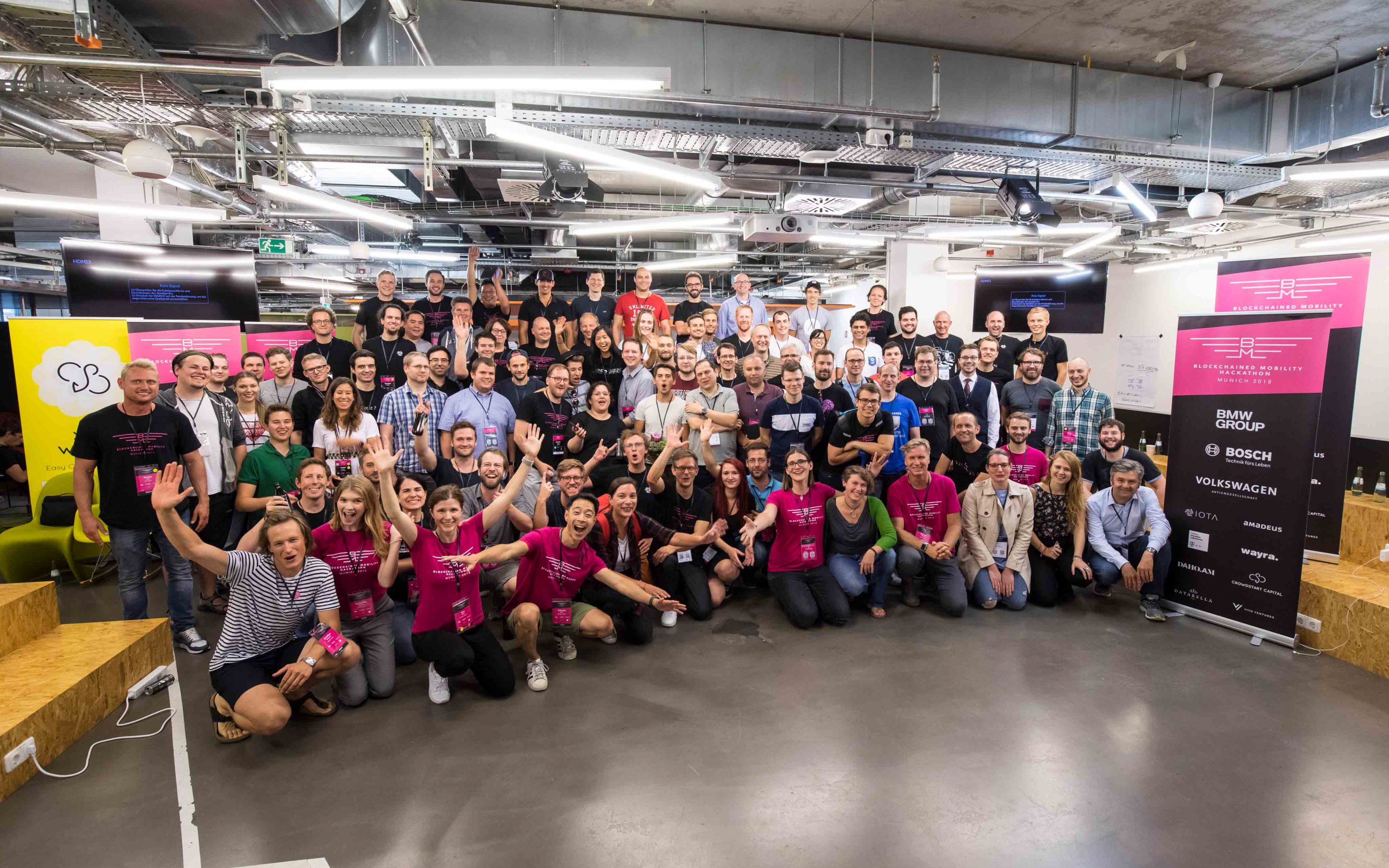
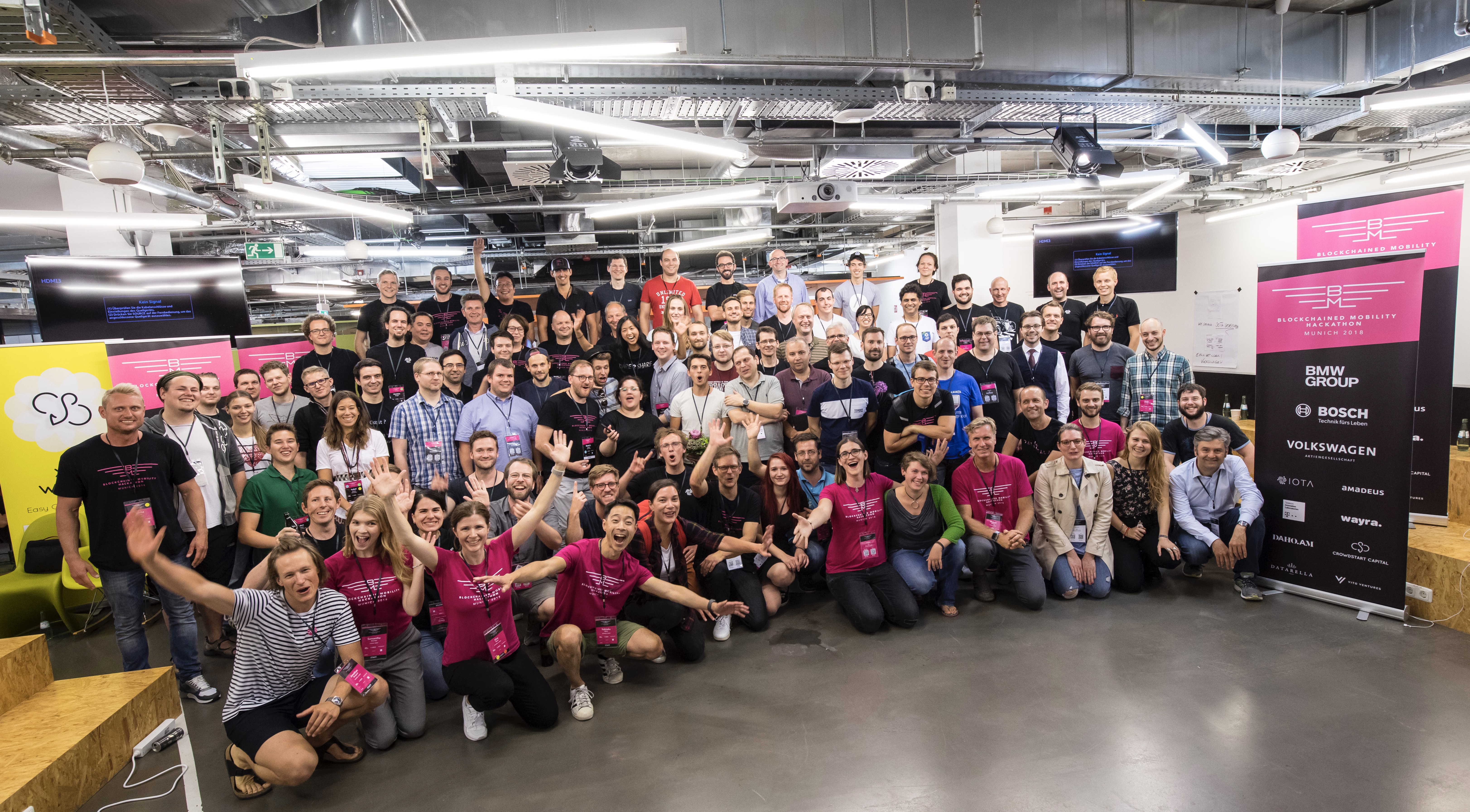
With our Blockchained Mobility Hackathon in July 2018 with BMW, VW, Bosch, Deutsche Telekom, Deutsche Bahn, Amadeus, IOTA and others, we demonstrated that the event‘s motto – Compete & Collaborate – isn‘t just a buzzy catchword, but a lived experience, if participants are strongly committed. The hackathon‘s results have not only demonstrated the power of hybrid teams – formed by different mobility players – but have triggered some concrete blockchain mobility projects and far-reaching cooperations.
Crowdstartcoin XSC
Our decision not to launch an ICO based out of Germany in late 2017, proved to be a wise one – regarding the emerging challenges of then apparently successful ICOs, with even the Ethereum ICO of 2016 becoming subject to scrutiny by regulators
After having decided not to ICO, we agreed upon distributing CrowdstartCoins XSC to developers in the blockchain community who add value to the ecosystem. In early 2018, we developed an automated process that enabled us to distribute free XSC to legitimate recipients with little effort. However, we had to abandon our original plan to develop Crowdvote, a community driven decision making model to compensate blockchain developers, due to its high complexity and scarce resources in our development team. Alternatively, we decided to donate a large chunk of CrowdstartCoins XSC to the newly founded European Blockchain Association EBA thta itself distributes XSC to its members, albeit in a broader sense: every new member gets a welcome bonus of 2,000 XSC, and XSC have generally been defined as the internal means of payment and rewards for transactions within the EBA member network.
Governance As A Service GaaS
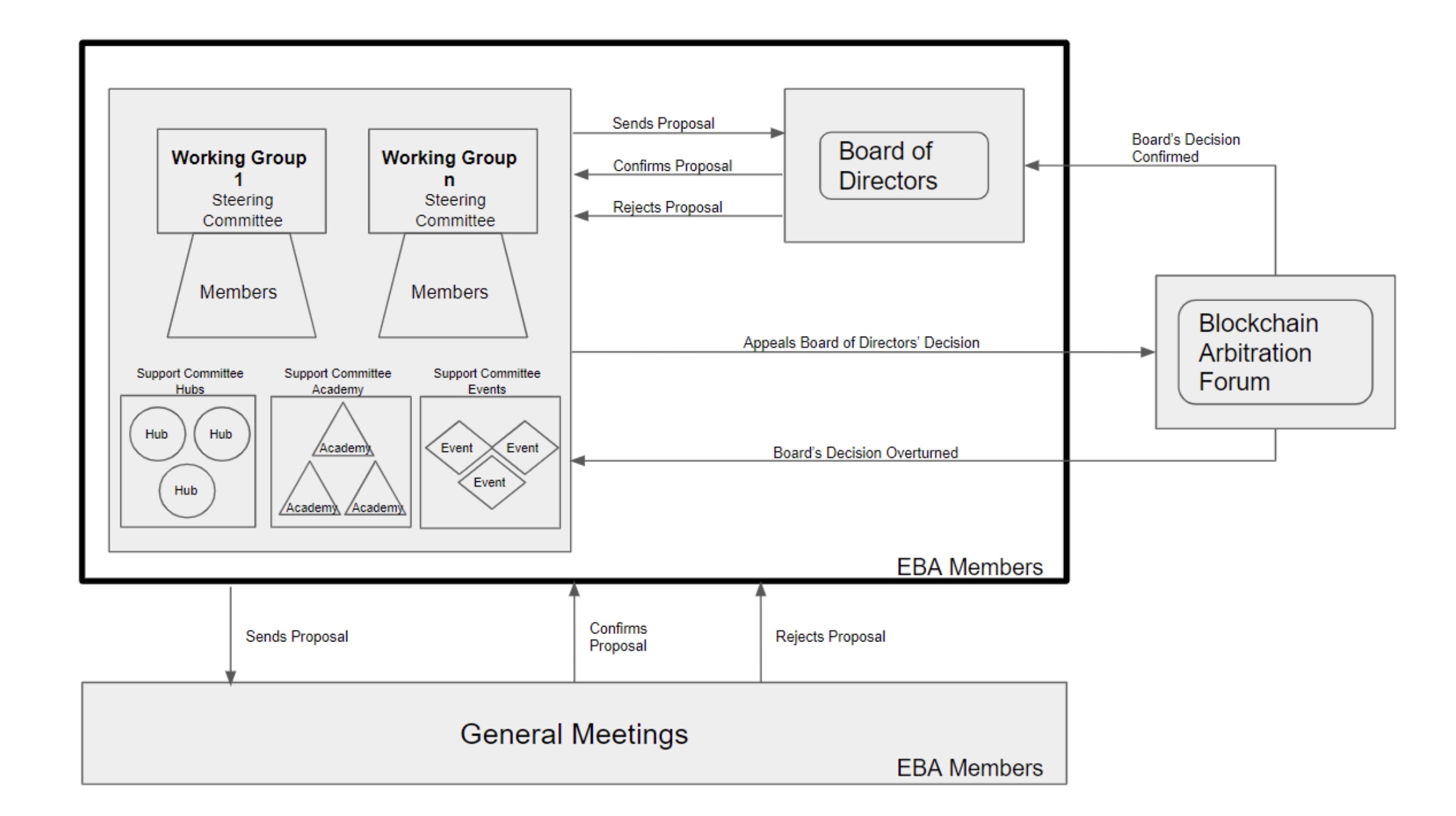
The Datarella team has supported the European Blockchain Association EBA in creating its Governance Model that sits at the core of its decentralised semi-autonomous organisation DSAO. Many of the above mentioned actual and upcoming failures of ICOs and other decentralised models can be ascribed to flawed governance models. In some cases, there was a complete lack of any proper governance. There is a general difference between governance of decentralised and centralised systems: in decentralised systems there is no central authority that oversees, controls or manages the system. All this has to be done by the imdividual participants, or nodes, by themselves. Thus, there has to be a proper incentive system in place that incentivises participants to act in ways according to the governance model.
We at Datarella will leverage on the experiences of co-creating the EBA governance by offering a Governance-As-A-Service GaaS model to our clients that aren’t interested in developing a governance model on their own. They can plug’n’play with the Datarella GaaS!
From our perspective, 2019 will be the first really big year for blockchain: we will see more live solutions with significant impact and we will see more blockchain-based Compete & Collaborate – that in turn results in great economic and social impact!
Blockchain is said to eliminate middlemen – just search for the purpose of distributed ledger technologies DLT, and you will end up with numerous predictions what kinds of middlemen will leave the playing field when blockchain arrives – disintermediation at its best. Although we have been developing blockchain solutions since 2015, we‘re somewhat sceptic about that disruption variant.
First – what is a middleman, and why does he actually exist, at all? Of course, there are many different kinds of middlemen in various industries, and their efforts are not necessarily compatible with each other. However, the common denominator of middlemen purposes is to facilitate relationships between two or more contracting partners. Be it a travel agent who connects a future traveler with hotels, airlines and other travel product suppliers, be it an auditor who audits financial processes of a company in order to prove the client’s correct and compliant behavior towards its shareholders – apparently there has been sufficient economic room for parties in between contracting partners.
Comes in blockchain and kills these middlemen? In theory: yes: blockchain technology provides a decentralized secure database and ledger that allows for individual access of all contracting partners without the formerly known risks and challenges of data sharing. In practice, we are sceptic. Sure, as a so-called trustless system, blockchain provides a decentralized notary function and therefore no external trust agent is needed any more. However, killing the trust agent results in a responsibility of each individual for everything the agent was responsible before.
Middlemen facilitators
Let‘s assume you are in the crypto trading business and you buy and sell your coins via a centralized crypto currency exchange. In this case, the exchange might help you recover your lost passwords that give you access to your account. If, alternatively, you trade via a decentralized crypto currency exchange, you are completely responsible for your passwords yourself – nobody will support you in case you lost access to your account. Same with any financial transaction on a blockchain: if you sent your Ether to your friend‘s wallet address, but unfortunately, you entered some transposed numbers into your transaction – your digital money is gone – unless the surprised unknown recipient sends it back to an account he doesn’t know himself. There is no bank (middleman) that could help to correct or withdraw your transaction.
These two examples alone show that predictions of fully occupied graveyards of middleman are exaggerated, if not simply wrong.
Let‘s look at a more differentiated case: in supply chains, there is a business run by middlemen that certify a product’s authenticity and provenance. With a blockchain system including a token that transports the product memory beside acting as a means of payment, theoretically there is no need for this kind of selective checks of materials or production processes. Since all network particpants have realtime access to the blockchain – and therefore to the complete product memory – everybody can be sure about correctness and consistency of the data in the supply chain.
However, who sets-up, runs, and maintains the blockchain? Who creates the governance model and acts as a contact entity for the network‘s participants? Who cares for the integration of the supply blockchain into legal and regulatory frameworks? If one of the participants would take that role – would everybody else trust the network? Would not the certification agent – the former middleman – be the best suited entity for this role? Isn‘t it the certification agent who already knows many, if not all, of the participants and therefore would be the one who could facilitate the blockchain in the best possible way?
Re-Intermediation
We at Datarella never have endorsed revolutionary disruption models that are based on 100% changes within industries. We think that gradual, evolutionary developments serve the needs of stakeholders in an industry better. Insofar, we expect blockchain technology to eliminate unnecessary and overpriced middlemen services, but at the same time blockchain can prove to be the ideal technology for all sorts of middlemen to re-invent themselves and bring their service offerings to the next level. This development would be then called re-intermediation, instead of dis-intermediation. No worries, middlemen: Blockchain might prove to be a proper business opportunity for you!