by SPR | 27 October 2021 | Autonomous Agents, Blockchain, Featured, MOBIX, SSI
In this blog post, we look at the potential of service automation through autonomous economic agents in Blockchain-based systems. Datarella’s partner Fetch.ai has made it their mission to combine intelligent agents with blockchain technology in several use cases. Deep Parking is one of them, and using a specific example from MOBIX here you can get a feel for the potential of autonomous agents.
The path to the fourth industrial age is being paved by the interplay of Big Data-driven automation, robotics, IoT and Distributed Ledger Technologies, aka Blockchain. Given the increasing amount of data, and the number of digital services that go hand in hand with this progress, the need to automate them is also growing. Users should be relieved of unnecessary work and offered optimal results.
Agents take on the role of autonomously performing tasks on behalf of their clients (individuals or objects). For this purpose, they can also interact with each other. Intelligent agents can make complex decisions by using ML, i.e. AI-powered algorithms, based on large amounts of data.
A blockchain, with its data supply, offers a particularly favourable environment for intelligent agents. The data of a blockchain are permanently available and are logically related to each other. Decentralisation can offer robustness (no single point of failure) and lower transaction costs. Agents can assume a fully autonomous identity on a blockchain through private keys. They can use it to authenticate themselves and communicate their suitability for certain tasks. Agents can use shared protocols (possibly through smart contracts) to coordinate, collaborate efficiently, e.g. by distributing complex tasks among themselves. They can negotiate and make distributed decisions (even though voting processes use their blockchain). Tasks, goals or motives of agents can be recorded in the blockchain and economic incentives can be set for optimal task performance.
With regard to the IoT, a blockchain (as a single point of truth) can integrate various sub-systems, s.a. smart household appliances, smart buildings, smart districts and smart cities, and create added value for all agents participating in the network. Fetch.ai is an example of how intelligent agents can realize automated services based on blockchain technology.
Among the use cases of Fetch.ai, we would like to highlight agents for mobility services – traffic sign agents, parking agents for Deep Parking, agents for eMobility, agents for trains and stations that could even form a decentralised train network. In the process, increasingly intelligent autonomous agents interact on behalf of people or infrastructure, searching for each other, negotiating with each other in the interest of offering their users optimal solutions. In such a case, an autonomous agent of a car could, on behalf of its owner, seek and negotiate with agents working on behalf of parking lots to navigate the car and its owner to a quick and cheap place to park. With Deep Parking at the IAA in Munich 2021, the potential of agents for such use cases becomes clear.
There it was demonstrated how agents negotiate their resources on behalf of vehicles, their owners and the infrastructure to find an optimal solution for everyone without further efforts for the users. The following graphics show an excerpt from the exemplary communication between the agents involved.
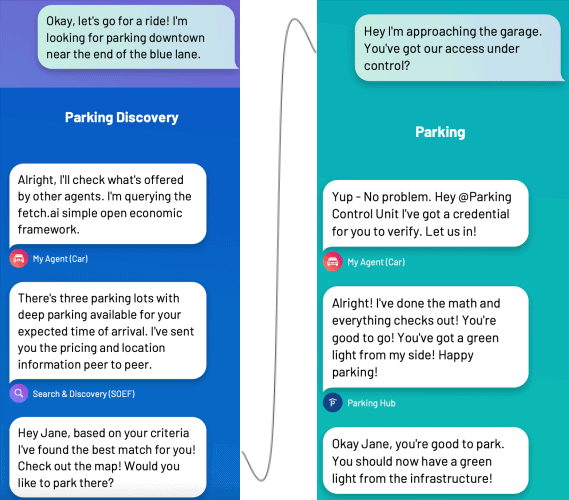
In this case, a user named Jane is looking for available parking space in the city centre. Without Jane having to do this herself, the agent in her car (My Agent (Car)) looks for another agent who offers a parking space via a specific (agent-)network (SOEF). Using Blockchain technology, agents handle authentication, price negotiation, reservation and even payment, autonomously according to their client’s preferences. When Jane approaches the parking lot, access is automatically granted to her car without further ado.
As shown, the scope of tasks autonomous agents can perform and the added value they can contribute is without limits. So, by using autonomous agents, the potential of Blockchain technology can be leveraged for all use cases where handling of huge amounts of data in real-time or near-time is needed.
by Martin Schäffner | 21 July 2020 | Blockchain
Last October during the Outlier Ventures Diffusion Hackathon, we built a Proof of Concept of a Parking Agent System – Effortless Parking, which could solve the coordination problem of parking in crowded cities. In this post, we will look at the individual components of the promising technology stack upon which we build this project – Fetch.ai.
Do you remember Agent Smith from the Matrix trilogy? If not, let us fresh up your memory. The Matrix is a science fiction movie in which mankind almost lost the war against the machines. Most of the living human population is stacked up in energy farming towers by machines overloads in order to harvest their biologically produced energy. The consciousness of these “human batteries” is hooked up into “the Matrix”, a computer program that simulates the experience of the world how we know it today. This keeps the “human batteries” docile, sedated, and entertained. Agent Smith is a software agent living in the Matrix. His job is to hunt down humans, like the protagonist Neo and other individuals of the last reminding human resistance, which reenter the Matrix to free other individuals. Mr. Smith and other agents act autonomously to reach their goals. Further, over the trilogy, he even manages to learn a new skill, which allows him to transform other “Matrix inhabitants” into copies of himself to fight Neo.
You might be asking, what does this have to do Fetch.Ai?
Autonomous Economic Agents
The core element of Fetch.Ai is software agents, so-called Autonomous Economic Agents (AEA) which are living in Fetch’s digital world, the Open Economic Framework (OEF). Similar to Agent Smith, these software agents operate, interact, and even learn new skills autonomously. However, the goal of these agents is to actively search and discover other agents to generate economic value. An agent can represent an actor or thing in today’s economy. They can serve as a data provider, such as a sensor, which offers its data to other agents. Vise versa, agents can request data from these sources and do computations to generate valuable information. All the search and discovery takes place in Fetch.Ai’s Matrix, the Open Economic Framework. As the world ”Open” in OEF reveals, it is open, so any business or individual can join the network to offer information and services. To establish trust in a network without a gatekeeper, Fetch.ai included a Self Sovereign Identity solution (SSI) for its software agents. This allows agents to earn a good, respectively bad reputation, depending on the quality of service they provided to other network participants.
Fetch’s software agents can independently acquire new skills, which are required to conduct their tasks. Let’s say, an agent has been tasked with buying concert tickets at the cheapest price on your behalf. It already has the negotiation skill but can autonomously acquire a betting skill to participate in an auction for you. These agents are not, however, General Artificial Intelligent (AGI), since their capabilities are limited to a certain field of activity.
Fetch Ledger & Token
The legal tender in the world of Fetch.ai is the native token FET. It is used as a digital currency to pay for all transactions, e.g. buying/selling of data, network operations, e.g. deploying new agents or conduction computations, and secure communication. The state of the Fetch.Ai world – the answers to who owns what and who is who to a given point in time – is documented by its Smart Ledger. This state-of-the-art ledger technology uses 6 separate chains that synchronize in order to ensure state consensus. Using multiple synchronized blockchains makes the Smart Ledger highly scalable and capable of processing over 30k transactions per second.
As a consensus mechanism, Fetch uses Proof-of-Stake – in which any token holder can participate to secure the network. Token owners can stake their FET to secure the network and earn staking rewards paid in FET:
- Participate in a staking auction directly.
Fetch.Ai offers 200 staking slots, which can be won through actions. The winners are entitled to run one or more validator nodes for which they are rewarded with 7500 FET per slot. For participating at the auction, a minimum amount of over 750k FET is required
- Join a staking pool
FET owners, who don’t want to run a validator node or not have sufficient tokens to participate in the action, can delegate their stake and join a staking pool. Participants will be rewarded with a 10% annual return on their delegated stake.
- Binance
Also, it is possible to earn staking rewards, by holding tokens in your Binance account. This option is probably the most convenient and is rewarded with a 1-4% annual yield.
Fetch.Ai is made up of three core elements, the Autonomous Economic Agents, which generate value by acting as a data provider or consumer, the Open Economic Framework, the digital world, which connects agents with each other and a highly scalable Smart Ledger, keeping track of the current state. In the next post, we will look at possible use cases, and elaborate on how networks built on Fetch.ai can offer lower transaction costs than today’s web2.0 multi-sided markets.
Stay tuned!
