
by Martin Schäffner | 10 February 2020 | KOSMoS
If you are setting up a blockchain-based system, one of the first questions you face is what kind of blockchain is best suited for your use case. This question also arose at our KOSMoS project where we are implementing a consortium blockchain for a group of german machine manufacturers and their clients. In cooperation with the Frankfurt School Blockchain Center, we published an article on Medium that shows our approach in finding the most appropriate type of blockchain.
If you want to read the full article, you can read about it here!
Within three years, the KOSMoS project intends to create blockchain-based frameworks for machine manufacturers to offer services for transparent maintenance and dynamic leasing contracts for their machines. Since these use cases are crucial to the stakeholders, it is important to choose the right type of blockchain to satisfy their needs.
Our methodology for choosing the correct type of blockchain followed three steps:
- Study existing types of blockchain and select a subset
- Define criteria for evaluating the most suitable blockchain system
- Compare the different blockchains to our predefined requirements
After comparing all possible types of blockchains, we eventually decided to implement the KOSMoS system on Hyperledger Fabric. One of the reasons for Hyperledger Fabric was the possibility to use channels between each machine manufacturer and its clients to keep sensitive information confidential while maintaining a shared blockchain infrastructure.
If you have any questions about the project, our methodology, or criticism, feel free to contact me via E-mail.
by Martin Schäffner | 4 February 2020 | Track and Trust
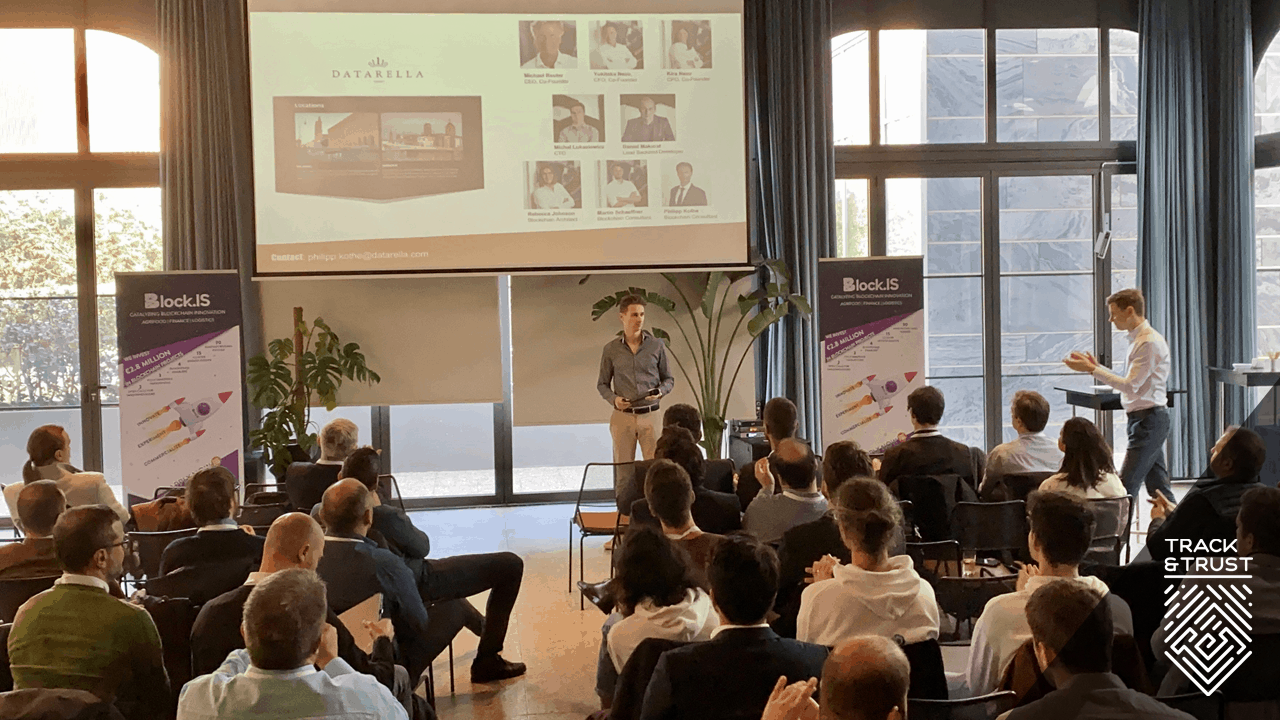
Track & Trust by Datatrella has been selected by the European innovation program Block.IS as one of the best blockchain logistics solutions. After two days of evaluation by experts from the business and technical domain in Istanbul, we are proud to announce that our project was selected to enter the next phase of the blockchain accelerator program funded by the European Union. The jury saw the tremendous impact of Track & Trust, bringing light into the logistic black box of complex, global supply chains.
The bushfires in Australia, the war in Libya or the Coronavirus outbreak in China. Our world is facing various challenges. However, besides the crises which are present in our daily news, over 200 million people in 81 countries are assessed for being in need of humanitarian assistance. A large percentage of these are concentrated in a small number of countries. For example in the Democratic Republic of Congo or Yemen, where millions of people are starving, have been displaced from their homes by war and suffer epidemic outbreaks of Ebola and Cholera took place.
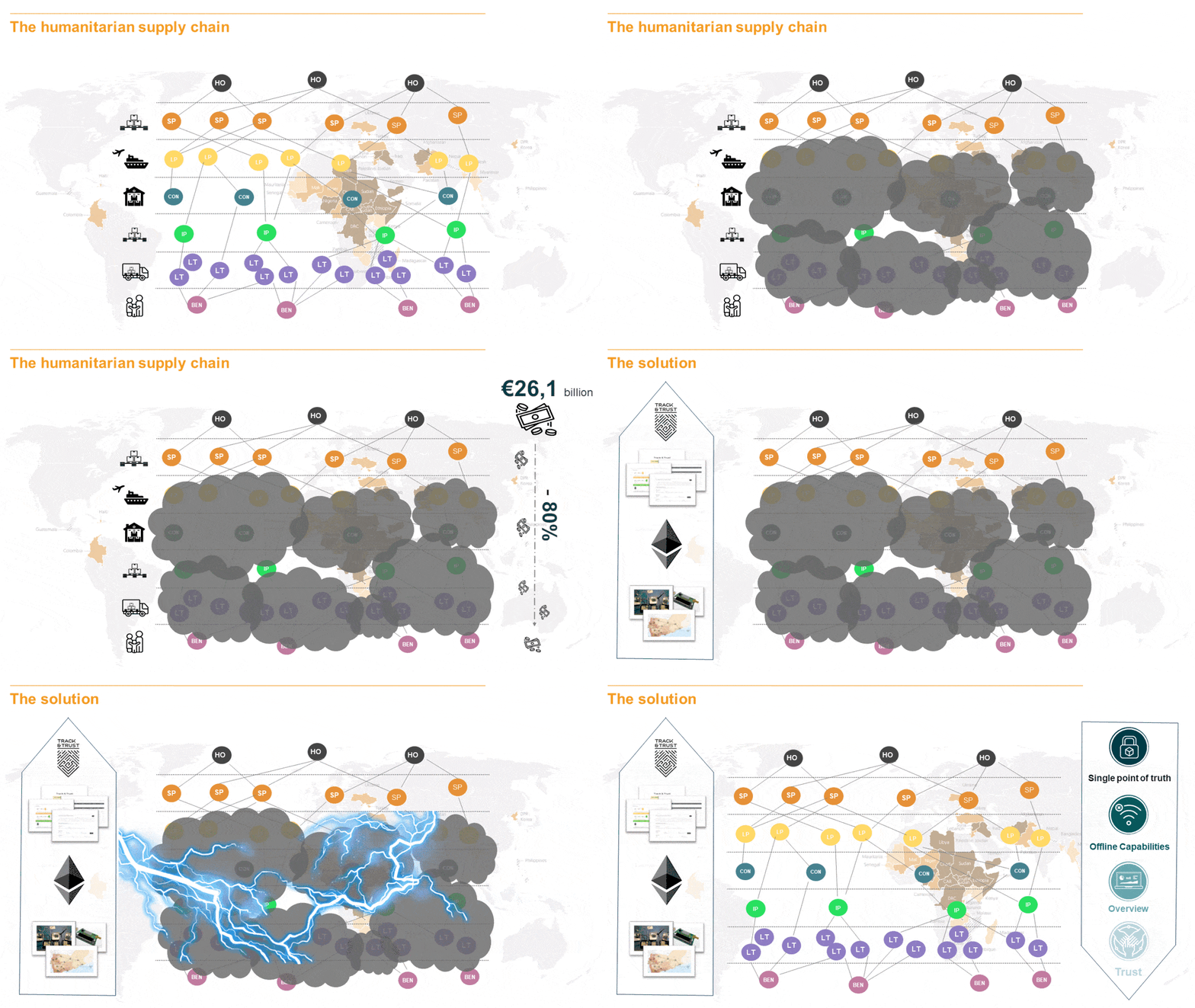
But how do life-saving supplies – like food, water, medicine, and shelter – reach the people in need? Here is where the humanitarian supply chain comes into play. In the GIF below we tried to illustrate one, in a simplified way, but as you will see these networks are complex.
Just to give you some characteristics on these networks:
- They are composed of multiple stakeholders from NGOs, governments, and military to private corporations
- They operate over multiple countries/continents
- They are ad-hoc and work under high time pressure
- They operate in the most demanding environments, like warzones, and after natural disasters
- Its is very hard to forecast their demand since:
- Every crisis is unique
- A lack of historical data
Further, if tracking of goods and shipments is done at all, it’s documented by organizations individually and manually. This makes the humanitarian supply chain vulnerable to human error and fraud.
All these characteristics result in tremendous costs. It is estimated that around 80 percent of the expenditures of aid agencies are in the area of supply chain management.
Luckily, we offer a unique solution that allows the tracking of shipments from the beginning to the very end of the supply chain, bring transparency, trust, and collaboration to the humanitarian supply chain. We call it Track & Trust.
Our solution is made up of three key components:
- A user-friendly interface, proving the supply chain stakeholders an overview of the actual state and details of a shipment.
- A Private Ethereum Blockchain, which allows the immutable and tamper-resilient documentation of handover data and serves as a single point of truth. Noteworthy, data is managed and governed by the involved stakeholders themself, no external intermediary is needed.
- A hardware kit, composed of LoRa nodes and satellite communication technology, which allow the creation of an asynchronous mesh network, which enables to broadcast changes in custody of goods without being dependent on existing telecommunication infrastructure.
Our goal is to minimize the cost related to human error and fraud of these life-saving supply chains to maximize the value which arrives at the people in need.
Track & Trust was created to address the problems of the humanitarian supply chain. However, these supply chains are by far the only ones facing challenges like transparency and accountability in times of globalization. Just consider the supply chains of pharmaceutical, food or luxury products that are fighting against a multi-billion dollar counterfeit industry, demolishing profits and the trust of their customers.
If you want to learn more about our Track & Trust system feel free to contact us or to read more on our company blog.
“This project is funded by Block.IS (Blockchain Innovation Spaces) Horizon 2020 research and innovation programme Project No. 824509, under the funding framework of the European Commission.”

by Martin Schäffner | 13 January 2020 | Blockchain
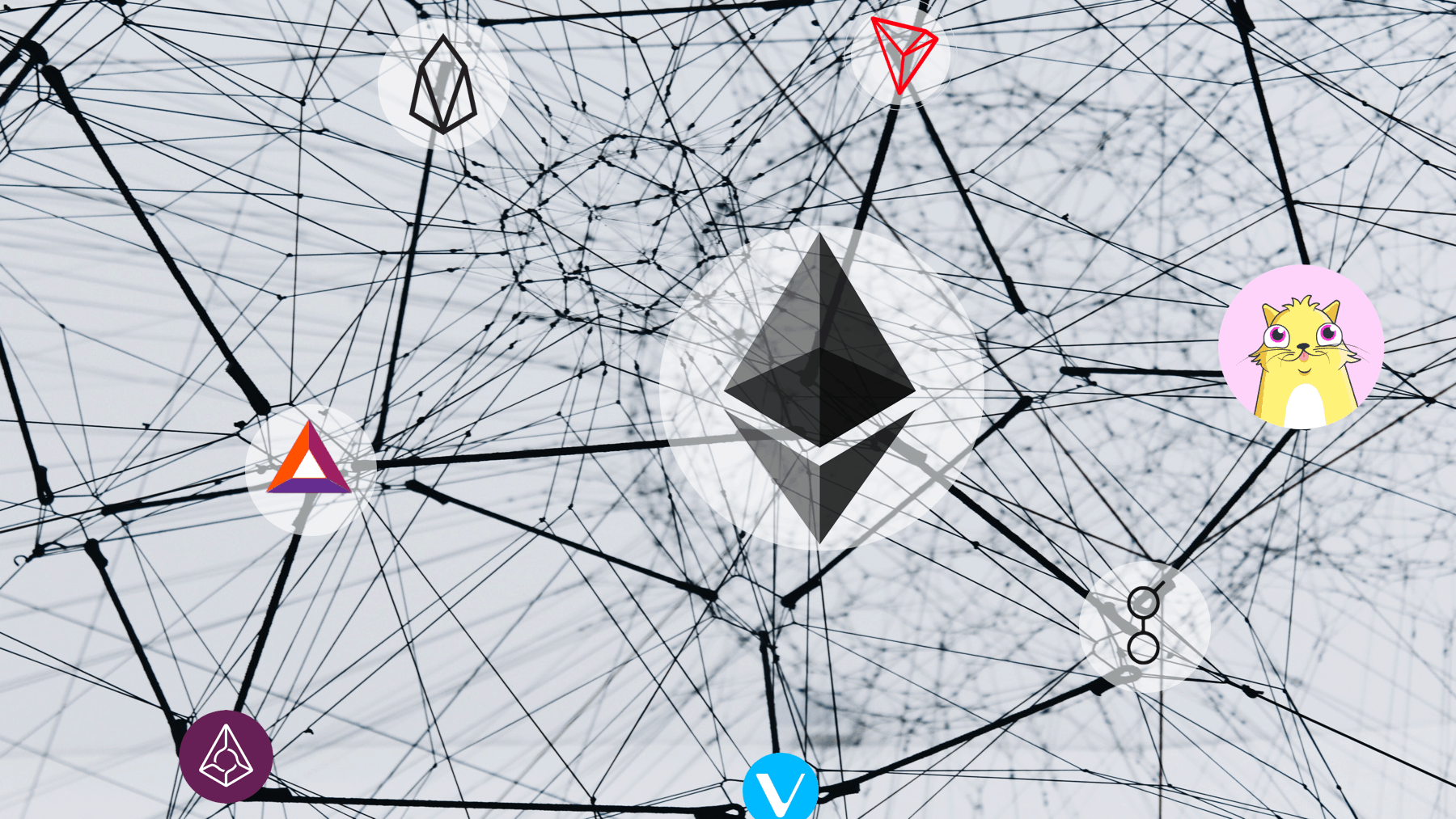
This is the second post in which we are going to examine blockchain protocols and their tokens. First up, we wanted to start with Ethereum and its native token, Ether, which allows a network of thousands of independent computers to form a single supercomputer.
The beauty of blockchain lies in the possibility to create, securely maintain and transfer digital units, so-called “tokens“. These tokens can serve the purpose of a medium of exchange, which is redeemable for something specific from someone specific. Generally spoken, this is what gives tokens their underlying value. As a consequence, these value units can be used to incentivize certain behavior.
Bitcoin, the first blockchain protocol uses its native token, BTC, to incentivize its network participants in competing to solving a cryptographic puzzle. Whoever solves the puzzle first is rewarded with new BTC and eligible to add a new block of transactions to the ledger.
Ethereum is a network protocol, which uses Ether to incentivize individual computers to act as a single supercomputer, called Ethereum Virtual Machine (EVM). This computer is capable of running any code, written in the native, Turing complete programming language Solidity. The code on the Ethereum Network follows an if/then logic is called a “Smart Contract”.
Smart Contracts are executed on all computers of the network simultaneously, therefore, in a decentralized manner. Once a Smart Contract is deployed to the network it is theoretically impossible to alter or delete it. To perform any changes the majority of the network would need to be convinced to rewrite the underlying code.
Imoratbillity brings the benefits of censorship resistance and prevents any manipulation through malicious actors. Further, running the code simultaneously on all computers of the network eliminates a single point of failure and prevents, therefore, any downtime. These prosperities make code that is running on the Ethereum network highly trustable. However, the downside of immutability arises through the missing opportunity to fix bugs within a Smart Contract once it is deployed.
Just like traditional programming code, Smart Contracts can be used for various purposes.
For example, a Smart Contract can express all the required rules to define ownership and the transfer of ownership, which are required to issue and manage a new token.
Further, Smart Contracts can be used to create computer programs, so-called decentralized applications (Dapps).
Also, it is possible to reproduce organizational rules and structures with Smart Contracts. These constructs are then referred to as Decentralized Autonomous Organizations (DAOs) and are managed over their specific tokens, which grant ownership rights such as voting or dividends.
However, you might ask yourself why people are buying computers, paying for running them and then contribute them to the Ethereum network?
Here is where Ether (ETH), the native token of the Ethereum network comes into play.
For performing any transactions on the Ethereum Virtual Machine a fee is charged and paid out to the validating network participants.
Transactions on the network include:
- The transfer of tokens
- The deployment of a new Smart Contract
- Triggering of a Smart Contract
The fees for these transactions are price in priced in “Gas”, the medium of account of the network. The amount of Gas charged for any transaction is predefined and derived from the computing power required to perform it. However, while the charged amount of Gas for a transaction is fixed, its price is variable and depends on the current degree of network utilization. The price of Gas expressed GigaWei (GWei), which accounts for 1/1.000.000.000 ETH.
As stated, Ethereum can be described as infrastructure to host the code of thousands of different tokens, Dapps or even DAOs, eliminating the need for developing and maintaining an individual blockchain for each project.
For exchanges and wallets to deal with this great variety of tokens Ethereum offers different token standards, which will be examined in depth in the following blog posts.
The most prominent one is probably the ERC20 standard, a fungible token, which has be frequently used as a financing method in initial coin offerings (ICOs).
Examples for application-specific ERC20 tokens are:
– GNT, the currency token of the Golem.network, a cloud computing platform.
– REP, a token is used to place bets on the prediction market Augur.
– BAT, of the Brave internet browser, which is paid to users for receiving adds.
– EOS, a smart contract platform.
Another popular token type is the ERC-721 standard, which allows creating non-fungible tokens. These tokens are unique and can be therefore used to represent real-world assets, such as fin art, real estate or digital collectibles. A good example of the use of ERC-721 tokens is the blockchain game Cryptokitties, in which players can own, breed and trade digital cats. The cats are priced in ETH and sold for up to 140.000 USD.
Ethereum is a great example of how blockchain and tokens can be used to create applications and new markets.
In the following posts, we will further explore the use cases of Ethereum.
Stay tuned!

by Martin Schäffner | 16 December 2019 | Blockchain
This is our first in a series of blog posts dealing with the topic blockchain token, what they are, and how they can be used.
Historically, the term “token” has been used to describe a physical object, like coins, made of base metals or other low-value substitutes (such as wood, ceramic, plastic or paper). These tokens are a form of private replacement money and serve the purpose of a medium of exchange for goods and services. Further, the concept of tokens has been studied and approved as a method of behavioral therapy in mental health facilities to incentive and reinforce desired behavior.
In the blockchain space, a token describes a qualifiable and programmable unit within a blockchain network. Sometimes a distinction is made between tokens and coins, in which coins refer to the native unit of a blockchain network while tokens don’t have an own underlying blockchain but are hosted on another one.
Tokens within a blockchain network are associated with addresses. These addresses are mathematically derived from a private key. A private key refers to a random created string of characters, 64 in the case of Bitcoin. To transfer a token from one address to another, the initiator of the transaction of needs to identify and authenticate himself to the network, that he is indeed the legitimate owner of these tokens. This is done by signing the transaction with the correlated private key of address from which the tokens shall be transferred.
While the digital nature of blockchain tokens makes transferring them more complicated, in comparison to their physical ancestors, however, it grants them also with distinct advantages.
First, the cost of issuing and maintaining blockchain tokens is marginal. For example, only a couple lines of solidity code and a fraction of 1 Ether, the native token of Ethereum, are required to create a new token on Ethereum. The token is then secured by the blockchain network its hosted on.
Second, tokens are programmable. This allows to create various distinct types of tokens and to implement special features, allowing to tailor them to serve countless purposes. For example, a token can be programmed to be either fungible or non-fungible. Fungible tokens, just like a 1EUR coin are, identical, interchangeable and divisible into smaller units, e.g. two 50ct coins.
In contrast, a non-fungible token is unique and therefore neither interchangeable nor divisible.A real-world example for a non-fungible token would be a one of a kind art piece like a painting of Pablo Picasso. Also, a token can be programmed to be transferable or non-transferable. Further, it is possible to connect tokens to another asset or a basket of assets, which allows, for example, to tokenize a security or to create a stable token.
Today already plenty of different tokens exist with use cases varying from currency and supply chain traceability to digital collectibles and countless more are going to be discovered in the following years. Time will show if blockchain tokens will have a similar impact on our financial system like the internet and e-mail had on the postal one as being considered by Dr. Shermin Voshmgir, the director of the Institute for Crypto-Economics at the Vienna University of Economics and Business.
In the following post, we will examine the use of blockchain tokens in-depth based on real-world use cases.
Stay tuned!
by Martin Schäffner | 8 November 2019 | Blockchain, Track and Trust
We at Datarella are working together with the UK Department for International Development’s (DFID) innovation and future technology program, Frontier Technology Livestreaming (FTL) and the European Space Agency (ESA) to increase efficiency within humanitarian supply chain.
Our goal is to maximize the value, which is arriving at the people in need by establishing transparency and collaboration between the responsible supply chain stakeholders. In part one of our blog post series, we described how we tested our Track and Trust System. For testing, we tracked a live shipment of 304 family tents from Pakistan to Dubai between the first four parties of DFID’s supply chain. In part two, we described the challenges, which occur when tracking the last-mile of the deliveries. In this post, we are going to go further down the rabbit hole and dive into the technology, which will enable us to overcome the Sisyphean task of last-mile supply chain tracking.
The story starts after the implementing partner received the goods, loaded the trucks and the driver starts his way to the destination in the crisis area.
The environmental circumstances surrounding humanitarian missions are highly heterogeneous and can range from tropical islands after a hurricane to newly built refugee camps close to a war zone. However, the one thing they have in common is that within the first few weeks after the disaster took place telecommunication infrastructure mostly is not available.
Despite these difficulties, to provide stakeholders within the supply chain with an overview about the current status of the deliveries, we at Datarella are working to test the usability of a LoRa-based Mesh Network which transmits the transaction data offline until it’s finally able to be posted to the blockchain via a satellite uplink. We’re partnering with our friends at Orora Tech who know the ins and outs of the satellite technology quite well since their main business involves the manufacture of nanosatellites.
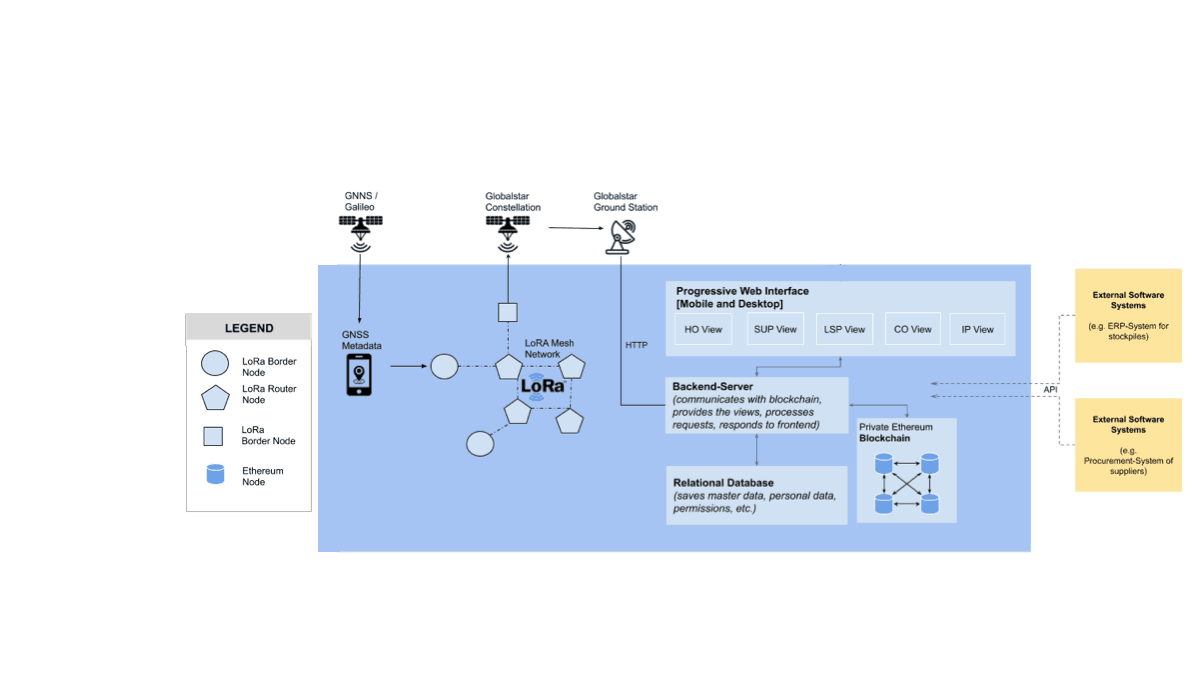
Our solution consists of the following components:
1. A user interface implemented as a progressive web app with offline capability
2. A LoRa-based Mesh Network
3. A Globalstar satellite uplink
4. A private permissioned Ethereum Blockchain
Whenever a transfer of goods occurs, the involved parties, e.g. the truck driver and the consignee in a base camp, will use their mobile phones to prepare the necessary blockchain handoff transactions offline. Data about location, time and custody will then be saved within the progressive web app interface (including pre-signed Ethereum transactions when possible).
Then, to transmit this data without having an internet connection, we are planning to use a LoRa-based mesh network.
A LoRa network can be described by its two main characteristics.
1. As the name indicates, it allows long-range transmissions with a reach of approximately 12km in rural areas.
2. It operates at low power consumption.
Further, the term “mesh network” describes a network composed of nodes, which connect in a direct, dynamically and non-hierarchical manner. Therefore, these networks are also referred to as “self-healing” since nodes can organize and configure themselves, which allows the network to persist even if some nodes are not available.
For creating a Pymesh LoRa Mesh, we are planning to use LoPy4, a 4-network (WiFi, BLE, LoRa, and Sigfox) and MicroPython combination controller. Further, we are considering to either equip some of them with Pytrack carrier boards, for very accurate GNSS Glonass GPS. An alternative method of geolocation is to feed in GPS data from the mobile phones of the drivers.
The network is implemented using OpenThread, an IPv6-based networking protocol. The reasons why we decided for this network type are its following features:
- Simplicity — Simple installation, start-up, and operation
- Security — All devices in a Thread network are authenticated and all communications are encrypted
- Reliability — Self-healing mesh networking, with no single point of failure, and spread-spectrum techniques to provide immunity to interference
- Efficiency — Low-power Thread devices can sleep and operate on battery power for years (Dependent on how often they wake to transmit)
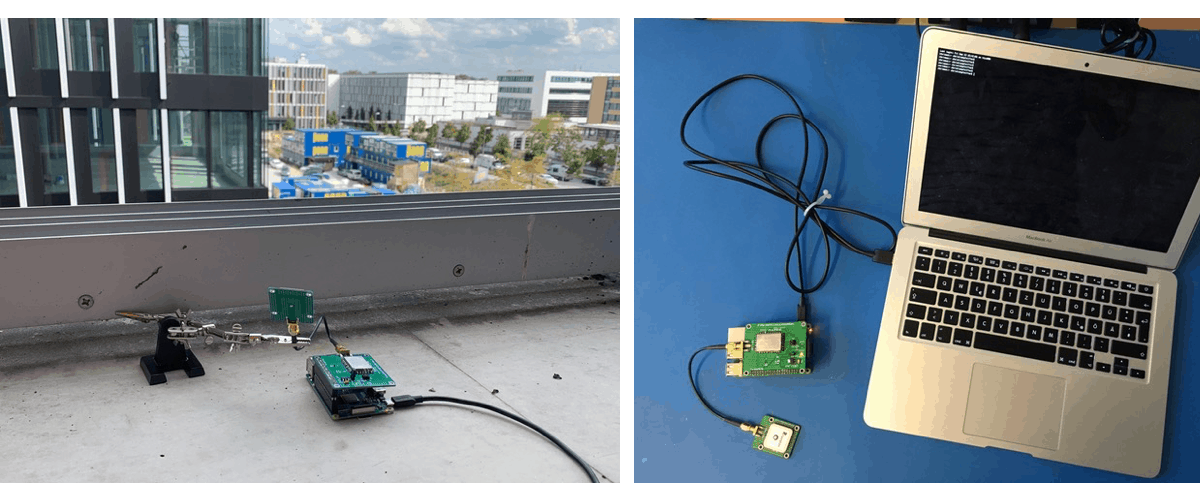
To create the Pymesh network, we are planning to install LoPy4s on the trucks, which are used to deliver the humanitarian goods to their destination. As soon a truck gets within the reach of another network node, it will transmit the offline transaction to the next router. The transaction will travel through the network node by node in this manner. Here you see a prototype
Since the reach of the LoRa routers is limited to approximately 12km we are also playing with the idea to install an air-based router, using a fixed-wing drone or a weather balloon, which would extend the reach up to 500km.
So far so good. Now the transaction data will be transmitted from truck to truck until it reaches a border router, which is connected to a satellite network. So far we have tested an uplink for a very basic JSON RPC transaction over a Globalstar simplex transmitter and successfully sent two data packets to the Globalstar constellation. Each contained a portion of the data needed to make an Ethereum transaction.
After the transaction data is sent via short bursts to the Globalstar constellation it will be received from a ground station, which is connected to the internet and executes the signed transaction in a live blockchain.
Together all of these components should enable a humanitarian agency to roll out tracking for their assets and provide transparency across their entire supply chain despite the total absence of telecommunications infrastructure in the last mile environment. All of this will be backed by a blockchain ledger providing the stakeholders in the humanitarian supply chain a single source of truth regarding custody all the way up until the final aid delivery.
by Martin Schäffner | 24 October 2019 | Blockchain
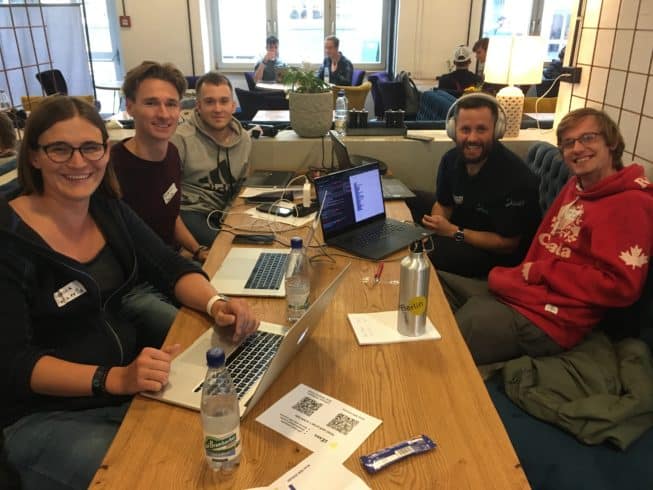
For the last year, we at Datarella have been working together with two leading sensor, IoT and infrastructure providers to collectively set technological standards and build distributed ledger technology to shape the future of mobility. On 19th and 20th of October Datarella participated at the Diffusion Hackathon by Outlier Ventures to experience live the 20 most exciting Web 3 protocols. We had the opportunity to dive deep into the Fetch.ai tech stack during the event and were able to leverage those tools to build a PoC over the course of two days. Fetch offers a unique agent-based approach to allow developers to turbocharge the matchmaking capabilities enabled by converging blockchain and AI. We proudly announce that our team of Rebecca Johnson (Datarealla), Tom Rae (Agent3), Idan Portal (2key), Tomasz Gęsior (Baltic Data Science) and Philipp Kothe (Datarella) won with our project “Effortless Parking” in two tracks.
During the hackathon, we built a project on top of a real-world use case in development within our consortium. Our Diffusion 2019 project is meant to extend and build on top of our current prototypes for improving coordination between parking lot operators, cars and the IoT & infrastructure providers whose systems make up the mobility landscape in which parking transactions take place.
Our goal was to increase the efficiency in the parking market by reducing the transaction costs which occur between the driver and the parking lot owner. Further, we wanted to prove that an open and collaborative market, enabled by web3 technologies, would be beneficial for both sides of this market. To strengthen our argument we will refer in this post to two economic theories, the transaction cost, and economic surplus theory.
1. Transaction costs
According to a study, car drivers spend around 40 hours a year searching for a parking space. This is not only a waste of time but is also responsible for one-third of all traffic, respectively traffic-related air pollution in inner cities. At the moment drivers have to download multiple apps and compare the offers of various parking garage operators to evaluate what is the best parking option close to the destination. Alternatively, many drives just drive around looking visually for an opportunity to park. However, both approaches are related to high opportunity and searching costs for the consumer.
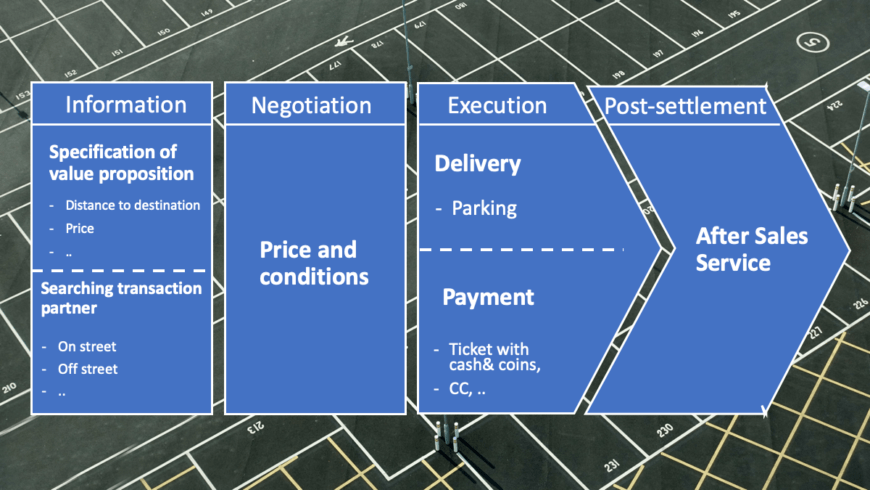
These costs together are also referred to as transactions costs and occur whenever a good or service is transferred via a technologically separable interface. Transaction costs describe both monetary and indirect costs such as time or effort. For a systematic approach, these costs can be divided by the time they take place in the transaction process. For example, prior to the conclusion of a contract, time needs to be spent searching and evaluating information, negotiating price and drafting/reviewing contracts, adjusting the contract/s, and finally, after contract execution, time must be spent to resolve any post-settlement disputes.
Like all costs, transaction costs have a limiting effect on economic growth. As a result, technological and organizational innovations that reduce transactions costs for users are becoming increasingly important for macroeconomic development.
2. Economic Surplus
Also, on the other side of the market, we identified high inefficiencies. In contrast to airlines or hotels, car park providers currently do not usually implement any kind of capacity utilization-based pricing. This, in combination with a lack of coordination and information among drivers, leads to a system of suboptimal asset utilization since some car parks are overbooked and while others are still nearly empty. The consequence is a limitation of the economic surplus created in the parking industry.
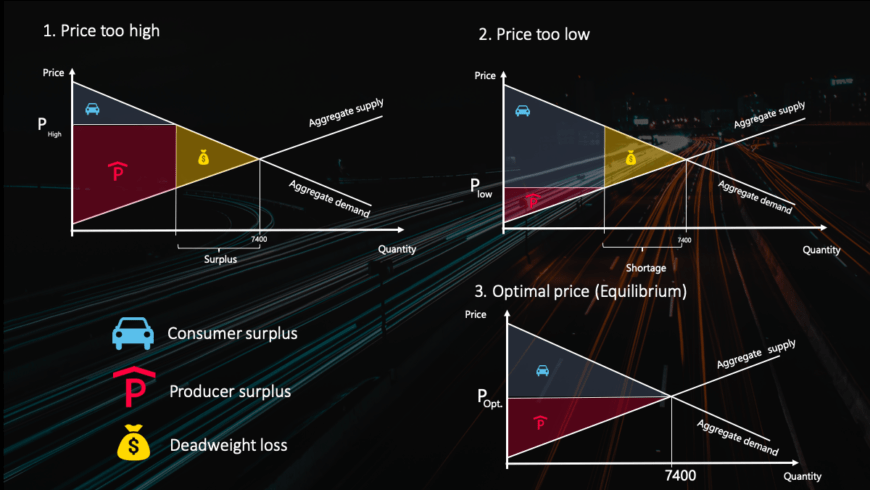
Economic surplus is a macroeconomic concept established and framed by the economist Alfred Marshall in the mid-19th century. Together with Karl Heinrich Rau, he developed a diagram, which shows the relation of demand and supply in dependency on price and available quantities of an economic good.
But let’s take this into practice and look at an example. The paid parking market in Munich consists of over 24 parking garages which offer about 7400 parking spaces.
In this simplified example, three scenarios are possible as shown in the graphic.
1. If the price is too high, there is not enough demand and we face a surplus in parking spaces.
2. If the price is too low a shortage occurs because there would be more people willing to park than operators offering lots.
-> In both cases, a deadweight loss is created and value is lost since the full market potential cannot be captured.
3. The equilibrium price is found. Hereby, the price is set where demand exactly meets supply, which allows to capture the full market potential. Important to note is that this system is referring to the average price, which is composed of the individual prices of each parking garage.
3. The Fetch.ai Solution
To solve this dilemma of coordination and optimal pricing our team used Fetch.ai, a system designed to increase market efficiency by helping to match supply and demand.
So, during this hackathon, we used Fetch.ai to build a software simulation that would allow us to model the revenue generated by the parking providers under both optimal and suboptimal coordination conditions. Our first model simulated the revenue of each parking lot operator without any cooperation between the different provider, coordination or dynamic capacity utilization based pricing. In that model, drivers just attempt to find the closest spot (which is close to the real behavior of inner-city drivers). The second model simulates a smart network in which the different operators collaborate and drivers are coordinated to the available parking spaces, which match their preferences for distance and price. Autonomous economic agents powered by AI negotiate to achieve economically efficient outcomes.
We implemented our project using Fecht.AI prebuild SDK library, which allowed us to run a local ledger and a local IEF node. Further, we implement a custom data service to represent the parking garages. In this model, the parking garages acted as data provider and the drivers compared then the data they saved as preference vector (like distance to destination, price..) with all of the available data from the garages. After all options are evaluated, the agents choose the best option for the driver and sets a deposit in Fetch (FET), the native token of the ecosystem, to reserve the parking spot. We then used Fetch.ai smart contracts to represent the tickets which are sold and bought.
This system allows to discover the equilibrium of the whole parking market dynamically, reacting to any changes in capacity utilization in real time. Practically it can be used to demonstrate to parking lot operators that they are leaving significant money on the table by not using a fair and neutral DLT based coordination and booking system alongside their competitors. Everyone’s better off in this model as deadweight loss and negative externalities are removed from the system while maximizing both parking operator revenues and net economic surplus.
We are absolutely thrilled to further discover the endless possibilities Fetch.ai offers. The best part of the system is the fact that these “simulations” are intended to be implemented within production systems in the future. This means that the same system we’re using to simulate the future economic and environmental effects can then be put into use to actually achieve those outcomes in a real-world system.
by Martin Schäffner | 15 October 2019 | Blockchain, SSI
We from Datarella are always encouraged to be experts in the field of blockchain-related concepts and technologies and also to share our knowledge with the blockchain community. This blogpost should raise awareness about Self-Sovereign Identity (SSI), a fundamentally new approach of digital ID enabling users to have autonomy about their decentralized identifiers (DIDs) on the internet.
Managing identities on the internet is a problem since its early days as it doesn’t have an integrated identity layer. Conventional identities are represented by identifiers provided by identity providers, such as an e-mail or a social media account like Facebook. The problem with these is that the identifier is not owned but only borrowed. The identity provider remains in control of the identifier and not the actual user. Although registration at new services is an annoying process already, the major problem is that websites store this personal information on their servers to determine who their users are. Based on the user information, data is generated and passed on to third parties without the explicit knowledge of the user. Besides, it often happens that this information is not sufficiently protected against criminal attacks.
DIDs as the fundamental component in Self-Sovereign Identity
The new digital ID concept “Self-Sovereign Identity” should allow users to have full autonomy about their identifier and control over how related personal information is shared and used and with whom. The fundamental component which makes it possible is the so-called decentralized identifier (DID). A DID represents the user in a pseudo-anonymous way and is derived from a public key generated on a blockchain or other distributed ledger technologies. Users can create and register their DIDs without the need for a central authority.
DIDs serve to create lifetime relationships with others in a decentralized and privacy-preserving manner. Only the information that is needed should be disclosed. A popular example is that a verifier doesn’t care about the actual date of birth but only if the user is old enough to use or access a service. By using zero-knowledge proofs, the verifier only sees this information, derived from the date of birth.
Self-Sovereign Identity further faces the challenge to merge the real-world identity closer to the offline world. This should be achieved by integrating verifiable credentials that can be issued to assert personal information to the DID. Credentials could contain any information, depending on the issuer, such as a valid digital ID, an attestation about a relationship like a club membership, or a digital diploma. By gathering such credentials, a user could integrate real-world identity characteristics to the online identity.
Still a long way to go for SSI
Even though the concept of SSI is very promising, and standardized formats, such as DID, exist, there are still big hurdles to take.
One challenge will be how this concept should be integrated on the internet. The usability has to be intuitive, so users tend to use their DIDs instead of a username and password combination. Then all actors have to be on-boarded. This is the typical chicken and egg problem. It requires a significant amount of services and authorities to accept or issue credentials but it also needs enough users to incentivize authorities to offer credentials first.
However, there are already several projects running that provide this technology. The Sovrin Network, for instance, provides an advanced identity ecosystem that allows users or authorities to form relationships with others and issue or receive credentials. The uPort project also provides a full SDK to implement Self-Sovereign Identity solutions on the Ethereum blockchain.
If you are interested in more information about Self-Sovereign Identity feel free to contact me via E-Mail or read into already existing documentation, such as the DID primer.

by Martin Schäffner | 10 October 2019 | Blockchain, Track and Trust
Whenever a crisis occurs, humanitarian organisations, their suppliers and logistics partners need to react as fast as possible to send urgently required goods to the people in need. During the previous months, we at Datarella have been working together with the UK Department for International Development’s innovation and future technology program, Frontier Technology Livestreaming, to enable transparency, collaboration and efficiency gains in humanitarian supply chains by implementing a blockchain-based tracking system. Now we are going to expand our ambitions by tackling the challenges of tracking the last-mile delivery, which is due to its demanding circumstances especially problematic. This is the second in a series of blog posts describing the work so far as well as what we’ve got planned. If you are not familiar with the Track & Trust story click here to learn about it.
Each humanitarian mission has its own specific challenges. Often, the conditions of roads are uncertain, and the telecommunication infrastructure is destroyed or unavailable. One of the biggest problems is keeping track of the chain of custody after the consignee receives goods from customs in-country.
Documentation about the current ownership and transactions of goods is mostly done manually, which makes it vulnerable to human error or fraud. As a consequence, high transaction and transportation costs occur since the implementing parties have a hard time finding out if the goods arrived properly at their destination.
To solve the problem of last-mile tracking within the humanitarian supply chain, we at Datarella applied for and received a kickstarter project grant from the European Space Agency. We are building out a series of prototypes to prove that our technical approach works while also engaging with our partners in humanitarian aid operations to test our assumptions.
As a solution, we propose our Track and Trust System combining bleeding edge blockchain and IoT technology to close the documentation gap in the last mile.
Hereby, we need to tackle two main challenges:
- The solution needs to document transactions of goods and their location in the blockchain without being directly connected to the internet.
- No expensive, eye-catching or complicated hardware can be installed in the trucks, which are delivering the goods since it might be stolen, endanger the driver or might be too complex used easily by drivers.
To solve the problem of offline data transmission, Datarella is working together with Orora Technologies to test the usability of a LoRa-Based Mesh Network. With the help of this low-cost, self-healing network data will be transmitted to the satellite base station. From there it will be uploaded using efficient Short Burst Data transmissions to the Globalstar satellite constellation.
Finally, all transactions will be saved into a private permissioned Ethereum blockchain to create a transparent and tamper-resistant register of transactions, which will serve the stakeholders as a single source of truth.
Over the next few weeks we’ll be describing our work to solve last mile delivery issues by augmenting the existing Track & Trust system with various offline capabilities.
We’ll be writing a series of blog posts outlining the work so far and what’s coming up soon. Stay tuned!
by Martin Schäffner | 20 September 2019 | Blockchain
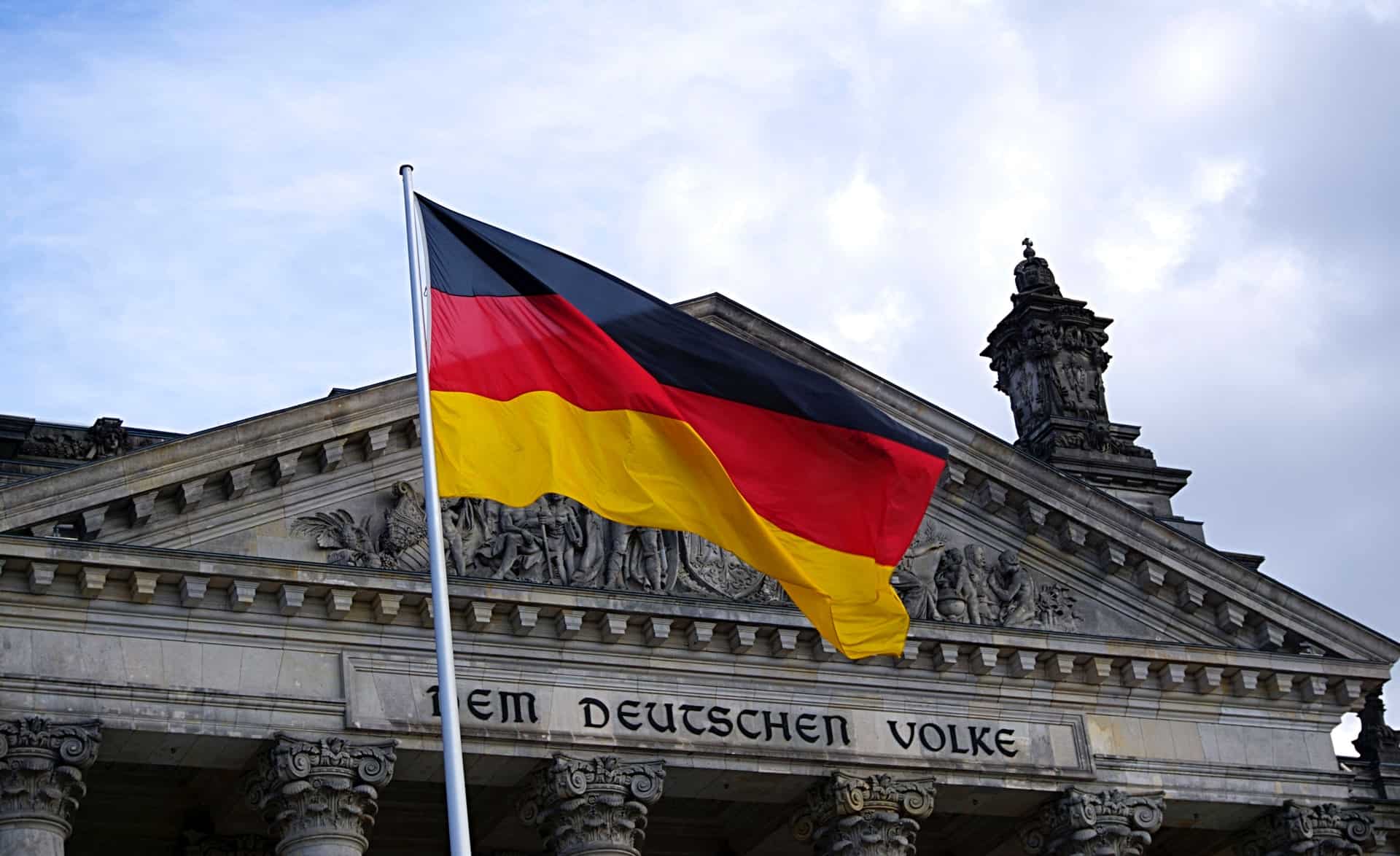
On 18 September 2019, the German government issued a 24-page strategy paper called “Blockchain-Strategie der Bundesregierung”, an official statement outlining the initiatives Germany together with other EU states plan to support Blockchain-technology. This paper was published shortly after the EU published its “Blockchain Now and Tomorrow” paper, which summarizes the EU initiatives regarding Blockchain application. It is worth mentioning, that the paper by Germany is much more extensive and specific when comparing both statements.
Blockchain is one of the most discussed technological topics within the German Cabinet. This is due to the fact that this technology will impact many different areas including economy, society, international trade and environment. The Cabinet states that Blockchain is “one of the technologies which is anticipated to have a profound impact over the next 10-15 years.”, mainly due to an increase of Blockchain activities within startups but also established companies. Therefore, the Germany government reached out to 168 prestigious experts with different backgrounds to elaborate the potential of Blockchain. The outcome of this initiative was the base for this strategy paper. The very good news is that in general the German government fully supports Blockchain technology. However, there are some limitations. The paper outlines that the Cabinet will not support private stablecoins as an alternative to sovereign currency. This implies that initiatives like Facebook’s Libra will be clearly blocked.
So, what are the key initiatives according to this paper?
Ensuring stability and stimulating innovation with Blockchain in the financial sector
The German Government plans to open German law for electronic securities as early as this year. In its first iteration, only digital bonds will be covered. If this turns well, electronic shares and investment funds on the Blockchain will be considered as a next step. The paper outlines “The regulation of electronic securities should be technology-neutral, so that future electronic value papers can also be issued on a Blockchain.”. That’s great, in particular for our new company RAAY Real Estate, which supports the issuance of digital tokens for the real estate industry.
Establishing a token exchange
The Cabinet will work on laws on the regulation for exchange for non-traditional securities, i.e. security tokens and cryptocurrencies. A new “BaFin” permit for exchanges will allow the trading of crypto-assets on German exchanges.
Enhancing and supporting Blockchain innovations
The German Government will promote and financially support Blockchain projects. As an example they plan to pilot a Blockchain-based energy system connected to a public database. Also, they mention that they will promote the testing of Blockchain-based verification of higher education certificates.
Applying Blockchain in digital ID
Germany will seriously explore the use of Blockchain for digital identity. Timing is unclear, but the Cabinet announced that they plan to explore the benefits of Blockchain in use cases like maintaining the records of civil status, document registration, passports and ID cards.
Blocking private stablecoins
The strategy paper clearly states that the German Government will not support the establishment of any private stablecoin to get dominance in the country, as well as in the EU.
Overall, the Blockchain strategy paper published by the German government clearly proves that Germany is very serious about becoming the leading state for Blockchain technology. Surprisingly, the paper is very extensive and covers a broad range starting from finance to industrial applications. According to CoinDesk, the German parliament member Thomas Heilmann stated: “The home of the emerging token economy will be in Germany, just as Silicon Valley became a hotspot for previous innovations.”
This is great to hear – let Germany become the Silicon Valley for Blockchain in Europe!
