Supporting charity projects is a great thing to do. Donors deserve to know for what their contributions were used. We are happy to announce the launch of a new, central feature, our SmartAid Token Management System (TMS). Projects on SmartAid can now use the dashboard of the TMS to allocate received donation tokens to their cost centres. These transactions are made visible to donors on their individual donation trackers, creating a transparent donation experience.
Recap: Traceable Donations with SmartAid
SmartAd’s mission is to make donating more transparent and engaging. As described in this previous blog posts, SmartAid uses a private permission Ethereum Blockchain to document each donation of its users. When you donate via the integrated PayPal API, we deploy a new ERC20 contract for you and send your donation tokens to the project’s address. The “Donation Code”, which is displayed on the top of your donation tracker, is the smart contract address of your donation token. With this address, you can identify and follow your donation within the SmartAid system.
SmartAid Token Management System (TMS)
Now the journey of your donation tokens can continue. With the support of the EU-funded accelerator program, Blockpool, we developed our Token Management System, which allows projects to allocate the received tokens transparently to their various costs centres.
The budget allocation is enabled by our simplistic and user-friendly dashboard.
Project dashboard with dummy data
On the dashboard, project managers gets an overview on the most important stats of their SmartAid projects. In the “Budget” widget, the SmartAid project can create a new cost centre. After entering the budget name and amount, the budget is saved as open budget. In this state, project managers can still alter budgets. When the budget is finalized, the project manager closes the budget. At this point, the magic happens and transactions on the SmartAid Blockchain are triggered. The same percentage amount of each donation tokens in the “available budget” is transferred to a new address, representing the cost centre.
Let’s picture this:
Alice donated 200 EUR, Bob 500 EUR and Charles 300 EUR to the Water projects. A funding milestone is reached and the SmartAid project can start. The first money was spent (500€) on a report, evaluating the best place to build a water well. The project creates a 500 EUR budget on the SmartAid dashboard. Once the payment is conducted, the project manager closes the “Location Evaluation” budget. 50%(500EUR/1000EUR) of the available budget/donations tokens are spent. 100 EUR/ (200*50%) of Alice, 250 EUR of Bob and 150EUR of Charle’s donation tokens are distributed to the address representing the location assessment.
Benefits of the TMS
The TMS provides projects on SmartAid three main benefits, a clear overview on the current funding situation, a tool to dynamically plan budgets and for reporting to donors. All of them are important, however, we hope that reporting to donors can solve one of the mayor issues for charity organizations, which we identified during surveys. Currently, projects can only spend donors’ money on previously defined activities. However, not everything can be planned in advance and circumstances occur, in which the donors’ money can create more impact if spend on something else then specified before. The TMS can solve this issue by giving projects the freedom to spend donations on the most relevant causes, while keeping their donors happy by reporting closely.
The information on the fund usage is made available for donors on the SmartAid web app. The project page displays the overall allocation of project funds. Further, each donor can review the spending of her individual donation usage on her donation tracker page. Together with blog posts, this provides transparency for the donors, which are rarely by any other donation platform.
Conclusion
SmartAid’s new Token Management System provides projects with a tool for budget planning and reporting to donors. All transactions are documented tamper resistant on the SmartAid blockchain. By having donation trackers, reading from the blockchain, donors can follow their donation and answer the important question of “what happened with my donation?”. While this brings an advantage over most other online donation tools, we are still at the beginning. Users need to trust that projects honestly allocated the token representations of their donations the same way the allocated fiat funds. We are keen to migrate SmartAid to a public blockchain network to eliminate the required trust, when handling with legacy fiat systems.
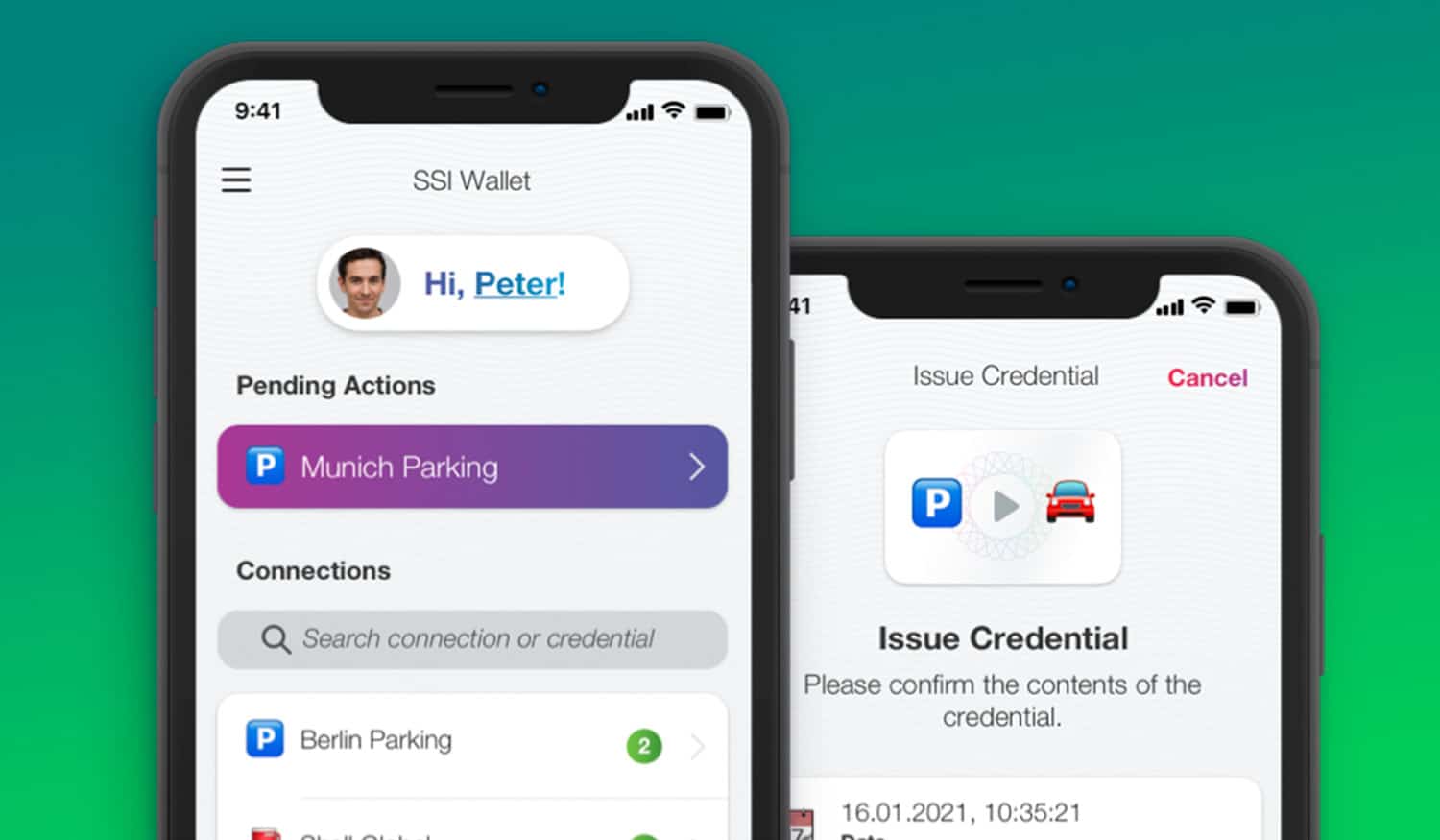
Datarella is offering its customers state-of-the-art Self-Sovereign Identity infrastructure with its SSI Wallet for innovative identity management. It can be integrated into new or existing ecosystems and provide fundamental decentralized identity infrastructure for users to authenticate, issue and receive Verifiable Credentials or transfer data. This allows for many innovative use cases like credential-based access management, automatic credential verification or trusted data transfer.
The Wallet
Having full control over an own digital identity is one of the fundamental principles for Self-Sovereign Identities. This includes that private keys and verifiable credentials are not stored on a centralized exchange or platform, but on the user’s very own devices in a decentralized manner. From this device, the user can issue or receive credentials and authenticate themselves by connecting with other SSI agents.
Like in the physical world where an identity is represented by an ID document which is often kept in a physical wallet, digital private keys and verifiable credentials are stored in a digital wallet. From here, the user can decide with whom the user interacts and shares information from its wallet. The user can ensure that private information is stored only on authorized devices and not in centralized databases which reduces the risk of data breaches tremendously. A wallet can have various forms, a browser extension, a hardware wallet or an entire app like Datarella’s SSI Wallet.
Technology
The SSI Wallet is meant to be deployed in ecosystems that allow users to interact with each other, with SSI compatible websites and IoT edge devices like micromobility vehicles. This is enabled by the Aries Framework Go, which supports a broad variety of edge- and cloud environments.
The wallet further provides a high level of privacy as it natively supports did:peer methods which creates pairwise pseudonymous DIDs for each individual connection and therefore avoids correlation by design. Even though did:peer does not require a ledger, the Aries-Framework Go supports public DID methods like did:web or DIF’s Sidetree protocol. It further allows selective disclosure of credentials thanks to its support for BBS+ signatures. The SSI wallet is therefore perfectly suited for public adoption as well.
It will soon also contain SDKR – a decentralized key backup and recovery mechanism that allows you to backup and recover your secrets with only your official eID. No need to remember passwords or the location of your backups thanks to eIDAS and decentralized and opaque storage capabilities from StorJ.
Conclusion
With our SSI Wallet, we are confident to demonstrate the benefits of Self-Sovereign Identity perfectly in a privacy-preserving and intuitive manner. By using the Aries-Framework Go, we can ensure that it works on web applications and mobile solutions as well as on proprietary IoT devices either without a ledger entirely (only P2P) or by using did:web or the Sidetree protocol.
It is no secret, Ethereum, the by market cap and adoption most successful smart contract blockchain, is at its limit. Various DeFi apps, like Uniswap, Aave, games, like Axie Infinity, NFT marketplaces and issuing protocols, like OpenSea and Rarible and countless transactions and other smart contract interactions are clocking up the network. Sidechains and Layer 2 solutions are here to tackle the scaling problem of Ethereum until its transition to Ethereum 2.0 in completed.
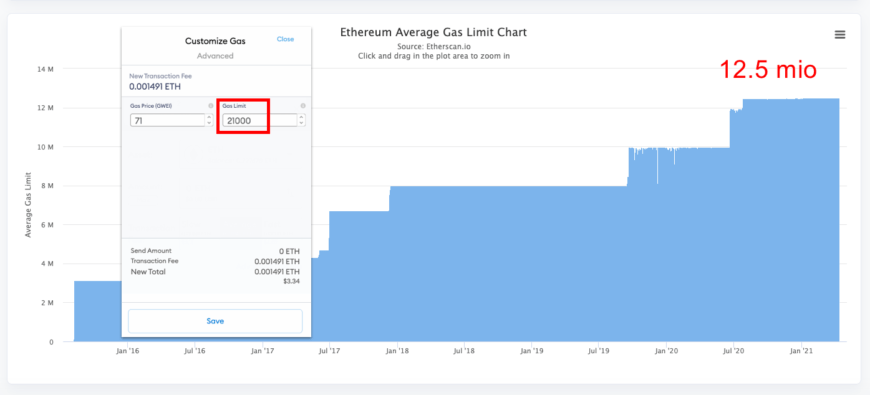
For each transaction on Ethereum a certain amount of Gas needs to be paid. The amount depends on the computational effort. A simple transfer of ETH costs 21.000 Gas while a trade on Uniswap can cost 250.000 Gas. Miners of the network set the Block Gas Limit, which specifies the amount of how much Gas can be included within one block. This limit is currently set to around 12.5 million. A new block is minted roughly every 13 seconds. Which transaction is getting in the next block is determined by the Gas Price the sender is willing to pay. To make an example, at the current Block Gas Limit 595 simple ETH transactions could be process, rounding to 45 transactions per second.
Solving the scaling issue of Ethereum
Since ETH 2.0 is still under development various teams are working on solutions to solve the scaling problem of Ethereum. Most scaling solutions can be categorized into Sidechains or Layer 2 solutions. The main difference between Sidechains Layer 2 solutions lies in their security mechanisms.
Sidechains
The term Sidechains describe blockchains with own consensus mechanisms, which are compatible with Ethereum. Examples are the xDai and Polygon network. xDai used a delegated proof of stake consensus mechanism, which allows for fast and inexpensive stable transactions. A transaction does not take longer than 5 seconds and 500 of them cost only around $0.01. A bridge between xDai and Ethereum makes it possible to transfer any ERC20/677/827 tokens between the networks. This scaling solution is used from various NFT minting platforms, like Nifty Ink, or DAO infrastructure providers.
Layer 2
In contrast, Layer 2 solution do not have their own consensus mechanism but rely on the security of Ethereum. An example of Layer 2s are Roll-ups, which describe off-chain aggregation of transactions inside a Ethereum Smart Contract. You can differentiate between ZK-Rollups and Optimistic Roll-ups. With ZK-Rollups, funds are hold by the smart contract on the mainchain. Computation and storage are done off-chain while validity is ensured using zero-knowledge proofs. A project with works on ZK-Rollups is Loopring. Optimistic Rollups, are using a challenge period of 1-2 weeks to challenge fraud in case the aggregator has submitted an incorrect transaction. Therefore, you are “optimistic” on the submitted transactions. A project using Optimitic Rollups to scale Ethereum is Optimism. Its launch is planned for July 2021. Uniswap is currently running a demo version, Unipig, on Optimism, which only required 143x gas costs and allows for transaction in milliseconds.
Conslusion
Sidechains and Layer 2 solutions are an essential element to solve the scaling problem of Layer 1 protocols. It will be interesting to see what will happen to them when hyper scalable Layer 1 solutions arise, like Ethereum 2.0, Solana, Elrond, and many more.
Uniswap, a Decentralized Exchange (DEX), generates every 24h around $3.5m in fees for liquidity providers of the protocol. A recent proposal suggests, taking 0.005% of the 0.03% fee to distribute it to the Uniswap DAO, to fund further development of the protocol. If implemented, holders of UNI, Uniswap’s governance token, are going to have control over these funding streams, $600k a day, $219m a year. Continue reading, to learn more about DAO governance tools, the use cases of governance tokens and the major DAO infrastructure providers.
What is Governance, and why do we need it?
Your friends and you need to make a decision to which bar to go (at least before corona). Multinational companies need to decide whether to put BTC on their balance sheet or not. And the United Nations need to reach agreement how to reduce CO2 emissions. Different types of organized groups require and use different governance tools to come to a collective decisions. Governance includes processes, like discussions and voting, tools, like laws and contracts, and structures, like democracies or hierarchies. While your friend and family language and informal hierarchies are sufficient to reach agreements, nation states require laws and formal voting processes. With the Bitcoin Network a new type of self-organized society arose, which don’t have a centralized entity responsible for decision-making. These novel types of organizations bring up their own governance primitives, which allows them governing and maintaining their underlying computer protocols.
Governance of Decentralized Autonomous Organizations
DAOs started with Bitcoin and developed since then. Today, we see different types of DAOs in the blockchain space. From people to come together to govern a layer one protocol, to Decentralized Application (dApp), to tokenized investment funds. In general, DAOs are stateless, open and not controlled by any single entity. The centre of DAOs are smart contract which control the funds of the organization. When it comes to DAO governance, you can differentiate between two main types, Off-Chain and On-Chain governance.
Off-Chain Governance
Bitcoin and Ethereum use an informal governance process. Proposals are made mainly by core developers and discussed in the community. When they reach consensus, miners, the entities which run the machines of the protocol, update the software of their nodes and thereby the underlying protocol. This process can be very time costly and can lead to hard forks if only a part of the network decides implementing the changes. A prominent example is the hard fork of Ethereum and Ethereum Classic, as a result of “The DAO” hack, or Bitcoin and Bitcoin Cash, which implemented a bigger block size.
On-Chain Governance
As the name indicates, the voting process of on-chain governance takes place on the blockchain, using some form of governance tokens. Hereby, three different types are common.
1. Company Model One governance token represents one vote. These tokens can be transferred and traded on open market. 2. Membership Model Each member of an organization gets assigned only one vote via a membership token. These tokens are non-transferable and in most cases even revocable. 3. Reputation model This system can be seen as a mix of the company and membership model. One reputation token represents one vote, like a company token. However, reputation tokens are not transferable, like membership tokens.
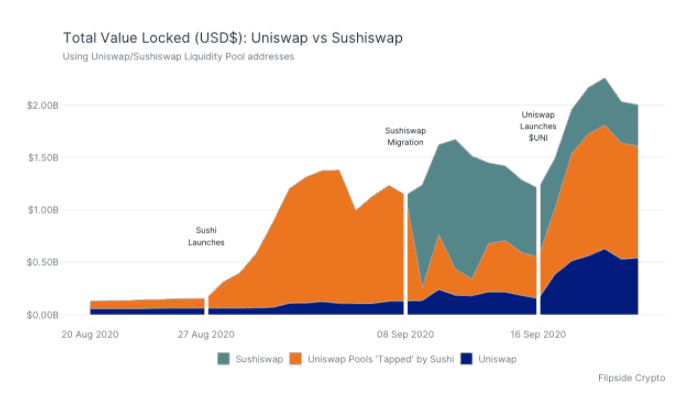
Governance tokens find application in modern layer 1 blockchain protocols, like Tezos, Cosmos and Polkadot. Further, blockchains built using the Pariy’s Substrate Framework facilitate on-chain voting. On-chain voting brings various advantages for layer 1 protocols since it significantly reduce the possibility of hard-forks and allow for faster turnaround time to implement changes. Further, governance tokens are extremely popular for Dapps, especially in decentralized finance (DeFi). One of the earliest examples is MKR, the governance token of the Maker DAO, which allows holders to vote on decisions on the protocol the stable coin DAI runs on. Today, most of the DeFi protocol have their governance tokens like COMP or AAVE, of the lending platforms Compound and Aave, or Automated Market Makers, Balancer (BAL) and Uniswap (UNI). Governance tokens do not only find a utility in allowing voting rights on proposals. They prove as a very effective marketing tool to attract users to actively use DeFi protocol. A great example is, how Sushiswap, a Uniswap clone, attracted over $1b of liquidity by introducing their $SUSHI governance token as a reward for users providing liquidity. Much of this liquidity came from Uniswap and went back to Uniswap after their launch of their own governance token $UNI.
DAO Infrastructure Providers
But how does voting and governance now work in detail? Most DAOs are made of three layers. The first layer are often web2 primitives to discuss proposals, like forums and communication tools, like Discord or Slack. The second layer contains a voting mechanism, involving governance tokens. The third layer involves the fund management of the DAO.
Aragon DAO is by far the most developed DAO infrastructure project. It hosts over 1700 DAOs which have around $900m crypto assets under management. Aragon offers a wide range of apps, for managing funds, projects, DAO specific governance tokens, permissions and voting. The sky’s the limit with Aragon. Custom apps can be developed using Aragon CLI. Further, Aragon offers the Aragon Court, a human based arbitration service. Aragon itself has two tokens, ART for voting on proposals and ANJ which need to be minted with ART and staked to become an Aragon Court judge. Aragon DAOs are only currently available on the Ethereum Mainnet. Since this made voting very expensive, Balancer Labs developed Snapshot, a gas-less off-chain voting tool, which leverages IPFS and Arweave to verifiable count votes. The latest integration of Aragon Agreement allows for off-chain voting on Snapshot with on-chain execution. Further, Aragon is developing an own blockchain, using the Cosmos SDKR, to migrate the platform risk caused by building on Ethereum.
Moloch DAO is a framework, which is used, for example, by MetaCartel DAO or The LAO. Moloch DAOs also have a proposal, voting and fund management template. This DAO framework features two types of tokens, Loots and Shares. Loots are economic shares in the funding pool of the DAO, without any voting rights. In contrast, Shares inherent also voting rights. The Pokemol app provides a frontend for Moloch DAOs and on DAOhaus you can find an overview on all Moloch DAOs. On special feature of Moloch DAOs is the “Ragequit” feature, which allows users to take their funds and leave a DAO if they not agree with decisions made by the community. Moloch DAOs can be launched on Ethereum Mainnet and also on xDai, a second layer solution with substantially lower fees.
DAOstack is used, for example, by The Genisis DAO and over 50 smaller organizations. Alchemy is the fund and proposal manager of the framework. The DAOstack introduced the GEN token to direct attention to the most relevant proposals. GEN can be bought by anyone and staked on any proposal of any DAO. However, GEN itself does not have any voting power, it is used as a signal for high quality proposals. Voting takes place using REP tokens of each DAO. When a proposal is passed, GEN stakers will be rewarded with GEN. This concept is called “Holographic Consensus”. Like a Moloch DAO, DAOstack is available on Ethereum Mainnet and the xDai network.
Community.xyz is the DAO framework of Arweave. Arweave itself is a new type of storage blockchain, which allows the creation of fully decentralized application. These dApps are governed by Profit Sharing Communities (PSCs) which can be created and managed using the Community.xyz dashboard. These DAOs leverage a super exciting token model, called Profit Sharing Tokens (PSTs). The utility of these tokens is two-fold: 1. Voting Like other governance tokens, the PSTs can be used to vote on proposals. For example, to reward contributors with newly minted PSTs for accomplishing tasks, written out on the community.xyz job board. 2. Monetization What makes PSTs especially interesting is, that they grant holders a share of the transaction fees (gas fees), paid by users while using the application. This model allows creators of dApps on the Arweave network to fund and continuously monetize on the usage of their applicaitons.
Conclusion
For the first time in history, Bitcoin granted mankind full control over their money. No centralized issuer. No single entity, which could hinder you from transferring your assets. This sovereignty is enabled by a new organizational form, often referred to as Decentralized Autonomous Organizations (DAOs). Modern DAOs come with governance tokens, which allow their holders to take part in the decision-making process of these organizations. DAOs and governance tokens form a new framework for organizing human collaboration. Most DAOs are open and operate boarderlessly. Anyone to join and to earn money for contributing to a common goal. Funds of these organizations are hold in Smart Contracts in a secure and transparent way. Currently, we are at the very beginning of this novel organization form. Time will tell how these communities will develop and integrate with existing legal frameworks.
We are happy to announce that Datarella is now an Associate Partner of the IDunion consortium. As an established blockchain solution provider Datarella adds expertise in blockchain development, system design and identity management.
IDunion develops a basic infrastructure for the verification of identity data. For this purpose, a distributed database will be jointly operated by a European cooperative. The network will be set up and managed by various actors consisting of private companies, associations, cooperatives, government institutions, educational institutions and other legal entities.
IDunion’s infrastructure is based on open standards and open source technology for Self-Sovereign Identity (SSI) and is particularly characterized by data economy and transparency. The solution gives users the opportunity to manage their identity information themselves and to decide when and with whom they want to share it.
Today, we trust Instagram, to keep track of our followers, likes, and chat histories. We trust banks, to document our balances and depots. We rely on Amazon, to maintain the lists of our past purchases. However, by trusting them we give up control and privacy. Slowly we are seeing adoption in Blockchain Technology as a decentralized and user-controlled trust machine. Similar to how banking software doesn’t keep track of your Instagram followers, it is likely that we will see a multi-chain future, in which use-case-specific blockchain networks are used to keep track of domain-specific states. Substrate by Parity Technologies allows for a first principle approach to creating these state machines.
Blockchain As State Machine
How much money did refugees spend in the markets of Jordanian refugee camps last month? #BuildingBlocks Which stakeholder within the long and complex humanitarian supply currently has custody of the emergency medical supplies? #Track&Trust Which parking credentials have been issued to my wallet, allowing me to park at the airport car park? #M-Zone Blockchain technology allows answering the above-stated questions in a trustless manner. Various components are required to allow individual participants of a decentralized computer network to reach an agreement over the state of a system. However, depending on the use case slightly different requirements arise for their underlying components. Some Blockchains need to be more secure, some faster, some more decentralized, some more private, and so on. Developing custom blockchains from scratch, with use-case optimized components, is very expensive. Imagine the costs for finding and bringing together experts of various computer science fields such as distributed databases, P2P networking, cryptography, and so on, to create a new Blockchain.
So wouldn’t it be great if there would a “Blockchain Kit”, which allows building custom, use-case optimized blockchain, using existing building blocks?
Substrate by Parity Technologies
And it turns out, there is Substrate by Parity Technologies, a modular and extensible framework for building blockchains from performant composable modules, called Pallets.
But let’s dive into the history of Party Technologies to get a better understanding of how Substrate evolved. Parity Technologies was founded by Dr Gavin Wood. Gavin is well known in the blockchain space for being the CTO and Co-Founder of Ethereum, cocreator of Ethereum’s Smart Contract programming language, Solidity, as well as its corresponding runtime environment, the Ethereum Virtual Machine (EVM). Since 2015 Parity Technologies built various blockchain clients, like parity Bitcoin, for Bitcoin (BTC) and Bitcoin Cash (BTH) mining, parity Zcash for the privacy blockchain Zcash, and OpenEthereum.
In 2017 Gavin published the Polkadot white paper stating the ambitions to create a heterogeneous multi-chain network, which connects various blockchains. During the development of the Polkadot Network, the engineers at Party Technologies noticed, that blockchains share many components and only some are unique. As a result, the Polkadot GitHub repo was forked to create a framework called Substrate.
So what is Substrate?
Substrate can be described as an open-source community, a modular software development framework, and a developer platform. The substrate framework allows the modular development of fast, secure, and socially scalable blockchains using substrate pallets.
1. Fast
Blockchains build on substrate reached up to 15k transactions per second.
2. Secure
The code of the framework is audited by top-tier blockchain auditing companies.
3. Socially Scalable
One major advantage of Blockchains build on the Substrate Framework is that they are upgradable without causing a hard fork. This is what’s meant by “socially Scaleable”. Hard forks are slow, inefficient, and costly since they require tremendous “cat herding” of node operators. Let’s take Bitcoin as an example. To update the network, the majority node operators, aka. Miners, need to be, first, convinced and, second, install the software update manually to their machines. In contrast, using Substrate, the business logic, which defines the behavior of a blockchain, is stored on-chain in the binary instruction format called WebAssembly, short Wasm. This allows automatically updating the whole network at a certain block height. So, let’s say some supervillain gets his hands on a Quantum Computer and you need to exchange the hashing algorithm of your blockchain for a quantum-proof one. The update can be done by sending a transaction. All the nodes will be updated automatically at a certain block height if they did not choose to leave the network.
The second benefit of using Wasm is that it can be run hardware-agnostic, which is a major benefit for node operators. Last but not least, Substrate Blockchains are interoperable with each other, as well as with other blockchain networks, like Ethereum, since they can be connected via the Polkadot Relay Chain.
4. Substrate Pallets
Substrate Pallets are the atomic building blocks of each Substrate Blockchain. A collection of pallets result in what is called runtime or simply the business logic of a blockchain. Each Pallet itself contains a domain-specific logic. The cool thing is, developers can discover, use and create Pallets on the Substrate Marketplace. Here are some Pallet examples from different categories you can use for building your own blockchain.
Category
Pallet
Accounts
Balances, for managing tokens
Recovery, social multi-sig recovery
Vesting, for looking tokens
Assets
(Non)-Fungible assets
Transfer
Destroy
Atomic Swaps, for exchange tokens
Consensus
Proof-of-Work
Aura (authority round)
BABE, slot-based block authoring with a known set of validates with on-chain randomness.
GRANDPA, finality gadget, if 2/3 of the GRANDPA authorities have voted for a particular block, it is considered final.
Governance
Democracy, for stakeholder voting
Election
Treasury
Identity
Superusers, which can remove accounts and slash balances
Smart Contracts
EVM, allowing for Ethereum compatible Smart Contracts
WASM, allowing fast, secure and efficient Smart Contracts
Conclusion
Substrate drastically reduces the costs of developing use-case optimized Blockchain infrastructure. Polkadot Network, which itself is mainly based on the substrate framework allows connecting these specialized blockchains, granting interoperability. Only time will tell how many Blockchains we will need in the end, but Substrate seems like a promising bridge to a decentralized state-keeping future.
The term “Token” is frequently used in the blockchain space. Shermin Voshmgir, the director of the Research Institute for Cryptoeconomics at the Vienna University of Economics, calls them even “the killer application of Blockchains“. This blog post aims to give you a better understanding of what a Token/Token Contract is.
A Token Contract is a special type of Smart Contract, which maps blockchain addresses to balances of value units – aka tokens. These software programs hold code, which specifies a set of functions and attributes of the value units, created and managed by the contract. Just like other Smart Contracts, Token Contracts are:
1. Censorship-resistant and Tamperproof
These computer programs are hosted on Smart Contract platforms, like Ethereum. Therefore, they are maintained and executed by all nodes of the blockchain network at the same time, which makes them censorship-resistant and tamperproof. Once they are deployed to the network, they cannot be changed.
2. Reactive
Smart contracts cannot initiate transactions themselves, they need to be called by an External Owned Account (EOA) or another Smart Contract. Therefore, they are mostly created by EOAs, which are controlled by private keys. However, Smart Contracts can send messages to call functions of other contracts, which allows creating a Smart Contract with another Smart Contract.
3. Controlled by their Code
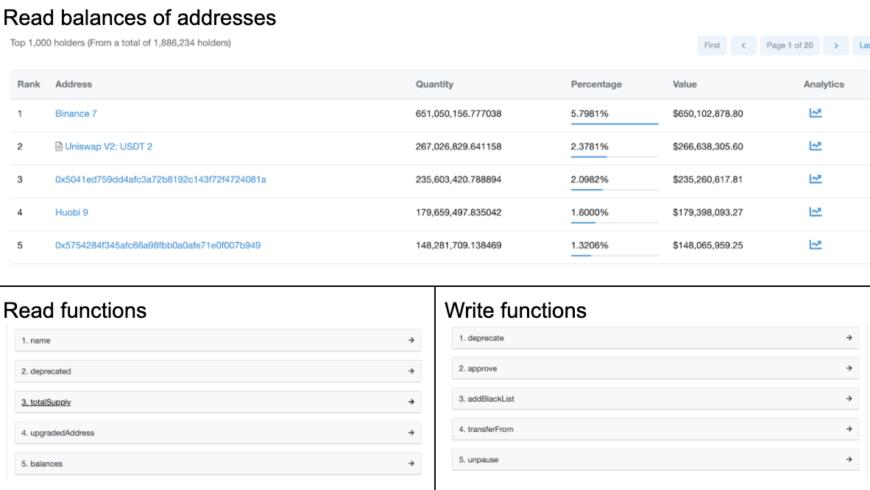
Unlike EOAs, Smart Contracts do not have a private key. These programs are solely controlled by the code they hold in their persistent internal storage. Their code specifies functions, from which they can read and write to. Read functions: allow retrieving information from the contract, for example, the balanceOf(account) function, which allows reading the balance of a certain address, or the name() function, which provides the name of a token. Write functions: enable, surprise, to write new information to a Smart Contract. Most common is probably the transferFrom () function, which allows subtracting from the balance of the sender’s address and add to the balance of the recipient. Another interesting write function is mint(account, amount) which allows, when called, to create new tokens and send them to a specific address, respectively, the burn(account, amount) function, to destroy tokens. Calling these functions can be restricted, so that, for example, only the address which deployed the contract can call the mint() function.
Have a look at Etherescan to check out token contracts deployed to the Ethereum Blockchain. For example, the Smart Contract of the popular stable coin Tether (USDT). As you can see in the image below you can read from the contract, e.g. to see which addresses hold USDT or write to the contract to send tokens.
Types of Token Contracts
In general, you can differentiate between two major groups of token contracts by the properties of the value units they create and keep track of, fungible tokens and non-fungible tokens (NFTs).
1. Fungible Tokens
The value units of these smart contracts are interchangeable. Further, the Token Contract specifies the number of decimals – thus the divisibility of a token. For example, 1.000000 USDT is, divisible to six decimal places. However, one might argue that the fungibility of value units recorded on public blockchains is reduced if the transaction history is publicly available. For example, if certain tokens are sent from an address, which is known for being related to criminal activity, like a hack, they might not be accepted by exchanges anymore and therefore are not fully fungible. Therefore, only privacy tokens, like Monero (XMR), which transaction history is not traceable, can be seen as fully fungible. Another example of fungible value units created by Token Contracts, next to the monetary use case, are equal voting rights represented by tokens.
2. Non-fungible Token Contracts
These token contracts create unique – thus clearly distinguishable value units, which are not divisible. Each token created by such a program has a unique tokenID, which makes it identifiable. Non-fungible tokens (NFT) are often used to represent real-world assets, like art or real estate. Further, popular use cases for this token type are digital collectibles, like crypto kitties, digital art or digital land. Also, an interesting use case is Blockchain Domains, like Unstoppable Domains, which use NFTs to represent “.crypto” domains on the Ethereum blockchain.
ERC – Token Standards
With the rise of Ethereum, Token Contract Standards have been established, which enable wallet applications to hold and manage any type of tokens, complying with the standard. Therefore, the rise of standards allowed for great usability advancements. Ethereum’s standards are titled as “ERC” which stands for Ethereum Request for Comments and refers to a document that specifies rules Ethereum-based tokens must comply with.
ERC20 Standard
The most popular token standard is probably the ERC20, which creates fungible tokens, mostly used most initial coin offerings (ICOs). It is fairly easy to create an on ERC20 contract since it only requires a couple of lines of code. By today, over 333,500 ERC20 contracts are listed on Etherescan. These Smart Contracts have optional functions, like a Name, Symbol or Decimal, and 6 mandatory functions:
totalSupply()
Can be fixed or variable. If it is variable it can be calculated and return the total amount
balanceOf(address_owner)
Shows amount of tokens held by a provided address
approve()
Authorizes a contract to do something e.g. withdraw tokens
Similar like approve but checks for sufficient balance of an address
ERC721
The predominant standard for Non-Fungible Tokens is the ERC-721 standard. Over 7,500 contracts emitting this type of tokens are listed on Etherscan.
Popular tokens created by ERC-721 are, for example, digital football player cards of sorare, blockchain domains of unstoppable, and also the famous cryptokitties as mentioned above.
Conclusion
Token Contracts are computer programs, which create and manage value units and are deployed to Smart Contract Platforms. These code snippets are at-will programmable and can be designed to fit any kind of use case, from digital currency to collectible. Further, they can be programmed to create self-reinforcing positive feedback loops to bootstrap Web3 platforms and are the basis of any Token Economy. Stay tuned!
Track and Trust successfully completed the BlockStart accelerator program, which initially started in March 2020. We want to look back on the last six months and share how we upgraded Track & Trust from an MVP to a market-ready product.
It all started at the ideation Kick-Off in March, where many startups presented their innovative products and solutions. It was an excellent chance for us to see how so many different companies intend to use blockchain for their services and gave us the opportunity to talk to startups that could be interested in testing our blockchain-based supply chain solution. As it turned out, we would see three of them back in September during the Pilot Stage.
Scope and Implementation Phase
Our goal during the BlockStart accelerator program was ambitious – we wanted to upgrade Track & Trust from an MVP to a market-ready product. After we successfully made it to the next round, we defined our four KPIs:
Implement an onboarding process in which users can self-register. During the MVP, we created the Keystore files by ourselves and sent it to our test-users. A self-registration process is one of the main requirements in a decentralized system. In addition to that, we also created profiles that are linked to a specific address.
Enable Multi-tenancy in the system. We want to limit the accessibility of information to only the respective users and their respective data. This increases privacy, security, and provides a clearer and smoother user-journey.
Make the Track and Trust interface dynamic. There were many hard-coded processes and interface-artifacts developed for the MVP. The contents on the different interfaces should dynamically show the data for the respective shipment.
Enable mobile-signing. In order to reduce data load and improve usability, we need a mobile app that contains the identity information as well as the private keys of the actor. As a result, handovers can be processed by scanning QR-Codes of the shipment without the need to document this on a computer.
During the implementation phase, we talked with many potential adopters that could perform tests with us in the pilot stage. These talks and the progress of implementation were the main topics in frequent calls with our mentor Joao Fernandes.
Testing with Adopters
After we successfully finished the implementation stage, we had the chance to test Track and Trust together with three adopters that we talked to during the implementation phase. This was Albicchiere, an Italy-based startup that runs a supply chain for refill packages of their wine dispenser, Go Limpets, a Portuguese-based company that sells sea food to the gastronomy, and Zelena Tocka, a Slovenian company whose supply chains manage the production and selling of local agriculture goods.
The objectives of the test were to perform a test with all three adopters through every stage of Track and Trust. As a result, we were very happy to see that they had no issues in testing Track and Trust and that the system would bring an advantage over their competitors. Another main takeaway for us was recognizing the versatility of the use cases Track and Trust can apply.
Take a look at our newest product video of Track & Trust:
The BlockStart accelerator program gave us the best chances to improve our product, get to know potential adopters, and receive valuable feedback that we will implement in the future. We thank the BlockStart organizers, and especially our mentor, Joao, for the smooth and successful guidance and communication during the program, as well as the three adopters for testing Track and Trust.
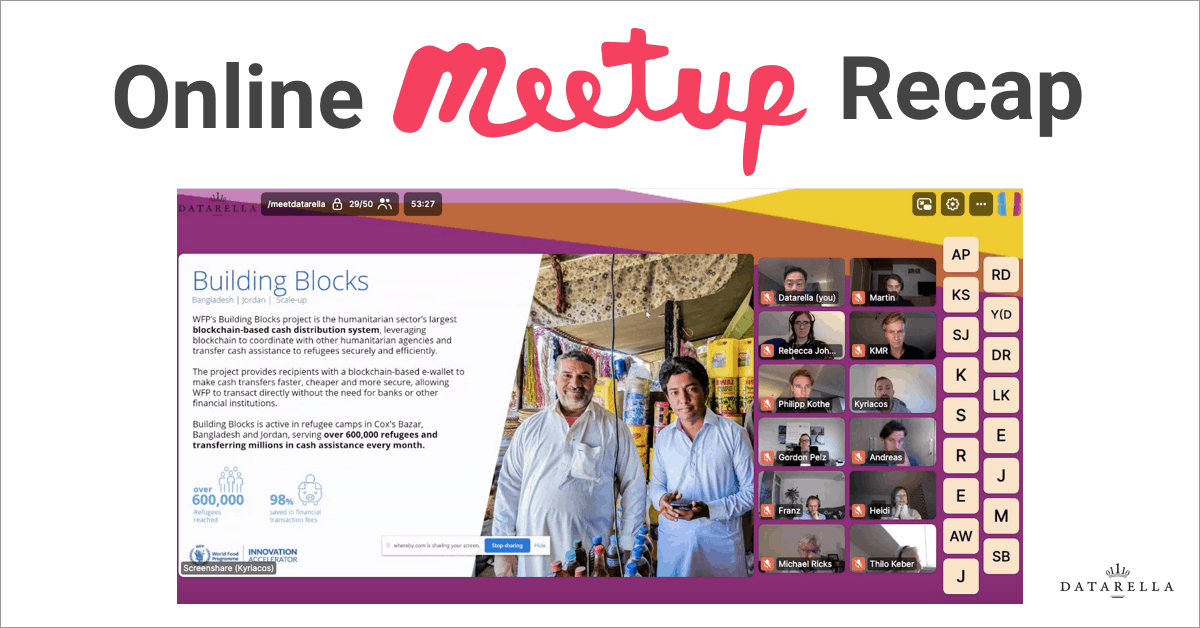
Not even COVID-19 can stop our meetups. However, since we did not want to risk the health of our audience, we decided to hold our 22nd Blockchain Munich Meetup online. No pizza, no beer, but insightful presentations of the application of blockchain technology in the aid industry.
First up was Kyriacos Koupparis, head of Frontier Innovations, WFP’s innovation accelerator. After we briefly celebrated that the World Food Program recently won the Nobel Peace Prize, Kyriacos gave us an overview of the various blockchain projects at his organization. Starting with our beloved Building Blocks project, which supports over 600k refugees in Jordan and Malaysia with cash vouchers for everyday purchases. Our blockchain-based system saved WFT millions of USD in foreign bank transfer costs. We at Datarella are very glad to help to maximize the value which arrives at the people in need. Next to using blockchain for finance, WFT sees the high potential in the application of blockchain technology to increase supply chain traceability. Here, we also completely agree with WFP. As demonstrated with our Track & Trust project, Blockchain Technology allows bringing clarity to complex supply chains by documenting each handover in the T&T Blockchain.
The next speaker was Franz von Weizsäcker, Head of Blockchain Lab at Deutsche Gesellschaft für Internationale Zusammenarbeit (GIZ). The GIZ is leveraging blockchain technology for real-world use cases. Franz presented a project in Georgia, in which the Bitcoin Blockchain is used to document hashes of land registry titles. Also, the GIZ is applying blockchain technology for supply chain solutions. On the one hand, to enable tracking the origin of organic spaces, on the other hand, for digital certification, which aims for trade facilitation at customs offices. Further, it was very interesting to learn about a community currency project the GIZ has started in Cameroon. The project was inspired by the work of the Grassroots Economics Foundation in Kenya, which uses complementary currencies to overcome the shortage of national currencies in poor communities.
Our last guest speaker this evening was Gordon Pelz, who is on the Board of Trustees of the YOU Stiftung. Gordon presented to two projects, in which the YOU Stiftung leverages blockchain technology, New Baraka and SmartAid. At the New Baraka project, a slum close to Dakar, the capital of Senegal, has been turned into attractive apartment buildings. The inhabitants of the prior slum moved into the new houses. Ownership of the living spaces will be transferred after a certain period to its new residences. Here, blockchain technology comes into play and is used to document symbolic rental payments of the previous slum inhabitants. Saving the data about the payees and payments into a blockchain serves as evidence at the time of transfer of ownership of the apartments. The second use case Gordon presented was SmartAid, our next generation donation platform the YOU Stiftung had launched together with Datarella. By today, the YOU Stiftung has collected over 1150 EUR via the SmartAid web app. The first steps of building a water well in Ghana are initiated. More details about the project status are going to be communicated soon via the project’s donation tracker. For more information on SmartAid and the water project please checkout SmartAid or our news blog news.smartaid.digital.
We were very happy to hear that blockchain technology is applied in so many real use cases in the aid industry, allowing for efficiency gains, where they are most needed. Let’s leverage the benefits of blockchain technology to make our world a better place for everyone.
We are looking forward to seeing you at our next meetup again.