by Kira Nezu | 19 June 2014 | Blockchain
“Of course, robots are a common sight these days.” “She’s – she’w not like a machine. She’s like a person. A living person. But after all, she’s much more complex than any other kind. She has to be.”
Philip K. Dick, Nanny
Our perception of the world is a tricky thing. We think of the sight that our brain derives from our eyes as connected to reality as such. But in fact, many of the shapes we believe to see, are formed in our mind, extrapolating the sensual stimuly into something, that has already been sitting there. When we see a gradient of darker space on the wall of our room, we built the image of a streight edge from it, a line – which obviously is a reduction of the complexity of the coloured pixels that originally arrived on our retina. Schemata – pre-set shapes that are partly inherrited genetically, partly acquired in our first days after birth – help us to reduce the deluge of visual information by several magnitudes.
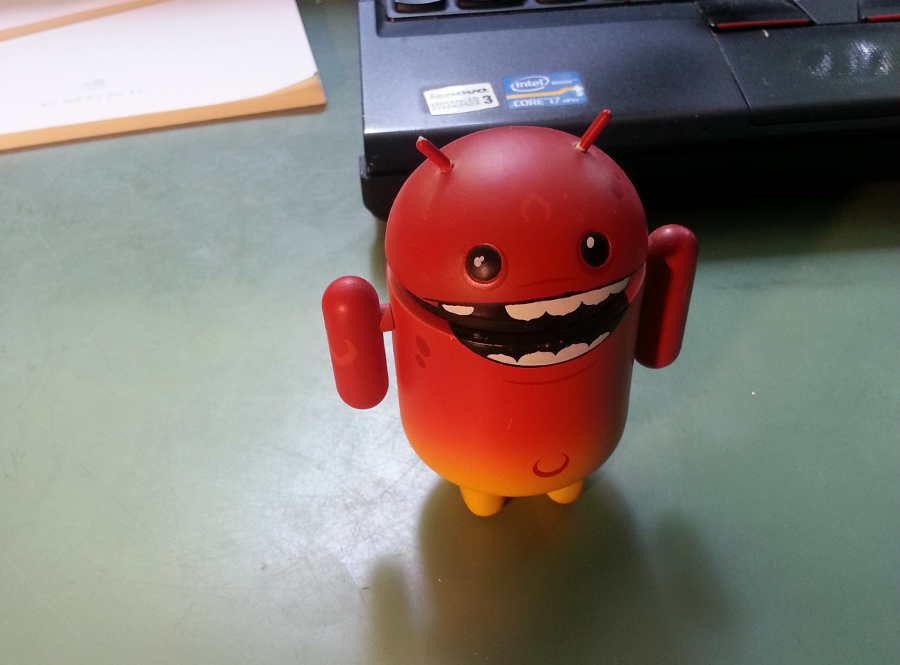
No scheme in our perception is stronger, than the face. We cannot help but seeing faces in any shape that would have two dots and a line beneath. And we immediately start communicating with those faces; we interpret their mood from the mimic we perceive, we regard them as happy, sad, or angry. And with very little interaction, such artificial faces become fully accepted as living beings. This is of course not only true for humans; most mamals don’t care much, if they interact with a robot or a living creature. I have seen this when working in primates research with great apes; and you can try it yourself: just let a cheep windup toy pet walk towards your dog or cat.
Now, our devices become more and more versatile. The biomorphic behavior that we can let our machines show, has long become convincing.
IBM programmers John Kelly and Carol Lockbaum were the first to teach a computer to sing: “Daisy Bell”, interpreted 1961 by an IBM 7094 became the first convincing demonstration of a computer interacting with a human voice.
Things that talk are much more convincing than things giving us text output on a screen. An impressive prove is Procter&Gamble’s talking toothbrush which persuades its users to brush their teeth more than three times longer.
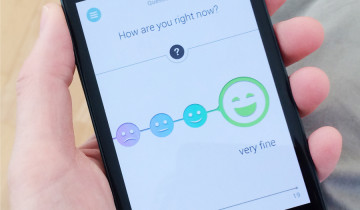
Smileys instead of written instructions are much easier to use and bring people to interact with our UI.
The whole thing gets creepy when people develop deeper emotions and bonds towards technology. We might think of robots like Mark13, looking as bad as they behave. In AI, Spielberg pictures android robots differently, however: the rageous mob of anti-robot activists stops their robot-killing, when they encounter David, the fake kid with a child-template face that still convinces everybody even after an x-ray reveils the metal skull beneath.
Recent research shows, that Spielberg was perfectly right in his prediction: people find it offensive being shown violence againced “neat” machines. And people have moral concerns about “hurting” an andoid or animal-like robot, if it feedbacks signs of pain – no matter if they are fully aware that the machine is not capable of feeling anything, at all.
It is nevertheless no guarantee of success, if brands use this anthropomorphic trick to make their products more appealing. Microsoft’s Bob is a nice example. Bob should ad a level of “kindness” to the Windows Operating System. It was a complete failure and nobody would remember it, save the fact that Comic Sans was introduced to the world that way. Bob was way to frumpish and ridiculous to stay.
The art of anthropomorphism in machines lies thus in not assaulting people with kitschy faces, but deploy nonverbal, gesture-like symbols to make us more efficient in our human-machine-interactions.
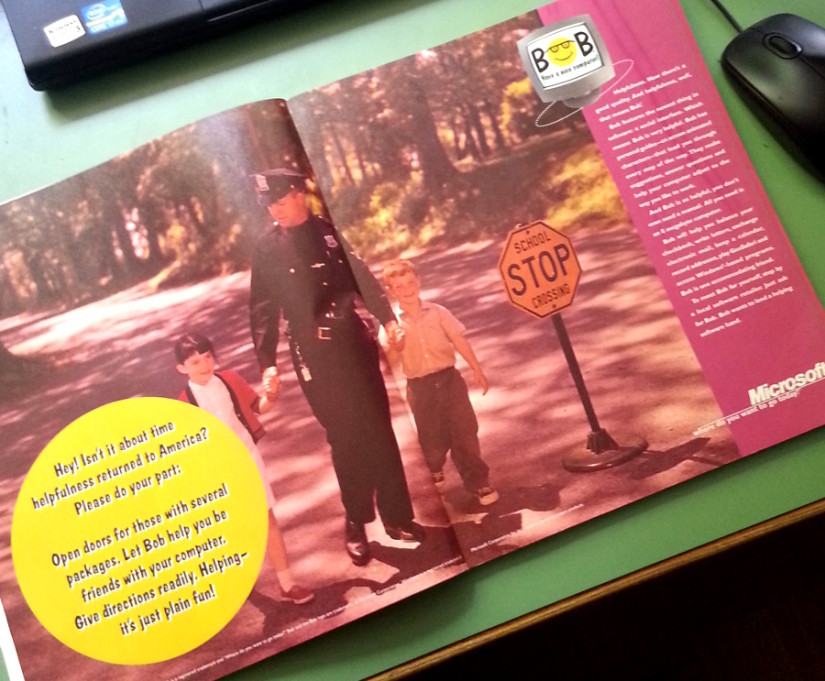
“Hey! Isn’t it about time helpfulness returned to America?” The times of Microsoft Bob (and Comic Sans …)

by Kira Nezu | 5 June 2014 | Blockchain
The slides of our talk at Munich DataGeeks Meetup:
“A smartphone is a mighty array of sensors. How to access the data, and get meaningful information from the various readings, like geo-location, gyroscope, accelerometer, or even the magnetic flux.
We also discuss the ehtical implication of mobile tracking: informational self-determination, “other-tracking” vs. self-tracking, and how to do spooky things with apparently innocent measurements.”
by Kira Nezu | 24 May 2014 | Blockchain
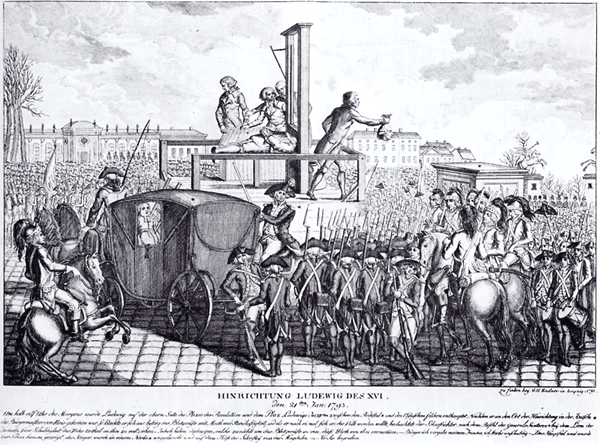
Picture above: The court of Louis XVI is regared as the ecstasy of courtesy. Esprit, the bon-mot and the courtly attire had been overdone to an extend never to be reached again. The end: the terror – the most uncourtly form of social cohabition.
“Privacy invasion is now one of our biggest knowledge industries.”
“The more the data banks record about us, the less we exist.”
Marshall McLuhan
“Handle so, dass du die Menschheit sowohl in deiner Person, als in der Person eines jeden anderen jederzeit zugleich als Zweck, niemals bloß als Mittel brauchst.”
(“Act in such a way that you treat humanity, whether in your own person or in the person of any other, always at the same time as an end and never merely as a means to an end”)
Immanuel Kant
“Being socially exposed is OK when you hold a lot of privilege, when people cannot hold meaningful power over you, or when you can route around such efforts. Such is the life of most of the tech geeks living in Silicon Valley. But I spend all of my time with teenagers, one of the most vulnerable populations because of their lack of agency (let alone rights). […] The odd thing about forced exposure is that it creates a scenario where everyone is a potential celebrity, forced into approaching every public interaction with the imagined costs of all future interpretations of that ephemeral situation.”
With danah boyd‘s concern, I completely sympathize. Usually we recommend to “stay safe from the dangers of the Internet” to children or teenagers . But what does that mean? Should they abstain from connecting to others on Facebook? And how should a teenager ask for her peer or friend not to post a picture on which she would be visible? (The option to let their parents solve problems with unwanted pictures for them is not realistic – apart maybe from gross denigrations and mobbing).
There is no real choice. Either we will be regarded whimsical, even Luddite, or we will leave a broad track of data in the world. As time goes by, our behavior maps ourselves into an image, a projection into the data realm. This image of ourselves lies more or less in the open. And many clandestine and creepy companions lurk arround watching our lives in the mirror of our data; Google, Facebook, advertising targeting systems, shop recommandation engines, and finally the governmental surveillance services, couching behind the curtain, waiting for us to fail.
But indiscretion is not restricted to professional data krakens. Our profiles with personal information, our posts, our check-ins can be read by anyone who wants to. And indeed this is our very intention: of course I love people following me on Twitter, and I have met some of my closest friends in social networks. Social media work through authenticity – this buzzword has been written and told so many times, that it leaves a flat taste. But it is true: if we are not open, tell in fact about ourselves, we will hardly get in contact with others. It is part of the culture of social media (as in social life in general), to disclose details about ourselves, even if they could be used against us. Like me, posting my drinking habits quite regularly; and of course I want people who know me, or who have an interest in me, to read this. But what would it feel like, if someone would set-up a “Joerg-drinks”-bot, publishing statistics about my wine-tweets? Without context this would certainly draw a rather unfavorable picture of me.
From personal experience I would judge the damage from mortifications by “manual” data access much more severe, than the professional analyses of data krakens for their commercial use. And while with the latter, privacy and self-determination rights can be defined and often also enforced legally (e.g. via law against unfair-competition), assaults on personal data by individuals can hardly be contained with legal means. Where does stalking start, what exactly is an insult, what malicious gossip? The worst is, that the victim has to act in defense – “Streisand-effect”, fleer and mockery is poured on people, who “just don’t understand the rules”, are “stupid enough” to try to resist.
“Just because people can profile, stereotype, and label people doesn’t mean that they should.” (danah boyd in her essay)
If you ask yourself where to set the limits what to do with data, the answer is not really hard:
data courtesy
Courtesy is a cultural technique to maintain distance. We are courteous to organize our distance to others, not to offend them. We become courteous by keeping within our boundaries, which are not defined by laws or other written rules, but by our understanding, respect, and sympathy with others. Courtesy is the esprit de conduite, the good spirit of conduct. What was defined as religious command, or feudal duty in ancient or medival times, was unfolded as philosophy during the enlightenment. While still an act of dominance and power of the strengthening kind against the weakening noblemen at the court of Louis XIV, esprit becomes a bourgeois habit after the French revolution. And Kant’s maximes for human dignity were made into explicit recommendations for everyday’s life by Adolph von Knigge in his guidebook “Über den Umgang mit Menschen”.
Even before the invention of the web, the community of the first users on the net had formulated the Netiquette . “When someone makes a mistake – whether it’s a spelling error or a spelling flame, a stupid question or an unnecessarily long answer – be kind about it.” – Kindness – integral part of courtesy – was a topic back then.
“Gar zu leicht missbrauchen oder vernachlässigen uns die Menschen, sobald wir mit ihnen in einem vollkommen vertraulichen Tone verkehren. Um angenehm zu leben, muss man fast immer als ein Fremder unter den Leuten erscheinen.”
(“Far too easily people abuse or neglect us, as soon as we use a confidential tone in conversation. To live in a pleasant way, we almost all the time have to appear as stranger among other people.”)
Adolph von Knigge
So the culture of courtesy of the 19th century might be well suited for our age of post-privacy. Courtesy is a cultural thing. Cultivated means taken care of. It is time to act carefully with our data, which are so closely tied to us. It is time for data courtesy.
[this text was originally posted in German at slow-media.net]
by Kira Nezu | 22 May 2014 | Blockchain
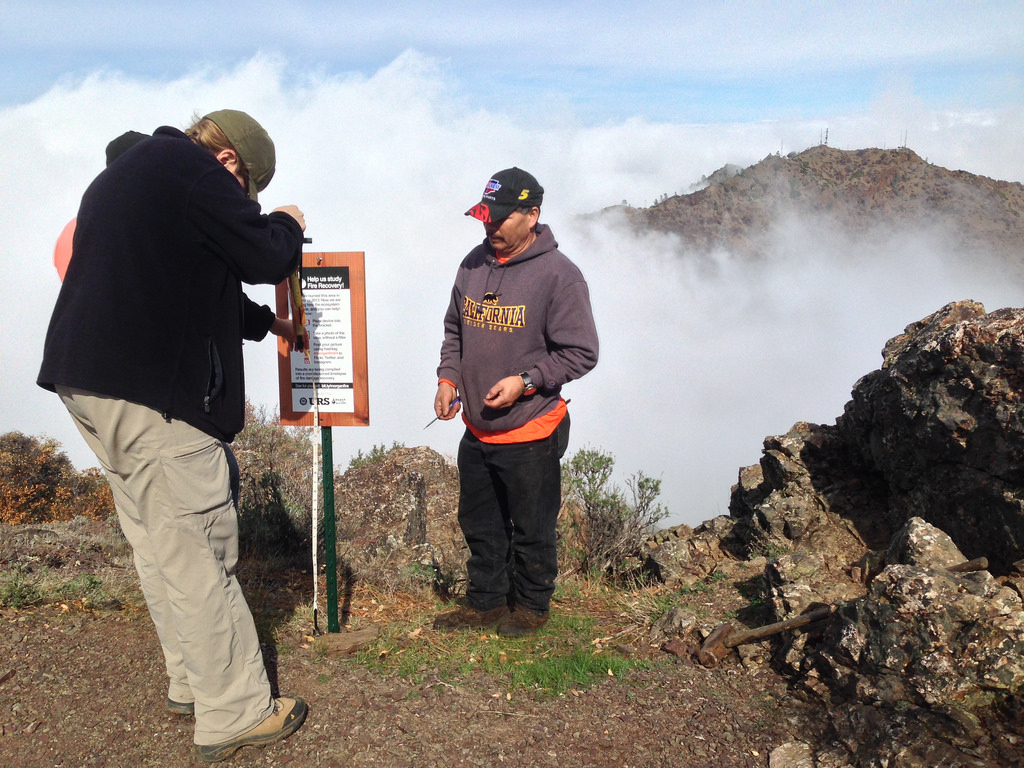
Image above: Nerds for Nature setting up #morganfire01. Licenced under CC-BY-SA 2.0
Mobile citizen science – people jointly contributing to research with their smartphones – has been a frequent topic on this blog (e.g. here, http://datarella.com/helping-people-to-understand-real-time-pollution-risks/, or http://datarella.com/mapping-particulate-dust-with-phones/). What makes it so compelling, is that on the one hand the crowd of participants can generate much more measurements than would be possible with just one team of researchers, on the other hand, it is way less expensive.
In the case of Nerds for Nature, the research set-up is truely minimalistic. The task, Nerds-for-Nature set, is to monitor the recovering flora and fauna at Mount Diablo State Park after a major wild fire, over the course of months and years. To do this, they installed a makeshift camera-stand at different locations, overlooking the desater area. They placed a sing next to the stand, with very simple instructions:
“Place the camera phone in the bracket.”
“Take a photo of the view without filter.”
“Post your picture using #diablofire01 to Twitter, Flickr and Instagram.”
The project went viral, when Sergej Kropenin who works for Twitter, endorsed the project with posting an image and the text “Cool use of twitter“. This has been retweeted more than 8.000 times now, which proves in an impressive way, how excited people are about these kind of projects!
Here is the link to Nerds for Nature:
www.nerdsfornature.org
by Kira Nezu | 20 May 2014 | Blockchain
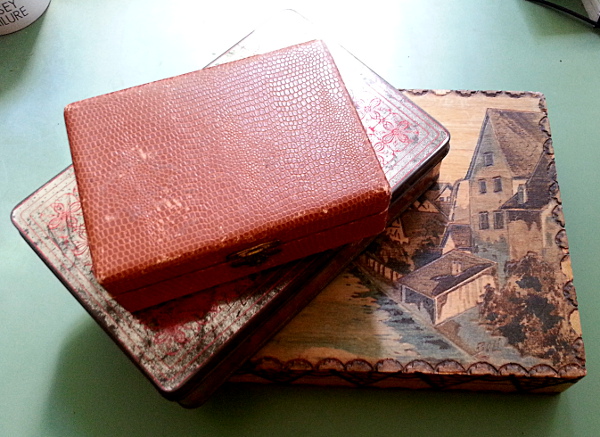
Image above: Our olfactory sense and our long-term memories are tied together. To track places lost, I have collected boxes; the smell inside triggers my memory.
Cats are more attached to places than to their masters, so people say. Although I doubt that this is really true literally, felines are certainly attached to their territory. Cats, dogs, as most mammals, recognize their place by its scent – which they also enrich with their own pheromones.
When we humans smell something, that reminds us of some place we have been to, the memoric sensation that is evoked, feels often like the place in its whole, including everything that took place there. Such a gestalt can have overwhelming power, sucking us into the past. (Now I must not miss to quote Proust here, because it seams you can’t write about memories triggered by aroma without reference to ‘À la recherche du temps perdu’, so here you are.)
Scents cannot be digitized. Because we never smell anything without adding all our long-term memories to the sensation, it is impossible to find a common language that transports how we experience the scent. Other than visual impressions, haptics, temperature, which can be shared verbally with others, our olfactory sensing is highly personal. While I am writing this, I am sitting on the windowsill of my study; the warm air carries the smell of lilacs to me. But although I can presume why people are fond of this flavor, I do not have much associations with it; I can rationalize the connection of spring blossoms with warm and pleasant weather, however lilacs are obviously not connotated in an emotional way for me.
Nostalgic souvenirs
When my grandmother died, and we cleared her house, realizing it would be the last time to smell the place was also when I bacame aware I would never come back, at all. So I kept a box with stationary as a scent capsule. Yet also this smell will fade away, and with it the access to those long-term memories.
Nostalgia is directly tied into our olfactory memory that way. Our limbic system stores complex emotional landscapes together with the smell we experienced there. These memory-compexes are processed pre-consciously (it is a very old part of our brain that we share with all vertebrae since the carbon age); and because the brain’s layers are not working independently, our consciousness is immediately involved, primed with emotions, and adds the rational context to the emotional scenery.
I am generally not prone to nostalgia. Nevertheless I love to evoke those complex memory-scenieries arbitrarily. I have therefore collected a couple of specimen – far from sufficent to cover my life so far – but anyway. Does anybody else do this? Has anyone heard of doing this systematically? I would love to hear about this!
Semiologic approach
Although scents are highly personal, it is interesting to see how specific olfactory sensations are correlated with words. When I was working for Hubert Burda Media, a major print publisher, we we drew a subsample of some 1,500 parfume userers from our 20,000 participants in our large market survey TdW. With partners from the cosmetics industry, we asked the participants to rate more or less arbitrary words we put together on a list (quite similar to Semiometrie). Since we knew the fragrance the participants would usually wear, this allowed for building a dictionary of words related to parfumes prefered. We cross checked: the main olfactory characteristic of the parfume (“fruity”, “clove”, “lavender”, “musty”, … the perfume people have operationalized a typology that way) was correlated to the words ranked positive; and vice versa, ranking a word positive was a good predictor for scent preference of our control group. So it seamed to work. Unfortunately I left my team for a new job (online video – no relation to the cosmetics industry whatsoever), and the research was not carried on.
I still belief that starting with lexical correlates to complex emotional memories is a good way in making the scent sensation more comparable between subjects. At least those words can work as metaphors that we can build a shared image of.
Scent libraries
Smell-samples like my nostagic remnants of aroma carriers when collected systematically soon get very creepy. The East-German Staatssicherheit had amassed thousands of rags from the clothes of dissidents. This intrusive, totalitarian practice was in use in West-Germany, too, however not to such a horrifying extent.

Juan Mari and Elena Arzak with their library of aromas.
(Courtesy of Restaurante Arzak)
A much more pleasant form of scent collection can be found at the restaurant of Juan Mari and Elena Arzak. Situated at the Biscay at San Sebastion, Arzak’s is regarded as one of the best restaurants in the world. Pioneering in molecular cuisine (they call it even cuisine d’investigation), the Arzaks deployed a method, commonly used by perfumers: a library of fragrances to be composed to the aroma like colors on a painter’s palette. Perfumers and master chefs alike manage to synthesize scents arbitarily from basic odors.
Smell tracking
Our olfactory system is thus integral part of our synaesthetic memories. If we could track smells like we can record images with our mobile phone, it would certainly complete our lifelogging efforts. Most fragrances decay quickly when exposed to oxygen. So it does not make much sense to physically store our records. The task would rather be at first to analyse the chemical composition of the smells that surround us, and second to provide means to synthezise the recorded smell-memories anytime later, similar to what perfumers or chefs do by means of their artistry.
An interesting approach was presented by Jenny Tillotson at the Quantified Self Conference in Amsterdam. Dr. Tillotson is designing sensory fashion, that despenses very small doses of parfume according to our body functions. If the device detects stress or anciety, it would provide the person wearing it with a scent, specially designed to sooth the condition. The scent’s composition is customized according to the person’s personal needs. The singular aromas (like lavender, rosemary, citrus, etc.) are suspended on a special chip, a so called lab-on-a-chip, that acts as a miniaturized dispenser.
I think this might be a good path to follow. Of course the task to compose personal parfumes from a set of five or so aromas according to preset parameters is much simpler (complex enough, anyway!) than I full scale analyzer-syntheziser for scent tracking would have to be. So there is a lot to do!
Further reading:
by Kira Nezu | 18 May 2014 | Blockchain
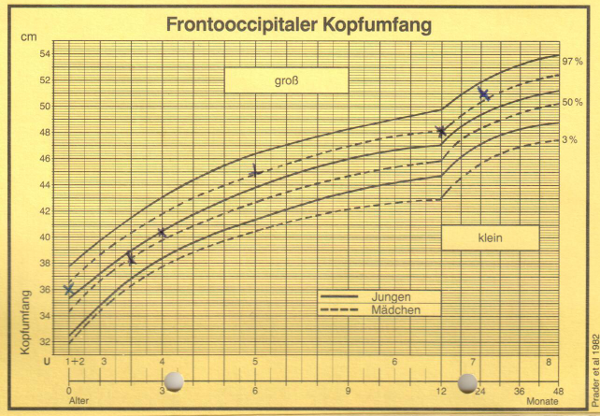
The diagram above shows the development of the frontooccipital circumference of a child’s head. We measure the growth of our children to track their healthy development. Only with the context of benchmarks does the data become meaningful. Without sharing, it is useless.
“Why Quantified Self Is The Next Big Thing” tells Michael Reuter in the last post on this blog. And I agree: The economic drive but even more the social incentives we earn from QS will lead its evolvement to ubiquity.
With this in mind, we should take a step back, and pause for a moment to think through some of the consequences a quantified society will bear on our lives, and on alternative routes this development might take along its path.
This post touches topics I took from a conversation on Twitter I had with Whitney Erin Boesel and Anne Wright (see here).
Quantified Self or Quantified Other?
“Quantified Toilet” was a nice piece of design fiction: big data collection from analyzing feces in a public toilet. It would not have been a good hoax if there wasn’t a short link to reality. In public space as well as in privatly owned para-public spaces like shopping malls, we are constantly quantized and monitored via a multitude of sensors. Traffic patterns, footfall, cellphone usage, noise level, but also telling environmental variables like micro-temperature and air moisture. Our phones also permanently track data not only about ourselves but also about other phones within reach. So we should be used to getting tracked. And there is hardly much difference between the CCTV surveillance we experience all the time and that we seem to mostly have accepted on the one side, and lifelogging, i.e. carrying a camera with us that takes pictures all the time, on the other. Nevertheless: there is very good reason to criticize the one and the other; both may be a gross violation of our right for informational self-determination.
However, we might think tracking only our personal data for our own purposes is different from tracking others. So lets think about social media: Twitter, Facebook, Linkedin, they are not called “social” without cause. These platforms only work for us, if we connect to others, and communicate. Our timeline is not a monologue – we are interacting with others. If you try to opt-out, all these connections you built while you were using the platform would stay, no matter if your profile would be deleted. And even further, your position in the social graph of others will take some effect, even if you had never signed in for an account; reconstructing a missing object from data collected arround the object. If we connect to a team of trackers with devices that support social sharing of data, our contribution might thus tell about others without their being aware. If we share our sleep-tracking with the Jawbone Up, our social graph will certainly make possible some predictions on the behavior of our peers that we added to our team. And if we send the cotton bud with the smear of bacterial fauna habitating on and in our body to µBiome for analysis, there will be characteristical biological traces of other people that we interacted with – shaking hands, kissing …
“Surveillance Marketing”
There are two narratives, why the QS data is valuable. The first is health applications. I am convinced, that Michael is right. I have even written that the data shared and collectively used for the public good might save the planet. The second story is about marketing. I make a living from predicting behavior from data. It is called social research, market research, advertising planning, targeting. It is my profession. It is not evil to bring goods to the market. It is not evil that facebook sells targeted ads. Nevertheless people might start to wonder if the deal is fair that they get offered from the platforms: “Data is made of people!”
Many of the gadgets and platforms in QS are funded by VCs. Of course most of them will have to get sold, otherwise the investors would not see their money back. Not even crowdfunding might save a start-up from that fate as we have seen very prominently demonstrated with Oculus.
So I think we can expect people demanding back control or even money. We should support an open source and open data QS culture, and build business model arround that. These businesses will be ethically correct and prove more robust. (The term “Surveillance Marketing” was coined by Bruce Sterling at Wired Nextfest in Milan right in our context).
Algorithm Ethics
At last year’s QS conference, Gary Wolf told of his experiment in taking the different gadgets to track walking and running and compare the results. As expected, there were huge differences. A similar observation with commercial gene-sequencing services lead to an investigation of the FDA. We can’t build technology without bringing value-judgments into it. I have written and talked about that extensively. It is important not only to know this fact. We should always ask: could this technology be done in a different way? And we should demand for laying open the algorithms. There should not be a black box when our most intimate data is concerned. In IT security, open cryptographic algorithms are the only protocols that can be trusted; this is widely accepted. Open QS algorithms should be thought of the same way.
Liberal Fallacy or Empowerment?
My fourth point is about self-determination and resoponsibility. QS is a great way to support people’s health. We have heard fantastic stories, how tracking your body, your mind, your mood can help people getting back autonomy to lead a self-determined, active life. We should not corrupt the great contribution QS can add by turning it against people.
What if someone cannot change her life even if she tried? The most common form of this argument, I tend to call the liberal fallacy goes like this: “Obese people should own scales, track their weight, food intake, and training, and then they will overcome their condition. If they don’t succeed, they are just lazy.” I have heard obese-blaming frequently; and although other forms of abelism are less accepted, it is still common to presume responsibility for failure with the one who failed.
Today, parents have to defend themselves for denying prenatal diagnostics. I have heard people blaming parents for giving birth to a child with a Down Syndrom. We must not allow people to force a decision like taking an abortion to others just because they would value humans’ lives only according to the fitness and health.
We should take care to help people with QS without patronizing. We should not imply that everybody is master of their lives. We should not hand our responsibility to care for others off to technology, leaving people alone with their problems, because we think that they can now achieve through technology in what they had been failing before. Our responsibility to respect others, to not discriminate against anybody, not segregate from anyone, and accept others’ personalities and weaknesses, this will not change with QS; it might rather become more difficult.
There is no “virtual reality” we could just unplug from. Our being embedded in data is the only reality there is. There will be no opt-out. So we should help people to understand their quantified lives. We should lead the discussion which ethics we want to govern our lives.
If we act responsibly with our technology and our practices, if we stay alert to the intentions behind it, if we keep the discussion open, fostering transparency, and if we sympathize with others rather then judging them, The Quantified Self will unfold to more than just “the next big thing”.
[Note: I had written a draft of this post after the twitter conversation here; when I opened the draft today, all was gone, exept one number: “42”. … it is not about the answers, it is about the questions …]
by Kira Nezu | 14 May 2014 | Blockchain
The Quantified Self Europe Conference 2014 had shown some activity on Twitter, as expected. 156 different people twittered using the #qseu14 tag. Nevertheless the absolute number of #qseu14-tweets slightly declined to ~1100 in 2014 from ~1700 in 2013.
The Twitter-activity, again hardly surprising, was higher on Saturday:
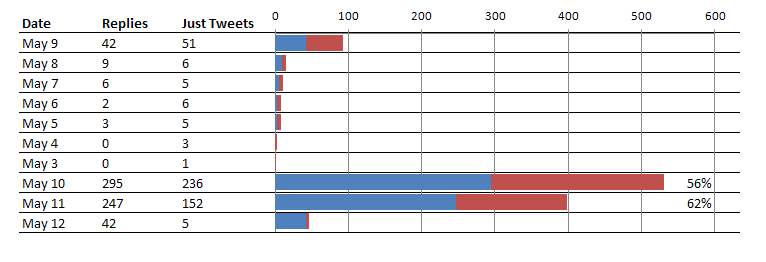
Distribution of twitter activity before and during the #qseu14 conference; blue=reply.
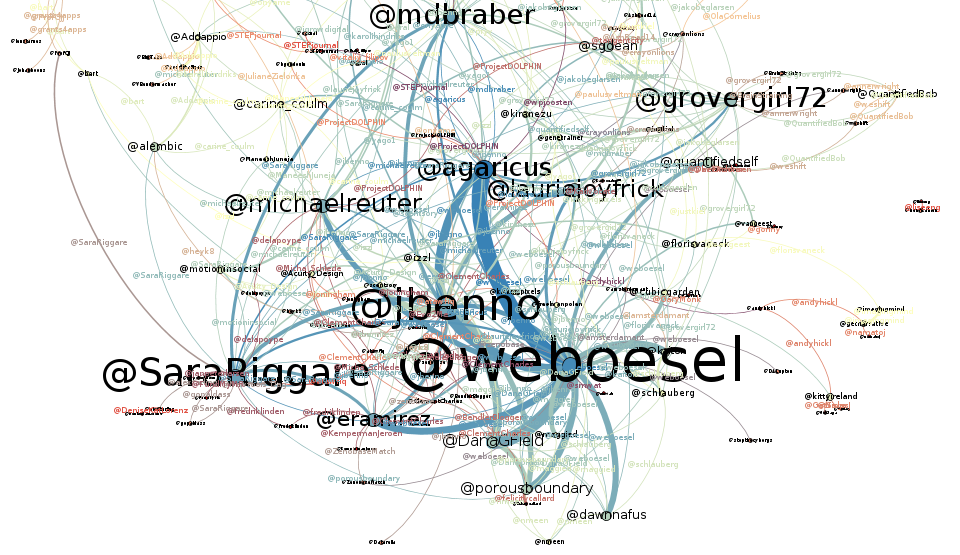
A nice hint on the socializing quality of the event gives the proportion of tweets sent as replies, which was higher on Sunday; maybe thus showing the more personal conversations. The connections between the conference are shown in this network graph:
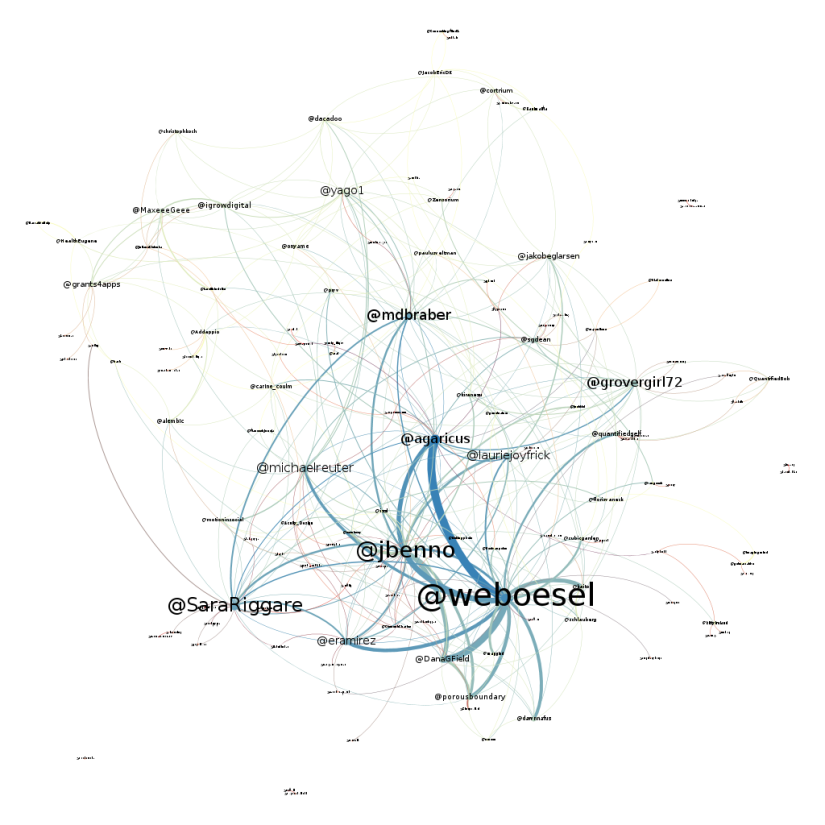
Network diagram of Tweet-Reply relationships. Method: Force Atlas; weights for edges are the counts of tweets from one person to the other
Two twitterers are clearly standing out: Number one again is Whitney Erin Boesel (@weboesel) with 196 tweets, almost reaching her last year’s count of 221 (then twittering under the nick of @phenatypical); number two is me (@jbenno) with 133 tweets, which means I have more than doubled, even if I had been the second highest scoring participant then, too.
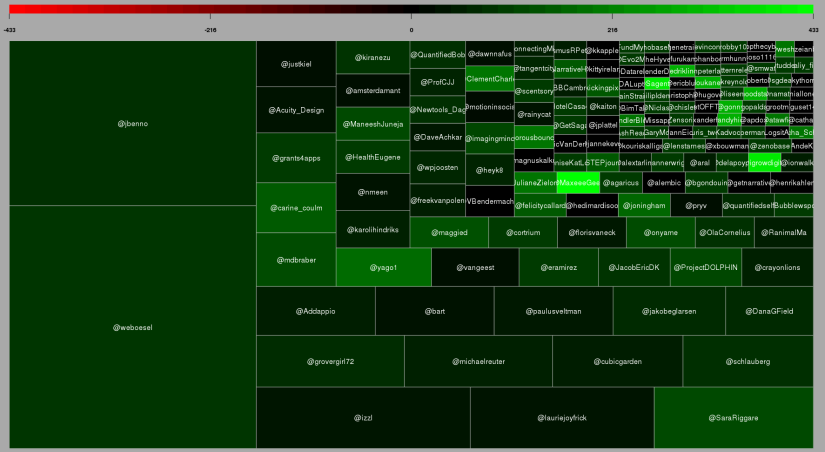
Twitter leaderboard for the #qs14 conference: Nr. 1 is Whitney Erin Boesel closely followed by myself. The colors reflect the percentage of people that had been included in the tweet as an reply.
Here’s an easy overview of the most common words with stopwords removed:

Words in the Tweets tagged #qseu14
And these are the idioms: the most common trigrams (=three consequtive words):
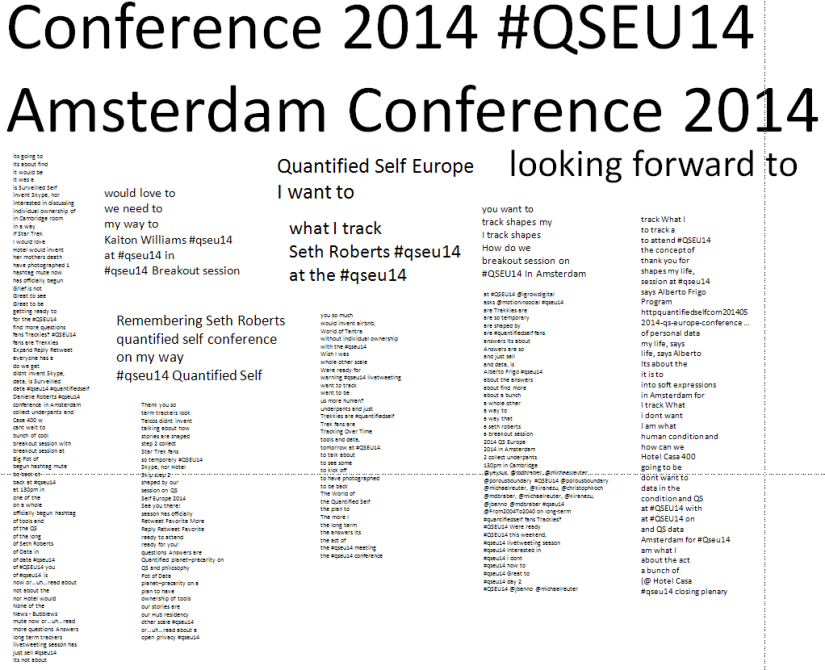
Trigrams from #qseu14 tweets.
I will post thoughts and impressions that I took home from #qseu14 soon, too.
by Kira Nezu | 12 May 2014 | Blockchain
At the Quantified Self Europe Conference 2014, which took place on May 10th and 11th, we hosted a session to discuss philosophical, and especially ethical aspects of self-tracking. Here are our slides with comments:
And here is the summary of the session on quantifiedself.com.
by Kira Nezu | 4 May 2014 | Blockchain
“The future is already there, it is just not evenly distributed” as William Gibson said.
At re:publica 2014 conference in Berlin we will demonstrate methods and tools to make good predictions and foresighting from sources found on the Net.
“With Big Data comes the end of the pundit” – foresight, predicting the future from the present, has always been the realm of obscure trend researchers, strategy planners, intelligence services or the RAND Corporation.
To get to useful insights about the changes in society, politics, culture, or technology, we do no longer have to rely on the esoteric, propriatory knowledge of individual researchers or institutes. We can harvest the tremendous treasure that lies at hands in the Internet.
In our session we will demostrate at real cases how to derive patterns and trends from sources like Twitter, Google Books or Google Correlate without heavy programming skills; we will search blogs with self-made crawlers, we will demonstrate how to find and visualize Twitter networks, and how to get information on people’s behavior using meta-data (just like the NSA does according to Snowden …)
Come to our session:
re:publica conference
Wednesday, May 7th at 12:30pm
stage B
Link to the re:publica-site:
re:publica Open Foresight
Audiostream from the session (in German):
http://voicepublic.com


