Datarella, a founding member of the European Blockchain Association, is thrilled that Dr. Clara Guerra, Deputy Director of the Office for Financial Market Innovation and Digitalisation (SFID) of the Government of the Principality of Liechtenstein, will contribute her exemplary expertise to the EBA as its new board member. Effective January 1, 2023, Dr. Guerra has taken over the position of Kent Gärtner, who stepped down from the EBA board.
As a lawyer by training with a focus on high-tech and innovation, Dr. Guerra previously worked in the private sector and is active as a board member in higher education and Medtech. She lectures and regularly publishes emerging tech and other innovation topics from a governmental perspective. With her unique insight into one of the most crypto-friendly markets in Europe, and her experience with regulation and policy work in the DeFi and blockchain, digitalization, and technology education field, she is a perfect fit for the association and its goal to empower the European blockchain ecosystem.
Adding a unique European viewpoint
“We could not be happier about Clara’s decision to join our board. She has a wealth of expertise and brings fresh ideas, insights, and points of view to the continuing conversations taking place within the blockchain and cryptocurrency ecosystem. In the current era of the industry, when nuanced and pragmatic dialogue is needed more than ever before, her skills in regulation and policy will be extremely beneficial. We are looking forward to working together with the other members of the EBA board to advance our mission of enhancing and bolstering the capabilities of the European blockchain ecosystem”, says Dr. Michael Gebert, Chairman of the European Blockchain Association.
“With its semi-autonomous, decentralized operating model, the European Blockchain Association is quite different from other associations. Our goal is to provide a platform for people who want to make an impact. Clara joining our board explicitly because she shares our vision and is willing to actively contribute to our various projects and working groups is a big win for the EBA and its members. We are thrilled to be working with her”, Datarella CEO Michael Reuter, Co-Chair of the European Blockchain Association, adds.
“Fostering innovation has always been my passion. Innovation is conventionally associated with strength. However, most of the time it is a rather fragile transition state that relies on enabling circumstances. Regulation is a key enabler for technological innovation, especially in the finance sector, and must be approached with deliberate consideration. I am very excited to join the European Blockchain Association. The active and very knowledgeable community, the pragmatic mindset, and the decentralized approach to achieving its goals are perfect frameworks for me. I am looking forward to collaborating with my fellow board members and the whole EBA community”, says Dr. Clara Guerra.
Kent Gärtner, who was a board member of the EBA since its inception is stepping down from his position for personal reasons. The board would like to thank him for his invaluable contributions in the start-up phase of the association.
Michael Reuter, CEO and Co-founder of Datarella, becomes an Advisor with Outlier Ventures, a London-based investor in technologies for an open data economy. Along with Outlier’s Senior Management, he plays a key role in developing Convergence Alliance CA, a unique community of open source protocols, enterprise, start-ups, government bodies and academia leading the next phase of the Web.
The Convergence Alliance’s mission is to accelerate and diffuse a more equitable, scalable and usable Web 3.0 to effect a New Open Data Economy based on the sovereignty of the user, countering platform monopolies and enabling a more evenly distributed value creation from AI.
Consisting of the three layers Production (IoT), Distribution (Crypto) and Consumption (AI), the Convergence stack addresses the whole Web 3 ecosystem with highly specialised, though integrated, protocols and service providers. Michael and his team at Datarella support Outlier Ventures In coordinating and integrating CA’s individual technologies and projects in order to pave the way for the next generation of smart distributed applications.
Convergence Alliance was launched by 18 enterprises and organisations in June, 2019. At its kick-off event Diffusion 2019, 19-20 October in Berlin, Convergence Alliance members work together with more than 500 developers and 20 protocols on 50m+ lines of open source code.
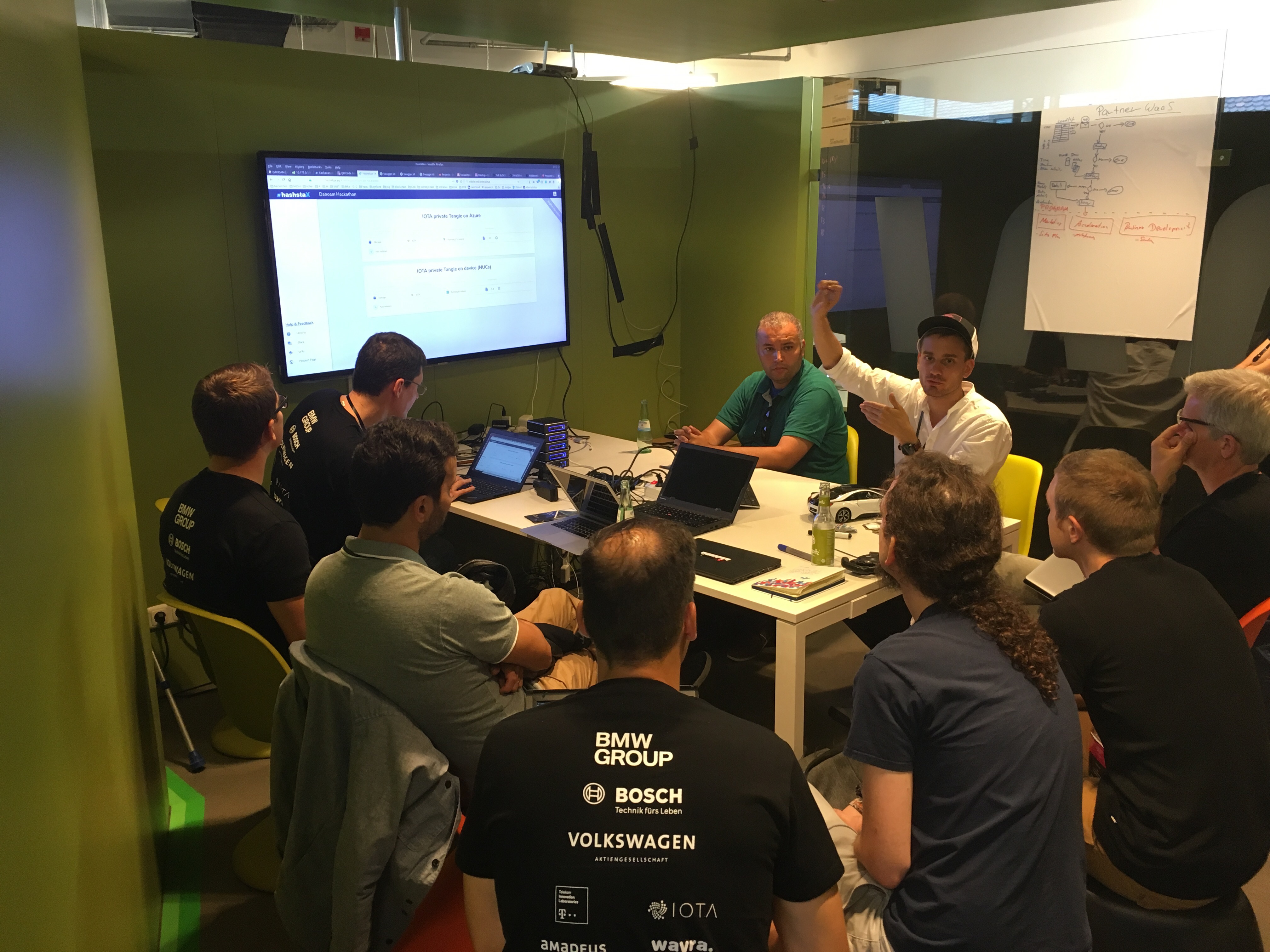
Over the weekend of 20-22 July, heavy rain poured on the streets of Munich. Which did not prevent 20,000 people to demonstrate against xenophobia at Königsplatz, also went more or less unnotced by the 150 participants of the BlockchainedMobility hackathon who met to create blockchain-based mobility solutions.
Hacker teams of leading European mobility players, such as BMW, Volkswagen Group, Bosch, Deutsche Bahn, Deutsche Telekom, Amadeus, and others mixed with freelance developers, designers and business experts to work on IOTA and Ethereum. On Sunday afternoon, the jury saw 18 project teams presenting a broad variety of mobility solutions, from specific applications, such as a EV charging station finder, to more generic solutions like a mobility API to match offerings of mobility providers with the needs of the end user.
Georg Eisenreich, Minister of the State of Bavaria
The hackathon started on Friday with a keynote by the Minister of State for Digital, Media and Europe, Georg Eisenreich, who highlighted the importance for collaboration of the State of Bavaria with on the one hand corporations, such as the hackathon‘s sponsors, on the other hand with the technology – or more specifically – the blockchain community. Minister Eisenreich emphasised the role of the State of Bavaria in providing a sound economical framework for blockchain startups and projects. He encouraged the participants to be creative and dare to found companies in order to foster Bavaria‘s and Europe‘s competitive advantage in the area of blockchain.
Michael Reuter (Datarella), Peter Busch (Bosch), Dominik Pietsch (BMW) Alisa Maas (IOTA) Klaus Schaaf (Volkswagen Group), Herbert Mangesius (Vito Ventures)
After the keynote, the representatives of the main sponsors Dominik Pietsch (BMW), Klaus Schaaf (Volkswagen Group), Peter Busch (Bosch), and Alisa Maas (IOTA) discussed the state of mobility and the expectations of the mobility players for the hackathon with Herbert Mangesius (Vito Ventures) and Michael Reuter (Datarella). At BMW, Volkswagen Group and Bosch, blockchain has obtained an important role within the areas of technology to work on. Dominik Pietsch, Klaus Schaaf and Peter Busch all agreed upon the importance their companies put in blockchain as a foundational layer for mobility solutions. Particularly in regard to the complex regulatory requirements for large corporations in any case of collaboration, blockchain serves as a neutral technological layer that allows for a joint use of mobility data provided by different players within the ecosystem.
Deutsche Telekom. Breakout Session
During Saturday and Sunday, hackers worked highly concentrated and steadily to create their applications they had to present towards the jury. Breakout sessions by the sponsor teams and Yoga interludes gave variety in the workflows. Some teams, e.g. Bosch and Deutsche Telekom, provided not only APIs but sensor-driven hardware the hackers could integrate into their projects.
Sunday evening, the jury announced 3 winners out of 18 projects, who received IOTA’s in worth of USD 5,000 (#1), USD 2,000 (#2) and USD 1,000 (#3) as well as 50,000 XSC (#1), 30,000 XSC (#2) and 15,000 XSC (#3). Additionally, Lewis Freiberg of the IOTA Foundation announced a special prize: the opportunity to receive USD 50,000 in IOTA tokens provided by the IOTA ecosystem fund for the best open-source project.The hackathon‘s winners were:
#1 OMS – Open Mobility API: USD 5,000+ 50,000 XSC + the opportunity to receive USD 50,000 from the IOTA ecosystem fund
OMS – Open Mobility API
#2 AgentFinder – EV Charging Station Finder USD 2,000 + 30,000 XSC
AgentFinder – EV Charging Station Finder
#3 Pac-Man On Wheels – Crowdsourced Incentive Scheme For Privately Collected Driving Data USD 1,000 + 15,000 XSC
Pac-Man On Wheels
We will publish short interviews with each project team over the next few days.
After the jury‘s decision, the hacker crowd gathered for a few more hours to get themselves the last drinks and discuss next steps: since everybody enjoyed this weekend and we received so much positive feedback from the community, we have already started thinking about how to build upon the success of the BlockchainedMobility hackathon. Hopefully we – and new sponsors and participants– will meet again, soon!
“I can honestly say my industry is being disrupted beyond belief right now. The funny thing is, I like it”, said Jamie Burke during yesterday’s Ethereum Munich meetup “The State of the ICO”. Jamie is betting his Outlier Venture’s fund on the idea to launch a handful, large ICOs to invest in communities and therefore in economies, rather than in startups.
Jamie’s fireside chat (no, there was no fire but it was hot as hell) with Datarella’s founders Michael Reuter and Joerg Blumtritt was a fascinating tour de force towards a potential next level of venture investing in general, and a new breed of investors focusing on communitarian, anti-fragile investments rather than amassing a portfolio of companies of which 90% will fail.
Before, lawyers Dr. Nina-Luisa Siedler of DWF and Dr. Markus Kaulartz of CMS inspired the audience with their highly informative and at the same time very sympathetic presentation on the legal aspects of ICOs. Both being long-time experts in the field of blockchain, managed to entertain everybody although their messages were far from being easy-going. Especially their slide “Consequences in case of incompliance” filled the room with enthusiasm. Their complete slidedeck “Legal Aspects of ICOs” can be downloaded here.
Again, the Ethereum meetup was a great success: everybody learned a lot, and from what we overheard on the floor, some of the individual conversations until late at night resulted in new ideas for …. future ICOs.