
by Maria Lema | 18 February 2020 | Blockchain, Track and Trust
This is a guest post by Maria Lema, the co-founder of Weaver Labs, a tech start-up building a Blockchain platform for the Telecommunications industry.
Connectivity is what allows us to exchange information real-time across the globe thanks to the existing infrastructure we call the Internet. Us as individuals and all our businesses rely on connectivity for the majority of our daily activities, we do everything online and it has become a utility: it’s an essential tool to create, develop and grow. With 5G being deployed, the telecoms sector must focus on innovation in the business models and supply chain dynamics to deliver the networks of the future.
Innovation: long time no see
Technological development in the communications sector hasn’t stopped since the creation of the telegraph, and we have learned to communicate faster and more efficiently across the Internet thanks to the creation of communications systems, standards, protocols and infrastructure such as fiber, antennas, switches and gateways.
Although we have changed the way we interact with the Internet and online applications, we haven’t changed much the way we deliver connectivity. Most will agree that, while we have undergone (and are probably still undergoing) a data and communications revolution, networks haven’t yet adapted to this new way of online interactions. We have adopted the smartphone and we have seen technologies grow from 2G to 4G, but the traditional supply chain and investment models in telecoms have achieved the tipping point. We need a transformation, one that is able to support and deliver the spectacular developments in emerging technologies: AI, Big Data, Robotics, Autonomous Vehicles, and more.
The Network Revolution
5G is the new generation of mobile networks and is purely software-based, so more than just another generation, it is an opportunity to innovate in the way we deliver connectivity with an infrastructure that supports the future cities and the explosion of data.
Following this transformation, networks are becoming a commodity: open source based and with a growing diversity in the equipment sector – in other words: competitive. This competitiveness is motivating new players to deploy and own network infrastructure: factories, hospitals and even whole cities are investing in infrastructure with a variety of applications in mind that require high bandwidth and support for a massive number of devices.
However, there are still challenges to realising the dream of open and diverse networks: convergence and integration is still something not fully solved. Despite being built around existing standards like the Internet Protocol (IP), there’s still a need for rigorous standardisation to allow for easy interoperability across network elements and all the actors involved – chip/device manufacturers, equipment vendors, operators, etc. From a service provider perspective, some of the key hurdles when building diverse and interoperable networks are:
- Simple: to create end to end services across the infrastructure targeting interoperability across multiple network elements.
- Open: to integrate new infrastructure and service offerings, with built-in security mechanisms that allows critical components to be onboarded faster.
- Scalable: grow horizontally with minimum interaction of the Service Provider.
Weaving Telecoms with Web 3.0: the fundamental shift
Decentralisation and tokenised economies are a solution to complex cross-actor engagements with mechanisms to reward network participants in exchange for contributions. Leveraging innovative P2P and Blockchain technology, we are a software and protocol stack that provides a simple, open and scalable solution that enables the horizontal integration much needed in networks. We create a marketplace of connectivity assets that replaces the Service Provider as a central point of trust to aggregate network resources.
Weaver is a P2P network created specifically for telecommunications, equipped with a new Messaging System (WireMQ) designed to manage real-time communications traffic across the network infrastructure. It builds on the horizontal integration of networks by adding a software layer on top that enables interoperability and convergence.
How does Weaver help to advance in the Network Revolution?
We create a connectivity platform that integrates any communications system and leverages existing infrastructure to communicate across all technologies in the P2P network. A great example is the mesh network Weaver built for the Track and Trust supply chain project with Datarella. We used WireMQ to route traffic from IoT devices into a Satellite base station, and it can be scaled up including 4G antennas, WiFi and more IoT technologies – which allows us to bring this directly into Smart Cities. We innovate in the supply chain, creating a platform for connectivity with mechanisms to exchange network resources and incentivise all network participants. The new business models are based on infrastructure sharing and revenue sharing where all contributors can capitalise on existing assets and create a viable return on investment in infrastructure for connectivity.

by Rebecca Johnson | 23 November 2017 | Blockchain
+++UPDATE+++
We’ve stirred much interest in the issuance of our XSC token at the IOTA hackathon in Gdansk. We therefore decided to prolong our rewards campaign for IOTA developers for 1 week:
If you’re a developer who committed code to advance the IOTA network during the month of November, you’ll be eligible. If you think you’re eligible you can request up to 250 XSC until Friday, 1 December 2017.
Fill out this form now! Show us that you’ve got the right stuff!
Developer Incentives Program: Claim XSC Rewards
For more information on the CSC Blockchain Evolution Incentive Scheme, click here and here.
+++UPDATE+++
This is the second installment outlining the experiences of the winning team “PlugInBaby” during the IOTA Hackathon. In the first post (found here), we describe the idea generation process. In this post, �team member Rebecca Johnson goes into more detail with regards to how the team built the project and what exactly it accomplishes.
Our PoC decentralizes and democratizes access to a network of electric vehicle chargers by allowing the chargers to costlessly broadcast their status (offline, occupied, available) via 0 value transactions on the tangle. Next, using a mobile app, users searching for a charging station can query the tangle using 0 value transactions to search for tags of available stations. They can reserve a charging spot and book micro transactions necessary to pay for electricity, all using IOTA.
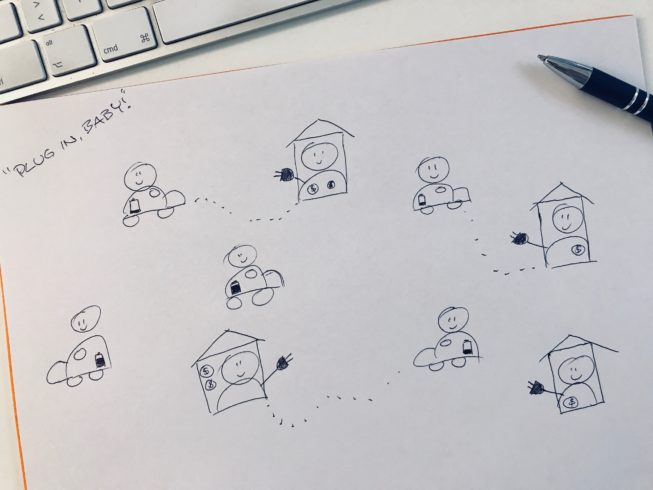
A world where individuals leverage open source software and DIY hardware to decentralise the market for energy.
Using the tangle as a database makes the solution quite elegant. The protocol for sending data and value are essentially the same which removes the need for a centralized payment processing layer and allows for the DIY ethic to extend all the way to the end-user.
This approach is also flexible enough to leave room for participation by utilities and other stakeholders since the hardware and software are open-source. Improvements are welcome and anyone is free to implement the idea. The code can be found here.
Requirements & Assumptions
- We restricted ourselves to using only IOTA for implementing the database functionality. This carries the theoretical advantages of future scalability, full decentralization and zero transaction costs for messages sent to and from the tangle as well as a mechanism for machine to machine electricity purchases.
- We assumed that the API and the interaction between the charger and the car app are out of scope for the hackathon.
- Charging station vendors need to send status messages for their stations (free, in-use, offline) using 0 balance transactions to the tangle. Our back-end provides this capability via terminal inputs. Since this is just a PoC we didn’t build out an API or UI for this portion.
- A web-based front-end, a back-end connection to the tangle and an API for communication between the two needed to be built. Given this, the team split into two groups of 3-4 developers each.
Back-End:
The experience of the PlugInBaby team was similar to that of the Freedom Pass team. We started out by following this tutorial from Baltic Data Science and gained speed by utilizing some of the resources from the Q&A with Chris Dukakis of IOTA. After that, we connected to a testnet node and started issuing transactions.
Like the Freedom Pass team, we also considered using a mainnet node but the issue of how to connect with neighbors was eventually a knockout criterion. This was actually due to security concerns. One of our team members had a Java Runtime Environment setup on a remote virtual machine and we considered setting up an instance of the IRI. In the end, however, we weren’t comfortable with the security risks that connecting with unknown nodes presented.
In contrast to the other teams, the “PlugInBaby” team used the IOTA Python Library to build and connect the backend. Documentation for this library is quite sparse in comparison with the JavaScript Library. We’d like to thank Andreas Osowski, Lewis Freiberg and Chris Dukakis of IOTA for their round-the-clock support in getting everything up and running.
Our team member Lukasz Zmudzinski has written a great blog post on his site which outlines which Python methods we used to read and write to the tangle in greater detail. We used the Tornado web framework and asynchronous networking library for this project and wrote our own API to communicate with the front end.
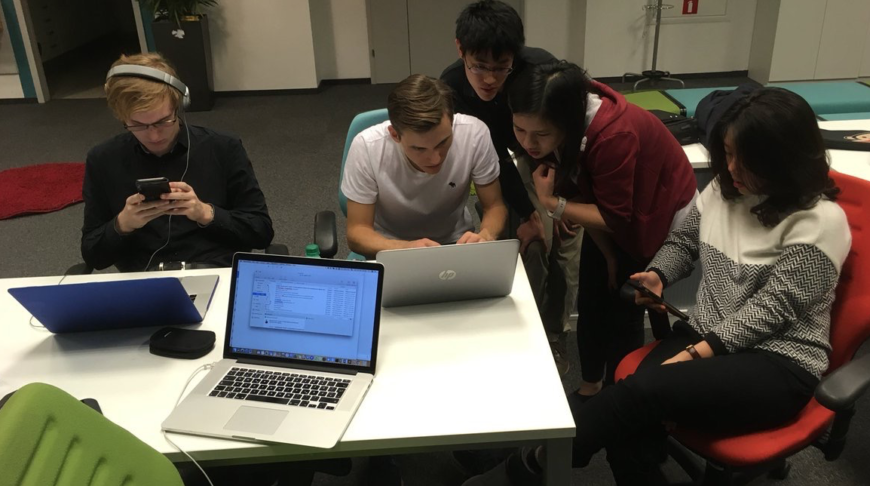
Team PlugInBaby hard at work on frontend development
Front End:
The front end was written primarily in JavaScript and utilizes server.js for Node. To accelerate development we started using a boilerplate/skeleton for Node.js web applications. We later used bootstrap and AngularJS to improve the styling and make our web app mobile-ready and responsive.
Users can query the tangle for the transactions of vendors with free stations and also read dynamic pricing information. The search mechanism uses information written to tags while the state information about the charging station and the station latitude/longitude are written in the message. This information is then passed via API calls to the front-end for interpretation in the UI.
User Experience:
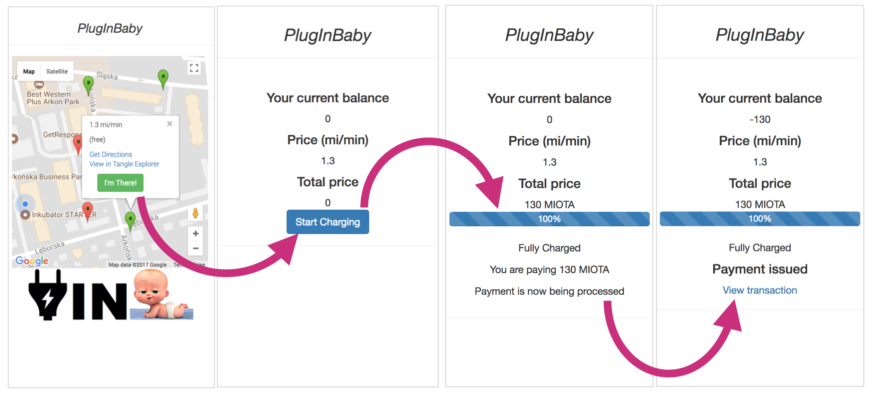
UI Workflow
- Step 1:
The user uses a smartphone app to query the tangle for available charging stations.
- Step 2:
The user selects a charging station from the map. Each station has dynamic pricing which is shown in real-time along with the map pin when selecting the station.
- Step 3:
The user drives to the station and lets the station know that they have arrived by sending a message to the tangle.
- Step 4:
The charging station tells the app that the car is fully charged.
- Step 5:
The user’s IOTA wallet is debited and the transaction is signed by the seed stored in the app.
- Step 6:
The charger resets its status to available on the tangle and all the transactions/messages are available for verification.
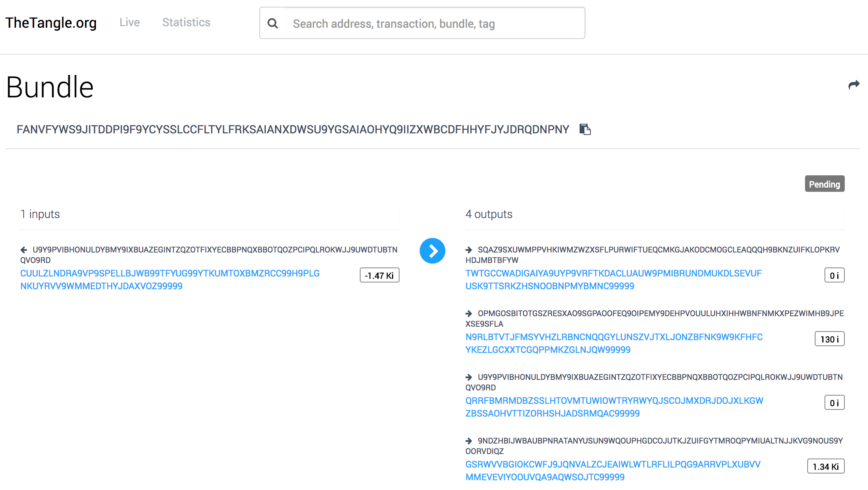
IOTA Tangle output: Following charging all transactions are available for inspection in the tangle.
What We Learned:
The PlugInBaby PoC demonstrates the feasibility of an IOTA-based search and payment app for IOTA-based DIY chargers but it is far from ready-for-use outside of the lab/hackathon. A number of issues came up which will need to be solved before this system would be appropriate for public use.
- Tags only allow for 27 characters which wouldn’t be enough to store latitude and longitude data plus a transaction ID without truncation. The team ended up using the message field to store data (location + charger status) while the tags were used to store a searchable charger identifier.
- Speed is quite limited on the testnet. Specifically, we found that the testnet confirmation times were quite long late at night (2-3 minutes) when fewer users were online running test applications. This is due to the fact that each new transaction must approve two other transactions. This approach scales well but also requires many active nodes to submit and approve transactions. As both the testnet and the mainnet grow this problem should be mitigated.
- Transaction caching was required to make the demo useable within the alloted three minute presentation time.
- While the support from the IOTA team was excellent, we noticed that the documentation, particularly regarding the phython libraries, is quite lacking. This makes development a slow trial and error process.
- Security and privacy are generally open questions within the IOTA ecosystem. The team assumed these issues to be outside the scope of this PoC. That said we raised privacy concerns regarding the possibility of API misuse and the lack of privacy often during the development process. Improved documentation and more descriptive error messages would go a long way towards making these issues easier to handle.
- Masked Authenticated Messaging (MAM), the planned Private Transaction layer, and the integration of zero-knowledge-proofs into the IOTA ecosystem are exciting areas for new research given the current limitations of IOTA in the area of security and privacy.
Conclusion
To sum up, the team learned a lot about the implementation of an exciting use case that really makes sense for IOTA. Is this the only way to build such a system? No. There are many other ways to find, navigate to and pay for electric vehicle charging. Many market-ready centralized systems are already up an running. Our PoC demonstrates, however, that it’s possible to solve this use case using IOTA alone which allows for the possibility of a scalable decentralized approach. This, in turn, could open up the field to many more players and provide a common system for various entities to build upon.
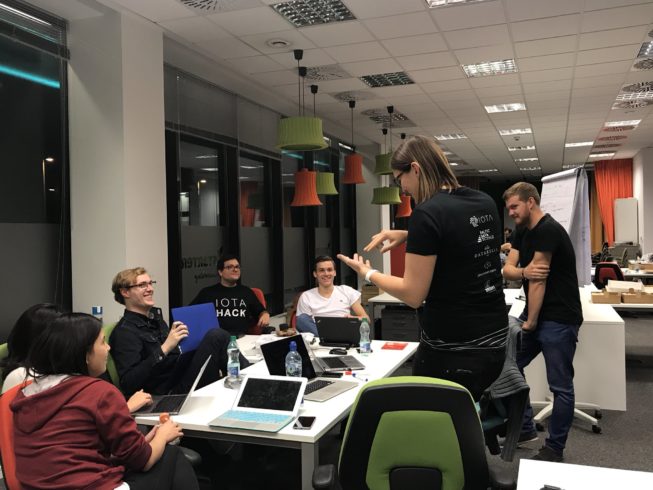
Team „PlugInBaby“ at the IOTA Hackathon in Gdansk, Poland
Here is an overview of all reports on the IOTA Hackathon’s projects:
1st place – “PlugInBaby”:
2nd place – “Freedom Pass”:

by Martin Schäffner | 9 May 2016 | Events
Dr. Christian Reitwiessner (https://mobile.twitter.com/ethchris), Team Lead Ethereum and co-designer and lead implementor of Solidity, will introduce us to Ethereum.
He’ll be talking about smart contracts, blockchain basics and the Ethereum Virtual Machine. We will create a smart contract during the event.
—-
Datarella CEO Joerg Blumtritt (https://twitter.com/jbenno) will then be talking about the trend to decentralize services:
With his presentation Decentralized Business – From Dapps to DAOs he’ll be taking up the great success of the DAO crowdfunding (https://daohub.org) which has generated over $20 million (as of Friday, 6 May).
—-
Hashtag: #ethmuc


