moveID, the identity-focused project within the Gaia-X 4 Future Mobility family, unveils the MOBIX app, its live demonstrator at the IAA MOBILITY 2023. MOBIX allows for peer-to-peer parking and EV charging and IAA Mobility visitors can experience a first glimpse of its vision of a decentralized mobility service ecosystem.
The demonstration involving Tesla and Jaguar electric vehicles will allow the visitors to experience the moveID’s vision of a vendor-neutral open ecosystem of data-driven mobility services with integrated payment capabilities. The live demo will show how autonomous transactions between connected devices streamline expenses and add new revenue streams.
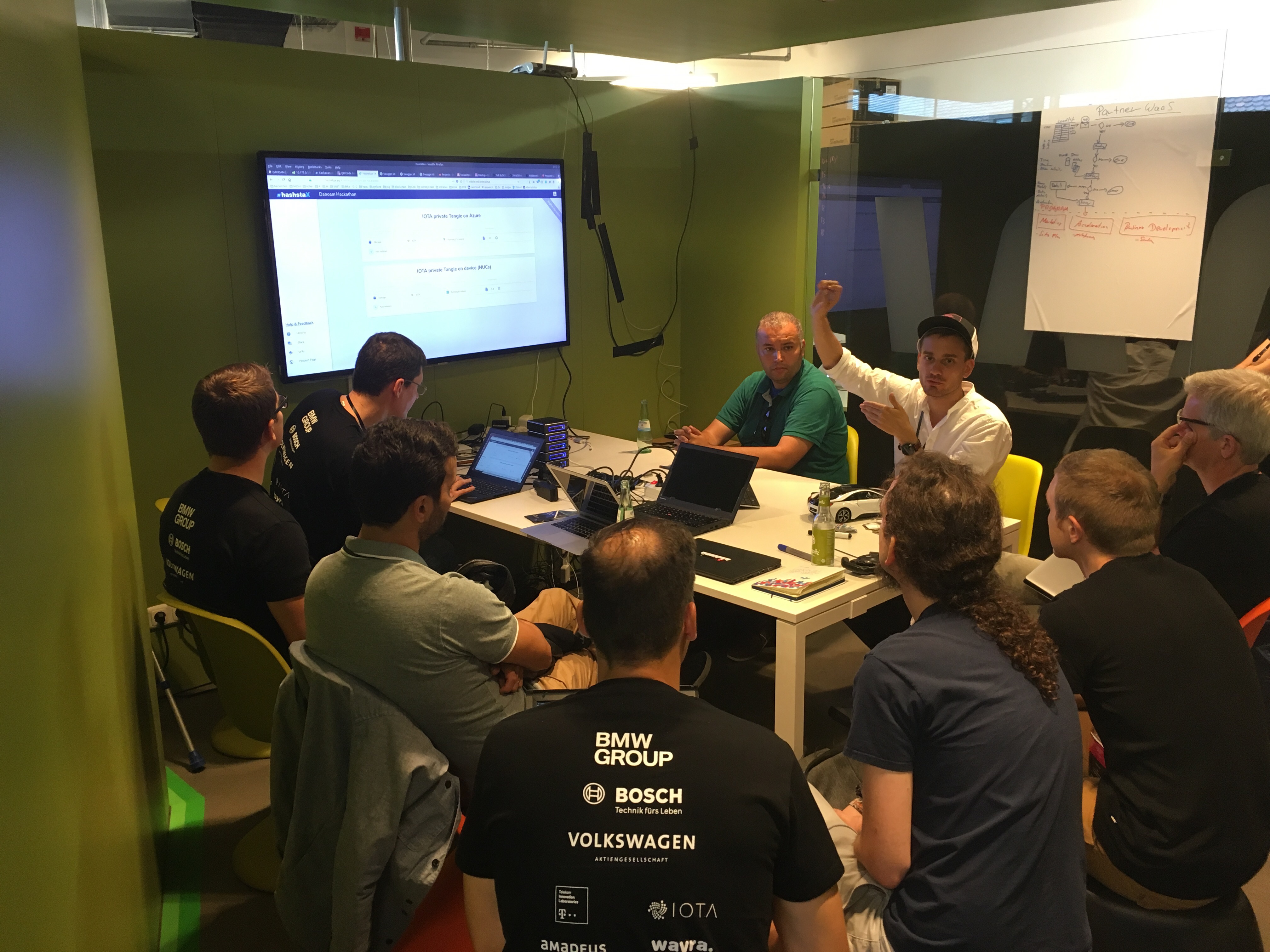
In preparation for the big event, several moveID consortium members, namely BOSCH, DENSO, ITK Engineering,peaq, htw saar, Ocean, and 51Nodes, have met for integration workshops in the Datarella offices in Munich. The goal of the first integration workshop was to connect the different software and hardware components provided by the partners and test the first set of workflows for the IAA demo from a user’s perspective. Datarella was entrusted with the planning and organization of the event as well as the integration of the different workflows into a seamless user experience via the MOBIX app.
The critical path that was completed, included three workflows, namely issuance of a Verifiable Credential to a vehicle, access to a parking space via a Verifiable Presentation to a Signal Head, and checkout of a parking space via a Verifiable Presentation to a Signal Head. The workflows are enabled by state-of-the-art Self-Sovereign Identity (SSI), Vehicle-to-Everything (V2X) as well as Fetch.aI micro-agent technology, all controlled via the MOBIX mobile application.
“Leveraging our long-time partner Fetch.ai’s micro-agents to connect different technologies and seeing the distilled result of the agent’s work in our MOBIX app is living proof of the power of the moveID tech stack,” says Datarella CEO Michael Reuter.
While the demonstration focuses on the mobility industry, the business model behind it can be implemented in a wide array of industries, such as Public-to-Private power grid interplay and smart supply chain management. The moveID project invites all stakeholders in the EV charging ecosystem to participate and make their charging solution part of the overall charging network. If you are interested in test drives, please contact our IAA Mobility team!
Together with 18 project partners in the Gaia-X 4 Future Mobility project moveID, Datarella develops the required digital identity infrastructure for the mobility of the future. With BOSCH heading the moveID consortium, leading mobility enterprises, Web3 companies, and research organizations create the foundation for autonomous driving and applications leveraging connected vehicles and devices.
Use Cases for the Mobility of the Future
The research project moveID comprises various scenarios of smart traffic management, s.a. parking, charging, or zoning. To create a trusted environment and connect all traffic participants, vehicles, and infrastructure components, s.a. traffic lights, access gates, and parking meters, obtain unique digital identities. All identities are managed as self-sovereign identities, a concept known as SSI, for maximum privacy and compliance with GDPR and the Gaia-X framework.
Datarella will co-create the standards and infrastructure for the future of mobility as part of the Gaia-X 4 Future Mobility moveID project, with an overall size of more than €20 million, by Gaia-X, the European Association for Data and Cloud. The three-year project brings together top industry players to build a sovereign digital infrastructure enabling secure, connected, and open mobility, with Datarella, conducting intense research and development as well as leveraging its expertise in creating successful mobility applications, s.a. Deep Parking, and MOBIX. To make moveID‘s decentralized digital identity infrastructure usable and to develop winning business models on top of it, B2B and B2C applications will be developed.
„With moveID, we will prove that European research projects like Gaia-X can be managed in an agile, dynamic way, and produce significant meaningful results for all mobility participants. Working with industry leaders like Bosch, or Continental on the one hand, and with Web3 projects and research institutes, on the other hand, collaboration is not a simple phrase – it‘s living reality“, says Datarella CEO Michael Reuter.
The Power of Web3
Besides Datarella, other project participants include Bosch, Ocean Protocol, Airbus, Continental, Fetch.ai, Materna, Denso, WOBCOM, ecsec, htw saar, Atos, Chainstep, ZU, peaq, 51nodes, ITK, DLR, and deltaDAO. The project will feature a strong Web3 component with contributions from leading projects in the space:
peaq, the Web3 network powering the Economy of Things, will conduct intense research and development within the project. peaq will further build up its layer-one blockchain in line with the co-created requirements and standards, aiming to grant Gaia-X’s moveID the perfect infrastructure for decentralized mobility applications. peaq will also provide its core functions: peaq ID – Self-Sovereign Machine Identities (SSMIs), peaq access, and peaq pay. peaq is built using Substrate and will soon be live on both Kusama as well as Polkadot. It is working on enabling collaboration and interoperability with the Ethereum and Cosmos ecosystems for other Web3 consortia collaborators in Gaia-X.
51nodes, a Web3 developing and integration company brings to the project its experience with SSI architecture and implementation in the context of decentralized mobility infrastructure. In addition to the development and integration of various SSI technologies, the focus of work will be on SSI interoperability challenges.
Through BigchainDB, Ocean Protocol – the Web3 platform to unlock data services for AI and business innovation – is providing key technical infrastructure for moveID to expedite the development of decentralized digital identity infrastructure for European mobility. Essential components of Ocean’s decentralized data marketplace technology, Compute-to-Data, and data pricing mechanisms are being leveraged to build a system architecture that ensures a seamless exchange of information between providers and customers of mobility applications.
deltaDAO, a web3 software development, integration, and consulting company, will co-develop decentralized data infrastructure and federation services in the context of the broader Gaia-X ecosystem. deltaDAO contributes its extensive knowledge regarding Gaia-X compliance, interoperability, and integration
Peter Busch, Product Owner for Distributed Ledger Technologies (Mobility) at Bosch, said: “Web3 technologies offer a promising digital foundation for future mobility solutions. With moveID, we are setting the foundation for a hyper-connected mobility infrastructure by leveraging self-sovereign device identities and decentralized data sharing to enable hundreds of potential use cases. We are thrilled to be exploring this exciting prospect side by side with some of the leading projects in the decentralized space such as peaq, Ocean Protocol, Datarella, 51nodes, and Chainstep.”
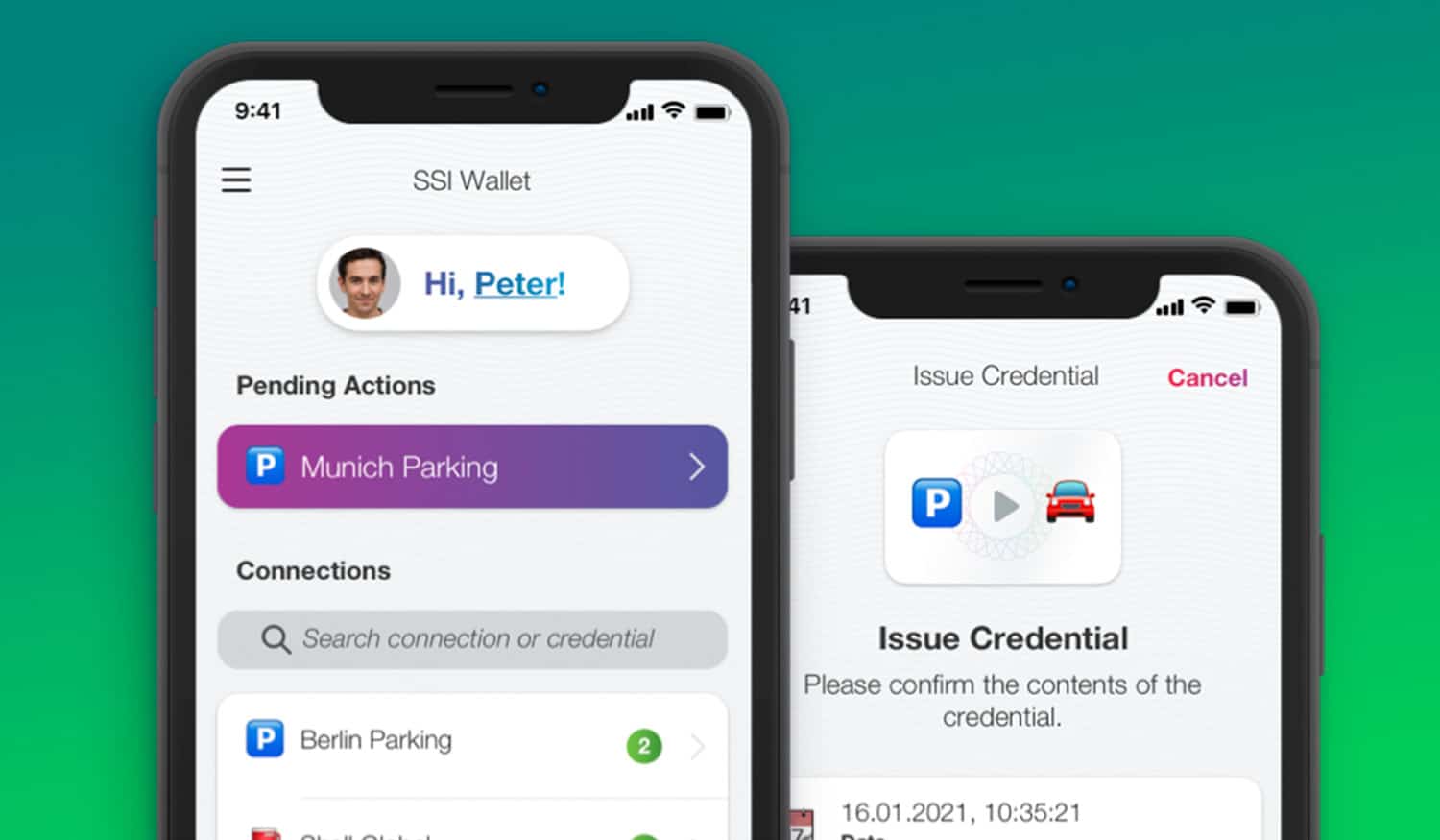
Datarella is offering its customers state-of-the-art Self-Sovereign Identity infrastructure with its SSI Wallet for innovative identity management. It can be integrated into new or existing ecosystems and provide fundamental decentralized identity infrastructure for users to authenticate, issue and receive Verifiable Credentials or transfer data. This allows for many innovative use cases like credential-based access management, automatic credential verification or trusted data transfer.
The Wallet
Having full control over an own digital identity is one of the fundamental principles for Self-Sovereign Identities. This includes that private keys and verifiable credentials are not stored on a centralized exchange or platform, but on the user’s very own devices in a decentralized manner. From this device, the user can issue or receive credentials and authenticate themselves by connecting with other SSI agents.
Like in the physical world where an identity is represented by an ID document which is often kept in a physical wallet, digital private keys and verifiable credentials are stored in a digital wallet. From here, the user can decide with whom the user interacts and shares information from its wallet. The user can ensure that private information is stored only on authorized devices and not in centralized databases which reduces the risk of data breaches tremendously. A wallet can have various forms, a browser extension, a hardware wallet or an entire app like Datarella’s SSI Wallet.
Technology
The SSI Wallet is meant to be deployed in ecosystems that allow users to interact with each other, with SSI compatible websites and IoT edge devices like micromobility vehicles. This is enabled by the Aries Framework Go, which supports a broad variety of edge- and cloud environments.
The wallet further provides a high level of privacy as it natively supports did:peer methods which creates pairwise pseudonymous DIDs for each individual connection and therefore avoids correlation by design. Even though did:peer does not require a ledger, the Aries-Framework Go supports public DID methods like did:web or DIF’s Sidetree protocol. It further allows selective disclosure of credentials thanks to its support for BBS+ signatures. The SSI wallet is therefore perfectly suited for public adoption as well.
It will soon also contain SDKR – a decentralized key backup and recovery mechanism that allows you to backup and recover your secrets with only your official eID. No need to remember passwords or the location of your backups thanks to eIDAS and decentralized and opaque storage capabilities from StorJ.
Conclusion
With our SSI Wallet, we are confident to demonstrate the benefits of Self-Sovereign Identity perfectly in a privacy-preserving and intuitive manner. By using the Aries-Framework Go, we can ensure that it works on web applications and mobile solutions as well as on proprietary IoT devices either without a ledger entirely (only P2P) or by using did:web or the Sidetree protocol.
Datarella is joining forces with Ocean Protocol to expand the Open Data Economy. moveID, our first project will be under the umbrella of GAIA-X, the European Association for Data & Cloud, as part of the GAIA-X 4 Future Mobility Project, which aims at bringing cloud applications to autonomous & networked vehicles.
The project’s overall goal will be the creation of a decentralized ecosystem of data & services that allows autonomous & networked vehicles to integrate into smart infrastructures and third-party services, following GAIA-X’s design principles. With mutual trust as its core concept, its stated goal will be achieving data sovereignty.
For Datarella, technology is an instrument to increase the quality of living, by supporting human beings in all kinds of professional and private activities. The growing complexity and diversity of our ecosystem require technological infrastructures that facilitate collaboration and cooperation. By planning, developing and implementing blockchain solutions worldwide, Datarella meets this requirement: in the fields of Finance, Supply Chain, and Mobility, we enable industry participants to join forces and create sustainable, crisis-proof business models. GAIA-X is the perfect environment for true collaboration. – Michael Reuter, CEO of Datarella
Data generated by network actors or Autonomous Economic Agents (AEAs) in the ecosystem can be useful to 3rd parties, and thus has value as an asset. Ocean Market unlocks the value of these by enabling every authenticated user to put their data up for sale and to monetize it. Vehicle data, for example, could be (re)used for traffic analysis for the generation of better traffic models such as optimized traffic light switching.
Different market actors will price data differently, depending on the method of data generation, data quality, and its utility to the potential buyer. Ocean Market allows for dynamic pricing and thus for optimal value generation for data generators and data curators, in a privacy-preserving manner.
This project will use Datarella’s Enterprise Blockchain Solutions, which serve as the foundational, underlying protocol for digital business transformation with converging technologies such as AI and autonomous machines. Datarella’s future mobility solutions are fueled by blockchain technology, real-time decentralized data management, transparency and GDPR compliance. Given the natural synergies between Ocean and Datarella, this partnership is the first of many that will drive enterprise adoption of Ocean Protocol technology in Datarella’s client base.
Our mission is for data to be treated as an asset. By tapping into underutilized data from mobility IoT sensors, AI can uncover mobility patterns and optimize services / reduce waste. Machines can speak to each other and algorithms can make optimizations – all in real-time. Ocean can tokenize mobility data from devices, thereby creating an opportunity for these tokens to be used as instruments in DeFi projects. This is one of the many ways in which we enable data owners to share in the value their data creates. – Razvan Olteanu, COO of Ocean Protocol
Ocean Protocol is a Day 1 Member of GAIA-X Association AISBL, an international non-profit organisation established to achieve the GAIA-X project goals for the development of an efficient, competitive, secure and trustworthy federation of data infrastructure and service providers for Europe – fostering digital sovereignty of European cloud service users.
—-
About Ocean Protocol Ocean Protocol’s mission is to kickstart a Web3 Data Economy that reaches the world, giving power back to data owners and enabling people to capture value from data to better our world. Data is a new asset class; Ocean Protocol unlocks its value. Data owners and consumers use the Ocean Market app to publish, discover, and consume data assets in a secure, privacy-preserving fashion. Ocean datatokens turn data into data assets. This enables data wallets, data exchanges, and data co-ops by leveraging crypto wallets, exchanges, and other DeFi tools. Projects use Ocean libraries and OCEAN in their own apps to help drive the Web3 Data Economy. The Ocean token is used to stake on data, to govern Ocean Protocol’s community funding, and to buy & sell data. Its supply is disbursed over time to drive near-term growth and long-term sustainability. OCEAN is designed to increase with a rise in usage volume.
Over the weekend of 20-22 July, heavy rain poured on the streets of Munich. Which did not prevent 20,000 people to demonstrate against xenophobia at Königsplatz, also went more or less unnotced by the 150 participants of the BlockchainedMobility hackathon who met to create blockchain-based mobility solutions.
Hacker teams of leading European mobility players, such as BMW, Volkswagen Group, Bosch, Deutsche Bahn, Deutsche Telekom, Amadeus, and others mixed with freelance developers, designers and business experts to work on IOTA and Ethereum. On Sunday afternoon, the jury saw 18 project teams presenting a broad variety of mobility solutions, from specific applications, such as a EV charging station finder, to more generic solutions like a mobility API to match offerings of mobility providers with the needs of the end user.
Georg Eisenreich, Minister of the State of Bavaria
The hackathon started on Friday with a keynote by the Minister of State for Digital, Media and Europe, Georg Eisenreich, who highlighted the importance for collaboration of the State of Bavaria with on the one hand corporations, such as the hackathon‘s sponsors, on the other hand with the technology – or more specifically – the blockchain community. Minister Eisenreich emphasised the role of the State of Bavaria in providing a sound economical framework for blockchain startups and projects. He encouraged the participants to be creative and dare to found companies in order to foster Bavaria‘s and Europe‘s competitive advantage in the area of blockchain.
Michael Reuter (Datarella), Peter Busch (Bosch), Dominik Pietsch (BMW) Alisa Maas (IOTA) Klaus Schaaf (Volkswagen Group), Herbert Mangesius (Vito Ventures)
After the keynote, the representatives of the main sponsors Dominik Pietsch (BMW), Klaus Schaaf (Volkswagen Group), Peter Busch (Bosch), and Alisa Maas (IOTA) discussed the state of mobility and the expectations of the mobility players for the hackathon with Herbert Mangesius (Vito Ventures) and Michael Reuter (Datarella). At BMW, Volkswagen Group and Bosch, blockchain has obtained an important role within the areas of technology to work on. Dominik Pietsch, Klaus Schaaf and Peter Busch all agreed upon the importance their companies put in blockchain as a foundational layer for mobility solutions. Particularly in regard to the complex regulatory requirements for large corporations in any case of collaboration, blockchain serves as a neutral technological layer that allows for a joint use of mobility data provided by different players within the ecosystem.
Deutsche Telekom. Breakout Session
During Saturday and Sunday, hackers worked highly concentrated and steadily to create their applications they had to present towards the jury. Breakout sessions by the sponsor teams and Yoga interludes gave variety in the workflows. Some teams, e.g. Bosch and Deutsche Telekom, provided not only APIs but sensor-driven hardware the hackers could integrate into their projects.
Sunday evening, the jury announced 3 winners out of 18 projects, who received IOTA’s in worth of USD 5,000 (#1), USD 2,000 (#2) and USD 1,000 (#3) as well as 50,000 XSC (#1), 30,000 XSC (#2) and 15,000 XSC (#3). Additionally, Lewis Freiberg of the IOTA Foundation announced a special prize: the opportunity to receive USD 50,000 in IOTA tokens provided by the IOTA ecosystem fund for the best open-source project.The hackathon‘s winners were:
#1 OMS – Open Mobility API: USD 5,000+ 50,000 XSC + the opportunity to receive USD 50,000 from the IOTA ecosystem fund
OMS – Open Mobility API
#2 AgentFinder – EV Charging Station Finder USD 2,000 + 30,000 XSC
AgentFinder – EV Charging Station Finder
#3 Pac-Man On Wheels – Crowdsourced Incentive Scheme For Privately Collected Driving Data USD 1,000 + 15,000 XSC
Pac-Man On Wheels
We will publish short interviews with each project team over the next few days.
After the jury‘s decision, the hacker crowd gathered for a few more hours to get themselves the last drinks and discuss next steps: since everybody enjoyed this weekend and we received so much positive feedback from the community, we have already started thinking about how to build upon the success of the BlockchainedMobility hackathon. Hopefully we – and new sponsors and participants– will meet again, soon!


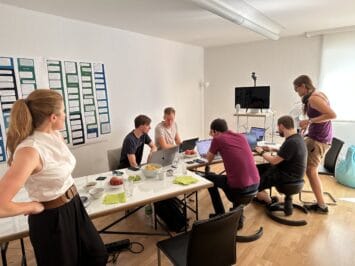 The critical path that was completed, included three workflows, namely issuance of a Verifiable Credential to a vehicle, access to a parking space via a Verifiable Presentation to a Signal Head, and checkout of a parking space via a Verifiable Presentation to a Signal Head. The workflows are enabled by state-of-the-art Self-Sovereign Identity (SSI), Vehicle-to-Everything (V2X) as well as Fetch.aI micro-agent technology, all controlled via the MOBIX mobile application.