
by Martin Schäffner | 17 April 2020 | Blockchain, Track and Trust
World Food Programme’s Building Blocks system is one of the best examples to understand how Blockchain technology can help to fight against COVID-19. Building Blocks is a Blockchain-based fully digitalized payment and bookkeeping system for any types of cashless transactions developed and further scaled up by Datarella and its subsidiary Baltic Data Science. Today, the Building Blocks is successfully up and running in Jordan since 2017 and expanded to Bangladesh by the end of 2019 by serving hundreds of thousands refugees in WFP’s refugee camps. Here’s how Datarella is leveraging Blockchain to support UN WFP in fighting COVID-19.
It’s been a while since Datarella successfully applied for an open call initiated by the WFP innovator programme in 2016. With this tender, WFP was evaluating whether Blockchain technology can help to improve the inefficiencies they were facing with paper vouchers issued to refugees in their camps for daily groceries. At that time, nobody was aware of a virus called “COVID-19” and working exclusively from home was simply unimaginable. But times have rapidly changed since the beginning of 2020. Today, we are facing probably the most severe economic downturn and human tragedy, affecting hundreds of thousands of people since WW2. .
So how can the Building Blocks system help against the coronavirus? For this to understand, you need to know what the system does. As said, Building Blocks is a payment and bookkeeping system for any cashless transactions helping refugees in camps to make their daily shoppings. Every month, the refugees receive a certain amount by WFP as digital food vouchers that can be used in the village’s supermarket.
There are two aspects to the Building Blocks system that helps to fight against the coronavirus. Both has to do with contactless interactions amongst the participants:
Cashless Payments
The Building Blocks system is built on a private Ethereum network. Every single transaction between a refugee and the supermarket is validated and recorded on the blockchain. The advantages are apparent. With the help of Blockchain, these transactions are executed cashless, meaning fully digitized without the need to get in physical contact with the other person. By the way, after the World Health Organization WHO released a statement on March 9 recommending that people turn to cashless transactions to fight the spread of COVID-19, a number of governments and retailers across the world took action. Not directly related to the fight against the coronavirus, other benefits of a Blockchain-based payment system include minimized risk of fraud and data mismanagement.
Contactless Identification:
In both countries Jordan and Bangladesh, where Building Blocks is up and running, refugees are able to authorize themselves for cashless payments without getting in direct physical contact with the counterpart. In Jordan, the authentication is performed through a system called IrisGuard. IrisGuard is an end-to-end iris recognition, verification, financial authentication and targeted cash transfer platform which removes the need for any form of ID such as username, password, card or pin. In Bangladesh, the Building Blocks system uses a different method for the identification. It was originally a fingerprint-based process, i.e. it was touch-based. However, due to the coronavirus pandemic, we changed the authentication procedure from a touch-based to a contactless system. Today, a QR code is issued to every single refugee who is entitled to receive aid by WFP.
In this recent article published by WFP, you can read more about the story of Building Blocks in Bangladesh and how leveraging blockchain to support UN WFP fighting COVID-19.
Please stay healthy and safe in these challenging times!

by Michael Reuter | 30 March 2020 | Blockchain
The Building Blocks payment system that Datarella has developed for the UN World Food Programme may serve as a blueprint for highly efficient distribution of financial transfers during the Corona crisis. The Building Blocks system was launched on 1 May, 2017, and since has supported several hundreds of thousands of Syrian refugees with their payments in Jordanian camp supermarkets. We at Datarella envision a similar system for disbursements of Corona-induced money transfers by governments and state agencies: Datarella can deploy a blockchain disbursement system for Coronavirus aid at short notice.
How Building Blocks Works
Donor countries provide the UN High Commission with funds for specific use in refugee aid. The UN High Commission forwards the funds to the WFP. The WFP administration in Rome is part of the Building Blocks Blockchain, through which all transactions in refugee camp supermarkets are processed. Every refugee receives a certain amount on their account each month, which they can spend for certain purposes. The refugee identifies herself at the supermarket checkout using the iris scan or ID app and has the amount incurred during his purchase debited from his account. The supermarket operator carries out a weekly transaction with the WFP administration in Rome and receives his money in local currency. Up to this point, all transactions have been carried out purely digitally in the form of blockchain transactions. With this process, savings of millions in bank and transfer fees are achieved. In addition to the highly efficient billing, there is no need for an additional audit by an auditor, since the building blocks system has been certified and blockchain technology guarantees the correctness of the transaction history.
Building Blocks for Corona Financial Transfers
A system inspired by the Building Blocks system can be used for financial transfers in the corona crisis. The federal and state ministries of economics and finance operate system nodes and thus have full control. Other nodes could – but do not have to be – operated by process-relevant organizations such as BaFin, Landesbanken, IHK, chambers of handicrafts, auditing companies, etc..The complete set of rules, including all levels, conditions and dependencies, are programmed as smart contracts. The final payouts can also be automated.
For Citizens and Companies – For All Types of Corona Aid
Every citizen and every company downloads an app that works as a wallet and that can be used to receive and send funds. The wallet also serves as an identification tool for the citizen or the company. The user fills out the application form for Corona emergency aid, loans, basic security or protection funds provided via the wallet. She uploads the necessary documents such as ID card via the wallet and sends the complete application. The user’s identity can be determined with a high degree of certainty via an additional ID function. If the authorized transfer recipient has been determined beyond doubt and automatically, the payment will be transferred to his account – also automatically.
We at Datarella are ready and working on a Building Blocks inspired version of a Corona Aid Disbursement System to be used in Germany, and the EU, we can deploy a Blockchain disbursement system for Coronavirus aid at short notice.
Other Approaches to Corona Aid Disbursements
There are other approaches to address the urgent need for efficient distribution of Corona-based aid. We can’t evaluate them in the same way we can assess our above described own system, but in one of our next posts we will describe one of them – the project “Diggi” which was created during a hackathon organised by the German Bundeskanzleramt a week ago.
by Michael Reuter | 30 April 2017 | Blockchain
What started with a Proof-of-Concept in Pakistan in early January this year, has been transformed in a fully functional Blockchain pilot being rolled out in Jordan in May, 2017. The Building Blocks project not only demonstrates the power and the impact of blockchain technology and its potential to enhance the lives of millions but it is proof of the technology’s potential for efficiency gains for a humanitarian agency, such as WFP.
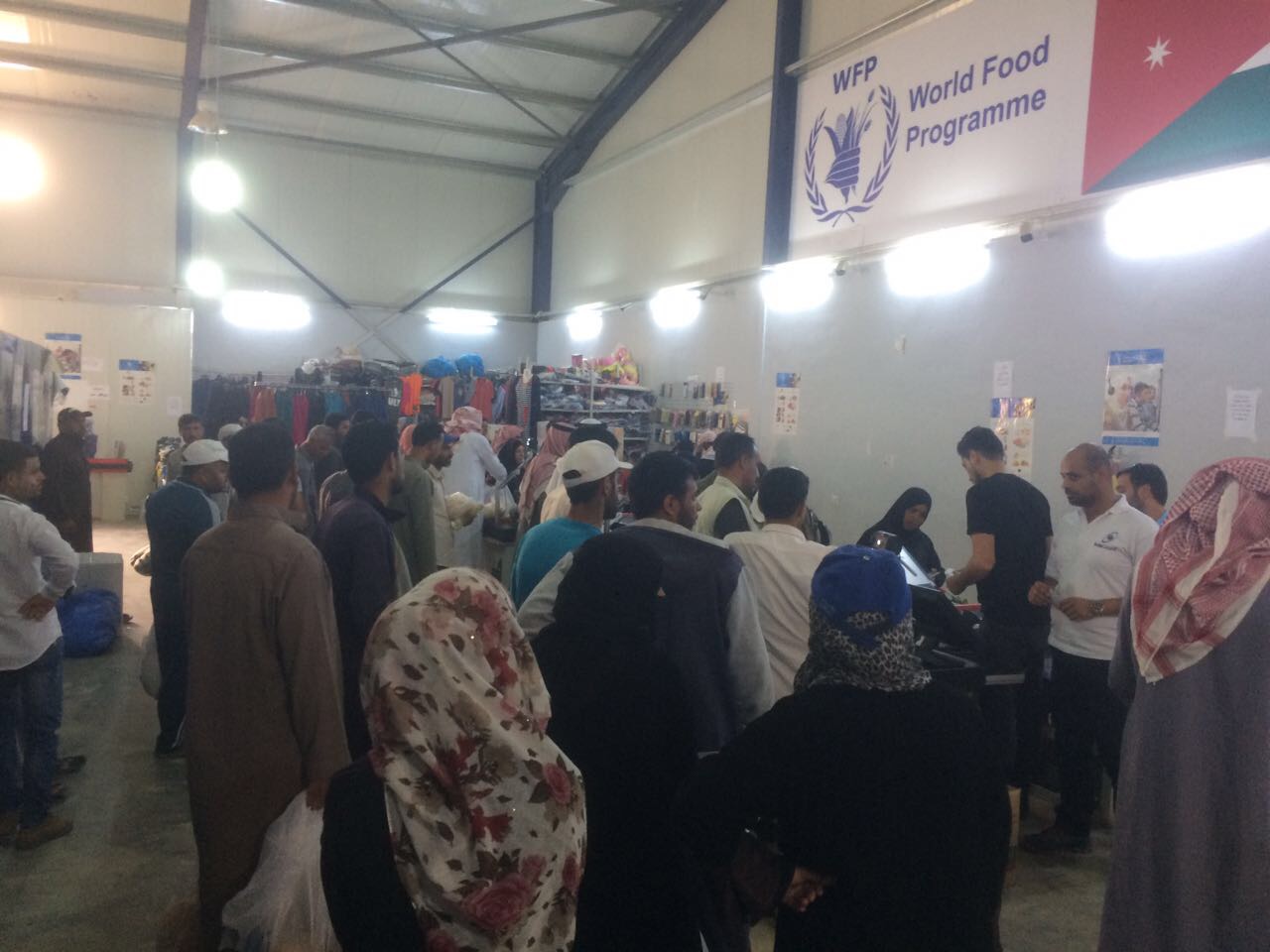
Based on the early, however robust prototype field tested in Pakistan, the Building Blocks pilot in Jordan now serves thousands of households in a Jordanian refugee camp Tazweed village. The inhabitants receive food vouchers that can be used in the village’s supermarket. The seamless integration of the existing iris scan identification technology into Building Blocks system allows the existing processes to stay in place without any need for changes for the beneficiaries, the supermarket nor WFP personnel. The only visible differences are a higher transparency of aid accounts for beneficiaries and easier bookkeeping for supermarket managers. The biggest, however invisible, advantage is a minimized risk of fraud or data mismanagement.
The economic benefits of harnessing Blockchain technology can amount to several million US-Dollars for the Jordanien refugee camp population, alone. The goal of the Building Blocks pilot is to demonstrate a fully-functional Blockchain solution that can serve as a role model and architecture for similar humanitarian projects worldwide and a base to develop other use cases.
The Datarella team wants to thank the WFP team, the IrisGuard team and our partners over at Parity Technologies for the great cooperation: from the beginning, we felt being one big team with everybody helping the others out when they needed it. Other than with this collaborative effort a project like Building Blocks would not have succeeded: Blockchain technology still is in its infancy and basic conditions in the field have proven to be challenging. Again: thank you very much for the opportunity to demonstrate the power and the real impact of Blockchain.
If you are interested in the Building Blocks project you might consider visiting our Ethereum Meetup on May, 16 .Here we will present more details and especially share our experiences gained in Tazweed village, Jordan
Find some more information on Coindesk or you contact us directly.
Foto by Houman Haddad, WFP: Opening scene, 1 May, 9:00 am, in the Tazweed Village supermarket, Jordan
