by Michael Reuter | 12 November 2020 | Blockchain, Smart Wallet
Datarella, in partnership with Fetch.ai, a Cambridge-based artificial intelligence lab building an open-access decentralized machine learning network for smart infrastructure, announced today the launch of M-ZONE, their smart city zoning infrastructure trials in Munich, Germany. Using their AI-powered software agents to optimize resource usage and reduce the city’s carbon footprint Datarella and Fetch.ai predict mass implementation of smart city infrastructure will result in 34,000t annual CO2 emission reduction.
M-ZONE will be launched in the Connex Buildings and will utilize multi-agent blockchain-based AI digitization services to unlock data and provide smart mobility solutions in its commercial real estate properties in the city center.
“Landlords, as well as the City Council, are interested in optimizing the parking space management, to allow for available parking for all employees of corporate tenants while organizing the traffic flow and preventing commuter traffic jams,” said Michael Reuter, CEO of Datarella. “Our system incentivizes community use of public transport through a tokenized incentive system while reducing the congestion that accounts for a great deal of Munich’s CO2 emissions.”
M-ZONE will solve the needs of various stakeholders:
-
Individual commuters and drivers: save time, money, and reduces driver stress
-
Property owners: simplified approval for new development projects
-
Tenants: lower rent through dynamic parking spot sharing
-
City Council: optimized traffic flows
-
Environment: less negative impact through saved CO2
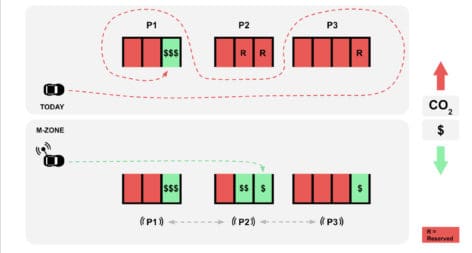 Upon implementation, AEAs (Autonomous Economic Agents) will support the sustainable and efficient use of city infrastructure in Munich through an application where they will autonomously negotiate the ‘price’ of parking spaces between the holders of parking spots, and those looking for parking spaces. Users can earn rewards in the digital currency if they choose less popular or in-demand parking spaces (or do not use the parking lot at all on some days). The Carpark AEA determines the reward levels to maximize resource usage.
“Fetch.ai provides a decentralized framework for building and customizing autonomous AI agents to carry out complex coordination tasks,” said Humayun Sheikh, CEO of Fetch.ai. “Our vision is to connect digital and real-life economies in order to enable automation over a decentralized network and change the way we use data.”
Users are incentivized to reduce their number of car trips to the Connex and adjacent corporate offices through a reward system which is measured by the utilization of parking spaces. Each registered user who is a regular car park user will be rewarded with a certain amount of tokens per minute for not parking at the parking lot. As soon as a car or its related wallet address is registered as parked by the Carpark AEA, the token airdrops to this wallet stop/slow. The number of tokens rewarded per wallet and minute depends on the current utilization of the parking lot.
“Assuming there is a 10% reduction in car usage across Munich alone, the city would see a 34.000 tonnes annual CO2 emission reduction,” continued Reuter. “Scaled up to cover all of Germany, that equates to 1.7 million tonnes CO2 reduction, annually. This smart city solution has the potential to penetrate huge markets simply by tapping into wasted data and utilizing it efficiently.”
For more information, please contact us!

by Martin Schäffner | 21 July 2020 | Blockchain
Last October during the Outlier Ventures Diffusion Hackathon, we built a Proof of Concept of a Parking Agent System – Effortless Parking, which could solve the coordination problem of parking in crowded cities. In this post, we will look at the individual components of the promising technology stack upon which we build this project – Fetch.ai.
Do you remember Agent Smith from the Matrix trilogy? If not, let us fresh up your memory. The Matrix is a science fiction movie in which mankind almost lost the war against the machines. Most of the living human population is stacked up in energy farming towers by machines overloads in order to harvest their biologically produced energy. The consciousness of these “human batteries” is hooked up into “the Matrix”, a computer program that simulates the experience of the world how we know it today. This keeps the “human batteries” docile, sedated, and entertained. Agent Smith is a software agent living in the Matrix. His job is to hunt down humans, like the protagonist Neo and other individuals of the last reminding human resistance, which reenter the Matrix to free other individuals. Mr. Smith and other agents act autonomously to reach their goals. Further, over the trilogy, he even manages to learn a new skill, which allows him to transform other “Matrix inhabitants” into copies of himself to fight Neo.
You might be asking, what does this have to do Fetch.Ai?
Autonomous Economic Agents
The core element of Fetch.Ai is software agents, so-called Autonomous Economic Agents (AEA) which are living in Fetch’s digital world, the Open Economic Framework (OEF). Similar to Agent Smith, these software agents operate, interact, and even learn new skills autonomously. However, the goal of these agents is to actively search and discover other agents to generate economic value. An agent can represent an actor or thing in today’s economy. They can serve as a data provider, such as a sensor, which offers its data to other agents. Vise versa, agents can request data from these sources and do computations to generate valuable information. All the search and discovery takes place in Fetch.Ai’s Matrix, the Open Economic Framework. As the world ”Open” in OEF reveals, it is open, so any business or individual can join the network to offer information and services. To establish trust in a network without a gatekeeper, Fetch.ai included a Self Sovereign Identity solution (SSI) for its software agents. This allows agents to earn a good, respectively bad reputation, depending on the quality of service they provided to other network participants.
Fetch’s software agents can independently acquire new skills, which are required to conduct their tasks. Let’s say, an agent has been tasked with buying concert tickets at the cheapest price on your behalf. It already has the negotiation skill but can autonomously acquire a betting skill to participate in an auction for you. These agents are not, however, General Artificial Intelligent (AGI), since their capabilities are limited to a certain field of activity.
Fetch Ledger & Token
The legal tender in the world of Fetch.ai is the native token FET. It is used as a digital currency to pay for all transactions, e.g. buying/selling of data, network operations, e.g. deploying new agents or conduction computations, and secure communication. The state of the Fetch.Ai world – the answers to who owns what and who is who to a given point in time – is documented by its Smart Ledger. This state-of-the-art ledger technology uses 6 separate chains that synchronize in order to ensure state consensus. Using multiple synchronized blockchains makes the Smart Ledger highly scalable and capable of processing over 30k transactions per second.
As a consensus mechanism, Fetch uses Proof-of-Stake – in which any token holder can participate to secure the network. Token owners can stake their FET to secure the network and earn staking rewards paid in FET:
- Participate in a staking auction directly.
Fetch.Ai offers 200 staking slots, which can be won through actions. The winners are entitled to run one or more validator nodes for which they are rewarded with 7500 FET per slot. For participating at the auction, a minimum amount of over 750k FET is required
- Join a staking pool
FET owners, who don’t want to run a validator node or not have sufficient tokens to participate in the action, can delegate their stake and join a staking pool. Participants will be rewarded with a 10% annual return on their delegated stake.
- Binance
Also, it is possible to earn staking rewards, by holding tokens in your Binance account. This option is probably the most convenient and is rewarded with a 1-4% annual yield.
Fetch.Ai is made up of three core elements, the Autonomous Economic Agents, which generate value by acting as a data provider or consumer, the Open Economic Framework, the digital world, which connects agents with each other and a highly scalable Smart Ledger, keeping track of the current state. In the next post, we will look at possible use cases, and elaborate on how networks built on Fetch.ai can offer lower transaction costs than today’s web2.0 multi-sided markets.
Stay tuned!
by Martin Schäffner | 24 October 2019 | Blockchain
For the last year, we at Datarella have been working together with two leading sensor, IoT and infrastructure providers to collectively set technological standards and build distributed ledger technology to shape the future of mobility. On 19th and 20th of October Datarella participated at the Diffusion Hackathon by Outlier Ventures to experience live the 20 most exciting Web 3 protocols. We had the opportunity to dive deep into the Fetch.ai tech stack during the event and were able to leverage those tools to build a PoC over the course of two days. Fetch offers a unique agent-based approach to allow developers to turbocharge the matchmaking capabilities enabled by converging blockchain and AI. We proudly announce that our team of Rebecca Johnson (Datarealla), Tom Rae (Agent3), Idan Portal (2key), Tomasz Gęsior (Baltic Data Science) and Philipp Kothe (Datarella) won with our project “Effortless Parking” in two tracks.
During the hackathon, we built a project on top of a real-world use case in development within our consortium. Our Diffusion 2019 project is meant to extend and build on top of our current prototypes for improving coordination between parking lot operators, cars and the IoT & infrastructure providers whose systems make up the mobility landscape in which parking transactions take place.
Our goal was to increase the efficiency in the parking market by reducing the transaction costs which occur between the driver and the parking lot owner. Further, we wanted to prove that an open and collaborative market, enabled by web3 technologies, would be beneficial for both sides of this market. To strengthen our argument we will refer in this post to two economic theories, the transaction cost, and economic surplus theory.
1. Transaction costs
According to a study, car drivers spend around 40 hours a year searching for a parking space. This is not only a waste of time but is also responsible for one-third of all traffic, respectively traffic-related air pollution in inner cities. At the moment drivers have to download multiple apps and compare the offers of various parking garage operators to evaluate what is the best parking option close to the destination. Alternatively, many drives just drive around looking visually for an opportunity to park. However, both approaches are related to high opportunity and searching costs for the consumer.
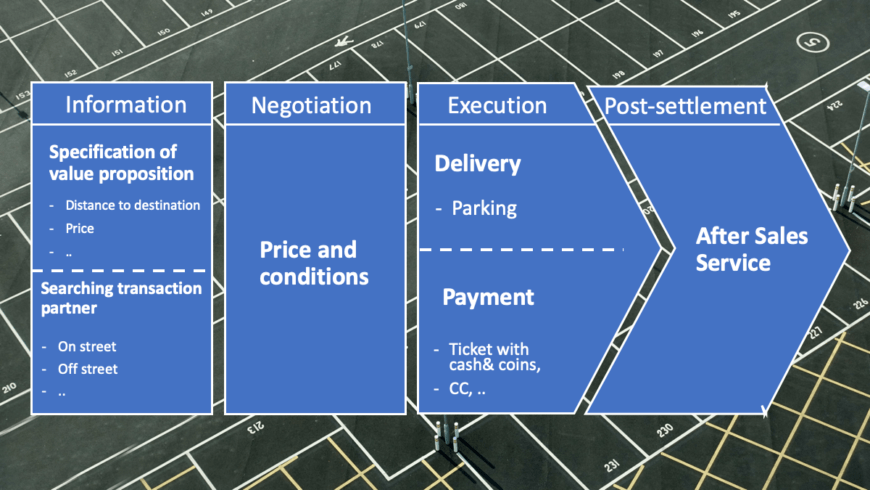
These costs together are also referred to as transactions costs and occur whenever a good or service is transferred via a technologically separable interface. Transaction costs describe both monetary and indirect costs such as time or effort. For a systematic approach, these costs can be divided by the time they take place in the transaction process. For example, prior to the conclusion of a contract, time needs to be spent searching and evaluating information, negotiating price and drafting/reviewing contracts, adjusting the contract/s, and finally, after contract execution, time must be spent to resolve any post-settlement disputes.
Like all costs, transaction costs have a limiting effect on economic growth. As a result, technological and organizational innovations that reduce transactions costs for users are becoming increasingly important for macroeconomic development.
2. Economic Surplus
Also, on the other side of the market, we identified high inefficiencies. In contrast to airlines or hotels, car park providers currently do not usually implement any kind of capacity utilization-based pricing. This, in combination with a lack of coordination and information among drivers, leads to a system of suboptimal asset utilization since some car parks are overbooked and while others are still nearly empty. The consequence is a limitation of the economic surplus created in the parking industry.
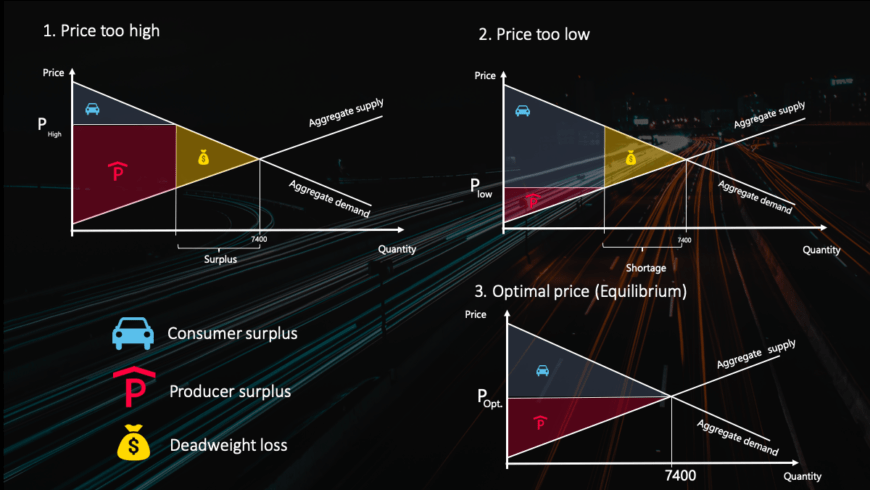
Economic surplus is a macroeconomic concept established and framed by the economist Alfred Marshall in the mid-19th century. Together with Karl Heinrich Rau, he developed a diagram, which shows the relation of demand and supply in dependency on price and available quantities of an economic good.
But let’s take this into practice and look at an example. The paid parking market in Munich consists of over 24 parking garages which offer about 7400 parking spaces.
In this simplified example, three scenarios are possible as shown in the graphic.
1. If the price is too high, there is not enough demand and we face a surplus in parking spaces.
2. If the price is too low a shortage occurs because there would be more people willing to park than operators offering lots.
-> In both cases, a deadweight loss is created and value is lost since the full market potential cannot be captured.
3. The equilibrium price is found. Hereby, the price is set where demand exactly meets supply, which allows to capture the full market potential. Important to note is that this system is referring to the average price, which is composed of the individual prices of each parking garage.
3. The Fetch.ai Solution
To solve this dilemma of coordination and optimal pricing our team used Fetch.ai, a system designed to increase market efficiency by helping to match supply and demand.
So, during this hackathon, we used Fetch.ai to build a software simulation that would allow us to model the revenue generated by the parking providers under both optimal and suboptimal coordination conditions. Our first model simulated the revenue of each parking lot operator without any cooperation between the different provider, coordination or dynamic capacity utilization based pricing. In that model, drivers just attempt to find the closest spot (which is close to the real behavior of inner-city drivers). The second model simulates a smart network in which the different operators collaborate and drivers are coordinated to the available parking spaces, which match their preferences for distance and price. Autonomous economic agents powered by AI negotiate to achieve economically efficient outcomes.
We implemented our project using Fecht.AI prebuild SDK library, which allowed us to run a local ledger and a local IEF node. Further, we implement a custom data service to represent the parking garages. In this model, the parking garages acted as data provider and the drivers compared then the data they saved as preference vector (like distance to destination, price..) with all of the available data from the garages. After all options are evaluated, the agents choose the best option for the driver and sets a deposit in Fetch (FET), the native token of the ecosystem, to reserve the parking spot. We then used Fetch.ai smart contracts to represent the tickets which are sold and bought.
This system allows to discover the equilibrium of the whole parking market dynamically, reacting to any changes in capacity utilization in real time. Practically it can be used to demonstrate to parking lot operators that they are leaving significant money on the table by not using a fair and neutral DLT based coordination and booking system alongside their competitors. Everyone’s better off in this model as deadweight loss and negative externalities are removed from the system while maximizing both parking operator revenues and net economic surplus.
We are absolutely thrilled to further discover the endless possibilities Fetch.ai offers. The best part of the system is the fact that these “simulations” are intended to be implemented within production systems in the future. This means that the same system we’re using to simulate the future economic and environmental effects can then be put into use to actually achieve those outcomes in a real-world system.