If you’re wondering why a blockchain company like us is writing a blog post about killing vampires, or if you’re confused because you’d think that meat products good for barbecue have nothing to do with our core competencies, you’ve landed in the right place!
This is a short explainer and introduction to proof-of-stake (PoS), which in the context of blockchain and distributed systems is a method for agreeing upon what is the true informational state of a distributed system. This is called the consensus mechanism in blockchain-talk and is often compared to proof-of-work (PoW), which is based on the simultaneous computation of many, many relatively simple calculations.
How does it work?
Proof-of-Stake is a process which starts with a pseudo-random number. This number is used to perform a lottery to see which node gets to validate the next block. And this is where the stake comes in. The probability of a node being allowed to validate a block can be based on the percentage of tokens that node has staked. The chosen validator then proposes a block. Some types of PoS allow for nodes with more stake to have more votes on the validity of this block.
In order to motivate nodes to participate honestly in the validation process, there are rewards and penalties in most PoS-models. The rewards are there so that someone will perform the common good of validating transactions, and the penalties are there to prevent corruption or attacks on the blockchain. One widely discussed attack is the nothing-at-stake attack which is when a node attempts to create blocks, or vote for all blocks, on top of many or all of the competing chains in an non-finalised state. It is in fact even in the interest of all rational nodes to do this, since the marginal cost is very low. For a penalty to be able to control for this type of behaviour, we need to know the full set of validators which are allowed to stake before the fork takes place, but then it’s easy to create a negative reward for those voting for multiple blocks. Another method of penalising validators for misbehaving is to create so conditions for when a validator is deemed dishonest beyond reasonable doubt. If this happens to a validator, the staked tokens are slashed. More here and here.
Why is PoS an improvement for blockchains?
Two reasons mainly:
It requires less energy. The wasted-energy argument of many blockchain discussions is based on the assumption that blockchains use PoW. I won’t get into the details of how PoW works here, but since PoS doesn’t require any racing to find a special key between different nodes like PoW, the energy consumption is drastically improved.
Economic incentives can be programmed into the model in a more certain way than in PoW. For example, centralisation cartels can be prevented by improved game-theoretic design and 51% attacks can be made incredibly expensive.
It should be noted that just as with many other parts of blockchain technology, there is room for development and innovation in staking protocols. There is already many different types of PoS with each having their own benefits and drawbacks. Hopefully, after having read this introduction, you feel empowered to dive deeper in other aspects of consensus mechanisms and blockchain!
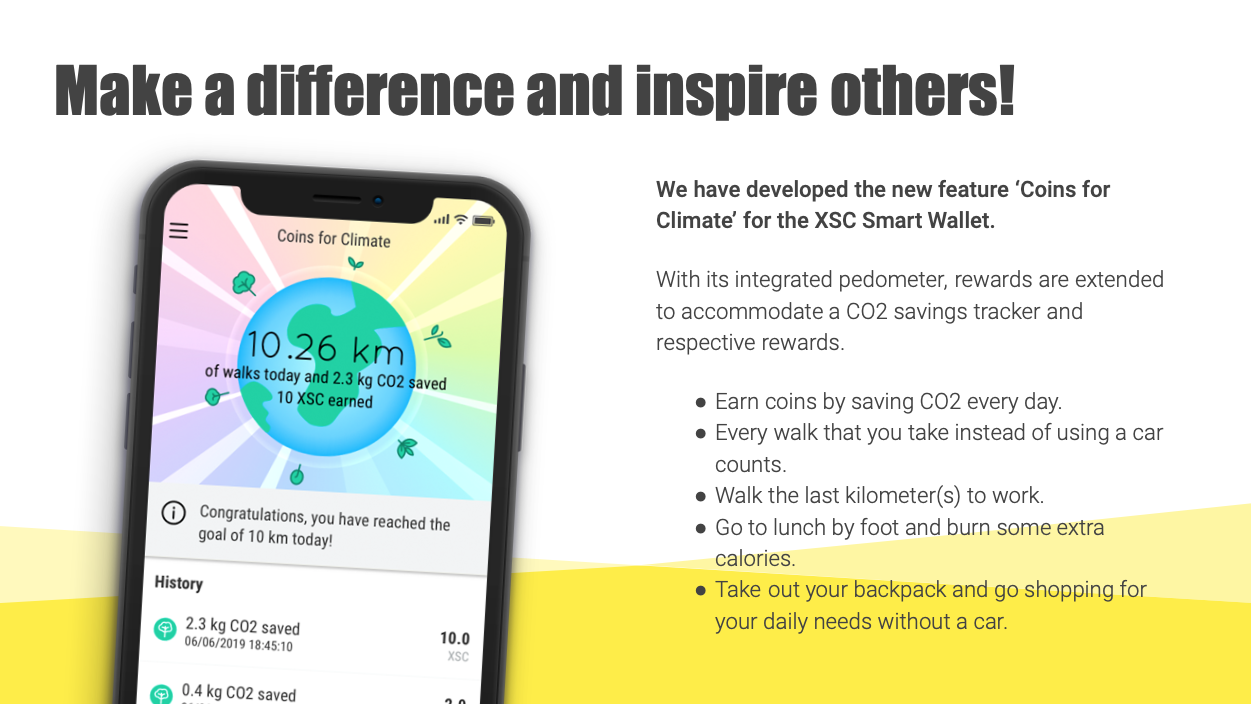
Companies soon will be held responsible by the EU for environmental, social and governmental (ESG) impact. Hence, Datarella proudly presents its latest addition to the XSC Smart Wallet: Coins for Climate. With Coins for Climate, employees are automatically rewarded for saving CO2 – by walking in stead of driving.
As I am writing this, the window of my office is wide open: It is Friday afternoon, the sun is shining and the day is sporting a pleasant 25°C. A few years back, under the same conditions, we would hear the motors of Porsches and Ferraris howling up and down Munich’s most loved strip for fancy cars, the Leopold- and Ludwigstrasse. Not anymore.
Munich’s fancy cars are caught up in the jam that has been haunting Munich streets for the last years. Traffic. Has. Gone. Up. A lot. Earlier today, there were very different sounds to be heard on the street: The shouts and chants of a „Fridays for Future“ crowd, a movement of young people throughout the country and continent protesting against exactly what I am witnessing this very moment outside my office window: CO2 increase.
2019 is the year of climate. CO2 awareness has been around a long while, but never as present and pressing as now. Finally. Companies are being pressured by the European Union to address environmental, social and governmental (ESG) issues.
XCS Smart Wallet with “Coins for Climate”
We at Datarella felt it is time to let our XSC Smart Wallet play a role in saving CO2 emissions. The UN estimates that we have just 12 years to limit climate change catastrophe and ensure that our children can thrive on planet earth. The ‘Avoid-Reduce-Compensate’ approach to CO2 emission increases the awareness of climate-saving activities and can be embedded by everyone into their lifestyle.
This approach isn’t just for private individuals but also for companies. Even financial Institutions – specifically Asset Managers – will be held responsible by the EU for the ESG impact of their investment portfolio.
Asset Management companies are already starting to adapt to the new mindset by saving CO2 on an internal basis – such as having CO2 saving challenges. “Coins for Climate” helps your company increase awareness of climate-saving activities and fulfill the ESG-Criteria. Companies offering Coins for Climate to their employees help demonstrate CO2 awareness first hand:
Earn coins by saving CO2 every day.
Every walk instead of using a car counts.
Walk the last kilometer(s) to work.
Go to lunch by foot and burn some extra calories.
Take out the backpack and go shopping for daily needs without a car.
I will soon swing by the jams of the city on my bike to head home – arriving home an hour earlier than all I pass on the way. And I am very much looking forward to have bike rides included in Coins for Climate!
And for those of you who are anticipating Coins for Climax: It will be a long wait.
On the basis of our humanitarian supply chain project with the UK Government, we explore how to combine security and UX best practices.
A question we have in each of our blockchain projects is that of the user-friendliness of having a decentralised architecture. In fact, it’s not only us having that problem but, according to a survey of 160 DApp projects in 2018 by the good people at Fluence Network, 75% of all mentioned new user onboarding as a major hurdle for adoption of blockchain. Additionally, the second biggest pain points for Dapp developers was “Bad UX of crypto”. In the following post I would like to show how we solved the largest of the issues with UX in blockchain, the key management.
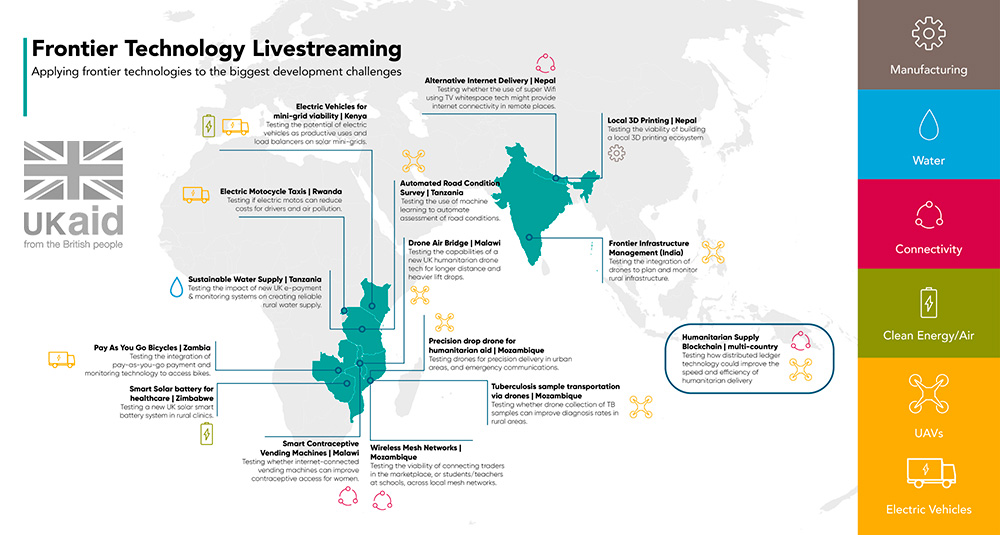
For a couple of months, we have been building a Proof-of-Technology as part of the Frontier Technology Livestreaming (FTL) programme of the UK Department for International Development (DFID). The technology to be “proven” in this case is blockchain, specifically within the setting of humanitariansupplychain management — here’s a link to a medium post for more on the topic.
We’ve been advancing according to plan, successfully finishing our first sprint and working hard to finish the second. This will be the final sprint before we enter the live test phase, where we will field-test the system with a real life humanitarian logistics supply chain. The “real life”-test in this case will mean tracking a regular shipment of goods to a disaster-stricken area, using the application we are building. In this post, I’d like to share some of our experiences in trying to make blockchain as user-friendly and safe as possible, two goals normally seen as diametrically opposed.
Firstly, the most basic user-experience (UX) consideration when implementing a permissioned (more on what this means: here) blockchain solution is: if and through what medium does the user interact with the blockchain system? One can imagine solutions ranging from a completely “authoritative” system where the end-user is happily ignorant of any blockchain activities going on in the background, much like few internet users are aware of exactly how passwords are checked when logging in to a service, to products where each user is trusted (and in some cases required) to set up and run their own node, manage keys, interact through API calls and verify all activities. We attempt to find some middle-ground by reasoning about what our users are actually likely to use and appreciate in a system.
In our case, the users range from technologically savvy, well-connected DFID professionals with up-to-date hardware down to logistics service provider personnel with limited connectivity and first generation android smart phones. Since we are working in a PoT, with a relatively limited scope and time frame, we decided to make some assumptions on the user constraints. Roughly, we assume all of our users:
Speak and read English
Have a device (mobile or not) with an updated browser installed
Have a working Internet connection with sufficient bandwidth to serve a React-based web application (React is one of the most common web programming frameworks for UI’s)
These assumptions allow us to target a very wide audience, and to extend functionality in the future to cover, for example, off-line use cases.
We do this by building a progressive web application — meaning that it is reliable, fast and flexible enough to be used on mobile or desktop — with a simple login procedure to separate user types from each other. The application is hosted on our cloud provider which connects to a database as well as our — wait for it — blockchain!
This means that a logistics planner in the offices of DFID can access the web application by opening a standard browser typing in the address of the application in the URL window and can then login using his or her personal username and password. Similarly, a user on the “ground” can accept an order for his or her leg of the shipment by logging in to the application over a browser on a mobile device.
After having established the point of access for the users to the blockchain, we needed to determine which actions a user should be required or allowed to take with respect to the blockchain system. Our aim was to empower the users to have as much control of the most critical parts in the supply chain as possible. This was partly to ensure trust in the system — the purpose of having a blockchain is to remove a single point-of-control of the data — and partly to communicate clearly to the user exactly what information comes onto the blockchain.
We’re working with an Ethereum-based system, which allows for smart contracts. This means that we could encode large parts of the business logic, such as in the chain, if we would like to. But, the more functionality which is on-chain, the more users have to interact with the blockchain. The interactions which affect the complexity on-chain are operations where the user needs to add new information. More interactions lead to more signing of messages or transactions to the chain. More signing means more usage of the key pair of the user, which is mostly quite awkward and non-intuitive for users.
This is why we opted for a solution where the user still has full possession of the private key, and no one else can manipulate signed information posted to the blockchain by them. By helping the user generate a new key pair upon registration and then allowing them to store it locally on their device, we hope to give as much responsibility to the user as they would like, while still keeping security risks to a minimum.
So, when does the user have to sign transactions?
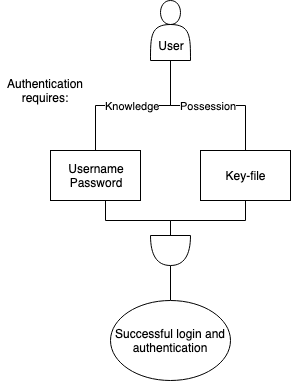
So, when does the user have to sign transactions? Exactly then, when custodianship is changed. The absolutely critical information, which must not be corrupted, is thereby secured the most. Custodianship change contains two steps: first, it needs to be handed over by the current custodian, and secondly, it has to be accepted by the custodian-to-be. Before both those transactions have been signed, custodianship still lies with the previous user. We try to make the “signing” as non-invasive as possible, by applying known procedures like “Username and password” plus a special key-file which needs to be provided by the user. It’s shown in a simplified form below:
A simplified chart of the authentication process.
The risk of such a system of user-controled keys is that the user loses the private key, but in our case, since we are working within a permissioned setting, there is a mitigation. Access to the platform is dependent on verifying the real identity of each user. Therefore, in the case of a lost key, the user has to re-register, but the information isn’t lost. The user will then have to re-verify the identity to regain access to the account, where a new key-pair can be generated.
In a future solution, there should not be a central authority to reset a password without the identity checks having been verified, but for the PoT it is acceptable.
We’ve now seen some of the challenges of usability we’ve been facing in building a humanitarian supply chain blockchain-solution within FTL. Usability and accessibility is an immense problem for blockchain in general. It strives to empower people but it is at risk of confusing and alienating people with complicated key management procedures and lacking interfaces. At Datarella, we don’t see the point in building technology that the end user can’t understand properly or feels uncomfortable using. Especially when the users are strapped for time, trying to help others in dire need, we have a responsibility to create technology which does not obstruct but enables our users.
Cryptography vs Cryptocurrency – one enabling the other
For many, the word ‘crypto’ brings Lamborghini’s, neckties with Bitcoin signs printed on them or really bad hip-hop, but up until some years ago, the original meaning was not crypto-currency, but cryptography. That is also the topic of this blogpost. Consider it a gentle introduction into a very specific branch of cryptography – zero-knowledge proofs (or ZKP) – and why blockchain has helped bring them back into vogue.
What are ZKP – intuition
So, let’s start off with the basics, what are zero-knowledge proofs? I’ll explain it through three common analogies with varying complexity, they all describe the same concept but appeal to different audiences.
1. This analogy is from StackExchange. Imagine your friend, Alice, tells you that she has a super-power. An amazingly useless super-power, but still. She can count all the leaves on a tree in your garden in front of your house in a few seconds! Of course, you don’t believe her, so you ask Alice to prove it. We’ve now created two roles that are omnipresent in ZKP, a prover (your friend Alice) and a verifier (you in this case). She proposes that she closes her eyes, you can then choose to either remove a leaf from the tree or not, and finally she can open her eyes. Now, to prove her super-power, she has to tell you whether or not you removed a leaf from the tree. If she’s wrong she failed to prove anything, but if Alice is right, you realise that she had a 1/2 chance to guess correctly and was just lucky. So you repeat the experiment, now if she’s right again, she would have had to have been right two times in a row, meaning her odds of being guessing correctly were 1/4. (At least assuming independence of events). This goes on and on until you are sufficiently convinced of her super-power being real. In this scenario, you didn’t learn HOW she does her magic counting of leaves, but you’re very sure that she know how to do it. There was ZERO KNOWLEDGE transferred from Alice to you regarding the procedure itself. Additionally, there was no, or a very small possibility for you, being honest, of not believing in Alice’s capability, and she couldn’t have convinced you without actually having the super-power. These three criteria are called ‘zero-knowledge’, ‘completeness’ and ‘soundness’, respectively, and are a part of all ZKP.
2. This one is from the booklet “Applied Kid Cryptography or How To Convince Your Children You Are Not Cheating” by Naor, Naor and Reingold. It relies on the game called “Where’s Waldo?” or “Where’s Wally?” in the UK-version. The goal of the game is to find the image of Waldo on a page filled with other things and figures. Let’s assume Alice and yourself are playing this game together. All of a sudden, Alice exclaims “I found Wally!”. Aggravated with jealousy you scream out “So prove it!”, (first the revelation of the leaf-counting super-power and now this!?). So how can Alice prove her knowledge of where Waldo is, without revealing to anyone else where he is? Simple, she takes a big cardboard with only a cut-out in the middle, just the size of a Waldo-image. As you close your eyes, Alice places the cardboard over the open pages of the Where’s Waldo?-book exactly so that only Waldo can be seen through the cut-out. You can verify that Alice knew where Waldo is, without learning where on the page he is. Again, this satisfies our three properties of zero-knowledge, completeness (you have to believe Alice found Waldo given the information she presented to you) and soundness (Alice couldn’t cheat by randomly placing the cardboard on the book except by being extremely lucky).
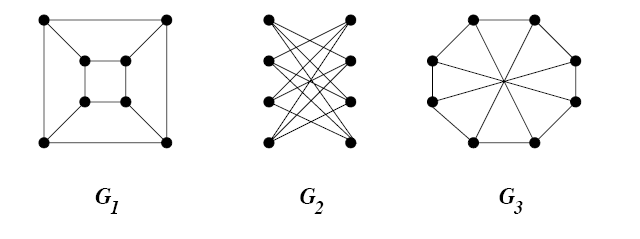
3. Now, my favourite example from a highly recommended blogpost by Jeremy Kun is more in the theoretical space. Instead of a difficult problem like counting leaves or finding Waldo, we now have the provably difficult and more formally defined problem of proving that two graphs are isomorphic. Let’s unpack that:
– A graph, G, is defined by a number of edges connecting the vertices of the graph. Thus a graph G = (V,E)
– Each edge can be represented as the tuple (u,v), where u and v are integers between 1 and the number of vertices of G, n.
– Given two graphs G = (V,E) and G’ = (V’,E’), they are isomorphic if there exists a couple of functions f: V->V’ and g: E->E’ such that f associates each value in V with exactly one element in V’ and vice versa. Correspondingly, g associates each value in E with exactly one value in E’ and vice versa.
source: Jeremy Kun’s blog on Math and Programming – https://jeremykun.files.wordpress.com/2015/11/gi-example.png?w=587&zoom=2
Intuitively, this means that graphs are isomorphic if we can transform one into the other by simply moving around the vertices, not adding or removing any edges and ending up with two identical figures. This is not exactly rigorous, but still somewhat accurate for our purposes.
Now, for the zero-knowledge part! Given two graphs, there’s no easy or efficient way of finding out if they are isomorphic. (If you find a way, let me know.) So, let’s say Alice knows that there exists an isomorphism between them, but she doesn’t want to reveal her isomorphism to you. She does this by taking e.g. G and mixing V. Then she sends you her newly formed isomorphic graph, called H. Alice additionally saves the permutation she did on G for later.
After having received H, you flip a coin with equal probabilities and depending on the outcome you give Alice a challenge. Heads, and Alice should provide you with the inverse, or backwards, permutation which gave her H. It should then give you G. If tails, Alice should provide you with her secret isomorphism, f composed with the permutation. This should now give you G’ when applied to H.
Given either of those permutations, you should now be able to verify that Alice possesses a ‘secret’ isomorphism. Additionally, you haven’t learned anything about the solution since you only received a uniformly random permutation or two uniformly random permutations composed which gives another uniformly random permutation.
Why ZKPs are interesting to blockchain
Ok, now that we’ve understood a bit what ZKP means, let’s see why it is interesting for blockchain technology. The most obvious area of application is of course privacy. Being able to prove something without having to reveal any information about the subject sounds like utopia for almost everyone with an eye on the current state of affairs in big data applications of corporates and states. A second, less obvious type of application is for scaling in blockchains. This relies on the fact that a proof of knowledge can be more succint, from a storage point of view, than the information it’s proving. Let’s look at some use cases of both application areas in more detail:
One of the first live applications of ZKP in blockchain for privacy was by ZCash – a cryptocurrency where the ‘knowledge’ being proven is that the sum of outgoing transactions are equal to the sum of incoming transactions (ZCash uses a UTXO model), that the sender has the authority to spend the coins being sent and finally that the private keys of the incoming ‘notes’ are effectively locking the whole transaction from being modified without the keys in question.
Another use case of ZKP for privacy is by Sovrin, who mainly uses regular public key cryptography and a fairly clever protocol to issue verifiable credentials such as “possession of a valid driver’s license in EU”. Then they apply a type of ZKP called accumulators to prove non-revocation of that very credential in a very succint manner. This was initially researched by IBM in the so-called idemix, back in 2007, but lacked an adequate platform to store the non-revocation lists in a persistent, trustless manner. Until blockchain arrived.
Generally speaking, ZKP can be used for a wide range of privacy-preserving applications, especially when it comes to the topic of identity, things such as range-proofs whereby it can be proven that one’s age is within a certain range (e.g. 18-65) without revealing the actual age. Or it can be proven that one is a resident of the EU without revealing in which country exactly.
One of the most pressing issues of public blockchains these days (and admittedly since some time) is that of scalability. Interestingly, ZKP may have a solution for this. Like ZCash, another privacy-focused cryptocurrency Monero implemented ZKP. However, Monero was using a different algorithm called RingCT to hide transaction information. It didn’t rely on the often criticised ‘trusted setup’ of ZCash (more here) but therefore had a very large transaction size resulting in low throughput. This was improved greatly by the application of so-called bulletproofs (also a type of range-proofs actually) in October 2018. This meant that the average transaction size was reduced by at least 80%, and the fees accordingly.
Even more extreme measures are being built by the coda team who aim to recursively compress an entire blockchain into a 20kB ZKP. Their CTO Izaak Meckler called it “A picture of a picture of a picture of a picture.”. It works by using a ZKP to prove the knowledge of a ZKP, which proves the knowledge of a ZKP, etc. This effectively leads to a constant-size blockchain which can be verified by anyone easily, not like in many existing public blockchains where the more users a blockchain has, the more difficult it gets for the average user to verify. Coda does, interestingly, not use ZKP at all for privacy. Yet.
We’ve seen a few examples to intuit what ZKP means and why they are interesting to apply in blockchain technology. It is part of what we are working on at Datarella, implementing industrial blockchain solutions for clients and in RAAY. If you would like to dig deeper into some of the topics we’ve learned about today, here are some resources:
Providing seamless B2B payments by connecting state-of-the-art payments infrastructure from Wirecard with battle-proven blockchain technology from Datarella.
Earlier this year, Datarella and Wirecard AG started a collaboration around a couple of blockchain projects. One of them was RAW coin, the trading of commodities made more efficient through the usage of blockchain.
We started by a thorough analysis of various commodity supply and trade chains, which led us to find the following challenges of supply chains:
rising pressure from global competition
many intermediaries and complex governance structures
the end-consumer is demanding ever-higher levels of transparency
struggle for supply chain stakeholders to maintain an adequate overview of their networks and the supply costs associated
difficulty to ensure the quality and integrity of raw materials
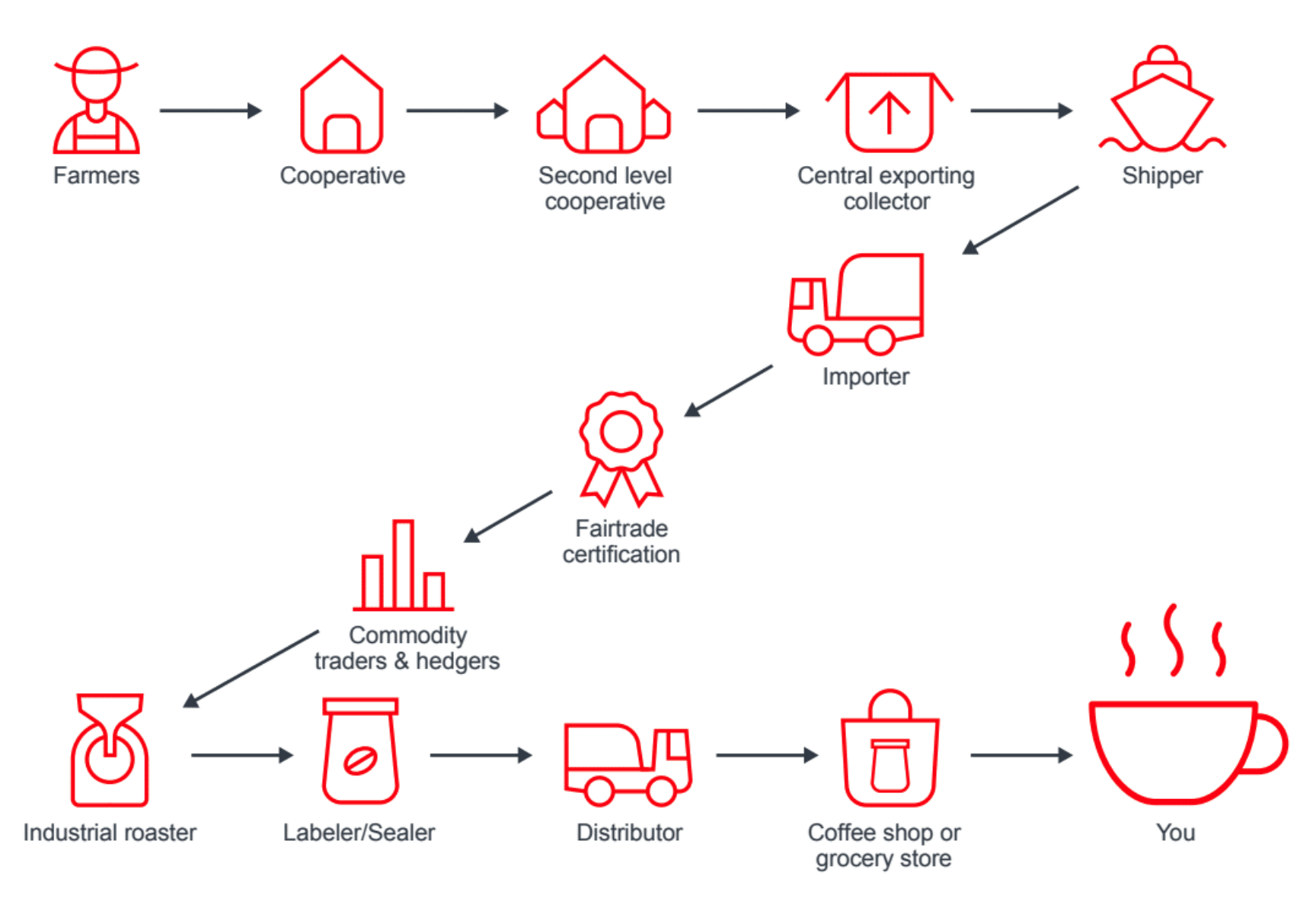
We decided to narrow the PoC down to one specific use case, namely coffee beans. The reason for this is not simply that we’re huge fans of (good) coffee, but actually, coffee is the second most sought after commodity after crude oil, globally. It has a trading volume of $100B per year and is grown in 50 countries (in some of which Wirecard offers financial services). Finally, the coffee supply chain has a large number of middle men and intermediaries adding marginal value but capturing a large amount of the end-price paid by consumers.
The coffee supply chain as it looks currently.
The basic idea of RAW.coin is to digitise trading mechanisms and replace middlemen. As a larger vision, we aim to establish the RAW.coin network to become the ecosystem for supply chains, ensuring the origin, quality, compliance and proper handling of items tracked by the network.
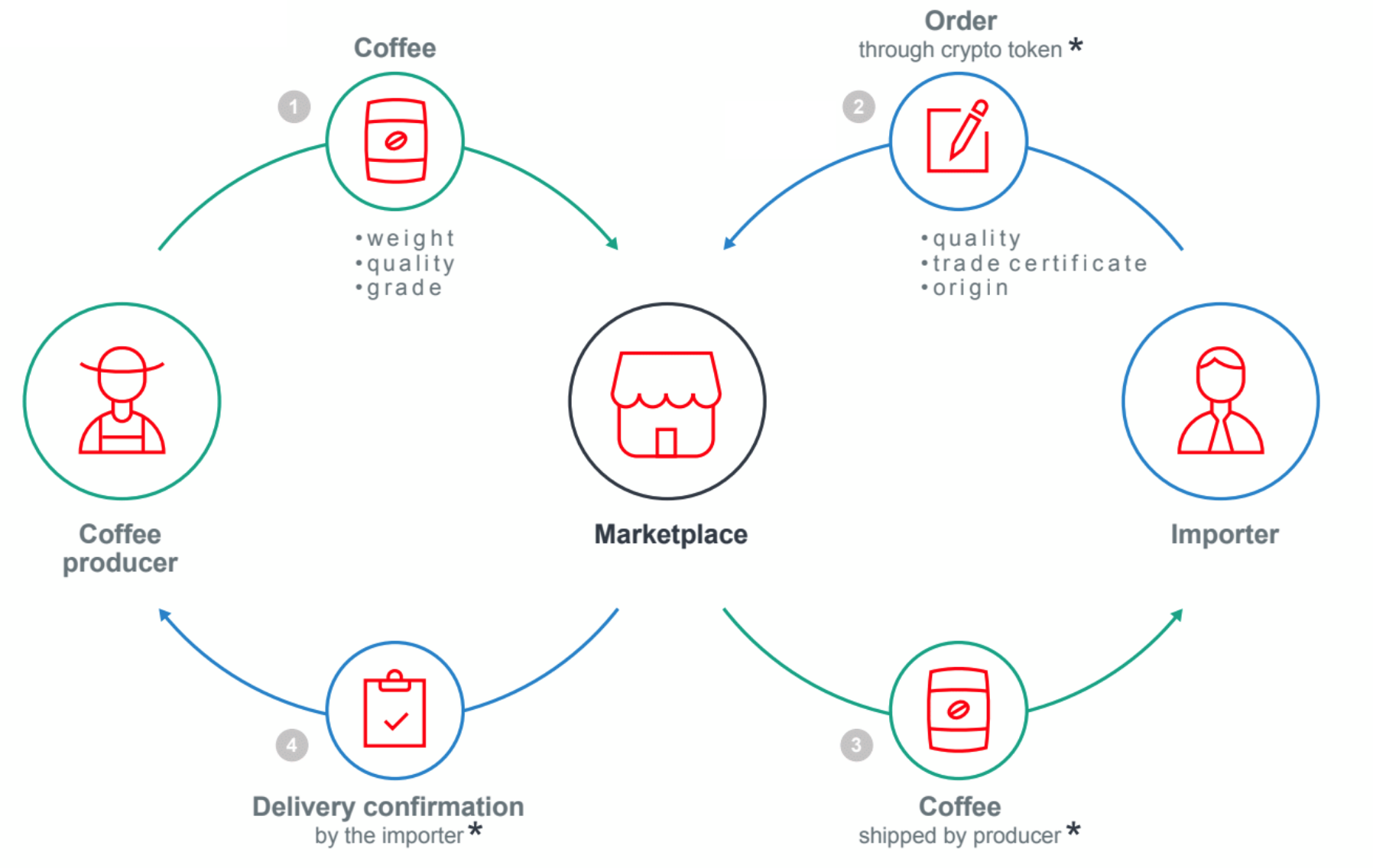
What the solution does is to connect the Producer and the Importer while providing a marketplace where any commodities can be traded. It’s based on Ethereum, using smart contracts and a modern decentralised architecture. We implemented smart contracts to represent the terms and conditions of the network as well as enforcing them at the same time through automation. Additionally, we integrated with Wirecard to provide truly seamless B2B payments and fiat interactions. All transactions are done using the cryptocurrency RAW, but which can be immediately exchanged into fiat using the Wirecard Gateway API.
The Product Journey of RAW.coin.
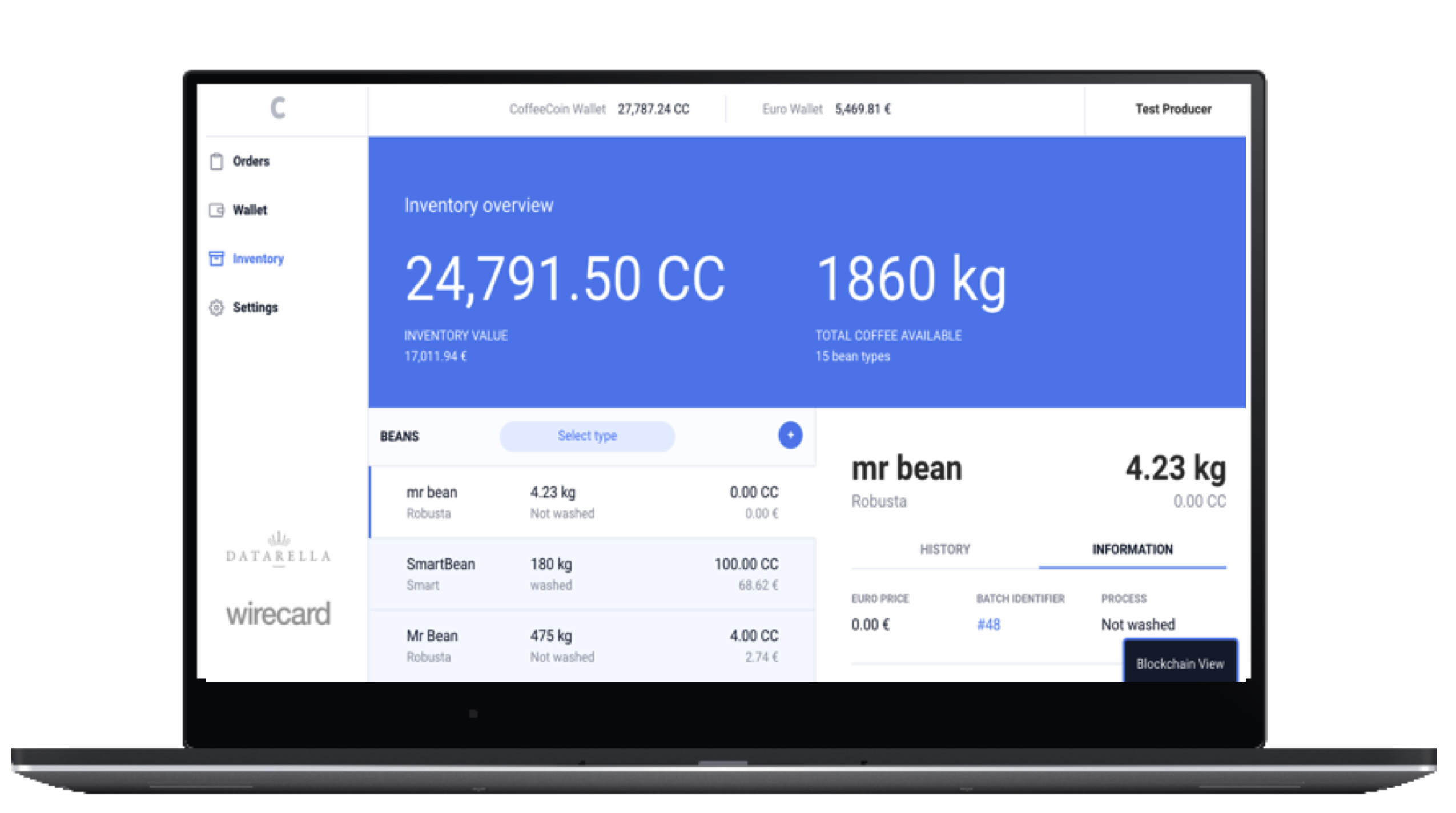
This is an actual screenshot of the current product:
RAW.coin as an application, prom the point of view of a Producer.
We are currently inquiring into the best way to scale up and apply it to other commodities and in which markets. If you wish to learn more, tweet us at @datarella or contact us!
We at Datarella are very proud to announce that we will work with the British Government Department for International Development (DFID) to develop a pilot project on the topic of “Blockchain in Humanitarian Supply Chains“!
The project is supported by the DFID innovation and future technologies programme, Frontier Technology Livestreaming. They source ways of improving how DFID works across the world using new technologies from DFID staff. Naturally, blockchain is one of those technologies, and supply chain operations is a very applicable area for this technology for three main reasons:
1. Transparency – Humanitarian supply chains could benefit from having the right tools to achieve increased transparency in a secure manner. More transparency could also facilitate collaboration across organisations.
2. Efficiency – If the operatives working at organisations in DFID and similar organisations (e.g. USAID, the UN World Food Programme, etc.) could rely more on the quality of data, they could focus on other matters. This could contribute to decreased “shrinkage” and thus improved efficiency as more goods are delivered to those in need.
3. Collaboration – Having a shared database of goods, shipments and importantly accountability, where many can write and read, but not change the history, is an ideal setup for collaboration. This could enable the creation of standards for data models and improved service to both those funding (mostly tax payers) and those on the receiving end.
With these prerequisites in mind, we are looking forward to the coming phases and sprints of the pilot where we will implement a live blockchain solution, hopefully of great use to many people, especially those in need of immediate and unconditional aid.
The project consists of building a blockchain-based system to track a shipment of plastic sheeting shelter kits (try to say that ten times in a row) from an offshore warehouse, by multiple logistics service providers to a country where they are needed. There they have to be cleared through customs, meaning that a consignee will need to assume responsibility for the shipment. This will also be tracked using a smart contract. Thereafter, a so-called implementing partner will start transporting and deploying the kits within the country.
If you have experience or are interested in learning more about this project and blockchain in humanitarian supply chains, feel free to @ @mountbranch or @datarella on twitter! Also, here’s a link to a Medium post by FTL themselves about the initial phase of the project!
An open IOT messaging service based on IOTA for nearby vehicles and infrastructure to communicate.
Q: What problem does your project solve?
A:Currently there is no broadly used method for smart infrastructure and vehicles from different manufacturers to communicate hindering progress in smart traffic management, accident avoidance and autonomous driving.
Q: What expertise and roles do your team members have?
A: Designer, Business Practitioner, Back- End Developers, Front End Developer
Q: Which technologies do you use for which purposes?
A: IOTA as the distributed ledger for recording the messages, Javascript services for messaging clients, Vue JS and UIkit for the demonstrator interface.
Q: How do you plan to proceed with your project?
Tricky question. Still thinking about that. We got really positive feedback even though we did not win.
Location detection with full privacy on Blockchain.
Q: What problem does your project solve?
A:All data in Blockchain open, so personal data (e.g. location data) can’t be stored on blockchain. With homomorphic encryption the data are computably stored on blockchain.
Q: What expertise and roles do your team members have?
A: Back-End Developer, App-Developer, Business Innovation
Q: Which technologies do you use for which purposes?
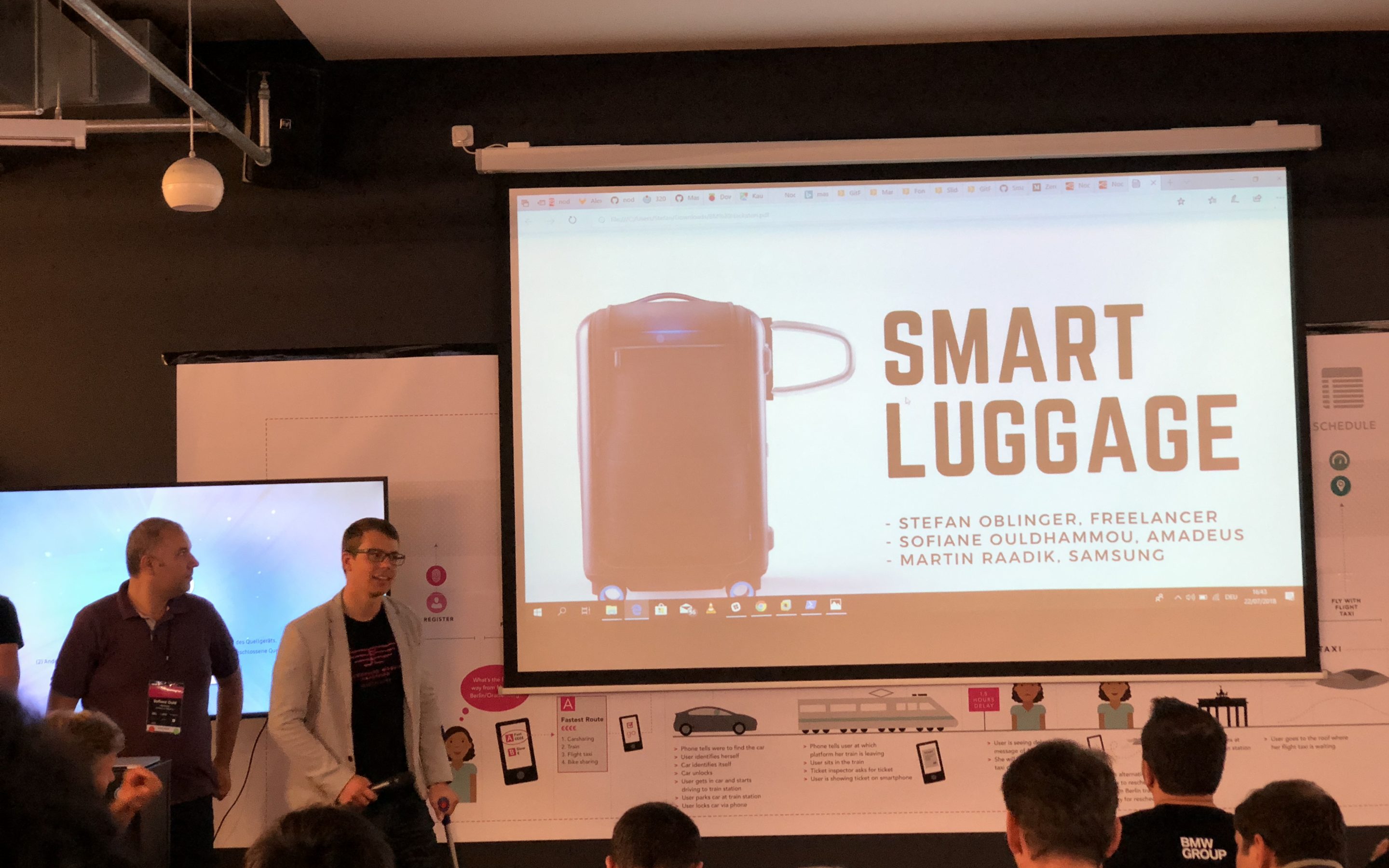
A: We free travellers from the burden of caring for their luggage. Therefore the luggage will autonomously determine the optimal route and transport mode while always taking the owner’s schedules and directions into account.
Q: What expertise and roles do your team members have?
A: We had little hands-on experience with IOTA. Our roles were Designer, Backend Developer, Tinkerer.
Q: Which technologies do you use for which purposes?
A: We decided on Node-RED on Raspberry Pi for prototyping of the “smart Infrastructure” part and chose IOTA as backend network for secure communication and payment.