by Kira Nezu | 14 May 2014 | Blockchain
The Quantified Self Europe Conference 2014 had shown some activity on Twitter, as expected. 156 different people twittered using the #qseu14 tag. Nevertheless the absolute number of #qseu14-tweets slightly declined to ~1100 in 2014 from ~1700 in 2013.
The Twitter-activity, again hardly surprising, was higher on Saturday:
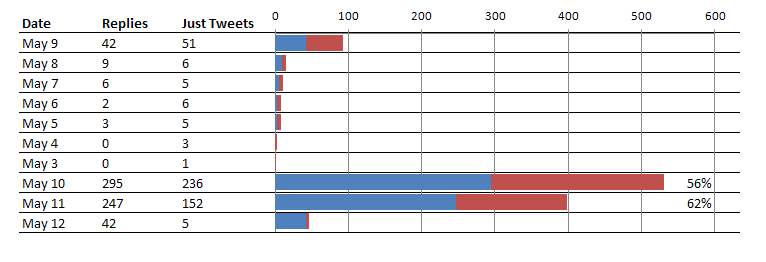
Distribution of twitter activity before and during the #qseu14 conference; blue=reply.
A nice hint on the socializing quality of the event gives the proportion of tweets sent as replies, which was higher on Sunday; maybe thus showing the more personal conversations. The connections between the conference are shown in this network graph:
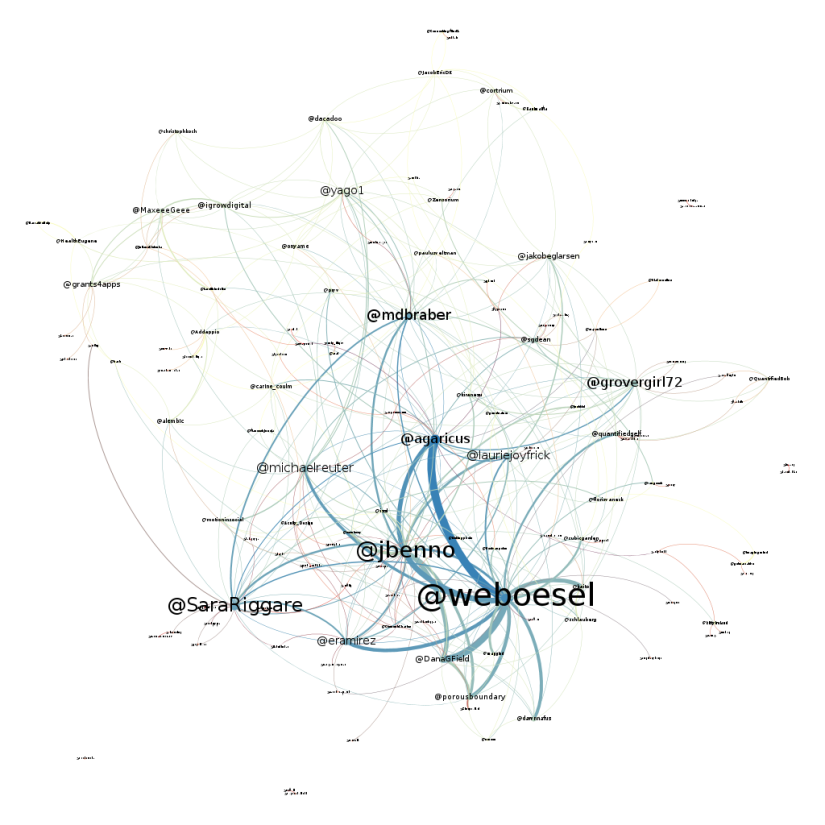
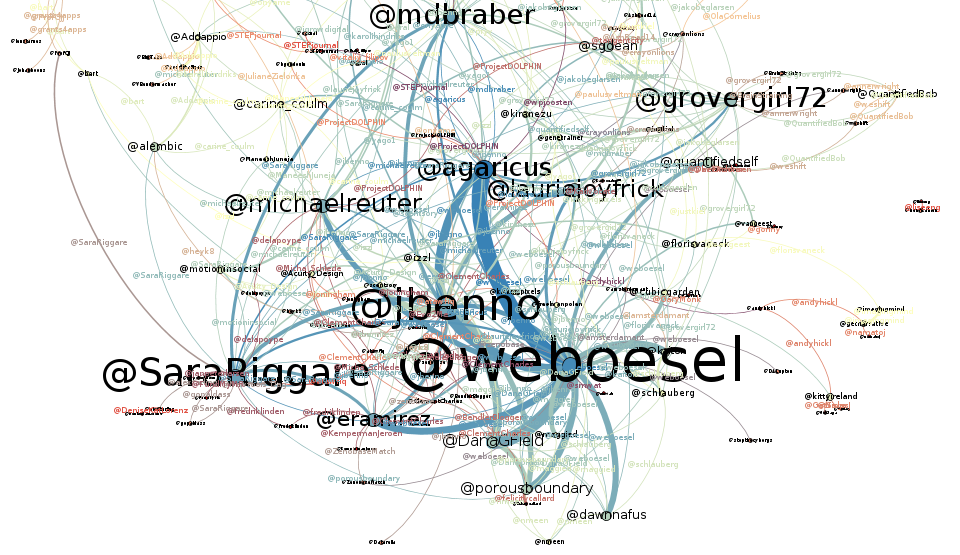
Network diagram of Tweet-Reply relationships. Method: Force Atlas; weights for edges are the counts of tweets from one person to the other
Two twitterers are clearly standing out: Number one again is Whitney Erin Boesel (@weboesel) with 196 tweets, almost reaching her last year’s count of 221 (then twittering under the nick of @phenatypical); number two is me (@jbenno) with 133 tweets, which means I have more than doubled, even if I had been the second highest scoring participant then, too.
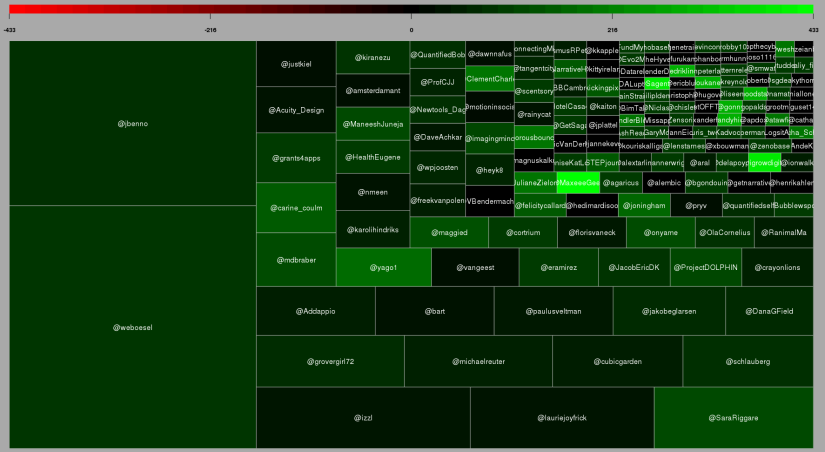
Twitter leaderboard for the #qs14 conference: Nr. 1 is Whitney Erin Boesel closely followed by myself. The colors reflect the percentage of people that had been included in the tweet as an reply.
Here’s an easy overview of the most common words with stopwords removed:

Words in the Tweets tagged #qseu14
And these are the idioms: the most common trigrams (=three consequtive words):
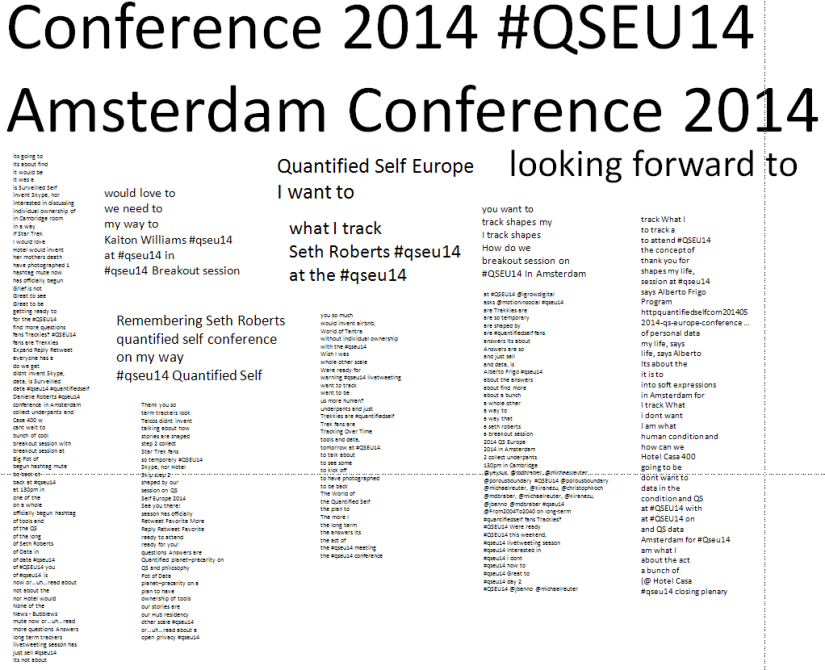
Trigrams from #qseu14 tweets.
I will post thoughts and impressions that I took home from #qseu14 soon, too.
by Michael Reuter | 13 May 2014 | Blockchain
Here is the transcript of the Datarella (DR) interview with Maximilian ‘Max’ Gotzler at the Quantified Self Conference 2014 in Amsterdam.
DR
At the Quantified Self Conference 2014 in Amsterdam, we’re together with Maximilian Gotzler, semi-professional basketballer and Berlin-based entrepreneur. Max, could you introduce yourself and tell us why you are here at the Quantified Self conference?
Max
First, I’m personally interested in Quantified Self: I want to know what’s new and how everything is evolving. Then, I held a presentation about a self-experiment about testosterone. And last but not least, I have presented my own startup biotrackr in an office hour.
DR
A self-experiment on testosterone – that sounds pretty interesting. Can you tell us more about that?
Max
It all started last year during some sort of a winter depression, when my blood test a relatively low level of testosterone. Since then I’ve tried to enhance this level by changing my nutrition and some aspects of my lifestyle, and I’ve presented the results here at the conference yesterday.
DR
What are the results?
Max
The results show that nutrition, sleep and stress have a big impact on the hormone balance, and especially on the testosterone level. Those three factors massively add to your well-being.
DR
You profit from your experience as a semi-professional basketballer, playing in Germany and the United States in building your startup biotrackr. Can you tell us about that?
Max
Sure. Biotracker provides a simple, easy-to-use process to measure your blood values at home. The user gets a test kit, takes her blood probe and sends it back to a laboratory. They get their results vizsuLized on our online platform.
The idea originates in competitive sports: as you said, I have been playing basketball, and the idea was to optimize performance by measuring several body-related parameters. And now I try to provide everybody with this competive sports concept to optimze health levels.
DR
Your test focuses on measuring a user’s Vitamine D level. What are the effects of the Vitamine D level on the body?
Max
Vitamine D holds many roles within the human body. It isn’t really a vitamine, but it’s a so-called secosteroid which evolves into a hormone. It has a big impact on the immune system, muscle growth, bone strength – and on your mood. In Germany and in other rather cold countries, most people have a Vitamine D deficiency – especially during the winter. And we want to make people aware of that. Since by measuring, you can spir people to change their behavior.
DR
Does that mean we all should sunbathe? I mean, that would speak against conventional wisdom.
Max
You should leave plain sunshine after 10-15 minutes or to put on some lotion. But I redommend to sunbathe the very first minutes without any lotion because then, the formerly inactive Vitamine D will be activated by the UVB rays and then can take full effect.
DR
Here at the Quantified Self conference all discussions are about self-tracking and knowing yourself better by measuring your body data. Which data do you track yourself?
Max
I’m very interested in sleep tracking: every night, I try to measure how long I sleep, how long it took me to fall asleep and how man phases of deep sleep I had. I want to optimize that. Additionally, I track my weight, body fat percentage, and my movements. And whereas I track sleep actively, I track all those other data passively.
DR
Ok, that means that you don’t invest much of your time in tracking. Which is your favorite tracking app?
Max
I really like Runkeeper which also shows your actuall running paths. Then I like an a called Mappiness, a mood app which asks you about your mood twice a day. And last but not least I really like the Jawbone UP app.
DR
Max, thank you very much!
Max
Very welcome!
by Michael Reuter | 13 May 2014 | Blockchain
Here’s the transcript of the Datarella (DR) interview with Dan Berglund of Stockholm-based life-logging startup Narrative.
DR
At the Quantified Self Conference 2014 in Amsterdam, we’re together with Dan Berglund from Swedish startup Narrative. Dan, could you introduce yourself and tell us a bit about Narrative?
Dan
Sure. I work as a Software Engineer at Narrative, a software and hardware company which makes a very tiny mobile camera that takes photos of everything you see. Photos are taken every 30 seconds, then they’re aggregated and we show you a meaningful representation of your data life.
DR
You’re wearing a narrative camera. Could you show it to us and explain what this camera does in comparison with a typical camera?
Dan
Yes. Here it is. It’s working automatically – so you wear it at your shirt or jacket, and it takes photos every 30 seconds. If you want to turn it off, you just put it into your pocket. Then we offer a service, which is connected with the camera: it aggregates all photos and tries to find the best ones by grouping together similar photos. So at the end, you have a diary of your life.
DR
What is the typical use case for the narrative? To automatically shoot photos during parties?
Dan
Sure – that would be one use case: special occasions like parties or when people are travelling. In general, people are interested to have photos made of their whole lives. Especially here at the Quantified Self – that’s the purpose of this crowd.
DR
Dan, you are the most senior developer at Narative – ars you also a co-founder?
Dan
No, I’m not a co-founder, but I have been with the company almost from the beginning and I’m a senior developer at Narrative.
DR
Can you tell us a bit about the challenges you have been cobfronted with during the early development phase of Narrative?
Dan
Yeah. Most developers of our team of 30 have a software background. And it was quite hard to understand how hard it is to develop hardware: you have long release cycles with long delays. And when you have to redisign something you have an additional delay of weeks or months. And this happend quite a few time during development.That, for sure, was the hardest part.
DR
Yesterday, your colleague Eric told me that you manufacture in Taiwan. How hard was it to set up this manufacturing process for a startup working out of Stockholm, Sweden?
Dan
We actually got some help from another startup called MuteWatch which uses the same suppliers and plants. Without them it would have been much harder, and still, it’s quite hard to put all relevant things together and build a streamlined production process.
DR
Apart from wearing your own Narrative camera, do you use other life-logging or self-tracking wearables?
Dan
I have tried out some passive tracking apps like Moves to track my movements – and similar ones- but I wouldn’t call myself a big life-logger or quantified self person. I’m more the kind of a ‘special events user’.
DR
Thank you very much, Dan!
Dan
Welcome!
—
[Here you can see Datarella CEO @jbenno life-logging with the narrative]
by Kira Nezu | 12 May 2014 | Blockchain
At the Quantified Self Europe Conference 2014, which took place on May 10th and 11th, we hosted a session to discuss philosophical, and especially ethical aspects of self-tracking. Here are our slides with comments:
And here is the summary of the session on quantifiedself.com.
by Michael Reuter | 7 May 2014 | Blockchain
Bring cutting-edge technologies and products to larger markets, making them mainstream – that’s what Moore’s Crossing the Chasm is all about. Where is this specific point in a technology’s adoption lifecycle that transforms a nerd toy into a quite natural product of everyday’s life?
The biggest, and possibly only, problem of the Quantified Self is its name: whereas “the self” is a widely known – though misunderstood – term, “quantified” is a so-called conversion: a verb turned into an adjective. Those grammatic conversions require additional thought processes before people either express them or understand them. Second, “quantified” is a foreign word which we all would not use every day.
It must be assumed that, when Kevin Kelly and Gary Wolf started the Quantified Self movement in 2007, agreeing upon this term did not come easy, although it exactly defines itself: an [international] collaboration of users and makers of self-tracking tools. In this definition, the difference between Quantified Self and self-tracking becomes evident: whereas self-tracking describes the individual (and detached) behavior of collecting data about oneself, the Quantified Self additionally contains the aspect of collaboration of individuals and/or groups of self-trackers. So – it seems to be difficult or even impossible to ease the way for the Quantified Self by renaming it self-tracking.
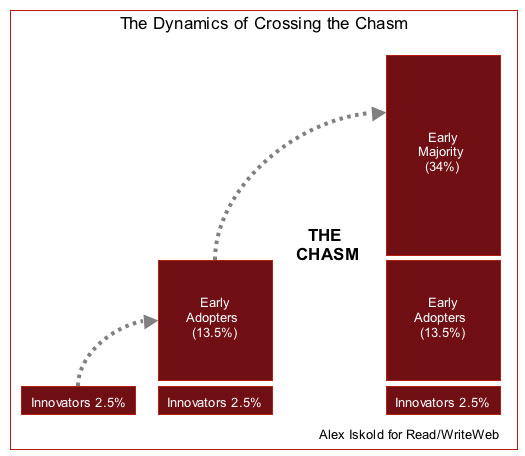
But, let’s put the wording problem aside for a moment, and let’s take a look at the hurdles technologies have to overcome on their way to mass market. Alex Iskold from RRW describes the dynamics:
To become a mass market product, it has to attract Innovators, which typically are defined as 2.5% of the market, followed by the Early Adopters, which make up for 13.5%. After used by around 16% of the market, a chasm yawns. To become mainstream, the product has to motivate the next group, the 34% Early Majority, to be used by up to 50% of the market.
Compared with 1991, when Geoffrey A. Moore introduced the term “Crossing the Chasm”, the speed of new market entrants has increased dramatically. Many technologies – especially those invented in Silicon Valley – are aimed at innovators and early adopters. And 12 months after a product has gained traction, it’s online at amazon.com or the Apple Store, and that means a worldwide availability. Today, startups can sell their products in the tens of thousands in a foreign market before they even have their first customer support agent hired – a typical early adopter’s problem.
In the U.S., retailers like Safeway, mobile operators and others have shelves offering fitness gear communicating with apps – the most visible quantified self products these days. According to Pew Internet, 66% of North Americans track themselves with dedicated devices and 46% state that they have changed their behavior based on the collected data. What Pew does not disclose is whether those people actually know that their behavior is called Quantified Self. It’s a matter of fact: more and more people who quantify themselves haven’t heard of that specific term before. They just do it. The reason: there are no “Quantified Self” signs at the shelves. People buy wristbands or smart watches, but not “quantified self” tools.
Coming back to wording: if “the Quantified Self” will be used as a more academic term for people buying wristbands, smart watches, smart clothes, etc., and sharing their data, then we’ll have the interesting effect of a coming mass market with a name only insiders know about.
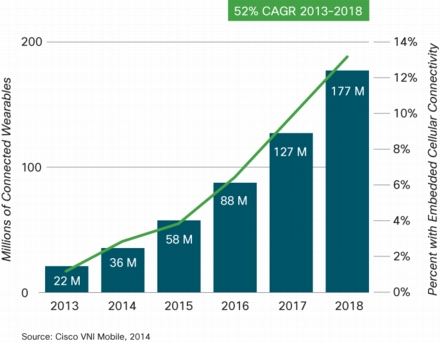
Did I say mass market? Indeed: ask the one market research company or another, the market for so-called wearable tech; i.e. the technology used by the Quantified Self – will grow to $30-40 billion in 2018. I call that a mass market. The assumption behind these numbers – as always – is that these products cross the chasm, that they overcome the hurdle from motivating early adopters only to wow the early majority, too.
In our opinion, that’s possible. Why? The Quantified Self / Wearable Tech will become a huge market because it empowers the individual: QS redirects competences from experts – physicists, scientists, etc. – to the individual. Sue Clark is able to collect and analyze enough high quality data to be informed about her health situation at all times. She can either predict serious health problems like strokes, or she can help to prevent them by changing her behavior to the better. QS gives autonomy back to the individual, and this is the main force behind a dynamic growth of this market.
The growth rates will depend on the availability, the usability and the personalization of advice – aka social relevance:
- Everybody must be able to use the device. The device itself should be free or cost less than $100.
- It must be absolutely easy to use the device – nobody must be overly creative or be urged to engage heavily.
- The user must get individual and personalized recommendations to change her behavior, if necessary. No standardized programs, but individual advice.
If these criteria are met, a QS device, be it a wearable app, or hardware, will be sold in its tens or hundreds of thousands within short notice. And problems like obesity, which alone costs the United States more than $150 billion in lost productivity a year, could be addressed in a new way.
And then, the Quantified Self will have crossed the chasm – perhaps without even being noticed.
by Kira Nezu | 4 May 2014 | Blockchain
“The future is already there, it is just not evenly distributed” as William Gibson said.
At re:publica 2014 conference in Berlin we will demonstrate methods and tools to make good predictions and foresighting from sources found on the Net.
“With Big Data comes the end of the pundit” – foresight, predicting the future from the present, has always been the realm of obscure trend researchers, strategy planners, intelligence services or the RAND Corporation.
To get to useful insights about the changes in society, politics, culture, or technology, we do no longer have to rely on the esoteric, propriatory knowledge of individual researchers or institutes. We can harvest the tremendous treasure that lies at hands in the Internet.
In our session we will demostrate at real cases how to derive patterns and trends from sources like Twitter, Google Books or Google Correlate without heavy programming skills; we will search blogs with self-made crawlers, we will demonstrate how to find and visualize Twitter networks, and how to get information on people’s behavior using meta-data (just like the NSA does according to Snowden …)
Come to our session:
re:publica conference
Wednesday, May 7th at 12:30pm
stage B
Link to the re:publica-site:
re:publica Open Foresight
Audiostream from the session (in German):
http://voicepublic.com
by Kira Nezu | 3 May 2014 | Blockchain
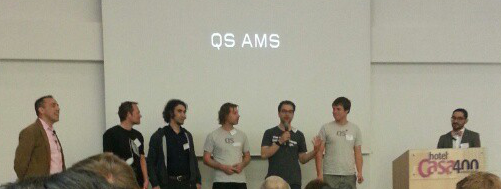
[Opening the QS Europe Conference 2013: Gery Wolf (left) and Ernesto Ramirez (right)]
The Quantified Self Europe Conference will take place May 10th to May 11th in Amsterdam. This year we are excited to not only visit but also take an active part in the conference. We will host a session:
QS and philosophy
We would like to discuss some philosophical (or rather “ideological”) aspects of QS:
– QS, postprivacy, and communalization of private life.
How does the practice of tracking, sharing, and using data for personal meaning challenge our ideas about human connection, ideas traditionally framed as oppositions between between “individuals” and “society.”
My thoughts on this topic, I have put down here:
“Organizing a System of 10 Billion People”
Hope to see many of you there!
by Michael Reuter | 2 May 2014 | Blockchain
Here’s the transcript of this Datarella (DR) interview with Klaus Bscheid:
DR
Klaus, can you tell us a little bit about ambiotex
Klaus
Sure! ambiotex has developed a textile with integrated sensors. With these sensors we can track a genuine one-lead ECG. Based on that ECG we can extrapolate not only the pulse rate but a heart rate variability (HRV). At the same time we quantify the user’s breathing rate as well as her breathing volume. Based on the analysis of the combination of these data we can draw many very interesting conclusions. In particular, we think that HRV analysis is useful for the regeneration of the human body, for insights into coping with stress, etc.
DR
Our textile is an undershirt, since it should be the very first layer being directly on your skin. You can wear this shirt during your sports activities as well as in your everyday life. So what do we do with all this body data? If it’s a sportsman, we can tell him his regeneration level, i.e. we can tell him whether it makes sense to exercise or not. This is important since many athletes don’t really know when to exercise and they might harm themselves. Additionally, we can tell the athlete on which level he should train: we know his individual aerobic threshold in realtime and can support him in planning and optimizing his workout.
If you think of the overworked manager, we can tell him when it’s too much for this day.
DR
That sounds as if I don’t have to visit the doctor because my health is constantly tracked by my Ambiotech shirt. Being a technology company, how can you provide this kind of medical support – do you cooperate with experts in this field?
Klaus
In the first step, our product will not be positioned as a health(care) product, since we first have to gain experiences and to acquire the appropriate certificates. We think that we are able to track and analyze many health-related data. We certainly would not submit that we were able to detect an imminent heart attack, but that’s definitely on our agenda. We want to enable the user to react on corresponding signals.
For the time being, our goal ist to provide our users with feedback on data he isn’t aware of. After all, that’s the goal of the Quantified Self: to get permanent feedback on my body’s functions. I don’t have to react, but I can react. This said, it’s important to provide the user with the appropriate analyses – since he won’t be able to interprete the 5 heart rate variability variables by himself. Here we are working with algorithms enabling meaningful analyses of these data.
DR
Klaus, you’re pretty deep into that topic self-tracking and yet, you don’t wear a wristband or a smart watch. Do you track yourself at all?
Klaus
Sure – I have tested some of these wristbands. And for some time, I liked it pretty much. But, after a while, I got bored by these wristbands. Also, I tested some smart watches. But I haven’t found the right one for me – still waiting for that one… But, I’m pretty sure that there’s a bright future for smart watches which cover a broad spectrum of quantifying and analyzing. However, we see that you have to collect certain parameters from your body directly and that’s our focus.
DR
Thank you very much, Klaus!
Klaus
Thank you!
[Please note: ambiotex is in test mode and will be launched summer 2014]
by Kira Nezu | 2 May 2014 | Blockchain

Tracking your life can mean any form of recording: some body measures like weight, your workout, your food intake, your sleep patterns – this is the “classic” Quantified Self. One of the most intrusive, yet intriguing ways of tracking your life, however is actually track it visually. Lifelogging, taking visual record of your life, has been popularized to some extent by Steve Mann. Mann became notorious for getting thrown out of a McDonalds in France for wearing his head mounted camera.
I have started to experiment with life logging myself. I use the Narrative Clip, a gadget of approximately 5cm diameter that you clip to your clothes and that automatically shoots a picture every 30 seconds.
While wearing the clip, I made several observations: although I quickly stopped thinking about my carrying the camera continuously with me, I realized that I started to adjust my behavior. I would sit more upright, eat and drink very cautiously, even turn my field of vision in a direction, I would expect to look more interesting on the images. People that I encountered in the public were obviously not aware of my surveillance, even though my clip is bright orange in color.
I have put together some random ranges of my day. Our culture is frankly not ready yet, to have bathroom-time shared, so I start with an image I take as rather unsuspicious: brushing my teeth and preparing to leave the house. After my cycling through the neighborhood to run some errand, you see my drinking tee, leaving for our office by the local communter train, where I met my friend Dr. Koehler (quite nicely portraited). After leaving the train, you see my walking from the station to our office. I close with a serries of our board meeting (where you see my collegue Kira sitting on the opposite side of the table).
[Tune in and watch our Datarella People interview with narrative engineer Dan Berglund]
[Note: I am going to write something about the inherent problem of gender culture and abelism that I feel going with self-tracking like this]

