News

Stay tuned with Datarella

404

[dsm_glitch_text glitch_text=”Oops! It looks like you are lost…” _builder_version=”3.19.15″ header_font=”Home-slider||||||||” header_text_align=”center” header_font_size=”50px”][/dsm_glitch_text]
The biggest thing in tech 2015-2025?

The biggest thing in tech 2015-2025?

From time to time we contemplate about which developments, movements or innovations are those that really matter, and that make this frequently mentioned difference. The results of these intellectual games must be subjective and are generated from a uniquely individual perspective. Things get fascinating, though, if you’re convinced that a specific development not only qualifies as your personal No 1 but should be on many people’s A-list. 

Speaking of technology, my personal No 1 which back in 2009 was ‚Apps’, since 2015 is „Blockchain“. Beside developments such as VR and AR that certainly will honour their promises, the blockchain will fundamentally change the way we use the internet. You can regard it as a layer on top of the internet which allows a completely different approach to transactions – i.e. the end-user perspective – and supply chains – i.e. B2B perspective.

Without summing up and repeating all aspects of a blockchain, let’s focus on just one aspect (which, by the way, is the only reason for using  a blockchain, anyway) – the automated consensus made possible by smart contracts. A smart contract is an algorithm defining and executing a set of rules, i.e. without an additional notary service deciding upon whether all contracting parties comply with all rules. Now, without knowing the technical details behind smart contracts, just ask yourself: how many manually executed processes immediately pop up in your mind that could be substituted by an automated process that minimizes time and costs.

VR and AR have been around for years now. Many companies have been founded, many have been shut down. From my perspective, both, AI and AR, need new use cases and new hardware  to demonstrate their raisons d’être. That’s why it takes so long until they can really demonstrate their added value.

Don’t get me wrong – I can see the sexiness of many VR and AR prototypes. But, still, our world is heading towards automated processes; i.e. automatisations of already existing processes. And here the blockchain comes into play: it’s the great enabler of this global development. That’s why I hereby submit that in 2025, the blockchain will be regarded as the biggest development in technology of the last 10 years.

Comments?

PS: This posts reflects my personal view which is not necessarily congruent with the Datarella team member’s

Mobility and Net Neutrality

Mobility and Net Neutrality

Driving by car is strongly connected with a feeling of personal freedom. While we book flights just for one specific itinerary, and train tickets are usually only valid for a short period in time, we can get into our car whenever we want and drive any route that comes to our mind. Traffic jams, detours, or temporary road blocks apply to every driver the same way. And also speed limits or priority are not depending on how much we pay. This also holds true for toll that might be charged to cross a bridge or a tunnel – every driver is treated the same way.

However can we take this condition for granted that provides a network of roads in a neutral way to every user? Net neutrality is not a matter of fact in every industry, not even in all branches of mobility and logistics. Rail services e.g. charge special rates for express trains. While the tariff structure of rail companies are rather transparent in passenger services, this is not the case for transportation of goods. Depending on the buying power and on the negotiations of the customers’ procurement, freight will be transported timely or might travel rather slowly to its destination.

In telecommunications, the rate structure is even more notorious for its lack of transparency. Voice and data plans vary by orders of magnitude regarding bandwidth or duration that comes with different plans.

Net neutrality in telecom services became an important issue when ‘over the top services’ like Youtube or Netflix started to consume significant proportions of bandwidths. It became obvious that in the long run the carriers would be degraded to mere suppliers of infrastructure, just delivering a commodity instead of becoming ‘value added services’ that could charge their customers extra for their precious entertainment programs.

Until now, users pay for using the service in terms of just transportation of the data packages, no matter whats in the date. Since they are the ones who pay, it should thus follow consequently that the services they want to access must not be charged by the telcos or otherwise the service would be charged twice. In Europa as in many parts of the world it is still mandatory for telcos to act neutrally regarding the services requested by the users.

‘Managed services’ is what telcos are lobbying for in opposition to net neutrality. The argument goes that companies like Google (with Youtube in particular) or Facebook act like parasites on the infrastructure – skimming the profits without contributing to maintain it. Although there is very little facts provided to prove the allegations, it is not totally implausible. Advocates for net neutrality would respond though, that restricting net neutrality would give telcos a wrong incentive, not to invest in infrastructure to improve the situation, instead to shorten supply to be able to raise the price for services, or even worse, to exclude competition like Skype or Whatsapp and rather continue selling their own products like voice telephony or SMS.

With roads, the situation is fundamentally different. It is comparably easy to add new wires or build additional base transceiver stations to get more throughput for the network. It is much harder to build more roads, in urban environments it is often even impossible to increase the capacity for traffic. The consequence can be seen everyday: Traffic jams, overcrowded parking lots, polluted air. Worst examples are the big metropolitan centers in China and India, but the situation in most big cities in the US is also dire.

Road access without regulations thus leads to a classic example of the ‘tragedy of the commons’. Each driver will ask herself, why she should be the one to refrain from the benefits of individual traffic and switch to public transport. Some cities have already introduced special tolls, like the congestion fee for entering central London.

Autonomous cars and car sharing services when becoming broadly available would indeed offer another model. Telecommunication carriers license frequencies in the electromagnetic spectrum from the state, for which they have to pay a considerable sum. In return they can offer differentiated rate plans to their customers, and realizing a significant upside for themselves. Cities or whole countries could offer mobility carriers a similar deal: Car sharing platforms would rent capacity from the public, and resell their added value mobility service to finance the infrastructure. Rate plans could be fine tuned and automatically adapt demand. It might in this way just become to expensive to use individual means of transport for a commute that you could as well do in public transport or by bicycle.

That this is no far fetched business model at all is shown by Uber. Uber’s surge pricing anticipates such mobility services reacting elastically to actual demand. A major outcry followed when people became aware that instead of being charged a few dollars like usually, they would suddenly face payments more expensive by orders of magnitude.

Since the times of Henry Ford, individual traffic in the own car has been woven into the culture of most societies. It is thus not easy see opportunities and risks from a more distanced, more objective vantage. It will also not be easy to find the right rules and regulations to make a system of managed services for mobility fair and supportive to the economy.

The worst would be a contemporary version of highwaymen. Second worse however would be to go on and waste space, pollute the air, and jam the vessels of urban life like it can be seen in many cities today. Net neutrality for mobility will therefore become an important issue.

Blockchain Meetup 3: Hacking the Blockchain

Blockchain Meetup 3: Hacking the Blockchain

KEYNOTE: Meredith L. Patterson

Mainstream media often presents the blockchain as a universal weapon against all kinds of fraud and hacks. Our keynote speaker,technologist and biopunk Meredith L. Patterson will take a dive into the security aspects of the blockchain, smart contracts, etc..

Meredith L. Patterson is a software engineer and security researcher living in Brussels, Belgium. She co-chairs the IEEE Workshop on Language-Theoretic Security, having started the field in 2005. She holds a B.A. and an M.A. in linguistics and currently works for Nuance Communications.

We are proud to have Meredith who is known for her work in computational linguistics and its applications to computer security.

(more…)

Blockchain Meetup 2: Global Chained Delivery Network

Blockchain Meetup 2: Global Chained Delivery Network


Carsten Stöcker, RWE AG, working in the ‘RWE Innovation Hub’ on blockchain technology use cases, will present and discuss his perspective on:

A Global Chained Delivery Network

• Sharing, Decentralisation, Access to Assets, New Forms of Value Exchange

• Physical Delivery and different types of delivery networks

• Chained Delivery Networks

• Example Use Cases

Some of us might have heard about this project of Carsten’s team: a teamwork with slock.it to explore some use cases in the energy sector.

(more…)

Blockchain Meetup 1: Ethereum 101 – Trustless, decentralized, smart contracts

Blockchain Meetup 1: Ethereum 101 – Trustless, decentralized, smart contracts

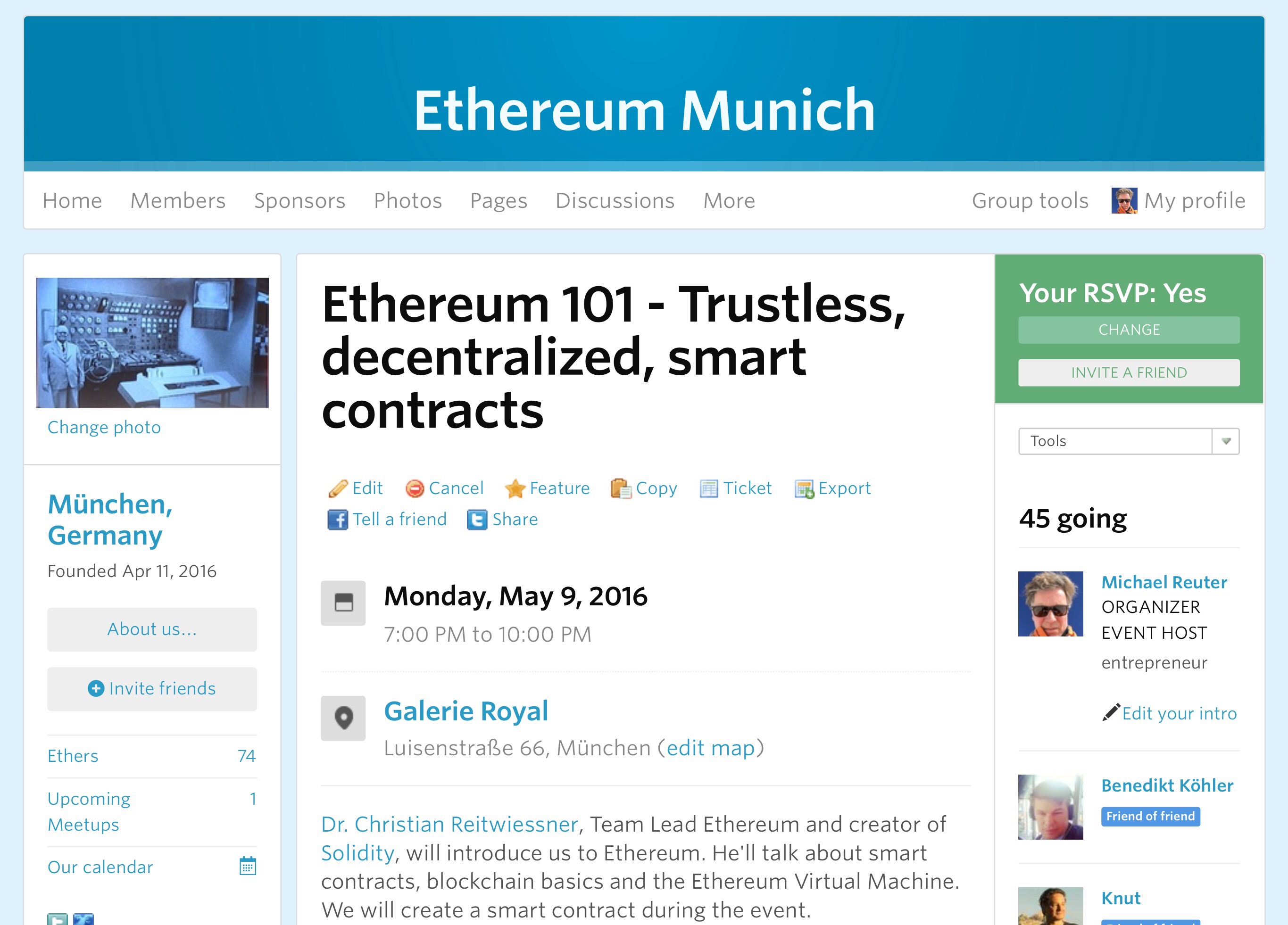
Dr. Christian Reitwiessner (https://mobile.twitter.com/ethchris), Team Lead Ethereum and co-designer and lead implementor of Solidity, will introduce us to Ethereum.

He’ll be talking about smart contracts, blockchain basics and the Ethereum Virtual Machine. We will create a smart contract during the event.

—-

Datarella CEO Joerg Blumtritt (https://twitter.com/jbenno) will then be talking about the trend to decentralize services:

With his presentation Decentralized Business – From Dapps to DAOs he’ll be taking up the great success of the DAO crowdfunding (https://daohub.org) which has generated over $20 million (as of Friday, 6 May).

—-

Hashtag: #ethmuc

My AlgorithmicMe: Our representation in data

Talk at Strata + Hadoop World Conference 2016, San Jose, Ca.

Today, algorithms predict our preferences, interests, and even future actions—recommendation engines, search, and advertising targeting are the most common applications. With data collected on mobile devices and the Internet of Things, these user profiles become algorithmic representations of our identities, which can supplement—or even replace—traditional social research by providing deep insight into people’s personalities. We can also use such data-based representations of ourselves to build intelligent agents who can act in the digital realm on our behalf: the AlgorithmicMe.

These algorithms must make value judgments, decisions on methods, or presets of the program’s parameters—choices made on how to deal with tasks according to social, cultural, or legal rules or personal persuasion—but this raises important questions about the transparency of these algorithms, including our ability (or lack thereof) to change or affect the way an algorithm views us.

Using key examples, Joerg Blumtritt and Majken Sander outline some of these value judgements, discuss their consequences, and present possible solutions, including algorithm audits and standardized specifications, but also more visionary concepts like an AlgorithmicMe, a data ethics oath, and algorithm angels that could raise awareness and guide developers in building their smart things. Joerg and Majken underscore the importance of higher awareness, education, and insight regarding those subjective algorithms that affect our lives. We need to look at how we—data consumers, data analysts, and developers—more or less knowingly produce subjective answers with our choice of methods and parameters, unaware of the bias we impose on a product, a company, and its users.

Let’s discuss all things Ethereum at our Ethereum Munich Meetup

Let’s discuss all things Ethereum at our Ethereum Munich Meetup

More and more Big Data projects we with Datarella are involved in demand not only administrative or legal security layers but also state-of-the-art technical frameworks to provide the maximum security there is for business as well as petsonal data.

To provide our clients with sustainable solutions we have partnered with Ethereum and its spin-off Ethcore. The Ethereum framework enables us to build business models on top of it, using a very sophisticated blockchain approach, smart contracts and elements of the DAO concept and finally, our own product, the Datarella Data Trust.

Since the blockchain, smart contracts, DAO and especially Ethereum are quite new to the Big Data scene, we aim to make them better known to a broader audience. So we have started the Ethereum Munich Meetup as a platform for presentations, discussions and development of Ethereum-based ideas, concepts, use cases, projects, etc..

If you are interested in all things Ethereum feel invited to our regular meetups!

The Need For Encryption

The Need For Encryption

With this post we do something quite unusual: we re-publish Apple’s letter to their customers. It’s not that we were such Apple fans that we would join  the company’s marketing efforts but the encryption of iPhones has been discussed for a long time. And this week, the FBI and the United States government, demanded that Apple builds a new version of iOS bypassing security and creating a backdoor. This might not be the first case of such a request a private company being asked to install a backdoor (we know that some have done it) but Apple does not retreat. Please read this letter and add your thoughts to that topic – either here at Datarella or other channels – we think that this needs to be discussed in public. And – maybe – there even are (secure) technical solutions to comply with the FBI’s requests AND privacy.

A message to our customers“, published by Apple, Inc., February 16:

February 16, 2016 

A Message to Our Customers

The United States government has demanded that Apple take an unprecedented step which threatens the security of our customers. We oppose this order, which has implications far beyond the legal case at hand.

This moment calls for public discussion, and we want our customers and people around the country to understand what is at stake.

The Need for Encryption

Smartphones, led by iPhone, have become an essential part of our lives. People use them to store an incredible amount of personal information, from our private conversations to our photos, our music, our notes, our calendars and contacts, our financial information and health data, even where we have been and where we are going.

All that information needs to be protected from hackers and criminals who want to access it, steal it, and use it without our knowledge or permission. Customers expect Apple and other technology companies to do everything in our power to protect their personal information, and at Apple we are deeply committed to safeguarding their data.

Compromising the security of our personal information can ultimately put our personal safety at risk. That is why encryption has become so important to all of us.

For many years, we have used encryption to protect our customers’ personal data because we believe it’s the only way to keep their information safe. We have even put that data out of our own reach, because we believe the contents of your iPhone are none of our business.

The San Bernardino Case

We were shocked and outraged by the deadly act of terrorism in San Bernardino last December. We mourn the loss of life and want justice for all those whose lives were affected. The FBI asked us for help in the days following the attack, and we have worked hard to support the government’s efforts to solve this horrible crime. We have no sympathy for terrorists.

When the FBI has requested data that’s in our possession, we have provided it. Apple complies with valid subpoenas and search warrants, as we have in the San Bernardino case. We have also made Apple engineers available to advise the FBI, and we’ve offered our best ideas on a number of investigative options at their disposal.

We have great respect for the professionals at the FBI, and we believe their intentions are good. Up to this point, we have done everything that is both within our power and within the law to help them. But now the U.S. government has asked us for something we simply do not have, and something we consider too dangerous to create. They have asked us to build a backdoor to the iPhone.

Specifically, the FBI wants us to make a new version of the iPhone operating system, circumventing several important security features, and install it on an iPhone recovered during the investigation. In the wrong hands, this software — which does not exist today — would have the potential to unlock any iPhone in someone’s physical possession.

The FBI may use different words to describe this tool, but make no mistake: Building a version of iOS that bypasses security in this way would undeniably create a backdoor. And while the government may argue that its use would be limited to this case, there is no way to guarantee such control.

The Threat to Data Security

Some would argue that building a backdoor for just one iPhone is a simple, clean-cut solution. But it ignores both the basics of digital security and the significance of what the government is demanding in this case.

In today’s digital world, the “key” to an encrypted system is a piece of information that unlocks the data, and it is only as secure as the protections around it. Once the information is known, or a way to bypass the code is revealed, the encryption can be defeated by anyone with that knowledge.

The government suggests this tool could only be used once, on one phone. But that’s simply not true. Once created, the technique could be used over and over again, on any number of devices. In the physical world, it would be the equivalent of a master key, capable of opening hundreds of millions of locks — from restaurants and banks to stores and homes. No reasonable person would find that acceptable.

The government is asking Apple to hack our own users and undermine decades of security advancements that protect our customers — including tens of millions of American citizens — from sophisticated hackers and cybercriminals. The same engineers who built strong encryption into the iPhone to protect our users would, ironically, be ordered to weaken those protections and make our users less safe.

We can find no precedent for an American company being forced to expose its customers to a greater risk of attack. For years, cryptologists and national security experts have been warning against weakening encryption. Doing so would hurt only the well-meaning and law-abiding citizens who rely on companies like Apple to protect their data. Criminals and bad actors will still encrypt, using tools that are readily available to them.

A Dangerous Precedent

Rather than asking for legislative action through Congress, the FBI is proposing an unprecedented use of the All Writs Act of 1789 to justify an expansion of its authority.

The government would have us remove security features and add new capabilities to the operating system, allowing a passcode to be input electronically. This would make it easier to unlock an iPhone by “brute force,” trying thousands or millions of combinations with the speed of a modern computer.

The implications of the government’s demands are chilling. If the government can use the All Writs Act to make it easier to unlock your iPhone, it would have the power to reach into anyone’s device to capture their data. The government could extend this breach of privacy and demand that Apple build surveillance software to intercept your messages, access your health records or financial data, track your location, or even access your phone’s microphone or camera without your knowledge.

Opposing this order is not something we take lightly. We feel we must speak up in the face of what we see as an overreach by the U.S. government.

We are challenging the FBI’s demands with the deepest respect for American democracy and a love of our country. We believe it would be in the best interest of everyone to step back and consider the implications.

While we believe the FBI’s intentions are good, it would be wrong for the government to force us to build a backdoor into our products. And ultimately, we fear that this demand would undermine the very freedoms and liberty our government is meant to protect.

Tim Cook

New Product Development in the Age of IoT

New Product Development in the Age of IoT

If you’re responsible for new product development in your company, you will be familiar with the several steps of that process. Experts mostly separate the new product development process into seven or eight steps, starting with idea generation and finishing with a post launch review. The fact that more and more things become smart; i.e. they either feature some intelligence or they are connected and controlled through the IoT, has significant implications on new product development, particularly on its very first phases.

Traditionally, ideation and screening of first product ideas have focused on research, brainstorming, SWOT analysis, market and consumer trends, and so forth. All these activities imply certain hypotheses and more or less tangible perceptions of products or product components. This works fine, as long as the final product is a one-way product; i.e. once produced and sold it won’t change (other than to age and break, ultimately). However, smart things aren’t on-directional, but bi-directional: they communicate, they change, and therefore their effects on consumers are far more complex and variable than those of their “dumb” predecessors.

The smarter a thing, or a group of things, is, the more complex the situations they will create for their environment and their users. The much discussed self-driving cars which algorithms must decide whom to run over in case of an inevitable accoident provide a good example of the complexity future products will create.

Now – what are the implications of smarr things and the IoT on new product development? The answer is pretty easy – we just have to look at the discussions regarding the IoT: privacy, responsibility, sustainability, awareness, acceptance, relevance, and ethics. Is my data secure? Who takes responsibility of data provenance? Do I want this thing to be smart? Do I accept a thing’s decision? Do things add value? Do others accept me using my smart thing? Can I defend using my smart thing against my beliefs?

We can sort these crtical questions into three categories:

  • – philosophy (ethical aspects),
  • – sociology (responsibility/acceptance aspects) and
  • – psychology (awareness/relevance aspects).

Philosophy, sociology and psychology are the “new” fields for benchmarking new product ideas. As distinct from present techniques of finding new product ideas, corporate innovation managers will have to broaden their scopes and companies will have to adapt by hiring and training their innovation departments towards these fields of expertise. Today, only very few companies seem to have inherited this new way of thinking: just look at how Apple creates and markets its products: there is no talk of product features, but of sustainable production chains, of family accounts or enhanced well-being.

Would you have thought that philosophy, sociology and psychology would play a pivotal role in new product development? Could that mean that philosophers sleeping in ceramic jars now can afford posh apartements, or formerly unemployed sociologists can choose their employers, or psychologists leave their universities to actually develop new products? And – will we see a lot mote useful, meaningful, usable and accepted products? I think so.