by Michael Reuter | 17 May 2014 | Blockchain
During the weekend of May 10-12, 250 students, scientists, artists, venture capitalists and entrepreneurs gathered at the Quantified Self Conference #qseu14 in Amsterdam, the fifth conference of its kind and the second one taking place in Europe. First timers, not being familiar with the concept of QS, got used to it pretty quickly and absorbed the essential aspects easily, as some of them told me during the breaks.
For me, it was a great experience and I learned even more than during #qseu13: the program was even more dense with most session descriptions reading so promising that selecting the “best ones” became quite tough. A nice location (the Casa 400) and a oerfect organisation (you won’t find a that kind of catering at other conferences) by Marcia and her team made the #qseu14 a real treat.
The Next Big Thing
And yet, this great experience is not the reason for this post. I think that the Quantified Self marks the beginning of the biggest societal shift since the Industrial Revolution. Or, to tone it a little bit down and to limit the claim to the more mundane area of economics: QS is the Next Big Thing. QS is the redistribution of power from experts and organizations to the individual. QS gives autonomy to the individual who, assessing herself through tracking tools and therefore knowing herself quantitavely and – based on data analysis – qualitatively, becomes independent from the opinion leadership of experts like medical doctors regarding the aspects of her health.
Redistribtion Of Power
In this sense, QS stands in a line with technologies and tools enabling billions of individuals of doing things formerly reserved to organizations: the internet itself, providing people with access to information, social media, enabling people to publish their own ideas, or 3D printers, enabling individuals to manufacture real products in their homes: all those redistribute power to the individual.
An Inbound Perspective
What is so special about the Quantified Self? Compared with the above mentioned technologies, QS isn’t about external tools to be used in order to do something you couldn’t before. It’s rather the inbound aspect of QS: by tracking themselves people start knowing themselves for the first time in history. It’s not about learning a new technique, it’s about learning about yourself. You use tools like wearable devices, smart clothes and apps to know yourself better and to optimize your lifestyle subsequently.
The Self
Trying to understand themselves better has kept people busy for centuries. Descartes, Locke, Hume, Nietzsche, Sartre and others pondered on the self, this agent responsible for the thoughts and actions of an individual. And still, the more complex the world has become, the less known the self seemed to be to their “owners”.
For instance, most aspects of health, being private affairs in earlier times, have been delegated to specialists in this field, medical doctors, psychologists and scientists. Even lifestyle health aspects as losing weight have been occupied by nutritional experts – may it even be the ubiquitous yellow press diet recommendation.
Health Care
And although we’re living longer than ever – the global life expectancy has improved to 68 years for men and 73 years for women – many health problems seem to be unsolvable. Obesity alone costs the U.S. health system more than $150 billion per year. So-called diseases of civilization have occurred or risen within the last decades, such as diabetes, cardiac diseases, specific types of cancer. And the proposed solutions of the health industry and its proponents is to cure the symptoms of these sicknesses, to produce more effective drugs and to develop the best therapies for so-called chronic diseases. As a diabetes patient, you get the diabetes treatment. No matter, if you are a 45-year-old mother, a 22-year-old obese student or a 72-year-old sporty pensioner, you get more or less the same diabetes treatment.
The Quantified Self In Health
What if it were possible to get the treatment which exactly matches your individual personal physique? What if the treatment took your complete lifestyle into account and would be adapted to your daily behavior? Or – even better: what, if a treatment would start with the prevention of diabetes by providing you with helpful advice regarding necessary behavior change based on the analysis on your realtime body data? Any health system in developed countries is based on fighting the symptoms of diseases, and on nurturing healthcare industries which need to retain their patients by providing them with drugs keeping them loyal customers. As long as the individual depends on the healthcare industry alone, he won’t get cured of diseases of civilization. There is an opportunity to leave this system, and this is the Quantified Self. As soon as the individual is provided with unbiased realtime data about his body, he can realize impending health risks and act accordingly by changing his behavior to prevent a disease. Or, he gets qualified recommendations regarding his lifestyle in order to reduce the negative effects of his chronic disease, or to even recover completely.
For sure, not everybody wants to know everything about himself, perhaps because he feels that the data would show that he’s in a very bad condition. Or, some people might just be quite insensitive towards their own health as some behaviors, such as smoking, seem to imply. And, as always, people will have to get used to track and analyze their body data consistently, as well as to learn to change their behavior based on recommendations. This latter aspect – how to motivate people to change their behavior – will be discussed in one of the next posts.
A Movement
The Quantified Self is not a technology, and it neither is an industry. It’s rather a movement, a lifestyle enabled by technologies such as apps, wearable device’s sensors and algorithms which translate body data into meaningful stories about human behavior. The Quantified Self is not powered by inventions, it isn’t owned by companies and it isn’t ‘protected’ from innovation by patents. The Quantified Self is powerd by the people, by individuals who realize that they have the ability to know and to make sense from all their data. By quantifying herself, the individual is the one who knows herself, who can change herself and therefore who can change the world. As soon as the individual becomes aware of her newly gained power, her re-gained autonomy, she will use it. And with her, billions of people.
In this post, I have pointed out the impacts of the Quantified Self on health care. There are other areas of life where we will see similar disruptive effects, e.g. education. Knowing your data makes the difference. And that’s why I think that the Quantified Self is the Next Big Thing.
What are your thoughts? Would love to read them!
by Michael Reuter | 13 May 2014 | Blockchain
Here is the transcript of the Datarella (DR) interview with Maximilian ‘Max’ Gotzler at the Quantified Self Conference 2014 in Amsterdam.
DR
At the Quantified Self Conference 2014 in Amsterdam, we’re together with Maximilian Gotzler, semi-professional basketballer and Berlin-based entrepreneur. Max, could you introduce yourself and tell us why you are here at the Quantified Self conference?
Max
First, I’m personally interested in Quantified Self: I want to know what’s new and how everything is evolving. Then, I held a presentation about a self-experiment about testosterone. And last but not least, I have presented my own startup biotrackr in an office hour.
DR
A self-experiment on testosterone – that sounds pretty interesting. Can you tell us more about that?
Max
It all started last year during some sort of a winter depression, when my blood test a relatively low level of testosterone. Since then I’ve tried to enhance this level by changing my nutrition and some aspects of my lifestyle, and I’ve presented the results here at the conference yesterday.
DR
What are the results?
Max
The results show that nutrition, sleep and stress have a big impact on the hormone balance, and especially on the testosterone level. Those three factors massively add to your well-being.
DR
You profit from your experience as a semi-professional basketballer, playing in Germany and the United States in building your startup biotrackr. Can you tell us about that?
Max
Sure. Biotracker provides a simple, easy-to-use process to measure your blood values at home. The user gets a test kit, takes her blood probe and sends it back to a laboratory. They get their results vizsuLized on our online platform.
The idea originates in competitive sports: as you said, I have been playing basketball, and the idea was to optimize performance by measuring several body-related parameters. And now I try to provide everybody with this competive sports concept to optimze health levels.
DR
Your test focuses on measuring a user’s Vitamine D level. What are the effects of the Vitamine D level on the body?
Max
Vitamine D holds many roles within the human body. It isn’t really a vitamine, but it’s a so-called secosteroid which evolves into a hormone. It has a big impact on the immune system, muscle growth, bone strength – and on your mood. In Germany and in other rather cold countries, most people have a Vitamine D deficiency – especially during the winter. And we want to make people aware of that. Since by measuring, you can spir people to change their behavior.
DR
Does that mean we all should sunbathe? I mean, that would speak against conventional wisdom.
Max
You should leave plain sunshine after 10-15 minutes or to put on some lotion. But I redommend to sunbathe the very first minutes without any lotion because then, the formerly inactive Vitamine D will be activated by the UVB rays and then can take full effect.
DR
Here at the Quantified Self conference all discussions are about self-tracking and knowing yourself better by measuring your body data. Which data do you track yourself?
Max
I’m very interested in sleep tracking: every night, I try to measure how long I sleep, how long it took me to fall asleep and how man phases of deep sleep I had. I want to optimize that. Additionally, I track my weight, body fat percentage, and my movements. And whereas I track sleep actively, I track all those other data passively.
DR
Ok, that means that you don’t invest much of your time in tracking. Which is your favorite tracking app?
Max
I really like Runkeeper which also shows your actuall running paths. Then I like an a called Mappiness, a mood app which asks you about your mood twice a day. And last but not least I really like the Jawbone UP app.
DR
Max, thank you very much!
Max
Very welcome!
by Michael Reuter | 13 May 2014 | Blockchain
Here’s the transcript of the Datarella (DR) interview with Dan Berglund of Stockholm-based life-logging startup Narrative.
DR
At the Quantified Self Conference 2014 in Amsterdam, we’re together with Dan Berglund from Swedish startup Narrative. Dan, could you introduce yourself and tell us a bit about Narrative?
Dan
Sure. I work as a Software Engineer at Narrative, a software and hardware company which makes a very tiny mobile camera that takes photos of everything you see. Photos are taken every 30 seconds, then they’re aggregated and we show you a meaningful representation of your data life.
DR
You’re wearing a narrative camera. Could you show it to us and explain what this camera does in comparison with a typical camera?
Dan
Yes. Here it is. It’s working automatically – so you wear it at your shirt or jacket, and it takes photos every 30 seconds. If you want to turn it off, you just put it into your pocket. Then we offer a service, which is connected with the camera: it aggregates all photos and tries to find the best ones by grouping together similar photos. So at the end, you have a diary of your life.
DR
What is the typical use case for the narrative? To automatically shoot photos during parties?
Dan
Sure – that would be one use case: special occasions like parties or when people are travelling. In general, people are interested to have photos made of their whole lives. Especially here at the Quantified Self – that’s the purpose of this crowd.
DR
Dan, you are the most senior developer at Narative – ars you also a co-founder?
Dan
No, I’m not a co-founder, but I have been with the company almost from the beginning and I’m a senior developer at Narrative.
DR
Can you tell us a bit about the challenges you have been cobfronted with during the early development phase of Narrative?
Dan
Yeah. Most developers of our team of 30 have a software background. And it was quite hard to understand how hard it is to develop hardware: you have long release cycles with long delays. And when you have to redisign something you have an additional delay of weeks or months. And this happend quite a few time during development.That, for sure, was the hardest part.
DR
Yesterday, your colleague Eric told me that you manufacture in Taiwan. How hard was it to set up this manufacturing process for a startup working out of Stockholm, Sweden?
Dan
We actually got some help from another startup called MuteWatch which uses the same suppliers and plants. Without them it would have been much harder, and still, it’s quite hard to put all relevant things together and build a streamlined production process.
DR
Apart from wearing your own Narrative camera, do you use other life-logging or self-tracking wearables?
Dan
I have tried out some passive tracking apps like Moves to track my movements – and similar ones- but I wouldn’t call myself a big life-logger or quantified self person. I’m more the kind of a ‘special events user’.
DR
Thank you very much, Dan!
Dan
Welcome!
—
[Here you can see Datarella CEO @jbenno life-logging with the narrative]
by Michael Reuter | 7 May 2014 | Blockchain
Bring cutting-edge technologies and products to larger markets, making them mainstream – that’s what Moore’s Crossing the Chasm is all about. Where is this specific point in a technology’s adoption lifecycle that transforms a nerd toy into a quite natural product of everyday’s life?
The biggest, and possibly only, problem of the Quantified Self is its name: whereas “the self” is a widely known – though misunderstood – term, “quantified” is a so-called conversion: a verb turned into an adjective. Those grammatic conversions require additional thought processes before people either express them or understand them. Second, “quantified” is a foreign word which we all would not use every day.
It must be assumed that, when Kevin Kelly and Gary Wolf started the Quantified Self movement in 2007, agreeing upon this term did not come easy, although it exactly defines itself: an [international] collaboration of users and makers of self-tracking tools. In this definition, the difference between Quantified Self and self-tracking becomes evident: whereas self-tracking describes the individual (and detached) behavior of collecting data about oneself, the Quantified Self additionally contains the aspect of collaboration of individuals and/or groups of self-trackers. So – it seems to be difficult or even impossible to ease the way for the Quantified Self by renaming it self-tracking.
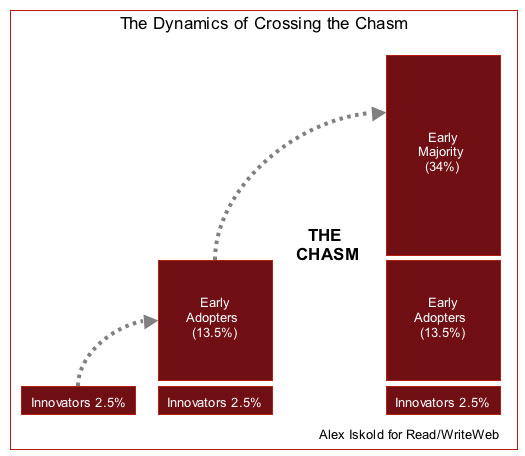
But, let’s put the wording problem aside for a moment, and let’s take a look at the hurdles technologies have to overcome on their way to mass market. Alex Iskold from RRW describes the dynamics:
To become a mass market product, it has to attract Innovators, which typically are defined as 2.5% of the market, followed by the Early Adopters, which make up for 13.5%. After used by around 16% of the market, a chasm yawns. To become mainstream, the product has to motivate the next group, the 34% Early Majority, to be used by up to 50% of the market.
Compared with 1991, when Geoffrey A. Moore introduced the term “Crossing the Chasm”, the speed of new market entrants has increased dramatically. Many technologies – especially those invented in Silicon Valley – are aimed at innovators and early adopters. And 12 months after a product has gained traction, it’s online at amazon.com or the Apple Store, and that means a worldwide availability. Today, startups can sell their products in the tens of thousands in a foreign market before they even have their first customer support agent hired – a typical early adopter’s problem.
In the U.S., retailers like Safeway, mobile operators and others have shelves offering fitness gear communicating with apps – the most visible quantified self products these days. According to Pew Internet, 66% of North Americans track themselves with dedicated devices and 46% state that they have changed their behavior based on the collected data. What Pew does not disclose is whether those people actually know that their behavior is called Quantified Self. It’s a matter of fact: more and more people who quantify themselves haven’t heard of that specific term before. They just do it. The reason: there are no “Quantified Self” signs at the shelves. People buy wristbands or smart watches, but not “quantified self” tools.
Coming back to wording: if “the Quantified Self” will be used as a more academic term for people buying wristbands, smart watches, smart clothes, etc., and sharing their data, then we’ll have the interesting effect of a coming mass market with a name only insiders know about.
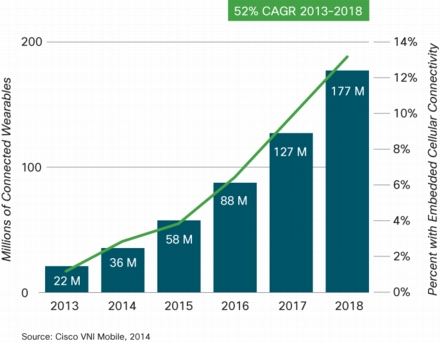
Did I say mass market? Indeed: ask the one market research company or another, the market for so-called wearable tech; i.e. the technology used by the Quantified Self – will grow to $30-40 billion in 2018. I call that a mass market. The assumption behind these numbers – as always – is that these products cross the chasm, that they overcome the hurdle from motivating early adopters only to wow the early majority, too.
In our opinion, that’s possible. Why? The Quantified Self / Wearable Tech will become a huge market because it empowers the individual: QS redirects competences from experts – physicists, scientists, etc. – to the individual. Sue Clark is able to collect and analyze enough high quality data to be informed about her health situation at all times. She can either predict serious health problems like strokes, or she can help to prevent them by changing her behavior to the better. QS gives autonomy back to the individual, and this is the main force behind a dynamic growth of this market.
The growth rates will depend on the availability, the usability and the personalization of advice – aka social relevance:
- Everybody must be able to use the device. The device itself should be free or cost less than $100.
- It must be absolutely easy to use the device – nobody must be overly creative or be urged to engage heavily.
- The user must get individual and personalized recommendations to change her behavior, if necessary. No standardized programs, but individual advice.
If these criteria are met, a QS device, be it a wearable app, or hardware, will be sold in its tens or hundreds of thousands within short notice. And problems like obesity, which alone costs the United States more than $150 billion in lost productivity a year, could be addressed in a new way.
And then, the Quantified Self will have crossed the chasm – perhaps without even being noticed.
by Michael Reuter | 2 May 2014 | Blockchain
Here’s the transcript of this Datarella (DR) interview with Klaus Bscheid:
DR
Klaus, can you tell us a little bit about ambiotex
Klaus
Sure! ambiotex has developed a textile with integrated sensors. With these sensors we can track a genuine one-lead ECG. Based on that ECG we can extrapolate not only the pulse rate but a heart rate variability (HRV). At the same time we quantify the user’s breathing rate as well as her breathing volume. Based on the analysis of the combination of these data we can draw many very interesting conclusions. In particular, we think that HRV analysis is useful for the regeneration of the human body, for insights into coping with stress, etc.
DR
Our textile is an undershirt, since it should be the very first layer being directly on your skin. You can wear this shirt during your sports activities as well as in your everyday life. So what do we do with all this body data? If it’s a sportsman, we can tell him his regeneration level, i.e. we can tell him whether it makes sense to exercise or not. This is important since many athletes don’t really know when to exercise and they might harm themselves. Additionally, we can tell the athlete on which level he should train: we know his individual aerobic threshold in realtime and can support him in planning and optimizing his workout.
If you think of the overworked manager, we can tell him when it’s too much for this day.
DR
That sounds as if I don’t have to visit the doctor because my health is constantly tracked by my Ambiotech shirt. Being a technology company, how can you provide this kind of medical support – do you cooperate with experts in this field?
Klaus
In the first step, our product will not be positioned as a health(care) product, since we first have to gain experiences and to acquire the appropriate certificates. We think that we are able to track and analyze many health-related data. We certainly would not submit that we were able to detect an imminent heart attack, but that’s definitely on our agenda. We want to enable the user to react on corresponding signals.
For the time being, our goal ist to provide our users with feedback on data he isn’t aware of. After all, that’s the goal of the Quantified Self: to get permanent feedback on my body’s functions. I don’t have to react, but I can react. This said, it’s important to provide the user with the appropriate analyses – since he won’t be able to interprete the 5 heart rate variability variables by himself. Here we are working with algorithms enabling meaningful analyses of these data.
DR
Klaus, you’re pretty deep into that topic self-tracking and yet, you don’t wear a wristband or a smart watch. Do you track yourself at all?
Klaus
Sure – I have tested some of these wristbands. And for some time, I liked it pretty much. But, after a while, I got bored by these wristbands. Also, I tested some smart watches. But I haven’t found the right one for me – still waiting for that one… But, I’m pretty sure that there’s a bright future for smart watches which cover a broad spectrum of quantifying and analyzing. However, we see that you have to collect certain parameters from your body directly and that’s our focus.
DR
Thank you very much, Klaus!
Klaus
Thank you!
[Please note: ambiotex is in test mode and will be launched summer 2014]
by Michael Reuter | 29 April 2014 | Blockchain
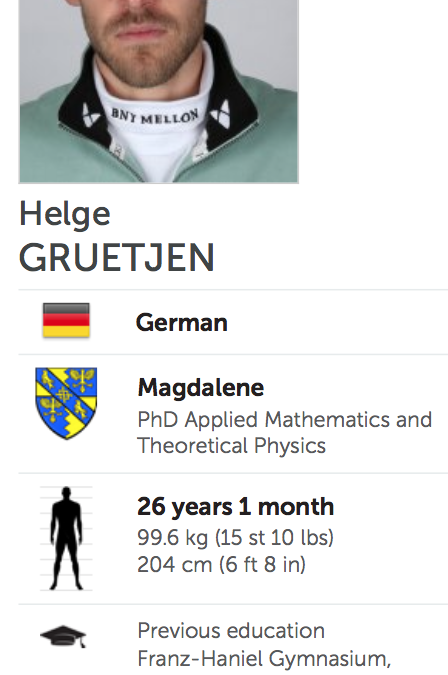
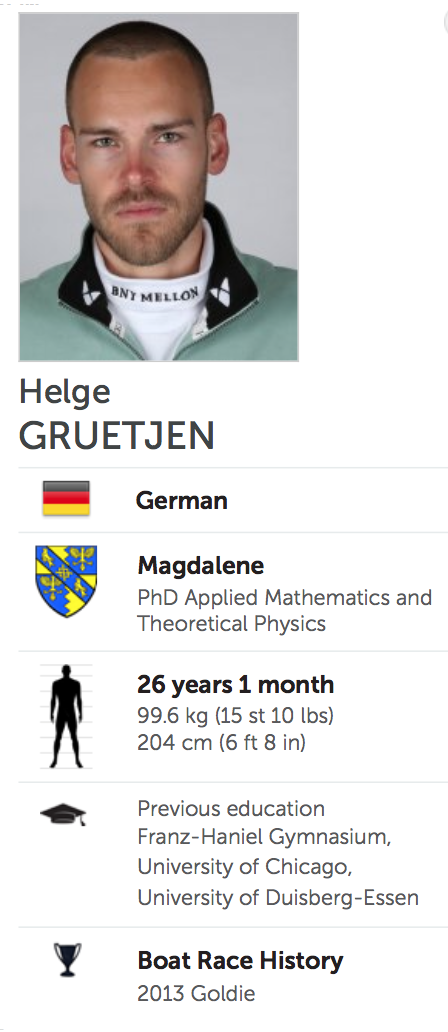
Cambridge PhD student Helge Gruetjen was a chain-smoker, weighting 120 kilograms, who started to row for the Cambridge University Boat Club in 2010 to become one of a team of five trying to beat the Oxford squad.
He had set himself an “unrealistic goal”: to lose more than 25 kilograms while bulking up, simultaneously. In the last 2.5 years the 26-year-old managed to lose 0.5 kilograms per week, by stopping smoking, tracking his food intake, sleep patterns and more, using an Excel sheet, 4 hours of training per day…..and a lot of will power.
“I knew I had to become very fit within 2.5 years. And I had to lose weight in a very soft and sustainable way.”
But how to motivate oneself to constantly lose weight during 2.5. years? For Helge, to be part of the Cambridge boat race team, was the biggest motivating factor. First, he analyzed his own behavior: which aspects of his life are obstacles to that goal and had to be changed. These were: smoking, exercise behavior, eating behavior, sleep patterns, etc.
“We have to get up at 5:45am and start our day with the first round of training. Then I head to my office. Then, in the afternoon, the second part of the training follows. We spend 6 hours per day on preparation for and the training itself.”
From slugabed to earlybird, from a lover of sweets to quit sugar totally: combined with daily exercise these have been the changes for Helge to lose 500 grams per week, the equivalent of about 500 calories less per day. Not being aware of actual quantified self and wearable tech gadgets as wristbands, etc., Helge used a classic Excel sheet to collect his personal data day for day. Being a theoretical physicist, he naturally is more interested in data than in nicely drawn charts. But he really likes the Quantified Self and thinks that it can play an instrumental part for many people who want to change their lives.
“I had my lows – and it was quite hard. But having managed to stick to my own rules for a certain time, I have seen the results: my plan really seems to work. Seeing the results and knowing that your plan is working gives you the willpower to move on, to reach the next level. An then I realized, that I did not really miss something after I had changed my lifestyle. After all, it’s a fun thing to do!”
Helge has been supported by his fellow boat race team members – he thinks that sharing experiences with like-minded persons is a crucial part of any lifestyle changes. Mutual motivational pushes are important in a team. However, for Helge the individual and personal goal is the most important aspect:
So here’s Helge Gruetjen’s recommendation for all of you who want to lose weight: start moving, start exercising, start today! Stay realistic, set yourself realistic goals! Check whether you reached your goals on a daily basis!
We could rephrase that: start with quantifying yourself today!
by Michael Reuter | 24 April 2014 | Blockchain
Here’s the transcript of this Datarella (DR) interview with Michael Ricks, self-tracker, investment banker and inventor.
DR
Michael, you are an American living in Munich, Germany. Could you tell us a little about you?
Michael
Ok – so, what am I? A guy who is trying to get the most out of life. I’m a father of four kids who are pretty active. I work as an investment banker and inventor, and otherwise I’m just enjoying life.
DR
How do you track yourself?
Michael
Probably like everyone does. I get up in the morning and think about what my day is going to bring. Every day I do a thousand repetitions of something or a combination of those thousand things. So, most days I start with a hundred stit-ups in bed! And that’s the beginning of tracking what I’m doing there in the course of the day. Then I figure out how many hours I’ve slept, and then I decide how to spend my day: I look at my calendar, divide up my time, dibide up my activity… and start!
DR
What reason would there be to stop tracking yourself?
Michael
If tracking became something which consumed more time and energy than it delivered in terms of benefit, I’d stop.
DR
That’s easy! Should more people track themselves?
Michael
Well, I think that people who don’t track are missing out. Usually you can see the symptoms of people’s failings to track their own bodies and activities. You see it on simple things: people being obese, you see it on more difficult things, e.g. people not being successful in their business activities simply because they’re not using their time sensibly.
DR
In which situations does tracking make especially sense?
Michael
I think it especially makes sense in terms of things that are life or death. So, I want to know whether I’m getting the right nutrition I need, I want to know if I’ve got some sort of dread disease that can be cured. I also want to keep up with my body’s development over time, if my organs are all doing their job. Finally, I want to keep myself on track, keep myself honest.
DR
Do you share your data?
Michael
That depends on what you mean with “sharing my data”: do I post it on Facebook for everyone ego read? No. But do I make my data available anonymously? We all do that probably a lot more than we think – so my blood tests is certainly information being compared in the lab I have my blood tests done in. Thats the same with some other things we do – it simply becomes public information.
DR
Sharing data can help people. It can save lives. Is sharing data there fore a social obligation?
Michael
Hm. An example of that would be the case of someone who has leukemia and a transfer of bone marrow from an appropriate donor could save their lives. But in order to find out who the appropriate donor is you have to know many more details than you see from looking from the outside. So people do have to get tested.
And I think it makes sense. I’m also a blood donor, and there you would got to have information that’s relevant for both parties in order to make sure that someone would get what they need.
DR
How has tracking changed your behavior?
Michael
I guess, I try to be purposeful in my life. And by tracking I’m able to better understand whether I’m really being purposeful. I then can think about what I’m doing with my time, what I’m doing with my body, and – in the end – have a better idea whether I’m delivering on my life mission.
DR
Cool – now the last one: what is your favorite tracking app and/or what must a tracking app offer?
Michael
Hm. I would honestly say I don’t have a favorite, yet, because I have to use different ways of tracking information in order to achieve all of my objectives. Right now, I’m using a wristband, the Jawbone Up, and – with all of its pitfalls, the device is able to keep me up and moving, not sitting around during the course of the day. It let’s me know whether or not I had a good, restful sleep, and how much of it. So that’s the one I use the most for right now.
DR
Great! Thank you very much!
Michael
Thank you!
by Michael Reuter | 15 April 2014 | Blockchain
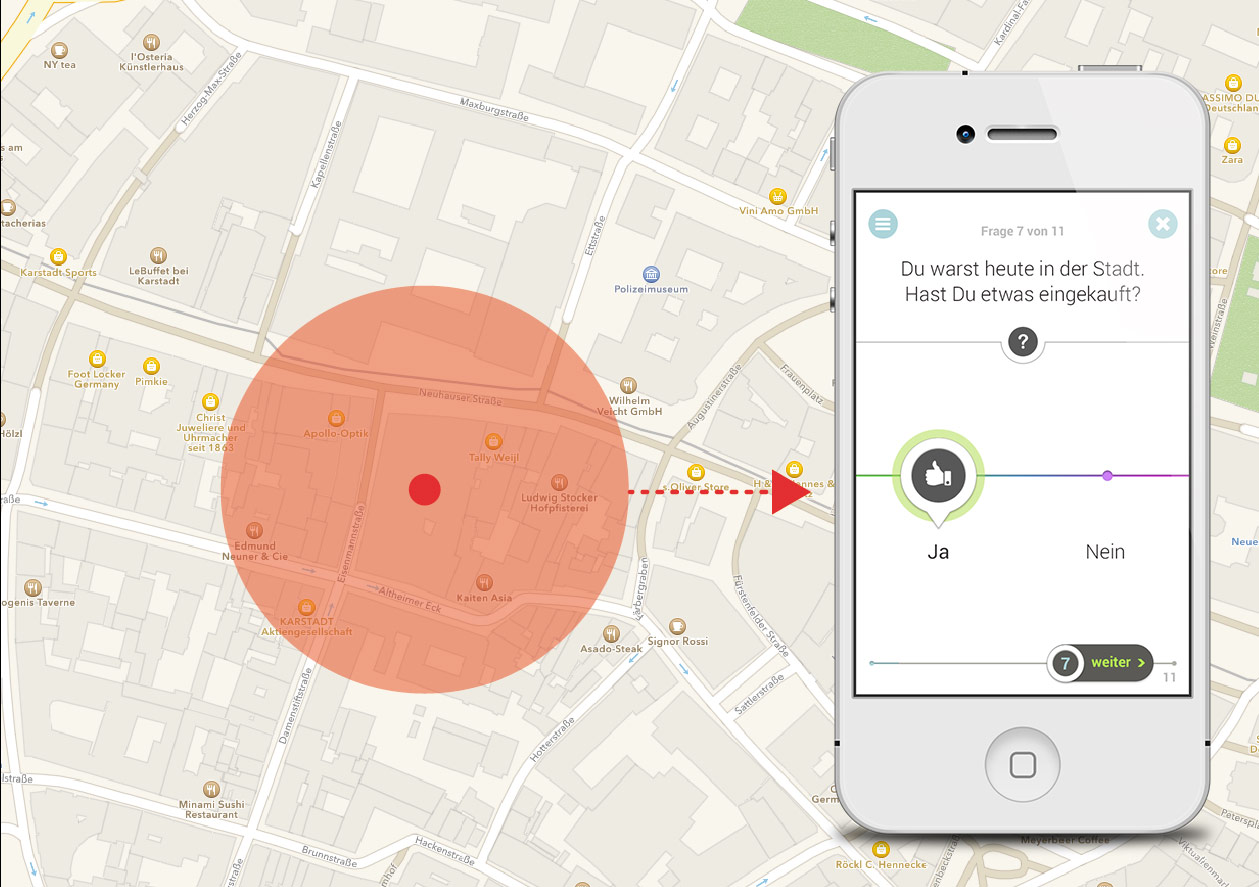
Know your customers and build an ongoing relationship between them and your brands by looking beyond a on-time meet-up caused by a marketing campaign! Highly engaged users become loyal customers, have higher LTVs and contribute more to your bottom line than the casual customer. Yes to that. But how to to build a stronger relationship with your customers? Do you know enough about them to accompany them on their journeys?
If you’re a reader of Nate Silver’s FiveThirtyEight, you’re aware of his disdain for opinion journalism (e.g. op-ed columns), which “[…] doesn’t seem to abide by the standards of either journalistic or scientific objectivity. Sometimes it doesn’t seem to abide by any standard at all.”
So, if a (well researched, if good) op-ed column does not fit to a journalistic or scientific standard – does a customer journey description, which (typically) ends when the customer actually starts his real life journey because she leaves her desktop, fit to any marketing research standard? Won’t the customer act and express herself in a different way when on the road, when actually being shopping, when passing by out-of-home advertisements in a hurry – compared with relaxing with her iPad in her living room?
Those real life customer journeys show that in order to fully understand your customers, you have to follow them everywhere. You have to plug into your customer to learn from her, to learn about the places she visits, about her habits and about her needs to eventually optimize her daily routine. If you manage to be that near to hear you can tell her the right story – in this case a story based on her data. Coming back to our analogy with journalism: The plural of anecdote is data, as political scientist Ray Wolfinger said in 1969.
Every user of a smartphone or any other wearable devices produces an enormous amount of data ever day. If you manage to collect that data, to analyze it correctly and to translate it into useful recommendations and appropriate user stories, you will build strong relationships with you customers. With our explore app, you can accompany your customers, ask the the right questions at the right times and learn a lot about their whereabouts, habits and attitudes.
by Michael Reuter | 9 April 2014 | Blockchain
Here’s the transcript of this Datarella (DR) interview with Florian Schumacher, Founder QS Meetups, Germany.
DR
Florian Schumacher, you started the first Quantified Self QS Meetup in Germany. Could you introduce yourself and tell us about your QS approach?
Florian
When I learned about Quantified Self in 2011, I immediately felt attracted by its very positive culture. Consequently, I started the QS meetups in Berlin and Munich in 2012 which is a lot of fun. Besides, I am a trendscout of Wearable Technologies AG. Here, I’m dealing with all devices you can wear and the sensors which collect behavioral data.
DR
What do you track yourself and how do you do that?
Florian
I regularly and passively track my weight, my body fat, my physical activities and my sleep – all those data are collected automatically, so that’s completely effortless. Then, I manually collect sample data on my blood pressure, blood sugar, my girth, and I try to keep an eye on my haemogram. This, I do on a weekly basis. Then I track other data as time, which is quite sophisticated, since it’s not automated at all and I track everything: every project, every lunch, every activity finds its place in my calendar. So I have a good overview of how I spend my time, and how my time is devoted to my hobbies.
DR
You told us that you have lost weight – voluntarily, that is – that means tracking has very specific consequences on your life!
Florian
Yes, indeed. I have been testing QS devices for three years now. While I kind of just tested theses devices before, I have started to use them for special purposes last year. I have been trying to lose weight, I’m on a special diet and let my ape count my calorie intake. Then I check what nutritients my food actually contains. Then I exercise regularly – and by tracking all that I can understand my body’s changes very well – and I like that very much!
DR
Then for you QS is more a motivational thing, rather than a supervisory body…
Florian
QS is a control body, but more in a positive sense: by comparing different measured values I learn and get a better understanding of my body and, consequently, I get motivated and become happy even if sometimes this way is somewhat hard.
DR
Do you share your tracking data with others?
Florian
Yes, but I only share some of my data: e.g. I share my steps within my Fitbit community – but only my steps – since for me these are indiscriminate data. All other data I would share with my doctor rather than with my friends.
DR
So you draw a line at sharing your data. Could you elaborate on that a little more?
Florian
I think that’s very personal everybody should define what data to share individually. Sharing your data can be very motivating if people have mutual goals. There are studies showing that everybody will be far more successful if all share their data which each other; e.g. people lose two to three times more weight if they share their goals and data. That means in case of very personal data (e.g. illnesses) I would share my data within a closed group of likeminded people, but I think everybody should decide that by herself – and there should be some control mechanisms preventing abuse of this data.
DR
At QS13, Gary Wolf [Co-founder of the Quantified Self] said that Tracking and data sharing would become a social responsibility to provide access to important learnings to everybody. Do you agree with Gary?
Florian
I don’t think that self-tracking should become a, obligation for everybody. But what I strongly support is the anonymous sharing of data to realize potential benefits in scientific research and pharmaceutical product development. I’m sure that this will promote our culture to the next level.
DR
A last question: which tracking app or gadget do you like most?
Florian
I really like this Basis band, since it automatically tracks my sleep, my movement and it accurately calculates my calorie intake. At the moment the Basis is the most accurate tracking device on the market and I like it very much!
DR
Thank you!
Florian
Welcome!
