by Martin Schäffner | 30 April 2019 | Blockchain
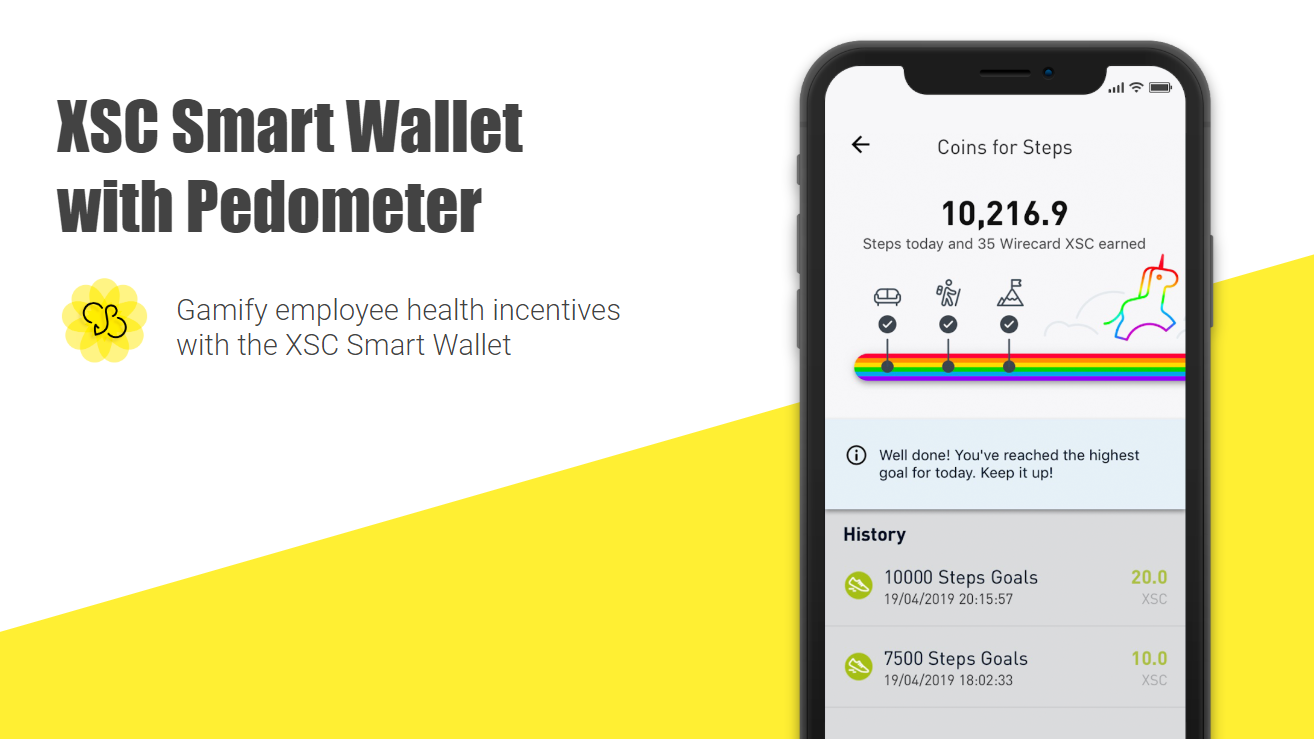
The successful XSC Wallet for Android and iOS just got a new pedometer function! You can now incentivise your employees to move more and stay healthier with automatic coin rewards.
Everyone knows regular physical activity is good for your health. The more a person moves on a daily basis, the healthier she tends to be. Exercise helps to reduce stress, makes you happy and promotes mental as well as physical performance.
Using the XSC-Wallet with Pedometer results in more movement, more health and more fun at work:
- Integrated pedometer gives feedback on your own activity
- Stay motivated by earning coins when you meet your goals
- Higher health, lower absenteeism due to sick days

Staggered goals reward the employee with XSC
Office workers quickly fall into the trap of living a largely sedentary lifestyle. Everyone wants healthy innovative employees but we all easily fall into just sitting in front of the computer all day. The extra kilos pile on and employee health and innovation are slowly eroded.
With the new pedometer function of the XSC Smart Wallet employees can be motivated to be more active both at work and during their leisure time.The XSC Smart Wallet uses sensor data to determine the number of steps a user takes over the course of the day.
The great thing about this is that after a certain number of steps, rewards are given out to the employee in the form of coins, which can then, for example, be exchanged for coffee, smoothies, or other benefits in the company cafeteria.
This simple and clear incentive encourages employees to move. In addition to the benefits of improved health and wellbeing, employees enjoy trading their coins in for perks like free coffee or fruit.
Employers gain an extremely cost effective tool for improving employee morale, encouraging innovation though greater employee fitness and engagement and perhaps most importantly by reducing employee absenteeism due to sickness.
by Rebecca Johnson | 9 March 2018 | Blockchain
Here’s a quick overview of four of the newest crypto wallets with built-in DAPP browsers
If ethereum is to realize its promise as the “world computer” we’re going to need more advanced wallets. Mobile has arguably overtaken desktop as the dominant paradigm for interacting on the web but most decentral applications aren’t mobile ready. DAPPs promise to be our connection to voting, governance and the backbone of the web’s future. There are lots of mobile wallets available now but in the coming world, just sending tokens and crypto back and forth won’t be enough.
Today we’re taking a quick look at four bleeding-edge wallets which combine a DAPP browser with a mobile crypto wallet. Since development in this area moves very very fast we’re not going to make any kind of a ranking. Instead, we’ll list a few key features where each app shines.

Cipher Browser
The Cipher Browser has a solid DAPP browser which handles the login process for early DAPPs such as cryptokitties.co and leeroy.io as though one was using metamask. The Touch ID integration is good and approving transactions is pain-free. In addition, adding custom ERC20 tokens to the app is quick and straightforward if you are someone who knows their way around etherscan and who’s not afraid to find out how many digits a token contract allows.
Who’s it for? Old-school crypto nerds who want to keep it simple.
Toshi Browser
The open source Toshi browser is not only a wallet and a DAPP browser but also an encrypted chat platform. It uses a chatbot for the initial user journey which in our experience is an either a “you love it or you hate it” kind of thing. After that, one can access an app store like DAPP browser, a public chat client based on identities tied to ethereum addresses and a wallet supporting both fungible and non-fungible ethereum assets.
Toshi uses the Signal protocol by Whisper Systems for chat and the uPort identity protocol to store user profiles. All in all, it’s pretty forward thinking stuff if a bit cluttered at times. There’s also one weakness for industrial applications. Developers and other geeks may want to work on more than one network (Testnet, POA etc.) If that’s your use case, this one isn’t for you.
Who’s it for? Social crypto nerds who love trying out new stuff.

Status Browser
Status takes the social / chat idea from Toshi to the next level. In Status, one finds not only contacts in the chat interface but also DAPPs. As in Toshi, setup occurs via a dialogue with a chatbot. Again this isn’t for everyone, but it’s super for people who prefer onboarding by bot.
Status defines itself as a new kind of peer-to-peer encrypted messaging and payment system rather than a DAPP browser or a wallet. Yes, it does offer those things too, but everything in the Status app is centered around chat. The idea is that people do business and transact with other people, so their communication should enable that.
Right now, status is only available as an alpha release that you can test on the testnet using Testflight (iOS). There’s a very lively Discord community if you want to jump in and join the dialogue.
Who’s it for? Do you dream of native ethereum transactions while using whatsapp? Then this app is for you!

Trust Wallet
Like Cipher, Trust Wallet offers a more conventional experience. There’s a browser tab, a transactions tab, a tokens tab, and settings. Everything is pretty self-explanatory. The Web3 integration in the DAPP browser is great, so log in and transaction approval are simple. Also, the developer is working with decentral exchanges such as Kyber Network to make sure the DAPP creators are building stuff that is actually usable on mobile.
Also, this open source app is the only one on our list that may be appropriate for use in industrial applications. This is due to the fact that the Trust wallet allows the user to switch the network and that a proof-of-authority network connection is possible.
Who’s it for? Crypto industrialists, exchange integrators, open source forkers and friends of straightforward wallet tech.