Just like your home address, bank address, or email address a blockchain address is a unique and secure identifier. This identifier, saved on a blockchain, can be used for sending and receiving cryptocurrencies. However, in contrast to traditional addresses, blockchain addresses are not assigned by centralized authorities. These addresses are mathematically derived from a user-generated private key.
Learn more about blockchain addresses and the two types, which exits in the Ethereum Network, in our Datarella Blockchain Bites slideshow of this week: Blockchain Addresses.
If you are setting up a blockchain-based system, one of the first questions you face is what kind of blockchain is best suited for your use case. This question also arose at our KOSMoS project where we are implementing a consortium blockchain for a group of german machine manufacturers and their clients. In cooperation with the Frankfurt School Blockchain Center, we published an article on Medium that shows our approach in finding the most appropriate type of blockchain.
If you want to read the full article, you can read about it here!
Within three years, the KOSMoS project intends to create blockchain-based frameworks for machine manufacturers to offer services for transparent maintenance and dynamic leasing contracts for their machines. Since these use cases are crucial to the stakeholders, it is important to choose the right type of blockchain to satisfy their needs.
Our methodology for choosing the correct type of blockchain followed three steps:
Study existing types of blockchain and select a subset
Define criteria for evaluating the most suitable blockchain system
Compare the different blockchains to our predefined requirements
After comparing all possible types of blockchains, we eventually decided to implement the KOSMoS system on Hyperledger Fabric. One of the reasons for Hyperledger Fabric was the possibility to use channels between each machine manufacturer and its clients to keep sensitive information confidential while maintaining a shared blockchain infrastructure.
If you have any questions about the project, our methodology, or criticism, feel free to contact me via E-mail.
This is the second post in which we are going to examine blockchain protocols and their tokens. First up, we wanted to start with Ethereum and its native token, Ether, which allows a network of thousands of independent computers to form a single supercomputer.
The beauty of blockchain lies in the possibility to create, securely maintain and transfer digital units, so-called “tokens“. These tokens can serve the purpose of a medium of exchange, which is redeemable for something specific from someone specific. Generally spoken, this is what gives tokens their underlying value. As a consequence, these value units can be used to incentivize certain behavior.
Bitcoin, the first blockchain protocol uses its native token, BTC, to incentivize its network participants in competing to solving a cryptographic puzzle. Whoever solves the puzzle first is rewarded with new BTC and eligible to add a new block of transactions to the ledger.
Ethereum is a network protocol, which uses Ether to incentivize individual computers to act as a single supercomputer, called Ethereum Virtual Machine (EVM). This computer is capable of running any code, written in the native, Turing complete programming language Solidity. The code on the Ethereum Network follows an if/then logic is called a “Smart Contract”.
Smart Contracts are executed on all computers of the network simultaneously, therefore, in a decentralized manner. Once a Smart Contract is deployed to the network it is theoretically impossible to alter or delete it. To perform any changes the majority of the network would need to be convinced to rewrite the underlying code.
Imoratbillity brings the benefits of censorship resistance and prevents any manipulation through malicious actors. Further, running the code simultaneously on all computers of the network eliminates a single point of failure and prevents, therefore, any downtime. These prosperities make code that is running on the Ethereum network highly trustable. However, the downside of immutability arises through the missing opportunity to fix bugs within a Smart Contract once it is deployed.
Just like traditional programming code, Smart Contracts can be used for various purposes.
For example, a Smart Contract can express all the required rules to define ownership and the transfer of ownership, which are required to issue and manage a new token.
Further, Smart Contracts can be used to create computer programs, so-called decentralized applications (Dapps).
Also, it is possible to reproduce organizational rules and structures with Smart Contracts. These constructs are then referred to as Decentralized Autonomous Organizations (DAOs) and are managed over their specific tokens, which grant ownership rights such as voting or dividends.
However, you might ask yourself why people are buying computers, paying for running them and then contribute them to the Ethereum network?
Here is where Ether (ETH), the native token of the Ethereum network comes into play.
For performing any transactions on the Ethereum Virtual Machine a fee is charged and paid out to the validating network participants. Transactions on the network include:
The transfer of tokens
The deployment of a new Smart Contract
Triggering of a Smart Contract
The fees for these transactions are price in priced in “Gas”, the medium of account of the network. The amount of Gas charged for any transaction is predefined and derived from the computing power required to perform it. However, while the charged amount of Gas for a transaction is fixed, its price is variable and depends on the current degree of network utilization. The price of Gas expressed GigaWei (GWei), which accounts for 1/1.000.000.000 ETH.
As stated, Ethereum can be described as infrastructure to host the code of thousands of different tokens, Dapps or even DAOs, eliminating the need for developing and maintaining an individual blockchain for each project.
For exchanges and wallets to deal with this great variety of tokens Ethereum offers different token standards, which will be examined in depth in the following blog posts.
The most prominent one is probably the ERC20 standard, a fungible token, which has be frequently used as a financing method in initial coin offerings (ICOs). Examples for application-specific ERC20 tokens are:
– GNT, the currency token of the Golem.network, a cloud computing platform.
– REP, a token is used to place bets on the prediction market Augur. – BAT, of the Brave internet browser, which is paid to users for receiving adds. – EOS, a smart contract platform.
Another popular token type is the ERC-721 standard, which allows creating non-fungible tokens. These tokens are unique and can be therefore used to represent real-world assets, such as fin art, real estate or digital collectibles. A good example of the use of ERC-721 tokens is the blockchain game Cryptokitties, in which players can own, breed and trade digital cats. The cats are priced in ETH and sold for up to 140.000 USD.
Ethereum is a great example of how blockchain and tokens can be used to create applications and new markets.
In the following posts, we will further explore the use cases of Ethereum.
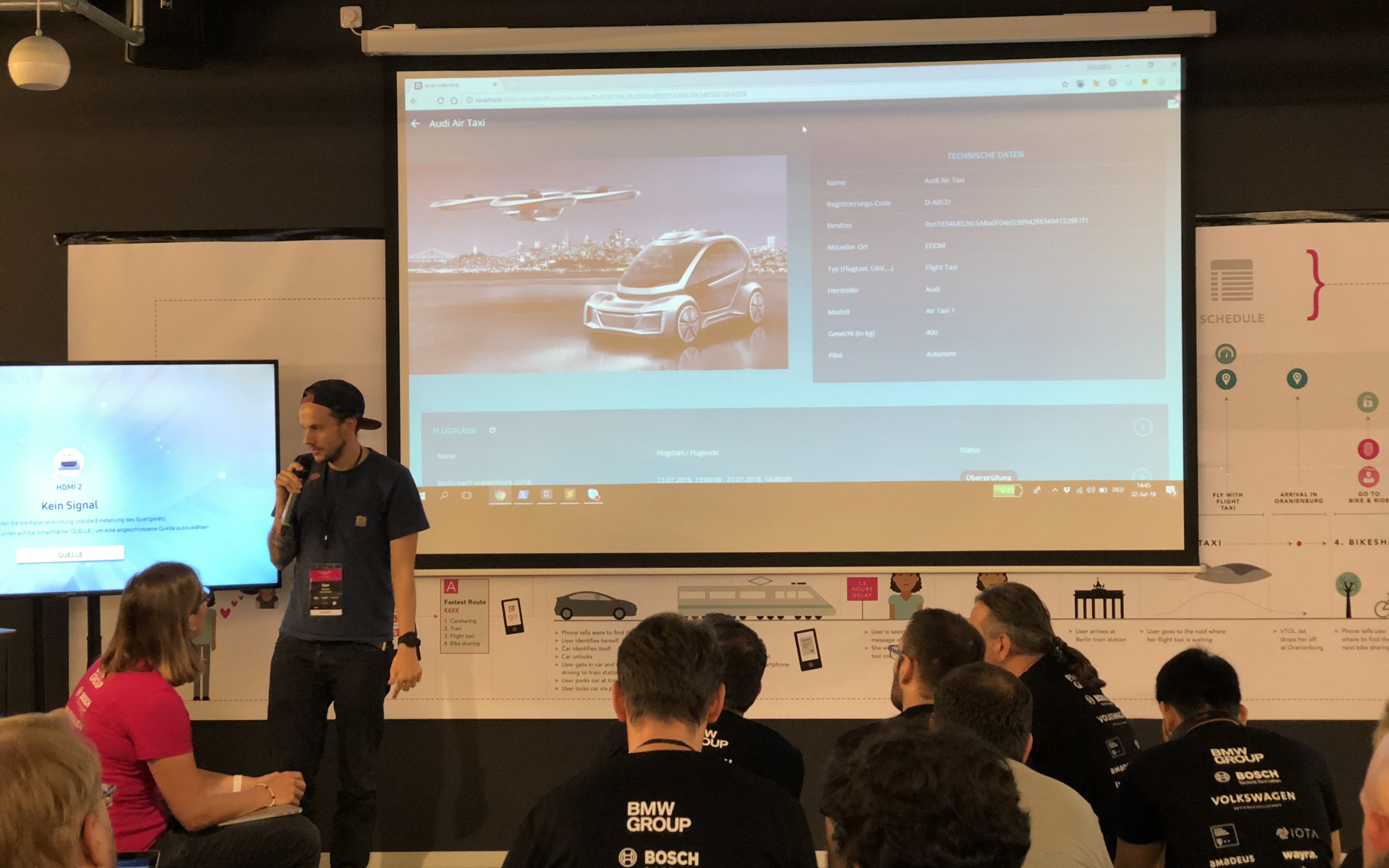
A: Mobility as a service (MaaS) through connecting Ethereum smart contracts with Datastreams on IOTA.
Q: What problem does your project solve?
A: We wanted to develop a case in the field of autonomous urban air mobility, better known for example as the concept of air taxis. In order to implement such an autonomous mobility concept, you have to bring together different partners. Making an air taxi fly is actually a bit more complicated than sending an autonomous car into traffic. Because you need some very important permission before you are allowed to start.
There is, for example, the flight control that has to check all the details of your flight to make sure that there is no other vehicle on the same route. Or the weather forecast service telling you if the conditions are okay for your flight. In addition to the permits, there are also other stakeholders, who should be integrated into the process. What about the insurance company offering real time insurance conditions depending on how much passengers you have and how long your flight will take? Or the booking platform where everybody can book easily his flight in an air taxi? So, at the end, it just makes sense to involve all parties in smart contracts on blockchain to automate as much processes as possible. And this is what we did.
Q: What expertise and roles do your team members have?
A: In our team we were one designer and two backend developers with numerous experiences in blockchain projects.
Q: Which technologies do you use for which purposes?
A: Mainly we used all kind of Ethereum based smart contracts, to bring the different participants together on a decentralized network. To get real time data of the air taxi we used the data streaming technology of IOTA. In our case, we created a process that opens a new data stream automatically in the moment in which the air taxi starts. From this point on we push the data stream in our Ethereum based smart contracts. To show the connection between IOTA and Ethereum, we used the data of the battery of the air taxi. The battery will be a very critical point for every autonomous process in the future. Because, while the air taxi is flying, the partners around, like for example the market places where you can book your air taxi, need the information when the air taxi will be available again for the next flight. And that is highly depended on the current status of the battery. So, to know in advance how long the air taxi has to charge after the flight before it can go back in the air, you need real time information about the battery condition.
Q: How do you plan to proceed with your project?
A: We will use the developed demo to show, what type of use cases you can implement at evan.network.
Here’s a quick overview of four of the newest crypto wallets with built-in DAPP browsers
If ethereum is to realize its promise as the “world computer” we’re going to need more advanced wallets. Mobile has arguably overtaken desktop as the dominant paradigm for interacting on the web but most decentral applications aren’t mobile ready. DAPPs promise to be our connection to voting, governance and the backbone of the web’s future. There are lots of mobile wallets available now but in the coming world, just sending tokens and crypto back and forth won’t be enough.
Today we’re taking a quick look at four bleeding-edge wallets which combine a DAPP browser with a mobile crypto wallet. Since development in this area moves very very fast we’re not going to make any kind of a ranking. Instead, we’ll list a few key features where each app shines.
Cipher Browser
The Cipher Browser has a solid DAPP browser which handles the login process for early DAPPs such as cryptokitties.co and leeroy.io as though one was using metamask. The Touch ID integration is good and approving transactions is pain-free. In addition, adding custom ERC20 tokens to the app is quick and straightforward if you are someone who knows their way around etherscan and who’s not afraid to find out how many digits a token contract allows.
Who’s it for? Old-school crypto nerds who want to keep it simple.
Toshi Browser
The open source Toshi browser is not only a wallet and a DAPP browser but also an encrypted chat platform. It uses a chatbot for the initial user journey which in our experience is an either a “you love it or you hate it” kind of thing. After that, one can access an app store like DAPP browser, a public chat client based on identities tied to ethereum addresses and a wallet supporting both fungible and non-fungible ethereum assets.
Toshi uses the Signal protocol by Whisper Systems for chat and the uPort identity protocol to store user profiles. All in all, it’s pretty forward thinking stuff if a bit cluttered at times. There’s also one weakness for industrial applications. Developers and other geeks may want to work on more than one network (Testnet, POA etc.) If that’s your use case, this one isn’t for you.
Who’s it for? Social crypto nerds who love trying out new stuff.
Status Browser
Status takes the social / chat idea from Toshi to the next level. In Status, one finds not only contacts in the chat interface but also DAPPs. As in Toshi, setup occurs via a dialogue with a chatbot. Again this isn’t for everyone, but it’s super for people who prefer onboarding by bot.
Status defines itself as a new kind of peer-to-peer encrypted messaging and payment system rather than a DAPP browser or a wallet. Yes, it does offer those things too, but everything in the Status app is centered around chat. The idea is that people do business and transact with other people, so their communication should enable that.
Right now, status is only available as an alpha release that you can test on the testnet using Testflight (iOS). There’s a very lively Discord community if you want to jump in and join the dialogue.
Who’s it for? Do you dream of native ethereum transactions while using whatsapp? Then this app is for you!
Trust Wallet
Like Cipher, Trust Wallet offers a more conventional experience. There’s a browser tab, a transactions tab, a tokens tab, and settings. Everything is pretty self-explanatory. The Web3 integration in the DAPP browser is great, so log in and transaction approval are simple. Also, the developer is working with decentral exchanges such as Kyber Network to make sure the DAPP creators are building stuff that is actually usable on mobile.
Also, this open source app is the only one on our list that may be appropriate for use in industrial applications. This is due to the fact that the Trust wallet allows the user to switch the network and that a proof-of-authority network connection is possible.
Who’s it for? Crypto industrialists, exchange integrators, open source forkers and friends of straightforward wallet tech.
More and more Big Data projects we with Datarella are involved in demand not only administrative or legal security layers but also state-of-the-art technical frameworks to provide the maximum security there is for business as well as petsonal data.
To provide our clients with sustainable solutions we have partnered with Ethereum and its spin-off Ethcore. The Ethereum framework enables us to build business models on top of it, using a very sophisticated blockchain approach, smart contracts and elements of the DAO concept and finally, our own product, the Datarella Data Trust.
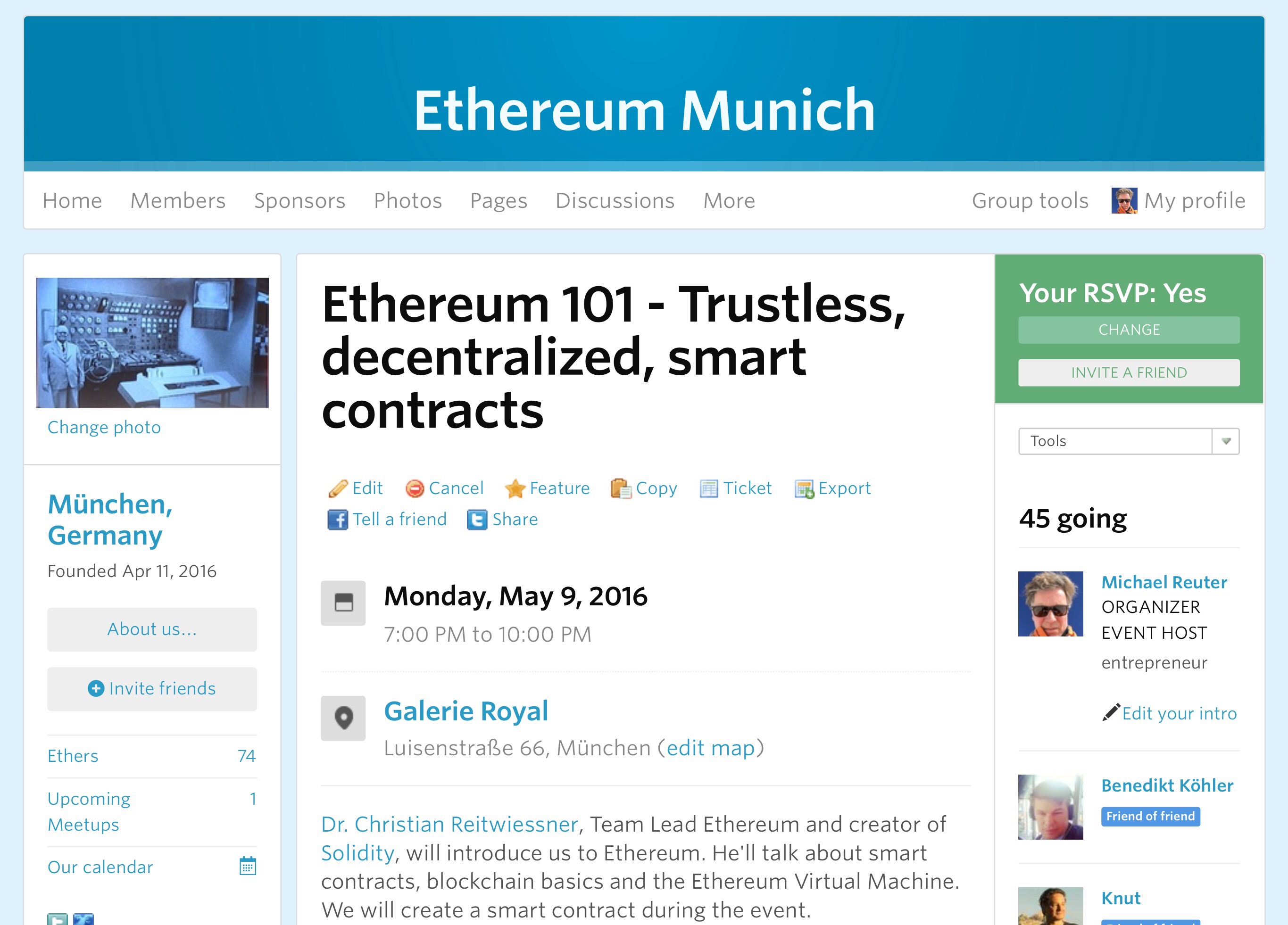
Since the blockchain, smart contracts, DAO and especially Ethereum are quite new to the Big Data scene, we aim to make them better known to a broader audience. So we have started the Ethereum Munich Meetup as a platform for presentations, discussions and development of Ethereum-based ideas, concepts, use cases, projects, etc..
If you are interested in all things Ethereum feel invited to our regular meetups!
We always take a little time in the very first days of a year to define Datarella’s main goals for this year. This time it was a pleasant task since 2015 went very well for Datarella: we achieved most of our goals and we could start without any legacy issues.
So, what to expect from Datarella in 2016? Beside our growing consulting business with fascinating projects and clients, we will focus on our product Data Trust and our project Data Coach. Due to our tight schedule in 2015, we haven’t published much about Data Trust and Data Coach, yet. I’d like to give a brief overview on both in this post.
Data Trust Generally speaking, Data Trust is a secure data market model for Big Data projects. Sharing data between businesses makes much sense: Both, data processing and analytics scale with the data, and development, quality assurance, as well as support become very efficient. The problem: Many businesses are hesitant to share their data with partners for security reasons, to maintain their competitive advantage, and also obligatory compliance aspects regarding data protection.
Data Trust solves this deadlock: With it we provide a secure sharing solution for corporations. Datarella organizes each client’s original data in separate data buckets.
Data Trust enables businesses to put their data to work together with the data of their business partners with guaranteed data security and control. Without giving away their data, they can now profit from analytics, results, and predictions that are based on the joint data within their network of partners. Thus, Data Trust is a market model – it provides each participant of a market with unparalleled insights into the market.
The Datarella Prediction Engine runs on top of the separated data buckets. The Datarella Prediction Engine has been designed for gathering precise statements regarding future business success in the areas of media & advertising, eCommerce, finance, mobility and health. Together with the Datarella Prediction Engine, Data Triust provides an absolutely trustful environment for clients to manage and analyze their company’s data.
Of course, the Datarella Data Trust can be audited.
Data Coach Whereas Data Trust already is a product and is already creating value for our clients, Data Coach is still in an experimental phase. The user interface of Data Coach is an app that provides the user with body activity and environmental data. The user shares this data with a closed professional graph and receives actionable insights into her health condition, behavior, training, etc. as feedback. Based in this feedback the user can react by changing her behavior.
The core of Data Coach is a blockchain environment that provides three essential elements of a professional network:
Data Security
Data Provenance
Peer-to-Peer Architecture
Cryptographic hash functions and completely historicized data chains make data sharing absolutely secure. The user completely owns her data. And she always knows her data’s whereabouts and defines whi can use it, how and when.
An essential part of our Data Coach project is our partner Ethereum, that provides a decentralized blockchain platform we build Data Coach on.
We are running very early tests of Data Coach in the area of sports and entertainment. We are active,y looking for partners to establish a pilot project in the health sector. So, if you think Data Coach could add value to your business and customers or patients, please don’t hesitate to contact me.