SmartAid – The Next Generation Donation Platform
Will my donation arrive at the people in need? Or will it get lost, somewhere in the administration costs of a humanitarian organization? Today, intransparent systems confront donors with a high degree of uncertainty, which diminishes their overall willingness to donate. Therefore, we at Datarella teamed up with the YOU Stiftung to create the next generation of donation platform for sustainable aid projects – SmartAid.
SmartAid is reinventing online charitable giving by implementing our Traceable Donation Technology – powered by Blockchain. SmartAid offers its users a unique donation experience with three distinct key value propositions:
-
- An effortless donation experience
- An engaging donation experience
- A trustless donation experience
An Effortless Donation Experience
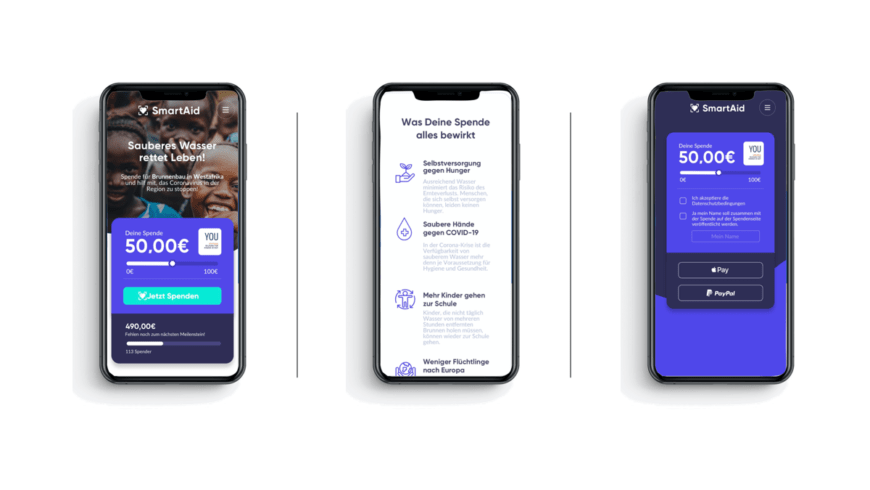
The first barrier, which hinders people from supporting impactful aid projects is the haze related to donating. Our goal is to make supporting these projects, which are often located on the other side of the world, as easy as buying a coffee. No login, no IBANS, no SWIFTs, no hidden fees, no subscriptions, no minimum amount, no bs. Simply scan a QR-Code, whether it is on a billboard at the metro station or on your computer screen or click a link and you will find yourself on the highly intuitive donation home page of SmartAid. Just a few clicks are required to conduct your good deed. Simply choose your favorite payment method and you help to create prospects for less privileged people.
An Engaging Donation Experience
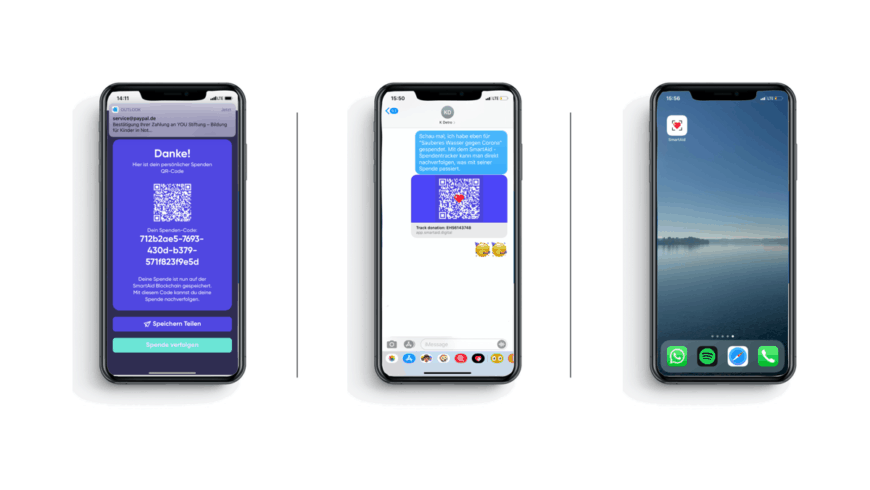
After your payment was processed, you will be rewarded with a unique QR-Code. Share this code and the attached link with your friends and family to show them the journey of your donation. Sending it to your community will also make it easy for you to find it back in your messaging history. Also, since SmartAid is a web app, you can download it to your home screen – just like a traditional app but without the hassle of downloading it from the app store.
A Trustless Donation Experience
The received QR-Code makes it not only easy to find your donation ID back in your message history, but it holds all the information required to track your very own donation among all others. At this point, SmartAid differentiates to traditional donation platforms – no trust is required since everything is documented immutably and transparently on the SmartAid Blockchain.

Traditional donation systems vs. SmartAid’s traceable donations
As illustrated in the graphic above, traditional donation systems allocate fiat currencies, like EUR, USD, in one pot, and distributed to different cost centers of an aid organization. Therefore, traditional donation platforms cannot provide donors visibility about the usage of their funds.
In contrast, on SmartAid each incoming donation is documented on the private Ethereum SmartAid Blockchain. To enable full transparency of the whereabout and usage of each individual donation, each payment will be represented by its own ERC-20 token contract. Each of these token contracts are distinguishable by their contract address. As visualized in the graphic above by different colors, this allows granting SmartAid donors blockchain secured clarity about how their funds will be used.
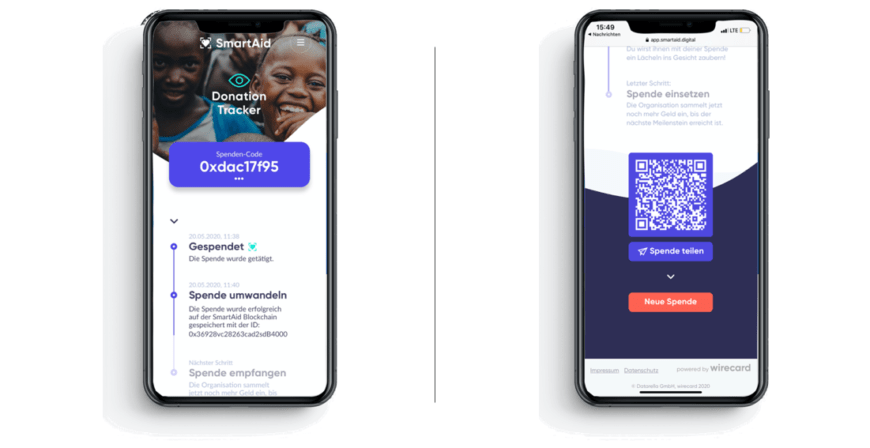
The donation tracker then provides the user an overview of the status of his donation. Here she will also be informed about the actual usage of her kind donation.
Donating hard-earned money to charity is a noble gesture. It requires a high amount of trust and transfers a significant amount of responsibility to the receiving party. Unfortunately, intransparent systems confront donors, as well as aid organizations, with a high degree of opaqueness. Donors face a high degree of uncertainty about the usage of their givings, which in turn diminishes their overall willingness to donate. At the same time, aid organizations are suffering from high costs of reporting to and providing their donors with formal audits. In both cases, the value which arrives at the people in need is significantly reduced. Therefore, we at Datarella are working with our partners on SmartAid to create the next generation of donation platform.
We are proud to announce that SmartAid is also among the winners of the EU funded H2020 accelerator Blockchers. Here we are going to extend the functionalities of SmartAid for aid organizations.
Stay tuned!