by Rebecca Johnson | 7 October 2024 | Blockchain, Track and Trust
This is the second article in a series of technical posts about how Track & Trust works at a component level. Building on your understanding of our mesh network technology, this post asks the question – what if everything starts going wrong? The answer as you will see lies in our Satellite-enabled Mesh Network nodes. Quick navigation links to the follow-up articles will be provided at the bottom of each article once the series is complete. For now, let’s jump in. The mesh network technology alone can’t get the job done. To make it work, we want the Track & Trust logistics tracking and communication to function even in the most challenging circumstances. However, addressing a few more challenges is necessary to achieve this. Additionally, we need to consider the limitations of the technology.
The Challenges
What if 4G doesn’t work at all? Remote logistics operations or external circumstances like war or political instability can cause this issue. In such cases, tracking becomes a challenge, especially when the electrical power is unreliable. Consequently, we need to find alternative solutions. We spent quite some time solving these issues. Fortunately, we did indeed find a way. With funding from the European Space Agency, we built a Satellite-enabled Mesh Network. Some mesh nodes now have more super powers, enabling them to do everything they could before, and more. Moreover, these special satellite-enabled mesh nodes are more expensive, but they have a special trick up their sleeves. They can post data to our servers even without 4G internet. Here’s how it works.
Satellite-Enabled Mesh Nodes
 The yellow box in the picture represents a satellite enabled mesh node. By adding an Iridium short burst data (SBD) transmitter to it, we gave it superpowers. Connecting this node to a mesh node via waterproof cables turns it into a super node. Our partners at OroraTech built this part of the system. Data arrives at this node using peer to peer communication over wifi-direct. The Iridium short burst data (SBD) Transmitter consumes information from cellmesh, finding out what data didn’t get posted to the internet via 4g. To make this work, a clear view of the sky is necessary. That’s why we waterproofed the enclosures. Strategic placement of these nodes is crucial. A good position is one where many other nodes will pass by, and it should also have a relatively solid electrical power supply. In our pilot, the roof of a local school with a solar power installation already in place proved to be an ideal location. Furthermore, this location allowed us to test the system in a real-world setting. Breaking down each data package into smaller packages is essential. These packages must be small enough to send over Iridium short burst data. As a result, each user action results in 8-9 individual satellite messages. These messages are encoded and transmitted individually, error checked, and then recombined. Finally, they can post to our backend systems.
 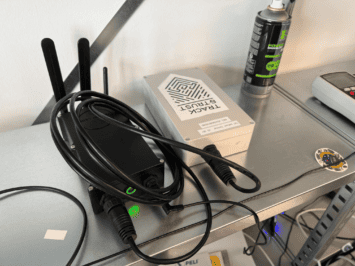 Here’s what it looks like in real life – a shot from our labs. In addition to the technical details, we will also cover the practical applications of the system.
What about electrical outages?
We anticipated that the nodes would need to be robust. Ensuring they have enough on-board power was crucial. This compensates for electrical outages, as delivery trucks can only supply 12v power when the ignition is on. Fortunately, our hardware engineer friends at Weaver Labs provided a solid solution to this issue inside these boxes. They equipped the nodes with integrated backup power systems and implemented a battery management system and software. This helps the nodes recover from power outages and situations where the on-board battery is fully depleted. Moreover, this ensures that the system remains operational even in challenging conditions. The result is a combination of hardware and software, enabled by mesh network technology, 4g, and satellite communication. This combination allows the system to stand up to difficult conditions and still work. In conclusion, our system is designed to provide reliable tracking and communication in even the most challenging environments. In our next post, I’ll address how the system handles security, covering the authentication and blockchain details backed into Track & Trust.
<<Previous Post
Next Post>>

by Rebecca Johnson | 4 October 2024 | Blockchain
This is the first in a series of technical posts about how Track & Trust works at a component level. To start, we’ll outline how our mesh network technology works in this post. Additionally, I’ll provide quick navigation links to the follow-up articles at the bottom of each article once the series is complete. For now, let’s jump in.
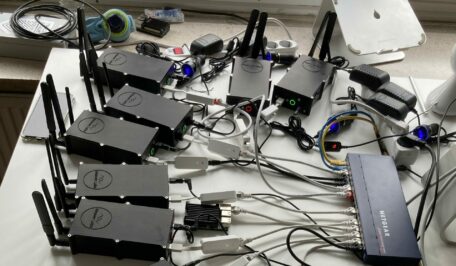
In the photo above we’re showcasing part of our fleet of mesh nodes. As you may recall, you may have seen them before in our recent post announcing that we passed our site acceptance tests with the European Space Agency. Our mesh nodes contain a lot inside. So, what kind of communications superpowers do they possess?
What’s mesh network technology ?
Mesh network technology can be a bit confusing but we’ll demystify the jargon. These black boxes are “mesh nodes,” which in our case means they can communicate with one another using wifi-direct. We also use this protocol to send data from Android phones directly to the nodes without a need for any additional gateways nor internet connectivity.
Why wifi-direct?
We chose wifi-direct because it’s really fast. In fact, nodes can detect one another and negotiate a wireless data connection even at highway speeds. Furthermore, they can do this with only a brief moment of communication.
We serve our application directly from the mesh node to a logistics employee’s phone using wifi-direct. This is useful because we don’t need an internet connection. Afterall we designed the system to cope with the worst conditions imaginable – and lack of network connectivity is where that starts.
Layer 1: Cellmesh Layer
Our partners at Weaver Labs contributed their cellmesh software. Cellmesh controls automatic detection, negotiation, and handling of communication between nodes. Additionally, it continually searches for communication resources like 4G or satcom and routes data to our servers which ensures continuity of operations in adverse conditions.
Layer 2: Mesh Node Layer
Datarella built a software layer on top of the lower-level networking technology from Weaver Labs. Consequently, we call this layer the Mesh Node layer. It has several big jobs:
- Manage data piped into cellmesh from user interactions
- Manage incoming data from cellmesh originating from other nodes
- Maintain efficient data replication between nodes
- Manage deletion of data already posted to the backend
In addition, the Mesh Node layer prevents our data pipelines from growing too large with redundant data. Together, the cellmesh and Mesh Node layers enable individual mesh nodes to connect with one another seamlessly. These nodes automatically authenticate their identities cryptographically and freely pass authenticated data back and forth. Nodes can also post this data directly to our backend servers.

In the image, the blue boxes represent nodes. The boxes provide service continuity for users in the field who want to post information like deliveries, pickups, damage, delays, and more. Sometimes they’re connected to one another but not always. Every box has two 4G cellular antennas and continuously searches for an exit to our Track & Trust cloud.
Patient and Resilient Mesh Network Technology
Our boxes are patient. If they’re offline, they wait until they’re online to post data. Alternatively, if they can’t do that, they wait for another node to come along. When connected, they play a game of telephone. For instance, if one node receives a message from another, it queues that message to pass along when it meets another box.
As we add more nodes to the system, it becomes more resilient. Meanwhile, our cellmesh and mesh node services mean that rollout is zero-configuration. Therefore, we simply plug the nodes into the trucks, and they start communicating with one another and the internet. They serve up mobile interfaces for drivers and warehouse workers to provide the most up-to-date information about what’s happening in the field.
Whenever a node connects with the cloud, it shares everything it knows. Moreover, it tells its “colleagues” which messages it successfully passed on. As a result, this allows them to forget information that they know a “colleague” node has already posted. This is technically known as a “gossip protocol” and it’s at the heart of how our Mesh Network Technology manages the information lifecycle.
In the next post, we’ll explore what happens if 4G isn’t working for some reason. There, we’ll discuss how satellite communications come into play as well as the critical role that GNSS plays.
Next Post >>
