Leveraging Blockchain To Support UN WFP In Fighting COVID-19

Leveraging Blockchain To Support UN WFP In Fighting COVID-19

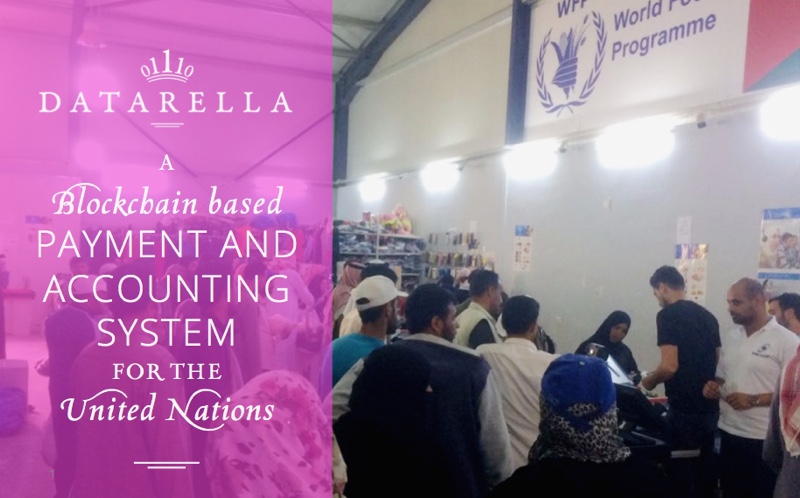
World Food Programme’s Building Blocks system is one of the best examples to understand how Blockchain technology can help to fight against COVID-19. Building Blocks is a Blockchain-based fully digitalized payment and bookkeeping system for any types of cashless transactions developed and further scaled up by Datarella and its subsidiary Baltic Data Science. Today, the Building Blocks is successfully up and running in Jordan since 2017 and expanded to Bangladesh by the end of 2019 by serving hundreds of thousands refugees in WFP’s refugee camps. Here’s how Datarella is leveraging Blockchain to support UN WFP in fighting COVID-19.

It’s been a while since Datarella successfully applied for an open call initiated by the WFP innovator programme in 2016. With this tender, WFP was evaluating whether Blockchain technology can help to improve the inefficiencies they were facing with paper vouchers issued to refugees in their camps for daily groceries. At that time, nobody was aware of a virus called “COVID-19” and working exclusively from home was simply unimaginable. But times have rapidly changed since the beginning of 2020. Today, we are facing probably the most severe economic downturn  and human tragedy, affecting hundreds of thousands of people since WW2. .

So how can the Building Blocks system help against the coronavirus? For this to understand, you need to know what the system does. As said, Building Blocks is a payment and bookkeeping system for any cashless transactions helping refugees in camps to make their daily shoppings. Every month, the refugees receive a certain amount by WFP as digital food vouchers that can be used in the village’s supermarket.

There are two aspects to the Building Blocks system that helps to fight against the coronavirus. Both has to do with contactless interactions amongst the participants:

Cashless Payments
The Building Blocks system is built on a private Ethereum network. Every single transaction between a refugee and the supermarket is validated and recorded on the blockchain. The advantages are apparent. With the help of Blockchain, these transactions are executed cashless, meaning fully digitized without the need to get in physical contact with the other person. By the way, after the World Health Organization WHO released a statement on March 9 recommending that people turn to cashless transactions to fight the spread of COVID-19, a number of governments and retailers across the world took action. Not directly related to the fight against the coronavirus, other benefits of a Blockchain-based payment system include minimized risk of fraud and data mismanagement.

Contactless Identification:
In both countries Jordan and Bangladesh, where Building Blocks is up and running, refugees are able to authorize themselves for cashless payments without getting in direct physical contact with the counterpart. In Jordan, the authentication is performed through a system called IrisGuard. IrisGuard is an end-to-end iris recognition, verification, financial authentication and targeted cash transfer platform which removes the need for any form of ID such as username, password, card or pin. In Bangladesh, the Building Blocks system uses a different method for the identification. It was originally a fingerprint-based process, i.e. it was touch-based. However, due to the coronavirus pandemic, we changed the authentication procedure from a touch-based to a contactless system. Today, a QR code is issued to every single refugee who is entitled to receive aid by WFP.

In this recent article published by WFP, you can read more about the story of Building Blocks in Bangladesh and how leveraging blockchain to support UN WFP fighting COVID-19.

Please stay healthy and safe in these challenging times!
Datarella – New Website

Datarella – New Website

Today, we have launched our new Datarella website. Over the course of several months, we discussed how to re-fresh or re-build our existing standard WordPress template which was more text-heavy than eye-catching. In some conversations, we realised that not only our grandmas had their issues with understanding what Datarella actually offers, but also some potential clients – something we ought to change if our goal is to convert website visitors into satisfied clients.

When building enterprise blockchain solutions, one very important aspect of the work is to show the actual outcome of the projects More specifically, it is key to clearly demonstrate why and which blockchain technology has been used and how it benefits the participants in the use case. The best way to bring a smile on the executive’s face is to either make her an active participant in a live demo, shoot a respective video or use photos of a real life showcase. You can’t beat the power of images and a live experience!

With these experiences in mind, we decided to strip our blockchain technology heavy content down to a minimum and use it more as an explainer of images that describe actual live use cases. In other words: we planned an image-heavy website that should induce a feeling of physical reality – visitors should easily understand the implications and benefits of Datarella’s work. In addition, we ignored side projects and focused on our three key areas of enterprise blockchain applications: Finance, Mobility and Supply Chain.

With this topical focus, a new, fresh look, with many images and symbols, we hope to make it clearer and easy to understand what our Enterprise Blockchain Solutions work is about and what our fantastic target-oriented teams in Munich and Gdansk create. Of course, we highly appreciate your feedback – either as comments, emails or in person at one of our Blockchain Meetups!

UN’s World Food Programme WFP Appoints Baltic Data Science As Partner In Building Blocks Project

UN’s World Food Programme WFP Appoints Baltic Data Science As Partner In Building Blocks Project

Our subsidiary Baltic Data Science (“BDS”) has formally been appointed by WFP to support them on the scale-up of the Building Blocks project.

We are very proud to announce that our close development partner and Polish associated company BDS has formally been appointed by the World Food Programme for the further roll-out the existing Building Blocks platform. At the beginning of the this year, we together with our partner BDS started to build a blockchain-based proof-of-concept for WFP and transformed it into a fully-functional blockchain-based transaction platform in Jordan. The inhabitants receive food vouchers that can be used in the village’s supermarket.

So what are the benefits compared to traditional transaction payments? Thanks to the blockchain technology, our innovative system provides higher transparency of aid accounts for beneficiaries and easy tracking of transaction which helps to lower the effort of bookkeeping for vendors and WFP. The biggest, however invisible, advantage is a minimized risk of fraud or data mismanagement.

We are excited to follow the next phase scale-up of the transaction platform and want to thank WFP for their trust and wish both partners a successful roll-out.

If you want to learn more about our services or specifically this project, please contact us at info@datarella.com or BDS at info@balticdatascience.com.

About WFP:
The United Nations World Food Programme “WFP”, with its headquarters located in Rome, Italy is the world’s largest humanitarian agency fighting hunger worldwide. WFP is mandated to deliver the food necessary to save the lives of victims of natural disasters, wars, and civil unrest. On average, WFP reaches more than 80 million people with food assistance in 75 countries each year. About 11,500 people work for the organization, most of them in remote areas, directly serving the hungry poor. WFP is part of the United Nations (UN) System.

About BDS:
Headquartered in Gdansk, Poland, BDS is an international data science and blockchain development company specializing in business-focused solutions. BDS develops data-driven applications (mobile/desktop frontends and backends) for international customers as well as blockchain-based applications.


IOTA Hackathon

IOTA Hackathon

The blockchain tech sphere in the fall of 2017 looks totally different than in the same period of 2016. Then, many people heard about blockchain for the very first time, now there are several dedicated blockchain platforms for specific applications. In the field of Industry 4.0, beside supply chain and robotics, IoT applications provide a hotbed for highly scalable blockchains, such as IOTA, NEO, or QTUM.

For and with one of these IoT-specific blockchains, IOTA, we will organize a hackathon, a week-end full of code, co-creation and ideas.

BUILD THE FUTURE WITH US!

Today is blockchain, tomorrow is industry 4.0 and the internet of everything. Autonomous cars, sensors and intelligent factories are the future but how will they communicate and transact among one another on a worldwide scale? IOTA is a blockless ledger system which enables scalable autonomous machine to machine micro-transactions without fees. Want to get your hands dirty and take part in building the future?

WHAT’S THE IOTA HACKATHON ALL ABOUT?

  • Developing services or products for the internet of things
  • Gaining experience with IOTA’s blockless ledger system for cutting-edge machine to machine transactions
  • Keynote speeches by key players in the industry
  • Networking, fun, free food and friendly competition

THREADS TO BE PURSUED

  • IoT Based Business Plans
  • Hardware Connectivity Layer: Bluetooth, Z-wave, ZigBee or LoRa
  • Application Layer: MQTT, XMPP
  • Fog, Mist & Edge Computing for IoT
  • Quantum security
  • IoT Maintenance & Lifecycle Management
  • Identity of Things (IDoT)

WHO CAN PARTICIPATE?

  • Developers (Esp. JavaScript, Java, Python)
  • Business Practitioners & Economists
  • UI/UX Designers

SCHEDULE

FRIDAY 17 NOV
18:00 – 19:00
Reception and Networking: Get comfortable and get to know one another

19:00 – 21:30
Keynote Presentations: Introductions and food for thought
– Jörg Blumtritt (Datarella)
– Dominik Schiener (IOTA)

SATURDAY 18 NOV
9:00 – 9:30
Breakfast and Coffee: Fuel up for the Hackathon

9:30 – 10:15
Individual Introductions: Barcamp style three keywords per person
30 Second Elevator Pitches: Explain your idea, build a team that can execute it!

10:15 – 11:00
Team Building: Chat with team leaders of interest & decide which team you want to hack with.

11:00 – 12:00
Speakers round: Getting started with IOTA: Dev Tools & Resources from Baltic Data Science

12:30 – 13:30
Lunch Break: Enjoy some delicious food and get ready

13:30 – 16:30
Time to Hack: Build, Test, Iterate

16:30 – 16:45
Movement Break: Get your blood pumping!

16:45 – 19:30
Time to Hack: Build, Test, Iterate

19:30 – 20:30
Dinner Break: Take some time to nourish the body and get ready for the all nighter to come!

20:30 – Late
Hack Till Your Heart’s Content: It’s up to you. The accelerator is open all night. Code till you drop.

SUNDAY 19 NOV
9:00 – 9:30
Breakfast and Coffee: Fuel up for the final day

9:30 – 12:30
Hacking and Presentation Prep: Get your demos running!

12:30 – 13:30
Lunch Break: Nutrition for the final stretch

13:30 – 14:00
One Last Check: Audio Visual and Tech Check for Demos

14:00 – 16:30
Demo Presentations: Show us what you’re made of!

16:30 – 17:30
Jury Session: Enjoy some refreshments while the jury deliberates

17:30 – 20:30
Awards Ceremony: Celebrate with the winners, network and celebrate

APPLICATION
To apply for the IOTA HACKATHON 2017 register now!
Don’t wait for too long – the number of participants is limited.

LOCATION
Lęborska 3b, 80-386 Gdańsk
NIP: 583-290-74-40

Based on our experiences with hackathons we think that Gdansk, Poland, is a perfectly suited location for this IOTA hackathon. Looking forward to hacking with you!