by Martin Schäffner | 1 February 2024 | Blockchain
In the dynamic landscape of manufacturing, achieving efficiency is key. One effective solution is the implementation of Multi-Tenancy Architectures, which allow multiple users, or “tenants,” to share software infrastructure. By leveraging Multi-Tenancy Architectures, manufacturers can streamline processes and improve operational efficiency, among other benefits.
Benefits of Multi-Tenancy in Manufacturing
1. Enhanced Collaboration and Resource Optimization
First and foremost, Multi-Tenancy empowers manufacturers to share the same software infrastructure, optimizing resources and reducing operational costs. For instance, imagine a unified platform for real-time inventory managementthat fosters seamless collaboration and enhances overall supply chain efficiency.
2. Cost Efficiency and Sustainability
Moreover, by minimizing individual expenses, Multi-Tenancy fosters significant cost efficiency and promotes economic sustainability. Picture this: manufacturers utilizing shared software infrastructure can reduce overhead while enhancing their overall operational efficiency.
3. Flexibility to Adapt to Industry Demands
In addition, Multi-Tenancy provides the flexibility that manufacturers need to swiftly adapt to dynamic industry demands. Specifically, manufacturers leverage shared software infrastructure to adjust production lines for customized orders, showcasing remarkable adaptability and responsiveness.
4. Robust Data Security and Privacy
Furthermore, addressing data security concerns is crucial. Multi-Tenancy implements robust access controls, ensuring that sensitive data remains confidential. Consequently, collaborative design and production planning among manufacturers and suppliers become secure, bolstering overall data privacy.
5. Accelerated Innovation through Collaboration
Lastly, Multi-Tenancy accelerates innovation by fostering collaboration among industry players. By utilizing shared software infrastructure, manufacturers can work together on joint research and development projects, sharing insights and resources that lead to the rapid development of innovative products.
Conclusion
In conclusion, the pursuit of efficiency through the implementation of Multi-Tenancy Architectures in the manufacturing industry emerges as a strategic imperative. To sum up, this architecture emphasizes its transformative power in streamlining operations, optimizing resources, and fostering a resilient manufacturing ecosystem. Ultimately, businesses that embrace Multi-Tenancy Architectures position themselves at the forefront of innovation, ready to tackle challenges and seize opportunities.

by Martin Schäffner | 29 January 2024 | Blockchain
Until now, discussions have primarily centered around Private or Private Permissioned Blockchains in the context of Multi-Tenancy Architectures. Today, a Public Permissionless Blockchain like the Secret Network, with its privacy-preserving functionalities and access control mechanisms, can also implement such a Multi-Tenancy Architecture.
Two contrasting architectural models in software deployment are Multi-Tenancy and Single-Tenancy. In cloud computing and Software-as-a-Service (SaaS) environments, Multi-Tenancy allows multiple tenants to share the underlying infrastructure, optimizing resource utilization and reducing overall expenses for individual tenants. In contrast, Single-Tenancy allocates a dedicated instance of the software application to each customer, operating in isolation with its own set of resources.
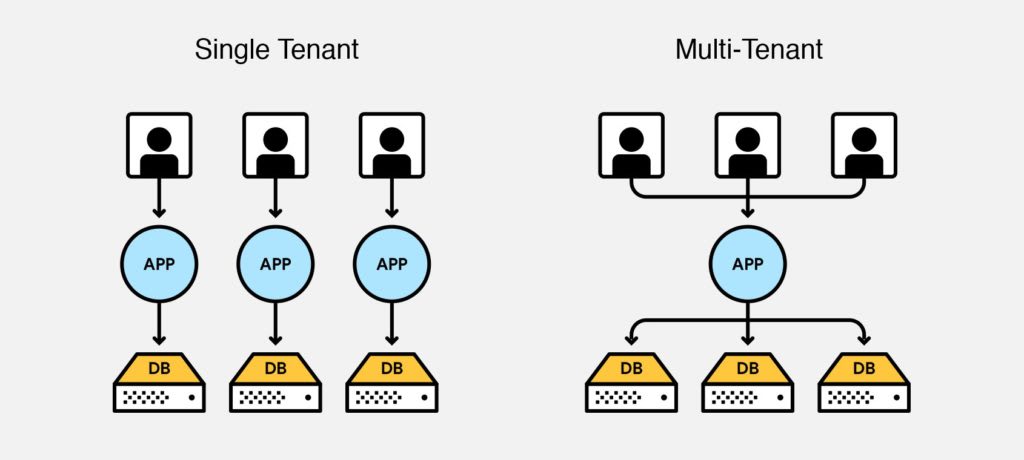
Single-Tenant vs. Multi-Tenant Architectures
The Secret Network, a public blockchain protocol centered on privacy-preserving smart contracts, offers a valuable solution for implementing Multi-Tenancy within the manufacturing industry. By harnessing the privacy features inherent in the Secret Network, the manufacturing sector stands to gain significantly from the establishment of cost-efficient, secure, and private data-sharing mechanisms among various stakeholders, including suppliers, manufacturers, and customers.
Distributed Ledger and Blockchain Technology
The progression of Distributed Ledger Technologies (DLTs), with blockchain being a notable type, has undergone a substantial transformation in its architecture and applications. This overview traces the evolution of blockchain from Single-Tenant solutions on public networks to the rise of private permissioned networks and the present state where public networks can facilitate multi-tenancy.
Secret Network Overview
The Secret Network, a public blockchain protocol, offers a comprehensive solution for implementing multi-tenancy in the manufacturing industry. It provides privacy-preserving smart contracts, programmable privacy, and a developer-friendly infrastructure, positioning it as an optimal choice for implementing multi-tenancy in the manufacturing sector.
Viewing Keys in Secret Network
Viewing keys, cryptographic tools that enable authorized users to access encrypted data, serve as a means of access control. They allow individuals to securely view specific data, assets, or content while preserving the overall privacy and confidentiality of the information. The owner of the corresponding private key creates a viewing key, which can be shared with trusted parties or applications but can also be revoked, providing a mechanism for controlled and secure data access.

Example of a transaction which can be read with the correct viewing key but stays encrypted when entering the wrong key
Conclusion
The integration of multi-tenancy within the manufacturing industry, particularly on the Secret Network, harnesses advanced blockchain features and cryptographic tools to achieve cost efficiency, streamlined data access, enhanced resource utilization, flexibility, and collaboration. The strategic use of viewing keys as an access control mechanism enhances the security and privacy of shared data, making it a valuable asset in managing user access within a multi-tenancy framework on the Secret Network.
