by Kira Nezu | 3 April 2014 | Blockchain
Many parameters a smartphone accidentially measures are useful in monitoring the environment. We have recently discussed, how air pollution with particulate dust can be monitored with an easy ad on to the phone’s camera. But there are even more subtle ways by which users can help to research and monitor environmental conditions.
Another example is given by A. Overeem et.al. who track urban temperature over time in various metropole regions arround the globe. The approach is as simple as powerful: a regression over the battery temperature (that is measured by every smartphone anyway).
The microphone, too, can give valuable data on local environmental conditions for an unlimited mass of individual users that participate. Sound level show noise emmission that can be located in space and time. Noise is regarded as a prime source of stress, but rather little is known about the changes that occur in different microgeographic regions.
Apps like Weather Signal use thus a combination of the phone’s sensors to contribute to a richer model for weather conditions.
Appart from just passivly deploying the phones as sensor boards themselves, it is of course also possible to collect data from other local sources and just transmit the results via smartphone. This can be done by letting the users take a picture of some reading of a scale which can then be processed via image recognition. Or you just ask people to put in the readings or their observations into some kind of questionnaire.
The fascinating thing is: since so many people in almost every country carry a smartphone, monitoring environmental conditions and changes is now possible on far larger scales than ever before.
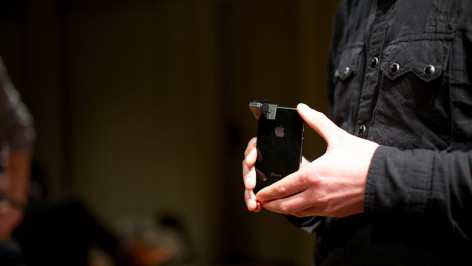
by Kira Nezu | 27 March 2014 | Blockchain
iSpex is a plastic contraption that can be clipped on top of a smartphone’s camera. In this simple slit spectrograph light is defracted and polarized by shining through birefringent plastic sheets and a polarisation film. iSpex measures how aerosoles – microscopic or nanoscopic particles hovering in the athmosphere – change the polarization of the highly polarized light that shines from an unclowded, blue sky. This change in polarization renders a distinct pattern in the spectrum, that is cast by the iSpex-device into the phone’s camera. By this approach, iSpex can measure how the air is polluted with particulate dust, which is regarded especially unhealthy and has become topic of fierce political discussions, when the EU ordered city governments to regulate and even lock out automotive traffic.
Behind iSpex stands a consortium of the Netherlands Research School for Astronomy at University of Leiden, Netherlands Institute for Space Research (SRON), National Institute for Public Health and the Environment (RIVM), and the Royal Netherlands Meteorological Institute (KNMI).
Over the course of summer and autumn 2013, thousands of people in the Netherlands participated in “national iSpex days”, jointly measuring particulate dust. The first results of this awesome social effort are published, and we can hope this project will find epigones in other countries.
iSpex website:
Measuring aerosols with spectropolarimetry

by Kira Nezu | 26 March 2014 | Blockchain

Smartphones carry versatile sensors. With appropriate apps, expensive instruments can be very well replaces – even sometimes the Geiger counter.
Gamma rays which are often products of radioactive decay, are also electromagnetic waves, just like light, however much more energetic. That means: as radioactive radiation can expose a chemical photographic film, it can as well effect the camera chip in the smartphone.
A team of researchers at the Idaho National Laboratory in Idaho Falls have used this property to change common smartphones into detectors for radioactive radiation. The radiation is recorded via the camera an an app, which calculates the radiation intensity from the data collected.
With this approach we learn again, how versatile mobile devices can be deployed. Up to thirty sensors in each smartphone measrure all kinds of variables like temperature, magnetism, brightness, sound and many more. With a little creativity we can combine these measurements and get valuable data about the environment around the smartphone and its user, that not rarely can replace expensive, specialized methods.
Here the link to the original publication:
Joshua J. Cogliati, Kurt W. Derr, Jayson Wharton: Using CMOS Sensors in a Cellphone for Gamma Detection and Classification

